


ASTM A753-08(2013)
(Specification)Standard Specification for Wrought Nickel-Iron Soft Magnetic Alloys (UNS K94490, K94840, N14076, N14080)
Standard Specification for Wrought Nickel-Iron Soft Magnetic Alloys (UNS K94490, K94840, N14076, N14080)
ABSTRACT
This specification covers commonly used wrought nickel-iron soft magnetic alloys produced or supplied expressly for use in magnetic cores and other parts requiring high magnetic permeability, high electrical resistivity, low coercive field strength, and low core loss. Four specific alloy types are covered such as Alloy Type 1, 2, 3, and 4. Alloy Type 2 in thin-strip form is available two different grades. Grade 1 is semi-isotropic and is recommended for use in transformer laminations. Grade 2 is isotropic and is recommended for use inn rotating machinery laminations. These materials are capable of being produced in a wide variety of forms and conditions such as forging billet, hot-rolled plate, strip, and bar, cold-finished bars, cold-rolled sheep and strip, shaped bar and wire. The alloys shall conform to the required chemical composition for carbon, manganese, silicon, phosphorus, sulfur, chromium, nickel, molybdenum, cobalt, copper, and iron. Dc magnetic testing shall be the only magnetic test methods used for all product forma and sizes other than thin strip and sheet measuring magnetic permeability and coercive field strength. The physical properties of annealed alloy such as electrical resistivity, saturation induction, density, Curie temperature and mean linear coefficient of expansion shall be measured. Mechanical properties of cold-rolled hard temper strip such as yiled strength, ultimated tensile strength, elongation,and hardness.
SCOPE
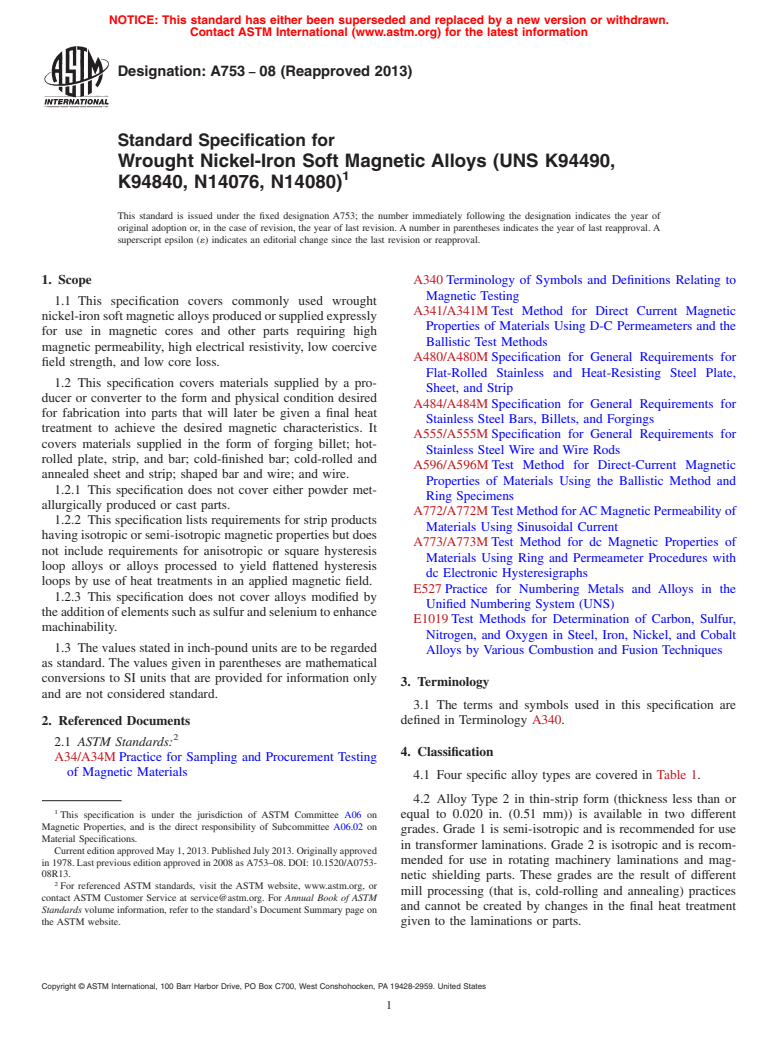
1.1 This specification covers commonly used wrought nickel-iron soft magnetic alloys produced or supplied expressly for use in magnetic cores and other parts requiring high magnetic permeability, high electrical resistivity, low coercive field strength, and low core loss.
1.2 This specification covers materials supplied by a producer or converter to the form and physical condition desired for fabrication into parts that will later be given a final heat treatment to achieve the desired magnetic characteristics. It covers materials supplied in the form of forging billet; hot-rolled plate, strip, and bar; cold-finished bar; cold-rolled and annealed sheet and strip; shaped bar and wire; and wire.
1.2.1 This specification does not cover either powder metallurgically produced or cast parts.
1.2.2 This specification lists requirements for strip products having isotropic or semi-isotropic magnetic properties but does not include requirements for anisotropic or square hysteresis loop alloys or alloys processed to yield flattened hysteresis loops by use of heat treatments in an applied magnetic field.
1.2.3 This specification does not cover alloys modified by the addition of elements such as sulfur and selenium to enhance machinability.
1.3 The values stated in inch-pound units are to be regarded as standard. The values given in parentheses are mathematical conversions to SI units that are provided for information only and are not considered standard.
General Information
Standards Content (Sample)
NOTICE: This standard has either been superseded and replaced by a new version or withdrawn.
Contact ASTM International (www.astm.org) for the latest information
Designation:A753 −08 (Reapproved 2013)
Standard Specification for
Wrought Nickel-Iron Soft Magnetic Alloys (UNS K94490,
K94840, N14076, N14080)
This standard is issued under the fixed designation A753; the number immediately following the designation indicates the year of
original adoption or, in the case of revision, the year of last revision. A number in parentheses indicates the year of last reapproval. A
superscript epsilon (´) indicates an editorial change since the last revision or reapproval.
1. Scope A340 Terminology of Symbols and Definitions Relating to
Magnetic Testing
1.1 This specification covers commonly used wrought
A341/A341M Test Method for Direct Current Magnetic
nickel-ironsoftmagneticalloysproducedorsuppliedexpressly
Properties of Materials Using D-C Permeameters and the
for use in magnetic cores and other parts requiring high
Ballistic Test Methods
magnetic permeability, high electrical resistivity, low coercive
A480/A480M Specification for General Requirements for
field strength, and low core loss.
Flat-Rolled Stainless and Heat-Resisting Steel Plate,
1.2 This specification covers materials supplied by a pro-
Sheet, and Strip
ducer or converter to the form and physical condition desired
A484/A484M Specification for General Requirements for
for fabrication into parts that will later be given a final heat
Stainless Steel Bars, Billets, and Forgings
treatment to achieve the desired magnetic characteristics. It
A555/A555M Specification for General Requirements for
covers materials supplied in the form of forging billet; hot-
Stainless Steel Wire and Wire Rods
rolled plate, strip, and bar; cold-finished bar; cold-rolled and
A596/A596M Test Method for Direct-Current Magnetic
annealed sheet and strip; shaped bar and wire; and wire.
Properties of Materials Using the Ballistic Method and
1.2.1 This specification does not cover either powder met-
Ring Specimens
allurgically produced or cast parts.
A772/A772M TestMethodforACMagneticPermeabilityof
1.2.2 This specification lists requirements for strip products
Materials Using Sinusoidal Current
havingisotropicorsemi-isotropicmagneticpropertiesbutdoes
A773/A773M Test Method for dc Magnetic Properties of
not include requirements for anisotropic or square hysteresis
Materials Using Ring and Permeameter Procedures with
loop alloys or alloys processed to yield flattened hysteresis
dc Electronic Hysteresigraphs
loops by use of heat treatments in an applied magnetic field.
E527 Practice for Numbering Metals and Alloys in the
1.2.3 This specification does not cover alloys modified by
Unified Numbering System (UNS)
theadditionofelementssuchassulfurandseleniumtoenhance
E1019 Test Methods for Determination of Carbon, Sulfur,
machinability.
Nitrogen, and Oxygen in Steel, Iron, Nickel, and Cobalt
1.3 The values stated in inch-pound units are to be regarded
Alloys by Various Combustion and Fusion Techniques
as standard. The values given in parentheses are mathematical
conversions to SI units that are provided for information only
3. Terminology
and are not considered standard.
3.1 The terms and symbols used in this specification are
defined in Terminology A340.
2. Referenced Documents
2.1 ASTM Standards:
4. Classification
A34/A34M Practice for Sampling and Procurement Testing
of Magnetic Materials
4.1 Four specific alloy types are covered in Table 1.
4.2 Alloy Type 2 in thin-strip form (thickness less than or
This specification is under the jurisdiction of ASTM Committee A06 on
equal to 0.020 in. (0.51 mm)) is available in two different
Magnetic Properties, and is the direct responsibility of Subcommittee A06.02 on
grades. Grade 1 is semi-isotropic and is recommended for use
Material Specifications.
in transformer laminations. Grade 2 is isotropic and is recom-
CurrenteditionapprovedMay1,2013.PublishedJuly2013.Originallyapproved
mended for use in rotating machinery laminations and mag-
in 1978. Last previous edition approved in 2008 as A753–08. DOI: 10.1520/A0753-
08R13.
netic shielding parts. These grades are the result of different
For referenced ASTM standards, visit the ASTM website, www.astm.org, or
mill processing (that is, cold-rolling and annealing) practices
contact ASTM Customer Service at service@astm.org. For Annual Book of ASTM
and cannot be created by changes in the final heat treatment
Standards volume information, refer to the standard’s Document Summary page on
the ASTM website. given to the laminations or parts.
Copyright © ASTM International, 100 Barr Harbor Drive, PO Box C700, West Conshohocken, PA 19428-2959. United States
A753−08 (2013)
TABLE 1 Specific Alloy Types
6.2 Determination of metallic constituents and phosphorus
A B
Alloy Type UNS Number Nickel Range, % shall be by a method(s) acceptable to both producer and user.
1 K94490 43.5 to 46.5 Analysis of carbon and sulfur shall be done in accordance with
2 K94840 47.0 to 49.0
Test Methods E1019.
3 N14076 75.0 to 78.0
4 N14080 79.0 to 82.0
7. Form and Condition
A
UNS refers to the Unified Numbering System, an alloy identification system
supported by ASTM. Refer to Practice E527 for details. 7.1 These materials are capable of being produced in a wide
B
Alloy Types 3 and 4 have additions of molybdenum, copper, and chromium to
variety of forms and conditions suitable for further manufac-
improve magnetic performance.
ture into specific magnetic articles. The desired form and
condition shall be specified and should be discussed with the
producer before ordering to assure receiving the appropriate
product. Available forms and conditions are:
7.1.1 Forging Billet— Hot worked; hot worked with sur-
5. Ordering Information
faces prepared by grinding.
5.1 Orders for material conforming to this specification
7.1.2 Hot-Rolled Plate, Strip, and Bar—Hot-rolled; hot-
shall include the following information:
rolled and acid cleaned; hot-rolled and annealed; hot-rolled,
5.1.1 Reference to this specification and year of issue or
annealed, and acid cleaned; hot-rolled and mechanically
revision.
cleaned; mechanical properties as specified.
5.1.2 Alloy type (Section 4) and grade where appropriate.
7.1.3 Cold-Finished Bars—Cold-drawn; cold-drawn and
5.1.3 Dimensions and tolerances (Section 12).
centerless ground; cold-drawn and annealed to specified me-
5.1.4 Quantity (weight or number of pieces as appropriate).
chanical properties.
5.1.5 Form and condition (Section 7).
7.1.4 Cold-Rolled Sheet and Strip —Cold-rolled; deep draw
5.1.6 Magnetic property requirements if they are other than
quality; cold-rolled and annealed to specified mechanical
those listed in this specification.
properties.
5.1.7 Certification of chemical analysis and magnetic qual-
7.1.5 Wire—Cold-drawn; cold-drawn and annealed to speci-
ity evaluation.
fied mechanical properties.
5.1.8 Marking and packaging requirements.
7.1.6 Shaped Bar and Wire—Cold-worked; cold-worked
5.1.9 End Use—Whenever possible, the user should specify
and annealed to specified mechanical properties.
whetherthematerialwillbemachined,blankedintoflatpieces,
blanked and formed, deep drawn to shape, wound into a core, 8. Magnetic Property Requirements—General
punched into laminations, or photo-etched. This will help the Requirements
producer to provide the most suitable material for the user’s
8.1 TestMethods— Because of the extremely high magnetic
fabricating practices.
permeabilities developed in these alloys after heat treatment,
5.1.10 Exceptions to this specification or special require-
the use of permeameters (Test Method A341/A341M)is
ments such as mechanical property requirements.
expressly forbidden. Allowable test methods are those using
ring-type specimens.
6. Chemical Composition
8.2 Test Specimen— Whenever possible, test specimen size
6.1 The alloys shall conform to the requirements prescribed
and shape shall conform to those listed in Practice A34/A34M.
in Table 2. Since magnetic performance is paramount, analysis
Specimen shapes such as stacked laminations, solid rings, and
variations are permitted by mutual agreement between the user
spirally wound tape and wire cores are necessary for the most
and producer.
accurate results. If, however, the product form or dimensions
precludes the use of a preferred test specimen, the specimen
shape and size shall be mutually agreed upon between the
producer and user.
TABLE 2 Chemical Requirements (Weight Percent)
8.3 Density—The assumed densities of these materials for
Alloy 1 Alloy 2 Alloy 3 Alloy 4
purposes of magnetic testing shall be as in Table 3:
UNS UNS UNS UNS
K94490 K94840 N14076 N14080
8.4 Heat Treatment— The heat treatment applied to the test
Carbon, max. 0.05 0.05 0.05 0.05
specimen shall be mutually agreed upon between the producer
Manganese, max. 0.80 0.80 1.5 0.80
and user. If no such agreement exists, the heat treatment
Silicon, max. 0.50 0.50 0.50 0.50
Phosphorus, max. 0.03 0.03 0.02 0.02
Sulfur, max. 0.01 0.01 0.01 0.01
TABLE 3 Assumed Density
Chromium 0.30 max. 0.30 max. 2.0-3.0 0.30 max.
Nickel 43.5-46.5 47.0-49.0 75.0-78.0 79.0-82.0
Assumed Density
Molybdenum 0.30 max 0.30 max. 0.50 max 3.5-6.0
3 3
Alloy Type UNS No. g/cm (kg/m )
Cobalt, max. 0.50 0.50 0.50 0.50
1 K94490 8.17 8170
Copper 0.30 max 0.30 max. 4.0-6.0 0.30 max.
2 K94840 8.25 8250
A
Iron balance balance balance balance
3 N14076 8.58 8580
A
Iron is the balance by difference. Quantitative analysis of this element is not 4 (4 % Mo) N14080 8.74 8740
4 (5 % Mo) N14080 8.77 8770
required.
A753−08 (2013)
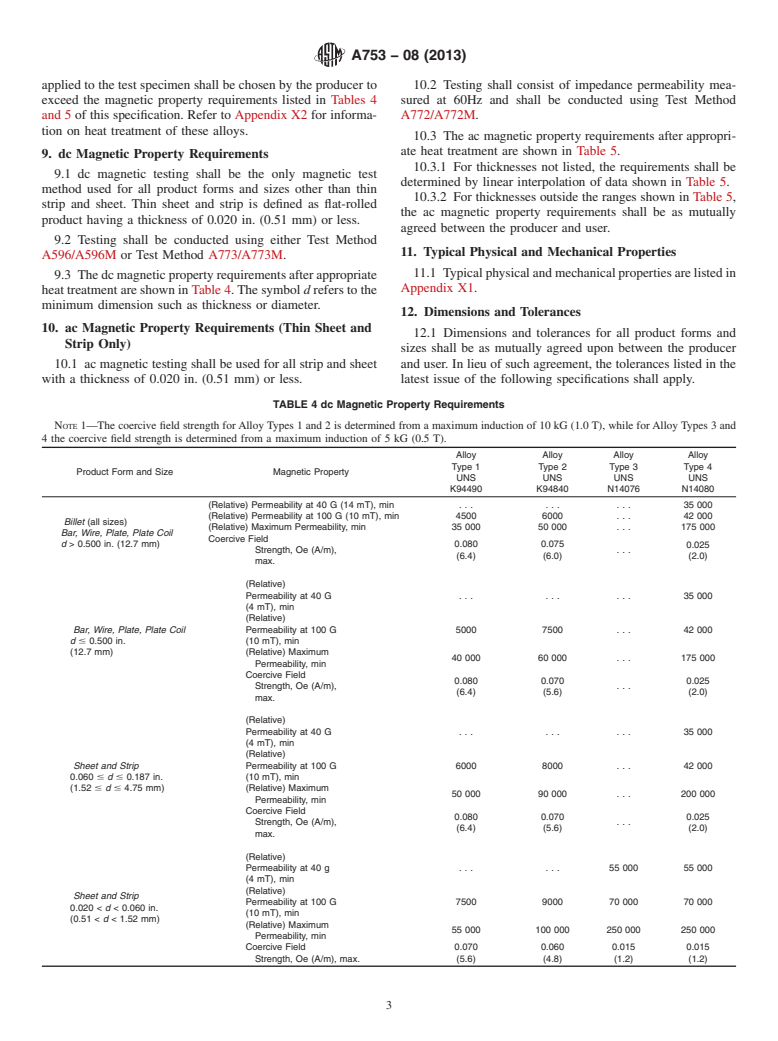
applied to the test specimen shall be chosen by the producer to 10.2 Testing shall consist of impedance permeability mea-
exceed the magnetic property requirements listed in Tables 4 sured at 60Hz and shall be conducted using Test Method
and 5 of this specification. Refer to Appendix X2 for informa- A772/A772M.
tion on heat treatment of these alloys.
10.3 The ac magnetic property requirements after appropri-
ate heat treatment are shown in Table 5.
9. dc Magnetic Property Requirements
10.3.1 For thicknesses not listed, the requirements shall be
9.1 dc magnetic testing shall be the only magnetic test
determined by linear interpolation of data shown in Table 5.
method used for all product forms and sizes other than thin
10.3.2 For thicknesses
...
Questions, Comments and Discussion
Ask us and Technical Secretary will try to provide an answer. You can facilitate discussion about the standard in here.