

ASTM D3462/D3462M-23
(Specification)Standard Specification for Asphalt Shingles Made from Glass Felt and Surfaced with Mineral Granules
General Information
- Abstract
ABSTRACT
This specification deals with the standards for asphalt roofing in shingle form, composed of glass felt or felts impregnated and coated on both sides with asphalt, and surface on the weather side with minerals. Physical requirements of the shingles such as behavior on melting, tear strength, wind resistance, fire resistance, softening point, and pliability shall be measured immediately after packaging or at a reasonable time. Physical and performance requirements after application and during in-service use are however beyond the scope of this specification.
SCOPE
1.1 This specification covers asphalt roofing in shingle form, composed of glass felt or felts impregnated and coated on both sides with asphalt, and surfaced on the weather side with mineral granules. This specification is designed for the evaluation of products as manufactured. The test methods, physical requirements, and minimum masses are to be measured immediately after packaging or at a reasonable time, as agreed upon between buyer and seller, after manufacture and before installation. Physical and performance requirements after application and during in-service use of the products described herein are beyond the scope of this material specification.
1.2 Shingles meeting this specification are intended to be applied with a headlap of not less than 51 mm [2 in.].
1.3 The shingles shall be supplied with a factory-applied self-sealing adhesive or be designed to be locked together during installation of the shingles.
1.4 The values stated in either SI units or inch-pound units are to be regarded separately as standard. The values stated in each system may not be exact equivalents; therefore, each system shall be used independently of the other. Combining values from the two systems may result in nonconformance with the standard.
1.5 The following safety hazards caveat pertains only to the test method described in this specification: This standard does not purport to address all of the safety concerns, if any, associated with its use. It is the responsibility of the user of this standard to establish appropriate safety, health, and environmental practices and determine the applicability of regulatory limitations prior to use.
1.6 This international standard was developed in accordance with internationally recognized principles on standardization established in the Decision on Principles for the Development of International Standards, Guides and Recommendations issued by the World Trade Organization Technical Barriers to Trade (TBT) Committee.
- Status
- Published
- Publication Date
- 30-Apr-2023
- Technical Committee
- D08 - Roofing and Waterproofing
- Drafting Committee
- D08.02 - Steep Roofing Products and Assemblies
Buy Documents
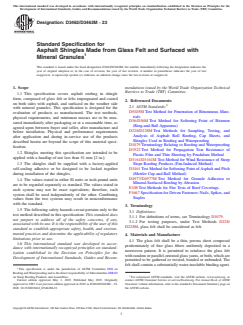
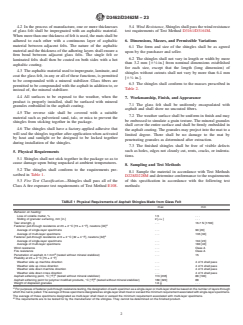
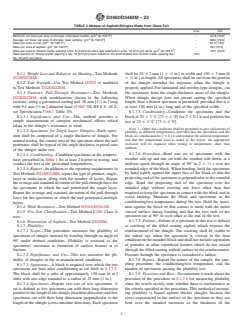

ASTM D3462/D3462M-23 - Standard Specification for Asphalt Shingles Made from Glass Felt and Surfaced with Mineral Granules
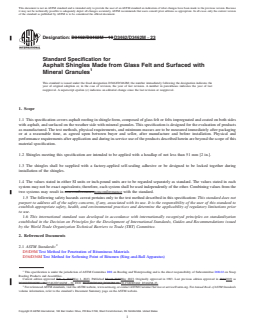
REDLINE ASTM D3462/D3462M-23 - Standard Specification for Asphalt Shingles Made from Glass Felt and Surfaced with Mineral Granules
Overview
ASTM D3462/D3462M-23 is a key international standard specifying the requirements for asphalt shingles made from glass felt and surfaced with mineral granules. Developed by ASTM International’s Committee D08 on Roofing and Waterproofing, this specification provides criteria for evaluating asphalt roofing shingles as manufactured-before installation and in-service use. The standard covers shingles composed of glass felt impregnated and coated with asphalt on both sides, finished on the weather-exposed side with mineral granules. ASTM D3462/D3462M-23 outlines detailed physical property requirements, test methods, and packaging specifications, ensuring the reliability and quality of asphalt shingles used in steep-slope roofing applications.
Key Topics
Material Composition
- Shingles consist of thin, porous glass felt reinforced as needed and fully coated with asphalt.
- Finished with mineral granules on the weather-exposed side for durability and protection.
- Reverse side treated with fine particulate material (e.g., sand, talc, mica) to prevent sticking during packaging.
Physical Requirements
- Performance criteria include behavior on heating, tear strength, wind resistance, fire resistance, softening point, and pliability.
- Shingles must not stick together in the package and should be defect-free with uniform appearance.
- Minimum mass and dimensional tolerances are strictly defined.
Application Requirements
- Intended installation with a minimum headlap of 51 mm (2 inches).
- Shingles supplied with factory-applied self-sealing adhesive or designed to lock together during installation.
- Dimensions, color, and style are to be agreed upon between buyer and seller.
Testing and Sampling
- Tests specified for evaluating the as-manufactured shingles include:
- Fastener pull-through resistance
- Tear strength
- Wind resistance (Class A, per ASTM D3161/D3161M)
- Fire resistance (Class A, per ASTM E108)
- Pliability and asphalt softening point
- Weight of displaced granules and mass composition
- Tests specified for evaluating the as-manufactured shingles include:
Measurement Units
- Standard permits use of either SI or inch-pound units, but they must not be combined in a single evaluation.
Applications
Asphalt shingles meeting ASTM D3462/D3462M-23 are widely used in:
- Residential and commercial steep-slope roofing: Ensures consistent performance and durability for single-family homes, multi-family buildings, and small commercial structures.
- New construction and re-roofing projects: Builders, roofing contractors, architects, and specifiers rely on this standard when selecting roofing materials for code compliance and warranty validation.
- Procurement and quality assurance: Manufacturers and purchasers use the defined criteria for product acceptance, ensuring delivery of roofing products that meet industry norms for wind and fire resistance, mass, flexibility, and appearance.
Following this ASTM specification in the selection and procurement process helps minimize installation issues, ensures roof longevity, and supports building code compliance.
Related Standards
The following ASTM standards are referenced or commonly used alongside ASTM D3462/D3462M-23 in the evaluation of asphalt shingles:
- ASTM D5/D5M: Penetration of Bituminous Materials
- ASTM D36/D36M: Softening Point of Bitumen (Ring-and-Ball Apparatus)
- ASTM D228/D228M: Sampling, Testing, and Analysis of Asphalt Roll Roofing, Cap Sheets, and Shingles
- ASTM D1922: Tear Resistance of Plastic Film and Thin Sheeting
- ASTM D3161/D3161M: Wind Resistance Test for Steep Slope Roofing Products
- ASTM D3461: Softening Point of Asphalt and Pitch (Mettler Cup-and-Ball Method)
- ASTM D4977/D4977M: Granule Adhesion Testing for Mineral-Surfaced Roofing
- ASTM E108: Fire Tests of Roof Coverings
- ASTM F1667: Specification for Nails, Spikes, and Staples used in roofing applications
Proper adherence to ASTM D3462/D3462M-23 fosters consistency, safety, and performance in the roofing industry, supporting the use of reliable asphalt shingles in varied climatic and building conditions.
Relations
- Effective Date
- 01-May-2020
- Effective Date
- 01-May-2020
- Effective Date
- 01-May-2020
- Effective Date
- 01-May-2020
- Effective Date
- 01-Apr-2020
- Effective Date
- 15-Mar-2020
- Effective Date
- 15-Dec-2019
- Effective Date
- 01-Nov-2019
- Effective Date
- 01-May-2019
- Effective Date
- 01-May-2019
- Effective Date
- 01-Jan-2019
- Effective Date
- 15-Dec-2018
- Effective Date
- 15-Dec-2018
- Effective Date
- 01-Nov-2018
- Effective Date
- 01-Sep-2018
Buy Documents
ASTM D3462/D3462M-23 - Standard Specification for Asphalt Shingles Made from Glass Felt and Surfaced with Mineral Granules
REDLINE ASTM D3462/D3462M-23 - Standard Specification for Asphalt Shingles Made from Glass Felt and Surfaced with Mineral Granules
Get Certified
Connect with accredited certification bodies for this standard

DIBt (Deutsches Institut für Bautechnik)
German Institute for Building Technology.
DIN CERTCO
DIN Group product certification.

Aboma Certification B.V.
Specialized in construction, metal, and transport sectors.
Sponsored listings
Frequently Asked Questions
ASTM D3462/D3462M-23 is a technical specification published by ASTM International. Its full title is "Standard Specification for Asphalt Shingles Made from Glass Felt and Surfaced with Mineral Granules". This standard covers: ABSTRACT This specification deals with the standards for asphalt roofing in shingle form, composed of glass felt or felts impregnated and coated on both sides with asphalt, and surface on the weather side with minerals. Physical requirements of the shingles such as behavior on melting, tear strength, wind resistance, fire resistance, softening point, and pliability shall be measured immediately after packaging or at a reasonable time. Physical and performance requirements after application and during in-service use are however beyond the scope of this specification. SCOPE 1.1 This specification covers asphalt roofing in shingle form, composed of glass felt or felts impregnated and coated on both sides with asphalt, and surfaced on the weather side with mineral granules. This specification is designed for the evaluation of products as manufactured. The test methods, physical requirements, and minimum masses are to be measured immediately after packaging or at a reasonable time, as agreed upon between buyer and seller, after manufacture and before installation. Physical and performance requirements after application and during in-service use of the products described herein are beyond the scope of this material specification. 1.2 Shingles meeting this specification are intended to be applied with a headlap of not less than 51 mm [2 in.]. 1.3 The shingles shall be supplied with a factory-applied self-sealing adhesive or be designed to be locked together during installation of the shingles. 1.4 The values stated in either SI units or inch-pound units are to be regarded separately as standard. The values stated in each system may not be exact equivalents; therefore, each system shall be used independently of the other. Combining values from the two systems may result in nonconformance with the standard. 1.5 The following safety hazards caveat pertains only to the test method described in this specification: This standard does not purport to address all of the safety concerns, if any, associated with its use. It is the responsibility of the user of this standard to establish appropriate safety, health, and environmental practices and determine the applicability of regulatory limitations prior to use. 1.6 This international standard was developed in accordance with internationally recognized principles on standardization established in the Decision on Principles for the Development of International Standards, Guides and Recommendations issued by the World Trade Organization Technical Barriers to Trade (TBT) Committee.
ABSTRACT This specification deals with the standards for asphalt roofing in shingle form, composed of glass felt or felts impregnated and coated on both sides with asphalt, and surface on the weather side with minerals. Physical requirements of the shingles such as behavior on melting, tear strength, wind resistance, fire resistance, softening point, and pliability shall be measured immediately after packaging or at a reasonable time. Physical and performance requirements after application and during in-service use are however beyond the scope of this specification. SCOPE 1.1 This specification covers asphalt roofing in shingle form, composed of glass felt or felts impregnated and coated on both sides with asphalt, and surfaced on the weather side with mineral granules. This specification is designed for the evaluation of products as manufactured. The test methods, physical requirements, and minimum masses are to be measured immediately after packaging or at a reasonable time, as agreed upon between buyer and seller, after manufacture and before installation. Physical and performance requirements after application and during in-service use of the products described herein are beyond the scope of this material specification. 1.2 Shingles meeting this specification are intended to be applied with a headlap of not less than 51 mm [2 in.]. 1.3 The shingles shall be supplied with a factory-applied self-sealing adhesive or be designed to be locked together during installation of the shingles. 1.4 The values stated in either SI units or inch-pound units are to be regarded separately as standard. The values stated in each system may not be exact equivalents; therefore, each system shall be used independently of the other. Combining values from the two systems may result in nonconformance with the standard. 1.5 The following safety hazards caveat pertains only to the test method described in this specification: This standard does not purport to address all of the safety concerns, if any, associated with its use. It is the responsibility of the user of this standard to establish appropriate safety, health, and environmental practices and determine the applicability of regulatory limitations prior to use. 1.6 This international standard was developed in accordance with internationally recognized principles on standardization established in the Decision on Principles for the Development of International Standards, Guides and Recommendations issued by the World Trade Organization Technical Barriers to Trade (TBT) Committee.
ASTM D3462/D3462M-23 is classified under the following ICS (International Classification for Standards) categories: 91.100.50 - Binders. Sealing materials. The ICS classification helps identify the subject area and facilitates finding related standards.
ASTM D3462/D3462M-23 has the following relationships with other standards: It is inter standard links to ASTM D4977/D4977M-20, ASTM D1079-20, ASTM D36/D36M-14(2020), ASTM D3161/D3161M-20, ASTM E108-20a, ASTM E108-20, ASTM D5/D5M-19a, ASTM D3161/D3161M-19a, ASTM D4977/D4977M-03(2019), ASTM D228/D228M-19, ASTM D3161/D3161M-19, ASTM D1079-18e1, ASTM D1079-18, ASTM D228/D228M-18, ASTM F1667-18. Understanding these relationships helps ensure you are using the most current and applicable version of the standard.
ASTM D3462/D3462M-23 is available in PDF format for immediate download after purchase. The document can be added to your cart and obtained through the secure checkout process. Digital delivery ensures instant access to the complete standard document.
Standards Content (Sample)
This international standard was developed in accordance with internationally recognized principles on standardization established in the Decision on Principles for the
Development of International Standards, Guides and Recommendations issued by the World Trade Organization Technical Barriers to Trade (TBT) Committee.
Designation: D3462/D3462M − 23
Standard Specification for
Asphalt Shingles Made from Glass Felt and Surfaced with
Mineral Granules
This standard is issued under the fixed designation D3462/D3462M; the number immediately following the designation indicates the
year of original adoption or, in the case of revision, the year of last revision. A number in parentheses indicates the year of last
reapproval. A superscript epsilon (´) indicates an editorial change since the last revision or reapproval.
1. Scope mendations issued by the World Trade Organization Technical
Barriers to Trade (TBT) Committee.
1.1 This specification covers asphalt roofing in shingle
form, composed of glass felt or felts impregnated and coated
2. Referenced Documents
on both sides with asphalt, and surfaced on the weather side
2.1 ASTM Standards:
with mineral granules. This specification is designed for the
D5/D5M Test Method for Penetration of Bituminous Mate-
evaluation of products as manufactured. The test methods,
rials
physical requirements, and minimum masses are to be mea-
D36/D36M Test Method for Softening Point of Bitumen
sured immediately after packaging or at a reasonable time, as
(Ring-and-Ball Apparatus)
agreed upon between buyer and seller, after manufacture and
D228/D228M Test Methods for Sampling, Testing, and
before installation. Physical and performance requirements
Analysis of Asphalt Roll Roofing, Cap Sheets, and
after application and during in-service use of the products
Shingles Used in Roofing and Waterproofing
described herein are beyond the scope of this material speci-
D1079 Terminology Relating to Roofing and Waterproofing
fication.
D1922 Test Method for Propagation Tear Resistance of
1.2 Shingles meeting this specification are intended to be
Plastic Film and Thin Sheeting by Pendulum Method
applied with a headlap of not less than 51 mm [2 in.].
D3161/D3161M Test Method for Wind Resistance of Steep
1.3 The shingles shall be supplied with a factory-applied Slope Roofing Products (Fan-Induced Method)
self-sealing adhesive or be designed to be locked together D3461 Test Method for Softening Point of Asphalt and Pitch
during installation of the shingles. (Mettler Cup-and-Ball Method)
D4977/D4977M Test Method for Granule Adhesion to
1.4 The values stated in either SI units or inch-pound units
Mineral-Surfaced Roofing by Abrasion
are to be regarded separately as standard. The values stated in
E108 Test Methods for Fire Tests of Roof Coverings
each system may not be exact equivalents; therefore, each
F1667 Specification for Driven Fasteners: Nails, Spikes, and
system shall be used independently of the other. Combining
Staples
values from the two systems may result in nonconformance
with the standard.
3. Terminology
1.5 The following safety hazards caveat pertains only to the
3.1 Definitions:
test method described in this specification: This standard does
3.1.1 For definitions of terms, see Terminology D1079.
not purport to address all of the safety concerns, if any,
3.1.2 For testing purposes, under Test Methods D228/
associated with its use. It is the responsibility of the user of this
D228M, glass felt shall be considered as felt.
standard to establish appropriate safety, health, and environ-
mental practices and determine the applicability of regulatory
4. Materials and Manufacture
limitations prior to use.
4.1 The glass felt shall be a thin, porous sheet composed
1.6 This international standard was developed in accor-
predominately of fine glass fibers uniformly deposited in a
dance with internationally recognized principles on standard-
nonwoven pattern. It is permitted to reinforce the glass felt
ization established in the Decision on Principles for the
with random or parallel-oriented glass yarns, or both, which are
Development of International Standards, Guides and Recom-
permitted to be gathered or twisted, bonded or unbonded. The
felt shall contain a substantially water-insoluble binding agent.
This specification is under the jurisdiction of ASTM Committee D08 on
Roofing and Waterproofing and is the direct responsibility of Subcommittee D08.02
on Steep Roofing Products and Assemblies. For referenced ASTM standards, visit the ASTM website, www.astm.org, or
Current edition approved May 1, 2023. Published May 2023. Originally contact ASTM Customer Service at service@astm.org. For Annual Book of ASTM
approved in 1983. Last previous edition approved in 2019 as D3462/D3462M – 19. Standards volume information, refer to the standard’s Document Summary page on
DOI: 10.1520/D3462_D3462M-23. the ASTM website.
Copyright © ASTM International, 100 Barr Harbor Drive, PO Box C700, West Conshohocken, PA 19428-2959. United States
D3462/D3462M − 23
4.2 In the process of manufacture, one or more thicknesses 5.4 Wind Resistance, Shingles shall pass the wind resistance
of glass felt shall be impregnated with an asphaltic material. test requirements of Test Method D3161/D3161M.
When more than one thickness of felt is used, the mats shall be
6. Dimensions, Masses, and Permissible Variations
adhered to each other with a continuous layer of asphaltic
material between adjacent felts. The nature of the asphaltic
6.1 The form and size of the shingles shall be as agreed
material and the thickness of the adhering layers shall ensure a
upon by the purchaser and seller.
firm bond between adjacent glass felts. The single felt or
6.2 The shingles shall not vary in length or width by more
laminated felts shall then be coated on both sides with a hot
than 3.2 mm [6 ⁄8 in.] from nominal dimensions established
asphaltic coating.
for each size, except that the length (long dimension) of
4.3 The asphaltic material used to impregnate, laminate, and
shingles without cutouts shall not vary by more than 6.4 mm
coat the glass felt, in any or all of these functions, is permitted
[6 ⁄4 in.].
to be compounded with a mineral stabilizer. Glass fibers are
6.3 The shingles shall conform to the masses prescribed in
permitted to be compounded with the asphalt in addition to, or
Table 2.
instead of, the mineral stabilizer.
4.4 All surfaces to be exposed to the weather, when the
7. Workmanship, Finish, and Appearance
product is properly installed, shall be surfaced with mineral
7.1 The glass felt shall be uniformly encapsulated with
granules embedded in the asphalt coating.
asphalt and shall show no uncoated fibers.
4.5 The reverse side shall be covered with a suitable
7.2 The weather surface shall be uniform in finish and may
material such as pulverized sand, talc, or mica to prevent the
be embossed to simulate a grain texture. The mineral granules
shingles from sticking together in the package.
shall cover the entire surface and shall be firmly embedded in
4.6 The shingles shall have a factory-applied adhesive that
the asphalt coating. The granules may project into the mat to a
will seal the shingles together after application when activated
limited degree. There shall be no damage to the mat by
by heat and sunlight or be designed to be locked together
penetrating granules as determined after extraction.
during installation of the shingles.
7.3 The finished shingles shall be free of visible defects
such as holes, edges not cleanly cut, rents, cracks, or indenta-
5. Physical Requirements
tions.
5.1 Shingles shall not stick together in the package so as to
cause damage upon being unpacked at ambient temperatures.
8. Sampling and Test Methods
5.2 The shingles shall conform to the requirements pre-
8.1 Sample the material in accordance with Test Methods
scribed in Table 1.
D228/D228M and determine conformance to the requirements
5.3 Fire Test Classification—Shingles shall pass all of the of this specification in accordance with the following test
Class A fire exposure test requirements of Test Method E108. methods:
TABLE 1 Physical Requirements of Asphalt Shingles Made from Glass Felt
max min
Behavior on heating:
Loss of volatile matter, % 1.5 . . .
Sliding of granular surfacing, mm [in.] 2 [ ⁄16 ] . . .
Tear strength, g . . . 16.7 N [1700]
A
Fastener pull-through resistance at 23 ± 2 °C [73 ± 4 °F], newtons [lbf]
Average of single-layer specimens . . . 90 [20]
Average of multi-layer specimens . . . 135 [30]
A
Fastener pull-through resistance at 0 ± 2 °C [32 ± 4 °F], newtons [lbf]
Average of single-layer specimens . . . 104 [23]
Average of multi-layer specimens . . . 180 [40]
Wind resistance . . . Class A
Fire resistance . . . Class A
B
Penetration of asphalt, 0.1 mm (tested without mineral stabilizer) . . . 15
Pliability at 23 ± 2 °C [73 ± 4 °F]
Weather side up machine direction . . . 4 of 5 shall pass
Weather side up cross direction . . . 4 of 5 shall pass
Weather side down machine direction . . . 4 of 5 shall pass
Weather side down cross direction . . . 4 of 5 shall pass
B
Asphalt softening point, °C [°F] (tested without mineral stabilizer) 113 [235] 88 [190]
B
Asphalt softening point for polymer modified products, °C [°F] (tested without mineral stabilizer) 160 [320] 88
Weight of displaced granules 1.0 g . . .
A
For purposes of fastener pull-through resistance testing, the designation of each specimen as a single-layer or multi-layer shall be based on the number of layers through
which the nail is pulled. The average of those specimens designate
...
This document is not an ASTM standard and is intended only to provide the user of an ASTM standard an indication of what changes have been made to the previous version. Because
it may not be technically possible to adequately depict all changes accurately, ASTM recommends that users consult prior editions as appropriate. In all cases only the current version
of the standard as published by ASTM is to be considered the official document.
Designation: D3462/D3462M − 19 D3462/D3462M − 23
Standard Specification for
Asphalt Shingles Made from Glass Felt and Surfaced with
Mineral Granules
This standard is issued under the fixed designation D3462/D3462M; the number immediately following the designation indicates the
year of original adoption or, in the case of revision, the year of last revision. A number in parentheses indicates the year of last
reapproval. A superscript epsilon (´) indicates an editorial change since the last revision or reapproval.
1. Scope
1.1 This specification covers asphalt roofing in shingle form, composed of glass felt or felts impregnated and coated on both sides
with asphalt, and surfaced on the weather side with mineral granules. This specification is designed for the evaluation of products
as manufactured. The test methods, physical requirements, and minimum masses are to be measured immediately after packaging
or at a reasonable time, as agreed upon between buyer and seller, after manufacture and before installation. Physical and
performance requirements after application and during in-service use of the products described herein are beyond the scope of this
material specification.
1.2 Shingles meeting this specification are intended to be applied with a headlap of not less than 51 mm [2 in.].
1.3 The shingles shall be supplied with a factory-applied self-sealing adhesive or be designed to be locked together during
installation of the shingles.
1.4 The values stated in either SI units or inch-pound units are to be regarded separately as standard. The values stated in each
system may not be exact equivalents; therefore, each system shall be used independently of the other. Combining values from the
two systems may result in non-conformancenonconformance with the standard.
1.5 The following safety hazards caveat pertains only to the test method described in this specification: This standard does not
purport to address all of the safety concerns, if any, associated with its use. It is the responsibility of the user of this standard to
establish appropriate safety, health, and environmental practices and determine the applicability of regulatory limitations prior
to use.
1.6 This international standard was developed in accordance with internationally recognized principles on standardization
established in the Decision on Principles for the Development of International Standards, Guides and Recommendations issued
by the World Trade Organization Technical Barriers to Trade (TBT) Committee.
2. Referenced Documents
2.1 ASTM Standards:
D5/D5M Test Method for Penetration of Bituminous Materials
D36/D36M Test Method for Softening Point of Bitumen (Ring-and-Ball Apparatus)
This specification is under the jurisdiction of ASTM Committee D08 on Roofing and Waterproofing and is the direct responsibility of Subcommittee D08.02 on Steep
Roofing Products and Assemblies.
Current edition approved Feb. 1, 2019May 1, 2023. Published March 2019May 2023. Originally approved in 1983. Last previous edition approved in 20162019 as
D3462/D3462M – 16.D3462/D3462M – 19. DOI: 10.1520/D3462_D3462M-19. 10.1520/D3462_D3462M-23.
For referenced ASTM standards, visit the ASTM website, www.astm.org, or contact ASTM Customer Service at service@astm.org. For Annual Book of ASTM Standards
volume information, refer to the standard’s Document Summary page on the ASTM website.
Copyright © ASTM International, 100 Barr Harbor Drive, PO Box C700, West Conshohocken, PA 19428-2959. United States
D3462/D3462M − 23
D228/D228M Test Methods for Sampling, Testing, and Analysis of Asphalt Roll Roofing, Cap Sheets, and Shingles Used in
Roofing and Waterproofing
D1079 Terminology Relating to Roofing and Waterproofing
D1922 Test Method for Propagation Tear Resistance of Plastic Film and Thin Sheeting by Pendulum Method
D3161/D3161M Test Method for Wind Resistance of Steep Slope Roofing Products (Fan-Induced Method)
D3461 Test Method for Softening Point of Asphalt and Pitch (Mettler Cup-and-Ball Method)
D4977/D4977M Test Method for Granule Adhesion to Mineral-Surfaced Roofing by Abrasion
E108 Test Methods for Fire Tests of Roof Coverings
F1667 Specification for Driven Fasteners: Nails, Spikes, and Staples
3. Terminology
3.1 Definitions:
D1079.
3.1.1 For definitions of terms, see Terminology
3.1.2 For testing purposes, under Test Methods D228/D228M, glass felt shall be considered as felt.
4. Materials and Manufacture
4.1 The glass felt shall be a thin, porous sheet composed predominately of fine glass fibers uniformly deposited in a nonwoven
pattern. It is permitted to reinforce the glass felt with random or parallel-oriented glass yarns, or both, which are permitted to be
gathered or twisted, bonded or unbonded. The felt shall contain a substantially water-insoluble binding agent.
4.2 In the process of manufacture, one or more thicknesses of glass felt shall be impregnated with an asphaltic material. When
more than one thickness of felt is used, the mats shall be adhered to each other with a continuous layer of asphaltic material
between adjacent felts. The nature of the asphaltic material and the thickness of the adhering layers shall ensure a firm bond
between adjacent glass felts. The single felt or laminated felts shall then be coated on both sides with a hot asphaltic coating.
4.3 The asphaltic material used to impregnate, laminate, and coat the glass felt, in any or all of these functions, is permitted to
be compounded with a mineral stabilizer. Glass fibers are permitted to be compounded with the asphalt in addition to, or instead
of, the mineral stabilizer.
4.4 All surfaces to be exposed to the weather, when the product is properly installed, shall be surfaced with mineral granules
embedded in the asphalt coating.
4.5 The reverse side shall be covered with a suitable material such as pulverized sand, talc, or mica to prevent the shingles from
sticking together in the package.
4.6 The shingles shall have a factory-applied adhesive that will seal the shingles together after application when activated by heat
and sunlight or be designed to be locked together during installation of the shingles.
5. Physical Requirements
5.1 Shingles shall not stick together in the package so as to cause damage upon being unpacked at ambient temperatures.
5.2 The shingles shall conform to the requirements prescribed in Table 1.
5.3 Fire Test Classification—Shingles shall pass all of the Class A fire exposure test requirements of Test Method E108.
5.4 Wind Resistance, Shingles shall pass the wind resistance test requirements of Test Method D3161/D3161M.
6. Dimensions, Masses, and Permissible Variations
6.1 The form and size of the shingles shall be as agreed upon by the purchaser and seller.
D3462/D3462M − 23
TABLE 1 Physical Requirements of Asphalt Shingles Made from Glass Felt
max min
Behavior on heating:
Loss of volatile matter, % 1.5 . . .
Sliding of granular surfacing, mm [in.] 2 [ ⁄16 ] . . .
Tear strength, g . . . 16.7 N [1700]
A
Fastener pull-through resistance at 23 ± 2°C [73 ± 4°F], newtons [lbf]
A
Fastener pull-through resistance at 23 ± 2 °C [73 ± 4 °F], newtons [lbf]
Average of single-layer specimens . . . 90 [20]
Average of multi-layer specimens . . . 135 [30]
A
Fastener pull-through resistance at 0 ± 2°C [32 ± 4°F], newtons [lbf]
A
Fastener pull-through resistance at 0 ± 2 °C [32 ± 4 °F], newtons [lbf]
Average of single-layer specimens . . . 104 [23]
Average of multi-layer specimens . . . 180 [40]
Wind resistance . . . Class A
Fire resistance . . . Class A
B
Penetration of asphalt, 0.1 mm (tested without mineral stabilizer) . . . 15
Pliability at 23 ± 2°C [73± 4°F]
Pliability at 23 ± 2 °C [73 ± 4 °F]
Weather side up machine direction . . . 4 of 5 shall pass
Weather side up cross direction . . . 4 of 5 shall pass
Weather side down machine direction . . . 4 of 5 shall pass
Weather side down cross direction . . . 4 of 5 shall pass
B
Asphalt softening point, °C [°F] (tested without mineral stabilizer) 113 [235] 88 [190]
B
Asphalt softening point for polymer modified products, °C [°F] (tested without mineral stabilizer) 160 [320] 88
Weight of displaced granules 1.0 g . . .
A
For purposes of fastener pull-through resistance testing, the designation of each specimen as a single-layer or multi-layer shall be based on the number of layers through
which the nail is pulled. The average of those specimens designated as single-layer shall meet or exceed the minimum requirement associated with single-layer specimens.
The average of those specimens designated as multi-layer shall meet or exceed the minimum requirement associated with multi-layer specimens.
B
The requirements are to be tested for by the manufacturer of the shingles. They cannot be determined on the finished product.
6.2 The shingles shall not vary in length or width by more than 3.2 mm [6 ⁄8 in.] from nominal dimensions established for each
size, except that the length (long dimension) of shingles without cutouts shall not vary by more than 6.4 mm [6 ⁄4 in.].
6.3 The shingles shall conform to the masses prescribed in Table 2.
7. Workmanship, Finish, and Appearance
7.1 The glass felt shall be uniformly encapsulated with asphalt and shall show no uncoated fibers.
7.2 The weather surface shall be uniform in finish and may be embossed to simulate a grain texture. The mineral granules shall
cover the entire surface and shall be firmly embedded in the asphalt coating. The granules may project into the mat to a limited
degree. There shall be no damage to the mat by pen
...