


ASTM A813/A813M-24
(Specification)Standard Specification for Single- or Double-Welded Austenitic Stainless Steel Pipe
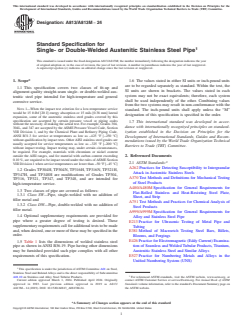
Standard Specification for Single- or Double-Welded Austenitic Stainless Steel Pipe
ABSTRACT
This specification covers two classes of fit-up and alignment quality straight-seam single- or double-welded austenitic steel pipe intended for high-temperature and general corrosive service. The steel shall conform to the specified chemical composition and tensile property requirements. Both ends of each double-welded pipe shall be visually examined to determine that complete fusion is attained between the two welds. Tension tests shall be made on specimens from two tubes for lots of more than 100 pipes, and one tension test shall be made on a specimen for lots of not more than 100 pipes, Also, for material heat treated in a batch type-furnace, flattening tests shall be made on 5 % of the pipe from each heat-treated lot. Finally, each pipe shall be subjected to the non-destructive electric test or the hydrostatic test.
SCOPE
1.1 This specification covers two classes of fit-up and alignment quality straight-seam single- or double-welded austenitic steel pipe intended for high-temperature and general corrosive service.
Note 1: When the impact test criterion for a low-temperature service would be 15 ft·lbf [20 J] energy absorption or 15 mils [0.38 mm] lateral expansion, some of the austenitic stainless steel grades covered by this specification are accepted by certain pressure vessel or piping codes without the necessity of making the actual test. For example, Grades 304, 304L, and 347 are accepted by the ASME Pressure Vessel Code, Section VIII Division 1, and by the Chemical Plant and Refinery Piping Code, ANSI B31.3 for service at temperatures as low as −425 °F [−250 °C] without qualification by impact tests. Other AISI stainless steel grades are usually accepted for service temperatures as low as −325 °F [−200 °C] without impact testing. Impact testing may, under certain circumstances, be required. For example, materials with chromium or nickel content outside the AISI ranges, and for material with carbon content exceeding 0.10 %, are required to be impact tested under the rules of ASME Section VIII Division 1 when service temperatures are lower than −50 °F [−45 °C]
1.2 Grades TP304H, TP304N, TP316H, TP316N, TP321H, TP347H, and TP348H are modifications of Grades TP304, TP316, TP321, TP347, and TP348, and are intended for high-temperature service.
1.3 Two classes of pipe are covered as follows:
1.3.1 Class SW—Pipe, single-welded with no addition of filler metal and
1.3.2 Class DW—Pipe, double-welded with no addition of filler metal.
1.4 Optional supplementary requirements are provided for pipe where a greater degree of testing is desired. These supplementary requirements call for additional tests to be made and, when desired, one or more of these may be specified in the order.
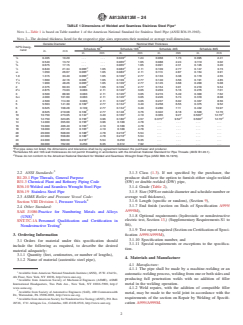
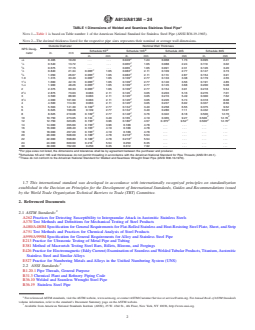
1.5 Table 1 lists the dimensions of welded stainless steel pipe as shown in ANSI B36.19. Pipe having other dimensions may be furnished provided such pipe complies with all other requirements of this specification.
1.6 The values stated in either SI units or inch-pound units are to be regarded separately as standard. Within the text, the SI units are shown in brackets. The values stated in each system may not be exact equivalents; therefore, each system shall be used independently of the other. Combining values from the two systems may result in non-conformance with the standard. The inch-pound units shall apply unless the “M” designation of this specification is specified in the order.
1.7 This international standard was developed in accordance with internationally recognized principles on standardization established in the Decision on Principles for the Development of International Standards, Guides and Recommendations issued by the World Trade Organization Technical Barriers to Trade (TBT) Committee.
General Information
- Status
- Published
- Publication Date
- 29-Feb-2024
- Technical Committee
- A01 - Steel, Stainless Steel and Related Alloys
- Drafting Committee
- A01.10 - Stainless and Alloy Steel Tubular Products
Relations
- Effective Date
- 01-Mar-2024
- Effective Date
- 01-Mar-2024
Overview
ASTM A813/A813M-24 is the standard specification for straight-seam single- or double-welded austenitic stainless steel pipe designed for high-temperature and general corrosive service. Developed by ASTM International, this standard ensures that welded stainless steel pipes meet stringent requirements for chemical composition, mechanical properties, dimensional tolerances, and quality assurance. The specification is widely recognized across industries for its relevance to pressure piping, chemical processing, and other demanding applications where corrosion resistance and mechanical integrity are critical.
Key Topics
- Grades Covered: Includes a range of austenitic stainless steel grades, such as TP304, TP304L, TP316, TP316L, and high-temperature variants like TP304H, TP316H, TP321H, TP347H, and TP348H, ensuring suitability for diverse high-temperature and corrosive applications.
- Classes of Pipe:
- Class SW: Single-welded pipe with no filler metal.
- Class DW: Double-welded pipe with no filler metal.
- Mechanical and Chemical Requirements: Specifies minimum tensile and yield strengths, and strict adherence to prescribed chemical compositions, ensuring consistent product performance.
- Testing and Inspection:
- Visual and Non-Destructive Testing: Each pipe undergoes either a hydrostatic test or a non-destructive electric test (ultrasonic or eddy current), in addition to visual inspections of weld fusion for double-welded pipes.
- Destructive Testing: Tensile tests are performed on representative samples. For batch heat-treated material, flattening tests cover a percentage of the production lot.
- Optional Supplementary Requirements: Additional tests can be specified for applications requiring higher levels of testing and reliability.
- Dimensional Standards: Pipe dimensions align with ANSI B36.19 standards, with strict permissible variation tolerances for outside diameter, out-of-roundness, wall thickness, and alignment.
Applications
ASTM A813/A813M-24 pipes are essential across a range of industries requiring robust corrosion resistance and reliability under extreme conditions. Typical application areas include:
- Chemical Processing Plants: Used in systems transporting corrosive chemicals due to their high resistance to aggressive environments.
- Petroleum Refineries: Pipelines exposed to both high temperatures and reactive fluids.
- Power Generation: Suitable for steam lines and heat exchangers in high-temperature circuits.
- Pharmaceutical Manufacturing: Sanitary piping where non-contamination and corrosion resistance are critical.
- Food and Beverage Industries: Used where both corrosion resistance and hygienic standards are mandatory.
- Pulp and Paper Mills: For handling corrosive process fluids under elevated temperatures.
Related Standards
ASTM A813/A813M-24 references several other important standards to ensure comprehensive product compliance and interoperability:
- ASTM A999/A999M: General requirements for alloy and stainless steel pipe.
- ASTM A262: Detection of susceptibility to intergranular attack in austenitic stainless steels.
- ASTM A370: Test methods for mechanical testing of steel products.
- ASTM A480/A480M: General requirements for flat-rolled stainless and heat-resisting steel.
- ANSI B31.3: Chemical plant and refinery piping code.
- ANSI B36.19: Stainless steel pipe dimensional standards.
- ASME Section VIII Division 1: Boiler and pressure vessel code for pressure-containing components.
Practical Value
Implementing ASTM A813/A813M-24 assures reliability and consistency in stainless steel pipe supply for critical infrastructure. The rigorous standards for welding, heat treatment, mechanical integrity, and inspection minimize risk, ensuring safe and durable installations in high-stress environments. Specifiers, engineers, and buyers can be confident that compliant pipes provide optimal performance in corrosive and high-temperature settings, reducing maintenance costs and enhancing safety.
Keywords
ASTM A813, stainless steel pipe, austenitic, welded pipe, high-temperature, corrosive service, pipe standards, non-destructive testing, chemical composition, mechanical properties, pressure piping, ANSI B36.19, ASME Section VIII, industrial piping.
Buy Documents
ASTM A813/A813M-24 - Standard Specification for Single- or Double-Welded Austenitic Stainless Steel Pipe
REDLINE ASTM A813/A813M-24 - Standard Specification for Single- or Double-Welded Austenitic Stainless Steel Pipe
Get Certified
Connect with accredited certification bodies for this standard

Institut za varilstvo d.o.o. (Welding Institute)
Slovenia's leading welding institute since 1952. ISO 3834, EN 1090, pressure equipment certification, NDT personnel, welder qualification. Only IIW Au
Sponsored listings
Frequently Asked Questions
ASTM A813/A813M-24 is a technical specification published by ASTM International. Its full title is "Standard Specification for Single- or Double-Welded Austenitic Stainless Steel Pipe". This standard covers: ABSTRACT This specification covers two classes of fit-up and alignment quality straight-seam single- or double-welded austenitic steel pipe intended for high-temperature and general corrosive service. The steel shall conform to the specified chemical composition and tensile property requirements. Both ends of each double-welded pipe shall be visually examined to determine that complete fusion is attained between the two welds. Tension tests shall be made on specimens from two tubes for lots of more than 100 pipes, and one tension test shall be made on a specimen for lots of not more than 100 pipes, Also, for material heat treated in a batch type-furnace, flattening tests shall be made on 5 % of the pipe from each heat-treated lot. Finally, each pipe shall be subjected to the non-destructive electric test or the hydrostatic test. SCOPE 1.1 This specification covers two classes of fit-up and alignment quality straight-seam single- or double-welded austenitic steel pipe intended for high-temperature and general corrosive service. Note 1: When the impact test criterion for a low-temperature service would be 15 ft·lbf [20 J] energy absorption or 15 mils [0.38 mm] lateral expansion, some of the austenitic stainless steel grades covered by this specification are accepted by certain pressure vessel or piping codes without the necessity of making the actual test. For example, Grades 304, 304L, and 347 are accepted by the ASME Pressure Vessel Code, Section VIII Division 1, and by the Chemical Plant and Refinery Piping Code, ANSI B31.3 for service at temperatures as low as −425 °F [−250 °C] without qualification by impact tests. Other AISI stainless steel grades are usually accepted for service temperatures as low as −325 °F [−200 °C] without impact testing. Impact testing may, under certain circumstances, be required. For example, materials with chromium or nickel content outside the AISI ranges, and for material with carbon content exceeding 0.10 %, are required to be impact tested under the rules of ASME Section VIII Division 1 when service temperatures are lower than −50 °F [−45 °C] 1.2 Grades TP304H, TP304N, TP316H, TP316N, TP321H, TP347H, and TP348H are modifications of Grades TP304, TP316, TP321, TP347, and TP348, and are intended for high-temperature service. 1.3 Two classes of pipe are covered as follows: 1.3.1 Class SW—Pipe, single-welded with no addition of filler metal and 1.3.2 Class DW—Pipe, double-welded with no addition of filler metal. 1.4 Optional supplementary requirements are provided for pipe where a greater degree of testing is desired. These supplementary requirements call for additional tests to be made and, when desired, one or more of these may be specified in the order. 1.5 Table 1 lists the dimensions of welded stainless steel pipe as shown in ANSI B36.19. Pipe having other dimensions may be furnished provided such pipe complies with all other requirements of this specification. 1.6 The values stated in either SI units or inch-pound units are to be regarded separately as standard. Within the text, the SI units are shown in brackets. The values stated in each system may not be exact equivalents; therefore, each system shall be used independently of the other. Combining values from the two systems may result in non-conformance with the standard. The inch-pound units shall apply unless the “M” designation of this specification is specified in the order. 1.7 This international standard was developed in accordance with internationally recognized principles on standardization established in the Decision on Principles for the Development of International Standards, Guides and Recommendations issued by the World Trade Organization Technical Barriers to Trade (TBT) Committee.
ABSTRACT This specification covers two classes of fit-up and alignment quality straight-seam single- or double-welded austenitic steel pipe intended for high-temperature and general corrosive service. The steel shall conform to the specified chemical composition and tensile property requirements. Both ends of each double-welded pipe shall be visually examined to determine that complete fusion is attained between the two welds. Tension tests shall be made on specimens from two tubes for lots of more than 100 pipes, and one tension test shall be made on a specimen for lots of not more than 100 pipes, Also, for material heat treated in a batch type-furnace, flattening tests shall be made on 5 % of the pipe from each heat-treated lot. Finally, each pipe shall be subjected to the non-destructive electric test or the hydrostatic test. SCOPE 1.1 This specification covers two classes of fit-up and alignment quality straight-seam single- or double-welded austenitic steel pipe intended for high-temperature and general corrosive service. Note 1: When the impact test criterion for a low-temperature service would be 15 ft·lbf [20 J] energy absorption or 15 mils [0.38 mm] lateral expansion, some of the austenitic stainless steel grades covered by this specification are accepted by certain pressure vessel or piping codes without the necessity of making the actual test. For example, Grades 304, 304L, and 347 are accepted by the ASME Pressure Vessel Code, Section VIII Division 1, and by the Chemical Plant and Refinery Piping Code, ANSI B31.3 for service at temperatures as low as −425 °F [−250 °C] without qualification by impact tests. Other AISI stainless steel grades are usually accepted for service temperatures as low as −325 °F [−200 °C] without impact testing. Impact testing may, under certain circumstances, be required. For example, materials with chromium or nickel content outside the AISI ranges, and for material with carbon content exceeding 0.10 %, are required to be impact tested under the rules of ASME Section VIII Division 1 when service temperatures are lower than −50 °F [−45 °C] 1.2 Grades TP304H, TP304N, TP316H, TP316N, TP321H, TP347H, and TP348H are modifications of Grades TP304, TP316, TP321, TP347, and TP348, and are intended for high-temperature service. 1.3 Two classes of pipe are covered as follows: 1.3.1 Class SW—Pipe, single-welded with no addition of filler metal and 1.3.2 Class DW—Pipe, double-welded with no addition of filler metal. 1.4 Optional supplementary requirements are provided for pipe where a greater degree of testing is desired. These supplementary requirements call for additional tests to be made and, when desired, one or more of these may be specified in the order. 1.5 Table 1 lists the dimensions of welded stainless steel pipe as shown in ANSI B36.19. Pipe having other dimensions may be furnished provided such pipe complies with all other requirements of this specification. 1.6 The values stated in either SI units or inch-pound units are to be regarded separately as standard. Within the text, the SI units are shown in brackets. The values stated in each system may not be exact equivalents; therefore, each system shall be used independently of the other. Combining values from the two systems may result in non-conformance with the standard. The inch-pound units shall apply unless the “M” designation of this specification is specified in the order. 1.7 This international standard was developed in accordance with internationally recognized principles on standardization established in the Decision on Principles for the Development of International Standards, Guides and Recommendations issued by the World Trade Organization Technical Barriers to Trade (TBT) Committee.
ASTM A813/A813M-24 is classified under the following ICS (International Classification for Standards) categories: 23.040.10 - Iron and steel pipes. The ICS classification helps identify the subject area and facilitates finding related standards.
ASTM A813/A813M-24 has the following relationships with other standards: It is inter standard links to ASTM A813/A813M-14(2019), ASTM A999/A999M-23. Understanding these relationships helps ensure you are using the most current and applicable version of the standard.
ASTM A813/A813M-24 is available in PDF format for immediate download after purchase. The document can be added to your cart and obtained through the secure checkout process. Digital delivery ensures instant access to the complete standard document.
Standards Content (Sample)
This international standard was developed in accordance with internationally recognized principles on standardization established in the Decision on Principles for the
Development of International Standards, Guides and Recommendations issued by the World Trade Organization Technical Barriers to Trade (TBT) Committee.
Designation: A813/A813M − 24
Standard Specification for
Single- or Double-Welded Austenitic Stainless Steel Pipe
This standard is issued under the fixed designation A813/A813M; the number immediately following the designation indicates the year
of original adoption or, in the case of revision, the year of last revision. A number in parentheses indicates the year of last reapproval.
A superscript epsilon (´) indicates an editorial change since the last revision or reapproval.
1. Scope* 1.6 The values stated in either SI units or inch-pound units
are to be regarded separately as standard. Within the text, the
1.1 This specification covers two classes of fit-up and
SI units are shown in brackets. The values stated in each
alignment quality straight-seam single- or double-welded aus-
system may not be exact equivalents; therefore, each system
tenitic steel pipe intended for high-temperature and general
shall be used independently of the other. Combining values
corrosive service.
from the two systems may result in non-conformance with the
NOTE 1—When the impact test criterion for a low-temperature service
standard. The inch-pound units shall apply unless the “M”
would be 15 ft·lbf [20 J] energy absorption or 15 mils [0.38 mm] lateral
designation of this specification is specified in the order.
expansion, some of the austenitic stainless steel grades covered by this
specification are accepted by certain pressure vessel or piping codes
1.7 This international standard was developed in accor-
without the necessity of making the actual test. For example, Grades 304,
dance with internationally recognized principles on standard-
304L, and 347 are accepted by the ASME Pressure Vessel Code, Section
ization established in the Decision on Principles for the
VIII Division 1, and by the Chemical Plant and Refinery Piping Code,
ANSI B31.3 for service at temperatures as low as −425 °F [−250 °C] Development of International Standards, Guides and Recom-
without qualification by impact tests. Other AISI stainless steel grades are
mendations issued by the World Trade Organization Technical
usually accepted for service temperatures as low as −325 °F [−200 °C]
Barriers to Trade (TBT) Committee.
without impact testing. Impact testing may, under certain circumstances,
be required. For example, materials with chromium or nickel content
outside the AISI ranges, and for material with carbon content exceeding 2. Referenced Documents
0.10 %, are required to be impact tested under the rules of ASME Section
2.1 ASTM Standards:
VIII Division 1 when service temperatures are lower than −50 °F [−45 °C]
A262 Practices for Detecting Susceptibility to Intergranular
1.2 Grades TP304H, TP304N, TP316H, TP316N, TP321H,
Attack in Austenitic Stainless Steels
TP347H, and TP348H are modifications of Grades TP304,
A370 Test Methods and Definitions for Mechanical Testing
TP316, TP321, TP347, and TP348, and are intended for
of Steel Products
high-temperature service.
A480/A480M Specification for General Requirements for
1.3 Two classes of pipe are covered as follows:
Flat-Rolled Stainless and Heat-Resisting Steel Plate,
1.3.1 Class SW—Pipe, single-welded with no addition of
Sheet, and Strip
filler metal and
A751 Test Methods and Practices for Chemical Analysis of
1.3.2 Class DW—Pipe, double-welded with no addition of
Steel Products
filler metal.
A999/A999M Specification for General Requirements for
1.4 Optional supplementary requirements are provided for
Alloy and Stainless Steel Pipe
pipe where a greater degree of testing is desired. These
E213 Practice for Ultrasonic Testing of Metal Pipe and
supplementary requirements call for additional tests to be made
Tubing
and, when desired, one or more of these may be specified in the
E381 Method of Macroetch Testing Steel Bars, Billets,
order.
Blooms, and Forgings
E426 Practice for Electromagnetic (Eddy Current) Examina-
1.5 Table 1 lists the dimensions of welded stainless steel
tion of Seamless and Welded Tubular Products, Titanium,
pipe as shown in ANSI B36.19. Pipe having other dimensions
Austenitic Stainless Steel and Similar Alloys
may be furnished provided such pipe complies with all other
E527 Practice for Numbering Metals and Alloys in the
requirements of this specification.
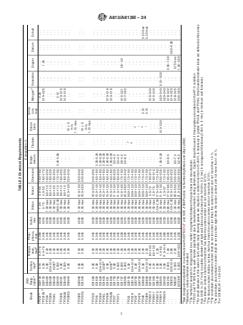
Unified Numbering System (UNS)
This specification is under the jurisdiction of ASTM Committee A01 on Steel,
Stainless Steel and Related Alloys and is the direct responsibility of Subcommittee
A01.10 on Stainless and Alloy Steel Tubular Products. For referenced ASTM standards, visit the ASTM website, www.astm.org, or
Current edition approved March 1, 2024. Published April 2024. Originally contact ASTM Customer Service at service@astm.org. For Annual Book of ASTM
approved in 1983. Last previous edition approved in 2019 as A813/ Standards volume information, refer to the standard’s Document Summary page on
A813M – 14 (2019). DOI: 10.1520/A0813_A0813M-24. the ASTM website.
*A Summary of Changes section appears at the end of this standard
Copyright © ASTM International, 100 Barr Harbor Drive, PO Box C700, West Conshohocken, PA 19428-2959. United States
A813/A813M − 24
A
TABLE 1 Dimensions of Welded and Seamless Stainless Steel Pipe
NOTE 1—Table 1 is based on Table number 1 of the American National Standard for Stainless Steel Pipe (ANSI B36.19-1965).
NOTE 2—The decimal thickness listed for the respective pipe sizes represents their nominal or average wall dimensions.
Outside Diameter Nominal Wall Thickness
NPS Desig-
B B
Schedule 5S Schedule 10S Schedule 40S Schedule 80S
nator
in. mm
in. mm in. mm in. mm in. mm
C
⁄8 0.405 10.29 . . . . . . 0.049 1.24 0.068 1.73 0.095 2.41
C
⁄4 0.540 13.72 . . . . . . 0.065 1.65 0.088 2.24 0.119 3.02
C
⁄8 0.675 17.15 . . . . . . 0.065 1.65 0.091 2.31 0.126 3.20
C C
⁄2 0.840 21.34 0.065 1.65 0.083 2.11 0.109 2.77 0.147 3.73
C C
⁄4 1.050 26.67 0.065 1.65 0.083 2.11 0.113 2.87 0.154 3.91
C C
1.0 1.315 33.40 0.065 1.65 0.109 2.77 0.133 3.38 0.179 4.55
1 C C
1 ⁄4 1.660 42.16 0.065 1.65 0.109 2.77 0.140 3.56 0.191 4.85
C C
1 ⁄2 1.900 48.26 0.065 1.65 0.109 2.77 0.145 3.68 0.200 5.08
C C
2 2.375 60.33 0.065 1.65 0.109 2.77 0.154 3.91 0.218 5.54
C
2 ⁄2 2.875 73.03 0.083 2.11 0.120 3.05 0.203 5.16 0.276 7.01
C
3 3.500 88.90 0.083 2.11 0.120 3.05 0.216 5.49 0.300 7.62
C
3 ⁄2 4.000 101.60 0.083 2.11 0.120 3.05 0.226 5.74 0.318 8.08
C
4 4.500 114.30 0.083 2.11 0.120 3.05 0.237 6.02 0.337 8.56
C C
5 5.563 141.30 0.109 2.77 0.134 3.40 0.258 6.55 0.375 9.52
C
6 6.625 168.28 0.109 2.77 0.134 3.40 0.280 7.11 0.432 10.97
C C
8 8.625 219.08 0.109 2.77 0.148 3.76 0.322 8.18 0.500 12.70
C C C C
10 10.750 273.05 0.134 3.40 0.165 4.19 0.365 9.27 0.500 12.70
C C C C C C
12 12.750 323.85 0.156 3.96 0.180 4.57 0.375 9.52 0.500 12.70
C
14 14.000 355.60 0.156 3.96 0.188 4.78 . . . . . . . . . . . .
C
16 16.000 406.40 0.165 4.19 0.188 4.78 . . . . . . . . . . . .
C
18 18.000 457.20 0.165 4.19 0.188 4.78 . . . . . . . . . . . .
C C
20 20.000 508.00 0.188 4.78 0.218 5.54 . . . . . . . . . . . .
C C
22 22.000 558.80 0.188 4.78 0.218 5.54 . . . . . . . . . . . .
C
24 24.000 609.60 0.218 5.54 0.250 6.35 . . . . . . . . . . . .
30 30.000 762.00 0.250 6.35 0.312 7.92 . . . . . . . . . . . .
A
For pipe sizes not listed, the dimensions and tolerances shall be by agreement between the purchaser and producer.
B
Schedules 5S and 10S wall thicknesses do not permit threading in accordance with the American National Standard for Pipe Threads (ANSI B1.20.1).
C
These do not conform to the American National Standard for Welded and Seamless Wrought Steel Pipe (ANSI B36.10-1979).
2.2 ANSI Standards: 3.1.3 Class (1.3). If not specified by the purchaser, the
B1.20.1 Pipe Threads, General Purpose producer shall have the option to furnish either single-welded
B31.3 Chemical Plant and Refinery Piping Code (SW) or double-welded (DW) pipe,
B36.10 Welded and Seamless Wrought Steel Pipe 3.1.4 Grade (Table 2),
B36.19 Stainless Steel Pipe 3.1.5 Size (NPS or outside diameter and schedule number or
average wall thickness),
2.3 ASME Boiler and Pressure Vessel Code:
3.1.6 Length (specific or random), (Section 9),
Section VIII Division 1, Pressure Vessels
3.1.7 End finish (section on Ends of Specification A999/
2.4 Other Standard:
A999M),
SAE J1086 Practice for Numbering Metals and Alloys
3.1.8 Optional requirements (hydrostatic or nondestructive
(UNS)
electric test, Section 13,) (Supplementary Requirements S1 to
SNT-TC-1A Personnel Qualification and Certification in
S6),
Nondestructive Testing
3.1.9 Test report required (Section on Certification of Speci-
3. Ordering Information
fication A999/A999M),
3.1.10 Specification number, and
3.1 Orders for material under this specification should
3.1.11 Special requirements or exceptions to the specifica-
include the following as required, to describe the desired
tion.
material adequately:
3.1.1 Quantity (feet, centimetres, or number of lengths),
4. Materials and Manufacture
3.1.2 Name of material (austenitic steel pipe),
4.1 Manufacture:
4.1.1 The pipe shall be made by a machine-welding or an
Available from American National Standards Institute (ANSI), 25 W. 43rd St.,
automatic-welding process, welding from one or both sides and
4th Floor, New York, NY 10036, http://www.ansi.org.
4 producing full penetration welds with no addition of filler
Available from American Society of Mechanical Engineers (ASME), ASME
metal in the welding operation.
International Headquarters, Two Park Ave., New York, NY 10016-5990, http://
www.asme.org.
4.1.2 Weld repairs, with the addition of compatible filler
Available from Society of Automotive Engineers (SAE), 400 Commonwealth
metal, may be made to the weld joint in accordance with the
Dr., Warrendale, PA 15096-0001, http://www.sae.org.
requirements of the section on Repair by Welding of Specifi-
Available from American Society for Nondestructive Testing (ASNT), P.O. Box
28518, 1711 Arlingate Ln., Columbus, OH 43228-0518, http://www.asnt.org. cation A999/A999M.
A813/A813M − 24
TABLE 2 Chemical Requirements
Composition, %
UNS
Manga- Phos- Tanta-
Grade Desig- Carbon, Sulfur, Molyb- Colum-
C
nese, phorus, Silicon Nickel Chromium Titanium lum, Nitrogen Vanadium Copper Cerium Cobalt
A B
nation max max denum bium
B
max max max
D
TP201 S20100 0.15 5.5–7.5 0.060 0.030 1.00 3.5–5.5 16.0–18.0 . . . . . . . . . . . . 0.25 . . . . . . . . . . . .
D
TP201LN S20153 0.03 6.4–7.5 0.045 0.015 0.75 4.0–5.0 16.0–17.5 . . . . . . . . . . . . 0.10–0.25 . . . 1.00 . . . . . .
TP304 S30400 0.08 2.00 0.045 0.030 1.00 max 8.0–11.0 18.0–20.0 . . . . . . . . . . . . . . . . . . . . . . . . . . .
TP304H S30409 0.04–0.10 2.00 0.045 0.030 1.00 max 8.0–11.0 18.0–20.0 . . . . . . . . . . . . . . . . . . . . . . . . . . .
E
TP304L S30403 0.030 2.00 0.045 0.030 1.00 max 8.0–12.0 18.0–20.0 . . . . . . . . . . . . . . . . . . . . . . . . . . .
. . . S30416 0.030 2.00 0.045 0.015 0.80–2.00 9.0–11.0 17.5–19.5 0.40–0.80 . . . . . . . . . 0.10 . . . . . . . . . . . .
TP304N S30451 0.08 2.00 0.045 0.030 1.00 max 8.0–11.0 18.0–20.0 . . . . . . . . . . . . 0.10–0.16 . . . . . . . . . . . .
TP304LN S30453 0.030 2.00 0.045 0.030 1.00 max 8.0–11.0 18.0–20.0 . . . . . . . . . . . . 0.10–0.16 . . . . . . . . . . . .
TP309Cb S30940 0.08 2.00 0.045 0.030 1.00 max 12.0–16.0 22.0–24.0 . . . . . . 10 × C . . . . . . . . . . . . . . . . . .
min,
1.10 max
TP309S S30908 0.08 2.00 0.045 0.030 1.00 max 12.0–15.0 22.0–24.0 . . . . . . . . . . . . . . . . . . . . . . . . . . .
TP310Cb S31040 0.08 2.00 0.045 0.030 1.00 max 19.0–22.0 24.0–26.0 . . . . . . 10 × C . . . . . . . . . . . . . . . . . .
min,
1.10 max
TP310S S31008 0.08 2.00 0.045 0.030 1.00 max 19.0–22.0 24.0–26.0 . . . . . . . . . . . . . . . . . . . . . . . . . . .
TP316 S31600 0.08 2.00 0.045 0.030 1.00 max 10.0–14.0 16.0–18.0 2.00–3.00 . . . . . . . . . . . . . . . . . . . . . . . .
TP316H S31609 0.04–0.10 2.00 0.045 0.030 1.00 max 10.0–14.0 16.0–18.0 2.00–3.00 . . . . . . . . . . . . . . . . . . . . . . . .
E
TP316L S31603 0.030 2.00 0.045 0.030 1.00 max 10.0–14.0 16.0–18.0 2.00–3.00 . . . . . . . . . . . . . . . . . . . . . . . .
TP316N S31651 0.08 2.00 0.045 0.030 1.00 max 10.0–15.0 16.0–18.0 2.00–3.00 0.10–0.16 . . . . . . . . . . . .
E
TP316LN S31653 0.030 2.00 0.045 0.030 1.00 max 10.0–13.0 16.0–18.0 2.00–3.00 . . . . . . . . . 0.10–0.16 . . . . . . . . . . . .
TP317 S31700 0.08 2.00 0.045 0.030 1.00 max 11.0–15.0 18.0–20.0 3.0–4.0 . . . . . . . . . . . . . . . . . . . . . . . .
TP317L S31703 0.030 2.00 0.045 0.030 1.00 max 11.0–15.0 18.0–20.0 3.0–4.0 . . . . . . . . . . . . . . . . . . . . . . . .
. . . S31727 0.030 1.00 0.030 0.030 1.00 max 14.5–16.5 17.5–19.0 3.8–4.5 . . . . . . . . . 0.15–0.21 . . . 2.8–4.0 . . . . . .
. . . S32053 0.030 1.00 0.030 0.010 1.00 max 24.0–26.0 22.0–24.0 5.0–6.0 . . . . . . . . . 0.17–0.22 . . . . . . . . . . . .
F
TP321 S32100 0.08 2.00 0.045 0.030 1.00 max 9.00–12.0 17.0–19.0 . . . . . . . . . . . . . . . . . . . . . . . .
G
TP321H S32109 0.04–0.10 2.00 0.045 0.030 1.00 max 9.00–12.0 17.0–19.0 . . . . . . . . . . . . . . . . . . . . . . . .
H
TP347 S34700 0.08 2.00 0.045 0.030 1.00 max 9.00–12.0 17.0–19.0 . . . . . . . . . . . . . . . . . . . . . . . .
I
TP347H S34709 0.04–0.10 2.00 0.045 0.030 1.00 max 9.00–12.0 17.0–19.0 . . . . . . . . . . . . . . . . . . . . . . . .
H
TP348 S34800 0.08 2.00 0.045 0.030 1.00 max 9.00–12.0 17.0–19.0 . . . . . . 0.10 . . . . . . . . . . . . 0.20 max
I
TP348H S34809 0.04–0.10 2.00 0.045 0.030 1.00 max 9.00–12.0 17.0–19.0 . . . . . . 0.10 . . . . . . . . . . . . 0.20 max
TPXM-10 S21900 0.08 8.0–10.0 0.045 0.030 1.00 max 5.5–7.5 19.0–21.5 . . . . . . . . . . . . 0.15–0.40 . . . . . . . . . . . .
TPXM-11 S21903 0.04 8.0–10.0 0.045 0.030 1.00 max 5.5–7.5 19.0–21.5 . . . . . . . . . . . . 0.15–0.40 . . . . . . . . . . . .
TPXM-15 S38100 0.08 2.00 0.030 0.030 1.50–2.50 17.5–18.5 17.0–19.0 . . . . . . . . . . . . . . . . . . . . . . . . . . .
TPXM-19 S20910 0.06 4.0–6.0 0.045 0.030 1.00 max 11.5–13.5 20.5–23.5 1.50–3.00 . . . 0.10–0.30 . . . 0.20–0.40 0.10–0.30 . . . . . . . . .
TPXM-29 S24000 0.08 11.5–14.5 0.060 0.030 1.00 max 2.3–3.7 17.0–19.0 . . . . . . . . . . . . 0.20–0.40 . . . . . . . . . . . .
. . . S31254 0.020 1.00 0.030 0.010 0.80 max 17.5–18.5 19.5–20.5 6.0–6.5 . . . . . . . . . 0.18–0.22 . . . 0.50–1.00 . . . . . .
. . . S30815 0.05–0.10 0.80 0.040 0.030 1.40–2.00 10.0–12.0 20.0–22.0 . . . . . . . . . . . . 0.14–0.20 . . . . . . 0.03–0.08 . . .
. . . N08367 0.030 2.00 0.040 0.030 1.00 max 23.5–25.5 20.0–22.0 6.0–7.0 . . . . . . . . . 0.18–0.25 . . . 0.75 max . . . . . .
J
. . . S31266 0.030 2.00–4.00 0.035 0.020 1.00 max 21.0–24.0 23.0–25.0 5.2–6.2 . . . . . . . . . 0.35–0.60 . . . 1.00–2.50 . . . . . .
A
New designation established in accordance with ASTM E527 and SAE J1086 Practice for Numbering Metals and Alloys (UNS).
B
Maximum, unless otherwise indicated.
C
The method of analysis for nitrogen shall be a matter of agreement between the purchaser and manufacturer.
D
TP 201 and TP 201LN may work harden significantly due to martensite formation during deformation. Caution should be used if these grades are ordered in the HT-0 condition.
E
For small diameter or thin walls or both, where many drawing passes are required, a carbon maximum of 0.040 % is necessary in grades TP304L and TP316L. Small outside diameter tubes are defined as those less
than 0.500 in. [12.7 mm] in outside diameter and light wall tubes as those less than 0.049 in. [1.2 mm] in average wall thickness (0.044 in. [1 mm] in minimum wall thickness).
F
The titanium content shall be not less than five times the carbon content and not more than 0.70 %.
G
The titanium content shall be not less than four times the carbon content and not more than 0.70 %.
H
The columbium plus tantalum content shall be not less than ten times the carbon content and not more than 1.0 %.
I
The columbium plus tantalum content shall be not less than eight times the carbon content and not more than 1.10 %.
J
For S31266, W = 1.50–2.50.
A813/A813M − 24
4.1.3 The pipe shall be pickled free of scale. When bright
NPS Number Lengths of Pipe in Lot
annealing is used, pickling is not necessary.
Under 2 400 or fraction thereof
4.2 Heat Treatment: 2 to 5 inclusive 200 or fraction thereof
6 and over 100 or fraction thereof
4.2.1 Except as provided in 4.2.6 and 4.2.7, all pipe shall be
6.2 The results of these analyses shall be reported to the
furnished in the heat-treated condition, except pipe sizes over
purchaser or his representative, and shall conform to the
NPS 6 may be furnished in the unheat-treated condition when
requirements specified in Section 5.
specified in the order. When the pipe is furnished without final
heat treatment, each pipe shall be marked HT-O and when a
6.3 If the analysis of one of the tests specified in 6.1 does
material test report for such pipe is furnished to the purchaser,
not conform to the requirements specified in Section 5, an
the report shall indicate that the pipe has not been heat-treated.
analysis of each length of flat-rolled stock from each heat or
The heat-treatment procedure, except for H grades, N08367,
pipe from the same heat or lot may be made, and all pipe
and S31254, shall consist of heating the pipe to a minimum
conforming to the requirements shall be accepted.
temperature of 1900 °F [1040 °C] and quenching in water or
6.4 For referee purposes, Test Methods, Practices, and
rapidly cooling by other means.
Terminology A751 shall be used.
4.2.2 All H grades shall be furnished in the solution-treated
condition. If cold working is involved in processing, the
7. Tensile Requirements
minimum solution treating temperature for Grades TP321H,
7.1 The tensile properties of the material shall conform to
TP347H, and TP348H shall be 2000 °F [1100 °C] and for
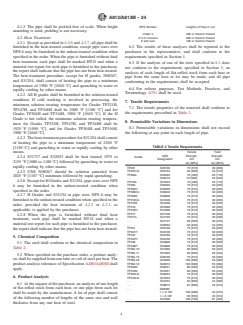
the requirements prescribed in Table 3.
Grades TP304H and TP316H, 1900 °F [1040 °C]. If the H
Grade is hot rolled, the minimum solution treating tempera-
8. Permissible Variations in Dimensions
tures for Grades TP321H, TP347H, and TP348H shall be
1925 °F [1050 °C], and for Grades TP304H and TP316H, 8.1 Permissible variations in dimensions shall not exceed
the following at any point in each length of pipe.
1900 °F [1040 °C].
4.2.3 The heat-treatment procedure for S31254 shall consist
of heating the pipe to a minimum temperature of 2100 °F
TABLE 3 Tensile Requirements
[1150 °C] and quenching in water or rapidly cooling by other
Tensile Yield
means.
UNS Strength, Strength,
4.2.4 S31727 and S32053 shall be heat treated 1975 to
Grade
Designation min min
2155 °F [1080 to 1180 °C] followed by quenching in water or
ksi [MPa] ksi [MPa]
rapidly cooling by other means.
TP201 S20100 75 [515] 38 [260]
TP201LN S20153 95 [665] 45 [310]
4.2.5 UNS N08367 should be solution annealed from
TP304L S30403 70 [485] 25 [170]
2025 °F [1107 °C] minimum followed by rapid quenching.
. . . S30416 73 [500] 32 [220]
4.2.6 Except for H Grades and S31254, pipe sizes over NPS
TP316L S31603 70 [485] 25 [170]
TP304 S30400 75 [515] 30 [205]
6 may be furnished in the unheat-treated condition when
TP304H S30409 75 [515] 30 [205]
specified in the order.
TP309Cb S30940 75 [515] 30 [205]
4.2.7 H Grades and S31254 in pipe sizes NPS 6 may be
TP309S S30908 75 [515] 30 [205]
TP310Cb S31040 75 [515] 30 [205]
furnished in the unheat-treated condition when specified in the
TP310S S31008 75 [515] 30 [205]
order, provided the heat treatment of 4.2.2 or 4.2.3, as
TP316 S31600 75 [515] 30 [205]
applicable, is applied by the purchaser.
TP316H S31609 75 [515] 30 [205]
TP317 S31700 75 [515] 30 [205]
4.2.8 When the pipe is furnished without final heat
TP317L S31703 75 [515] 30 [205]
treatment, each pipe shall be marked HT-O and when a
. . . S31727 80 [550] 36 [245]
material test report for such pipe is furnished to the purchaser,
. . . S32053 93 [640] 43 [295]
TP321 S32100 75 [515] 30 [205]
the report shall indicate that the pipe has not been heat-treated.
TP321H S32109 75 [515] 30 [205]
TP347 S34700 75 [515] 30 [205]
5. Chemical Composition
TP347H S34709 75 [515] 30 [205]
TP348 S34800 75 [515] 30 [205]
5.1 The steel shall conform to the chemical composition in
TP348H S34809 75 [515] 30 [205]
Table 2.
TPXM-10 S21900 90 [620] 50 [345]
TPXM-11 S21903 90 [620] 50 [345]
5.2 When specified on the purchase order, a product analy-
TPXM-15 S38100 75 [515] 30 [205]
sis shall be supplied from one tube or coil of steel per heat. The
TPXM-29 S24000 100 [690] 55 [380]
TPXM-19 S20910 100 [690] 55 [380]
product analysis tolerance of Specification A480/A480M shall
TP304N S30451 80 [550] 35 [240]
apply.
TP316N S31651 80 [550] 35 [240]
TP304LN S30453 75 [515] 30 [205]
6. Product Analysis
TP316LN S31653 75 [515] 30 [205]
. . . S31254 94 [650] 44 [300]
6.1 At the request of the purchaser, an analysis of one length
. . . S30815 87 [600] 45 [310]
of flat-rolled stock from each heat, or one pipe from each lot . . . N08367
t # 0.187 100 [690] 45 [310]
shall be made by the manufacturer. A lot of pipe shall consist
t > 0.187 95 [655] 45 [310]
of the following number of lengths of the same size and wall
. . . S31266 109 [750] 61 [420]
thickness from any one heat of steel.
A813/A813M − 24
8.1.1 Specified
...
This document is not an ASTM standard and is intended only to provide the user of an ASTM standard an indication of what changes have been made to the previous version. Because
it may not be technically possible to adequately depict all changes accurately, ASTM recommends that users consult prior editions as appropriate. In all cases only the current version
of the standard as published by ASTM is to be considered the official document.
Designation: A813/A813M − 14 (Reapproved 2019) A813/A813M − 24
Standard Specification for
Single- or Double-Welded Austenitic Stainless Steel Pipe
This standard is issued under the fixed designation A813/A813M; the number immediately following the designation indicates the year
of original adoption or, in the case of revision, the year of last revision. A number in parentheses indicates the year of last reapproval.
A superscript epsilon (´) indicates an editorial change since the last revision or reapproval.
1. Scope Scope*
1.1 This specification covers two classes of fit-up and alignment quality straight-seam single- or double-welded austenitic steel
pipe intended for high-temperature and general corrosive service.
NOTE 1—When the impact test criterion for a low-temperature service would be 15 ft·lbf [20 J] energy absorption or 15 mils [0.38 mm] lateral expansion,
some of the austenitic stainless steel grades covered by this specification are accepted by certain pressure vessel or piping codes without the necessity
of making the actual test. For example, Grades 304, 304L, and 347 are accepted by the ASME Pressure Vessel Code, Section VIII Division 1, and by
the Chemical Plant and Refinery Piping Code, ANSI B31.3 for service at temperatures as low as −425 °F [−250 °C] without qualification by impact tests.
Other AISI stainless steel grades are usually accepted for service temperatures as low as −325 °F [−200 °C] without impact testing. Impact testing may,
under certain circumstances, be required. For example, materials with chromium or nickel content outside the AISI ranges, and for material with carbon
content exceeding 0.10 %, are required to be impact tested under the rules of ASME Section VIII Division 1 when service temperatures are lower than
−50 °F [−45 °C]
1.2 Grades TP304H, TP304N, TP316H, TP316N, TP321H, TP347H, and TP348H are modifications of Grades TP304, TP316,
TP321, TP347, and TP348, and are intended for high-temperature service.
1.3 Two classes of pipe are covered as follows:
1.3.1 Class SW—Pipe, single-welded with no addition of filler metal and
1.3.2 Class DW—Pipe, double-welded with no addition of filler metal.
1.4 Optional supplementary requirements are provided for pipe where a greater degree of testing is desired. These supplementary
requirements call for additional tests to be made and, when desired, one or more of these may be specified in the order.
1.5 Table 1 lists the dimensions of welded stainless steel pipe as shown in ANSI B36.19. Pipe having other dimensions may be
furnished provided such pipe complies with all other requirements of this specification.
1.6 The values stated in either SI units or inch-pound units are to be regarded separately as standard. Within the text, the SI units
are shown in brackets. The values stated in each system may not be exact equivalents; therefore, each system shall be used
independently of the other. Combining values from the two systems may result in non-conformance with the standard. The
inch-pound units shall apply unless the “M” designation of this specification is specified in the order.
This specification is under the jurisdiction of ASTM Committee A01 on Steel, Stainless Steel and Related Alloys and is the direct responsibility of Subcommittee A01.10
on Stainless and Alloy Steel Tubular Products.
Current edition approved March 1, 2019March 1, 2024. Published March 2019April 2024. Originally approved in 1983. Last previous edition approved in 20142019 as
A813/A813M – 14.A813/A813M – 14 (2019). DOI: 10.1520/A0813_A0813M-14R19. 10.1520/A0813_A0813M-24.
*A Summary of Changes section appears at the end of this standard
Copyright © ASTM International, 100 Barr Harbor Drive, PO Box C700, West Conshohocken, PA 19428-2959. United States
A813/A813M − 24
A
TABLE 1 Dimensions of Welded and Seamless Stainless Steel Pipe
NOTE 1—Table 1 is based on Table number 1 of the American National Standard for Stainless Steel Pipe (ANSI B36.19-1965).
NOTE 2—The decimal thickness listed for the respective pipe sizes represents their nominal or average wall dimensions.
Outside Diameter Nominal Wall Thickness
NPS Desig-
B B
Schedule 5S Schedule 10S Schedule 40S Schedule 80S
nator
in. mm
in. mm in. mm in. mm in. mm
C
⁄8 0.405 10.29 . . . . . . 0.049 1.24 0.068 1.73 0.095 2.41
C
⁄4 0.540 13.72 . . . . . . 0.065 1.65 0.088 2.24 0.119 3.02
C
⁄8 0.675 17.15 . . . . . . 0.065 1.65 0.091 2.31 0.126 3.20
C C
⁄2 0.840 21.34 0.065 1.65 0.083 2.11 0.109 2.77 0.147 3.73
3 C C
⁄4 1.050 26.67 0.065 1.65 0.083 2.11 0.113 2.87 0.154 3.91
C C
1.0 1.315 33.40 0.065 1.65 0.109 2.77 0.133 3.38 0.179 4.55
C C
1 ⁄4 1.660 42.16 0.065 1.65 0.109 2.77 0.140 3.56 0.191 4.85
C C
1 ⁄2 1.900 48.26 0.065 1.65 0.109 2.77 0.145 3.68 0.200 5.08
C C
2 2.375 60.33 0.065 1.65 0.109 2.77 0.154 3.91 0.218 5.54
C
2 ⁄2 2.875 73.03 0.083 2.11 0.120 3.05 0.203 5.16 0.276 7.01
C
3 3.500 88.90 0.083 2.11 0.120 3.05 0.216 5.49 0.300 7.62
C
3 ⁄2 4.000 101.60 0.083 2.11 0.120 3.05 0.226 5.74 0.318 8.08
C
4 4.500 114.30 0.083 2.11 0.120 3.05 0.237 6.02 0.337 8.56
C C
5 5.563 141.30 0.109 2.77 0.134 3.40 0.258 6.55 0.375 9.52
C
6 6.625 168.28 0.109 2.77 0.134 3.40 0.280 7.11 0.432 10.97
C C
8 8.625 219.08 0.109 2.77 0.148 3.76 0.322 8.18 0.500 12.70
C C C C
10 10.750 273.05 0.134 3.40 0.165 4.19 0.365 9.27 0.500 12.70
C C C C C C
12 12.750 323.85 0.156 3.96 0.180 4.57 0.375 9.52 0.500 12.70
C
14 14.000 355.60 0.156 3.96 0.188 4.78 . . . . . . . . . . . .
C
16 16.000 406.40 0.165 4.19 0.188 4.78 . . . . . . . . . . . .
C
18 18.000 457.20 0.165 4.19 0.188 4.78 . . . . . . . . . . . .
C C
20 20.000 508.00 0.188 4.78 0.218 5.54 . . . . . . . . . . . .
C C
22 22.000 558.80 0.188 4.78 0.218 5.54 . . . . . . . . . . . .
C
24 24.000 609.60 0.218 5.54 0.250 6.35 . . . . . . . . . . . .
30 30.000 762.00 0.250 6.35 0.312 7.92 . . . . . . . . . . . .
A
For pipe sizes not listed, the dimensions and tolerances shall be by agreement between the purchaser and producer.
B
Schedules 5S and 10S wall thicknesses do not permit threading in accordance with the American National Standard for Pipe Threads (ANSI B1.20.1).
C
These do not conform to the American National Standard for Welded and Seamless Wrought Steel Pipe (ANSI B36.10-1979).
1.7 This international standard was developed in accordance with internationally recognized principles on standardization
established in the Decision on Principles for the Development of International Standards, Guides and Recommendations issued
by the World Trade Organization Technical Barriers to Trade (TBT) Committee.
2. Referenced Documents
2.1 ASTM Standards:
A262 Practices for Detecting Susceptibility to Intergranular Attack in Austenitic Stainless Steels
A370 Test Methods and Definitions for Mechanical Testing of Steel Products
A480/A480M Specification for General Requirements for Flat-Rolled Stainless and Heat-Resisting Steel Plate, Sheet, and Strip
A751 Test Methods and Practices for Chemical Analysis of Steel Products
A999/A999M Specification for General Requirements for Alloy and Stainless Steel Pipe
E213 Practice for Ultrasonic Testing of Metal Pipe and Tubing
E381 Method of Macroetch Testing Steel Bars, Billets, Blooms, and Forgings
E426 Practice for Electromagnetic (Eddy Current) Examination of Seamless and Welded Tubular Products, Titanium, Austenitic
Stainless Steel and Similar Alloys
E527 Practice for Numbering Metals and Alloys in the Unified Numbering System (UNS)
2.2 ANSI Standards:
B1.20.1 Pipe Threads, General Purpose
B31.3 Chemical Plant and Refinery Piping Code
B36.10 Welded and Seamless Wrought Steel Pipe
B36.19 Stainless Steel Pipe
For referenced ASTM standards, visit the ASTM website, www.astm.org, or contact ASTM Customer Service at service@astm.org. For Annual Book of ASTM Standards
volume information, refer to the standard’s Document Summary page on the ASTM website.
Available from American National Standards Institute (ANSI), 25 W. 43rd St., 4th Floor, New York, NY 10036, http://www.ansi.org.
A813/A813M − 24
2.3 ASME Boiler and Pressure Vessel Code:
Section VIII Division 1, Pressure Vessels
2.4 Other Standard:
SAE J1086 Practice for Numbering Metals and Alloys (UNS)
SNT-TC-1A Personnel Qualification and Certification in Nondestructive Testing
3. Ordering Information
3.1 Orders for material under this specification should include the following as required, to describe the desired material
adequately:
3.1.1 Quantity (feet, centimetres, or number of lengths),
3.1.2 Name of material (austenitic steel pipe),
3.1.3 Class (1.3). If not specified by the purchaser, the producer shall have the option to furnish either single-welded (SW) or
double-welded (DW) pipe,
3.1.4 Grade (Table 2),
3.1.5 Size (NPS or outside diameter and schedule number or average wall thickness),
3.1.6 Length (specific or random), (Section 9),
3.1.7 End finish (section on Ends of Specification A999/A999M),
3.1.8 Optional requirements (hydrostatic or nondestructive electric test, Section 13,) (Supplementary Requirements S1 to S6),
3.1.9 Test report required (Section on Certification of Specification A999/A999M),
3.1.10 Specification number, and
3.1.11 Special requirements or exceptions to the specification.
4. Materials and Manufacture
4.1 Manufacture:
4.1.1 The pipe shall be made by a machine-welding or an automatic-welding process, welding from one or both sides and
producing full penetration welds with no addition of filler metal in the welding operation.
4.1.2 Weld repairs, with the addition of compatible filler metal, may be made to the weld joint in accordance with the requirements
of the section on Repair by Welding of Specification A999/A999M.
4.1.3 The pipe shall be pickled free of scale. When bright annealing is used, pickling is not necessary.
4.2 Heat Treatment:
4.2.1 Except as provided in 4.2.6 and 4.2.7, all pipe shall be furnished in the heat-treated condition, except pipe sizes over NPS
6 may be furnished in the unheat-treated condition when specified in the order. When the pipe is furnished without final heat
treatment, each pipe shall be marked HT-O and when a material test report for such pipe is furnished to the purchaser, the report
shall indicate that the pipe has not been heat-treated. The heat-treatment procedure, except for H grades, N08367, and S31254, shall
consist of heating the pipe to a minimum temperature of 1900 °F [1040 °C] and quenching in water or rapidly cooling by other
means.
Available from American Society of Mechanical Engineers (ASME), ASME International Headquarters, Two Park Ave., New York, NY 10016-5990, http://
www.asme.org.
Available from Society of Automotive Engineers (SAE), 400 Commonwealth Dr., Warrendale, PA 15096-0001, http://www.sae.org.
Available from American Society for Nondestructive Testing (ASNT), P.O. Box 28518, 1711 Arlingate Ln., Columbus, OH 43228-0518, http://www.asnt.org.
A813/A813M − 24
TABLE 2 Chemical Requirements
Composition, %
UNS
Manga- Phos- Tanta-
Grade Desig- Carbon, Sulfur, Molyb- Colum-
C
nese, phorus, Silicon Nickel Chromium Titanium lum, Nitrogen Vanadium Copper Cerium Cobalt
A B
nation max max denum bium
B
max max max
D
TP201 S20100 0.15 5.5–7.5 0.060 0.030 1.00 3.5–5.5 16.0–18.0 . . . . . . . . . . . . 0.25 . . . . . . . . . . . .
D
TP201LN S20153 0.03 6.4–7.5 0.045 0.015 0.75 4.0–5.0 16.0–17.5 . . . . . . . . . . . . 0.10–0.25 . . . 1.00 . . . . . .
TP304 S30400 0.08 2.00 0.045 0.030 1.00 max 8.0–11.0 18.0–20.0 . . . . . . . . . . . . . . . . . . . . . . . . . . .
TP304H S30409 0.04–0.10 2.00 0.045 0.030 1.00 max 8.0–11.0 18.0–20.0 . . . . . . . . . . . . . . . . . . . . . . . . . . .
E
TP304L S30403 0.030 2.00 0.045 0.030 1.00 max 8.0–12.0 18.0–20.0 . . . . . . . . . . . . . . . . . . . . . . . . . . .
. . . S30416 0.030 2.00 0.045 0.015 0.80–2.00 9.0–11.0 17.5–19.5 0.40–0.80 . . . . . . . . . 0.10 . . . . . . . . . . . .
TP304N S30451 0.08 2.00 0.045 0.030 1.00 max 8.0–11.0 18.0–20.0 . . . . . . . . . . . . 0.10–0.16 . . . . . . . . . . . .
TP304LN S30453 0.030 2.00 0.045 0.030 1.00 max 8.0–11.0 18.0–20.0 . . . . . . . . . . . . 0.10–0.16 . . . . . . . . . . . .
TP309Cb S30940 0.08 2.00 0.045 0.030 1.00 max 12.0–16.0 22.0–24.0 . . . . . . 10 × C . . . . . . . . . . . . . . . . . .
min,
1.10 max
TP309S S30908 0.08 2.00 0.045 0.030 1.00 max 12.0–15.0 22.0–24.0 . . . . . . . . . . . . . . . . . . . . . . . . . . .
TP310Cb S31040 0.08 2.00 0.045 0.030 1.00 max 19.0–22.0 24.0–26.0 . . . . . . 10 × C . . . . . . . . . . . . . . . . . .
min,
1.10 max
TP310S S31008 0.08 2.00 0.045 0.030 1.00 max 19.0–22.0 24.0–26.0 . . . . . . . . . . . . . . . . . . . . . . . . . . .
TP316 S31600 0.08 2.00 0.045 0.030 1.00 max 10.0–14.0 16.0–18.0 2.00–3.00 . . . . . . . . . . . . . . . . . . . . . . . .
TP316H S31609 0.04–0.10 2.00 0.045 0.030 1.00 max 10.0–14.0 16.0–18.0 2.00–3.00 . . . . . . . . . . . . . . . . . . . . . . . .
E
TP316L S31603 0.030 2.00 0.045 0.030 1.00 max 10.0–14.0 16.0–18.0 2.00–3.00 . . . . . . . . . . . . . . . . . . . . . . . .
TP316N S31651 0.08 2.00 0.045 0.030 1.00 max 10.0–15.0 16.0–18.0 2.00–3.00 0.10–0.16 . . . . . . . . . . . .
E
TP316LN S31653 0.030 2.00 0.045 0.030 1.00 max 10.0–13.0 16.0–18.0 2.00–3.00 . . . . . . . . . 0.10–0.16 . . . . . . . . . . . .
TP317 S31700 0.08 2.00 0.045 0.030 1.00 max 11.0–15.0 18.0–20.0 3.0–4.0 . . . . . . . . . . . . . . . . . . . . . . . .
TP317L S31703 0.030 2.00 0.045 0.030 1.00 max 11.0–15.0 18.0–20.0 3.0–4.0 . . . . . . . . . . . . . . . . . . . . . . . .
. . . S31727 0.030 1.00 0.030 0.030 1.00 max 14.5–16.5 17.5–19.0 3.8–4.5 . . . . . . . . . 0.15–0.21 . . . 2.8–4.0 . . . . . .
. . . S32053 0.030 1.00 0.030 0.010 1.00 max 24.0–26.0 22.0–24.0 5.0–6.0 . . . . . . . . . 0.17–0.22 . . . . . . . . . . . .
F
TP321 S32100 0.08 2.00 0.045 0.030 1.00 max 9.00–12.0 17.0–19.0 . . . . . . . . . . . . . . . . . . . . . . . .
G
TP321H S32109 0.04–0.10 2.00 0.045 0.030 1.00 max 9.00–12.0 17.0–19.0 . . . . . . . . . . . . . . . . . . . . . . . .
H
TP347 S34700 0.08 2.00 0.045 0.030 1.00 max 9.00–12.0 17.0–19.0 . . . . . . . . . . . . . . . . . . . . . . . .
I
TP347H S34709 0.04–0.10 2.00 0.045 0.030 1.00 max 9.00–12.0 17.0–19.0 . . . . . . . . . . . . . . . . . . . . . . . .
H
TP348 S34800 0.08 2.00 0.045 0.030 1.00 max 9.00–12.0 17.0–19.0 . . . . . . 0.10 . . . . . . . . . . . . 0.20 max
I
TP348H S34809 0.04–0.10 2.00 0.045 0.030 1.00 max 9.00–12.0 17.0–19.0 . . . . . . 0.10 . . . . . . . . . . . . 0.20 max
TPXM-10 S21900 0.08 8.0–10.0 0.045 0.030 1.00 max 5.5–7.5 19.0–21.5 . . . . . . . . . . . . 0.15–0.40 . . . . . . . . . . . .
TPXM-11 S21903 0.04 8.0–10.0 0.045 0.030 1.00 max 5.5–7.5 19.0–21.5 . . . . . . . . . . . . 0.15–0.40 . . . . . . . . . . . .
TPXM-15 S38100 0.08 2.00 0.030 0.030 1.50–2.50 17.5–18.5 17.0–19.0 . . . . . . . . . . . . . . . . . . . . . . . . . . .
TPXM-19 S20910 0.06 4.0–6.0 0.045 0.030 1.00 max 11.5–13.5 20.5–23.5 1.50–3.00 . . . 0.10–0.30 . . . 0.20–0.40 0.10–0.30 . . . . . . . . .
TPXM-29 S24000 0.08 11.5–14.5 0.060 0.030 1.00 max 2.3–3.7 17.0–19.0 . . . . . . . . . . . . 0.20–0.40 . . . . . . . . . . . .
. . . S31254 0.020 1.00 0.030 0.010 0.80 max 17.5–18.5 19.5–20.5 6.0–6.5 . . . . . . . . . 0.18–0.22 . . . 0.50–1.00 . . . . . .
. . . S30815 0.05–0.10 0.80 0.040 0.030 1.40–2.00 10.0–12.0 20.0–22.0 . . . . . . . . . . . . 0.14–0.20 . . . . . . 0.03–0.08 . . .
. . . N08367 0.030 2.00 0.040 0.030 1.00 max 23.5–25.5 20.0–22.0 6.0–7.0 . . . . . . . . . 0.18–0.25 . . . 0.75 max . . . . . .
J
. . . S31266 0.030 2.00–4.00 0.035 0.020 1.00 max 21.0–24.0 23.0–25.0 5.2–6.2 . . . . . . . . . 0.35–0.60 . . . 1.00–2.50 . . . . . .
A
New designation established in accordance with ASTM E527 and SAE J1086 Practice for Numbering Metals and Alloys (UNS).
B
Maximum, unless otherwise indicated.
C
The method of analysis for nitrogen shall be a matter of agreement between the purchaser and manufacturer.
D
TP 201 and TP 201LN may work harden significantly due to martensite formation during deformation. Caution should be used if these grades are ordered in the HT-0 condition.
E
For small diameter or thin walls or both, where many drawing passes are required, a carbon maximum of 0.040 % is necessary in grades TP304L and TP316L. Small outside diameter tubes are defined as those less
than 0.500 in. [12.7 mm] in outside diameter and light wall tubes as those less than 0.049 in. [1.2 mm] in average wall thickness (0.044 in. [1 mm] in minimum wall thickness).
F
The titanium content shall be not less than five times the carbon content and not more than 0.70 %.
G
The titanium content shall be not less than four times the carbon content and not more than 0.70 %.
H
The columbium plus tantalum content shall be not less than ten times the carbon content and not more than 1.0 %.
I
The columbium plus tantalum content shall be not less than eight times the carbon content and not more than 1.10 %.
J
For S31266, W = 1.50–2.50.
A813/A813M − 24
4.2.2 All H grades shall be furnished in the solution-treated condition. If cold working is involved in processing, the minimum
solution treating temperature for Grades TP321H, TP347H, and TP348H shall be 2000 °F [1100 °C] and for Grades TP304H and
TP316H, 1900 °F [1040 °C]. If the H Grade is hot rolled, the minimum solution treating temperatures for Grades TP321H,
TP347H, and TP348H shall be 1925 °F [1050 °C], and for Grades TP304H and TP316H, 1900 °F [1040 °C].
4.2.3 The heat-treatment procedure for S31254 shall consist of heating the pipe to a minimum temperature of 2100 °F [1150 °C]
and quenching in water or rapidly cooling by other means.
4.2.4 S31727 and S32053 shall be heat treated 1975 to 2155 °F [1080 to 1180 °C] followed by quenching in water or rapidly
cooling by other means.
4.2.5 UNS N08367 should be solution annealed from 2025 °F [1107 °C] minimum followed by rapid quenching.
4.2.6 Except for H Grades and S31254, pipe sizes over NPS 6 may be furnished in the unheat-treated condition when specified
in the order.
4.2.7 H Grades and S31254 in pipe sizes NPS 6 may be furnished in the unheat-treated condition when specified in the order,
provided the heat treatment of 4.2.2 or 4.2.3, as applicable, is applied by the purchaser.
4.2.8 When the pipe is furnished without final heat treatment, each pipe shall be marked HT-O and when a material test report
for such pipe is furnished to the purchaser, the report shall indicate that the pipe has not been heat-treated.
5. Chemical Composition
5.1 The steel shall conform to the chemical composition in Table 2.
5.2 When specified on the purchase order, a product analysis shall be supplied from one tube or coil of steel per heat. The product
analysis tolerance of Specification A480/A480M shall apply.
6. Product Analysis
6.1 At the request of the purchaser, an analysis of one length of flat-rolled stock from each heat, or one pipe from each lot shall
be made by the manufacturer. A lot of pipe shall consist of the following number of lengths of the same size and wall thickness
from any one heat of steel.
NPS Number Lengths of Pipe in Lot
Under 2 400 or fraction thereof
2 to 5 inclusive 200 or fraction thereof
6 and over 100 or fraction thereof
6.2 The results of these analyses shall be reported to the purchaser or his representative, and shall conform to the requirements
specified in Section 5.
6.3 If the analysis of one of the tests specified in 6.1 does not conform to the requirements specified in Section 5, an analysis of
each length of flat-rolled stock from each heat or pipe from the same heat or lot may be made, and all pipe conforming to the
requirements shall be accepted.
6.4 For referee purposes, Test Methods, Practices, and Terminology A751 shall be used.
7. Tensile Requirements
7.1 The tensile properties of the material shall conform to the requirements prescribed in Table 3.
8. Permissible Variations in Dimensions
8.1 Permissible variations in dimensions shall not exceed the following at any point in each length of pipe.
A813/A813M − 24
TABLE 3 Tensile Requirements
Tensile Yield
UNS Strength, Strength,
Grade
Designation min min
ksi [MPa] ksi [MPa]
TP201 S20100 75 [515] 38 [260]
TP201LN S20153 95 [665] 45 [310]
TP304L S30403 70 [485] 25 [170]
. . . S30416 73 [500] 32 [220]
TP316L S31603 70 [485] 25 [170]
TP304 S30400 75 [515] 30 [205]
TP304H S30409 75 [515] 30 [205]
TP309Cb S30940 75 [515] 30 [205]
TP309S S30908 75 [515] 30 [205]
TP310Cb S31040 75 [515] 30 [205]
TP310S S31008 75 [515] 30 [205]
TP316 S31600 75 [515] 30 [205]
TP316H S31609 75 [515] 30 [205]
TP317 S31700 75 [515] 30 [205]
TP317L S31703 75 [515] 30 [205]
. . . S31727 80 [550] 36 [245]
. . . S32053 93 [640] 43 [295]
TP321 S32100 75 [515] 30 [205]
TP321H S32109 75 [515] 30 [205]
TP347 S34700 75 [515] 30 [205]
TP347H S34709 75 [515] 30 [205]
TP348 S34800 75 [515] 30 [205]
TP348H S34809 75 [515] 30 [205]
TPXM-10 S21900 90 [620] 50 [345]
TPXM-11 S21903 90 [620] 50 [345]
TPXM-15 S38100 75 [515] 30 [205]
TPXM-29 S24000 100 [690] 55 [380]
TPXM-19 S20910 100 [690] 55 [380]
TP304N S30451 80 [550] 35 [240]
TP316N S31651 80 [550] 35 [240]
TP304LN S30453 75 [515] 30 [205]
TP316LN S31653 75 [515] 30 [205]
. . . S31254 94 [650] 44 [300]
. . . S30815 87 [600] 45 [310]
. . . N08367
t # 0.187 100 [690] 45 [310]
t > 0.187 95 [655] 45 [310]
...
Questions, Comments and Discussion
Ask us and Technical Secretary will try to provide an answer. You can facilitate discussion about the standard in here.
Loading comments...