

ASTM A335/A335M-24
(Specification)Standard Specification for Seamless Ferritic Alloy-Steel Pipe for High-Temperature Service
General Information
- Abstract
ABSTRACT
This specification covers seamless ferritic alloy-steel pipe for high-temperature service. The pipe shall be suitable for bending, flanging (vanstoning), and similar forming operations, and for fusion welding. Grade P2 and P12 steel pipes shall be made by coarse-grain melting practice. The steel material shall conform to chemical composition, tensile property, and hardness requirements. Each length of pipe shall be subjected to the hydrostatic test. Also, each pipe shall be examined by a non-destructive examination method in accordance to the required practices. The range of pipe sizes that may be examined by each method shall be subjected to the limitations in the scope of the respective practices. The different mechanical test requirements for pipes, namely, transverse or longitudinal tension test, flattening test, and hardness or bend test are presented.
SCOPE
1.1 This specification2 covers nominal wall and minimum wall seamless ferritic alloy-steel pipe intended for high-temperature service. Pipe ordered to this specification shall be suitable for bending, flanging (vanstoning), and similar forming operations, and for fusion welding. Selection will depend upon design, service conditions, mechanical properties, and high-temperature characteristics.
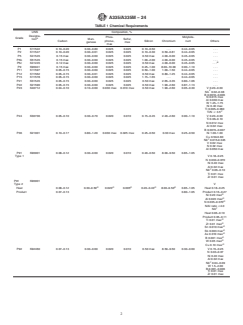
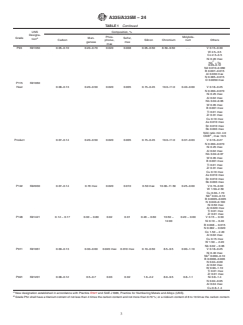
1.2 Several grades of ferritic steels (see Note 1) are covered. Their compositions are given in Table 1.
Note 1: Ferritic steels in this specification are defined as low- and intermediate-alloy steels containing up to and including 10 % chromium.
1.3 Supplementary requirements (S1 to S9) of an optional nature are provided. Supplementary requirements S1 through S6 call for additional tests to be made, and when desired, shall be so stated in the order together with the number of such tests required as applicable.
1.4 The values stated in either SI units or inch-pound units are to be regarded separately as standard. Within the text, the SI units are shown in brackets. The values stated in each system may not be exact equivalents; therefore, each system shall be used independently of the other. Combining values from the two systems may result in non-conformance with the standard. The inch-pound units shall apply unless the “M” designation of this specification is specified in the order.
Note 2: The dimensionless designator NPS (nominal pipe size) has been substituted in this standard for such traditional terms as “nominal diameter,” “size,” and “nominal size.”
1.5 This international standard was developed in accordance with internationally recognized principles on standardization established in the Decision on Principles for the Development of International Standards, Guides and Recommendations issued by the World Trade Organization Technical Barriers to Trade (TBT) Committee.
- Status
- Published
- Publication Date
- 31-Mar-2024
- Technical Committee
- A01 - Steel, Stainless Steel and Related Alloys
- Drafting Committee
- A01.10 - Stainless and Alloy Steel Tubular Products
Buy Documents
ASTM A335/A335M-24 - Standard Specification for Seamless Ferritic Alloy-Steel Pipe for High-Temperature Service
REDLINE ASTM A335/A335M-24 - Standard Specification for Seamless Ferritic Alloy-Steel Pipe for High-Temperature Service
Overview
ASTM A335/A335M-24 is the standard specification developed by ASTM for seamless ferritic alloy-steel pipes intended for high-temperature service. These pipes are designed to withstand elevated temperatures and are suitable for bending, flanging (vanstoning), similar forming operations, and fusion welding. This specification outlines comprehensive requirements, including chemical composition, mechanical properties, hardness, and testing protocols, to ensure safe and reliable performance in high-temperature, high-pressure environments.
The specification applies to several grades of ferritic alloy steels, defined as those with up to and including 10% chromium content. Manufacturers and purchasers rely on this standard for ensuring material quality, fitness for service, and conformance with internationally recognized ISO and WTO guidelines.
Key Topics
Material Grades and Composition
- Covers numerous grades (e.g., P1, P2, P5, P9, P11, P12, P22, P91, P92) tailored for various high-temperature applications.
- Defined chemical composition for each grade, emphasizing chromium and molybdenum content for enhanced heat resistance.
Mechanical Properties
- Sets specific requirements for tensile strength, yield strength, hardness, and elongation.
- Ensured by mandatory tensile, hardness, flattening, and bend tests.
Dimensional Requirements
- Specifies outside diameter, wall thickness, and permissible variations.
- NPS (Nominal Pipe Size) designator used in place of traditional terms like "nominal diameter."
Testing and Inspection
- Each pipe length subject to hydrostatic testing and non-destructive examination (NDE), such as ultrasonic, eddy current, or flux leakage tests.
- Further mechanical testing includes transverse or longitudinal tension, flattening, and bend tests.
Heat Treatment
- Requirements for full or isothermal annealing, normalizing and tempering, or subcritical annealing based on pipe grade.
Certification and Marking
- Each product requires certification and clear marking for traceability, including grade, size, schedule, lot number, and the testing method(s) used.
Applications
ASTM A335/A335M-24 seamless ferritic alloy-steel pipes are widely used in industries requiring high-temperature and high-pressure resistance, including:
- Power Generation
- Steam pipes, headers, and boiler components in thermal power plants and nuclear reactors.
- Petrochemical and Refining
- Piping systems in refineries, chemical plants, and gas processing facilities.
- Oil & Gas
- Transmission lines, heat exchangers, and onshore/offshore process piping.
- Industrial Boilers
- Hot pipelines and superheaters where structural integrity at elevated temperature is a critical design consideration.
These applications benefit from the specification’s comprehensive requirements, which help ensure longevity, safety, and compliance in mission-critical operations.
Related Standards
For complete compliance and optimal performance, ASTM A335/A335M-24 is frequently used in conjunction with the following standards:
- ASTM A999/A999M: General requirements for alloy and stainless steel pipe.
- ASME B36.10M: Welded and seamless wrought steel pipe dimensions.
- AWS A5 Series: Specifications for welding consumables for alloy steels.
- ASTM E92, E213, E309, E381, E570: Methods for hardness testing, ultrasonic and eddy current examination, and macroetch testing.
- SAE J1086: Practice for Numbering Metals and Alloys (UNS system).
- SNT-TC-1A: Personnel qualification for non-destructive testing.
Practical Value
ASTM A335/A335M-24 ensures consistent quality across global supply chains, promotes material interoperability, and supports international trade. Utilities, EPC contractors, and fabricators rely on its stringent requirements to select, procure, and inspect pipes for demanding high-temperature service, minimizing the risk of premature failure and downtime.
Adhering to this standard not only aids in compliance with regulatory and safety requirements but also contributes to operational efficiency and lifecycle cost savings in high-temperature piping systems.
Relations
- Effective Date
- 01-Apr-2024
- Effective Date
- 01-Apr-2024
- Effective Date
- 01-Apr-2024
- Effective Date
- 01-Apr-2024
- Effective Date
- 01-Apr-2024
- Effective Date
- 01-Apr-2024
- Effective Date
- 01-Apr-2024
- Referred By
ASTM F1155-10(2019) - Standard Practice for Selection and Application of Piping System Materials - Effective Date
- 01-Apr-2024
- Effective Date
- 01-Apr-2024
Buy Documents
ASTM A335/A335M-24 - Standard Specification for Seamless Ferritic Alloy-Steel Pipe for High-Temperature Service
REDLINE ASTM A335/A335M-24 - Standard Specification for Seamless Ferritic Alloy-Steel Pipe for High-Temperature Service
Get Certified
Connect with accredited certification bodies for this standard

Institut za varilstvo d.o.o. (Welding Institute)
Slovenia's leading welding institute since 1952. ISO 3834, EN 1090, pressure equipment certification, NDT personnel, welder qualification. Only IIW Au
Sponsored listings
Frequently Asked Questions
ASTM A335/A335M-24 is a technical specification published by ASTM International. Its full title is "Standard Specification for Seamless Ferritic Alloy-Steel Pipe for High-Temperature Service". This standard covers: ABSTRACT This specification covers seamless ferritic alloy-steel pipe for high-temperature service. The pipe shall be suitable for bending, flanging (vanstoning), and similar forming operations, and for fusion welding. Grade P2 and P12 steel pipes shall be made by coarse-grain melting practice. The steel material shall conform to chemical composition, tensile property, and hardness requirements. Each length of pipe shall be subjected to the hydrostatic test. Also, each pipe shall be examined by a non-destructive examination method in accordance to the required practices. The range of pipe sizes that may be examined by each method shall be subjected to the limitations in the scope of the respective practices. The different mechanical test requirements for pipes, namely, transverse or longitudinal tension test, flattening test, and hardness or bend test are presented. SCOPE 1.1 This specification2 covers nominal wall and minimum wall seamless ferritic alloy-steel pipe intended for high-temperature service. Pipe ordered to this specification shall be suitable for bending, flanging (vanstoning), and similar forming operations, and for fusion welding. Selection will depend upon design, service conditions, mechanical properties, and high-temperature characteristics. 1.2 Several grades of ferritic steels (see Note 1) are covered. Their compositions are given in Table 1. Note 1: Ferritic steels in this specification are defined as low- and intermediate-alloy steels containing up to and including 10 % chromium. 1.3 Supplementary requirements (S1 to S9) of an optional nature are provided. Supplementary requirements S1 through S6 call for additional tests to be made, and when desired, shall be so stated in the order together with the number of such tests required as applicable. 1.4 The values stated in either SI units or inch-pound units are to be regarded separately as standard. Within the text, the SI units are shown in brackets. The values stated in each system may not be exact equivalents; therefore, each system shall be used independently of the other. Combining values from the two systems may result in non-conformance with the standard. The inch-pound units shall apply unless the “M” designation of this specification is specified in the order. Note 2: The dimensionless designator NPS (nominal pipe size) has been substituted in this standard for such traditional terms as “nominal diameter,” “size,” and “nominal size.” 1.5 This international standard was developed in accordance with internationally recognized principles on standardization established in the Decision on Principles for the Development of International Standards, Guides and Recommendations issued by the World Trade Organization Technical Barriers to Trade (TBT) Committee.
ABSTRACT This specification covers seamless ferritic alloy-steel pipe for high-temperature service. The pipe shall be suitable for bending, flanging (vanstoning), and similar forming operations, and for fusion welding. Grade P2 and P12 steel pipes shall be made by coarse-grain melting practice. The steel material shall conform to chemical composition, tensile property, and hardness requirements. Each length of pipe shall be subjected to the hydrostatic test. Also, each pipe shall be examined by a non-destructive examination method in accordance to the required practices. The range of pipe sizes that may be examined by each method shall be subjected to the limitations in the scope of the respective practices. The different mechanical test requirements for pipes, namely, transverse or longitudinal tension test, flattening test, and hardness or bend test are presented. SCOPE 1.1 This specification2 covers nominal wall and minimum wall seamless ferritic alloy-steel pipe intended for high-temperature service. Pipe ordered to this specification shall be suitable for bending, flanging (vanstoning), and similar forming operations, and for fusion welding. Selection will depend upon design, service conditions, mechanical properties, and high-temperature characteristics. 1.2 Several grades of ferritic steels (see Note 1) are covered. Their compositions are given in Table 1. Note 1: Ferritic steels in this specification are defined as low- and intermediate-alloy steels containing up to and including 10 % chromium. 1.3 Supplementary requirements (S1 to S9) of an optional nature are provided. Supplementary requirements S1 through S6 call for additional tests to be made, and when desired, shall be so stated in the order together with the number of such tests required as applicable. 1.4 The values stated in either SI units or inch-pound units are to be regarded separately as standard. Within the text, the SI units are shown in brackets. The values stated in each system may not be exact equivalents; therefore, each system shall be used independently of the other. Combining values from the two systems may result in non-conformance with the standard. The inch-pound units shall apply unless the “M” designation of this specification is specified in the order. Note 2: The dimensionless designator NPS (nominal pipe size) has been substituted in this standard for such traditional terms as “nominal diameter,” “size,” and “nominal size.” 1.5 This international standard was developed in accordance with internationally recognized principles on standardization established in the Decision on Principles for the Development of International Standards, Guides and Recommendations issued by the World Trade Organization Technical Barriers to Trade (TBT) Committee.
ASTM A335/A335M-24 is classified under the following ICS (International Classification for Standards) categories: 23.040.10 - Iron and steel pipes. The ICS classification helps identify the subject area and facilitates finding related standards.
ASTM A335/A335M-24 has the following relationships with other standards: It is inter standard links to ASTM A335/A335M-23, ASTM F1387-23, ASTM A336/A336M-23, ASTM A999/A999M-23, ASTM E1351-01(2020), ASTM D1066-18e1, ASTM D3370-18, ASTM F1155-10(2019), ASTM F721-18(2022). Understanding these relationships helps ensure you are using the most current and applicable version of the standard.
ASTM A335/A335M-24 is available in PDF format for immediate download after purchase. The document can be added to your cart and obtained through the secure checkout process. Digital delivery ensures instant access to the complete standard document.
Standards Content (Sample)
This international standard was developed in accordance with internationally recognized principles on standardization established in the Decision on Principles for the
Development of International Standards, Guides and Recommendations issued by the World Trade Organization Technical Barriers to Trade (TBT) Committee.
Designation: A335/A335M − 24
Standard Specification for
Seamless Ferritic Alloy-Steel Pipe for High-Temperature
Service
This standard is issued under the fixed designation A335/A335M; the number immediately following the designation indicates the year
of original adoption or, in the case of revision, the year of last revision. A number in parentheses indicates the year of last reapproval.
A superscript epsilon (´) indicates an editorial change since the last revision or reapproval.
This standard has been approved for use by agencies of the U.S. Department of Defense.
1. Scope* 1.5 This international standard was developed in accor-
2 dance with internationally recognized principles on standard-
1.1 This specification covers nominal wall and minimum
ization established in the Decision on Principles for the
wall seamless ferritic alloy-steel pipe intended for high-
Development of International Standards, Guides and Recom-
temperature service. Pipe ordered to this specification shall be
mendations issued by the World Trade Organization Technical
suitable for bending, flanging (vanstoning), and similar form-
Barriers to Trade (TBT) Committee.
ing operations, and for fusion welding. Selection will depend
upon design, service conditions, mechanical properties, and
2. Referenced Documents
high-temperature characteristics.
2.1 ASTM Standards:
1.2 Several grades of ferritic steels (see Note 1) are covered.
A999/A999M Specification for General Requirements for
Their compositions are given in Table 1.
Alloy and Stainless Steel Pipe
E92 Test Methods for Vickers Hardness and Knoop Hard-
NOTE 1—Ferritic steels in this specification are defined as low- and
intermediate-alloy steels containing up to and including 10 % chromium.
ness of Metallic Materials
E213 Practice for Ultrasonic Testing of Metal Pipe and
1.3 Supplementary requirements (S1 to S9) of an optional
Tubing
nature are provided. Supplementary requirements S1 through
E309 Practice for Eddy Current Examination of Steel Tubu-
S6 call for additional tests to be made, and when desired, shall
lar Products Using Magnetic Saturation
be so stated in the order together with the number of such tests
E381 Method of Macroetch Testing Steel Bars, Billets,
required as applicable.
Blooms, and Forgings
1.4 The values stated in either SI units or inch-pound units
E527 Practice for Numbering Metals and Alloys in the
are to be regarded separately as standard. Within the text, the
Unified Numbering System (UNS)
SI units are shown in brackets. The values stated in each
E570 Practice for Flux Leakage Examination of Ferromag-
system may not be exact equivalents; therefore, each system
netic Steel Tubular Products
shall be used independently of the other. Combining values
2.2 ASME Standard:
from the two systems may result in non-conformance with the
B36.10M Welded and Seamless Wrought Steel Pipe
standard. The inch-pound units shall apply unless the “M”
2.3 AWS Specifications
designation of this specification is specified in the order.
A5.5/A5.5M Specification for Low-Alloy Steel Electrodes
NOTE 2—The dimensionless designator NPS (nominal pipe size) has for Shielded Metal Arc Welding
been substituted in this standard for such traditional terms as “nominal
A5.23/A5.23M Specification for Low-Alloy Steel Elec-
diameter,” “size,” and “nominal size.”
trodes and Fluxes for Submerged Arc Welding
A5.28/A5.28M Specification for Low-Alloy Steel Elec-
trodes for Gas Shielded Arc Welding
This specification is under the jurisdiction of ASTM Committee A01 on Steel,
Stainless Steel and Related Alloys and is the direct responsibility of Subcommittee
A01.10 on Stainless and Alloy Steel Tubular Products. For referenced ASTM standards, visit the ASTM website, www.astm.org, or
Current edition approved April 1, 2024. Published April 2024. Originally contact ASTM Customer Service at service@astm.org. For Annual Book of ASTM
approved in 1951. Last previous edition approved in 2023 as A335/A335M – 23. Standards volume information, refer to the standard’s Document Summary page on
DOI: 10.1520/A0335_A0335M-24. the ASTM website.
2 4
For ASME Boiler and Pressure Vessel Code applications see related Specifi- Available from American Welding Society (AWS), 550 NW LeJeune Rd.,
cation SA-335 in Section II of that Code. Miami, FL 33126, http://www.aws.org.
*A Summary of Changes section appears at the end of this standard
Copyright © ASTM International, 100 Barr Harbor Drive, PO Box C700, West Conshohocken, PA 19428-2959. United States
A335/A335M − 24
TABLE 1 Chemical Requirements
UNS Composition, %
Designa-
Phos- Molybde-
Grade A
Man- Sulfur,
tion
Carbon phorus, Silicon Chromium num Others
ganese max
max
P1 K11522 0.10–0.20 0.30–0.80 0.025 0.025 0.10–0.50 . . . 0.44–0.65 . . .
P2 K11547 0.10–0.20 0.30–0.61 0.025 0.025 0.10–0.30 0.50–0.81 0.44–0.65 . . .
P5 K41545 0.15 max 0.30–0.60 0.025 0.025 0.50 max 4.00–6.00 0.45–0.65 . . .
P5b K51545 0.15 max 0.30–0.60 0.025 0.025 1.00–2.00 4.00–6.00 0.45–0.65 . . .
B
P5c K41245 0.12 max 0.30–0.60 0.025 0.025 0.50 max 4.00–6.00 0.45–0.65 . . .
P9 K90941 0.15 max 0.30–0.60 0.025 0.025 0.25–1.00 8.00–10.00 0.90–1.10 . . .
P11 K11597 0.05–0.15 0.30–0.60 0.025 0.025 0.50–1.00 1.00–1.50 0.44–0.65 . . .
P12 K11562 0.05–0.15 0.30–0.61 0.025 0.025 0.50 max 0.80–1.25 0.44–0.65 . . .
P15 K11578 0.05–0.15 0.30–0.60 0.025 0.025 1.15–1.65 . . . 0.44–0.65 . . .
P21 K31545 0.05–0.15 0.30–0.60 0.025 0.025 0.50 max 2.65–3.35 0.80–1.06 . . .
P22 K21590 0.05–0.15 0.30–0.60 0.025 0.025 0.50 max 1.90–2.60 0.87–1.13 . . .
P23 K40712 0.04–0.10 0.10–0.60 0.030 max 0.010 max 0.50 max 1.90–2.60 0.05–0.30 V 0.20–0.30
F
Nb 0.02–0.08
B 0.0010–0.006
N 0.015 max
Al 0.030 max
W 1.45–1.75
Ni 0.40 max
Ti 0.005–0.060
C
Ti/N $ 3.5
P24 K30736 0.05–0.10 0.30–0.70 0.020 0.010 0.15–0.45 2.20–2.60 0.90–1.10 V 0.20–0.30
Ti 0.06–0.10
N 0.012 max
Al 0.02 max
B 0.0015–0.007
P36 K21001 0.10–0.17 0.80–1.20 0.030 max 0.025 max 0.25–0.50 0.30 max 0.25–0.50 Ni 1.00-1.30
Cu 0.50-0.80
F
Nb 0.015-0.045
V 0.02 max
N 0.02 max
Al 0.050 max
P91 K90901 0.08–0.12 0.30–0.60 0.020 0.010 0.20–0.50 8.00–9.50 0.85–1.05
Type 1 V 0.18–0.25
N 0.030–0.070
Ni 0.40 max
Al 0.02 max
F
Nb 0.06–0.10
Ti 0.01 max
Zr 0.01 max
P91 K90901
Type 2 V
D D D D D
Heat 0.08–0.12 0.30–0.50 0.020 0.005 0.20–0.40 8.00–9.50 0.85–1.05 Heat 0.18–0.25
Product 0.07–0.13 0.80–1.05 Product 0.16–0.27
D
Ni 0.20 max
D
Al 0.020 max
D
N 0.035–0.070
N/Al ratio $4.0
F
Nb
Heat 0.06–0.10
Product 0.05–0.11
D
Ti 0.01 max
D
Zr 0.01 max
D
Sn 0.010 max
D
Sb 0.003 max
D
As 0.010 max
D
B 0.001 max
D
W 0.05 max
D
Cu 0.10 max
P92 K92460 0.07–0.13 0.30–0.60 0.020 0.010 0.50 max 8.50–9.50 0.30–0.60 V 0.15–0.25
N 0.03–0.07
Ni 0.40 max
Al 0.02 max
F
Nb 0.04–0.09
W 1.5–2.00
B 0.001–0.006
Ti 0.01 max
Zr 0.01 max
A335/A335M − 24
TABLE 1 Continued
UNS Composition, %
Designa-
Phos- Molybde-
Grade A
Man- Sulfur,
tion
Carbon phorus, Silicon Chromium num Others
ganese max
max
P93 K91350 0.05–0.10 0.20–0.70 0.020 0.008 0.05–0.50 8.50–9.50 . . . V 0.15–0.30
W 2.5–3.5
Co 2.5–3.5
Ni 0.20 max
F
Nb + Ta
0.05–0.12
Nd 0.010–0.060
B 0.007–0.015
Al 0.030 max
N 0.005–0.015
O 0.0050 max
P115 K91060
Heat 0.08–0.13 0.20–0.50 0.020 0.005 0.15–0.45 10.0–11.0 0.40–0.60 V 0.18–0.25
N 0.030–0.070
Ni 0.25 max
Al 0.02 max
Nb 0.02–0.06
W 0.05 max
B 0.001 max
Ti 0.01 max
Zr 0.01 max
Cu 0.10 max
As 0.010 max
Sn 0.010 max
Sb 0.003 max
N/Al ratio min 4.0
E
CNB , max 10.5
Product 0.07–0.14 0.20–0.50 0.020 0.005 0.15–0.45 10.0–11.0 0.37–0.63 V 0.16–0.27
N 0.030–0.070
Ni 0.25 max
Al 0.02 max
Nb 0.02–0.07
W 0.05 max
B 0.001 max
Ti 0.01 max
Zr 0.01 max
Cu 0.10 max
As 0.010 max
Sn 0.010 max
Sb 0.003 max
P122 K92930 0.07–0.14 0.70 max 0.020 0.010 0.50 max 10.00–11.50 0.25–0.60 V 0.15–0.30
W 1.50–2.50
Cu 0.30–1.70
F
Nb 0.04–0.10
B 0.0005–0.005
N 0.040–0.100
Ni 0.50 max
Al 0.020 max
Ti 0.01 max
Zr 0.01 max
P128 K91421 0.12 – 0.17 0.30 – 0.80 0.02 0.01 0.20 – 0.60 10.50 – 0.20 – 0.60 V 0.15 – 0.30
12.00 Ni 0.10 – 0.40
B 0.008 – 0.015
N 0.002 – 0.020
Co 1.50 – 2.20
Al 0.02 max
Cu 0.15 max
W 1.50 – 2.20
Nb 0.02 – 0.06
P911 K91061 0.09–0.13 0.30–0.60 0.020 max 0.010 max 0.10–0.50 8.5–9.5 0.90–1.10 V 0.18–0.25
Ni 0.40 max
F
Nb 0.060–0.10
B 0.0003–0.006
N 0.04–0.09
Al 0.02 max
W 0.90–1.10
Ti 0.01 max
Zr 0.01 max
P921 K91201 0.08–0.12 0.5–0.7 0.03 0.02 1.6–2.2 8.0–9.5 0.8–1.1 Ni 0.8–1.4
N 0.02–0.05
Al 0.04 max
Cu 0.8–1.4
A
New designation established in accordance with Practice E527 and SAE J1086, Practice for Numbering Metals and Alloys (UNS).
B
Grade P5c shall have a titanium content of not less than 4 times the carbon content and not more than 0.70 %; or a niobium content of 8 to 10 times the carbon content.
A335/A335M − 24
C
Alternatively, in lieu of this ratio minimum, the material shall have a minimum hardness of 275 HV in the hardened condition, defined as after austenitizing and cooling
to room temperature but prior to tempering. Hardness testing shall be performed at mid-thickness of the product. Hardness test frequency shall be two samples of product
per heat treatment lot and the hardness testing results shall be reported on the material test report.
D
Applies to both heat and product analyses.
E
Chromium-Nickel Balance is defined as CNB = (Cr + 6Si + 4Mo + 1.5W + 11V + 5Nb + 9Ti + 12Al) – (40C + 30N + 4Ni + 2Mn + 1CU).
F
The terms Niobium (Nb) and Columbium (Cb) are alternate names for the same element.
NOTE 3—It is recommended that the temperature for tempering should
A5.29/A5.29M Low-Alloy Steel Electrodes for Flux Cored
be at least 100 °F [50 °C] above the intended service temperature;
Arc Welding
consequently, the purchaser should advise the manufacturer if the service
2.4 Other Documents:
temperature is to be over 1100 °F [600 °C].
SNT-TC-1A Recommended Practice for Nondestructive Per-
NOTE 4—Certain of the ferritic steels covered by this specification will
sonnel Qualification and Certification
harden if cooled rapidly from above their critical temperature. Some will
air harden, that is, become hardened to an undesirable degree when cooled
SAE J 1086 Practice for Numbering Metals and Alloys
in air from high temperatures. Therefore, operations involving heating
(UNS)
such steels above their critical temperatures, such as welding, flanging,
and hot bending, should be followed by suitable heat treatment.
3. Ordering Information
6. Chemical Composition
3.1 Orders for material under this specification should
include the following, as required, to describe the desired
6.1 The steel shall conform to the requirements as to
material adequately:
chemical composition prescribed in Table 1.
3.1.1 Quantity (feet, metres, or number of lengths),
3.1.2 Name of material (seamless alloy steel pipe), 7. Workmanship, Finish, and Appearance
3.1.3 Grade (Table 1),
7.1 The pipe manufacturer shall explore a sufficient number
3.1.4 Manufacture (hot-finished or cold-drawn),
of visual surface imperfections to provide reasonable assurance
3.1.5 Size using one of the following:
that they have been properly evaluated with respect to depth.
3.1.5.1 NPS and schedule number,
Exploration of all surface imperfections is not required but may
3.1.5.2 Outside diameter and nominal wall thickness,
be necessary to ensure compliance with 7.2.
3.1.5.3 Outside diameter and minimum wall thickness,
7.2 Surface imperfections that penetrate more than 12 ⁄2 %
3.1.5.4 Inside diameter and nominal wall thickness, and
of the nominal wall thickness or encroach on the minimum
3.1.5.5 Inside diameter and minimum wall thickness.
wall thickness shall be considered defects. Pipe with such
3.1.6 Length (specific or random),
defects shall be given one of the following dispositions:
3.1.7 End finish (Ends Section of Specification A999/
7.2.1 The defect may be removed by grinding provided that
A999M),
the remaining wall thickness is within specified limits.
3.1.8 Optional requirements (Section 8, 12, and 13 of this
7.2.2 Repaired in accordance with the repair welding pro-
specification. See the Sections on Hydrostatic Test Require-
visions of 7.6.
ments and Permissible Variation in Weight for Seamless Pipe in
7.2.3 The section of pipe containing the defect may be cut
Specification A999/A999M),
off within the limits of requirements on length.
3.1.9 Specification designation, and
7.2.4 Rejected.
3.1.10 Special requirements or any supplementary require-
ments selected, or both. 7.3 To provide a workmanlike finish and basis for evaluat-
3.1.11 The flattening or bend test shall be performed on 5 %
ing conformance with 7.2, the pipe manufacturer shall remove
of the pipe (or fewer in accordance with 14.2) unless Supple- by grinding the following:
mentary Requirement S3 is specified.
7.3.1 Mechanical marks, abrasions (see Note 5) and pits,
any of which imperfections are deeper than ⁄16 in. [1.6 mm].
4. General Requirements
NOTE 5—Marks and abrasions are defined as cable marks, dinges, guide
4.1 Material furnished to this specification shall conform to
marks, roll marks, ball scratches, scores, die marks, and the like.
the applicable requirements of the current edition of Specifi-
7.3.2 Visual imperfections, commonly referred to as scabs,
cation A999/A999M, unless otherwise provided herein.
seams, laps, tears, or slivers, found by exploration in accor-
dance with 7.1 to be deeper than 5 % of the nominal wall
5. Materials and Manufacture
thickness.
5.1 Pipe may be either hot finished or cold drawn with the
7.4 At the purchaser’s discretion, pipe shall be subject to
finishing treatment as required in 5.2.
rejection if surface imperfections acceptable under 7.2 are not
5.2 Heat Treatment:
scattered, but appear over a large area in excess of what is
5.2.1 All pipe shall be reheated for heat treatment and heat
considered a workmanlike finish. Disposition of such pipe shall
treated in accordance with the requirements of Table 2.
be a matter of agreement between the manufacturer and the
purchaser.
Available from American Society for Nondestructive Testing (ASNT), P.O. Box
7.5 When imperfections or defects are removed by grinding,
28518, 1711 Arlingate Ln., Columbus, OH 43228-0518, http://www.asnt.org.
a smooth curved surface shall be maintained, and the wall
Available from SAE International (SAE), 400 Commonwealth Dr., Warrendale,
PA 15096-0001, http://www.sae.org. thickness shall not be decreased below that permitted by this
A335/A335M − 24
A
TABLE 2 Heat Treatment Requirements
Grade Heat Treat Type Normalizing Cooling Media Subcritical
Temperature, Annealing or
min or range Tempering
°F [°C] Temperature,
min or range
°F [°C]
P1 full or isothermal anneal or . . . . . . . . .
normalize and temper or . . . . . . 1200 [650]
subcritical anneal . . . . . . 1200–1300 [650–705]
P2 full or isothermal anneal or . . . . . . . . .
normalize and temper or . . . . . . 1250 [675]
subcritical anneal . . . . . . 1200–1300 [650–705]
P5 full or isothermal anneal or . . . . . . . . .
normalize and temper . . . . . . 1250 [675]
P5b full or isothermal anneal or . . . . . . . . .
normalize and temper . . . . . . 1250 [675]
P5c subcritical anneal . . . . . . 1325–1375 [715–745]
P9 full or isothermal anneal or . . . . . . . . .
normalize and temper . . . . . . 1250 [675]
P11 full or isothermal anneal or . . . . . . . . .
normalize and temper . . . . . . 1200 [650]
P12 full or isothermal anneal or . . . . . . . . .
normalize and temper or . . . . . . 1200 [650]
subcritical anneal . . . . . . 1200–1300 [650–705]
P15 full or isothermal anneal or . . . . . . . . .
normalize and temper . . . . . . 1200 [650]
P21 full or isothermal anneal or . . . . . . . . .
normalize and temper . . . . . . 1250 [675]
P22 full or isothermal anneal or . . . . . . . . .
normalize and temper . . . . . . 1250 [675]
P23 normalize and temper 1900–1975 [1040–1080] air or 1350–1470 [730–800]
accelerated
cooling
P24 normalize and temper 1800–1870 [980–1020] air or 1350–1420 [730–770]
accelerated
cooling
B
P36 normalize and temper 1650 [900] . . . 1100 [595]
C
P91 Type 1 and Type 2 normalize and temper or 1900–1975 [1040–1080] . . . 1350–1470 [730–800]
quench and temper 1900–1975 [1040–1080] . . . 1350–1470 [730–800]
D
P92 normalize and temper 1900–1975 [1040–1080] 1350–1470 [730–800]
P93 normalize and temper 1960–2140 [1070–1170] . . . 1380–1455 [750–790]
D
P115 normalize and temper 1920–2010 [1050–1100] 1380–1455 [750–790]
P122 normalize and temper 1900–1975 [1040–1080] . . . 1350–1470 [730–800]
P128 normalize and temper 1975–2140 [1080–1170] air 1400–1470 [760–800]
D
P911 normalize and temper 1900–1975 [1040–1080] 1365–1435 [740–780]
P921 normalize and temper 1670–1740 [910–950] air 1350–1420 [730–770]
A
Where ellipses ({) appear in this table there is no requirement.
B
Alternatively, Grade P36, Class 2 shall be cooled from the austenitizing temperature by accelerated cooling in air or by liquid quenching.
C
Except when Supplementary Requirement S7 is specified by the purchaser.
D
Accelerated cooling from the normalizing temperature shall be permitted for section thicknesses greater than 3 in. [75 mm].
specification. The outside diameter at the point of grinding may 7.6.4 After weld repair, Grade P911 shall be heat treated at
be reduced by the amount so removed. 1365–1435 °F [740–780 °C].
7.6.5 After weld repair, Grade P24 shall be heat treated at
7.6 Weld repair shall be permitted only subject to the
1350–1420 °F [730–770 °C].
approval of the purchaser and in accordance with Specification
7.6.6 After weld repair, Grade P93 shall be heat treated to
A999/A999M.
1350–1455 °F [730–790 °C].
7.6.1 All repair welds in P91 shall be made with one of the
7.6.7 After weld repair, Grade P115 shall be heat treated at
following welding processes and consumables: SMAW, A5.5/
1345–1435 °F [730–780 °C].
A5.5M E90XX-B9; SAW, A5.23/A5.23M EB9 + neutral flux;
7.6.8 After weld repair, Grade P128 shall be heat treated at
GTAW, A5.28/A5.28M ER90S-B9; and FCAW A5.29/A5.29M
1400–1470 °F [760–800 °C].
E91T1-B9. In addition, the sum of the Ni+Mn content of all
welding consumables used to weld repair P91 Type 1 and Type 7.7 The finished pipe shall be reasonably straight.
2 shall not exceed 1.0 %.
8. Product Analysis
7.6.2 All repair welds in P92, P93, P911, and P122, shall be
made using welding consumables meeting the chemical re- 8.1 At the request of the purchaser, an analysis of two pipes
quirements for the grade in Table 1. from each lot as defined hereafter shall be made by the
7.6.3 After weld repair, Grades P23, P91 Type 1 and Type 2, manufacturer. A lot is all pipe of the same nominal size and
P92, and P122 shall be heat treated at 1350–1470 °F [730–800 wall thickness (schedule) which is produced from the same
°C]. heat of steel and shall be limited as follows:
A335/A335M − 24
erties shall be met and verified on material taken from the
NPS Designator Maximum Number of
Lengths in a Lot
half-thickness location.
Under 2 400
2 to 5 200
10. Permissible Variations in Diameter
6 and over 100
8.2 The results of these analyses shall be reported to the 10.1 For pipe ordered to NPS [DN] or outside diameter,
variations in outside diameter shall not exceed those specified
purchaser or the purchaser’s representative, and shall conform
to the requirements specified in Table 1. in Table 7.
10.2 For pipe ordered to inside diameter, the inside diameter
8.3 For grade P91 Type 1 the carbon content may vary for
the product analysis by −0.01 % and +0.02 % from the shall not vary more than 6 1 % from the specified inside
diameter.
specified range as per Table 1.
8.4 If the analysis of one of the tests specified in 8.1 does
11. Permissible Variations in Wall Thickness
not conform to the requirements specified in 6.1, an analysis of
11.1 In addition to the implicit limitation of wall thickness
each billet or pipe from the same heat or lot may be made, and
for pipe imposed by the limitation on weight in Specification
all billets or pipe conforming to the requirements shall be
A999/A999M, the wall thickness for pipe at any point shall be
accepted.
within the tolerances specified in Table 8. The minimum wall
9. Tensile and Hardness Requirements thickness and outside diameter for inspection for compliance
with this requirement for pipe ordered by NPS [DN] and
9.1 The tensile properties of the material shall conform to
schedule number is shown in ASME B36.10M.
the requirements prescribed in Table 3.
9.2 Table 4 lists elongation requirements.
12. Hydrostatic Test
9.3 Table 5 gives the computed minimum elongation values
12.1 The requirements for grades other than P91 Type 1 and
for each ⁄32-in. [0.8-mm] decrease in wall thickness. Where the
Type 2, P92, P93, P115, P911, P122, and P128 are shown in
wall thickness lies between two values above, the minimum
12.1.1 – 12.1.4.
elongation value is determined by the following formula:
12.1.1 Each length of pipe with outside diameter greater
B
Direction of Test Equation
than 10 in. [250 mm] and wall thickness less than or equal to
Longitudinal, all grades except P23, P24, E = 48t + 15.00
0.75 in. [19 mm], shall be submitted to the hydrostatic test,
P36, P91 Type 1 and Type 2, P92, [E = 1.87 t + 15.00]
except as provided for in 12.1.4.
P921, P93, P115, P122, P128, and
P911
12.1.2 Pipe of all other sizes shall be subjected to the
nondestructive electric test as shown in Section 13, except as
Transverse, all grades except P23, P24, E = 32t + 10.00
provided for in 12.1.3 and 12.1.4.
P36, P91 Type 1 and Type 2, P92, [E = 1.25 t + 10.00]
P921, P93, P115, P122, P128, and
12.1.3 When specified by the purchaser, pipe of all other
P911
sizes shall be furnished without the hydrostatic test and without
nondestructive examination.
Longitudinal, P23, P24, P91 Type 1 and E = 32t + 10.00
Type 2, P92, P921, P115, P122, P128, [E = 1.25 t + 10.00]
12.1.4 When specified by the purchaser, pipe shall be
and P911
furnished with both the hydrostatic test and a nondestructive
Longitudinal, P36 E = 32t
...
This document is not an ASTM standard and is intended only to provide the user of an ASTM standard an indication of what changes have been made to the previous version. Because
it may not be technically possible to adequately depict all changes accurately, ASTM recommends that users consult prior editions as appropriate. In all cases only the current version
of the standard as published by ASTM is to be considered the official document.
Designation: A335/A335M − 23 A335/A335M − 24
Standard Specification for
Seamless Ferritic Alloy-Steel Pipe for High-Temperature
Service
This standard is issued under the fixed designation A335/A335M; the number immediately following the designation indicates the year
of original adoption or, in the case of revision, the year of last revision. A number in parentheses indicates the year of last reapproval.
A superscript epsilon (´) indicates an editorial change since the last revision or reapproval.
This standard has been approved for use by agencies of the U.S. Department of Defense.
1. Scope*
1.1 This specification covers nominal wall and minimum wall seamless ferritic alloy-steel pipe intended for high-temperature
service. Pipe ordered to this specification shall be suitable for bending, flanging (vanstoning), and similar forming operations, and
for fusion welding. Selection will depend upon design, service conditions, mechanical properties, and high-temperature
characteristics.
1.2 Several grades of ferritic steels (see Note 1) are covered. Their compositions are given in Table 1.
NOTE 1—Ferritic steels in this specification are defined as low- and intermediate-alloy steels containing up to and including 10 % chromium.
1.3 Supplementary requirements (S1 to S9) of an optional nature are provided. Supplementary requirements S1 through S6 call
for additional tests to be made, and when desired, shall be so stated in the order together with the number of such tests required
as applicable.
1.4 The values stated in either SI units or inch-pound units are to be regarded separately as standard. Within the text, the SI units
are shown in brackets. The values stated in each system may not be exact equivalents; therefore, each system shall be used
independently of the other. Combining values from the two systems may result in non-conformance with the standard. The
inch-pound units shall apply unless the “M” designation of this specification is specified in the order.
NOTE 2—The dimensionless designator NPS (nominal pipe size) has been substituted in this standard for such traditional terms as “nominal diameter,”
“size,” and “nominal size.”
1.5 This international standard was developed in accordance with internationally recognized principles on standardization
established in the Decision on Principles for the Development of International Standards, Guides and Recommendations issued
by the World Trade Organization Technical Barriers to Trade (TBT) Committee.
2. Referenced Documents
2.1 ASTM Standards:
This specification is under the jurisdiction of ASTM Committee A01 on Steel, Stainless Steel and Related Alloys and is the direct responsibility of Subcommittee A01.10
on Stainless and Alloy Steel Tubular Products.
Current edition approved May 1, 2023April 1, 2024. Published May 2023April 2024. Originally approved in 1951. Last previous edition approved in 20222023 as
A335/A335M – 22.A335/A335M – 23. DOI: 10.1520/A0335_A0335M-23.10.1520/A0335_A0335M-24.
For ASME Boiler and Pressure Vessel Code applications see related Specification SA-335 in Section II of that Code.
For referenced ASTM standards, visit the ASTM website, www.astm.org, or contact ASTM Customer Service at service@astm.org. For Annual Book of ASTM Standards
volume information, refer to the standard’s Document Summary page on the ASTM website.
*A Summary of Changes section appears at the end of this standard
Copyright © ASTM International, 100 Barr Harbor Drive, PO Box C700, West Conshohocken, PA 19428-2959. United States
A335/A335M − 24
TABLE 1 Chemical Requirements
UNS Composition, %
Designa-
Phos- Molybde-
Grade A
Man- Sulfur,
tion
Carbon phorus, Silicon Chromium num Others
ganese max
max
P1 K11522 0.10–0.20 0.30–0.80 0.025 0.025 0.10–0.50 . . . 0.44–0.65 . . .
P2 K11547 0.10–0.20 0.30–0.61 0.025 0.025 0.10–0.30 0.50–0.81 0.44–0.65 . . .
P5 K41545 0.15 max 0.30–0.60 0.025 0.025 0.50 max 4.00–6.00 0.45–0.65 . . .
P5b K51545 0.15 max 0.30–0.60 0.025 0.025 1.00–2.00 4.00–6.00 0.45–0.65 . . .
B
P5c K41245 0.12 max 0.30–0.60 0.025 0.025 0.50 max 4.00–6.00 0.45–0.65 . . .
P9 K90941 0.15 max 0.30–0.60 0.025 0.025 0.25–1.00 8.00–10.00 0.90–1.10 . . .
P11 K11597 0.05–0.15 0.30–0.60 0.025 0.025 0.50–1.00 1.00–1.50 0.44–0.65 . . .
P12 K11562 0.05–0.15 0.30–0.61 0.025 0.025 0.50 max 0.80–1.25 0.44–0.65 . . .
P15 K11578 0.05–0.15 0.30–0.60 0.025 0.025 1.15–1.65 . . . 0.44–0.65 . . .
P21 K31545 0.05–0.15 0.30–0.60 0.025 0.025 0.50 max 2.65–3.35 0.80–1.06 . . .
P22 K21590 0.05–0.15 0.30–0.60 0.025 0.025 0.50 max 1.90–2.60 0.87–1.13 . . .
P23 K40712 0.04–0.10 0.10–0.60 0.030 max 0.010 max 0.50 max 1.90–2.60 0.05–0.30 V 0.20–0.30
F
Nb 0.02–0.08
B 0.0010–0.006
N 0.015 max
Al 0.030 max
W 1.45–1.75
Ni 0.40 max
Ti 0.005–0.060
C
Ti/N $ 3.5
P24 K30736 0.05–0.10 0.30–0.70 0.020 0.010 0.15–0.45 2.20–2.60 0.90–1.10 V 0.20–0.30
Ti 0.06–0.10
N 0.012 max
Al 0.02 max
B 0.0015–0.007
P36 K21001 0.10–0.17 0.80–1.20 0.030 max 0.025 max 0.25–0.50 0.30 max 0.25–0.50 Ni 1.00-1.30
Cu 0.50-0.80
F
Nb 0.015-0.045
V 0.02 max
N 0.02 max
Al 0.050 max
P91 K91560 0.08–0.12 0.30–0.60 0.020 0.010 0.20–0.50 8.00–9.50 0.85–1.05
Type 1 V 0.18–0.25
P91 K90901 0.08–0.12 0.30–0.60 0.020 0.010 0.20–0.50 8.00–9.50 0.85–1.05
Type 1 V 0.18–0.25
N 0.030–0.070
Ni 0.40 max
Al 0.02 max
F
Nb 0.06–0.10
Ti 0.01 max
Zr 0.01 max
P91 K91560
Type 2 V
P91 K90901
Type 2 V
D D D D D
Heat 0.08–0.12 0.30–0.50 0.020 0.005 0.20–0.40 8.00–9.50 0.85–1.05 Heat 0.18–0.25
Product 0.07–0.13 0.80–1.05 Product 0.16–0.27
D
Ni 0.20 max
D
Al 0.020 max
D
N 0.035–0.070
N/Al ratio $4.0
F
Nb
Heat 0.06–0.10
Product 0.05–0.11
D
Ti 0.01 max
D
Zr 0.01 max
D
Sn 0.010 max
D
Sb 0.003 max
D
As 0.010 max
D
B 0.001 max
D
W 0.05 max
D
Cu 0.10 max
P92 K92460 0.07–0.13 0.30–0.60 0.020 0.010 0.50 max 8.50–9.50 0.30–0.60 V 0.15–0.25
N 0.03–0.07
Ni 0.40 max
Al 0.02 max
F
Nb 0.04–0.09
W 1.5–2.00
B 0.001–0.006
Ti 0.01 max
Zr 0.01 max
A999/A999M Specification for General Requirements for Alloy and Stainless Steel Pipe
A335/A335M − 24
TABLE 1 Continued
UNS Composition, %
Designa-
Phos- Molybde-
Grade A
Man- Sulfur,
tion
Carbon phorus, Silicon Chromium num Others
ganese max
max
P93 K91350 0.05–0.10 0.20–0.70 0.020 0.008 0.05–0.50 8.50–9.50 . . . V 0.15–0.30
W 2.5–3.5
Co 2.5–3.5
Ni 0.20 max
F
Nb + Ta
0.05–0.12
Nd 0.010–0.060
B 0.007–0.015
Al 0.030 max
N 0.005–0.015
O 0.0050 max
P115 K91060
Heat 0.08–0.13 0.20–0.50 0.020 0.005 0.15–0.45 10.0–11.0 0.40–0.60 V 0.18–0.25
N 0.030–0.070
Ni 0.25 max
Al 0.02 max
Nb 0.02–0.06
W 0.05 max
B 0.001 max
Ti 0.01 max
Zr 0.01 max
Cu 0.10 max
As 0.010 max
Sn 0.010 max
Sb 0.003 max
N/Al ratio min 4.0
E
CNB , max 10.5
Product 0.07–0.14 0.20–0.50 0.020 0.005 0.15–0.45 10.0–11.0 0.37–0.63 V 0.16–0.27
N 0.030–0.070
Ni 0.25 max
Al 0.02 max
Nb 0.02–0.07
W 0.05 max
B 0.001 max
Ti 0.01 max
Zr 0.01 max
Cu 0.10 max
As 0.010 max
Sn 0.010 max
Sb 0.003 max
P122 K92930 0.07–0.14 0.70 max 0.020 0.010 0.50 max 10.00–11.50 0.25–0.60 V 0.15–0.30
W 1.50–2.50
Cu 0.30–1.70
F
Nb 0.04–0.10
B 0.0005–0.005
N 0.040–0.100
Ni 0.50 max
Al 0.020 max
Ti 0.01 max
Zr 0.01 max
P128 K91421 0.12 – 0.17 0.30 – 0.80 0.02 0.01 0.20 – 0.60 10.50 – 0.20 – 0.60 V 0.15 – 0.30
12.00 Ni 0.10 – 0.40
B 0.008 – 0.015
N 0.002 – 0.020
Co 1.50 – 2.20
Al 0.02 max
Cu 0.15 max
W 1.50 – 2.20
Nb 0.02 – 0.06
P911 K91061 0.09–0.13 0.30–0.60 0.020 max 0.010 max 0.10–0.50 8.5–9.5 0.90–1.10 V 0.18–0.25
Ni 0.40 max
F
Nb 0.060–0.10
B 0.0003–0.006
N 0.04–0.09
Al 0.02 max
W 0.90–1.10
Ti 0.01 max
Zr 0.01 max
P921 K91201 0.08–0.12 0.5–0.7 0.03 0.02 1.6–2.2 8.0–9.5 0.8–1.1 Ni 0.8–1.4
N 0.02–0.05
Al 0.04 max
Cu 0.8–1.4
A
New designation established in accordance with Practice E527 and SAE J1086, Practice for Numbering Metals and Alloys (UNS).
B
Grade P5c shall have a titanium content of not less than 4 times the carbon content and not more than 0.70 %; or a niobium content of 8 to 10 times the carbon content.
A335/A335M − 24
C
Alternatively, in lieu of this ratio minimum, the material shall have a minimum hardness of 275 HV in the hardened condition, defined as after austenitizing and cooling
to room temperature but prior to tempering. Hardness testing shall be performed at mid-thickness of the product. Hardness test frequency shall be two samples of product
per heat treatment lot and the hardness testing results shall be reported on the material test report.
D
Applies to both heat and product analyses.
E
Chromium-Nickel Balance is defined as CNB = (Cr + 6Si + 4Mo + 1.5W + 11V + 5Nb + 9Ti + 12Al) – (40C + 30N + 4Ni + 2Mn + 1CU).
F
The terms Niobium (Nb) and Columbium (Cb) are alternate names for the same element.
E92 Test Methods for Vickers Hardness and Knoop Hardness of Metallic Materials
E213 Practice for Ultrasonic Testing of Metal Pipe and Tubing
E309 Practice for Eddy Current Examination of Steel Tubular Products Using Magnetic Saturation
E381 Method of Macroetch Testing Steel Bars, Billets, Blooms, and Forgings
E527 Practice for Numbering Metals and Alloys in the Unified Numbering System (UNS)
E570 Practice for Flux Leakage Examination of Ferromagnetic Steel Tubular Products
2.2 ASME Standard:
B36.10M Welded and Seamless Wrought Steel Pipe
2.3 AWS Specifications
A5.5/A5.5M Specification for Low-Alloy Steel Electrodes for Shielded Metal Arc Welding
A5.23/A5.23M Specification for Low-Alloy Steel Electrodes and Fluxes for Submerged Arc Welding
A5.28/A5.28M Specification for Low-Alloy Steel Electrodes for Gas Shielded Arc Welding
A5.29/A5.29M Low-Alloy Steel Electrodes for Flux Cored Arc Welding
2.4 Other Documents:
SNT-TC-1A Recommended Practice for Nondestructive Personnel Qualification and Certification
SAE J 1086 Practice for Numbering Metals and Alloys (UNS)
3. Ordering Information
3.1 Orders for material under this specification should include the following, as required, to describe the desired material
adequately:
3.1.1 Quantity (feet, metres, or number of lengths),
3.1.2 Name of material (seamless alloy steel pipe),
3.1.3 Grade (Table 1),
3.1.4 Manufacture (hot-finished or cold-drawn),
3.1.5 Size using one of the following:
3.1.5.1 NPS and schedule number,
3.1.5.2 Outside diameter and nominal wall thickness,
3.1.5.3 Outside diameter and minimum wall thickness,
3.1.5.4 Inside diameter and nominal wall thickness, and
3.1.5.5 Inside diameter and minimum wall thickness.
3.1.6 Length (specific or random),
3.1.7 End finish (Ends Section of Specification A999/A999M),
3.1.8 Optional requirements (Section 8, 12, and 13 of this specification. See the Sections on Hydrostatic Test Requirements and
Permissible Variation in Weight for Seamless Pipe in Specification A999/A999M),
Available from American Welding Society (AWS), 550 NW LeJeune Rd., Miami, FL 33126, http://www.aws.org.
Available from American Society for Nondestructive Testing (ASNT), P.O. Box 28518, 1711 Arlingate Ln., Columbus, OH 43228-0518, http://www.asnt.org.
Available from SAE International (SAE), 400 Commonwealth Dr., Warrendale, PA 15096-0001, http://www.sae.org.
A335/A335M − 24
3.1.9 Specification designation, and
3.1.10 Special requirements or any supplementary requirements selected, or both.
3.1.11 The flattening or bend test shall be performed on 5 % of the pipe (or fewer in accordance with 14.2) unless Supplementary
Requirement S3 is specified.
4. General Requirements
4.1 Material furnished to this specification shall conform to the applicable requirements of the current edition of Specification
A999/A999M, unless otherwise provided herein.
5. Materials and Manufacture
5.1 Pipe may be either hot finished or cold drawn with the finishing treatment as required in 5.2.
5.2 Heat Treatment:
5.2.1 All pipe shall be reheated for heat treatment and heat treated in accordance with the requirements of Table 2.
NOTE 3—It is recommended that the temperature for tempering should be at least 100 °F [50 °C] above the intended service temperature; consequently,
the purchaser should advise the manufacturer if the service temperature is to be over 1100 °F [600 °C].
NOTE 4—Certain of the ferritic steels covered by this specification will harden if cooled rapidly from above their critical temperature. Some will air harden,
that is, become hardened to an undesirable degree when cooled in air from high temperatures. Therefore, operations involving heating such steels above
their critical temperatures, such as welding, flanging, and hot bending, should be followed by suitable heat treatment.
6. Chemical Composition
6.1 The steel shall conform to the requirements as to chemical composition prescribed in Table 1.
7. Workmanship, Finish, and Appearance
7.1 The pipe manufacturer shall explore a sufficient number of visual surface imperfections to provide reasonable assurance that
they have been properly evaluated with respect to depth. Exploration of all surface imperfections is not required but may be
necessary to ensure compliance with 7.2.
7.2 Surface imperfections that penetrate more than 12 ⁄2 % of the nominal wall thickness or encroach on the minimum wall
thickness shall be considered defects. Pipe with such defects shall be given one of the following dispositions:
7.2.1 The defect may be removed by grinding provided that the remaining wall thickness is within specified limits.
7.2.2 Repaired in accordance with the repair welding provisions of 7.6.
7.2.3 The section of pipe containing the defect may be cut off within the limits of requirements on length.
7.2.4 Rejected.
7.3 To provide a workmanlike finish and basis for evaluating conformance with 7.2, the pipe manufacturer shall remove by
grinding the following:
7.3.1 Mechanical marks, abrasions (see Note 5) and pits, any of which imperfections are deeper than ⁄16 in. [1.6 mm].
NOTE 5—Marks and abrasions are defined as cable marks, dinges, guide marks, roll marks, ball scratches, scores, die marks, and the like.
7.3.2 Visual imperfections, commonly referred to as scabs, seams, laps, tears, or slivers, found by exploration in accordance with
7.1 to be deeper than 5 % of the nominal wall thickness.
A335/A335M − 24
A
TABLE 2 Heat Treatment Requirements
Grade Heat Treat Type Normalizing Cooling Media Subcritical
Temperature, Annealing or
min or range Tempering
°F [°C] Temperature,
min or range
°F [°C]
P1 full or isothermal anneal or . . . . . . . . .
normalize and temper or . . . . . . 1200 [650]
subcritical anneal . . . . . . 1200–1300 [650–705]
P2 full or isothermal anneal or . . . . . . . . .
normalize and temper or . . . . . . 1250 [675]
subcritical anneal . . . . . . 1200–1300 [650–705]
P5 full or isothermal anneal or . . . . . . . . .
normalize and temper . . . . . . 1250 [675]
P5b full or isothermal anneal or . . . . . . . . .
normalize and temper . . . . . . 1250 [675]
P5c subcritical anneal . . . . . . 1325–1375 [715–745]
P9 full or isothermal anneal or . . . . . . . . .
normalize and temper . . . . . . 1250 [675]
P11 full or isothermal anneal or . . . . . . . . .
normalize and temper . . . . . . 1200 [650]
P12 full or isothermal anneal or . . . . . . . . .
normalize and temper or . . . . . . 1200 [650]
subcritical anneal . . . . . . 1200–1300 [650–705]
P15 full or isothermal anneal or . . . . . . . . .
normalize and temper . . . . . . 1200 [650]
P21 full or isothermal anneal or . . . . . . . . .
normalize and temper . . . . . . 1250 [675]
P22 full or isothermal anneal or . . . . . . . . .
normalize and temper . . . . . . 1250 [675]
P23 normalize and temper 1900–1975 [1040–1080] air or 1350–1470 [730–800]
accelerated
cooling
P24 normalize and temper 1800–1870 [980–1020] air or 1350–1420 [730–770]
accelerated
cooling
B
P36 normalize and temper 1650 [900] . . . 1100 [595]
C
P91 Type 1 and Type 2 normalize and temper or 1900–1975 [1040–1080] . . . 1350–1470 [730–800]
quench and temper 1900–1975 [1040–1080] . . . 1350–1470 [730–800]
D
P92 normalize and temper 1900–1975 [1040–1080] 1350–1470 [730–800]
P93 normalize and temper 1960–2140 [1070–1170] . . . 1380–1455 [750–790]
D
P115 normalize and temper 1920–2010 [1050–1100] 1380–1455 [750–790]
P122 normalize and temper 1900–1975 [1040–1080] . . . 1350–1470 [730–800]
P128 normalize and temper 1975–2140 [1080–1170] air 1400–1470 [760–800]
D
P911 normalize and temper 1900–1975 [1040–1080] 1365–1435 [740–780]
P921 normalize and temper 1670–1740 [910–950] air 1350–1420 [730–770]
A
Where ellipses ({) appear in this table there is no requirement.
B
Alternatively, Grade P36, Class 2 shall be cooled from the austenitizing temperature by accelerated cooling in air or by liquid quenching.
C
Except when Supplementary Requirement S7 is specified by the purchaser.
D
Accelerated cooling from the normalizing temperature shall be permitted for section thicknesses greater than 3 in. [75 mm].
7.4 At the purchaser’s discretion, pipe shall be subject to rejection if surface imperfections acceptable under 7.2 are not scattered,
but appear over a large area in excess of what is considered a workmanlike finish. Disposition of such pipe shall be a matter of
agreement between the manufacturer and the purchaser.
7.5 When imperfections or defects are removed by grinding, a smooth curved surface shall be maintained, and the wall thickness
shall not be decreased below that permitted by this specification. The outside diameter at the point of grinding may be reduced
by the amount so removed.
7.5.1 Wall thickness measurements shall be made with a mechanical caliper or with a properly calibrated nondestructive testing
device of appropriate accuracy. In case of dispute, the measurement determined by use of the mechanical caliper shall govern.
7.6 Weld repair shall be permitted only subject to the approval of the purchaser and in accordance with Specification
A999/A999M.
7.6.1 All repair welds in P91 shall be made with one of the following welding processes and consumables: SMAW, A5.5/A5.5M
A335/A335M − 24
E90XX-B9; SAW, A5.23/A5.23M EB9 + neutral flux; GTAW, A5.28/A5.28M ER90S-B9; and FCAW A5.29/A5.29M E91T1-B9.
In addition, the sum of the Ni+Mn content of all welding consumables used to weld repair P91 Type 1 and Type 2 shall not exceed
1.0 %.
7.6.2 All repair welds in P92, P93, P911, and P122, shall be made using welding consumables meeting the chemical requirements
for the grade in Table 1.
7.6.3 After weld repair, Grades P23, P91 Type 1 and Type 2, P92, and P122 shall be heat treated at 1350–1470 °F [730–800 °C].
7.6.4 After weld repair, Grade P911 shall be heat treated at 1365–1435 °F [740–780 °C].
7.6.5 After weld repair, Grade P24 shall be heat treated at 1350–1420 °F [730–770 °C].
7.6.6 After weld repair, Grade P93 shall be heat treated to 1350–1455 °F [730–790 °C].
7.6.7 After weld repair, Grade P115 shall be heat treated at 1345–1435 °F [730–780 °C].
7.6.8 After weld repair, Grade P128 shall be heat treated at 1400–1470 °F [760–800 °C].
7.7 The finished pipe shall be reasonably straight.
8. Product Analysis
8.1 At the request of the purchaser, an analysis of two pipes from each lot as defined hereafter shall be made by the manufacturer.
A lot is all pipe of the same nominal size and wall thickness (schedule) which is produced from the same heat of steel and shall
be limited as follows:
NPS Designator Maximum Number of
Lengths in a Lot
Under 2 400
2 to 5 200
6 and over 100
8.2 The results of these analyses shall be reported to the purchaser or the purchaser’s representative, and shall conform to the
requirements specified in Table 1.
8.3 For grade P91 Type 1 the carbon content may vary for the product analysis by −0.01 % and +0.02 % from the specified range
as per Table 1.
8.4 If the analysis of one of the tests specified in 8.1 does not conform to the requirements specified in 6.1, an analysis of each
billet or pipe from the same heat or lot may be made, and all billets or pipe conforming to the requirements shall be accepted.
9. Tensile and Hardness Requirements
9.1 The tensile properties of the material shall conform to the requirements prescribed in Table 3.
TABLE 3 Tensile Requirements
Grade
P91 P92, P93,
Type 1 P911, P36 Class
P1, P2 P12 P23 P24 P921 P115 P122 P128 All Others
and P36 Class 2
Type 2 1
Tensile strength,
min:
ksi 55 60 74 85 85 90 109 90 90 94 95.5 60
MPa 380 415 510 585 585 620 750 620 620 650 660 415
Yield strength,
min:
ksi 30 32 58 60 60 64 84 65 58 71 66.5 30
MPa 205 220 400 415 415 440 580 450 400 490 460 205
A335/A335M − 24
9.2 Table 4 lists elongation requirements.
9.3 Table 5 gives the computed minimum elongation values for each ⁄32-in. [0.8-mm] decrease in wall thickness. Where the wall
thickness lies between two values above, the minimum elongation value is determined by the following formula:
B
Direction of Test Equation
Longitudinal, all grades except P23, P24, E = 48t + 15.00
P36, P91 Type 1 and Type 2, P92, [E = 1.87 t + 15.00]
P921, P93, P115, P122, P128, and
P911
Transverse, all grades except P23, P24, E = 32t + 10.00
P36, P91 Type 1 and Type 2, P92, [E = 1.25 t + 10.00]
P921, P93, P115, P122, P128, and
P911
Longitudinal, P23, P24, P91 Type 1 and E = 32t + 10.00
Type 2, P92, P921, P115, P122, P128, [E = 1.25 t + 10.00]
and P911
Longitudinal, P36 E = 32t + 5.0
[E = 1.25 t + 5.0]
Longitudinal, P93 E = 32t + 9.0
[E = 1.25 t + 9.0]
where:
E = elongation in 2 in. or 50 mm, %, and
t = actual thickness of specimens, in. [mm].
9.4 Table 6 lists hardness requirements.
9.5 For Grade P91 Type 1 and Type 2, when quenching and tempering has been performed, the tensile and hardness properties
shall be met and verified on material taken from the half-thickness location.
TABLE 4 Elongation Requirements
Elongation Requirements
All grades
except P23, P24, P23, P24, P91
P36, P91 Type 1 Type 1 and
and Type 2, P92, Type 2, P92,
P921, P921,
P93, P115, P115,
P122, P128, and P122, P128, and
P911 P911 P36 P93
Longi- Trans- Longi- Trans- Longi- Longi-
tudi- verse tudi- verse tudi- tudi-
nal nal nal nal
Elongation in 2 in. or 50 mm,
(or 4D), min, %:
Basic minimum elongation 30 20 20 . . . 15 19
for wall ⁄16 in. [8 mm] and
over in thickness, strip tests,
and for all small sizes tested
in full section
When standard round 2-in. 22 14 20 13 . . .
or 50-mm gage length or
...