

ASTM B476-21
(Specification)Standard Specification for General Requirements for Wrought Precious Metal Electrical Contact Materials
General Information
- Abstract
ABSTRACT
This specification covers general requirements common to wrought precious metal electrical contact alloy products in the form of sheet, strip, wire, and rod. The raw material shall be of such quality and purity that the finished product shall have the properties and characteristics prescribed in the applicable product specification. The product shall be produced by a combination of hot or cold working operations, it shall be finished, unless otherwise specified, by cold working, annealing, or heat treatment as may be necessary to meet the specified properties. Surfaces of all material furnished to this specification shall be smooth, clean, and free from scratches, stains, rough spots, slivers, laps, scale, pits, and any other injurious defects. Test methods such as chemical analysis and physical tests shall be performed accordingly.
SIGNIFICANCE AND USE
11.1 For purpose of determining compliance with the specified limits for requirements of the properties listed in the following table, an observed value or a calculated value shall be rounded as indicated in accordance with Practice E29.
Property
Unit
Rounded Unit
for Observed or
Calculated Value
Chemical composition
percent
Hardness
Knoop (100-g load unless other-
wise specified)
Vicker (specify load)
Rockwell (all scales, specify which)
Rockwell superficial (all scales,
specify which)
nearest unit on the last right
hand place of figure of
specified limit
Resistivity
μΩ·cm
Tensile strength
psi (MPa)
nearest 1000 psi (nearest 10
MPa)
Yield Strength
psi (MPa)
nearest 1000 psi (nearest
10 MPa)
Elongation
Below 5 %
percent
nearest multiple of 0.5 %
5 % and over
percent
nearest 1 %
Grain size
Up to 0.055 mm incl.
mm
nearest multiple of 0.005
mm
Over 0.055 to 0.160, mm, incl.
mm
nearest 0.01 mm
SCOPE
1.1 This specification covers general requirements common to wrought precious metal electrical contact alloy products in the form of sheet, strip, wire, and rod. Unless otherwise specified in the purchase order or in an individual specification, these general requirements shall apply to wrought electrical contact materials where indicated in the applicable product specifications issued by ASTM.
1.2 In case of conflict, the requirements on the purchase order, the individual specification, and this general specification shall prevail in the sequence named.
1.3 The values stated in inch-pound units are to be regarded as standard. The values given in parentheses are mathematical conversions to SI units that are provided for information only and are not considered standard.
1.4 This standard does not purport to address all of the safety concerns, if any, associated with its use. It is the responsibility of the user of this standard to become familiar with all hazards including those identified in the appropriate Safety Data Sheet (SDS) for this product/material as provided by the manufacturer, to establish appropriate safety, health, and environmental practices, and determine the applicability of regulatory limitations prior to use.
1.5 This international standard was developed in accordance with internationally recognized principles on standardization established in the Decision on Principles for the Development of International Standards, Guides and Recommendations issued by the World Trade Organization Technical Barriers to Trade (TBT) Committee.
- Status
- Published
- Publication Date
- 31-Oct-2021
- Technical Committee
- B02 - Nonferrous Metals and Alloys
Buy Documents

ASTM B476-21 - Standard Specification for General Requirements for Wrought Precious Metal Electrical Contact Materials
REDLINE ASTM B476-21 - Standard Specification for General Requirements for Wrought Precious Metal Electrical Contact Materials
Overview
ASTM B476-21: Standard Specification for General Requirements for Wrought Precious Metal Electrical Contact Materials establishes the general requirements for alloy products used in electrical contacts. This international ASTM standard covers wrought precious metal products provided in the form of sheet, strip, wire, and rod. The standard ensures that the raw materials, manufacturing processes, and final inspection meet stringent criteria, resulting in high-quality materials for use in electrical applications.
The specification applies broadly across multiple industries where reliable and consistent performance, quality, and conformity are critical for precious metal electrical contacts. By adhering to these requirements, manufacturers, suppliers, and end-users can trust the structural and electrical integrity of their materials and components.
Key Topics
Scope and Applicability
- Applies to wrought precious metal electrical contact alloys: sheet, strip, wire, and rod.
- Includes general requirements unless otherwise specified in purchase orders or specific product specifications.
Material and Manufacture
- Requires raw materials of sufficient quality and purity for specified product properties.
- Mandates manufacturing by hot or cold working, with appropriate finishing via cold working, annealing, or heat treatment as necessary.
Dimensional Requirements
- Specifies tolerances for diameters, thickness, width, straightness, and flatness.
- Establishes that any deviations may be cause for rejection.
Workmanship and Surface Quality
- All supplied materials must have smooth, clean surfaces free from scratches, stains, roughness, slivers, laps, scale, pits, or injurious defects.
Testing and Inspection
- Chemical analysis and physical tests, including hardness, tensile strength, yield strength, elongation, resistivity, and grain size.
- Sampling and testing methods referenced by relevant ASTM standards.
- Visual inspection required; magnification up to 50× for defect assessment.
Certification and Documentation
- Manufacturers must provide certification of compliance and, when specified, detailed test reports.
Packaging and Marking
- Products must be packaged and marked to ensure protection, traceability, and correct identification during transport and storage.
Applications
The ASTMB476-21 standard is vital for several sectors, including:
- Electrical and Electronics Manufacturing
- Used in the production of electrical switches, relays, connectors, and circuit breakers, all of which rely on stable and low-resistance contact materials.
- Aerospace and Defense
- Critical where performance, reliability, and quality of precious metal electrical contacts influence system safety and operation.
- Automotive Industry
- Applicable in advanced vehicle electronic systems, ensuring consistent electrical performance in demanding conditions.
- Telecommunications
- Supports the construction of reliable connectors and switching components for robust communication infrastructures.
- Medical Devices
- Ensures biocompatibility and electrical performance in sensitive medical electrical equipment.
The standard supports procurement, quality control, and compliance across global supply chains for manufacturers and end-users who require wrought precious metal contacts.
Related Standards
Several ASTM and international standards are referenced or used in conjunction with ASTM B476-21, including:
- ASTM B63 - Test Method for Resistivity of Metallically Conducting Resistance and Contact Materials
- ASTM E3 - Guide for Preparation of Metallographic Specimens
- ASTM E8/E8M - Test Methods for Tension Testing of Metallic Materials
- ASTM E29 - Practice for Using Significant Digits in Test Data to Determine Conformance with Specifications
- ASTM E55 - Practice for Sampling Wrought Nonferrous Metals and Alloys for Determination of Chemical Composition
- ASTM E112 - Test Methods for Determining Average Grain Size
- ASTM E384 - Test Method for Microindentation Hardness of Materials
By following ASTM B476-21 and its referenced methodologies, organizations ensure consistent quality and interoperability of precious metal electrical contact materials in the global marketplace.
Relations
- Effective Date
- 01-May-2013
- Effective Date
- 15-Nov-2012
- Effective Date
- 01-Nov-2010
- Effective Date
- 01-Feb-2010
- Effective Date
- 01-Feb-2010
- Effective Date
- 01-May-2009
- Effective Date
- 01-Oct-2008
- Effective Date
- 15-Mar-2008
- Effective Date
- 15-Mar-2008
- Effective Date
- 01-Jan-2008
- Effective Date
- 15-Dec-2007
- Effective Date
- 01-Jul-2007
- Effective Date
- 01-Jul-2007
- Effective Date
- 01-Jul-2007
- Effective Date
- 01-May-2007
Buy Documents
ASTM B476-21 - Standard Specification for General Requirements for Wrought Precious Metal Electrical Contact Materials
REDLINE ASTM B476-21 - Standard Specification for General Requirements for Wrought Precious Metal Electrical Contact Materials
Get Certified
Connect with accredited certification bodies for this standard

Element Materials Technology
Materials testing and product certification.

Inštitut za kovinske materiale in tehnologije
Institute of Metals and Technology. Materials testing, metallurgical analysis, NDT.
Sponsored listings
Frequently Asked Questions
ASTM B476-21 is a technical specification published by ASTM International. Its full title is "Standard Specification for General Requirements for Wrought Precious Metal Electrical Contact Materials". This standard covers: ABSTRACT This specification covers general requirements common to wrought precious metal electrical contact alloy products in the form of sheet, strip, wire, and rod. The raw material shall be of such quality and purity that the finished product shall have the properties and characteristics prescribed in the applicable product specification. The product shall be produced by a combination of hot or cold working operations, it shall be finished, unless otherwise specified, by cold working, annealing, or heat treatment as may be necessary to meet the specified properties. Surfaces of all material furnished to this specification shall be smooth, clean, and free from scratches, stains, rough spots, slivers, laps, scale, pits, and any other injurious defects. Test methods such as chemical analysis and physical tests shall be performed accordingly. SIGNIFICANCE AND USE 11.1 For purpose of determining compliance with the specified limits for requirements of the properties listed in the following table, an observed value or a calculated value shall be rounded as indicated in accordance with Practice E29. Property Unit Rounded Unit for Observed or Calculated Value Chemical composition percent Hardness Knoop (100-g load unless other- wise specified) Vicker (specify load) Rockwell (all scales, specify which) Rockwell superficial (all scales, specify which) nearest unit on the last right hand place of figure of specified limit Resistivity μΩ·cm Tensile strength psi (MPa) nearest 1000 psi (nearest 10 MPa) Yield Strength psi (MPa) nearest 1000 psi (nearest 10 MPa) Elongation Below 5 % percent nearest multiple of 0.5 % 5 % and over percent nearest 1 % Grain size Up to 0.055 mm incl. mm nearest multiple of 0.005 mm Over 0.055 to 0.160, mm, incl. mm nearest 0.01 mm SCOPE 1.1 This specification covers general requirements common to wrought precious metal electrical contact alloy products in the form of sheet, strip, wire, and rod. Unless otherwise specified in the purchase order or in an individual specification, these general requirements shall apply to wrought electrical contact materials where indicated in the applicable product specifications issued by ASTM. 1.2 In case of conflict, the requirements on the purchase order, the individual specification, and this general specification shall prevail in the sequence named. 1.3 The values stated in inch-pound units are to be regarded as standard. The values given in parentheses are mathematical conversions to SI units that are provided for information only and are not considered standard. 1.4 This standard does not purport to address all of the safety concerns, if any, associated with its use. It is the responsibility of the user of this standard to become familiar with all hazards including those identified in the appropriate Safety Data Sheet (SDS) for this product/material as provided by the manufacturer, to establish appropriate safety, health, and environmental practices, and determine the applicability of regulatory limitations prior to use. 1.5 This international standard was developed in accordance with internationally recognized principles on standardization established in the Decision on Principles for the Development of International Standards, Guides and Recommendations issued by the World Trade Organization Technical Barriers to Trade (TBT) Committee.
ABSTRACT This specification covers general requirements common to wrought precious metal electrical contact alloy products in the form of sheet, strip, wire, and rod. The raw material shall be of such quality and purity that the finished product shall have the properties and characteristics prescribed in the applicable product specification. The product shall be produced by a combination of hot or cold working operations, it shall be finished, unless otherwise specified, by cold working, annealing, or heat treatment as may be necessary to meet the specified properties. Surfaces of all material furnished to this specification shall be smooth, clean, and free from scratches, stains, rough spots, slivers, laps, scale, pits, and any other injurious defects. Test methods such as chemical analysis and physical tests shall be performed accordingly. SIGNIFICANCE AND USE 11.1 For purpose of determining compliance with the specified limits for requirements of the properties listed in the following table, an observed value or a calculated value shall be rounded as indicated in accordance with Practice E29. Property Unit Rounded Unit for Observed or Calculated Value Chemical composition percent Hardness Knoop (100-g load unless other- wise specified) Vicker (specify load) Rockwell (all scales, specify which) Rockwell superficial (all scales, specify which) nearest unit on the last right hand place of figure of specified limit Resistivity μΩ·cm Tensile strength psi (MPa) nearest 1000 psi (nearest 10 MPa) Yield Strength psi (MPa) nearest 1000 psi (nearest 10 MPa) Elongation Below 5 % percent nearest multiple of 0.5 % 5 % and over percent nearest 1 % Grain size Up to 0.055 mm incl. mm nearest multiple of 0.005 mm Over 0.055 to 0.160, mm, incl. mm nearest 0.01 mm SCOPE 1.1 This specification covers general requirements common to wrought precious metal electrical contact alloy products in the form of sheet, strip, wire, and rod. Unless otherwise specified in the purchase order or in an individual specification, these general requirements shall apply to wrought electrical contact materials where indicated in the applicable product specifications issued by ASTM. 1.2 In case of conflict, the requirements on the purchase order, the individual specification, and this general specification shall prevail in the sequence named. 1.3 The values stated in inch-pound units are to be regarded as standard. The values given in parentheses are mathematical conversions to SI units that are provided for information only and are not considered standard. 1.4 This standard does not purport to address all of the safety concerns, if any, associated with its use. It is the responsibility of the user of this standard to become familiar with all hazards including those identified in the appropriate Safety Data Sheet (SDS) for this product/material as provided by the manufacturer, to establish appropriate safety, health, and environmental practices, and determine the applicability of regulatory limitations prior to use. 1.5 This international standard was developed in accordance with internationally recognized principles on standardization established in the Decision on Principles for the Development of International Standards, Guides and Recommendations issued by the World Trade Organization Technical Barriers to Trade (TBT) Committee.
ASTM B476-21 is classified under the following ICS (International Classification for Standards) categories: 77.120.99 - Other non-ferrous metals and their alloys. The ICS classification helps identify the subject area and facilitates finding related standards.
ASTM B476-21 has the following relationships with other standards: It is inter standard links to ASTM B63-07(2013), ASTM E112-12, ASTM E112-10, ASTM E384-10, ASTM E384-10e1, ASTM E384-09, ASTM E29-08, ASTM E384-08ae1, ASTM E384-08a, ASTM E384-08, ASTM E384-07a, ASTM E3-01(2007), ASTM E3-01(2007)e1, ASTM E384-07, ASTM B63-07. Understanding these relationships helps ensure you are using the most current and applicable version of the standard.
ASTM B476-21 is available in PDF format for immediate download after purchase. The document can be added to your cart and obtained through the secure checkout process. Digital delivery ensures instant access to the complete standard document.
Standards Content (Sample)
This international standard was developed in accordance with internationally recognized principles on standardization established in the Decision on Principles for the
Development of International Standards, Guides and Recommendations issued by the World Trade Organization Technical Barriers to Trade (TBT) Committee.
Designation:B476 −21
Standard Specification for
General Requirements for Wrought Precious Metal Electrical
Contact Materials
This standard is issued under the fixed designation B476; the number immediately following the designation indicates the year of
original adoption or, in the case of revision, the year of last revision.Anumber in parentheses indicates the year of last reapproval.A
superscript epsilon (´) indicates an editorial change since the last revision or reapproval.
This standard has been approved for use by agencies of the U.S. Department of Defense.
1. Scope 2.2 ASTM Standards:
B63Test Method for Resistivity of Metallically Conducting
1.1 This specification covers general requirements common
Resistance and Contact Materials
to wrought precious metal electrical contact alloy products in
E3Guide for Preparation of Metallographic Specimens
the form of sheet, strip, wire, and rod. Unless otherwise
E8Test Methods for Tension Testing of Metallic Materials
specifiedinthepurchaseorderorinanindividualspecification,
[Metric] E0008_E0008M
these general requirements shall apply to wrought electrical
E29Practice for Using Significant Digits in Test Data to
contact materials where indicated in the applicable product
Determine Conformance with Specifications
specifications issued by ASTM.
E55Practice for Sampling Wrought Nonferrous Metals and
1.2 In case of conflict, the requirements on the purchase
Alloys for Determination of Chemical Composition
order, the individual specification, and this general specifica-
E112Test Methods for Determining Average Grain Size
tion shall prevail in the sequence named.
E384Test Method for Microindentation Hardness of Mate-
1.3 The values stated in inch-pound units are to be regarded rials
as standard. The values given in parentheses are mathematical
3. Terminology
conversions to SI units that are provided for information only
and are not considered standard.
3.1 Definitions:
3.1.1 lot, n—the quantity of material of the same type, size,
1.4 This standard does not purport to address all of the
andfinishproducedatonetimefromthesamecastorheat,and
safety concerns, if any, associated with its use. It is the
heat treated in the same heat-treatment cycle.
responsibility of the user of this standard to become familiar
with all hazards including those identified in the appropriate
4. Ordering Information
Safety Data Sheet (SDS) for this product/material as provided
by the manufacturer, to establish appropriate safety, health,
4.1 Ordersformaterialtothisspecificationshallincludethe
and environmental practices, and determine the applicability
following information:
of regulatory limitations prior to use.
4.1.1 Designation and revision date of this specification.
1.5 This international standard was developed in accor-
4.1.1.1 Ifarevisiondateisnotdesignated,thelatestrevision
dance with internationally recognized principles on standard-
should be used.
ization established in the Decision on Principles for the
4.1.2 Designation and revision date of the applicable prod-
Development of International Standards, Guides and Recom-
uct specification.
mendations issued by the World Trade Organization Technical
4.1.2.1 Ifarevisiondateisnotdesignated,thelatestrevision
Barriers to Trade (TBT) Committee.
of the product specification should be used.
4.1.3 Description of material form,
2. Referenced Documents
4.1.4 Dimensions of the material,
2.1 The following documents of the issue in effect, on the
4.1.5 Total quantity of each size,
date of material purchase, form a part of this specification to 4.1.6 Temper of the material (annealed, cold worked, etc.),
the extent referenced herein:
4.1.7 Temper test (hardness or tensile) (Section 10),
4.1.8 Special requirements (if any), and
This specification is under the jurisdiction of ASTM Committee B02 on
Nonferrous Metals and Alloys and is the direct responsibility of Subcommittee
B02.05 on Precious Metals and Electrical Contact Materials. For referenced ASTM standards, visit the ASTM website, www.astm.org, or
Current edition approved Nov. 1, 2021. Published December 2021. Originally contact ASTM Customer Service at service@astm.org. For Annual Book of ASTM
approved in 1968. Last previous edition approved in 2017 as B476–01(2017). Standards volume information, refer to the standard’s Document Summary page on
DOI: 10.1520/B0476-21. the ASTM website.
Copyright © ASTM International, 100 Barr Harbor Drive, PO Box C700, West Conshohocken, PA 19428-2959. United States
B476−21
4.1.9 Certification (Section 14). 6.4.1 The thickness tolerances shall be those prescribed in
Table 3.
4.2 Specify the following, if required:
6.4.2 The width standard tolerance for slit products shall be
4.2.1 Certificate of compliance of physical and chemical
those prescribed in Table 4.
requirement.
6.4.3 The straightness (camber or edgewise curvature) tol-
4.2.2 Test Data—Specifytestsandanalysestobeperformed
erance for slit strip is prescribed in Table 4 also.
and reported.
4.2.3 Special packaging, if required. 6.5 Flatness—Theflatnessofblanks,shims,circles,orother
forms should be negotiated between the manufacturer and the
5. Materials and Manufacture
purchaser.The following suggestion is to be used for guidance
only when the manufacturer and the purchaser discuss flatness
5.1 Therawmaterialshallbeofsuchqualityandpuritythat
requirements. It is not a requirement of this specification,
the finished product shall have the properties and characteris-
unless agreed upon and made part of the purchase order or
ticsprescribedintheapplicableproductspecificationissuedby
request for quotation. The flatness of a flat form shall be that
ASTM.
the maximum deviation from the flat surface shall be less than
5.2 The product shall be produced by a combination of hot
1% of the measurement distance specified for the product,
or cold working operations. it shall be finished, unless other-
such as diameter for circles, length or width of blanks, or any
wise specified, by such cold working, annealing, or heat
specific measurement length; that is, maximum of 0.20 in.
treatmentasmaybenecessarytomeetthespecifiedproperties.
(5.08 mm) deviation in any 20 in. (508 mm) length in any
direction.
6. Dimensions and Permissible Variations
7. Workmanship
6.1 General—For the purpose of determining conformance
with the dimensional requirements prescribed in this
7.1 Surfaces of all material furnished to this specification
specification,anymeasuredvalueoutsidethespecifiedlimiting
shall be smooth, clean, and free from scratches, stains, rough
values for any dimension may be cause for rejection.
spots, slivers, laps, scale, pits, and any other injurious defects
within limits consistent with the best possible practice.
6.2 Tolerance tables to cover all forms of products can
become quite voluminous. For this reason, it is recommended
8. Sampling
that tolerances be established and agreed upon between the
producer and user at the time of placing an order or an inquiry
8.1 Sampling—Theportionsizeandselectionofpiecesshall
forquotationofpriceanddelivery.RefertotheSupplementary
be as follows:
Requirements Section (S1. and S2.). Details of form and 8.1.1 Chemical Analysis—Samples for chemical analysis
tolerances for products not covered by this specification, such
shall be taken and prepared in accordance with Practice E55.
as, the types of materials listed below, and means of The minimum weight of the composite sample that is to be
measurement, should be established between producer and
divided into three equal parts shall be 6 g.
user. 8.1.2 Physical Tests—For physical tests, a test specimen
6.2.1 Sawed products,
shall be taken from each of four randomly selected individual
6.2.2 Square sheared products, units of finished product from a lot. If the lot consists of less
6.2.3 Flatwire,thickness,width,andedgeradiustolerances,
thanfourunits,apieceshallbetakenfromeachindividualunit.
6.2.4 Edge rolled flat wire, thickness, width, and corner
9. Number of Tests and Retests
radius tolerances.
9.1 If any specimen tested shows a defective test method or
6.3 Wire and Rod:
extraneous flaws, it may be discarded and another specimen
6.3.1 The standard tolerances applied to the diameter of
substituted.
wire and rod shall be as prescribed in Table 1.
6.3.2 The rod straightness and length tolerance shall be
9.2 If the chemical analysis fails to conform to the specified
those prescribed in Table 2.
limits, analysis shall be made on a new composite sample,
prepared from samples selected in accordance with Practice
6.4 Strip and Sheet—Supplied in the form of coils, flat
E55 or 8.1.2 after the physical tests have been performed. The
lengths or on spools.
results of this retest shall comply with the specified require-
ments.
9.3 Therequiredphysicaltestsshallbeperformedontwoof
TABLE 1 Round Wire and Rod Diameter Tolerance
four of the pieces selected in accordance with 8.1.2.
Diameter, in. (mm) Tolerance, ±, in. (mm)
9.3.1 If one of the two tests made to determine any of the
Up to 0.010 (0.25), incl 0.0001 (0.002)
physicalpropertiesfailstomeetaspecifiedlimit,thistestshall
Over 0.010 to 0.020 (0
...
This document is not an ASTM standard and is intended only to provide the user of an ASTM standard an indication of what changes have been made to the previous version. Because
it may not be technically possible to adequately depict all changes accurately, ASTM recommends that users consult prior editions as appropriate. In all cases only the current version
of the standard as published by ASTM is to be considered the official document.
Designation: B476 − 01 (Reapproved 2017) B476 − 21
Standard Specification for
General Requirements for Wrought Precious Metal Electrical
Contact Materials
This standard is issued under the fixed designation B476; the number immediately following the designation indicates the year of
original adoption or, in the case of revision, the year of last revision. A number in parentheses indicates the year of last reapproval. A
superscript epsilon (´) indicates an editorial change since the last revision or reapproval.
This standard has been approved for use by agencies of the U.S. Department of Defense.
1. Scope
1.1 This specification covers general requirements common to wrought precious metal electrical contact alloy products in the form
of sheet, strip, wire, and rod. Unless otherwise specified in the purchase order or in an individual specification, these general
requirements shall apply to wrought electrical contact materials where indicated in the applicable product specifications issued by
ASTM.
1.2 In case of conflict, the requirements on the purchase order, the individual specification, and this general specification shall
prevail in the sequence named.
1.3 The values stated in inch-pound units are to be regarded as standard. The values given in parentheses are mathematical
conversions to SI units that are provided for information only and are not considered standard.
1.4 This standard does not purport to address all of the safety concerns, if any, associated with its use. It is the responsibility
of the user of this standard to become familiar with all hazards including those identified in the appropriate Safety Data Sheet
(SDS) for this product/material as provided by the manufacturer, to establish appropriate safety safety, health, and healthenvi-
ronmental practices, and determine the applicability of regulatory limitations prior to use.
1.5 This international standard was developed in accordance with internationally recognized principles on standardization
established in the Decision on Principles for the Development of International Standards, Guides and Recommendations issued
by the World Trade Organization Technical Barriers to Trade (TBT) Committee.
2. Referenced Documents
2.1 The following documents of the issue in effect, on the date of material purchase, form a part of this specification to the extent
referenced herein:
2.2 ASTM Standards:
B63 Test Method for Resistivity of Metallically Conducting Resistance and Contact Materials
B772 Guide for Specifying the Chemical Compositions for Electrical Contact Materials (Arcing and Nonarcing) (Withdrawn
2021)
E3 Guide for Preparation of Metallographic Specimens
This specification is under the jurisdiction of ASTM Committee B02 on Nonferrous Metals and Alloys and is the direct responsibility of Subcommittee B02.05 on
Precious Metals and Electrical Contact Materials.
Current edition approved April 1, 2017Nov. 1, 2021. Published April 2017December 2021. Originally approved in 1968. Last previous edition approved in 20122017 as
B476 – 01 (2012).(2017). DOI: 10.1520/B0476-01R17.10.1520/B0476-21.
For referenced ASTM standards, visit the ASTM website, www.astm.org, or contact ASTM Customer Service at service@astm.org. For Annual Book of ASTM Standards
volume information, refer to the standard’s Document Summary page on the ASTM website.
Copyright © ASTM International, 100 Barr Harbor Drive, PO Box C700, West Conshohocken, PA 19428-2959. United States
B476 − 21
E8 Test Methods for Tension Testing of Metallic Materials [Metric] E0008_E0008M
E29 Practice for Using Significant Digits in Test Data to Determine Conformance with Specifications
E55 Practice for Sampling Wrought Nonferrous Metals and Alloys for Determination of Chemical Composition
E112 Test Methods for Determining Average Grain Size
E384 Test Method for Microindentation Hardness of Materials
3. Terminology
3.1 Definitions:
3.1.1 lot, n—the quantity of material of the same type, size, and finish produced at one time from the same cast or heat, and heat
treated in the same heat-treatment cycle.
4. Ordering Information
4.1 Orders for material to this specification shall include the following information:
4.1.1 Designation and revision date of this specification.
4.1.1.1 If a revision date is not designated, the latest revision should be used.
4.1.2 Designation and revision date of the applicable product specification.
4.1.2.1 If a revision date is not designated, the latest revision of the product specification should be used.
4.1.3 Description of material form,
4.1.4 Dimensions of the material,
4.1.5 Total quantity of each size,
4.1.6 Temper of the material (annealed, cold worked, etc.),
4.1.7 Temper test (hardness or tensile) (Section 10),
4.1.8 Special requirements (if any), and
4.1.9 Certification (Section 14).
4.2 Specify the following, if required:
4.2.1 Certificate of compliance of physical and chemical requirement.
4.2.2 Test Data—Specify tests and analyses to be performed and reported.
4.2.3 Special packaging, if required.
5. Materials and Manufacture
5.1 The raw material shall be of such quality and purity that the finished product shall have the properties and characteristics
prescribed in the applicable product specification issued by ASTM.
5.2 The product shall be produced by a combination of hot or cold working operations. it shall be finished, unless otherwise
specified, by such cold working, annealing, or heat treatment as may be necessary to meet the specified properties.
6. Dimensions and Permissible Variations
6.1 General—For the purpose of determining conformance with the dimensional requirements prescribed in this specification, any
measured value outside the specified limiting values for any dimension may be cause for rejection.
B476 − 21
6.2 Tolerance tables to cover all forms of products can become quite voluminous. For this reason, it is recommended that
tolerances be established and agreed upon between the producer and user at the time of placing an order or an inquiry for quotation
of price and delivery. Refer to the Supplementary Requirements Section 16 (Supplementary Requirements).(S1. and S2.). Details
of form and tolerances for products not covered by this specification, such as, the types of materials listed below, and means of
measurement, should be established between producer and user.
6.2.1 Sawed products,
6.2.2 Square sheared products,
6.2.3 Flat wire, thickness, width, and edge radius tolerances,
6.2.4 Edge rolled flat wire, thickness, width, and corner radius tolerances.
6.3 Wire and Rod:
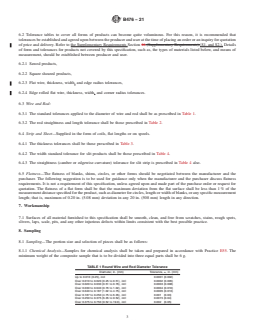
6.3.1 The standard tolerances applied to the diameter of wire and rod shall be as prescribed in Table 1.
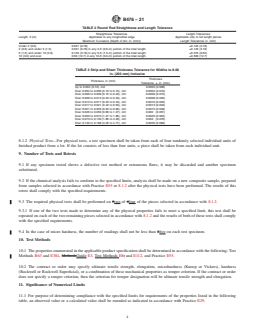
6.3.2 The rod straightness and length tolerance shall be those prescribed in Table 2.
6.4 Strip and Sheet—Supplied in the form of coils, flat lengths or on spools.
6.4.1 The thickness tolerances shall be those prescribed in Table 3.
6.4.2 The width standard tolerance for slit products shall be those prescribed in Table 4.
6.4.3 The straightness (camber or edgewise curvature) tolerance for slit strip is prescribed in Table 4 also.
6.5 Flatness—The flatness of blanks, shims, circles, or other forms should be negotiated between the manufacturer and the
purchaser. The following suggestion is to be used for guidance only when the manufacturer and the purchaser discuss flatness
requirements. It is not a requirement of this specification, unless agreed upon and made part of the purchase order or request for
quotation. The flatness of a flat form shall be that the maximum deviation from the flat surface shall be less than 1 % of the
measurement distance specified for the product, such as diameter for circles, length or width of blanks, or any specific measurement
length; that is, maximum of 0.20 in. (5.08 mm) deviation in any 20 in. (508 mm) length in any direction.
7. Workmanship
7.1 Surfaces of all material furnished to this specification shall be smooth, clean, and free from scratches, stains, rough spots,
slivers, laps, scale, pits, and any other injurious defects within limits consistent with the best possible practice.
8. Sampling
8.1 Sampling—The portion size and selection of pieces shall be as follows:
8.1.1 Chemical Analysis—Samples for chemical analysis shall be taken and prepared in accordance with Practice E55. The
minimum weight of the composite sample that is to be divided into three equal parts shall be 6 g.
TABLE 1 Round Wire and Rod Diameter Tolerance
Diameter, in. (mm) Tolerance, ±, in. (mm)
Up to 0.010 (0.25), incl 0.0001 (0.002)
Over 0.010 to 0.020 (0.25 to 0.51), incl 0.0002 (0.005)
Over 0.020 to 0.030 (0.51 to 0.76), incl 0.0003 (0.008)
Over 0.030 to 0.040 (0.76 to 1.02), incl 0.0004 (0.010)
Over 0.040 to 0.187 (1.02 to 4.75), incl 0.0005 (0.013)
Over 0.187 to 0.250 (4.75 to 6.35), incl 0.001 (0.03)
Over 0.250 to 0.375 (6.35 to 9.52), incl 0.0015 (0.04)
Over 0.375 to 0.750 (9.52 to 19.0), incl 0.002 (0.05)
B476 − 21
TABLE 2 Round Rod Straightness and Length Tolerance
Straightness Tolerances Length Tolerances
Length, ft (m) Applicable to any longitudinal edge Applicable only to full length pieces
Maximum Curvature (Depth of Arc; in. (mm)) Length Tolerances in. (mm)
Under 2 (0.6) 0.031 (0.78) ±0.125 (3.18)
2 (0.6) and under 5 (1.5) 0.031 (0.78) in any 2-ft (0.6-m) portion of the total length. ±0.125 (3.18)
5 (1.5) and under 10 (3.0) 0.125 (3.18) in any 5-ft (1.5-m) portion of the total length. ±0.375 (9.52)
10 (3.0) and over 0.50 (12.7) in any 10
...