

ASTM E3317-22
(Specification)Standard Specification for Silica-Based Sediments for the Evaluation of Stormwater Treatment Devices
General Information
- Abstract
SCOPE
1.1 This specification covers the minerology, specific gravity, and particle size distributions (PSDs) of silica-based sediments to be used in the laboratory performance testing of stormwater treatment devices as well as criteria defining acceptable error for the target PSDs.
1.2 Silica-based sediment is used as a surrogate material for performance and scour determinations for some manufactured stormwater treatment devices such as hydrodynamic separators and filters. These data are used to gain regulatory approvals within certain jurisdictions.
1.3 Acceptance of test results attained according to this specification may be subject to specific requirements set by a Quality Assurance Project Plan, a specific verification protocol, or a policy set by an Authority Having Jurisdiction (AHJ). It is advised to review one or all of the above to ensure compliance.
1.4 The values stated in inch-pound units are to be regarded as standard, except for methods to establish and report sediment concentration and particle size. It is convention to exclusively describe sediment concentration in mg/L and particle size in mm or μm, both of which are SI units. The SI units given in parentheses are mathematical conversions, which are provided for information purposes only and are not considered standard. Reporting of test results in units other than inch-pound units shall be regarded as conforming with this test method.
1.5 This standard does not purport to address all of the safety concerns, if any, associated with its use. It is the responsibility of the user of this standard to establish appropriate safety, health, and environmental practices and determine the applicability of regulatory limitations prior to use. Silica-based sediment is considered hazardous under the OSHA Hazard Communications Standard (29 CFR 1910.1200).
1.6 This international standard was developed in accordance with internationally recognized principles on standardization established in the Decision on Principles for the Development of International Standards, Guides and Recommendations issued by the World Trade Organization Technical Barriers to Trade (TBT) Committee.
- Status
- Published
- Publication Date
- 30-Sep-2022
- Technical Committee
- E64 - Stormwater Control Measures
- Drafting Committee
- E64.01 - Lab Evaluation


Overview
ASTM E3317-22: Standard Specification for Silica-Based Sediments for the Evaluation of Stormwater Treatment Devices defines requirements for silica-based sediments used as surrogate testing materials in laboratory performance evaluations of stormwater treatment devices, including hydrodynamic separators and filters. This standard specifies criteria such as mineralogy, specific gravity, and particle size distribution (PSD) for test sediments to ensure reliable and repeatable results. Compliance with this specification is often necessary for regulatory submission and device certification processes in various jurisdictions.
Key Topics
- Material Requirements: The standard mandates that silica-based sediment for testing must comprise at least 98% silicon dioxide (SiO₂) and have a specified specific gravity of 2.65.
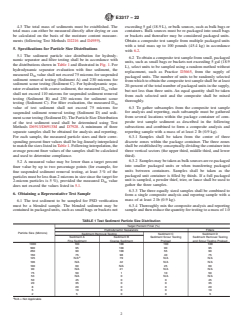
- Particle Size Distribution: Criteria for target PSDs are outlined for different stormwater treatment tests-such as sediment removal and scour-for both fine and coarse sediments. ASTM test methods D6913/D6913M (sieve analysis) and D7928 (hydrometer analysis) are designated for particle size assessments.
- Sampling and Verification: The specification describes processes for obtaining representative, composite samples from packaged or bulk sediments. At least three separate samples are required for analysis, with guidelines for random sampling and thorough mixing.
- Measurement and Reporting Units: While inch-pound units are standard for mass-related measurements, sediment concentration is reported in mg/L and particle size in mm or μm, both using SI units as convention.
- Quality Assurance: Acceptance of test outcomes is often governed by a Project Quality Assurance Plan, verification protocols, or policies of the Authority Having Jurisdiction (AHJ). Users are advised to confirm compliance with the relevant regulatory or project requirements.
- Safety Considerations: Due to silica-based sediment's classification as hazardous under OSHA's Hazard Communications Standard (29 CFR 1910.1200), users must follow appropriate safety, health, and environmental practices.
Applications
ASTM E3317-22 is widely applied in the following contexts:
- Laboratory Performance Testing: Provides industry-standard criteria for choosing and verifying test sediments in laboratory evaluations of stormwater treatment devices, ensuring that test results are reproducible and representative.
- Device Approval and Certification: Test results obtained using sediments specified by this standard support manufacturers and engineers in obtaining regulatory approvals for new or improved stormwater treatment systems in many jurisdictions.
- Research and Development: Used in university and industrial research to standardize experiments involving sediment removal, particle separation, and device efficiency studies related to stormwater control technologies.
- Quality Control: Serves as a reference for developing verification protocols and procedural checklists in consulting, governmental, and third-party testing laboratories working with stormwater control measures.
Related Standards
For comprehensive implementation and compliance, consider the following referenced standards:
- ASTM D6913/D6913M - Test Methods for Particle-Size Distribution (Gradation) of Soils Using Sieve Analysis
- ASTM D7928 - Test Method for Particle-Size Distribution (Gradation) of Fine-Grained Soils Using the Sedimentation (Hydrometer) Analysis
- ASTM D2216 - Test Methods for Laboratory Determination of Water (Moisture) Content of Soil and Rock by Mass
- ASTM D4959 - Test Method for Determination of Water Content of Soil By Direct Heating
- ASTM D3665 - Practice for Random Sampling of Construction Materials
- ASTM E3318 - Terminology for Standards Relating to Stormwater Control Measures
- OSHA 29 CFR 1910.1200 - Hazard Communications Standard
Keywords: silica-based sediment, ASTM E3317, stormwater treatment, particle size distribution, laboratory testing, hydrodynamic separator, stormwater filter, regulatory approval, quality assurance, hazardous materials, stormwater control measures.
Relations
- Refers
ASTM D4959-24 - Standard Test Method for Determination of Water Content of Soil By Direct Heating - Effective Date
- 01-Feb-2024
- Effective Date
- 01-Jan-2024
- Effective Date
- 01-Mar-2019
- Effective Date
- 01-May-2016
- Effective Date
- 01-May-2016
- Refers
ASTM D4959-16 - Standard Test Method for Determination of Water Content of Soil By Direct Heating - Effective Date
- 01-Jan-2016
- Effective Date
- 01-Jun-2012
- Effective Date
- 01-Jul-2010
- Effective Date
- 01-Aug-2007
- Effective Date
- 01-Feb-2007
- Effective Date
- 01-Jan-2006
- Effective Date
- 01-Mar-2005
- Effective Date
- 10-Dec-2002
- Effective Date
- 10-Mar-2000
- Effective Date
- 10-Feb-1999
Get Certified
Connect with accredited certification bodies for this standard

CIS Institut d.o.o.
Personal Protective Equipment (PPE) certification body. Notified Body NB-2890 for EU Regulation 2016/425 PPE.

Kiwa BDA Testing
Building and construction product certification.
Kmetijski inštitut Slovenije
Agricultural Institute of Slovenia. Soil testing, plant health, agricultural product analysis.
Sponsored listings
Frequently Asked Questions
ASTM E3317-22 is a technical specification published by ASTM International. Its full title is "Standard Specification for Silica-Based Sediments for the Evaluation of Stormwater Treatment Devices". This standard covers: SCOPE 1.1 This specification covers the minerology, specific gravity, and particle size distributions (PSDs) of silica-based sediments to be used in the laboratory performance testing of stormwater treatment devices as well as criteria defining acceptable error for the target PSDs. 1.2 Silica-based sediment is used as a surrogate material for performance and scour determinations for some manufactured stormwater treatment devices such as hydrodynamic separators and filters. These data are used to gain regulatory approvals within certain jurisdictions. 1.3 Acceptance of test results attained according to this specification may be subject to specific requirements set by a Quality Assurance Project Plan, a specific verification protocol, or a policy set by an Authority Having Jurisdiction (AHJ). It is advised to review one or all of the above to ensure compliance. 1.4 The values stated in inch-pound units are to be regarded as standard, except for methods to establish and report sediment concentration and particle size. It is convention to exclusively describe sediment concentration in mg/L and particle size in mm or μm, both of which are SI units. The SI units given in parentheses are mathematical conversions, which are provided for information purposes only and are not considered standard. Reporting of test results in units other than inch-pound units shall be regarded as conforming with this test method. 1.5 This standard does not purport to address all of the safety concerns, if any, associated with its use. It is the responsibility of the user of this standard to establish appropriate safety, health, and environmental practices and determine the applicability of regulatory limitations prior to use. Silica-based sediment is considered hazardous under the OSHA Hazard Communications Standard (29 CFR 1910.1200). 1.6 This international standard was developed in accordance with internationally recognized principles on standardization established in the Decision on Principles for the Development of International Standards, Guides and Recommendations issued by the World Trade Organization Technical Barriers to Trade (TBT) Committee.
SCOPE 1.1 This specification covers the minerology, specific gravity, and particle size distributions (PSDs) of silica-based sediments to be used in the laboratory performance testing of stormwater treatment devices as well as criteria defining acceptable error for the target PSDs. 1.2 Silica-based sediment is used as a surrogate material for performance and scour determinations for some manufactured stormwater treatment devices such as hydrodynamic separators and filters. These data are used to gain regulatory approvals within certain jurisdictions. 1.3 Acceptance of test results attained according to this specification may be subject to specific requirements set by a Quality Assurance Project Plan, a specific verification protocol, or a policy set by an Authority Having Jurisdiction (AHJ). It is advised to review one or all of the above to ensure compliance. 1.4 The values stated in inch-pound units are to be regarded as standard, except for methods to establish and report sediment concentration and particle size. It is convention to exclusively describe sediment concentration in mg/L and particle size in mm or μm, both of which are SI units. The SI units given in parentheses are mathematical conversions, which are provided for information purposes only and are not considered standard. Reporting of test results in units other than inch-pound units shall be regarded as conforming with this test method. 1.5 This standard does not purport to address all of the safety concerns, if any, associated with its use. It is the responsibility of the user of this standard to establish appropriate safety, health, and environmental practices and determine the applicability of regulatory limitations prior to use. Silica-based sediment is considered hazardous under the OSHA Hazard Communications Standard (29 CFR 1910.1200). 1.6 This international standard was developed in accordance with internationally recognized principles on standardization established in the Decision on Principles for the Development of International Standards, Guides and Recommendations issued by the World Trade Organization Technical Barriers to Trade (TBT) Committee.
ASTM E3317-22 is classified under the following ICS (International Classification for Standards) categories: 13.060.30 - Sewage water. The ICS classification helps identify the subject area and facilitates finding related standards.
ASTM E3317-22 has the following relationships with other standards: It is inter standard links to ASTM D4959-24, ASTM E3318-24, ASTM D2216-19, ASTM D7928-16, ASTM D7928-16e1, ASTM D4959-16, ASTM D3665-12, ASTM D2216-10, ASTM D3665-07e1, ASTM D4959-07, ASTM D3665-06, ASTM D2216-05, ASTM D3665-02, ASTM D4959-00, ASTM D3665-99. Understanding these relationships helps ensure you are using the most current and applicable version of the standard.
ASTM E3317-22 is available in PDF format for immediate download after purchase. The document can be added to your cart and obtained through the secure checkout process. Digital delivery ensures instant access to the complete standard document.
Standards Content (Sample)
This international standard was developed in accordance with internationally recognized principles on standardization established in the Decision on Principles for the
Development of International Standards, Guides and Recommendations issued by the World Trade Organization Technical Barriers to Trade (TBT) Committee.
Designation: E3317 −22
Standard Specification for
Silica-Based Sediments for the Evaluation of Stormwater
Treatment Devices
This standard is issued under the fixed designation E3317; the number immediately following the designation indicates the year of
original adoption or, in the case of revision, the year of last revision. A number in parentheses indicates the year of last reapproval. A
superscript epsilon (´) indicates an editorial change since the last revision or reapproval.
1. Scope ization established in the Decision on Principles for the
Development of International Standards, Guides and Recom-
1.1 This specification covers the minerology, specific
mendations issued by the World Trade Organization Technical
gravity, and particle size distributions (PSDs) of silica-based
Barriers to Trade (TBT) Committee.
sediments to be used in the laboratory performance testing of
stormwater treatment devices as well as criteria defining
2. Referenced Documents
acceptable error for the target PSDs.
2.1 ASTM Standards:
1.2 Silica-based sediment is used as a surrogate material for
D2216 Test Methods for Laboratory Determination of Water
performance and scour determinations for some manufactured
(Moisture) Content of Soil and Rock by Mass
stormwater treatment devices such as hydrodynamic separators
D3665 Practice for Random Sampling of Construction Ma-
and filters. These data are used to gain regulatory approvals
terials
within certain jurisdictions.
D4959 Test Method for Determination of Water Content of
1.3 Acceptance of test results attained according to this
Soil By Direct Heating
specification may be subject to specific requirements set by a
D6913/D6913M Test Methods for Particle-Size Distribution
QualityAssuranceProjectPlan,aspecificverificationprotocol,
(Gradation) of Soils Using Sieve Analysis
or a policy set by anAuthority Having Jurisdiction (AHJ). It is
D7928 Test Method for Particle-Size Distribution (Grada-
advised to review one or all of the above to ensure compliance.
tion) of Fine-Grained Soils Using the Sedimentation
(Hydrometer) Analysis
1.4 The values stated in inch-pound units are to be regarded
E3318 Terminology for Standards Relating to Stormwater
as standard, except for methods to establish and report sedi-
Control Measures
ment concentration and particle size. It is convention to
exclusively describe sediment concentration in mg/L and 2.2 Other Standards:
particle size in mm or µm, both of which are SI units. The SI 29 CFR 1910.1200 OSHA Hazard Communications Stan-
units given in parentheses are mathematical conversions, dard
which are provided for information purposes only and are not
3. Terminology
considered standard. Reporting of test results in units other
than inch-pound units shall be regarded as conforming with
3.1 Definitions:
this test method.
3.1.1 For definitions of common technical terms used in this
1.5 This standard does not purport to address all of the standard, refer to Terminology E3318.
safety concerns, if any, associated with its use. It is the
4. Specification for Silica-Based Sediment
responsibility of the user of this standard to establish appro-
priate safety, health, and environmental practices and deter-
4.1 The silica-based sediment shall comprise a minimum
mine the applicability of regulatory limitations prior to use.
98 % SiO .
Silica-based sediment is considered hazardous under the
4.2 Technical data provided by the sediment supplier shall
OSHA Hazard Communications Standard (29 CFR
list a Specific Gravity equal to 2.65 for the silica-based
1910.1200).
sediment used for the test.
1.6 This international standard was developed in accor-
dance with internationally recognized principles on standard-
For referenced ASTM standards, visit the ASTM website, www.astm.org, or
This test method is under the jurisdiction of ASTM Committee E64 on contact ASTM Customer Service at service@astm.org. For Annual Book of ASTM
Stormwater Control Measures and is the direct responsibility of Subcommittee Standards volume information, refer to the standard’s Document Summary page on
E64.01 on Lab Evaluation. the ASTM website.
Current edition approved Oct. 1, 2022. Published October 2022. DOI: 10.1520/ Available from Occupational Safety and Health Administration (OSHA), 200
E3317-22. Constitution Ave., NW, Washington, DC 20210, http://www.osha.gov.
Copyright © ASTM International, 100 Barr Harbor Drive, PO Box C700, West Conshohocken, PA 19428-2959. United States
E3317 − 22
4.3 The total mass of sediments must be established. The exceeding 5 gal (18.9 L), or bulk sources, such as bulk bags or
total mass can either be measured directly after drying or can containers. Bulk sources must be re-packaged into small bags
be calculated on the basis of the moisture content measure- or buckets and thereafter may be considered packaged units.
ments (following Test Methods D2216 and D4959). Obtain a composite test sample from multiple packaged units
with a total mass up to 100 pounds (45.4 kg) in accordance
5. Specifications for Particle Size Distributions
with 6.2.
5.1 The sediment particle size distribution for hydrody-
6.2 To obtain a composite test sample from small, packaged
namic separator and filter testing shall be in accordance with
units, such as small bags or buckets not exceeding 5 gal (18.9
the distributions shown in Table 1 and illustrated in Fig. 1. For
L), select units to be sampled using a random method without
hydrodynamic separator evaluation with fine sediment, the
replacement, such as Practice D3665, from the supply of
measured D value shall not exceed 75 microns for suspended
packaged units. The number of units to be randomly selected
sediment removal testing (Sediment A) an
...