

ASTM D4332-22
(Practice)Standard Practice for Conditioning Containers, Packages, or Packaging Components for Testing
General Information
- Abstract
SIGNIFICANCE AND USE
4.1 Many materials from which containers and packages are made, especially cellulosic materials, undergo changes in physical properties as the temperature and the relative humidity (RH) to which they are exposed are varied. Therefore, the package should be placed and kept in a specified atmosphere for a length of time such that subsequent measurements of physical properties will be meaningful and reproducible.
4.2 The conditions described in this practice are either historically accepted standard conditions or special laboratory conditions chosen to represent particular phases of the distribution environment. These special conditions do not necessarily duplicate actual field conditions, but tend to simulate them and have effects on packages and materials which may be related to their field performance.
SCOPE
1.1 This practice provides for standard and special conditioning and testing atmospheres that may be used to simulate particular field conditions that a container, package, or packaging component may encounter during its life or testing cycle.
1.2 This practice describes procedures for conditioning these containers, packages, or packaging components so that they approach or reach equilibrium with the atmosphere to which they may be exposed. This standard is commonly used for conditioning when conducting transit simulation tests.
1.3 Practice D685 should be used as the relevant conditioning standard when quantification of box compression strength at standard atmosphere conditions is required.
1.4 This standard does not purport to address all of the safety concerns, if any, associated with its use. It is the responsibility of the user of this standard to establish appropriate safety, health, and environmental practices and determine the applicability of regulatory limitations prior to use.
1.5 This international standard was developed in accordance with internationally recognized principles on standardization established in the Decision on Principles for the Development of International Standards, Guides and Recommendations issued by the World Trade Organization Technical Barriers to Trade (TBT) Committee.
- Status
- Published
- Publication Date
- 30-Apr-2022
- Technical Committee
- D10 - Packaging
Buy Documents


ASTM D4332-22 - Standard Practice for Conditioning Containers, Packages, or Packaging Components for Testing
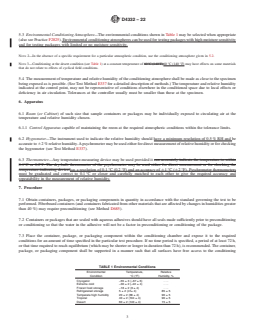

REDLINE ASTM D4332-22 - Standard Practice for Conditioning Containers, Packages, or Packaging Components for Testing
Overview
ASTM D4332-22: Standard Practice for Conditioning Containers, Packages, or Packaging Components for Testing is an internationally recognized practice developed by ASTM International. This standard outlines procedures to condition containers, packages, and packaging components under controlled atmospheric conditions prior to testing. The aim is to ensure that materials reach equilibrium with specified conditions of temperature and relative humidity (RH), making subsequent physical property measurements accurate and reproducible. ASTM D4332-22 is essential for creating meaningful and comparable packaging test results, especially when packaging materials are sensitive to climatic changes.
Key Topics
- Significance of Conditioning: Many packaging materials, especially those made from cellulosic substances, significantly change their physical properties with fluctuations in temperature and RH. Conditioning ensures these materials are evaluated under standardized laboratory conditions or simulated field conditions.
- Atmospheric Conditions: The standard defines several conditioning environments, including:
- Preconditioning Atmosphere: 20°C to 40°C (68°F to 104°F), 10–35% RH
- Standard Conditioning Atmosphere: 23 ± 1°C (73.4 ± 2°F), 50 ± 2% RH
- Special Environmental Conditionings: Includes conditions such as cryogenic, extreme cold, frozen food storage, refrigerated storage, temperate high humidity, tropical, and desert environments for packages with different sensitivities.
- Laboratory Protocols: Containers, packages, or components are placed within a conditioning chamber for a period (often at least 72 hours or until equilibrium) to simulate real-life environmental exposure.
- Measurement Techniques: Accurate measurement of temperature and RH is required, with instruments such as hygrometers and psychrometers ensuring reproducibility of test results.
- Reporting Requirements: Documentation must include details about the conditioning environment, exposure time, and any deviations from the standard procedure, ensuring transparency and traceability.
Applications
ASTM D4332-22 is widely used in the packaging industry to:
- Transit Simulation Testing: Conditioning specimens prior to mechanical testing such as drop, vibration, or compression tests ensures that results reflect field performance more closely.
- Quality Control of Packaging: Reproducible conditions help compare packaging systems from different batches or suppliers.
- Development of Climate-Resistant Packaging: By conditioning specimens to challenging environments, manufacturers can evaluate and improve packaging for export or extreme conditions.
- Regulatory and Certification Compliance: Many international and domestic regulations require that packaging undergo standardized conditioning before certification or acceptance tests, especially for products shipped globally.
- Research & Development: Laboratories use this standard to study how environmental factors affect packaging material selection and design.
Related Standards
ASTM D4332-22 references and works alongside several other standards, including:
- ASTM D685: Conditioning Paper and Paper Products for Testing, recommended for box compression strength quantification.
- ASTM D996: Terminology of Packaging and Distribution Environments.
- ASTM E171: Conditioning and Testing Flexible Barrier Packaging.
- ASTM E337: Measuring Humidity with a Psychrometer.
- ASTM F2825: Climatic Stressing of Packaging Systems for Single Parcel Delivery.
These related standards provide more specific procedures and terminology for various materials and testing circumstances, complementing ASTM D4332-22 in packaging quality assurance and distribution testing.
Keywords: package conditioning, packaging testing, ASTM D4332, environmental testing, preconditioning, relative humidity, temperature control, packaging standards, laboratory conditioning, packaging components, reproducible test results.
Relations
- Effective Date
- 01-Mar-2018
- Effective Date
- 01-Oct-2015
- Effective Date
- 01-Oct-2015
- Effective Date
- 01-Nov-2012
- Effective Date
- 01-Dec-2010
- Effective Date
- 01-Dec-2010
- Effective Date
- 01-Dec-2010
- Effective Date
- 01-Oct-2007
- Effective Date
- 01-Apr-2007
- Effective Date
- 01-Apr-2004
- Effective Date
- 10-Oct-2002
- Effective Date
- 10-Apr-2002
- Effective Date
- 10-Apr-2002
- Effective Date
- 01-Jan-1996
- Effective Date
- 15-Nov-1994
Buy Documents
ASTM D4332-22 - Standard Practice for Conditioning Containers, Packages, or Packaging Components for Testing
REDLINE ASTM D4332-22 - Standard Practice for Conditioning Containers, Packages, or Packaging Components for Testing
Get Certified
Connect with accredited certification bodies for this standard

BRCGS (Brand Reputation Compliance Global Standards)
Global food safety and quality standards owner.
Sponsored listings
Frequently Asked Questions
ASTM D4332-22 is a standard published by ASTM International. Its full title is "Standard Practice for Conditioning Containers, Packages, or Packaging Components for Testing". This standard covers: SIGNIFICANCE AND USE 4.1 Many materials from which containers and packages are made, especially cellulosic materials, undergo changes in physical properties as the temperature and the relative humidity (RH) to which they are exposed are varied. Therefore, the package should be placed and kept in a specified atmosphere for a length of time such that subsequent measurements of physical properties will be meaningful and reproducible. 4.2 The conditions described in this practice are either historically accepted standard conditions or special laboratory conditions chosen to represent particular phases of the distribution environment. These special conditions do not necessarily duplicate actual field conditions, but tend to simulate them and have effects on packages and materials which may be related to their field performance. SCOPE 1.1 This practice provides for standard and special conditioning and testing atmospheres that may be used to simulate particular field conditions that a container, package, or packaging component may encounter during its life or testing cycle. 1.2 This practice describes procedures for conditioning these containers, packages, or packaging components so that they approach or reach equilibrium with the atmosphere to which they may be exposed. This standard is commonly used for conditioning when conducting transit simulation tests. 1.3 Practice D685 should be used as the relevant conditioning standard when quantification of box compression strength at standard atmosphere conditions is required. 1.4 This standard does not purport to address all of the safety concerns, if any, associated with its use. It is the responsibility of the user of this standard to establish appropriate safety, health, and environmental practices and determine the applicability of regulatory limitations prior to use. 1.5 This international standard was developed in accordance with internationally recognized principles on standardization established in the Decision on Principles for the Development of International Standards, Guides and Recommendations issued by the World Trade Organization Technical Barriers to Trade (TBT) Committee.
SIGNIFICANCE AND USE 4.1 Many materials from which containers and packages are made, especially cellulosic materials, undergo changes in physical properties as the temperature and the relative humidity (RH) to which they are exposed are varied. Therefore, the package should be placed and kept in a specified atmosphere for a length of time such that subsequent measurements of physical properties will be meaningful and reproducible. 4.2 The conditions described in this practice are either historically accepted standard conditions or special laboratory conditions chosen to represent particular phases of the distribution environment. These special conditions do not necessarily duplicate actual field conditions, but tend to simulate them and have effects on packages and materials which may be related to their field performance. SCOPE 1.1 This practice provides for standard and special conditioning and testing atmospheres that may be used to simulate particular field conditions that a container, package, or packaging component may encounter during its life or testing cycle. 1.2 This practice describes procedures for conditioning these containers, packages, or packaging components so that they approach or reach equilibrium with the atmosphere to which they may be exposed. This standard is commonly used for conditioning when conducting transit simulation tests. 1.3 Practice D685 should be used as the relevant conditioning standard when quantification of box compression strength at standard atmosphere conditions is required. 1.4 This standard does not purport to address all of the safety concerns, if any, associated with its use. It is the responsibility of the user of this standard to establish appropriate safety, health, and environmental practices and determine the applicability of regulatory limitations prior to use. 1.5 This international standard was developed in accordance with internationally recognized principles on standardization established in the Decision on Principles for the Development of International Standards, Guides and Recommendations issued by the World Trade Organization Technical Barriers to Trade (TBT) Committee.
ASTM D4332-22 is classified under the following ICS (International Classification for Standards) categories: 55.020 - Packaging and distribution of goods in general. The ICS classification helps identify the subject area and facilitates finding related standards.
ASTM D4332-22 has the following relationships with other standards: It is inter standard links to ASTM F2825-18, ASTM D1968-15, ASTM F2825-10(2015), ASTM D685-12, ASTM D996-10a, ASTM F2825-10e1, ASTM F2825-10, ASTM E337-02(2007), ASTM E171-94(2007), ASTM D996-04, ASTM E337-02, ASTM D996-99, ASTM D996-02, ASTM E337-84(1996)e1, ASTM E171-94(2002). Understanding these relationships helps ensure you are using the most current and applicable version of the standard.
ASTM D4332-22 is available in PDF format for immediate download after purchase. The document can be added to your cart and obtained through the secure checkout process. Digital delivery ensures instant access to the complete standard document.
Standards Content (Sample)
This international standard was developed in accordance with internationally recognized principles on standardization established in the Decision on Principles for the
Development of International Standards, Guides and Recommendations issued by the World Trade Organization Technical Barriers to Trade (TBT) Committee.
Designation: D4332 − 22
Standard Practice for
Conditioning Containers, Packages, or Packaging
Components for Testing
This standard is issued under the fixed designation D4332; the number immediately following the designation indicates the year of
original adoption or, in the case of revision, the year of last revision. A number in parentheses indicates the year of last reapproval. A
superscript epsilon (´) indicates an editorial change since the last revision or reapproval.
1. Scope E171 Practice for Conditioning and Testing Flexible Barrier
Packaging
1.1 This practice provides for standard and special condi-
E337 Test Method for Measuring Humidity with a Psy-
tioning and testing atmospheres that may be used to simulate
chrometer (the Measurement of Wet- and Dry-Bulb Tem-
particular field conditions that a container, package, or pack-
peratures)
aging component may encounter during its life or testing cycle.
F2825 Practice for Climatic Stressing of Packaging Systems
1.2 This practice describes procedures for conditioning
for Single Parcel Delivery
these containers, packages, or packaging components so that
they approach or reach equilibrium with the atmosphere to 3. Terminology
which they may be exposed. This standard is commonly used
3.1 Terms and definitions used in this practice may be found
for conditioning when conducting transit simulation tests.
in Terminology D996, Terminology D1968, or Specification
1.3 Practice D685 should be used as the relevant condition- E171.
ing standard when quantification of box compression strength
4. Significance and Use
at standard atmosphere conditions is required.
4.1 Many materials from which containers and packages are
1.4 This standard does not purport to address all of the
made, especially cellulosic materials, undergo changes in
safety concerns, if any, associated with its use. It is the
physicalpropertiesasthetemperatureandtherelativehumidity
responsibility of the user of this standard to establish appro-
(RH) to which they are exposed are varied. Therefore, the
priate safety, health, and environmental practices and deter-
package should be placed and kept in a specified atmosphere
mine the applicability of regulatory limitations prior to use.
for a length of time such that subsequent measurements of
1.5 This international standard was developed in accor-
physical properties will be meaningful and reproducible.
dance with internationally recognized principles on standard-
ization established in the Decision on Principles for the
4.2 The conditions described in this practice are either
Development of International Standards, Guides and Recom-
historically accepted standard conditions or special laboratory
mendations issued by the World Trade Organization Technical
conditions chosen to represent particular phases of the distri-
Barriers to Trade (TBT) Committee.
bution environment. These special conditions do not necessar-
ily duplicate actual field conditions, but tend to simulate them
2. Referenced Documents
and have effects on packages and materials which may be
2.1 ASTM Standards:
related to their field performance.
D685 Practice for Conditioning Paper and Paper Products
5. Atmospheric Conditions
for Testing
D996 Terminology of Packaging and Distribution Environ-
5.1 Preconditioning Atmosphere—20 °C to 40 °C (68 °F to
ments
104 °F) and 10 % to 35 % relative humidity.
D1968 Terminology Relating to Paper and Paper Products
5.2 Standard Conditioning Atmosphere—23 °C 6 1°C
(73.4 °F 6 2 °F) and 50 % 6 2 % relative humidity.
This practice is under the jurisdiction of ASTM Committee D10 on Packaging
NOTE 1—Average values must fall within these limits. Short-term
and is the direct responsibility of Subcommittee D10.21 on Shipping Containers and
fluctuations and measurement limitations may cause individual measure-
Systems - Application of Performance Test Methods.
ments to vary up to 62°C(63.6 °F) and 65 % relative humidity without
Current edition approved May 1, 2022. Published June 2022. Originally
significant impairment of test precision.
approved in 1984. Last previous edition approved in 2014 as D4332 – 14. DOI:
10.1520/D4332-22.
For referenced ASTM standards, visit the ASTM website, www.astm.org, or
contact ASTM Customer Service at service@astm.org. For Annual Book of ASTM
Standards volume information, refer to the standard’s Document Summary page on
the ASTM website.
Copyright © ASTM International, 100 Barr Harbor Drive, PO Box C700, West Conshohocken, PA 19428-2959. United States
D4332 − 22
5.3 Environmental ConditioningAtmosphere—The environ- to be performed. Fiberboard containers (and containers fabri-
mental conditions shown in Table 1 may be selected when cated from other materials that are affected by changes in
appropriate (also see Practice F2825). Environmental condi- humiditiesgreaterthan40 %)mayrequirepreconditioning(see
tioning atmospheres can be used for testing packages with high Method D685).
moisture sensitivity and for testing packages with limited or no
7.2 Containers or packages that are sealed with aqueous
moisture sensitivity.
adhesives should have all seals made sufficiently prior to
preconditioning or conditioning so that the water in the
NOTE 2—In the absence of a specific requirement for a particular
atmospheric condition, use the conditioning atmosphere given in 5.2. adhesive will not be a factor in p
...
This document is not an ASTM standard and is intended only to provide the user of an ASTM standard an indication of what changes have been made to the previous version. Because
it may not be technically possible to adequately depict all changes accurately, ASTM recommends that users consult prior editions as appropriate. In all cases only the current version
of the standard as published by ASTM is to be considered the official document.
Designation: D4332 − 14 D4332 − 22
Standard Practice for
Conditioning Containers, Packages, or Packaging
Components for Testing
This standard is issued under the fixed designation D4332; the number immediately following the designation indicates the year of
original adoption or, in the case of revision, the year of last revision. A number in parentheses indicates the year of last reapproval. A
superscript epsilon (´) indicates an editorial change since the last revision or reapproval.
1. Scope
1.1 This practice provides for standard and special conditioning and testing atmospheres that may be used to simulate particular
field conditions that a container, package, or packaging component may encounter during its life or testing cycle.
1.2 This practice describes procedures for conditioning these containers, packages, or packaging components so that they approach
or reach equilibrium with the atmosphere to which they may be exposed. This standard is commonly used for conditioning when
conducting transit simulation tests.
1.3 Practice D685 should be used as the relevant conditioning standard when quantification of box compression strength at
standard atmosphere conditions is required.
1.4 This standard does not purport to address all of the safety concerns, if any, associated with its use. It is the responsibility
of the user of this standard to establish appropriate safety safety, health, and healthenvironmental practices and determine the
applicability of regulatory limitations prior to use.
1.5 This international standard was developed in accordance with internationally recognized principles on standardization
established in the Decision on Principles for the Development of International Standards, Guides and Recommendations issued
by the World Trade Organization Technical Barriers to Trade (TBT) Committee.
2. Referenced Documents
2.1 ASTM Standards:
D685 Practice for Conditioning Paper and Paper Products for Testing
D996 Terminology of Packaging and Distribution Environments
E41D1968 Terminology Relating to ConditioningPaper and Paper Products (Withdrawn 2019)
E171 Practice for Conditioning and Testing Flexible Barrier Packaging
E337 Test Method for Measuring Humidity with a Psychrometer (the Measurement of Wet- and Dry-Bulb Temperatures)
F2825 Practice for Climatic Stressing of Packaging Systems for Single Parcel Delivery
3. Terminology
3.1 Terms and definitions used in this practice may be found in Terminology D996, Terminology E41D1968, or Specification
E171.
This practice is under the jurisdiction of ASTM Committee D10 on Packaging and is the direct responsibility of Subcommittee D10.21 on Shipping Containers and
Systems - Application of Performance Test Methods.
Current edition approved Nov. 1, 2014May 1, 2022. Published January 2015June 2022. Originally approved in 1984. Last previous edition approved in 20132014 as
D4332D4332 – 14. –13. DOI: 10.1520/D4332-14.10.1520/D4332-22.
For referenced ASTM standards, visit the ASTM website, www.astm.org, or contact ASTM Customer Service at service@astm.org. For Annual Book of ASTM Standards
volume information, refer to the standard’s Document Summary page on the ASTM website.
Copyright © ASTM International, 100 Barr Harbor Drive, PO Box C700, West Conshohocken, PA 19428-2959. United States
D4332 − 22
4. Significance and Use
4.1 Many materials from which containers and packages are made, especially cellulosic materials, undergo changes in physical
properties as the temperature and the relative humidity (RH) to which they are exposed are varied. Therefore, the package should
be placed and kept in a specified atmosphere for a length of time such that subsequent measurements of physical properties will
be meaningful and reproducible.
4.2 The conditions described in this practice are either historically accepted standard conditions or special laboratory conditions
chosen to represent particular phases of the distribution environment. These special conditions do not necessarily duplicate actual
field conditions, but tend to simulate them and have effects on packages and materials which may be related to their field
performance.
5. Atmospheric Conditions
5.1 Preconditioning Atmosphere—2020 °C to 40°C (6840 °C (68 °F to 104°F)104 °F) and 1010 % to 35 % relative humidity.
5.2 Standard Conditioning Atmosphere— 23 6 1°C (73.4 6 2°F) and 5023 °C 6 1 °C (73.4 °F 6 2 °F) and 50 % 6 2 % relative
humidity.
NOTE 1—Average values must fall within these limits. Short-term fluctuations and measurement limitations may cause individual measurements to vary
up to 62°C (63.6°F)62 °C (63.6 °F) and 65 % relative humidity without significant impairment of test precision.
D4332 − 22
5.3 Environmental Conditioning Atmosphere—The environmental conditions shown in Table 1 may be selected when appropriate
(also see Practice F2825). Environmental conditioning atmospheres can be used for testing packages with high moisture sensitivity
and for testing packages with limited or no moisture sensitivity.
NOTE 2—In the absence of a specific requirement for a particular atmospheric condition, use the conditioning atmosphere given in 5.2.
NOTE 3—Conditioning at the desert condition (see Table 1) at a constant temperature of 60°C (140°F)60 °C (140 °F) may have effects on some materials
that do not relate to effects of cyclical field conditions.
5.4 The measurement of temperature and relative humidity of the conditioning atmosphere shall be made as close to the specimen
being exposed as is possible. (See Test Method E337 for a detailed description of methods.) T
...