

ASTM D5445-21
(Practice)Standard Practice for Pictorial Markings for Handling of Goods
General Information
- Abstract
SIGNIFICANCE AND USE
4.1 Packages are often marked with handling instructions in the language of the country of origin. While this may safeguard the consignment to some extent, it is of little value for goods consigned to, or through, countries using different languages, and of no value at all if people unloading the packages are illiterate. Pictorial symbols offer the most likely means of conveying the consignor’s intention and their adoption will, therefore, undoubtedly reduce loss and damage through incorrect handling. The use of pictorial symbols does not provide any guarantee of satisfactory handling; proper protective packaging is therefore of primary importance.
SCOPE
1.1 This practice establishes a set of symbols to be used for marking of packages or containers to indicate special handling and storage requirements.
1.2 The values stated in SI units are to be regarded as standard. The values given in parentheses after SI units are provided for information only and are not considered standard.
1.3 This standard does not purport to address all of the safety concerns, if any, associated with its use. It is the responsibility of the user of this standard to establish appropriate safety, health, and environmental practices and determine the applicability of regulatory limitations prior to use.
1.4 This international standard was developed in accordance with internationally recognized principles on standardization established in the Decision on Principles for the Development of International Standards, Guides and Recommendations issued by the World Trade Organization Technical Barriers to Trade (TBT) Committee.
- Status
- Published
- Publication Date
- 30-Sep-2021
- Technical Committee
- D10 - Packaging
- Drafting Committee
- D10.11 - Terminology (definitions)
Overview
ASTM D5445-21: Standard Practice for Pictorial Markings for Handling of Goods provides an internationally recognized set of pictorial symbols for marking packages and containers. These visual symbols convey special handling and storage requirements regardless of language or literacy abilities. By using standardized pictorial markings, organizations can significantly reduce the risk of loss or damage due to improper handling during international and domestic shipments.
ASTM D5445-21 was developed according to global principles outlined by the World Trade Organization Technical Barriers to Trade (TBT) Committee, ensuring broad application and alignment with other international standards. The standard emphasizes the essential role of clear, consistent communications to protect goods throughout the logistics chain while highlighting that robust packaging remains essential for safeguarding contents.
Key Topics
- Pictorial Markings: The standard establishes approved symbols to indicate handling instructions such as “Fragile,” “This Way Up,” “Keep Dry,” “Do Not Stack,” and more.
- Universal Communication: Pictorial symbols ensure essential handling information is communicated effectively across language and literacy barriers, critical for international shipping and trade.
- Symbol Design and Application:
- Preferred symbol colors are black on a contrasting background for visibility.
- Red may be used to emphasize warning symbols.
- Symbols should be printed, stenciled, or firmly attached to packages, positioned for clear visibility.
- Suggested symbol sizes are 100, 150, or 200 mm, with adjustments for package dimensions.
- Handling Instructions: Each symbol conveys specific instructions, with some symbols (like “Fragile” or “Keep Refrigerated”) requiring placement on multiple package sides for clarity.
- Regulatory and Safety Considerations: The standard advises users to be aware of applicable safety, health, and environmental practices and regulatory limitations linked to package handling and marking.
Applications
- International Shipping and Logistics: The use of standardized pictorial markings simplifies the movement of goods through multilingual and multicultural transport networks, minimizing misunderstandings and handling errors.
- Distribution Centers and Warehousing: Warehouse staff and machinery operators rely on visible handling symbols to correctly move, store, and stack goods, preventing incidental damage and ensuring safe working environments.
- Manufacturing and Packaging: Manufacturers and packaging designers integrate these pictorial markings during packaging design or pre-shipment labeling to maintain compliance with international shipping requirements and customer demands.
- Retail and Final-Mile Delivery: Clear pictorial handling instructions help ensure that goods arrive at the point of sale or final destination in optimal condition, enhancing customer satisfaction and reducing the likelihood of returns due to damage.
Related Standards
- ASTM D996 - Terminology of Packaging and Distribution Environments: Offers standardized definitions relevant to packaging and distribution, ensuring consistency in use of terminology.
- ISO 780 - Pictorial Marking for Handling of Goods: Provides a comparable set of international symbols and is referenced for broader recognition in global trade.
- ISO 7000 - Registration of Markings and Symbols: Maintains an international register of graphic symbols, enabling harmonization of symbol usage and design.
Keywords: pictorial markings, packaging symbols, international shipping, ASTM D5445, handling instructions, ISO 780, logistics, package labeling, handling symbols, packaging safety
By adopting the pictorial markings defined in ASTM D5445-21, organizations enhance the clarity and efficacy of their package labeling practices, resulting in safer, more efficient logistics operations and greater protection for transported goods worldwide.
Relations
- Effective Date
- 01-Dec-2010
- Effective Date
- 01-Apr-2004
- Effective Date
- 10-Apr-2002
- Effective Date
- 10-Apr-2002
Get Certified
Connect with accredited certification bodies for this standard

BRCGS (Brand Reputation Compliance Global Standards)
Global food safety and quality standards owner.
Sponsored listings
Frequently Asked Questions
ASTM D5445-21 is a standard published by ASTM International. Its full title is "Standard Practice for Pictorial Markings for Handling of Goods". This standard covers: SIGNIFICANCE AND USE 4.1 Packages are often marked with handling instructions in the language of the country of origin. While this may safeguard the consignment to some extent, it is of little value for goods consigned to, or through, countries using different languages, and of no value at all if people unloading the packages are illiterate. Pictorial symbols offer the most likely means of conveying the consignor’s intention and their adoption will, therefore, undoubtedly reduce loss and damage through incorrect handling. The use of pictorial symbols does not provide any guarantee of satisfactory handling; proper protective packaging is therefore of primary importance. SCOPE 1.1 This practice establishes a set of symbols to be used for marking of packages or containers to indicate special handling and storage requirements. 1.2 The values stated in SI units are to be regarded as standard. The values given in parentheses after SI units are provided for information only and are not considered standard. 1.3 This standard does not purport to address all of the safety concerns, if any, associated with its use. It is the responsibility of the user of this standard to establish appropriate safety, health, and environmental practices and determine the applicability of regulatory limitations prior to use. 1.4 This international standard was developed in accordance with internationally recognized principles on standardization established in the Decision on Principles for the Development of International Standards, Guides and Recommendations issued by the World Trade Organization Technical Barriers to Trade (TBT) Committee.
SIGNIFICANCE AND USE 4.1 Packages are often marked with handling instructions in the language of the country of origin. While this may safeguard the consignment to some extent, it is of little value for goods consigned to, or through, countries using different languages, and of no value at all if people unloading the packages are illiterate. Pictorial symbols offer the most likely means of conveying the consignor’s intention and their adoption will, therefore, undoubtedly reduce loss and damage through incorrect handling. The use of pictorial symbols does not provide any guarantee of satisfactory handling; proper protective packaging is therefore of primary importance. SCOPE 1.1 This practice establishes a set of symbols to be used for marking of packages or containers to indicate special handling and storage requirements. 1.2 The values stated in SI units are to be regarded as standard. The values given in parentheses after SI units are provided for information only and are not considered standard. 1.3 This standard does not purport to address all of the safety concerns, if any, associated with its use. It is the responsibility of the user of this standard to establish appropriate safety, health, and environmental practices and determine the applicability of regulatory limitations prior to use. 1.4 This international standard was developed in accordance with internationally recognized principles on standardization established in the Decision on Principles for the Development of International Standards, Guides and Recommendations issued by the World Trade Organization Technical Barriers to Trade (TBT) Committee.
ASTM D5445-21 is classified under the following ICS (International Classification for Standards) categories: 01.080.20 - Graphical symbols for use on specific equipment; 55.020 - Packaging and distribution of goods in general. The ICS classification helps identify the subject area and facilitates finding related standards.
ASTM D5445-21 has the following relationships with other standards: It is inter standard links to ASTM D996-10a, ASTM D996-04, ASTM D996-02, ASTM D996-99. Understanding these relationships helps ensure you are using the most current and applicable version of the standard.
ASTM D5445-21 is available in PDF format for immediate download after purchase. The document can be added to your cart and obtained through the secure checkout process. Digital delivery ensures instant access to the complete standard document.
Standards Content (Sample)
This international standard was developed in accordance with internationally recognized principles on standardization established in the Decision on Principles for the
Development of International Standards, Guides and Recommendations issued by the World Trade Organization Technical Barriers to Trade (TBT) Committee.
Designation: D5445 − 21
Standard Practice for
Pictorial Markings for Handling of Goods
This standard is issued under the fixed designation D5445; the number immediately following the designation indicates the year of
original adoption or, in the case of revision, the year of last revision. A number in parentheses indicates the year of last reapproval. A
superscript epsilon (´) indicates an editorial change since the last revision or reapproval.
This standard has been approved for use by agencies of the U.S. Department of Defense.
1. Scope 4. Significance and Use
1.1 This practice establishes a set of symbols to be used for
4.1 Packages are often marked with handling instructions in
marking of packages or containers to indicate special handling
thelanguageofthecountryoforigin.Whilethismaysafeguard
and storage requirements.
the consignment to some extent, it is of little value for goods
consigned to, or through, countries using different languages,
1.2 The values stated in SI units are to be regarded as
and of no value at all if people unloading the packages are
standard. The values given in parentheses after SI units are
illiterate. Pictorial symbols offer the most likely means of
provided for information only and are not considered standard.
conveying the consignor’s intention and their adoption will,
1.3 This standard does not purport to address all of the
therefore, undoubtedly reduce loss and damage through incor-
safety concerns, if any, associated with its use. It is the
rect handling. The use of pictorial symbols does not provide
responsibility of the user of this standard to establish appro-
any guarantee of satisfactory handling; proper protective pack-
priate safety, health, and environmental practices and deter-
aging is therefore of primary importance.
mine the applicability of regulatory limitations prior to use.
1.4 This international standard was developed in accor-
5. Symbols
dance with internationally recognized principles on standard-
ization established in the Decision on Principles for the 5.1 Display of Symbols—Symbols may appear on a label or
Development of International Standards, Guides and Recom-
should preferably be printed directly on the package. It is
mendations issued by the World Trade Organization Technical recommended that printed symbols be painted, stenciled (see
Barriers to Trade (TBT) Committee.
Note 1), preprinted or otherwise reproduced, as specified
herein. Affirmative symbols need not be framed by border
2. Referenced Documents
lines, but all negative symbols, that is, “DO NOT . ,” shall
have borders with a slash mark across.
2.1 ASTM Standards:
D996 Terminology of Packaging and Distribution Environ-
NOTE 1—For stencilling, the symbols may be provided with bars if
ments
required (see Appendix X1).
2.2 ISO Standards:
5.2 Color of Symbols—The preferred color for symbols is
ISO 780 Pictorial Marking for Handling of Goods
black. If the color of the package is such that the symbol would
ISO 7000 Registration of Markings and Symbols
not show clearly, provide a panel of a suitable contrasting
color,preferablywhite,asabackground.Takecaretoavoidthe
3. Terminology
use of colors that could lead to confusion with the labeling of
3.1 Definitions—General definitions for packaging and dis-
dangerous goods. The color red may be used when increased
tribution are found in Terminology D996.
emphasis is required to focus attention of package handlers.
5.3 Size of Symbols—The suggested sizes of symbols shall
be 100, 150, or 200 mm (4, 6, or 8 in.).The size or shape of the
This practice is under the jurisdiction of ASTM Committee D10 on Packagin-
gand is the direct responsibility of Subcommittee D10.11 on Terminology (defini-
package may, however, necessitate use of larger or smaller
tions).
sizes for the symbols, scaled proportionately.
Current edition approved Oct. 1, 2021. Published December 2021. Originally
approved in 1993. Last previous edition approved in 2015 as D5445 – 15. DOI:
5.4 Number, Location, and Position of Symbols:
10.1520/D5445-21.
2 5.4.1 Use only those pictorial markings required for the
For referenced ASTM standards, visit the ASTM website, www.astm.org, or
contact ASTM Customer Service at service@astm.org. For Annual Book of ASTM package.
Standards volume information, refer to the standard’s Document Summary page on
5.4.2 The number of identical symbols to be affixed to any
the ASTM website.
package depends on its size and shape (see remarks column for
Available from American National Standards Institute, 25 W. 43rd St., New
York, NY 10017. each symbol).
Copyright © ASTM International, 100 Barr Harbor Drive, PO Box C700, West Conshohocken, PA 19428-2959. United States
D5445 − 21
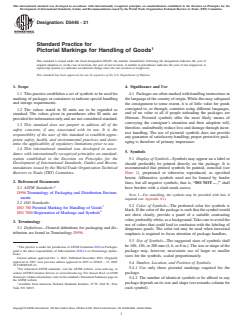
FUNCTION: To indicate (a) that the contents of the package are
fragile;
(b) that it has to be handled with care.
REMARKS: Place on at least two adjacent sides in upper corner.
When used with Symbol 2, that symbol shall be closest to corner
(see 2b).
ISO 7000/ No. 0621
SYMBOL 1 “Fragile Handle With Care”
5.4.3 When packages are formed into a unit load, locate
symbols so as to ensure they are visible (see Symbol 2).
5.4.4 Give particular attention to the correct application of
the marks. Faulty application may lead to misinterpretation.
Apply Symbols 4, 6, 7, and 32 in their correct respective
positions to convey their meanings clearly and fully.
6. Handling Instructions
6.1 Indicate handling instructions on packages by using the
corresponding symbols given in the remarks column of each
symbol. Symbol 1 contains two messages.
6.2 If necessary the cautionary basic text may appear below
thesymbolinEnglishorinthenationallanguageofthecountry
of destination, or both. However, to the extent possible,
instructions should be written in languages commonly used in
international trade.
7. Keywords
7.1 handling; packaging; pictorial markings; symbols
D5445 − 21
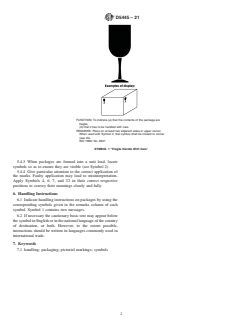
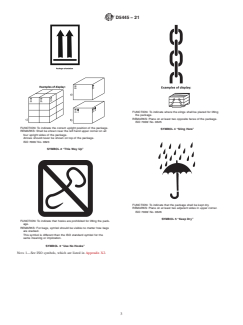
FUNCTION: To indicate where the slings shall be placed for lifting
the package.
REMARKS: Place on at least two opposite faces of the package.
ISO 7000/ No. 0625
FUNCTION: To indicate the correct upright position of the package.
SYMBOL 4 “Sling Here”
REMARKS: Shall be shown near the left hand upper corner on all
four upright sides of the package.
Arrows should never be shown on top of the package.
ISO 7000/ No. 0623
SYMBOL 2 “This Way Up”
FUNCTION: To indicate that the package shall be kept dry.
REMARKS: Place on at least two adjacent sides in upper corner.
ISO 7000/ No. 0626
SYMBOL 5 “Keep Dry”
FUNCTION: To indicate that hooks are prohibited for lifting the pack-
age.
REMARKS: For bags, symbol should be visible no matter how bags
are stacked.
This symbol is different than the ISO standard symbol for the
same meaning or implication.
SYMBOL 3 “Use No Hooks”
NOTE 1—See ISO symbols, which are listed in Appendix X2.
D5445 − 21
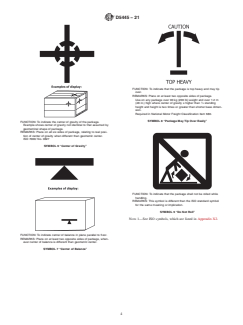
FUNCTION: To indicate that the package is top heavy and may tip
over.
REMARKS: Place on at least two opposite sides of package.
Use on any package over 90 kg (200 lb) weight and over 1.2 m
(48 in.) high where center of gravity s higher than ⁄2 standing
height and height is two times or greater than shorter base dimen-
sion.
Required in National Motor Freight Classification Item 680.
SYMBOL 8 “Package May Tip Over Easily”
FUNCTION: To indicate the center of gravity of the package.
Example shows center of gravity not identical to that assumed by
geometrical shape of package.
REMARKS: Place on all six sides of package, relating to real posi-
tion of center of gravity when different than geometric center.
ISO 7000/ No. 0627
SYMBOL 6 “Center of Gravity”
FUNCTION: To indicate that the package shall not be rolled while
handling.
REMARKS: This symbol is different than the ISO standard symbol
for the same meaning or implication.
SYMBOL 9 “Do Not Roll”
NOTE 1—See ISO symbols, which are listed in Appendix X2.
FUNCTION: To indicate center of balance in plane parallel to floor.
REMARKS: Place on at least two opposite sides of package, when-
ever center of balance is different than geometric center.
SYMBOL 7 “Center of Balance”
D5445 − 21
FUNCTION: To indicate that the package shall be kept away from
FUNCTION: To indicate the temperature limits within which the pack-
heat.
age shall be kept and handled.
REMARKS: The symbol, letters, and border must be black and the
REMARKS: ISO 7000/ No. 0632
background must be white, except for the starburst which must be
red.
SYMBOL 12 “Temperature Limits”
SYMBOL 10 “Keep Away from Heat”
FUNCTION: To indicate that the package shall be kept away from
FUNCTION: To indicate that stacking of the package is not allowed.
cold.
No other load shall be placed on any package with this symbol.
REMARKS: Use on at least two adjacent sides.
SYMBOL 11 “Keep Away from Cold”
This symbol is different than the ISO standard symbol for the
same meaning or implication.
SYMBOL 13 “Do Not Stack”
NOTE 1—See ISO symbols, which are listed in Appendix X2.
D5445 − 21
FUNCTION: To indicate where hand trucks shall not be placed when
handling the package.
REMARKS: Place on lower part of each side of package where
hand trucks are not to be used.
This symbol is different than the ISO standard symbol for the
same meaning or implication.
FUNCTION: To indicate the limited stacking possibilities of the pack-
age when like packages are placed on top.
SYMBOL 16 “No Hand Trucks Here”
REMARKS: Place on at least two adjacent sides, where N = number
of packages, maximum for stacking.
NOTE 1—See ISO symbols, which are listed in Appendix X2.
This symbol is different than the ISO standard symbol for the
same meaning or implication.
SYMBOL 14 “Stacking Limitation by Number”
NOTE 1—See ISO symbols, which are listed in Appendix X2.
FUNCTION: To indicate that the lift truck type depicted shall not be
used to handle the package.
REMARKS: Place on each side of package where the lift truck is
prohibited from handling.
This symbol is different than the ISO standard symbol for the
same meaning or implication.
SYMBOL 17 “D
...
This document is not an ASTM standard and is intended only to provide the user of an ASTM standard an indication of what changes have been made to the previous version. Because
it may not be technically possible to adequately depict all changes accurately, ASTM recommends that users consult prior editions as appropriate. In all cases only the current version
of the standard as published by ASTM is to be considered the official document.
Designation: D5445 − 15 D5445 − 21
Standard Practice for
Pictorial Markings for Handling of Goods
This standard is issued under the fixed designation D5445; the number immediately following the designation indicates the year of
original adoption or, in the case of revision, the year of last revision. A number in parentheses indicates the year of last reapproval. A
superscript epsilon (´) indicates an editorial change since the last revision or reapproval.
This standard has been approved for use by agencies of the U.S. Department of Defense.
1. Scope
1.1 This practice establishes a set of symbols to be used for marking of packages or containers to indicate special handling and
storage requirements.
1.2 The values stated in SI units are to be regarded as standard. The values given in parentheses after SI units are provided for
information only and are not considered standard.
1.3 This standard does not purport to address all of the safety concerns, if any, associated with its use. It is the responsibility
of the user of this standard to establish appropriate safety safety, health, and healthenvironmental practices and determine the
applicability of regulatory limitations prior to use.
1.4 This international standard was developed in accordance with internationally recognized principles on standardization
established in the Decision on Principles for the Development of International Standards, Guides and Recommendations issued
by the World Trade Organization Technical Barriers to Trade (TBT) Committee.
2. Referenced Documents
2.1 ASTM Standards:
D996 Terminology of Packaging and Distribution Environments
2.2 ISO Standards:
ISO 780 Pictorial Marking for Handling of Goods
ISO 7000 Registration of Markings and Symbols
3. Terminology
3.1 Definitions—General definitions for packaging and distribution are found in Terminology D996.
4. Significance and Use
4.1 Packages are often marked with handling instructions in the language of the country of origin. While this may safeguard the
consignment to some extent, it is of little value for goods consigned to, or through, countries using different languages, and of no
value at all if people unloading the packages are illiterate. Pictorial symbols offer the most likely means of conveying the
This practice is under the jurisdiction of ASTM Committee D10 on Packagingand is the direct responsibility of Subcommittee D10.11 on Terminology (definitions).
Current edition approved Sept. 1, 2015Oct. 1, 2021. Published September 2015December 2021. Originally approved in 1993. Last previous edition approved in 20112015
as D5445–11a. DOI: 10.1520/D5445-15. – 15. DOI: 10.1520/D5445-21.
For referenced ASTM standards, visit the ASTM website, www.astm.org, or contact ASTM Customer Service at service@astm.org. For Annual Book of ASTM Standards
volume information, refer to the standard’sstandard’s Document Summary page on the ASTM website.
Available from American National Standards Institute, 25 W. 43rd St., New York, NY 10017.
Copyright © ASTM International, 100 Barr Harbor Drive, PO Box C700, West Conshohocken, PA 19428-2959. United States
D5445 − 21
consignor’sconsignor’s intention and their adoption will, therefore, undoubtedly reduce loss and damage through incorrect
handling. The use of pictorial symbols does not provide any guarantee of satisfactory handling; proper protective packaging is
therefore of primary importance.
5. Symbols
5.1 Display of Symbols—Symbols may appear on a label or should preferably be printed directly on the package. It is
recommended that printed symbols be painted, stenciled (see Note 1), preprinted or otherwise reproduced, as specified herein.
Affirmative symbols need not be framed by border lines, but all negative symbols, that is, “DO NOT . ,” shall have borders with
a slash mark across.
NOTE 1—For stencilling, the symbols may be provided with bars if required (see Appendix X1).
5.2 Color of Symbols—The preferred color for symbols is black. If the color of the package is such that the symbol would not show
clearly, provide a panel of a suitable contrasting color, preferably white, as a background. Take care to avoid the use of colors that
could lead to confusion with the labeling of dangerous goods. The color red may be used when increased emphasis is required to
focus attention of package handlers.
5.3 Size of Symbols—The suggested sizes of symbols shall be 100, 150, or 200 mm (4, 6, or 8 in.). The size or shape of the package
may, however, necessitate use of larger or smaller sizes for the symbols, scaled proportionately.
5.4 Number, Location, and Position of Symbols:
5.4.1 Use only those pictorial markings required for the package.
5.4.2 The number of identical symbols to be affixed to any package depends on its size and shape (see remarks column for each
symbol).
5.4.3 When packages are formed into a unit load, locate symbols so as to ensure they are visible (see Symbol 2).
5.4.4 Give particular attention to the correct application of the marks. Faulty application may lead to misinterpretation. Apply
Symbols 4, 6, 7, and 32 in their correct respective positions to convey their meanings clearly and fully.
6. Handling Instructions
6.1 Indicate handling instructions on packages by using the corresponding symbols given in the remarks column of each symbol.
Symbol 1 contains two messages.
6.2 If necessary the cautionary basic text may appear below the symbol in English or in the national language of the country of
destination, or both. However, to the extent possible, instructions should be written in languages commonly used in international
trade.
7. Keywords
7.1 handling; packaging; pictorial markings; symbols
D5445 − 21
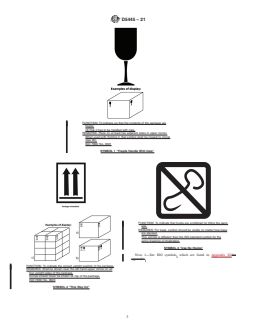
FUNCTION: To indicate (a) that the contents of the package are
fragile;
(b) that it has to be handled with care.
REMARKS: Place on at least two adjacent sides in upper corner.
When used with Symbol 2, that symbol shall be closest to corner
(see 2b).
ISO 7000/ No. 0621
SYMBOL 1 “Fragile Handle With Care”
FUNCTION: To indicate that hooks are prohibited for lifting the pack-
age.
REMARKS: For bags, symbol should be visible no matter how bags
are stacked.
This symbol is different than the ISO standard symbol for the
same meaning or implication.
SYMBOL 3 “Use No Hooks”
NOTE 1—See ISO symbols, which are listed in Appendix X2the
appendix.
FUNCTION: To indicate the correct upright position of the package.
REMARKS: Shall be shown near the left hand upper corner on all
four upright sides of the package.
Arrows should never be shown on top of the package.
ISO 7000/ No. 0623
SYMBOL 2 “This Way Up”
D5445 − 21
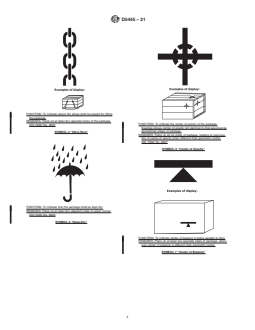
FUNCTION: To indicate where the slings shall be placed for lifting
the package.
REMARKS: Place on at least two opposite faces of the package.
FUNCTION: To indicate the center of gravity of the package.
ISO 7000/ No. 0625
Example shows center of gravity not identical to that assumed by
geometrical shape of package.
SYMBOL 4 “Sling Here”
REMARKS: Place on all six sides of package, relating to real posi-
tion of center of gravity when different than geometric center.
ISO 7000/ No. 0627
SYMBOL 6 “Center of Gravity”
FUNCTION: To indicate that the package shall be kept dry.
REMARKS: Place on at least two adjacent sides in upper corner.
ISO 7000/ No. 0626
SYMBOL 5 “Keep Dry”
FUNCTION: To indicate center of balance in plane parallel to floor.
REMARKS: Place on at least two opposite sides of package, when-
ever center of balance is different than geometric center.
SYMBOL 7 “Center of Balance”
D5445 − 21
FUNCTION: To indicate that the package is top heavy and may tip
over.
REMARKS: Place on at least two opposite sides of package.
Use on any package over 90 kg (200 lb) weight and over 1.2 m
(48 in.) high where center of gravity s higher than ⁄2 standing
height and height is two times or greater than shorter base dimen-
sion.
Required in National Motor Freight Classification Item 680.
FUNCTION: To indicate that the package shall be kept away from
heat.
SYMBOL 8 “Package May Tip Over Easily”
REMARKS: The symbol, letters, and border must be black and the
background must be white, except for the starburst which must be
red.
SYMBOL 10 “Keep Away from Heat”
FUNCTION: To indicate that the package shall not be rolled while
handling.
REMARKS: This symbol is different than the ISO standard symbol
for the same meaning or implication.
FUNCTION: To indicate that the package shall be kept away from
cold.
SYMBOL 9 “Do Not Roll”
SYMBOL 11 “Keep Away from Cold”
NOTE 1—See ISO symbols, which are listed in Appendix X2the
appendix.
D5445 − 21
FUNCTION: To indicate the limited stacking possibilities of the pack-
age when like packages are placed on top.
REMARKS: Place on at least two adjacent sides, where N = number
of packages, maximum for stacking.
This symbol is different than the ISO standard symbol for the
FUNCTION: To indicate the temperature limits within which the pack-
same meaning or implication.
age shall be kept and handled.
REMARKS: ISO 7000/ No. 0632
SYMBOL 14 “Stacking Limitation by Number”
SYMBOL 12 “Temperature Limits”
NOTE 1—See ISO symbols, which are listed in Appendix X2the
appendix.
FUNCTION: To indicate that stacking of the package is not allowed.
No other load shall be placed on any package with this symbol.
REMARKS: Use on at least two adjacent sides.
This symbol is different than the ISO standard symbol for the
FUNCTION: To indicate the limited stacking possibilities of the pack-
same meaning or implication.
age when unlike packages are placed on top.
REMARKS: Use on at least two adjacent sides.
SYMBOL 13 “Do Not Stack”
ISO 7000/ No. 0630
NOTE 1—See ISO symbols, which are listed in Appendix X2the
SYMBOL 15 “Stacking Limitation by Weight”
appendix.
D5445 − 21
FUNCTION: To indicate where hand trucks shall not be placed when
FUNCTION: To indicate that the lift truck type depicted shall not be
handling the package.
used to handle the package.
REMARKS: Place on lower part of each side of package where
REMARKS: Place on each side of package where the lift truck is
hand trucks are not to be used.
prohibited from handling.
This symbol is different than
...