

ASTM F2825-18
(Practice)Standard Practice for Climatic Stressing of Packaging Systems for Single Parcel Delivery
General Information
- Abstract
SIGNIFICANCE AND USE
5.1 This practice provides a method for conditioning packaging systems using climatic conditions that occur in actual distribution. The recommended exposure levels are based on available information on shipping, handling and storage environments, current industry practices, and published studies. They are not absolute extremes, but recorded daily averages in cold and hot climates of the world.
SCOPE
1.1 This practice provides a uniform basis for evaluating, in a laboratory, the ability of a packaging system to withstand a range of climatic stresses that a packaging system may be exposed to during distribution throughout the world and still provide the product protection from damage or alteration.
1.2 This practice is designed as conditioning prior to testing for overnight or two-day delivery systems of a single parcel packaging system or as a standalone test for climatic stressing of packaging systems.
Note 1: Practice F2825 climatic stressing or conditioning is short term in duration. Fiberboard containers are not expected to approach equilibrium moisture content at the climatic conditions used in Practice F2825. Therefore, Practice F2825 conditioning should not be used for distribution environments other than one- to two-day single parcel delivery as it may provide inaccurate or misleading test results for the fiberboard containers.
1.3 This practice does not cover refrigerated, frozen food storage, or cryogenic storage conditions. Only the climatic environments encountered in various regions of the world are covered by this practice.
1.4 The values stated in SI units are to be regarded as standard. No other units of measurement are included in this standard.
1.5 This standard does not purport to address all of the safety concerns, if any, associated with its use. It is the responsibility of the user of this standard to establish appropriate safety, health, and environmental practices and determine the applicability of regulatory limitations prior to use.
1.6 This international standard was developed in accordance with internationally recognized principles on standardization established in the Decision on Principles for the Development of International Standards, Guides and Recommendations issued by the World Trade Organization Technical Barriers to Trade (TBT) Committee.
- Status
- Published
- Publication Date
- 28-Feb-2018
- Technical Committee
- D10 - Packaging
Buy Documents


ASTM F2825-18 - Standard Practice for Climatic Stressing of Packaging Systems for Single Parcel Delivery


REDLINE ASTM F2825-18 - Standard Practice for Climatic Stressing of Packaging Systems for Single Parcel Delivery
Overview
ASTM F2825-18: Standard Practice for Climatic Stressing of Packaging Systems for Single Parcel Delivery establishes a uniform, laboratory-based method to evaluate packaging systems subjected to a range of climatic stresses encountered during overnight or two-day single parcel deliveries. Developed by ASTM International under Committee D10 on Packaging, this standard is an essential tool for packaging engineers, quality assurance teams, and logistics professionals focused on optimizing single parcel packaging performance in global shipping environments. The standard is based on documented daily atmospheric averages in hot, cold, humid, and dry climates worldwide, providing realistic, not extreme, test conditions.
Key Topics
Climatic Conditioning: The practice specifies a sequence of exposure to various temperature and humidity conditions simulating real-world distribution environments. Conditions such as cold, hot/dry, warm/humid, and controlled room environments are used for short-term testing, emulating the actual transit and handling cycles experienced by single parcel packages.
Scope and Applicability: The standard is specifically designed for short-term climatic stressing in one- to two-day distribution systems typical of express and e-commerce delivery. It is not suitable for extended storage, refrigerated, frozen, or cryogenic systems.
Test Methodology:
- Defines packaging system, modes, and durations of transport.
- Establishes test plans based on outlined climatic sequences.
- Emphasizes accurate documentation of all test variables and environmental parameters.
- Provides guidance on suitable test apparatus, including controlled environment chambers and precise humidity/temperature measurement devices.
Reporting Requirements: ASTM F2825-18 details the key factors to include in test reports, such as exposure conditions, preconditioning details, test results, and compliance statements.
Applications
Practical applications of ASTM F2825-18 include:
- Packaging System Evaluation: Enables manufacturers and shippers to validate the robustness of packaging designs for e-commerce, pharmaceuticals, electronics, or other products sensitive to environmental factors during fast delivery.
- Quality Assurance: Supports routine quality control by providing repeatable laboratory conditioning steps prior to physical package testing, ensuring packaging systems reliably protect their contents throughout typical transit conditions.
- Regulatory and Industry Compliance: Assists companies in meeting customer and regulatory requirements for package testing by following a globally recognized standard.
- Optimization: Allows logistics and packaging teams to refine materials and designs by revealing performance weaknesses under a variety of short-term climatic stresses.
- Documentation and Traceability: The standard's thorough reporting framework improves traceability and communication among manufacturers, suppliers, and customers.
Related Standards
Implementing ASTM F2825-18 can be complemented by referencing other key standards:
- ASTM D996 - Terminology of Packaging and Distribution Environments: Provides definitions for packaging and shipping environments used within ASTM F2825-18.
- ASTM D4332 - Practice for Conditioning Containers, Packages, or Packaging Components for Testing: Offers broader approaches to temperature and humidity preconditioning for packages.
- ASTM E337 - Test Method for Measuring Humidity with a Psychrometer: Useful for accurate humidity measurement in climatic chambers.
- ASTM F17 - Terminology Relating to Primary Barrier Packaging: Covers terms specific to packaging designed to protect the product.
- ISO 2233 - Packaging-Complete, Filled Transport Packages: Conditioning for Testing: International alignment for conditioning transport packages before performance testing.
ASTM F2825-18 is a critical resource for achieving reliable, real-world performance validation of packaging systems designed for rapid, single parcel delivery under a wide variety of global climatic conditions. It enhances both the sustainability and integrity of products throughout the supply chain.
Relations
- Effective Date
- 01-Mar-2018
- Effective Date
- 01-May-2020
- Effective Date
- 01-Oct-2018
- Effective Date
- 15-Aug-2018
- Effective Date
- 01-Jun-2017
- Effective Date
- 01-Aug-2013
- Effective Date
- 15-Apr-2013
- Effective Date
- 15-Mar-2013
- Effective Date
- 01-Nov-2012
- Effective Date
- 01-Dec-2010
- Effective Date
- 01-Aug-2008
- Effective Date
- 01-Oct-2007
- Effective Date
- 01-Sep-2007
- Effective Date
- 01-May-2007
- Effective Date
- 01-Dec-2006
Buy Documents
ASTM F2825-18 - Standard Practice for Climatic Stressing of Packaging Systems for Single Parcel Delivery
REDLINE ASTM F2825-18 - Standard Practice for Climatic Stressing of Packaging Systems for Single Parcel Delivery
Get Certified
Connect with accredited certification bodies for this standard

BRCGS (Brand Reputation Compliance Global Standards)
Global food safety and quality standards owner.
Sponsored listings
Frequently Asked Questions
ASTM F2825-18 is a standard published by ASTM International. Its full title is "Standard Practice for Climatic Stressing of Packaging Systems for Single Parcel Delivery". This standard covers: SIGNIFICANCE AND USE 5.1 This practice provides a method for conditioning packaging systems using climatic conditions that occur in actual distribution. The recommended exposure levels are based on available information on shipping, handling and storage environments, current industry practices, and published studies. They are not absolute extremes, but recorded daily averages in cold and hot climates of the world. SCOPE 1.1 This practice provides a uniform basis for evaluating, in a laboratory, the ability of a packaging system to withstand a range of climatic stresses that a packaging system may be exposed to during distribution throughout the world and still provide the product protection from damage or alteration. 1.2 This practice is designed as conditioning prior to testing for overnight or two-day delivery systems of a single parcel packaging system or as a standalone test for climatic stressing of packaging systems. Note 1: Practice F2825 climatic stressing or conditioning is short term in duration. Fiberboard containers are not expected to approach equilibrium moisture content at the climatic conditions used in Practice F2825. Therefore, Practice F2825 conditioning should not be used for distribution environments other than one- to two-day single parcel delivery as it may provide inaccurate or misleading test results for the fiberboard containers. 1.3 This practice does not cover refrigerated, frozen food storage, or cryogenic storage conditions. Only the climatic environments encountered in various regions of the world are covered by this practice. 1.4 The values stated in SI units are to be regarded as standard. No other units of measurement are included in this standard. 1.5 This standard does not purport to address all of the safety concerns, if any, associated with its use. It is the responsibility of the user of this standard to establish appropriate safety, health, and environmental practices and determine the applicability of regulatory limitations prior to use. 1.6 This international standard was developed in accordance with internationally recognized principles on standardization established in the Decision on Principles for the Development of International Standards, Guides and Recommendations issued by the World Trade Organization Technical Barriers to Trade (TBT) Committee.
SIGNIFICANCE AND USE 5.1 This practice provides a method for conditioning packaging systems using climatic conditions that occur in actual distribution. The recommended exposure levels are based on available information on shipping, handling and storage environments, current industry practices, and published studies. They are not absolute extremes, but recorded daily averages in cold and hot climates of the world. SCOPE 1.1 This practice provides a uniform basis for evaluating, in a laboratory, the ability of a packaging system to withstand a range of climatic stresses that a packaging system may be exposed to during distribution throughout the world and still provide the product protection from damage or alteration. 1.2 This practice is designed as conditioning prior to testing for overnight or two-day delivery systems of a single parcel packaging system or as a standalone test for climatic stressing of packaging systems. Note 1: Practice F2825 climatic stressing or conditioning is short term in duration. Fiberboard containers are not expected to approach equilibrium moisture content at the climatic conditions used in Practice F2825. Therefore, Practice F2825 conditioning should not be used for distribution environments other than one- to two-day single parcel delivery as it may provide inaccurate or misleading test results for the fiberboard containers. 1.3 This practice does not cover refrigerated, frozen food storage, or cryogenic storage conditions. Only the climatic environments encountered in various regions of the world are covered by this practice. 1.4 The values stated in SI units are to be regarded as standard. No other units of measurement are included in this standard. 1.5 This standard does not purport to address all of the safety concerns, if any, associated with its use. It is the responsibility of the user of this standard to establish appropriate safety, health, and environmental practices and determine the applicability of regulatory limitations prior to use. 1.6 This international standard was developed in accordance with internationally recognized principles on standardization established in the Decision on Principles for the Development of International Standards, Guides and Recommendations issued by the World Trade Organization Technical Barriers to Trade (TBT) Committee.
ASTM F2825-18 is classified under the following ICS (International Classification for Standards) categories: 55.040 - Packaging materials and accessories. The ICS classification helps identify the subject area and facilitates finding related standards.
ASTM F2825-18 has the following relationships with other standards: It is inter standard links to ASTM F2825-10(2015), ASTM F17-20, ASTM F17-18a, ASTM F17-18, ASTM F17-17, ASTM F17-13a, ASTM F17-13, ASTM D4332-13, ASTM F17-12, ASTM D996-10a, ASTM F17-08, ASTM E337-02(2007), ASTM F17-07a, ASTM F17-07, ASTM F17-06. Understanding these relationships helps ensure you are using the most current and applicable version of the standard.
ASTM F2825-18 is available in PDF format for immediate download after purchase. The document can be added to your cart and obtained through the secure checkout process. Digital delivery ensures instant access to the complete standard document.
Standards Content (Sample)
This international standard was developed in accordance with internationally recognized principles on standardization established in the Decision on Principles for the
Development of International Standards, Guides and Recommendations issued by the World Trade Organization Technical Barriers to Trade (TBT) Committee.
Designation: F2825 − 18
Standard Practice for
Climatic Stressing of Packaging Systems for Single Parcel
Delivery
This standard is issued under the fixed designation F2825; the number immediately following the designation indicates the year of
original adoption or, in the case of revision, the year of last revision. A number in parentheses indicates the year of last reapproval. A
superscript epsilon (´) indicates an editorial change since the last revision or reapproval.
1. Scope 2. Referenced Documents
2.1 ASTM Standards:
1.1 This practice provides a uniform basis for evaluating, in
D996 Terminology of Packaging and Distribution Environ-
a laboratory, the ability of a packaging system to withstand a
ments
range of climatic stresses that a packaging system may be
D4332 Practice for Conditioning Containers, Packages, or
exposed to during distribution throughout the world and still
Packaging Components for Testing
provide the product protection from damage or alteration.
E337 Test Method for Measuring Humidity with a Psy-
1.2 This practice is designed as conditioning prior to testing
chrometer (the Measurement of Wet- and Dry-Bulb Tem-
for overnight or two-day delivery systems of a single parcel
peratures)
packaging system or as a standalone test for climatic stressing
F17 Terminology Relating to Primary Barrier Packaging
of packaging systems.
2.2 ISO Standard:
NOTE1—PracticeF2825climaticstressingorconditioningisshortterm ISO 2233 Packaging—Complete,FilledTransportPackages:
in duration. Fiberboard containers are not expected to approach equilib-
Conditioning for Testing
rium moisture content at the climatic conditions used in Practice F2825.
Therefore,PracticeF2825conditioningshouldnotbeusedfordistribution 3. Terminology
environments other than one- to two-day single parcel delivery as it may
3.1 Definitions:
provide inaccurate or misleading test results for the fiberboard containers.
3.1.1 Fordefinitionsusedinthispractice,seeTerminologies
1.3 This practice does not cover refrigerated, frozen food
D996 and F17.
storage, or cryogenic storage conditions. Only the climatic
3.1.2 climatic stressing—exposing packaging system test
environments encountered in various regions of the world are
samples to conditions of temperature and humidity for a
covered by this practice.
specified period of time which would simulate expected
1.4 The values stated in SI units are to be regarded as
conditions seen in the defined storage and distribution system.
standard. No other units of measurement are included in this
4. Summary of Practice
standard.
4.1 Products shipped through the distribution environment,
1.5 This standard does not purport to address all of the
regardless of mode of transportation, encounter various cli-
safety concerns, if any, associated with its use. It is the
matic and physical environments as they pass through different
responsibility of the user of this standard to establish appro-
parts of the world at various times of the year. This practice is
priate safety, health, and environmental practices and deter-
designed to provide guidance when establishing the climatic
mine the applicability of regulatory limitations prior to use.
stressesimpartedtopackagingsystemsusingexpectedclimatic
1.6 This international standard was developed in accor-
conditions and durations that they can encounter in distribution
dance with internationally recognized principles on standard-
in order to evaluate its ability to provide protection to the
ization established in the Decision on Principles for the
package contents or devices.
Development of International Standards, Guides and Recom-
mendations issued by the World Trade Organization Technical 5. Significance and Use
Barriers to Trade (TBT) Committee.
5.1 This practice provides a method for conditioning pack-
aging systems using climatic conditions that occur in actual
1 2
This practice is under the jurisdiction ofASTM Committee D10 on Packaging For referenced ASTM standards, visit the ASTM website, www.astm.org, or
andisthedirectresponsibilityofSubcommitteeD10.21onShippingContainersand contact ASTM Customer Service at service@astm.org. For Annual Book of ASTM
Systems - Application of Performance Test Methods. Standards volume information, refer to the standard’s Document Summary page on
Current edition approved March 1, 2018. Published April 2018. Originally the ASTM website.
approved in 2010. Last previous edition approved in 2015 as F2825 – 10(2015). Available fromAmerican National Standards Institute (ANSI), 25 W. 43rd St.,
DOI: 10.1520/F2825–18. 4th Floor, New York, NY 10036, http://www.ansi.org.
Copyright © ASTM International, 100 Barr Harbor Drive, PO Box C700, West Conshohocken, PA 19428-2959. United States
F2825 − 18
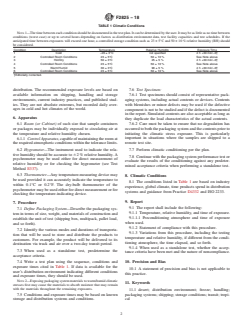
TABLE 1 Climatic Conditions
NOTE1—Thetimebetweeneachconditionshouldbedocumentedinthetestplan.Itcanbedeterminedbytheuser.Itmaybeaslittleasnotimebetween
conditions (worst case) or up to several hours depending on factors as distribution environment data, test facility capacities and test schedules. If the
anticipated time between exposures will exceed one hour, a controlled storage condition such as 23 ± 5°C and 50 ± 10 % relative humidity (RH) should
be considered.
Condition Description Temperature Relative Humidity Exposure Time
1 Cold –20 ± 3°C not specified 4 h +30 min/–0†
2 Controlled Room Conditions 23 ± 5°C 50 ± 10 % See Note above
3 Hot/Dry 50 ± 3°C 25 ± 5 % 4 h +30 min/–0†
4 Controlled Room Conditions 23 ± 5°C 50 ± 10 % See Note above
5 Warm/Humid 30 ± 3°C 90 ± 5 % 4 h +30 min/–0†
6 Controlled Room Conditions 23 ± 5°C 50 ± 10 % See Note above
†Editorially corrected.
distribution. The recommended exposure levels are b
...
This document is not an ASTM standard and is intended only to provide the user of an ASTM standard an indication of what changes have been made to the previous version. Because
it may not be technically possible to adequately depict all changes accurately, ASTM recommends that users consult prior editions as appropriate. In all cases only the current version
of the standard as published by ASTM is to be considered the official document.
Designation: F2825 − 10 (Reapproved 2015) F2825 − 18
Standard Practice for
Climatic Stressing of Packaging Systems for Single Parcel
Delivery
This standard is issued under the fixed designation F2825; the number immediately following the designation indicates the year of
original adoption or, in the case of revision, the year of last revision. A number in parentheses indicates the year of last reapproval. A
superscript epsilon (´) indicates an editorial change since the last revision or reapproval.
1. Scope
1.1 This practice provides a uniform basis for evaluating, in a laboratory, the ability of a packaging system to withstand a range
of climatic stresses that a packaging system may be exposed to during distribution throughout the world and still provide the
product protection from damage or alteration.
1.2 This practice is designed as conditioning prior to testing for overnight or two-day delivery systems of a single parcel
packaging system or as a standalone test for climatic stressing of packaging systems.
NOTE 1—Practice F2825 climatic stressing or conditioning is short term in duration. Fiberboard containers are not expected to approach equilibrium
moisture content at the climatic conditions used in Practice F2825. Therefore, Practice F2825 conditioning should not be used for distribution
environments other than one- to two-day single parcel delivery as it may provide inaccurate or misleading test results for the fiberboard containers.
1.3 This practice does not cover refrigerated, frozen food storage, or cryogenic storage conditions. Only the climatic
environments encountered in various regions of the world are covered by this practice.
1.4 The values stated in SI units are to be regarded as standard. No other units of measurement are included in this standard.
1.5 The values stated in inch-pound units are to be regarded as standard. The values given in parentheses are mathematical
conversions to SI units that are provided for information only and are not considered standard.This standard does not purport to
address all of the safety concerns, if any, associated with its use. It is the responsibility of the user of this standard to establish
appropriate safety, health, and environmental practices and determine the applicability of regulatory limitations prior to use.
1.6 This international standard was developed in accordance with internationally recognized principles on standardization
established in the Decision on Principles for the Development of International Standards, Guides and Recommendations issued
by the World Trade Organization Technical Barriers to Trade (TBT) Committee.
2. Referenced Documents
2.1 ASTM Standards:
D996 Terminology of Packaging and Distribution Environments
D4332 Practice for Conditioning Containers, Packages, or Packaging Components for Testing
E337 Test Method for Measuring Humidity with a Psychrometer (the Measurement of Wet- and Dry-Bulb Temperatures)
F17 Terminology Relating to Primary Barrier Packaging
2.2 ISO Standard:
ISO 2233 Packaging—Complete, Filled Transport Packages: Conditioning for Testing
3. Terminology
3.1 Definitions:
3.1.1 For definitions used in this practice, see Terminologies D996 and F17.
3.1.2 climatic stressing—exposing packaging system test samples to conditions of temperature and humidity for a specified
period of time which would simulate expected conditions seen in the defined storage and distribution system.
This practice is under the jurisdiction of ASTM Committee D10 on Packaging and is the direct responsibility of Subcommittee D10.21 on Shipping Containers and
Systems - Application of Performance Test Methods.
Current edition approved Oct. 1, 2015March 1, 2018. Published October 2015April 2018. Originally approved in 2010. Last previous edition approved in 20102015 as
ϵ1
F2825 – 10 .(2015). DOI: 10.1520/F2825–10R15.10.1520/F2825–18.
For referenced ASTM standards, visit the ASTM website, www.astm.org, or contact ASTM Customer Service at service@astm.org. For Annual Book of ASTM Standards
volume information, refer to the standard’s Document Summary page on the ASTM website.
Available from American National Standards Institute (ANSI), 25 W. 43rd St., 4th Floor, New York, NY 10036, http://www.ansi.org.
Copyright © ASTM International, 100 Barr Harbor Drive, PO Box C700, West Conshohocken, PA 19428-2959. United States
F2825 − 18
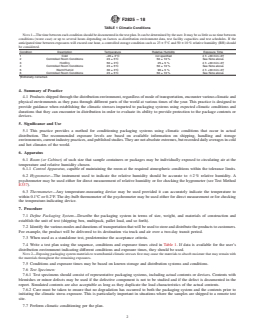
TABLE 1 Climatic Conditions
NOTE 1—The time between each condition should be documented in the test plan. It can be determined by the user. It may be as little as no time between
conditions (worst case) or up to several hours depending on factors as distribution environment data, test facility capacities and test schedules. If the
anticipated time between exposures will exceed one hour, a controlled storage condition such as 23 ± 5°C and 50 ± 10 % relative humidity (RH) should
be considered.
Condition Description Temperature Relative Humidity Exposure Time
1 Cold –20 ± 3°C not specified 4 h +30 min/–0†
2 Controlled Room Conditions 23 ± 5°C 50 ± 10 % See Note above
3 Hot/Dry 50 ± 3°C 25 ± 5 % 4 h +30 min/–0†
4 Controlled Room Conditions 23 ± 5°C 50 ± 10 % See Note above
5 Warm/Humid 30 ± 3°C 90 ± 5 % 4 h +30 min/–0†
6 Controlled Room Conditions 23 ± 5°C 50 ± 10 % See Note above
†Editorially corrected.
4. Summary of Practice
4.1 Products shipped through the distribution environment, regardless of mode of transportation, encounter various climatic and
physical environments as they pass through different parts of the world at various times of the year. This practice is designed to
provide guidance when establishing the climatic stresses imparted to packaging systems using expected climatic conditions and
durations that they can encounter in distribution in order to evaluate its ability to provide protection to the pack
...