


ASTM G100-89(2015)
(Test Method)Standard Test Method for Conducting Cyclic Galvanostaircase Polarization
Standard Test Method for Conducting Cyclic Galvanostaircase Polarization
SIGNIFICANCE AND USE
3.1 In this test method, susceptibility to localized corrosion of aluminum is indicated by a protection potential (Eprot) determined by cyclic galvanostaircase polarization (1). The more noble this potential, the less susceptible is the alloy to initiation of localized corrosion. The results of this test method are not intended to correlate in a quantitative manner with the rate of propagation of localized corrosion that one might observe in service.
3.2 The breakdown (Eb), and protection potentials (Eprot) determined by the cyclic GSCP method correlate with the constant potential corrosion test (immersion-glassware) result for aluminum (1, 6, 7). When the applied potential was more negative than the GSCP Eprot, no pit initiation was observed. When the applied potential was more positive than the GSCP Eprot, pitting occurred even when the applied potential was less negative than Eb.
3.2.1 Severe crevice corrosion occurred when the separation of Eb and Eprot was 500 mV or greater and Eprot was less than −400 mV Vs. SCE (in 100 ppm NaCl) (1, 6, 8). For aluminum, Eprot determined by cyclic GSCP agrees with the repassivation potential determined by the scratch potentiostatic method (1, 9). Both the scratch potentiostatic method and the constant potential technique for determination of Eprot require much longer test times and are more involved techniques than the GSCP method.
3.3 DeBerry and Viebeck (3-5) found that the breakdown potentials (Eb) (galvanodynamic polarization, similar to GSCP but no kinetic information) had a good correlation with the inhibition of localized corrosion of 304L stainless steel by surface active compounds. They attained accuracy and precision by avoiding the strong induction effect which they observed by the potentiodynamic technique.
3.4 If this test method is followed using the specific alloy discussed it will provide (GSCP) measurements that will reproduce data developed at other times in other laboratories.
3.5 Eb and Epro...
SCOPE
1.1 This test method covers a procedure for conducting cyclic galvanostaircase polarization (GSCP) to determine relative susceptibility to localized corrosion (pitting and crevice corrosion) for aluminum alloy 3003-H14 (UNS A93003) (1).2 It may serve as guide for examination of other alloys (2-5). This test method also describes a procedure that can be used as a check for one's experimental technique and instrumentation.
1.2 The values stated in SI units are to be regarded as standard. No other units of measurement are included in this standard.
1.3 This standard does not purport to address all of the safety concerns, if any, associated with its use. It is the responsibility of the user of this standard to establish appropriate safety and health practices and determine the applicability of regulatory limitations prior to use.
General Information
Buy Standard
Standards Content (Sample)
NOTICE: This standard has either been superseded and replaced by a new version or withdrawn.
Contact ASTM International (www.astm.org) for the latest information
Designation: G100 − 89 (Reapproved 2015)
Standard Test Method for
Conducting Cyclic Galvanostaircase Polarization
This standard is issued under the fixed designation G100; the number immediately following the designation indicates the year of
original adoption or, in the case of revision, the year of last revision.Anumber in parentheses indicates the year of last reapproval.A
superscript epsilon (´) indicates an editorial change since the last revision or reapproval.
1. Scope determined by cyclic galvanostaircase polarization (1). The
more noble this potential, the less susceptible is the alloy to
1.1 This test method covers a procedure for conducting
initiationoflocalizedcorrosion.Theresultsofthistestmethod
cyclic galvanostaircase polarization (GSCP) to determine rela-
are not intended to correlate in a quantitative manner with the
tive susceptibility to localized corrosion (pitting and crevice
2 rate of propagation of localized corrosion that one might
corrosion) for aluminum alloy 3003-H14 (UNSA93003) (1).
observe in service.
It may serve as guide for examination of other alloys (2-5).
Thistestmethodalsodescribesaprocedurethatcanbeusedas 3.2 The breakdown (E ), and protection potentials (E )
b prot
a check for one’s experimental technique and instrumentation. determined by the cyclic GSCP method correlate with the
constant potential corrosion test (immersion-glassware) result
1.2 The values stated in SI units are to be regarded as
for aluminum (1, 6, 7). When the applied potential was more
standard. No other units of measurement are included in this
negative than the GSCP E , no pit initiation was observed.
prot
standard.
When the applied potential was more positive than the GSCP
1.3 This standard does not purport to address all of the
E ,pittingoccurredevenwhentheappliedpotentialwasless
prot
safety concerns, if any, associated with its use. It is the
negative than E .
b
responsibility of the user of this standard to establish appro-
3.2.1 Severecrevicecorrosionoccurredwhentheseparation
priate safety and health practices and determine the applica-
of E and E was 500 mV or greater and E was less
b prot prot
bility of regulatory limitations prior to use.
than−400 mV Vs. SCE (in 100 ppm NaCl) (1, 6, 8). For
aluminum, E determined by cyclic GSCP agrees with the
prot
2. Referenced Documents
repassivationpotentialdeterminedbythescratchpotentiostatic
2.1 ASTM Standards:
method (1, 9). Both the scratch potentiostatic method and the
D1193Specification for Reagent Water
constant potential technique for determination of E require
prot
G1Practice for Preparing, Cleaning, and Evaluating Corro-
much longer test times and are more involved techniques than
sion Test Specimens
the GSCP method.
G5Reference Test Method for Making Potentiodynamic
3.3 DeBerry and Viebeck (3-5) found that the breakdown
Anodic Polarization Measurements
potentials (E ) (galvanodynamic polarization, similar to GSCP
b
G59TestMethodforConductingPotentiodynamicPolariza-
but no kinetic information) had a good correlation with the
tion Resistance Measurements
inhibition of localized corrosion of 304L stainless steel by
G69Test Method for Measurement of Corrosion Potentials
surface active compounds. They attained accuracy and preci-
of Aluminum Alloys
sion by avoiding the strong induction effect which they
observed by the potentiodynamic technique.
3. Significance and Use
3.4 If this test method is followed using the specific alloy
3.1 In this test method, susceptibility to localized corrosion
discussed it will provide (GSCP) measurements that will
of aluminum is indicated by a protection potential (E )
prot
reproduce data developed at other times in other laboratories.
3.5 E and E obtainedarebasedontheresultsfromeight
b prot
This test method is under the jurisdiction of ASTM Committee G01 on
different laboratories that followed the standard procedure
Corrosion of Metals and is the direct responsibility of Subcommittee G01.11 on
Electrochemical Measurements in Corrosion Testing.
using aluminum alloy 3003-H14 (UNS A93003). E and E
b prot
Current edition approved Nov. 1, 2015. Published December 2015. Originally
are included with statistical analysis to indicate the acceptable
ɛ1
approved in 1989. Last previous edition approved in 2010 as G100–89(2010) .
range.
DOI: 10.1520/G0100-89R15.
The boldface numbers in parentheses refer to a list of references at the end of
4. Apparatus
this standard.
For referenced ASTM standards, visit the ASTM website, www.astm.org, or
4.1 Cell—The cell should be constructed of inert materials
contact ASTM Customer Service at service@astm.org. For Annual Book of ASTM
such as borosilicate glass and PTFE fluorocarbon. It should
Standards volume information, refer to the standard’s Document Summary page on
the ASTM website. have ports for the insertion of a working electrode (1 cm flat
Copyright © ASTM International, 100 Barr Harbor Drive, PO Box C700, West Conshohocken, PA 19428-2959. United States
G100 − 89 (2015)
specimen holder using PTFE gasket (no crevice type) (Note 1)
so that 1 cm is exposed to the test solution.Apply 29 m-g of
torque.
4.3.2 Auxiliary Electrodes—Graphite, (ultrafine grade)
(Note 3).
NOTE 3—Coarse grades of graphite should be avoided because they
absorb solute impurities. Ultrafine grades are available from spectro-
graphic supply companies.
4.3.3 Reference Electrode—Saturated calomel (Note 1). It
should be checked against another reference which has not
been exposed to test solutions and they should be within 3 mV
of each other. Practice G69 round robin test conducted by
G01.11 (unpublished results) indicate that potential difference
should not exceed 2 or 3 mV. The reference electrode is
connected to the test bridge solution which consists of 75%
saturated KCl, prepared by adding 1 part (by volume) of
distilled water to 3 parts saturated KCl. When the bridge is in
active use, the bridge solution should be replaced once each
day and the bridge tip immersed in this solution when not in
use. Any test solution that does not deposit films may also be
usedinthebridge.(TheVYCOR tip should notbeallowedto
go to dryness.)
4.4 Magnetic Stirrer.
5. Procedure
5.1 Test solution, 3000 6 30 ppm (0.0513 M) NaCl. For
FIG. 1 Schematic Wiring Diagram for Galvanostaircase Polariza-
example, transfer 6.000 g reagent grade NaCl to a 2-L
tion
volumetric flask. Dissolve in ASTM Type IV water (deminer-
alized or distilled) and dilute to the mark. (See Specification
D1193.)
specimen holder (Note 1) is very convenient), two auxiliary 5.2 Assemble cell with the electrodes described in Section
electrodes, salt bridge for reference electrode, and a thermom-
4.Placethereferencebridgeprobeabout2probetipdiameters
eterorathermostatprobefortemperaturecontrol.Thefigurein away from the working electrode.
Test Method G5 would be satisfactory, but a flat bottom cell is
5.3 Fill the cell with the test solution so that the level is
also satisfactory provided that all of the essential ports are
about 25 mm above the working electrode.
provided. (See Ref (10) for details.)
5.4 Maintain a temperature of 25 6 1°C.
NOTE 1—These specific recommendations and conditions were fol-
5.5 Do not deaerate.
lowed to improve the interlaboratory precision during the round robin for
galvanostaircase polarization.
5.6 Turn on the magnetic s
...
This document is not an ASTM standard and is intended only to provide the user of an ASTM standard an indication of what changes have been made to the previous version. Because
it may not be technically possible to adequately depict all changes accurately, ASTM recommends that users consult prior editions as appropriate. In all cases only the current version
of the standard as published by ASTM is to be considered the official document.
´1
Designation: G100 − 89 (Reapproved 2010) G100 − 89 (Reapproved 2015)
Standard Test Method for
Conducting Cyclic Galvanostaircase Polarization
This standard is issued under the fixed designation G100; the number immediately following the designation indicates the year of
original adoption or, in the case of revision, the year of last revision. A number in parentheses indicates the year of last reapproval. A
superscript epsilon (´) indicates an editorial change since the last revision or reapproval.
ε NOTE—Clarified the SI unit statement editorially in May 2010.
1. Scope
1.1 This test method covers a procedure for conducting cyclic galvanostaircase polarization (GSCP) to determine relative
susceptibility to localized corrosion (pitting and crevice corrosion) for aluminum alloy 3003-H14 (UNS A93003) (1). It may serve
as guide for examination of other alloys (2-5). This test method also describes a procedure that can be used as a check for one’s
experimental technique and instrumentation.
1.2 The values stated in SI units are to be regarded as standard. No other units of measurement are included in this standard.
1.3 This standard does not purport to address all of the safety concerns, if any, associated with its use. It is the responsibility
of the user of this standard to establish appropriate safety and health practices and determine the applicability of regulatory
limitations prior to use.
2. Referenced Documents
2.1 ASTM Standards:
D1193 Specification for Reagent Water
G1 Practice for Preparing, Cleaning, and Evaluating Corrosion Test Specimens
G5 Reference Test Method for Making Potentiodynamic Anodic Polarization Measurements
G59 Test Method for Conducting Potentiodynamic Polarization Resistance Measurements
G69 Test Method for Measurement of Corrosion Potentials of Aluminum Alloys
3. Significance and Use
3.1 In this test method, susceptibility to localized corrosion of aluminum is indicated by a protection potential (E ) determined
prot
by cyclic galvanostaircase polarization (1). The more noble this potential, the less susceptible is the alloy to initiation of localized
corrosion. The results of this test method are not intended to correlate in a quantitative manner with the rate of propagation of
localized corrosion that one might observe in service.
3.2 The breakdown (E ), and protection potentials (E ) determined by the cyclic GSCP method correlate with the constant
b prot
potential corrosion test (immersion-glassware) result for aluminum (1, 6, 7). When the applied potential was more negative than
the GSCP E , no pit initiation was observed. When the applied potential was more positive than the GSCP E , pitting occurred
prot prot
even when the applied potential was less negative than E .
b
3.2.1 Severe crevice corrosion occurred when the separation of E and E was 500 mV or greater and E was less than −400
b prot prot
mV Vs. SCE (in 100 ppm NaCl) (1, 6, 8). For aluminum, E determined by cyclic GSCP agrees with the repassivation potential
prot
determined by the scratch potentiostatic method (1, 9). Both the scratch potentiostatic method and the constant potential technique
for determination of E require much longer test times and are more involved techniques than the GSCP method.
prot
3.3 DeBerry and Viebeck (3-5) found that the breakdown potentials (E ) (galvanodynamic polarization, similar to GSCP but no
b
kinetic information) had a good correlation with the inhibition of localized corrosion of 304L stainless steel by surface active
compounds. They attained accuracy and precision by avoiding the strong induction effect which they observed by the
potentiodynamic technique.
This test method is under the jurisdiction of ASTM Committee G01 on Corrosion of Metals and is the direct responsibility of Subcommittee G01.11 on Electrochemical
Measurements in Corrosion Testing.
Current edition approved May 1, 2010Nov. 1, 2015. Published May 2010December 2015. Originally approved in 1989. Last previous edition approved in 20042010 as
ɛ1
G100–89(2004).G100–89(2010) . DOI: 10.1520/G0100-89R10E01.10.1520/G0100-89R15.
The boldface numbers in parentheses refer to a list of references at the end of this standard.
For referenced ASTM standards, visit the ASTM website, www.astm.org, or contact ASTM Customer Service at service@astm.org. For Annual Book of ASTM Standards
volume information, refer to the standard’s Document Summary page on the ASTM website.
Copyright © ASTM International, 100 Barr Harbor Drive, PO Box C700, West Conshohocken, PA 19428-2959. United States
G100 − 89 (2015)
FIG. 1 Schematic Wiring Diagram for Galvanostaircase Polarization
3.4 If this test method is followed using the specific alloy discussed it will provide (GSCP) measurements that will reproduce
data developed at other times in other laboratories.
3.5 E and E obtained are based on the results from eight different laboratories that followed the standard procedure using
b prot
aluminum alloy 3003-H14 (UNS A93003). E and E are included with statistical analysis to indicate the acceptable range.
b prot
4. Apparatus
4.1 Cell—The cell should be constructed of inert materials such as borosilicate glass and PTFE fluorocarbon. It should have
ports for the insertion of a working electrode (1 cm flat specimen holder (Note 1) is very convenient), two auxiliary electrodes,
salt bridge for reference electrode, and a thermometer or a thermostat probe for temperature control. The figure in Test Method
G5 would be satisfactory, but a flat bottom cell is also satisfactory provided that all of the essential ports are provided. (See Ref
(10) for details.)
NOTE 1—These specific recommendations and conditions were followed to improve the interlaboratory precision during the round robin for
galvanostaircase polarization.
4.2 Current Staircase Generator and Recorder—The schematic diagram of the apparatus is given in Fig. 1. The recorder may
be replaced by a plotter if the current staircase signal is generated with the aid of a computer. The current staircase may be
generated manually (Note 2) but this is not recommended. The most convenient current staircase generators are found in recent
commercial potentiostats where the software is available. The electrical equipment may be checked in accordance with the
procedure in Practice G59.
NOTE 2—The current staircase signal was generated manually in the round robin because automated system or software was not available when this
project was started.
4.3 Electrodes:
4.3.1 Working Electrode—For generating data to be compared to the reference data included herein, use type 3003-H14 (UNS
A93003) A1 in sheet form. Cut 1.55 cm diameter circles and prepare in accordance with Practice G1 using 600-grit diamond slurry
on a flat lapping machine. Install in flat specimen holder using PTFE gasket (no crevice type) (Note 1) so that 1 cm is exposed
to the test solution. Apply 29 m-g of torque.
4.3.2 Auxiliary Electrodes—Graphite, (ultrafine grade) (Note 3).
NOTE 3—Coarse grades of graphite should be avoided because they absorb solute impurities. Ultrafine grades are available from spectrographic supply
companies.
G100 − 89 (2015)
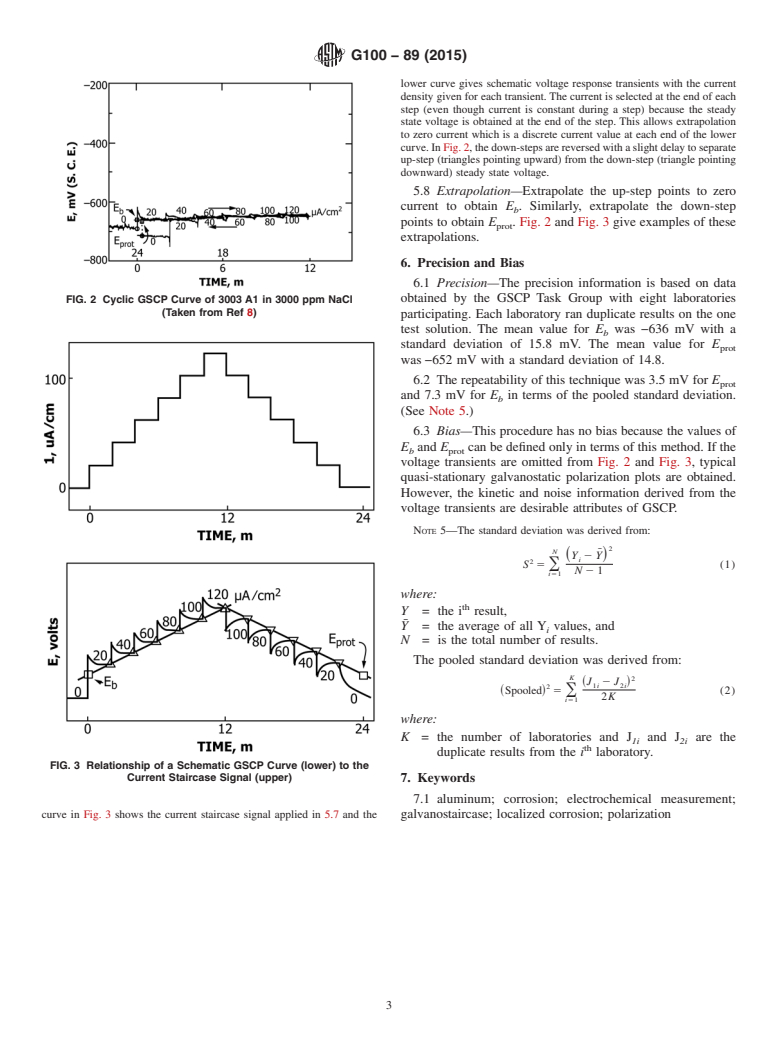
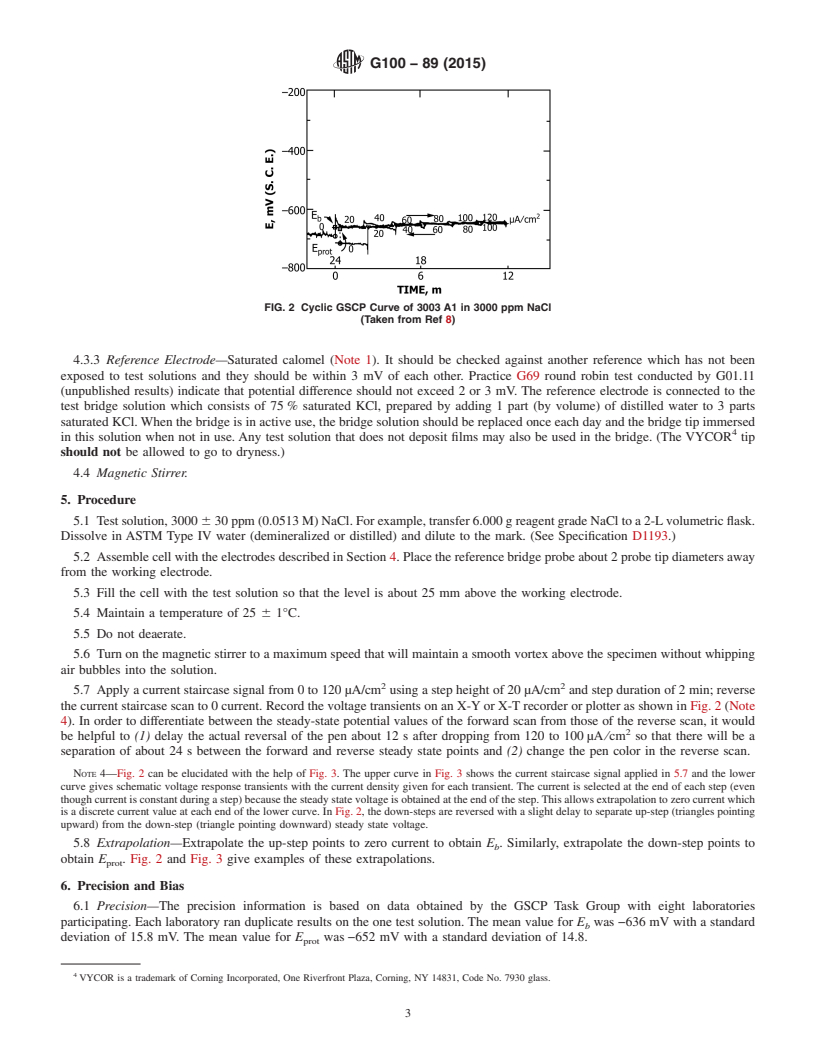
FIG. 2 Cyclic GSCP Curve of 3003 A1 in 3000 ppm NaCl
(Taken from Ref 8)
4.3.3 Reference Electrode—Saturated calomel (Note 1). It should be checked against another reference which has not been
exposed to test solut
...
Questions, Comments and Discussion
Ask us and Technical Secretary will try to provide an answer. You can facilitate discussion about the standard in here.