

ASTM D3751/D3751M-10(2017)
(Practice)Standard Practice for Evaluation of Furniture Polish
General Information
- Abstract
SIGNIFICANCE AND USE
3.1 This practice defines the properties to be tested, the apparatus to be used, and the comparisons of product performance. It is recognized that considerable discretion exists among formulators and marketers of furniture polish on which properties or performance characteristics are best for their products. This practice will be flexible to honor this fact within the confines of the furniture polish definition below.
3.2 The methods of testing are subjective and empirical in order to conform to the basic characteristics of the industry and to allow flexibility in testing.
SCOPE
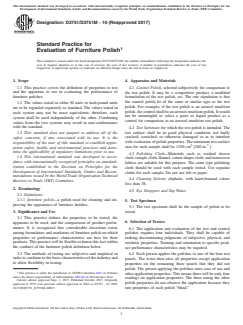
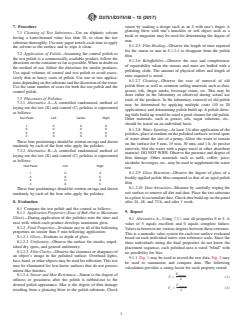
1.1 This practice covers the definition of properties to test and the apparatus to use in evaluating the performance of furniture polishes.
1.2 The values stated in either SI units or inch-pound units are to be regarded separately as standard. The values stated in each system may not be exact equivalents; therefore, each system shall be used independently of the other. Combining values from the two systems may result in non-conformance with the standard.
1.3 This standard does not purport to address all of the safety concerns, if any, associated with its use. It is the responsibility of the user of this standard to establish appropriate safety, health, and environmental practices and determine the applicability of regulatory limitations prior to use.
1.4 This international standard was developed in accordance with internationally recognized principles on standardization established in the Decision on Principles for the Development of International Standards, Guides and Recommendations issued by the World Trade Organization Technical Barriers to Trade (TBT) Committee.
- Status
- Published
- Publication Date
- 31-Aug-2017
- Technical Committee
- D21 - Polishes
- Drafting Committee
- D21.04 - Performance Tests
Overview
ASTM D3751/D3751M-10(2017): Standard Practice for Evaluation of Furniture Polish is a widely recognized guideline developed by ASTM International for the assessment of furniture polish products. This standard specifies the essential properties to be tested, outlines the apparatus and materials required, and details the comparative methods to evaluate product performance. Importantly, this practice adopts both subjective and empirical approaches, reflecting the flexible and variable needs of the furniture polish industry. The standard allows manufacturers, formulators, and marketers significant discretion while ensuring transparent and repeatable evaluation methods.
Key Topics
- Test Properties: Defines characteristics such as gloss, uniformity, film clarity, smear and mar resistance, film healing, rebuffability, cleaning ability, water spotting resistance, gloss retention, and dust attraction.
- Test Apparatus: Recommends specific types of control polishes, test substrates (surfaces in good condition), polishing cloths, cleaning solvents, and application equipment.
- Test Procedures: Describes step-by-step cleaning, polish application, product placement (using randomized methods), and rating systems for both test and control samples.
- Subjective Evaluation: Relies on the judgment of trained evaluators to assess physical and aesthetic properties. Procedures are designed to minimize bias, such as through “blind” evaluations.
- Rating Scales: Employs two possible rating systems: a 0-to-5 scale (where 5 is excellent), or a 1-to-5 comparative scale with the control always rated at 3 as a reference point.
- Result Reporting: Provides guidance on recording, summarizing, and statistically analyzing results, including environmental factors such as temperature and humidity.
- Standard Flexibility: Accommodates different furniture polish types and industry expectations, recognizing that preferences for specific properties may vary among end users and product developers.
Applications
ASTM D3751/D3751M-10(2017) is essential for:
- Quality Control and Product Development: Helps manufacturers evaluate new or existing furniture polish formulations for performance enhancements.
- Comparative Product Benchmarking: Enables objective comparison between a test polish and a market reference product, supporting product claims and marketing.
- Consumer Safety and Regulatory Compliance: Assures stakeholders that testing is performed under both SI and inch-pound units, with a focus on safe handling and relevant regulatory considerations.
- Third-Party Testing and Certification: Provides an industry-accepted methodology for independent laboratories to assess the quality and advertising claims of furniture polishes.
- Technical Education and Training: Serves as a detailed resource for training technicians, laboratory staff, and quality assurance personnel on standardized evaluation procedures.
Related Standards
Professionals referencing ASTM D3751/D3751M-10(2017) for evaluation of furniture polish may also find value in related and supporting ASTM and international standards, including:
- ASTM D3274 - Standard Test Method for Evaluating Degree of Surface Disfigurement of Painted or Coated Specimens
- ASTM D4828 - Standard Test Methods for Practical Washability of Organic Coatings
- ASTM D6441 - Standard Practice for Evaluating Cleaning Performance of Products Intended for Use on Resilient Flooring
- ISO Standards for surface evaluation, cleaning, and coating durability
- Regulatory frameworks guided by the World Trade Organization Technical Barriers to Trade (TBT) Committee principles
Practical Value
By adhering to ASTM D3751/D3751M-10(2017), organizations gain a consistent, repeatable, and internationally accepted methodology for assessing the full range of key properties in furniture polish products. Adoption of this standard supports enhanced product performance, consumer trust, and market competitiveness, while enabling compliance and best practices for safety and environmental stewardship.
Get Certified
Connect with accredited certification bodies for this standard

ECOCERT
Organic and sustainability certification.

Eurofins Food Testing Global
Global leader in food, environment, and pharmaceutical product testing.

Intertek Bangladesh
Intertek certification and testing services in Bangladesh.
Sponsored listings
Frequently Asked Questions
ASTM D3751/D3751M-10(2017) is a standard published by ASTM International. Its full title is "Standard Practice for Evaluation of Furniture Polish". This standard covers: SIGNIFICANCE AND USE 3.1 This practice defines the properties to be tested, the apparatus to be used, and the comparisons of product performance. It is recognized that considerable discretion exists among formulators and marketers of furniture polish on which properties or performance characteristics are best for their products. This practice will be flexible to honor this fact within the confines of the furniture polish definition below. 3.2 The methods of testing are subjective and empirical in order to conform to the basic characteristics of the industry and to allow flexibility in testing. SCOPE 1.1 This practice covers the definition of properties to test and the apparatus to use in evaluating the performance of furniture polishes. 1.2 The values stated in either SI units or inch-pound units are to be regarded separately as standard. The values stated in each system may not be exact equivalents; therefore, each system shall be used independently of the other. Combining values from the two systems may result in non-conformance with the standard. 1.3 This standard does not purport to address all of the safety concerns, if any, associated with its use. It is the responsibility of the user of this standard to establish appropriate safety, health, and environmental practices and determine the applicability of regulatory limitations prior to use. 1.4 This international standard was developed in accordance with internationally recognized principles on standardization established in the Decision on Principles for the Development of International Standards, Guides and Recommendations issued by the World Trade Organization Technical Barriers to Trade (TBT) Committee.
SIGNIFICANCE AND USE 3.1 This practice defines the properties to be tested, the apparatus to be used, and the comparisons of product performance. It is recognized that considerable discretion exists among formulators and marketers of furniture polish on which properties or performance characteristics are best for their products. This practice will be flexible to honor this fact within the confines of the furniture polish definition below. 3.2 The methods of testing are subjective and empirical in order to conform to the basic characteristics of the industry and to allow flexibility in testing. SCOPE 1.1 This practice covers the definition of properties to test and the apparatus to use in evaluating the performance of furniture polishes. 1.2 The values stated in either SI units or inch-pound units are to be regarded separately as standard. The values stated in each system may not be exact equivalents; therefore, each system shall be used independently of the other. Combining values from the two systems may result in non-conformance with the standard. 1.3 This standard does not purport to address all of the safety concerns, if any, associated with its use. It is the responsibility of the user of this standard to establish appropriate safety, health, and environmental practices and determine the applicability of regulatory limitations prior to use. 1.4 This international standard was developed in accordance with internationally recognized principles on standardization established in the Decision on Principles for the Development of International Standards, Guides and Recommendations issued by the World Trade Organization Technical Barriers to Trade (TBT) Committee.
ASTM D3751/D3751M-10(2017) is classified under the following ICS (International Classification for Standards) categories: 71.100.99 - Other products of the chemical industry. The ICS classification helps identify the subject area and facilitates finding related standards.
ASTM D3751/D3751M-10(2017) is available in PDF format for immediate download after purchase. The document can be added to your cart and obtained through the secure checkout process. Digital delivery ensures instant access to the complete standard document.
Standards Content (Sample)
This international standard was developed in accordance with internationally recognized principles on standardization established in the Decision on Principles for the
Development of International Standards, Guides and Recommendations issued by the World Trade Organization Technical Barriers to Trade (TBT) Committee.
Designation: D3751/D3751M − 10 (Reapproved 2017)
Standard Practice for
Evaluation of Furniture Polish
This standard is issued under the fixed designation D3751/D3751M; the number immediately following the designation indicates the
year of original adoption or, in the case of revision, the year of last revision. A number in parentheses indicates the year of last
reapproval. A superscript epsilon (´) indicates an editorial change since the last revision or reapproval.
1. Scope 4. Apparatus and Materials
1.1 This practice covers the definition of properties to test 4.1 Control Polish, selected subjectively for comparison to
and the apparatus to use in evaluating the performance of
the test polish. It may be a competitive product, a modified
furniture polishes.
formulation of the test polish, etc. The one stipulation is that
the control polish be of the same or similar type as the test
1.2 The values stated in either SI units or inch-pound units
polish. For example, if the test polish is an aerosol emulsion
are to be regarded separately as standard. The values stated in
polish, the control shall be an aerosol emulsion polish. It would
each system may not be exact equivalents; therefore, each
not be meaningful to select a paste or liquid product as a
system shall be used independently of the other. Combining
control for comparison to an aerosol emulsion test polish.
values from the two systems may result in non-conformance
with the standard.
4.2 Test Substrate for which the test polish is intended. The
test surface shall be in good physical condition, not badly
1.3 This standard does not purport to address all of the
cracked, scratched, or otherwise damaged so as to interfere
safety concerns, if any, associated with its use. It is the
with evaluation of polish properties. The minimum test surface
responsibility of the user of this standard to establish appro-
2 2
area for each sample shall be 1290 cm [200 in. ].
priate safety, health, and environmental practices and deter-
mine the applicability of regulatory limitations prior to use.
4.3 Polishing Cloth—Materials such as washed cheese
1.4 This international standard was developed in accor-
cloth, rumple cloth, flannel, cotton diaper cloth, and nonwoven
dance with internationally recognized principles on standard-
fabrics are suitable for this purpose. The same type polishing
ization established in the Decision on Principles for the
cloth should be used with each sample tested. Use separate
Development of International Standards, Guides and Recom-
cloths for each sample. Do not use felt or paper.
mendations issued by the World Trade Organization Technical
4.4 Cleaning Solvent, aliphatic, with kauri-butanol values
Barriers to Trade (TBT) Committee.
less than 38.
2. Terminology
4.5 Eye Droppers and Tap Water.
2.1 Definitions:
2.1.1 furniture polish—a polish used for cleaning and im-
5. Test Specimen
proving the appearance of furniture finishes.
5.1 The test specimen shall be the sample of polish to be
3. Significance and Use tested.
3.1 This practice defines the properties to be tested, the
6. Selection of Testers
apparatus to be used, and the comparisons of product perfor-
mance. It is recognized that considerable discretion exists
6.1 The application and evaluation of the test and control
among formulators and marketers of furniture polish on which
polishes requires four individuals. They shall be capable of
properties or performance characteristics are best for their
making discriminating judgments of subjective, physical, and
products.This practice will be flexible to honor this fact within
aesthetic properties. Training and orientation to specific prod-
the confines of the furniture polish definition below.
uct performance characteristics may be required.
3.2 The methods of testing are subjective and empirical in
6.2 Each person applies the polishes to one of the four test
order to conform to the basic characteristics of the industry and
panels. The tester then rates all properties except application
to allow flexibility in testing.
properties on the remaining three panels that they did not
polish. The person applying the polishes rates ease of use and
This practice is under the jurisdiction of ASTM Committee D21 on Polishes
other application properties.This means there will be only four
and is the direct responsibility of Subcommittee D21.04 on Performance Tests.
readings on application properties. The three rating the other
Current edition approved Sept. 1, 2017. Published October 2017. Originally
polish properties do not observe the application because they
approved in 1979. Last previous edition approved in 2010 as D3751 – 10. DOI:
10.1520/D3751_D3751M-10R17. rate properties of each polish “blind.”
Copyright © ASTM International, 100 Barr Harbor Drive, PO Box C700, West Conshohocken, PA 19428-2959. United States
D3751/D3751M − 10 (2017)
7. Procedure smear by making a design such as an S with one’s finger. A
glancing blow with one’s knuckles or soft object such as a
7.1 Cleaning of Test Substrates—Use an aliphatic solvent
book or magazine may be used for determining the degree of
having a kauri-butanol value less than 38, to clean the test
mar.
substrate thoroughly. Use new paper towels each time to apply
8.1.2.5 Film Healing—Observe the length of time required
the solvent to the surface and to wipe it clean.
for the smear or mar in 8.1.2.4 to disappear from the polish
7.2 Application of Polish—Assuming the control polish or
film.
the test polish is a commercially available product, follow the
8.1.2.6 Rebuffability—Observe the ease and completeness
directionsonthecontainersofaraspossible.Whenindoubton
of repairability when the smears and mars are buffed with a
the method of use, follow the directions for similar products.
polishing cloth. The amount of physical effort and length of
Use equal volumes of control and test polish to avoid exces-
time required is noted.
sively thin or heavy coats of polish. Use one or two applica-
8.1.2.7 Cleaning—Observe the ease of removal of old
tionsdependingonthesubstrateandthediscretionofthetester.
polish films as well as common soiling materials such as dust,
Use the same number of coats for both the test polish and the
grease, oils, finger marks, beverage stains, etc. This may be
control polish.
done either in the laboratory or observed during actual use
7.3 Placement of Polishes:
trials of the products. In the laboratory, removal of old polish
7.3.1 Alternative A—A controlled randomized method of
may be determined by applying multiple coats (10 to 20
laying out the test (X) and control (C) polishes is represented
applications) and determining polish build-up. A polish show-
as follows:
ing little build-up would be rated a good cleaner for old polish.
Test Panel Left Center Right
Other materials, such as grease, oils, sugar solutions, etc.,
should be tested on an individual basis.
1C X C
2C C X 8.1.2.8 Water Spotting—At least 2 h after application of the
3X C X
polishes,placeatrandomonthepo
...