

ASTM D3898-93(2023)
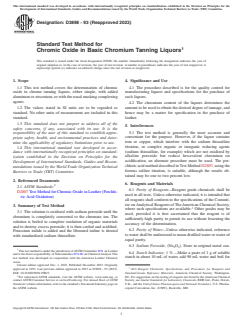
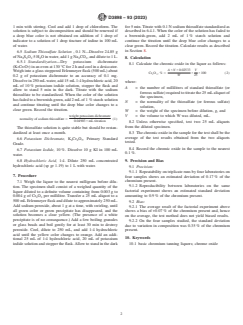
(Test Method)Standard Test Method for Chromic Oxide in Basic Chromium Tanning Liquors
General Information
- Abstract
SIGNIFICANCE AND USE
4.1 The procedure described is for the quality control for manufacturing liquors and specifications for the purchase of such liquors.
4.2 The chromium content of the liquors determines the amount to be used to obtain the desired degree of tannage, and hence may be a matter for specification in the purchase of leather.
SCOPE
1.1 This test method covers the determination of chromic oxide in chrome tanning liquors, either simple, with added aluminum or zirconium, or with the usual masking complexing agents.
1.2 The values stated in SI units are to be regarded as standard. No other units of measurement are included in this standard.
1.3 This standard does not purport to address all of the safety concerns, if any, associated with its use. It is the responsibility of the user of this standard to establish appropriate safety, health, and environmental practices and determine the applicability of regulatory limitations prior to use.
1.4 This international standard was developed in accordance with internationally recognized principles on standardization established in the Decision on Principles for the Development of International Standards, Guides and Recommendations issued by the World Trade Organization Technical Barriers to Trade (TBT) Committee.
- Status
- Published
- Publication Date
- 30-Nov-2023
- Technical Committee
- D31 - Leather
- Drafting Committee
- D31.06 - Chemical Analysis


Overview
ASTM D3898-93(2023) - Standard Test Method for Chromic Oxide in Basic Chromium Tanning Liquors specifies a highly accurate laboratory test procedure for determining the chromic oxide (Cr₂O₃) content in basic chromium tanning liquors. These liquors are critical in the tanning process of leather production. The method supports both quality control in manufacturing and verification of specifications for purchasing such tanning liquors. Developed by ASTM International, the standard aligns with globally recognized principles and reflects best practices in industrial chemical analysis.
Key Topics
- Purpose: To quantitatively determine chromic oxide in chrome tanning liquors, which may include additives (aluminum or zirconium) or masking/complexing agents.
- Scope: Applies to basic chromium tanning liquors used in leather manufacturing. The test is valid for both simple and complex formulations typical in modern tanning operations.
- Units: All measurements and calculations are expressed in SI units, ensuring consistency worldwide.
- Significance: The chromium content established by this method is vital for controlling the degree of tannage and for contractual agreements in the leather industry.
- Test Method Summary:
- The test involves oxidizing the sample with sodium peroxide to convert chromium to chromate ions.
- The solution undergoes a series of chemical treatments (including boiling, cooling, acidification, and titration) to determine chromic oxide content using sodium thiosulfate.
- Special attention is given to reagent purity and standardization for reliable, repeatable results.
- Precision & Bias: The method demonstrates high repeatability and minimal bias, ensuring trustworthy quality control data.
Applications
- Leather Manufacturing: Routine application in tanneries to monitor and regulate chromic oxide levels in tanning liquors, directly impacting leather quality, uniformity, and compliance with purchase agreements.
- Purchasing & Quality Verification: Used by procurement teams to confirm that supplied tanning liquors conform to specified chromic oxide concentrations, helping avoid disputes and ensure product consistency.
- Process Optimization: Enables better control of tanning processes by adjusting liquor chromium content based on precise, standardized measurements.
- Research & Development: Supports formulation and testing of new tanning chemicals or process options where chromic oxide content is a key parameter.
Related Standards
- ASTM D2807: Test Method for Chromic Oxide in Leather (Perchloric Acid Oxidation) - used as an alternative when interfering substances such as iron, copper, or certain reducing agents are present in tanning liquors.
- International Guidance: Developed in accordance with WTO TBT Committee principles, supporting harmonization with other international standards on chemical analysis in leather processing.
- Analytical Reagent Specifications: References standards from organizations such as the American Chemical Society (ACS) for reagent purity, further enhancing reliability.
Practical Value
By following ASTM D3898-93(2023), laboratories and manufacturers gain:
- Consistent Quality Control: Standardizes chromic oxide measurement, reducing variability across batches and suppliers.
- Compliance and Traceability: Ensures specifications are met for both internal and external audits or certifications.
- Global Acceptance: Aligns with international norms, facilitating trade and acceptance of test results across borders.
- Process Efficiency: Enables proactive adjustments to formulations, minimizing waste and improving resource use in tanning operations.
Keywords: chromic oxide, chromium tanning liquors, ASTM D3898, leather quality control, analytical chemistry, standard test method, tannage specification, chemical analysis, SI units, reagent standards.
Relations
- Replaces
ASTM D3898-93(2015) - Standard Test Method for Chromic Oxide in Basic Chromium Tanning Liquors - Effective Date
- 01-Dec-2023
- Effective Date
- 01-Dec-2023
- Referred By
ASTM D3913-03(2020)e1 - Standard Test Method for Acidity in Basic Chromium Tanning Liquors - Effective Date
- 01-Dec-2023
- Referred By
ASTM D3897-18 - Standard Test Method for Calculation of Basicity of Chrome Tanning Liquors - Effective Date
- 01-Dec-2023
Get Certified
Connect with accredited certification bodies for this standard

Control Union Certifications
Global certification for agriculture and sustainability.

Hohenstein Institut
Textile testing and certification.

Bureau Veritas Bangladesh
Bureau Veritas certification services in Bangladesh.
Sponsored listings
Frequently Asked Questions
ASTM D3898-93(2023) is a standard published by ASTM International. Its full title is "Standard Test Method for Chromic Oxide in Basic Chromium Tanning Liquors". This standard covers: SIGNIFICANCE AND USE 4.1 The procedure described is for the quality control for manufacturing liquors and specifications for the purchase of such liquors. 4.2 The chromium content of the liquors determines the amount to be used to obtain the desired degree of tannage, and hence may be a matter for specification in the purchase of leather. SCOPE 1.1 This test method covers the determination of chromic oxide in chrome tanning liquors, either simple, with added aluminum or zirconium, or with the usual masking complexing agents. 1.2 The values stated in SI units are to be regarded as standard. No other units of measurement are included in this standard. 1.3 This standard does not purport to address all of the safety concerns, if any, associated with its use. It is the responsibility of the user of this standard to establish appropriate safety, health, and environmental practices and determine the applicability of regulatory limitations prior to use. 1.4 This international standard was developed in accordance with internationally recognized principles on standardization established in the Decision on Principles for the Development of International Standards, Guides and Recommendations issued by the World Trade Organization Technical Barriers to Trade (TBT) Committee.
SIGNIFICANCE AND USE 4.1 The procedure described is for the quality control for manufacturing liquors and specifications for the purchase of such liquors. 4.2 The chromium content of the liquors determines the amount to be used to obtain the desired degree of tannage, and hence may be a matter for specification in the purchase of leather. SCOPE 1.1 This test method covers the determination of chromic oxide in chrome tanning liquors, either simple, with added aluminum or zirconium, or with the usual masking complexing agents. 1.2 The values stated in SI units are to be regarded as standard. No other units of measurement are included in this standard. 1.3 This standard does not purport to address all of the safety concerns, if any, associated with its use. It is the responsibility of the user of this standard to establish appropriate safety, health, and environmental practices and determine the applicability of regulatory limitations prior to use. 1.4 This international standard was developed in accordance with internationally recognized principles on standardization established in the Decision on Principles for the Development of International Standards, Guides and Recommendations issued by the World Trade Organization Technical Barriers to Trade (TBT) Committee.
ASTM D3898-93(2023) is classified under the following ICS (International Classification for Standards) categories: 59.140.10 - Processes and auxiliary materials. The ICS classification helps identify the subject area and facilitates finding related standards.
ASTM D3898-93(2023) has the following relationships with other standards: It is inter standard links to ASTM D3898-93(2015), ASTM D5356-17a, ASTM D3913-03(2020)e1, ASTM D3897-18. Understanding these relationships helps ensure you are using the most current and applicable version of the standard.
ASTM D3898-93(2023) is available in PDF format for immediate download after purchase. The document can be added to your cart and obtained through the secure checkout process. Digital delivery ensures instant access to the complete standard document.
Standards Content (Sample)
This international standard was developed in accordance with internationally recognized principles on standardization established in the Decision on Principles for the
Development of International Standards, Guides and Recommendations issued by the World Trade Organization Technical Barriers to Trade (TBT) Committee.
Designation: D3898 − 93 (Reapproved 2023)
Standard Test Method for
Chromic Oxide in Basic Chromium Tanning Liquors
This standard is issued under the fixed designation D3898; the number immediately following the designation indicates the year of
original adoption or, in the case of revision, the year of last revision. A number in parentheses indicates the year of last reapproval. A
superscript epsilon (´) indicates an editorial change since the last revision or reapproval.
1. Scope 4. Significance and Use
1.1 This test method covers the determination of chromic 4.1 The procedure described is for the quality control for
oxide in chrome tanning liquors, either simple, with added manufacturing liquors and specifications for the purchase of
aluminum or zirconium, or with the usual masking complexing such liquors.
agents.
4.2 The chromium content of the liquors determines the
1.2 The values stated in SI units are to be regarded as amount to be used to obtain the desired degree of tannage, and
standard. No other units of measurement are included in this hence may be a matter for specification in the purchase of
standard. leather.
1.3 This standard does not purport to address all of the
5. Interferences
safety concerns, if any, associated with its use. It is the
5.1 The test method is generally the most accurate and
responsibility of the user of this standard to establish appro-
convenient for the purpose. However, if the liquor contains
priate safety, health, and environmental practices and deter-
iron or copper, which interfere with the sodium thiosulfate
mine the applicability of regulatory limitations prior to use.
titration, or complex organic or inorganic reducing agents
1.4 This international standard was developed in accor-
(sodium thiosulfate, for example) which are not oxidized by
dance with internationally recognized principles on standard-
alkaline peroxide but reduce hexavalent chromium on
ization established in the Decision on Principles for the
acidification, an alternate procedure must be used. The per-
Development of International Standards, Guides and Recom-
chloric acid method described in Test Method D2807, using the
mendations issued by the World Trade Organization Technical
ferrous sulfate titration, is suitable, although the results ob-
Barriers to Trade (TBT) Committee.
tained may be one to two percent low.
2. Referenced Documents
6. Reagents and Materials
2.1 ASTM Standards:
6.1 Purity of Reagents—Reagent grade chemicals shall be
D2807 Test Method for Chromic Oxide in Leather (Perchlo-
used in all tests. Unless otherwise indicated, it is intended that
ric Acid Oxidation)
all reagents shall conform to the specifications of the Commit-
tee on Analytical Reagents of The American Chemical Society,
3. Summary of Test Method
where such specifications are available. Other grades may be
3.1 The solution is oxidized with sodium peroxide until the
used, provided it is first ascertained that the reagent is of
chromium is completely converted to the chromate ion. The
sufficiently high purity to permit its use without lessening the
solution is boiled to complete oxidation of organic materials
accuracy of the determination.
and to destroy excess peroxide; it is then cooled and acidified.
6.2 Purity of Water—Unless otherwise indicated, reference
Potassium iodide is added and the liberated iodine is titrated
to water shall be understood to mean distilled water or water of
with standardized sodium thiosulfate.
equal purity.
6.3 Sodium Peroxide, (Na O ). Store in original metal can.
2 2
This test method is under the jurisdiction of ASTM Committee D31 on Leather
6.4 Starch Indicator, 1 % —Make a paste of 1 g of soluble
and is the direct responsibility of Subcommittee D31.06 on Chemical Analysis This
starch in about 10 mL of water, add 90 mL water and boil for
test method was developed in cooperation with the American Leather Chemists
Assoc.
Current edition approved Dec. 1, 2023. Published December 2023. Originally
approved in 1991. Last previous edition approved in 2015 as D3898 – 93 (2015). ACS Reagent Chemicals, Specifications and Procedures for Reagents and
DOI: 10.1520/D3898-93R23. Standard-Grade Reference Materials, American Chemical Society, Washington,
For referenced ASTM standards, visit the ASTM website, www.astm.org, or DC. For suggestions on the testing of reagents not listed by the American Chemical
contact ASTM Customer Service at service@astm.org. For Annual Book of ASTM Society, see Analar Standards for Laboratory Chemicals, BDH Ltd., Poole, Dorset,
Standards volume information, refer to the standard’s Document Summary page on U.K., and the United States Pharmacopeia and National Formulary, U.S. Pharma-
the ASTM website. copeial Convention, Inc. (USPC), Rockville, MD.
Copyright © ASTM International, 100 Barr Harbor Drive, PO Box C700, West Conshohocken, PA 19428-2959. United States
D3898 − 93 (2023)
1 min with stirring. Cool and add 1 drop of chloroform. The for 5 min. Titrate with 0.1 N sodium thiosulfate standardized as
solution is subject to decomposition and should be renewed if described in 6.4.1. Wh
...