

ASTM B617-98(2021)
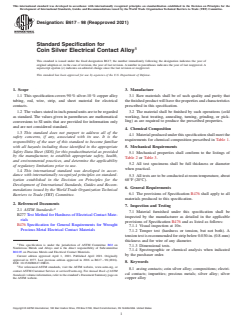
(Specification)Standard Specification for Coin Silver Electrical Contact Alloy
General Information
- Abstract
ABSTRACT
This specification covers silver-copper alloy tubing, rod, wire, strip, and sheet material for electrical contacts. The material shall be finished by cold working, heat treating, annealing, turning, grinding, or pickling as are required to produce the prescribed properties. Material produced under this specification shall meet the requirements for chemical composition of silver, copper, zinc, iron, cadmium, lead, nickel, aluminum, and phosphorous. Mechanical properties such as tensile strength, elongation, and hardness shall conform to the prescribed requirements. Materials shall be inspected by visual inspection, temper test, dimensional test, and spectographic or chemical analysis
SCOPE
1.1 This specification covers 90 % silver-10 % copper alloy tubing, rod, wire, strip, and sheet material for electrical contacts.
1.2 The values stated in inch-pound units are to be regarded as standard. The values given in parentheses are mathematical conversions to SI units that are provided for information only and are not considered standard.
1.3 This standard does not purport to address all of the safety concerns, if any, associated with its use. It is the responsibility of the user of this standard to become familiar with all hazards including those identified in the appropriate Safety Data Sheet (SDS) for this product/material as provided by the manufacturer, to establish appropriate safety, health, and environmental practices, and determine the applicability of regulatory limitations prior to use.
1.4 This international standard was developed in accordance with internationally recognized principles on standardization established in the Decision on Principles for the Development of International Standards, Guides and Recommendations issued by the World Trade Organization Technical Barriers to Trade (TBT) Committee.
- Status
- Published
- Publication Date
- 31-Mar-2021
- Technical Committee
- B02 - Nonferrous Metals and Alloys


Overview
ASTM B617-98(2021) - Standard Specification for Coin Silver Electrical Contact Alloy establishes essential criteria for the composition, manufacturing, and performance of 90% silver - 10% copper alloy materials designed for use in electrical contacts. Published by ASTM International, this standard is widely recognized for ensuring quality and reliability in electrical contact applications. It applies to coin silver alloy tubing, rod, wire, strip, and sheet products, detailing requirements for chemical composition, mechanical properties, and inspection/testing methods.
The specification is applicable to industries that demand high-performance silver-copper electrical contacts, such as electrical equipment manufacturing, switchgear, and power distribution systems. Designed with both inch-pound units and corresponding SI values for reference, this standard supports international compliance and manufacturing consistency.
Key Topics
- Material Scope: Covers tubing, rod, wire, strip, and sheet made of 90% silver and 10% copper alloy, commonly known as coin silver alloy, ideal for electrical contact applications.
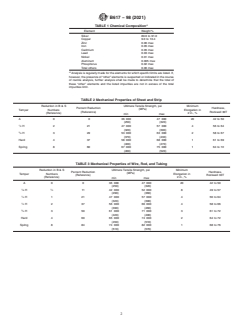
- Chemical Composition: Strict limits on elements, including silver, copper, zinc, iron, cadmium, lead, nickel, aluminum, phosphorous, and other potential impurities. Quality control through spectrographic or chemical analysis is an integral part of the process.
- Mechanical Properties: Specifies minimum requirements for ultimate tensile strength, elongation, and Rockwell hardness across various tempers for both sheet/strip and wire, rod, or tubing.
- Manufacturing Processes: Details accepted methods including cold working, heat treatment, annealing, turning, grinding, and pickling to achieve desired physical properties.
- Inspection and Testing: Reinforces the importance of visual inspection, temper testing (hardness or tension), dimensional checks, and chemical analysis to ensure compliance.
- Safety Considerations: Promotes awareness of applicable safety practices and regulatory requirements, including review of Safety Data Sheets (SDS).
Applications
Materials compliant with ASTM B617-98(2021) are widely used in:
- Electrical Switches and Relays: High-conductivity, reliable coin silver contacts for durable performance in circuit control and switching devices.
- Circuit Breakers and Connectors: Ensures low-resistance electrical connections and minimizes arcing and contact degradation.
- Distribution and Transmission Equipment: Provides dependable properties for high-load environments and extended service life.
- Precision Electronics: Useful in industries where contact reliability, low signal loss, and corrosion resistance are critical-such as aerospace, telecommunications, and instrumentation.
- Custom Alloy Components: Enables manufacturers to specify material parameters for specialized applications requiring precious metal alloys with precise performance characteristics.
Related Standards
To ensure comprehensive quality and compatibility, ASTM B617-98(2021) references and aligns with several related standards:
- ASTM B476: General Requirements for Wrought Precious Metal Electrical Contact Materials, which supplements the specific requirements of B617.
- ASTM B277: Test Method for Hardness of Electrical Contact Materials, providing guidance for hardness testing protocols.
- Federal and Military Packaging Standards: (e.g., Fed. Std. No. 102 and MIL-STD-129) for preservation, packing, and shipment marking.
Other international and ASTM standards related to electrical contact materials, silver alloys, and test methods may also be referenced for complete regulatory compliance and best practices in manufacturing and inspection.
Keywords: coin silver alloy, silver-copper electrical contacts, ASTM B617, electrical contact material standard, silver alloy mechanical properties, electrical connector standards, silver alloy chemical composition, precious metal alloys for electronics
Relations
- Effective Date
- 01-Apr-2024
- Effective Date
- 01-May-2012
- Effective Date
- 01-May-2012
- Effective Date
- 01-Jun-2006
- Effective Date
- 01-Jun-2006
- Effective Date
- 10-May-2001
- Effective Date
- 15-Aug-1995
Get Certified
Connect with accredited certification bodies for this standard

Element Materials Technology
Materials testing and product certification.

Inštitut za kovinske materiale in tehnologije
Institute of Metals and Technology. Materials testing, metallurgical analysis, NDT.
Sponsored listings
Frequently Asked Questions
ASTM B617-98(2021) is a technical specification published by ASTM International. Its full title is "Standard Specification for Coin Silver Electrical Contact Alloy". This standard covers: ABSTRACT This specification covers silver-copper alloy tubing, rod, wire, strip, and sheet material for electrical contacts. The material shall be finished by cold working, heat treating, annealing, turning, grinding, or pickling as are required to produce the prescribed properties. Material produced under this specification shall meet the requirements for chemical composition of silver, copper, zinc, iron, cadmium, lead, nickel, aluminum, and phosphorous. Mechanical properties such as tensile strength, elongation, and hardness shall conform to the prescribed requirements. Materials shall be inspected by visual inspection, temper test, dimensional test, and spectographic or chemical analysis SCOPE 1.1 This specification covers 90 % silver-10 % copper alloy tubing, rod, wire, strip, and sheet material for electrical contacts. 1.2 The values stated in inch-pound units are to be regarded as standard. The values given in parentheses are mathematical conversions to SI units that are provided for information only and are not considered standard. 1.3 This standard does not purport to address all of the safety concerns, if any, associated with its use. It is the responsibility of the user of this standard to become familiar with all hazards including those identified in the appropriate Safety Data Sheet (SDS) for this product/material as provided by the manufacturer, to establish appropriate safety, health, and environmental practices, and determine the applicability of regulatory limitations prior to use. 1.4 This international standard was developed in accordance with internationally recognized principles on standardization established in the Decision on Principles for the Development of International Standards, Guides and Recommendations issued by the World Trade Organization Technical Barriers to Trade (TBT) Committee.
ABSTRACT This specification covers silver-copper alloy tubing, rod, wire, strip, and sheet material for electrical contacts. The material shall be finished by cold working, heat treating, annealing, turning, grinding, or pickling as are required to produce the prescribed properties. Material produced under this specification shall meet the requirements for chemical composition of silver, copper, zinc, iron, cadmium, lead, nickel, aluminum, and phosphorous. Mechanical properties such as tensile strength, elongation, and hardness shall conform to the prescribed requirements. Materials shall be inspected by visual inspection, temper test, dimensional test, and spectographic or chemical analysis SCOPE 1.1 This specification covers 90 % silver-10 % copper alloy tubing, rod, wire, strip, and sheet material for electrical contacts. 1.2 The values stated in inch-pound units are to be regarded as standard. The values given in parentheses are mathematical conversions to SI units that are provided for information only and are not considered standard. 1.3 This standard does not purport to address all of the safety concerns, if any, associated with its use. It is the responsibility of the user of this standard to become familiar with all hazards including those identified in the appropriate Safety Data Sheet (SDS) for this product/material as provided by the manufacturer, to establish appropriate safety, health, and environmental practices, and determine the applicability of regulatory limitations prior to use. 1.4 This international standard was developed in accordance with internationally recognized principles on standardization established in the Decision on Principles for the Development of International Standards, Guides and Recommendations issued by the World Trade Organization Technical Barriers to Trade (TBT) Committee.
ASTM B617-98(2021) is classified under the following ICS (International Classification for Standards) categories: 77.120.99 - Other non-ferrous metals and their alloys. The ICS classification helps identify the subject area and facilitates finding related standards.
ASTM B617-98(2021) has the following relationships with other standards: It is inter standard links to ASTM B277-18(2024), ASTM B277-95(2012), ASTM B476-01(2012), ASTM B277-95(2006), ASTM B476-01(2006), ASTM B476-01, ASTM B277-95(2001). Understanding these relationships helps ensure you are using the most current and applicable version of the standard.
ASTM B617-98(2021) is available in PDF format for immediate download after purchase. The document can be added to your cart and obtained through the secure checkout process. Digital delivery ensures instant access to the complete standard document.
Standards Content (Sample)
This international standard was developed in accordance with internationally recognized principles on standardization established in the Decision on Principles for the
Development of International Standards, Guides and Recommendations issued by the World Trade Organization Technical Barriers to Trade (TBT) Committee.
Designation:B617 −98(Reapproved 2021)
Standard Specification for
Coin Silver Electrical Contact Alloy
This standard is issued under the fixed designation B617; the number immediately following the designation indicates the year of
original adoption or, in the case of revision, the year of last revision.Anumber in parentheses indicates the year of last reapproval.A
superscript epsilon (´) indicates an editorial change since the last revision or reapproval.
This standard has been approved for use by agencies of the U.S. Department of Defense.
1. Scope 3. Manufacture
1.1 This specification covers 90% silver-10% copper alloy 3.1 Raw materials shall be of such quality and purity that
tubing, rod, wire, strip, and sheet material for electrical thefinishedproductwillhavethepropertiesandcharacteristics
contacts. prescribed in this specification.
3.2 The material shall be finished by such operations (cold
1.2 Thevaluesstatedininch-poundunitsaretoberegarded
as standard. The values given in parentheses are mathematical working, heat treating, annealing, turning, grinding, or pick-
ling) as are required to produce the prescribed properties.
conversions to SI units that are provided for information only
and are not considered standard.
4. Chemical Composition
1.3 This standard does not purport to address all of the
4.1 Materialproducedunderthisspecificationshallmeetthe
safety concerns, if any, associated with its use. It is the
requirements for chemical composition prescribed in Table 1.
responsibility of the user of this standard to become familiar
with all hazards including those identified in the appropriate
5. Mechanical Requirements
Safety Data Sheet (SDS) for this product/material as provided
5.1 Mechanical properties shall conform to the listings of
by the manufacturer, to establish appropriate safety, health,
Table 2 or Table 3.
and environmental practices, and determine the applicability
5.2 All test specimens shall be full thickness or diameter
of regulatory limitations prior to use.
when practical.
1.4 This international standard was developed in accor-
dance with internationally recognized principles on standard- 5.3 Alltestsaretobeconductedatroomtemperature,about
ization established in the Decision on Principles for the
68°F (20°C).
Development of International Standards, Guides and Recom-
6. General Requirements
mendations issued by the World Trade Organization Technical
6.1 The provisions of Specification B476 shall apply to all
Barriers to Trade (TBT) Committee.
materials produced to this specification.
2. Referenced Documents
7. Inspection and Testing
2.1 ASTM Standards:
7.1 Material furnished under this specification shall be
B277Test Method for Hardness of Electrical Contact Mate-
inspected by the manufacturer as detailed in the applicable
rials
provisions of Specification B476 and as listed as follows:
B476Specification for General Requirements for Wrought
7.1.1 Visual inspection at 10×.
Precious Metal Electrical Contact Materials
7.1.2 Temper test (hardness or tension, but not both). A
tensiontestisrecommendedforstripbelow0.030-in.(0.8-mm)
thickness and for wire of any diameter.
This specification is under the jurisdiction of ASTM Committee B02 on
7.1.3 Dimensional tests.
Nonferrous Metals and Alloys and is the direct responsibility of Subcommittee
7.1.4 Spectrographic or chemical analysis when indicated
B02.05 on Precious Metals and Electrical Contact Materials.
by the purchaser order.
Current edition approved April 1, 2021. Published April 2021. Originally
approved in 1977. Last previous edition approved in 2016 as B617–98(2016).
8. Keywords
DOI: 10.1520/B0617-98R21.
For referenced ASTM standards, visit the ASTM website, www.astm.org, or
8.1 arcing contacts; coin silver alloy; compositions; electri-
contact ASTM Customer Service at service@astm.org. For Annual Book of ASTM
cal contacts; impurities; precious metals; silver alloy; silver
Standards volume information, refer to the standard’s Document Summary page on
the ASTM website. copper alloy
Copyright © ASTM International, 100 Barr Harbor Drive, PO Box C700, West Conshohocken, PA 19428-2959. United States
B617−98(2021)
A
TABLE 1 Chemical Composition
Element Weight %
Silver 89.6 to 91.0
Copper 9.0 to 10.4
Zinc 0.06 max
Iron 0.05 max
Cadmium 0.05 max
Lead 0.03 max
Nickel 0.01 max
Aluminum 0.005 max
Phosphorus 0.02 max
Total others 0.06 max
A
Analysis is regularly made for the elements for which specific limits are listed. If,
however, the presence of “other” elements is suspected or indicated in the course
of routine analysis, further analysis shall be made to determine that the total of
these “other” elements and the listed im
...