

ASTM B1011/B1011M-22
(Specification)Standard Specification for Cobalt Alloy Spring Wire
General Information
- Abstract
SCOPE
1.1 This specification covers cold-drawn cobalt alloy spring wire intended especially for the manufacture of springs.
1.1.1 This specification requires capability properties after age hardening test samples of the cold worked spring wire to ensure final mechanical properties are satisfied. The spring is typically age hardened after fabrication to increase its strength. However, mechanical properties cannot be obtained from finished springs.
1.2 The values stated in either SI units or inch-pound units are to be regarded separately as standard. The values stated in each system may not be exact equivalents; therefore, each system shall be used independently of the other. Combining values from the two systems may result in non-conformance with the standard.
1.3 Unless the order specifies an “M” designation, the material shall be furnished to inch-pound units.
1.4 This international standard was developed in accordance with internationally recognized principles on standardization established in the Decision on Principles for the Development of International Standards, Guides and Recommendations issued by the World Trade Organization Technical Barriers to Trade (TBT) Committee.
- Status
- Published
- Publication Date
- 31-Mar-2022
- Technical Committee
- B02 - Nonferrous Metals and Alloys
- Drafting Committee
- B02.07 - Refined Nickel and Cobalt and Their Alloys

Overview
ASTM B1011/B1011M-22 sets the standard specification for cobalt alloy spring wire, primarily designed for the manufacture of springs requiring superior mechanical properties. This specification defines the requirements for cold-drawn cobalt alloy spring wire, ensuring optimal performance after specific age hardening heat treatments. The standard addresses both inch-pound and SI units and is developed in alignment with globally recognized standardization practices, offering guidance for both suppliers and purchasers in the field of advance spring manufacturing.
Key Topics
- Material Coverage: The specification encompasses cold-drawn cobalt alloy wires intended for high-strength spring applications.
- Mechanical Properties: It mandates specific mechanical tests after age hardening, ensuring that wire meets rigorous tensile and yield strength requirements. The standard recognizes that direct mechanical testing of finished springs is not feasible.
- Heat Treatment: Springs are commonly age hardened post-fabrication to reach their final mechanical properties, as prescribed by the standard.
- Ordering Requirements: Purchasers must specify details such as quantity, alloy type, dimensions, UNS designation, and any specific heat treatment or surface finish when ordering the wire.
- Unit Systems: The standard is available in both SI and inch-pound units; the chosen system must be specified independently for compliance.
- Packaging and Delivery: Proper packaging, labeling, and shipping documentation assure traceability and protection during transport and storage.
- Supplementary Requirements: Includes provisions for meeting NACE MR0175/ISO 15156 for service in H₂S-containing oil and gas environments, particularly regarding hardness limitations.
Applications
Cobalt alloy spring wire compliant with ASTM B1011/B1011M-22 is valued for its high strength, corrosion resistance, and excellent mechanical stability after age hardening. Key application areas include:
- Aerospace Springs: Where superior mechanical properties and reliability are critical under demanding service conditions.
- Medical Devices: Precision springs used in medical instruments, taking advantage of the material’s stability and biocompatibility.
- Oil and Gas Industry: Springs intended for use in harsh, H₂S-containing environments, requiring compliance with NACE MR0175/ISO 15156.
- High-Performance Industrial Springs: Heavy-duty and fatigue-resistant springs for electrical, magnetic, and high-temperature applications.
By adhering to this standard, manufacturers achieve reliable, high-performing springs for critical and specialized applications.
Related Standards
ASTM B1011/B1011M-22 references and aligns with several related standards that enhance its scope and utility:
- ASTM B880: Specification for General Requirements for Chemical Check Analysis Limits for Nickel, Nickel Alloys, and Cobalt Alloys.
- ASTM E8/E8M: Test Methods for Tension Testing of Metallic Materials.
- ASTM E18: Test Methods for Rockwell Hardness of Metallic Materials.
- ASTM E92: Test Methods for Vickers Hardness and Knoop Hardness of Metallic Materials.
- ASTM E354: Test Methods for Chemical Analysis of High-Temperature, Electrical, Magnetic, and Other Similar Iron, Nickel, and Cobalt Alloys.
- ASTM E527: Practice for Numbering Metals and Alloys in the Unified Numbering System (UNS).
- SAE J1086: Numbering Metals and Alloys.
- NACE MR0175/ISO 15156: Petroleum and natural gas industries - Materials for use in H₂S-containing environments in oil and gas production.
Keywords: ASTM B1011, cobalt alloy spring wire, cold-drawn spring wire, mechanical properties, age hardening, high-strength spring, UNS R30003, UNS R30035, NACE MR0175, corrosion resistant spring wire.
Relations
- Effective Date
- 01-Jan-2024
- Effective Date
- 01-Jul-2018
- Effective Date
- 01-Jul-2017
- Effective Date
- 15-Jul-2016
- Effective Date
- 01-Feb-2015
- Effective Date
- 01-Jun-2013
- Effective Date
- 01-Dec-2012
- Effective Date
- 01-Dec-2011
- Effective Date
- 01-Nov-2011
- Effective Date
- 15-May-2008
- Effective Date
- 01-Mar-2008
- Effective Date
- 15-Jan-2008
- Effective Date
- 01-Apr-2007
- Effective Date
- 01-Jun-2006
- Effective Date
- 01-Apr-2005
Get Certified
Connect with accredited certification bodies for this standard

Element Materials Technology
Materials testing and product certification.

Inštitut za kovinske materiale in tehnologije
Institute of Metals and Technology. Materials testing, metallurgical analysis, NDT.
Sponsored listings
Frequently Asked Questions
ASTM B1011/B1011M-22 is a technical specification published by ASTM International. Its full title is "Standard Specification for Cobalt Alloy Spring Wire". This standard covers: SCOPE 1.1 This specification covers cold-drawn cobalt alloy spring wire intended especially for the manufacture of springs. 1.1.1 This specification requires capability properties after age hardening test samples of the cold worked spring wire to ensure final mechanical properties are satisfied. The spring is typically age hardened after fabrication to increase its strength. However, mechanical properties cannot be obtained from finished springs. 1.2 The values stated in either SI units or inch-pound units are to be regarded separately as standard. The values stated in each system may not be exact equivalents; therefore, each system shall be used independently of the other. Combining values from the two systems may result in non-conformance with the standard. 1.3 Unless the order specifies an “M” designation, the material shall be furnished to inch-pound units. 1.4 This international standard was developed in accordance with internationally recognized principles on standardization established in the Decision on Principles for the Development of International Standards, Guides and Recommendations issued by the World Trade Organization Technical Barriers to Trade (TBT) Committee.
SCOPE 1.1 This specification covers cold-drawn cobalt alloy spring wire intended especially for the manufacture of springs. 1.1.1 This specification requires capability properties after age hardening test samples of the cold worked spring wire to ensure final mechanical properties are satisfied. The spring is typically age hardened after fabrication to increase its strength. However, mechanical properties cannot be obtained from finished springs. 1.2 The values stated in either SI units or inch-pound units are to be regarded separately as standard. The values stated in each system may not be exact equivalents; therefore, each system shall be used independently of the other. Combining values from the two systems may result in non-conformance with the standard. 1.3 Unless the order specifies an “M” designation, the material shall be furnished to inch-pound units. 1.4 This international standard was developed in accordance with internationally recognized principles on standardization established in the Decision on Principles for the Development of International Standards, Guides and Recommendations issued by the World Trade Organization Technical Barriers to Trade (TBT) Committee.
ASTM B1011/B1011M-22 is classified under the following ICS (International Classification for Standards) categories: 21.160 - Springs; 77.120.99 - Other non-ferrous metals and their alloys. The ICS classification helps identify the subject area and facilitates finding related standards.
ASTM B1011/B1011M-22 has the following relationships with other standards: It is inter standard links to ASTM E8/E8M-24, ASTM E18-18, ASTM E18-17, ASTM E8/E8M-16, ASTM E8/E8M-15, ASTM E8/E8M-13, ASTM E18-12, ASTM E8/E8M-11, ASTM E18-11, ASTM E18-08a, ASTM B880-03(2008), ASTM E18-08, ASTM E18-07, ASTM E354-93(2006), ASTM E18-05e1. Understanding these relationships helps ensure you are using the most current and applicable version of the standard.
ASTM B1011/B1011M-22 is available in PDF format for immediate download after purchase. The document can be added to your cart and obtained through the secure checkout process. Digital delivery ensures instant access to the complete standard document.
Standards Content (Sample)
This international standard was developed in accordance with internationally recognized principles on standardization established in the Decision on Principles for the
Development of International Standards, Guides and Recommendations issued by the World Trade Organization Technical Barriers to Trade (TBT) Committee.
Designation:B1011/B1011M −22
Standard Specification for
Cobalt Alloy Spring Wire
ThisstandardisissuedunderthefixeddesignationB1011/B1011M;thenumberimmediatelyfollowingthedesignationindicatestheyear
of original adoption or, in the case of revision, the year of last revision. A number in parentheses indicates the year of last reapproval.
A superscript epsilon (´) indicates an editorial change since the last revision or reapproval.
1. Scope E92 Test Methods for Vickers Hardness and Knoop Hard-
ness of Metallic Materials
1.1 This specification covers cold-drawn cobalt alloy spring
E354 Test Methods for Chemical Analysis of High-
wire intended especially for the manufacture of springs.
Temperature,Electrical,Magnetic,andOtherSimilarIron,
1.1.1 This specification requires capability properties after
Nickel, and Cobalt Alloys
age hardening test samples of the cold worked spring wire to
E527 Practice for Numbering Metals and Alloys in the
ensure final mechanical properties are satisfied. The spring is
Unified Numbering System (UNS)
typically age hardened after fabrication to increase its strength.
2.2 NACE Standard:
However, mechanical properties cannot be obtained from
NACE MR0175/ISO 15156 Petroleum and natural gas
finished springs.
industries—Materials for use in H2S-containing environ-
1.2 The values stated in either SI units or inch-pound units
ments in oil and gas production
are to be regarded separately as standard. The values stated in
2.3 SAE Standard:
each system may not be exact equivalents; therefore, each
J 1086 Numbering Metals and Alloys
system shall be used independently of the other. Combining
values from the two systems may result in non-conformance
3. Ordering Information
with the standard.
3.1 It is the responsibility of the purchaser to specify all
1.3 Unless the order specifies an “M” designation, the
requirements that are necessary for material ordered under this
material shall be furnished to inch-pound units.
specification. Such requirements may include, but are not
1.4 This international standard was developed in accor-
limited to the following:
dance with internationally recognized principles on standard-
3.1.1 Quantity (weight or number of pieces),
ization established in the Decision on Principles for the
3.1.2 Name of material,
Development of International Standards, Guides and Recom-
3.1.3 Melt method (see 5.1),
mendations issued by the World Trade Organization Technical
3.1.4 Finish (see 5.4),
Barriers to Trade (TBT) Committee.
3.1.5 Dimension(s) with tolerance(s),
3.1.6 UNS designation (Table 1),
2. Referenced Documents
3.1.7 ASTM designation and date of issue,
2.1 ASTM Standards:
3.1.8 Special requirements and any supplementary require-
B880 Specification for General Requirements for Chemical
ments(suchasS1forNACEMR0175/ISO15156service),and
Check Analysis Limits for Nickel, Nickel Alloys and
3.1.9 Packaging (see 5.5).
Cobalt Alloys
NOTE 1—A typical ordering description is as follows:
E8/E8M Test Methods for Tension Testing of Metallic Ma-
2000 lb [900 kg] Cobalt Alloy Spring Wire, cold-drawn and stearate
terials
coated, 0.032-in. [0.82 mm] diameter, in 100-lb [45 kg] 16-in. [0.4 m]
E18 Test Methods for Rockwell Hardness of Metallic Ma-
coils, UNS R30035, to ASTM B1011/B1011M, dated ____.
terials
4. General Requirements for Delivery
4.1 Spring wire shall be shipped in suitable packing and
This specification is under the jurisdiction of ASTM Committee B02 on
shall include a shipping tag or label to include size, alloy,
Nonferrous Metals and Alloys and is the direct responsibility of Subcommittee
B02.07 on Refined Nickel and Cobalt and Their Alloys.
purchase order number, heat or batch number and other
Current edition approved April 1, 2022. Published April 2022. Originally
approved in 2019. Last previous edition approved in 2019 as B1011/B1011M – 19.
DOI: 10.1520/B1011_B1011M-22.
2 3
For referenced ASTM standards, visit the ASTM website, www.astm.org, or Available from NACE International (NACE), 15835 ParkTen Pl., Houston,TX
contact ASTM Customer Service at service@astm.org. For Annual Book of ASTM 77084, http://www.nace.org.
Standards volume information, refer to the standard’s Document Summary page on Available from SAE International (SAE), 400 Commonwealth Dr.,Warrendale,
the ASTM website. PA 15096, http://www.sae.org.
Copyright © ASTM International, 100 Barr Harbor Drive, PO Box C700, West Conshohocken, PA 19428-2959. United States
B1011/B1011M−22
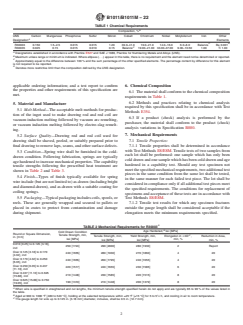
TABLE 1 Chemical Requirements
B
Composition, %
UNS Carbon Manganese Phosphorus Sulfur Silicon Cobalt Chromium Nickel Molybdenum Iron Other
A
Designation Elements
C D
R30003 0.150 1.5–2.5 0.015 0.015 1.20 39.0–41.0 19.0–21.0 14.0–16.0 6.0–8.0 Balance Be 0.001
C
R30035 0.025 0.15 0.015 0.010 0.15 Balance 19.00–21.00 33.00–37.00 9.00–10.50 1.00 Ti 1.00
A
Designations established in accordance with Practice E527 and SAE J 1086, Practice for Numbering Metals and Alloys (UNS).
B
Maximum unless range or minimum is indicated. Where ellipses (. . .) appear in this table, there is no requirement and the element need not be determined or reported.
C
Approximately equal to the difference between 100 % and the sum percentage of the other specified elements. The percentage content by difference for this element
is not required to be reported.
D
Denotes more restrictive limit than the composition defined by the UNS designation.
applicable ordering information; and a test report to confirm 6. Chemical Composition
the properties and other requirements of this specification are
6.1 The material shall conform to the chemical composition
met.
requirements in Table 1.
6.2 Methods and practices relating to chemical analysis
5. Material and Manufacture
required by this specification shall be in accordance with Test
5.1 MeltMethod—The acceptable melt methods for produc-
Methods E354.
tion of the ingot used to make drawing rod and rod coil are
6.3 If a product (check) analysis is performed by the
vacuum induction melting followed by vacuum arc remelting,
purchaser, the material shall conform to the product (check)
or vacuum induction melting followed by electro-slag remelt-
analysis variations in Specification B880.
ing.
7. Mechanical Requirements
5.2 Surface Quality—Drawing rod and rod coil used for
drawing shall be shaved, peeled, or suitably prepared prior to 7.1 Tensile Properties:
final drawing to remove laps, seams, and other surface defects.
7.1.1 Tensile properties shall be determined in accordance
with Test Methods E8/E8M. Tensile tests of two samples from
5.3 Condition—Spring wire shall be furnished in the cold-
each lot shall be performed: one sample which has only been
drawn condition. Following fabrication, springs are typically
colddrawnandonesamplewhichhasbeencolddra
...
This document is not an ASTM standard and is intended only to provide the user of an ASTM standard an indication of what changes have been made to the previous version. Because
it may not be technically possible to adequately depict all changes accurately, ASTM recommends that users consult prior editions as appropriate. In all cases only the current version
of the standard as published by ASTM is to be considered the official document.
Designation: B1011/B1011M − 19 B1011/B1011M − 22
Standard Specification for
Cobalt Alloy Spring Wire
This standard is issued under the fixed designation B1011/B1011M; the number immediately following the designation indicates the year
of original adoption or, in the case of revision, the year of last revision. A number in parentheses indicates the year of last reapproval.
A superscript epsilon (´) indicates an editorial change since the last revision or reapproval.
1. Scope
1.1 This specification covers cold-drawn cobalt alloy spring wire intended especially for the manufacture of springs.
1.1.1 This specification requires capability properties after age hardening test samples of the cold worked spring wire to ensure
final mechanical properties are satisfied. The spring is typically age hardened after fabrication to increase its strength. However,
mechanical properties cannot be obtained from finished springs.
1.2 The values stated in either SI units or inch-pound units are to be regarded separately as standard. The values stated in each
system may not be exact equivalents; therefore, each system shall be used independently of the other. Combining values from the
two systems may result in non-conformance with the standard.
1.3 Unless the order specifies an “M” designation, the material shall be furnished to inch-pound units.
1.4 This international standard was developed in accordance with internationally recognized principles on standardization
established in the Decision on Principles for the Development of International Standards, Guides and Recommendations issued
by the World Trade Organization Technical Barriers to Trade (TBT) Committee.
2. Referenced Documents
2.1 ASTM Standards:
B880 Specification for General Requirements for Chemical Check Analysis Limits for Nickel, Nickel Alloys and Cobalt Alloys
E8E8/E8M Test Methods for Tension Testing of Metallic Materials [Metric] E0008_E0008M
E18 Test Methods for Rockwell Hardness of Metallic Materials
E92 Test Methods for Vickers Hardness and Knoop Hardness of Metallic Materials
E354 Test Methods for Chemical Analysis of High-Temperature, Electrical, Magnetic, and Other Similar Iron, Nickel, and
Cobalt Alloys
E527 Practice for Numbering Metals and Alloys in the Unified Numbering System (UNS)
2.2 SAE Standard:
J 1086 Numbering Metals and Alloys
This specification is under the jurisdiction of ASTM Committee B02 on Nonferrous Metals and Alloys and is the direct responsibility of Subcommittee B02.07 on Refined
Nickel and Cobalt and Their Alloys.
Current edition approved Nov. 1, 2019April 1, 2022. Published December 2019April 2022. Originally approved in 2019. Last previous edition approved in 2019 as
B1011/B1011M – 19. DOI: 10.1520/B1011_B1011M-19.10.1520/B1011_B1011M-22.
For referenced ASTM standards, visit the ASTM website, www.astm.org, or contact ASTM Customer Service at service@astm.org. For Annual Book of ASTM Standards
volume information, refer to the standard’s Document Summary page on the ASTM website.
Copyright © ASTM International, 100 Barr Harbor Drive, PO Box C700, West Conshohocken, PA 19428-2959. United States
B1011/B1011M − 22
2.2 NACE International Standard:
NACE MR0175/ISO 15156 Petroleum and natural gas industries—Materials for use in H2S-containing environments in oil and
gas production
2.3 SAE Standard:
J 1086 Numbering Metals and Alloys
3. Ordering Information
3.1 It is the responsibility of the purchaser to specify all requirements that are necessary for material ordered under this
specification. Such requirements may include, but are not limited to the following:
3.1.1 Quantity (weight or number of pieces),
3.1.2 Name of material,
3.1.3 Melt method (see 5.1),
3.1.4 Finish (see 5.4),
3.1.5 Dimension(s) with tolerance(s),
3.1.6 UNS designation (Table 1),
3.1.7 ASTM designation and date of issue,
3.1.8 Special requirements and any supplementary requirements (such as S1 for NACE MR0175/ISO 15156 service), and
3.1.9 Packaging (see 5.5).
NOTE 1—A typical ordering description is as follows:
2000 lb [900 kg] Cobalt Alloy Spring Wire, cold-drawn and stearate coated, 0.032-in. [0.82 mm] diameter, in 100-lb [45 kg] 16-in. [0.4 m] coils, UNS
R30035, to ASTM B1011/B1011M, dated ____.
NOTE 1—A typical ordering description is as follows:
2000 lb [900 kg] Cobalt Alloy Spring Wire, cold-drawn and stearate coated, 0.032-in. [0.82 mm] diameter, in 100-lb [45 kg] 16-in. [0.4 m] coils, UNS
R30035, to ASTM B1011/B1011M, dated ____.
4. General Requirements for Delivery
4.1 Spring wire shall be shipped in suitable packing and shall include a shipping tag or label to include size, alloy, purchase order
number, heat or batch number and other applicable ordering information; and a test report to confirm the properties and other
requirements of this specification are met.
TABLE 1 Chemical Requirements
B
Composition, %
UNS Carbon Manganese Phosphorus Sulfur Silicon Cobalt Chromium Nickel Molybdenum Iron Other
A
Designation Elements
C D
R30003 0.015 1.5–2.5 0.015 0.015 1.20 39.0–41.0 19.0–21.0 14.0–16.0 6.0–8.0 Balance Be 0.001
C D
R30003 0.150 1.5–2.5 0.015 0.015 1.20 39.0–41.0 19.0–21.0 14.0–16.0 6.0–8.0 Balance Be 0.001
C
R30035 0.025 0.15 0.015 0.010 0.15 Balance 19.00–21.00 33.00–37.00 9.00–10.50 1.00 Ti 1.00
A
Designations established in accordance with Practice E527 and SAE J 1086, Practice for Numbering Metals and Alloys (UNS).
B
Maximum unless range or minimum is indicated. Where ellipses (. . .) appear in this table, there is no requirement and the element need not be determined or reported.
C
Approximately equal to the difference between 100 % and the sum percentage of the other specified elements. The percentage content by difference for this element
is not required to be reported.
D
Denotes more restrictive limit than the composition defined by the UNS designation.
Available from SAE International (SAE), 400 Commonwealth Dr., Warrendale, PA 15096, http://www.sae.org.
Available from NACE International (NACE), 15835 Park Ten Pl., Houston, TX 77084, http://www.nace.org.
Available from SAE International (SAE), 400 Commonwealth Dr., Warrendale, PA 15096, http://www.sae.org.
B1011/B1011M − 22
5. Material and Manufacture
5.1 Melt Method—The acceptable melt methods for production of the ingot used to make drawing rod and rod coil are vacuum
induction melting followed by vacuum arc remelting, or vacuum induction melting followed by electro-slag remelting.
5.2 Surface Quality—Drawing rod and rod coil used for drawing shall be shaved, peeled, or suitably prepared prior to final
drawing to remove laps, seams, and other surface defects.
5.3 Condition—Spring wire shall be furnished in the cold-drawn condition. Following fabrication, springs are typically age
hardened to increase mechanical properties. The capability tensile strengths following the prescribed heat treatment are shown in
Table 2 and Table 3.
5.4 Finish—Types of finish typically available for spring wire include (but are not limited to) as-drawn (including bright and
diamond-drawn), and as-drawn with a suitable co
...