

ASTM B579-22
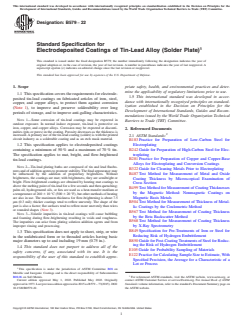
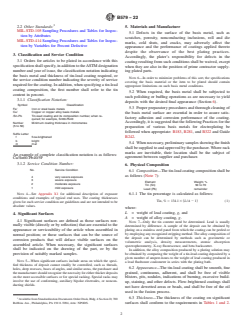
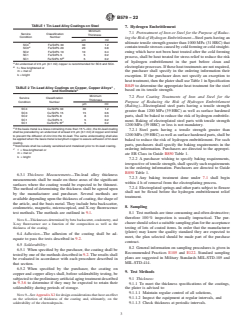
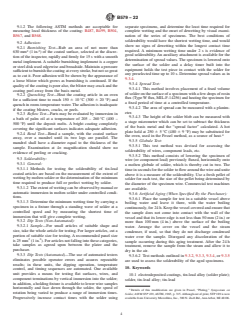
(Specification)Standard Specification for Electrodeposited Coatings of Tin-Lead Alloy (Solder Plate)
General Information
- Abstract
ABSTRACT
This specification establishes the requirements for mat, bright, and flow-brightened electrodeposited tin-lead alloy coatings on fabricated articles of iron, steel, copper, and copper alloys to protect them against corrosion, to improve and preserve solderability over long periods of storage, and to improve anti-galling characteristics. Sheets, strips, or wires in the unfabricated form, or threaded articles having a specified diameter, are not covered here. The classification notation shall include the type of basis metal, thickness of tin-lead coating required, service condition number indicating the severity of service required, and coating composition. Coatings shall be sampled, tested, and shall conform accordingly to specified requirements as to composition, appearance, thickness, adhesion (to be examined either by burnishing test, quenching test, reflow test, or bend test), and solderability (to be assessed either by non-automated or automated dip test, spread test, globule test, or artificial aging test).
SCOPE
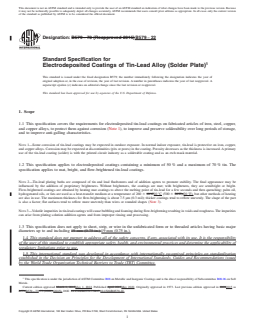
1.1 This specification covers the requirements for electrodeposited tin-lead coatings on fabricated articles of iron, steel, copper, and copper alloys, to protect them against corrosion (Note 1), to improve and preserve solderability over long periods of storage, and to improve anti-galling characteristics.
Note 1: Some corrosion of tin-lead coatings may be expected in outdoor exposure. In normal indoor exposure, tin-lead is protective on iron, copper, and copper alloys. Corrosion may be expected at discontinuities (pits or pores) in the coating. Porosity decreases as the thickness is increased. A primary use of the tin-lead coating (solder) is with the printed circuit industry as a solderable coating and as an etch mask material.
1.2 This specification applies to electrodeposited coatings containing a minimum of 50 % and a maximum of 70 % tin. The specification applies to mat, bright, and flow-brightened tin-lead coatings.
Note 2: Tin-lead plating baths are composed of tin and lead fluoborates and of addition agents to promote stability. The final appearance may be influenced by the addition of proprietary brighteners. Without brighteners, the coatings are mat; with brighteners, they are semibright or bright. Flow-brightened coatings are obtained by heating mat coatings to above the melting point of tin-lead for a few seconds and then quenching; palm oil, hydrogenated oils, or fats are used as a heat-transfer medium at a temperature of 260 ± 10 °C (500 ± 20 °F), but other methods of heating are also in use. The maximum thickness for flow-brightening is about 7.5 μm (0.3 mil); thicker coatings tend to reflow unevenly. The shape of the part is also a factor; flat surfaces tend to reflow more unevenly than wires or rounded shapes (Note 3).
Note 3: Volatile impurities in tin-lead coatings will cause bubbling and foaming during flow-brightening resulting in voids and roughness. The impurities can arise from plating solution addition agents and from improper rinsing and processing.
1.3 This specification does not apply to sheet, strip, or wire in the unfabricated form or to threaded articles having basic major diameters up to and including 19 mm (0.75 in.).
1.4 This standard does not purport to address all of the safety concerns, if any, associated with its use. It is the responsibility of the user of this standard to establish appropriate safety, health, and environmental practices and determine the applicability of regulatory limitations prior to use.
1.5 This international standard was developed in accordance with internationally recognized principles on standardization established in the Decision on Principles for the Development of International Standards, Guides and Recommendations issued by the World Trade Organization Technical Barriers to Trade (TBT) Committee.
- Status
- Published
- Publication Date
- 30-Apr-2022
- Technical Committee
- B08 - Metallic and Inorganic Coatings
- Drafting Committee
- B08.06 - Soft Metals
Buy Documents
ASTM B579-22 - Standard Specification for Electrodeposited Coatings of Tin-Lead Alloy (Solder Plate)
REDLINE ASTM B579-22 - Standard Specification for Electrodeposited Coatings of Tin-Lead Alloy (Solder Plate)
Overview
ASTM B579-22 is the standard specification for electrodeposited coatings of tin-lead alloy (commonly known as solder plate) on fabricated articles made of iron, steel, copper, and copper alloys. This standard, developed by ASTM International, outlines key requirements and guidelines for applying mat, bright, and flow-brightened tin-lead coatings. The primary objectives are to enhance corrosion protection, maintain solderability during long-term storage, and improve anti-galling properties of the coated articles.
The standard does not apply to unfabricated forms such as sheets, strips, or wires, nor to threaded articles up to and including 19 mm in diameter.
Key Topics
Scope of Requirements:
- Material Compatibility: Applies to fabricated articles of iron, steel, copper, and copper alloys.
- Coating Composition: Specifies tin-lead alloy coatings with a tin content between 50% and 70%.
- Coating Types: Covers mat, bright, and flow-brightened finish options, each offering unique surface features and benefits.
- Service Conditions: Classifies coatings based on the expected severity of exposure-ranging from mild to very severe-which guides the required coating thickness.
- Surface Preparation & Appearance: Highlights the importance of proper cleaning and preparation of the base metal to ensure adhesion and surface quality.
- Thickness and Adhesion: Defines minimum coating thickness based on service conditions, and provides recommended test methods for measuring thickness and assessing adhesion (burnishing, quenching, reflow, and bend tests).
- Solderability: Outlines procedures to evaluate and maintain solderability, crucial for electrical and electronic applications.
Corrosion Resistance:
- Tin-lead coatings provide effective protection against corrosion in indoor environments but may show signs of corrosion and porosity in outdoor exposure.
- Thicker coatings reduce porosity and improve protection.
Hydrogen Embrittlement:
- Details pre-treatment and post-coating baking requirements for high-tensile steel components to minimize the risk of hydrogen embrittlement.
Testing and Quality Assurance:
- Methods for sampling and inspecting coated articles are defined, including reference to relevant ASTM and military standards for sampling procedures.
- Specifies that quality checks must be part of the purchasing agreement to ensure compliance.
Applications
Tin-Lead Solder Plate Uses:
- Printed Circuit Boards (PCBs): Provides solderable surfaces and serves as an etch mask during manufacturing.
- Connectors and Components: Applied to prevent corrosion and to ensure reliable electrical connections over extended storage periods.
- Fasteners and Mechanical Parts: Improves anti-galling characteristics, reducing wear when parts are assembled or in use.
- General Industrial Components: Offers protection to fabricated metal articles used in various indoor and controlled environments.
Service Condition Examples:
- Mild/Moderate Service: Short-term storage or interior-use components.
- Severe/Very Severe Service: Components exposed to moisture, industrial atmospheres, or abrasion, which require thicker, more robust coatings.
Related Standards
Professionals applying ASTM B579-22 should also be aware of several related ASTM standards and guides that support compliance and best practices:
- ASTM B183: Preparation of low-carbon steel for electroplating.
- ASTM B242: Preparation of high-carbon steel for plating applications.
- ASTM B281: Preparation of copper and its alloys for electroplating.
- ASTM B322: General cleaning of metals before plating.
- ASTM B487, B499, B504, B567, B568: Methods for measuring coating thickness.
- ASTM B849, B850: Guidelines for pre- and post-plating treatments to prevent hydrogen embrittlement.
- MIL-STD-105 / MIL-STD-414: Sampling procedures for inspection.
By following ASTM B579-22 and these related standards, manufacturers and engineers can ensure the reliability, longevity, and functionality of tin-lead alloy coated articles for demanding industrial and electronic use.
Key SEO Terms: tin-lead alloy coating, solder plate, electrodeposited coatings, ASTM B579-22, corrosion protection, solderability, anti-galling, industrial plating standards.
Relations
- Effective Date
- 01-Nov-2023
- Effective Date
- 01-Apr-2019
- Effective Date
- 01-Apr-2019
- Effective Date
- 01-Nov-2014
- Effective Date
- 01-Nov-2014
- Effective Date
- 01-Dec-2013
- Effective Date
- 01-May-2013
- Effective Date
- 01-Oct-2011
- Effective Date
- 01-Aug-2011
- Effective Date
- 01-Oct-2010
- Effective Date
- 01-Sep-2009
- Effective Date
- 01-Sep-2009
- Effective Date
- 01-Sep-2009
- Effective Date
- 01-Sep-2009
- Refers
ASTM B568-98(2009) - Standard Test Method for Measurement of Coating Thickness by X-Ray Spectrometry - Effective Date
- 01-Sep-2009
Buy Documents
ASTM B579-22 - Standard Specification for Electrodeposited Coatings of Tin-Lead Alloy (Solder Plate)
REDLINE ASTM B579-22 - Standard Specification for Electrodeposited Coatings of Tin-Lead Alloy (Solder Plate)
Get Certified
Connect with accredited certification bodies for this standard

DVS-ZERT GmbH
German welding certification society.
CARES (UK Certification Authority for Reinforcing Steels)
UK certification for reinforcing steels and construction.
EWF/IIW (European/International Welding Federation)
International welding personnel certification.
Sponsored listings
Frequently Asked Questions
ASTM B579-22 is a technical specification published by ASTM International. Its full title is "Standard Specification for Electrodeposited Coatings of Tin-Lead Alloy (Solder Plate)". This standard covers: ABSTRACT This specification establishes the requirements for mat, bright, and flow-brightened electrodeposited tin-lead alloy coatings on fabricated articles of iron, steel, copper, and copper alloys to protect them against corrosion, to improve and preserve solderability over long periods of storage, and to improve anti-galling characteristics. Sheets, strips, or wires in the unfabricated form, or threaded articles having a specified diameter, are not covered here. The classification notation shall include the type of basis metal, thickness of tin-lead coating required, service condition number indicating the severity of service required, and coating composition. Coatings shall be sampled, tested, and shall conform accordingly to specified requirements as to composition, appearance, thickness, adhesion (to be examined either by burnishing test, quenching test, reflow test, or bend test), and solderability (to be assessed either by non-automated or automated dip test, spread test, globule test, or artificial aging test). SCOPE 1.1 This specification covers the requirements for electrodeposited tin-lead coatings on fabricated articles of iron, steel, copper, and copper alloys, to protect them against corrosion (Note 1), to improve and preserve solderability over long periods of storage, and to improve anti-galling characteristics. Note 1: Some corrosion of tin-lead coatings may be expected in outdoor exposure. In normal indoor exposure, tin-lead is protective on iron, copper, and copper alloys. Corrosion may be expected at discontinuities (pits or pores) in the coating. Porosity decreases as the thickness is increased. A primary use of the tin-lead coating (solder) is with the printed circuit industry as a solderable coating and as an etch mask material. 1.2 This specification applies to electrodeposited coatings containing a minimum of 50 % and a maximum of 70 % tin. The specification applies to mat, bright, and flow-brightened tin-lead coatings. Note 2: Tin-lead plating baths are composed of tin and lead fluoborates and of addition agents to promote stability. The final appearance may be influenced by the addition of proprietary brighteners. Without brighteners, the coatings are mat; with brighteners, they are semibright or bright. Flow-brightened coatings are obtained by heating mat coatings to above the melting point of tin-lead for a few seconds and then quenching; palm oil, hydrogenated oils, or fats are used as a heat-transfer medium at a temperature of 260 ± 10 °C (500 ± 20 °F), but other methods of heating are also in use. The maximum thickness for flow-brightening is about 7.5 μm (0.3 mil); thicker coatings tend to reflow unevenly. The shape of the part is also a factor; flat surfaces tend to reflow more unevenly than wires or rounded shapes (Note 3). Note 3: Volatile impurities in tin-lead coatings will cause bubbling and foaming during flow-brightening resulting in voids and roughness. The impurities can arise from plating solution addition agents and from improper rinsing and processing. 1.3 This specification does not apply to sheet, strip, or wire in the unfabricated form or to threaded articles having basic major diameters up to and including 19 mm (0.75 in.). 1.4 This standard does not purport to address all of the safety concerns, if any, associated with its use. It is the responsibility of the user of this standard to establish appropriate safety, health, and environmental practices and determine the applicability of regulatory limitations prior to use. 1.5 This international standard was developed in accordance with internationally recognized principles on standardization established in the Decision on Principles for the Development of International Standards, Guides and Recommendations issued by the World Trade Organization Technical Barriers to Trade (TBT) Committee.
ABSTRACT This specification establishes the requirements for mat, bright, and flow-brightened electrodeposited tin-lead alloy coatings on fabricated articles of iron, steel, copper, and copper alloys to protect them against corrosion, to improve and preserve solderability over long periods of storage, and to improve anti-galling characteristics. Sheets, strips, or wires in the unfabricated form, or threaded articles having a specified diameter, are not covered here. The classification notation shall include the type of basis metal, thickness of tin-lead coating required, service condition number indicating the severity of service required, and coating composition. Coatings shall be sampled, tested, and shall conform accordingly to specified requirements as to composition, appearance, thickness, adhesion (to be examined either by burnishing test, quenching test, reflow test, or bend test), and solderability (to be assessed either by non-automated or automated dip test, spread test, globule test, or artificial aging test). SCOPE 1.1 This specification covers the requirements for electrodeposited tin-lead coatings on fabricated articles of iron, steel, copper, and copper alloys, to protect them against corrosion (Note 1), to improve and preserve solderability over long periods of storage, and to improve anti-galling characteristics. Note 1: Some corrosion of tin-lead coatings may be expected in outdoor exposure. In normal indoor exposure, tin-lead is protective on iron, copper, and copper alloys. Corrosion may be expected at discontinuities (pits or pores) in the coating. Porosity decreases as the thickness is increased. A primary use of the tin-lead coating (solder) is with the printed circuit industry as a solderable coating and as an etch mask material. 1.2 This specification applies to electrodeposited coatings containing a minimum of 50 % and a maximum of 70 % tin. The specification applies to mat, bright, and flow-brightened tin-lead coatings. Note 2: Tin-lead plating baths are composed of tin and lead fluoborates and of addition agents to promote stability. The final appearance may be influenced by the addition of proprietary brighteners. Without brighteners, the coatings are mat; with brighteners, they are semibright or bright. Flow-brightened coatings are obtained by heating mat coatings to above the melting point of tin-lead for a few seconds and then quenching; palm oil, hydrogenated oils, or fats are used as a heat-transfer medium at a temperature of 260 ± 10 °C (500 ± 20 °F), but other methods of heating are also in use. The maximum thickness for flow-brightening is about 7.5 μm (0.3 mil); thicker coatings tend to reflow unevenly. The shape of the part is also a factor; flat surfaces tend to reflow more unevenly than wires or rounded shapes (Note 3). Note 3: Volatile impurities in tin-lead coatings will cause bubbling and foaming during flow-brightening resulting in voids and roughness. The impurities can arise from plating solution addition agents and from improper rinsing and processing. 1.3 This specification does not apply to sheet, strip, or wire in the unfabricated form or to threaded articles having basic major diameters up to and including 19 mm (0.75 in.). 1.4 This standard does not purport to address all of the safety concerns, if any, associated with its use. It is the responsibility of the user of this standard to establish appropriate safety, health, and environmental practices and determine the applicability of regulatory limitations prior to use. 1.5 This international standard was developed in accordance with internationally recognized principles on standardization established in the Decision on Principles for the Development of International Standards, Guides and Recommendations issued by the World Trade Organization Technical Barriers to Trade (TBT) Committee.
ASTM B579-22 is classified under the following ICS (International Classification for Standards) categories: 25.220.40 - Metallic coatings. The ICS classification helps identify the subject area and facilitates finding related standards.
ASTM B579-22 has the following relationships with other standards: It is inter standard links to ASTM B849-02(2023), ASTM B849-02(2019), ASTM B281-88(2019)e1, ASTM B242-99(2014), ASTM B183-79(2014), ASTM B281-88(2013), ASTM B849-02(2013), ASTM B504-90(2011), ASTM E122-09e1, ASTM E105-10, ASTM B567-98(2009a), ASTM B242-99(2009), ASTM B850-98(2009), ASTM B322-99(2009), ASTM B568-98(2009). Understanding these relationships helps ensure you are using the most current and applicable version of the standard.
ASTM B579-22 is available in PDF format for immediate download after purchase. The document can be added to your cart and obtained through the secure checkout process. Digital delivery ensures instant access to the complete standard document.
Standards Content (Sample)
This international standard was developed in accordance with internationally recognized principles on standardization established in the Decision on Principles for the
Development of International Standards, Guides and Recommendations issued by the World Trade Organization Technical Barriers to Trade (TBT) Committee.
Designation: B579 −22
Standard Specification for
Electrodeposited Coatings of Tin-Lead Alloy (Solder Plate)
This standard is issued under the fixed designation B579; the number immediately following the designation indicates the year of
original adoption or, in the case of revision, the year of last revision.Anumber in parentheses indicates the year of last reapproval.A
superscript epsilon (´) indicates an editorial change since the last revision or reapproval.
This standard has been approved for use by agencies of the U.S. Department of Defense.
1. Scope priate safety, health, and environmental practices and deter-
mine the applicability of regulatory limitations prior to use.
1.1 Thisspecificationcoverstherequirementsforelectrode-
1.5 This international standard was developed in accor-
posited tin-lead coatings on fabricated articles of iron, steel,
dance with internationally recognized principles on standard-
copper, and copper alloys, to protect them against corrosion
ization established in the Decision on Principles for the
(Note 1), to improve and preserve solderability over long
Development of International Standards, Guides and Recom-
periods of storage, and to improve anti-galling characteristics.
mendations issued by the World Trade Organization Technical
NOTE 1—Some corrosion of tin-lead coatings may be expected in
Barriers to Trade (TBT) Committee.
outdoor exposure. In normal indoor exposure, tin-lead is protective on
iron, copper, and copper alloys. Corrosion may be expected at disconti-
2. Referenced Documents
nuities(pitsorpores)inthecoating.Porositydecreasesasthethicknessis
increased.Aprimaryuseofthetin-leadcoating(solder)iswiththeprinted 2.1 ASTM Standards:
circuit industry as a solderable coating and as an etch mask material.
B183Practice for Preparation of Low-Carbon Steel for
Electroplating
1.2 This specification applies to electrodeposited coatings
B242Guide for Preparation of High-Carbon Steel for Elec-
containing a minimum of 50% and a maximum of 70% tin.
troplating
The specification applies to mat, bright, and flow-brightened
B281Practice for Preparation of Copper and Copper-Base
tin-lead coatings.
Alloys for Electroplating and Conversion Coatings
NOTE 2—Tin-lead plating baths are composed of tin and lead fluobo-
B322Guide for Cleaning Metals Prior to Electroplating
ratesandofadditionagentstopromotestability.Thefinalappearancemay
B487Test Method for Measurement of Metal and Oxide
be influenced by the addition of proprietary brighteners. Without
brighteners, the coatings are mat; with brighteners, they are semibright or Coating Thickness by Microscopical Examination of
bright. Flow-brightened coatings are obtained by heating mat coatings to
Cross Section
abovethemeltingpointoftin-leadforafewsecondsandthenquenching;
B499Test Method for Measurement of CoatingThicknesses
palm oil, hydrogenated oils, or fats are used as a heat-transfer medium at
by the Magnetic Method: Nonmagnetic Coatings on
atemperatureof260 610°C(500 620°F),butothermethodsofheating
Magnetic Basis Metals
are also in use. The maximum thickness for flow-brightening is about 7.5
µm (0.3 mil); thicker coatings tend to reflow unevenly. The shape of the
B504Test Method for Measurement of Thickness of Metal-
part is also a factor; flat surfaces tend to reflow more unevenly than wires
lic Coatings by the Coulometric Method
or rounded shapes (Note 3).
B567Test Method for Measurement of Coating Thickness
NOTE 3—Volatile impurities in tin-lead coatings will cause bubbling
by the Beta Backscatter Method
and foaming during flow-brightening resulting in voids and roughness.
The impurities can arise from plating solution addition agents and from B568Test Method for Measurement of Coating Thickness
improper rinsing and processing.
by X-Ray Spectrometry
B849Specification for Pre-Treatments of Iron or Steel for
1.3 This specification does not apply to sheet, strip, or wire
Reducing Risk of Hydrogen Embrittlement
in the unfabricated form or to threaded articles having basic
B850GuideforPost-CoatingTreatmentsofSteelforReduc-
major diameters up to and including 19mm (0.75in.).
ing the Risk of Hydrogen Embrittlement
1.4 This standard does not purport to address all of the
E105Guide for Probability Sampling of Materials
safety concerns, if any, associated with its use. It is the
E122PracticeforCalculatingSampleSizetoEstimate,With
responsibility of the user of this standard to establish appro-
Specified Precision, the Average for a Characteristic of a
Lot or Process
This specification is under the jurisdiction of ASTM Committee B08 on
Metallic and Inorganic Coatings and is the direct responsibility of Subcommittee
B08.06 on Soft Metals. For referenced ASTM standards, visit the ASTM website, www.astm.org, or
Current edition approved May 1, 2022. Published May 2022. Originally contact ASTM Customer Service at service@astm.org. For Annual Book of ASTM
approvedin1973.Lastpreviouseditionapprovedin2015asB579–73(2015).DOI: Standards volume information, refer to the standard’s Document Summary page on
10.1520/B0579-22. the ASTM website.
Copyright © ASTM International, 100 Barr Harbor Drive, PO Box C700, West Conshohocken, PA 19428-2959. United States
B579 − 22
2.2 Other Standards: 5. Materials and Manufacture
MIL-STD-105Sampling Procedures and Tables for Inspec-
5.1 Defects in the surface of the basis metal, such as
tion by Attributes
scratches, porosity, nonconducting inclusions, roll and die
MIL-STD-414Sampling Procedures and Tables for Inspec-
marks, cold shuts, and cracks, may adversely affect the
tion by Variables for Percent Defective
appearance and the performance of coatings applied thereto
despite the observance of the best plating practices.
3. Classification and Service Condition
Accordingly, the plater’s responsibility for defects in the
3.1 Orders for articles to be plated in accordance with this
coating resulting from such conditions shall be waived, except
specificationshallspecify,inadditiontotheASTMdesignation
when they are also in the position of prime contractor supply-
number and year of issue, the classification notation indicating
ing plated parts.
the basis metal and thickness of tin-lead coating required, or
NOTE 6—In order to minimize problems of this sort, the specifications
the service condition number indicating the severity of service
covering the basis material or the item to be plated should contain
requiredforthecoating.Inaddition,whenspecifyingatin-lead
appropriate limitations on such basis metal conditions.
coating composition, the first number shall refer to the tin
5.2 When required, the basis metal shall be subjected to
content in percent.
such polishing or buffing operations as are necessary to yield
3.1.1 Classification Notation:
deposits with the desired final appearance (Section 6).
Symbol Classification
5.3 Properpreparatoryproceduresandthoroughcleaningof
Fe/ Iron or steel basis metals
Cu/ Copper or copper alloy basis metals
the basis metal surface are essential in order to assure satis-
/Sn-Pb Tin-lead coating and its composition number, when re-
factory adhesion and corrosion performance of the coating.
quired; for example, Sn60-Pb40
Accordingly,itissuggestedthatthefollowingPracticesforthe
Number Minimum coating thickness in micrometres
(5 to 50)
preparation of various basis metals for electroplating be
followed when appropriate: B183, B281, and B322 and Guide
Suffix Letter
B242.
f flow-brightened
b bright
5.4 Whennecessary,preliminarysamplesshowingthefinish
m mat
shallbesuppliedtoandapprovedbythepurchaser.Whererack
marks are inevitable, their location shall be the subject of
An example of complete classification notation is as follows:
agreement between supplier and purchaser.
Cu/Sn60-Pb40/5F
3.1.2 Service Condition Number:
6. Physical Composition
No. Service Condition
6.1 Composition—Thetin-leadcoatingcompositionshallbe
as follows (Note 7):
4 very severe exposure
3 severe exposure
Element Weight, %
2 moderate exposure
Tin (Sn) 50 to 70
1 mild exposure
Lead (Pb) remainder
NOTE 4—See Appendix X1 for additional description of exposure
6.1.1 The tin percentage is calculated as follows:
conditions and examples of typical end uses. The coating thicknesses
Tin,% 5134.1 3 ~L/A 21! (1)
given for each service condition are guidelines and are not intended to be
absolute values.
where:
L = weight of lead coating, g, and
4. Significant Surfaces
A = weight of alloy coating, g.
4.1 Significant surfaces are defined as those surfaces nor-
NOTE 7—Only the tin content need be determined. Lead is usually
mally visible (directly or by reflection) that are essential to the
determined by difference. A sample of the deposit can be obtained by
appearance or serviceability of the article when assembled in plating on a stainless steel panel from which the coating can be peeled or
by employing any recognized stripping method.The alloy composition of
normal position; or those surfaces that can be the source of
the deposit can be determined by methods such as gravimetric or
corrosion products that will deface visible surfaces on the
volumetric analysis, density measurements, atomic absorption
assembled article. When necessary, the significant surfaces
spectrophotometry, X-ray fluorescence, and beta backscatter.
shall be indicated on the drawing of the part, or by the
In addition, the alloy composition produced by a plating solution may
be obtained by comparing the weight of a tin-lead coating deposited by a
provision of suitably marked samples.
given number of ampere-hours to the weight of lead coating produced in
NOTE 5—When significant surfaces include areas on which the speci-
a lead fluoborate coulometer in series with the plating bath.
fied thickness of deposit cannot readily be controlled, such as threads,
6.2 Appearance—The tin-lead coating shall be smooth, fine
holes, deep recesses, bases of angles, and similar areas, the purchaser and
grained, continuous, adherent, and shall be free of visible
themanufacturershouldrecognizethenecessityforeitherthickerdeposits
on the more accessible surfaces or for special racking. Special racks may
blisters, pits, nodules, indications of burning, excessive build-
involve the use of conforming, auxiliary bipolar electrodes, or noncon-
up, staining, and other defects. Flow-brightened coatings shall
ducting shields.
not have dewetted areas or beads, and shall be free of the oil
used in the fusion process.
6.3 Thickness—The thickness of the coating on significant
AvailablefromStandardizationDocumentsOrderDesk,Bldg.4SectionD,700
Robbins Ave., Philadelphia, PA 19111-5094, Attn: NPODS. surfaces shall conform to the requirements in Tables 1 and 2.
B579 − 22
TABLE 1 Tin-Lead Alloy Coatings on Steel
7. Hydrogen Embrittlement
Minimum
7.1 Pretreatment of Iron or Steel for the Purpose of Reduc-
Service Classification
Thickness
Condition Number
ing the Risk of Hydrogen Embrittlement—Steelpartshavingan
µm mil
ultimate tensile strength greater than 1000MPa (31HRC) that
A
SC4 Fe/SnPb 30 30 1.2
A
containtensilestressescausedbycoldformingorcoldstraight-
SC3 Fe/SnPb 20 20 0.8
SC2 Fe/SnPb 10 10 0.4
ening which have not been heat treated after the cold forming
SC1 Fe/SnPb 5 5 0.2
process, shall be heat treated for stress relief to reduce the risk
B
SC1 Fe/SnPb 5f 50.2
of hydrogen embrittlement in the part before clean and
A
An undercoat of 2.5 µm (0.1 mil) copper is recommended for SC3 and SC4.
B electroplateprocesses.Iftheseheattreatmentsarenotrequired,
f = flow brightened or
m = mat or
the purchaser shall specify in the ordering information their
b=bright
exception. If the purchaser does not specify an exception to
heattreatment,thentheplatershalluseTable1inSpecification
B849 to determine the appropriate heat treatment for the steel
A
TABLE 2 Tin-Lead Alloy Coatings on Copper, Copper Alloys ,
B
based on its tensile strength.
and Nonmetals
Minimum
7.2 Post Coating Treatments of Iron and Steel for the
Service Classification
Thickness
Purpose of Reducing the Risk of Hydrogen Embrittlement
Condition Number
µm mil
(Baking)—Electroplated steel parts having a tensile strength
SC4 Cu/SnPb 30 30 1.2
greater than 1200MPa (39HRC) as well as surface hardened
SC3 Cu/SnPb 15 15 0.6
parts, shall be baked to reduce the risk of hydrogen embrittle-
SC2 Cu/SnPb 8 8 0.3
SC1 Cu/SnPb 5 5 0.2
ment. Baking of electroplated steel parts with tensile strength
C
SC1 Cu/SnPb 5f 50.2
1200MPa (39HRC) or less is not mandatory.
A
If the basis metal is a brass containing more than 15 % zinc, the tin-lead coating
7.2.1 Steel parts having a tensile strength greater than
shall be preceded by an undercoat of at least 2.5 µm (0.1 mil) of copper and nickel
1200MPa(39HRC)aswellassurfacehardenedparts,shallbe
to prevent the diffusion of zinc into the tin-lead. The same undercoating shall also
be applied when the basis metal is beryllium copper to assure adhesion of tin-lead
baked to reduce the risk of hydrogen embrittlement. For such
coating.
parts, purchasers shall specify the baking req
...
This document is not an ASTM standard and is intended only to provide the user of an ASTM standard an indication of what changes have been made to the previous version. Because
it may not be technically possible to adequately depict all changes accurately, ASTM recommends that users consult prior editions as appropriate. In all cases only the current version
of the standard as published by ASTM is to be considered the official document.
Designation: B579 − 73 (Reapproved 2015) B579 − 22
Standard Specification for
Electrodeposited Coatings of Tin-Lead Alloy (Solder Plate)
This standard is issued under the fixed designation B579; the number immediately following the designation indicates the year of
original adoption or, in the case of revision, the year of last revision. A number in parentheses indicates the year of last reapproval. A
superscript epsilon (´) indicates an editorial change since the last revision or reapproval.
This standard has been approved for use by agencies of the U.S. Department of Defense.
1. Scope
1.1 This specification covers the requirements for electrodeposited tin-lead coatings on fabricated articles of iron, steel, copper,
and copper alloys, to protect them against corrosion (Note 1), to improve and preserve solderability over long periods of storage,
and to improve anti-galling characteristics.
NOTE 1—Some corrosion of tin-lead coatings may be expected in outdoor exposure. In normal indoor exposure, tin-lead is protective on iron, copper,
and copper alloys. Corrosion may be expected at discontinuities (pits or pores) in the coating. Porosity decreases as the thickness is increased. A primary
use of the tin-lead coating (solder) is with the printed circuit industry as a solderable coating and as an etch mask material.
1.2 This specification applies to electrodeposited coatings containing a minimum of 50 % and a maximum of 70 % tin. The
specification applies to mat, bright, and flow-brightened tin-lead coatings.
NOTE 2—Tin-lead plating baths are composed of tin and lead fluoborates and of addition agents to promote stability. The final appearance may be
influenced by the addition of proprietary brighteners. Without brighteners, the coatings are mat; with brighteners, they are semibright or bright.
Flow-brightened coatings are obtained by heating mat coatings to above the melting point of tin-lead for a few seconds and then quenching; palm oil,
hydrogenated oils, or fats are used as a heat-transfer medium at a temperature of 260 6 10°C10 °C (500 6 20°F),20 °F), but other methods of heating
are also in use. The maximum thickness for flow-brightening is about 7.5 μm (0.3 mil); thicker coatings tend to reflow unevenly. The shape of the part
is also a factor; flat surfaces tend to reflow more unevenly than wires or rounded shapes (Note 3).
NOTE 3—Volatile impurities in tin-lead coatings will cause bubbling and foaming during flow-brightening resulting in voids and roughness. The impurities
can arise from plating solution addition agents and from improper rinsing and processing.
1.3 This specification does not apply to sheet, strip, or wire in the unfabricated form or to threaded articles having basic major
diameters up to and including 19 mm (0.75 in.).19 mm (0.75 in.).
1.4 This standard does not purport to address all of the safety concerns, if any, associated with its use. It is the responsibility
of the user of this standard to establish appropriate safety, health, and environmental practices and determine the applicability of
regulatory limitations prior to use.
1.5 This international standard was developed in accordance with internationally recognized principles on standardization
established in the Decision on Principles for the Development of International Standards, Guides and Recommendations issued
by the World Trade Organization Technical Barriers to Trade (TBT) Committee.
This specification is under the jurisdiction of ASTM Committee B08 on Metallic and Inorganic Coatings and is the direct responsibility of Subcommittee B08.06 on Soft
Metals.
Current edition approved March 1, 2015May 1, 2022. Published April 2015May 2022. Originally approved in 1973. Last previous edition approved in 20092015 as
B579B579 – 73–73 (2009).(2015). DOI: 10.1520/B0579-73R15.10.1520/B0579-22.
Copyright © ASTM International, 100 Barr Harbor Drive, PO Box C700, West Conshohocken, PA 19428-2959. United States
B579 − 22
2. Referenced Documents
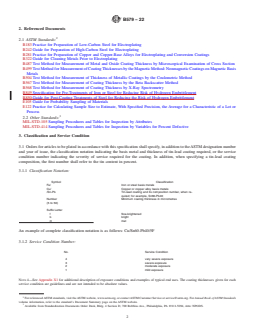
2.1 ASTM Standards:
B183 Practice for Preparation of Low-Carbon Steel for Electroplating
B242 Guide for Preparation of High-Carbon Steel for Electroplating
B281 Practice for Preparation of Copper and Copper-Base Alloys for Electroplating and Conversion Coatings
B322 Guide for Cleaning Metals Prior to Electroplating
B487 Test Method for Measurement of Metal and Oxide Coating Thickness by Microscopical Examination of Cross Section
B499 Test Method for Measurement of Coating Thicknesses by the Magnetic Method: Nonmagnetic Coatings on Magnetic Basis
Metals
B504 Test Method for Measurement of Thickness of Metallic Coatings by the Coulometric Method
B567 Test Method for Measurement of Coating Thickness by the Beta Backscatter Method
B568 Test Method for Measurement of Coating Thickness by X-Ray Spectrometry
B849 Specification for Pre-Treatments of Iron or Steel for Reducing Risk of Hydrogen Embrittlement
B850 Guide for Post-Coating Treatments of Steel for Reducing the Risk of Hydrogen Embrittlement
E105 Guide for Probability Sampling of Materials
E122 Practice for Calculating Sample Size to Estimate, With Specified Precision, the Average for a Characteristic of a Lot or
Process
2.2 Other Standards:
MIL-STD-105 Sampling Procedures and Tables for Inspection by Attributes
MIL-STD-414 Sampling Procedures and Tables for Inspection by Variables for Percent Defective
3. Classification and Service Condition
3.1 Orders for articles to be plated in accordance with this specification shall specify, in addition to the ASTM designation number
and year of issue, the classification notation indicating the basis metal and thickness of tin-lead coating required, or the service
condition number indicating the severity of service required for the coating. In addition, when specifying a tin-lead coating
composition, the first number shall refer to the tin content in percent.
3.1.1 Classification Notation:
Symbol Classification
Fe/ Iron or steel basis metals
Cu/ Copper or copper alloy basis metals
/Sn-Pb Tin-lead coating and its composition number, when re-
quired; for example, Sn60-Pb40
Number Minimum coating thickness in micrometres
(5 to 50)
Suffix Letter
f flow-brightened
b bright
m mat
An example of complete classification notation is as follows: Cu/Sn60-Pb40/5F
3.1.2 Service Condition Number:
No. Service Condition
4 very severe exposure
3 severe exposure
2 moderate exposure
1 mild exposure
NOTE 4—See Appendix X1 for additional description of exposure conditions and examples of typical end uses. The coating thicknesses given for each
service condition are guidelines and are not intended to be absolute values.
For referenced ASTM standards, visit the ASTM website, www.astm.org, or contact ASTM Customer Service at service@astm.org. For Annual Book of ASTM Standards
volume information, refer to the standard’s Document Summary page on the ASTM website.
Available from Standardization Documents Order Desk, Bldg. 4 Section D, 700 Robbins Ave., Philadelphia, PA 19111-5094, Attn: NPODS.
B579 − 22
4. Significant Surfaces
4.1 Significant surfaces are defined as those surfaces normally visible (directly or by reflection) that are essential to the appearance
or serviceability of the article when assembled in normal position; or those surfaces that can be the source of corrosion products
that will deface visible surfaces on the assembled article. When necessary, the significant surfaces shall be indicated on the drawing
of the part, or by the provision of suitably marked samples.
NOTE 5—When significant surfaces include areas on which the specified thickness of deposit cannot readily be controlled, such as threads, holes, deep
recesses, bases of angles, and similar areas, the purchaser and the manufacturer should recognize the necessity for either thicker deposits on the more
accessible surfaces or for special racking. Special racks may involve the use of conforming, auxiliary bipolar electrodes, or nonconducting shields.
5. Materials and Manufacture
5.1 Defects in the surface of the basis metal, such as scratches, porosity, nonconducting inclusions, roll and die marks, cold shuts,
and cracks, may adversely affect the appearance and the performance of coatings applied thereto despite the observance of the best
plating practices. Accordingly, the plater’s responsibility for defects in the coating resulting from such conditions shall be waived,
except when he isthey are also in the position of prime contractor supplying plated parts.
NOTE 6—In order to minimize problems of this sort, the specifications covering the basis material or the item to be plated should contain appropriate
limitations on such basis metal conditions.
5.2 When required, the basis metal shall be subjected to such polishing or buffing operations as are necessary to yield deposits
with the desired final appearance (Section 6).
5.3 Proper preparatory procedures and thorough cleaning of the basis metal surface are essential in order to assure satisfactory
adhesion and corrosion performance of the coating. Accordingly, it is suggested that the following Practices for the preparation of
various basis metals for electroplating be followed when appropriate: B183, B281, and B322 and Guide B242.
5.4 When necessary, preliminary samples showing the finish shall be supplied to and approved by the purchaser. Where rack marks
are inevitable, their location shall be the subject of agreement between supplier and purchaser.
6. Physical Composition
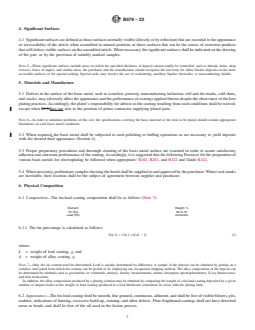
6.1 Composition—The tin-lead coating composition shall be as follows (Note 7):
Element Weight, %
Tin (Sn) 50 to 70
Lead (Pb) remainder
6.1.1 The tin percentage is calculated as follows:
Tin,%5 134.1 3 L/A 2 1 (1)
~ !
where:
L = weight of lead coating, g, and
A = weight of alloy coating, g.
NOTE 7—Only the tin content need be determined. Lead is usually determined by difference. A sample of the deposit can be obtained by plating on a
stainless steel panel from which the coating can be peeled or by employing any recognized stripping method. The alloy composition of the deposit can
be determined by methods such as gravimetric or volumetric analysis, density measurements, atomic absorption spectrophotometry, X-ray fluorescence,
and beta backscatter.
In addition, the alloy composition produced by a plating solution may be obtained by comparing the weight of a tin-lead coating deposited by a given
number of ampere-hours to the weight of lead coating produced in a lead fluoborate coulometer in series with the plating bath.
6.2 Appearance—The tin-lead coating shall be smooth, fine grained, continuous, adherent, and shall be free of visible blisters, pits,
nodules, indications of burning, excessive build-up, staining, and other defects. Flow-brightened coatings shall not have dewetted
areas or beads, and shall be free of the oil used in the fusion process.
B579 − 22
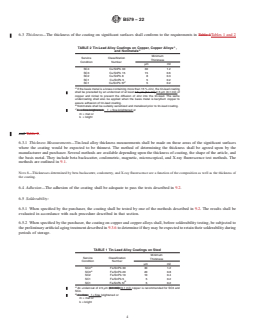
6.3 Thickness—The thickness of the coating on significant surfaces shall conform to the requirements in Table 1Tables 1 and 2
A
TABLE 2 Tin-Lead Alloy Coatings on Copper, Copper Alloys ,
B
and Nonmetals
Minimum
Service Classification
Thickness
Condition Number
μm mil
SC4 Cu/SnPb 30 30 1.2
SC3 Cu/SnPb 15 15 0.6
SC2 Cu/SnPb 8 8 0.3
SC1 Cu/SnPb 5 5 0.2
C
SC1 Cu/SnPb 5f 5 0.2
A
If the basis metal is a brass containing more than 15 % zinc, the tin-lead coating
shall be preceded by an undercoat of at least 2.5 μm (0.1 mil) 2.5 μm (0.1 mil) of
copper and nickel to prevent the diffusion of zinc into the tin-lead. The same
undercoating shall also be applied when the basis metal is beryllium copper to
assure adhesion of tin-lead coating.
B
Nonmetals shall be suitably sensitized and metalized prior to tin-lead coating.
C
f = flow-brightened f = flow-brightened or
m = mat or
b = bright
and Table 2.
6.3.1 Thickness Measurements—Tin-lead alloy thickness measurements shall be made on those areas of the significant surfaces
where the coating would be expected to be thinnest. The method of determining the thickness shall be agreed upon by the
manufacturer and purchaser. Several methods are available depending upon the thickness of coating, the shape of the article, and
the basis metal. They include beta backscatter, coulometric, magnetic, microscopical, and X-ray fluorescence test methods. The
methods are outlined in 9.1.
NOTE 8—Thicknesses determined by beta backscatter, coulometry, and X-ray fluorescence are a function of the composition as well as the thickness of
the coating.
6.4 Adhesion—The adhesion of the coating shall be adequate to pass the tests described in 9.2.
6.5 Solderability:
6.5.1 When specified by the purchaser, the coating shall be tested by one of the methods described in 9.2. The results shall be
evaluated in accordance with each procedure described in that section.
6.5.2 When specified by the purchaser, the coating on copper and copper alloys shall, before solderability testing, be subjected to
the preliminary artificial aging treatment described in 9.3.6 to determine if they may be expected to retain their solderability during
periods of storage.
TABLE 1 Tin-Lead Alloy Coatings on Steel
Minimum
Service Classification
Thickness
Condition Number
μm mil
A
SC4 Fe/SnPb 30 30 1.2
A
SC3 Fe/SnPb 20 20 0.8
SC2 Fe/SnPb 10 10 0.4
SC1 Fe/SnPb 5 5 0.2
B
SC1 Fe/SnPb 5f 5 0.2
A
An undercoat of 2.5 μm (0.1 mil) (0.1 mil) copper is recommended for SC3 and
SC4.
B
f = flow f = flow brightened or
m = mat or
b = bright
B579 − 22
NOTE 9—See Appendix X2 for design considerations that have an effect on the selection of thickness of the coating and, ultima
...