

ASTM E2033-17
(Practice)Standard Practice for Radiographic Examination Using Computed Radiography (Photostimulable Luminescence Method)
General Information
- Abstract
SIGNIFICANCE AND USE
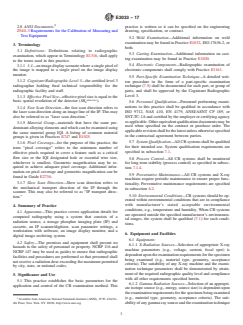
5.1 This practice establishes the basic parameters for the application and control of the CR examination method. This practice is written so it can be specified on the engineering drawing, specification, or contract.
5.2 Weld Examination—Additional information on weld examination may be found in Practice E1032, ISO 17636-2, or both.
5.3 Casting Examination—Additional information on casting examination may be found in Practice E1030.
5.4 Electronic Components—Radiographic examination of electronic components shall comply with Practice E1161.
5.5 Part-Specific Examination Technique—A detailed written procedure in the form of a part-specific examination technique (7.5) shall be documented for each part, or group of parts, and shall be approved by the Cognizant Radiographic Level 3.
5.6 Personnel Qualification—Personnel performing examinations to this practice shall be qualified in accordance with ISO 9712, NAS 410, EN 4179, ANSI/ASNT CP 189, or SNT-TC-1A and certified by the employer or certifying agency as applicable. Other equivalent qualification documents may be used when specified on the contract or purchase order. The applicable revision shall be the latest unless otherwise specified in the contractual agreement between parties.
5.7 System Qualification—All CR systems shall be qualified for their intended use. System qualification requirements are specified in subsection 7.1.
5.8 Process Control—All CR systems shall be monitored for long term stability (process control) as specified in subsection 7.1.4.
5.9 Preventative Maintenance—All CR systems and X-ray machines require periodic maintenance to ensure proper functionality. Preventative maintenance requirements are specified in subsection 6.2.
5.10 Environmental Conditions—CR systems should be operated within environmental conditions that are in compliance with manufacturer’s stated acceptable environmental conditions, e.g., temperature and humidity. When CR systems are operated outsid...
SCOPE
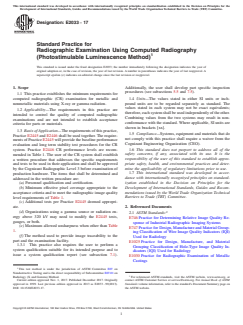
1.1 This practice establishes the minimum requirements for computed radiographic (CR) examination for metallic and nonmetallic materials using X-ray or gamma radiation.
1.2 Applicability—The requirements in this practice are intended to control the quality of computed radiographic examinations and are not intended to establish acceptance criteria for parts or materials.
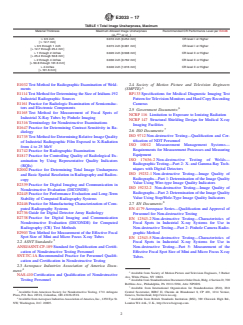
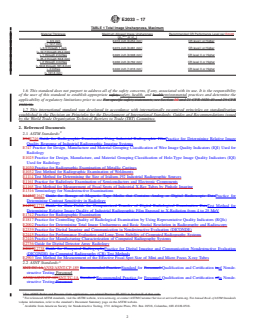
1.3 Basis of Application—The requirements of this practice, Practice E2445 and E2446 shall be used together. The requirements of Practice E2445 will provide the baseline performance evaluation and long term stability test procedures for the CR system. Practice E2446 CR performance levels are recommended in Table 1. The user of the CR system shall establish a written procedure that addresses the specific requirements and tests to be used in their application and shall be approved by the Cognizant Radiographic Level 3 before examination of production hardware. The items that shall be determined and addressed in the written procedure are:
(a) Personnel qualification and certification.
(b) Minimum effective pixel coverage appropriate to the acceptance criteria and to meet the radiographic image quality level requirements of Table 1.
(c) Additional tests per Practice E2445 deemed appropriate.
(d) Organizations using a gamma source or radiation energy above 320 kV may need to modify the E2445 tests, gauges, or both.
(e) Maximum allowed unsharpness when other than Table 1.
(f) The method used to provide image traceability to the part and the examination facility.
1.3.1 This practice also requires the user to perform a system qualification suitable for its intended purpose and to issue a system qualification report (see subsection 7.1). Additionally, the user shall develop part specific inspection procedures (see subsections 5.5 and 7.5).
1.4 Units—The values stated in either SI units or inch-pound units are to be regarded separately as s...
- Status
- Published
- Publication Date
- 31-Oct-2017
- Technical Committee
- E07 - Nondestructive Testing
- Drafting Committee
- E07.01 - Radiography (X and Gamma) Method
Buy Documents
ASTM E2033-17 - Standard Practice for Radiographic Examination Using Computed Radiography (Photostimulable Luminescence Method)
REDLINE ASTM E2033-17 - Standard Practice for Radiographic Examination Using Computed Radiography (Photostimulable Luminescence Method)
Overview
ASTM E2033-17: Standard Practice for Radiographic Examination Using Computed Radiography (Photostimulable Luminescence Method) provides comprehensive guidelines for using computed radiography (CR) with photostimulable luminescence to perform radiographic examinations of both metallic and nonmetallic materials. Developed by ASTM International, this standard outlines the essential parameters, control procedures, personnel qualifications, and equipment requirements for employing CR as a nondestructive testing (NDT) method with X-ray or gamma radiation sources. Its scope encompasses system qualification, process control, preventative maintenance, and the environmental considerations necessary to ensure high-quality and reproducible radiographic inspection results.
Key Topics
- minimum requirements for computed radiographic examinations using X-ray or gamma radiation
- System qualification and routine performance checks for all CR systems
- Written procedures for part-specific examination techniques, to be reviewed by a qualified radiographic Level 3
- Personnel qualification and certification, referencing ISO 9712, NAS 410, EN 4179, ANSI/ASNT CP 189, or SNT-TC-1A
- Process control and long-term system stability as core elements of quality assurance
- Preventative maintenance protocols for both CR systems and X-ray machines
- Environmental operation conditions aligned with manufacturer recommendations
- Use of appropriate image quality indicators (IQIs) and reference quality indicators (RQIs) for performance assessment
- Documentation and traceability of radiographic results and system qualification
- Guidance and cross-references for special applications, such as welds and electronic components
Applications
Computed radiography (CR) using the photostimulable luminescence method is widely adopted throughout industries that require detailed imaging for quality control and safety assurance. This standard is critical for:
- Weld inspection: Ensuring weld integrity in pressure vessels, pipelines, and structural assemblies
- Casting examinations: Detecting internal defects or inconsistencies in metal castings across automotive, aerospace, and manufacturing sectors
- Inspection of electronic components: Non-destructive evaluation for detecting flaws in semiconductors or sensitive assemblies
- General NDT applications: Including but not limited to components and assemblies in the aerospace, construction, power generation, and shipbuilding industries
Adhering to ASTM E2033-17 assists in ensuring the repeatability, reliability, and traceability of CR imaging results, ultimately helping organizations meet regulatory requirements and maintain high standards of safety and product quality.
Related Standards
ASTM E2033-17 references and complements several key national and international standards to provide a comprehensive approach to computed radiography in nondestructive testing. Notable related standards include:
- ASTM E2445: Practice for Performance Evaluation and Long-Term Stability of Computed Radiography Systems
- ASTM E2446: Practice for Manufacturing Characterization of Computed Radiography Systems
- ASTM E1030: Practice for Radiographic Examination of Metallic Castings
- ASTM E1032: Practice for Radiographic Examination of Weldments
- ASTM E747 & E1025: Practices for Image Quality Indicators in Radiology
- ISO 9712: Certification of Nondestructive Testing Personnel
- ISO 17636-2: Non-destructive Testing of Welds - Radiographic Testing - Part 2: X- and Gamma-Ray Techniques with Digital Detectors
- EN 4179: Qualification and Approval of Personnel for Non-destructive Testing
- ANSI/ASNT CP 189, SNT-TC-1A: Personnel qualification and certification for NDT
Utilizing ASTM E2033-17 in conjunction with these related standards ensures robust, validated NDT processes with a strong emphasis on system performance, operator competency, and accurate documentation.
Keywords: ASTM E2033-17, computed radiography, CR, photostimulable luminescence, nondestructive testing, NDT, system qualification, personnel certification, radiographic examination, image quality indicators, process control, weld inspection, casting inspection, electronic component inspection, preventive maintenance, ISO 9712.
Relations
- Effective Date
- 01-Feb-2024
- Effective Date
- 01-Dec-2023
- Effective Date
- 01-Dec-2019
- Effective Date
- 01-Dec-2019
- Effective Date
- 01-Mar-2019
- Effective Date
- 01-Feb-2019
- Effective Date
- 01-Feb-2018
- Effective Date
- 01-Feb-2018
- Effective Date
- 01-Feb-2018
- Effective Date
- 01-Jan-2018
- Effective Date
- 01-Nov-2017
- Effective Date
- 15-Jun-2017
- Effective Date
- 01-Feb-2017
- Effective Date
- 01-Aug-2016
- Effective Date
- 01-Feb-2016
Buy Documents
ASTM E2033-17 - Standard Practice for Radiographic Examination Using Computed Radiography (Photostimulable Luminescence Method)
REDLINE ASTM E2033-17 - Standard Practice for Radiographic Examination Using Computed Radiography (Photostimulable Luminescence Method)
Frequently Asked Questions
ASTM E2033-17 is a standard published by ASTM International. Its full title is "Standard Practice for Radiographic Examination Using Computed Radiography (Photostimulable Luminescence Method)". This standard covers: SIGNIFICANCE AND USE 5.1 This practice establishes the basic parameters for the application and control of the CR examination method. This practice is written so it can be specified on the engineering drawing, specification, or contract. 5.2 Weld Examination—Additional information on weld examination may be found in Practice E1032, ISO 17636-2, or both. 5.3 Casting Examination—Additional information on casting examination may be found in Practice E1030. 5.4 Electronic Components—Radiographic examination of electronic components shall comply with Practice E1161. 5.5 Part-Specific Examination Technique—A detailed written procedure in the form of a part-specific examination technique (7.5) shall be documented for each part, or group of parts, and shall be approved by the Cognizant Radiographic Level 3. 5.6 Personnel Qualification—Personnel performing examinations to this practice shall be qualified in accordance with ISO 9712, NAS 410, EN 4179, ANSI/ASNT CP 189, or SNT-TC-1A and certified by the employer or certifying agency as applicable. Other equivalent qualification documents may be used when specified on the contract or purchase order. The applicable revision shall be the latest unless otherwise specified in the contractual agreement between parties. 5.7 System Qualification—All CR systems shall be qualified for their intended use. System qualification requirements are specified in subsection 7.1. 5.8 Process Control—All CR systems shall be monitored for long term stability (process control) as specified in subsection 7.1.4. 5.9 Preventative Maintenance—All CR systems and X-ray machines require periodic maintenance to ensure proper functionality. Preventative maintenance requirements are specified in subsection 6.2. 5.10 Environmental Conditions—CR systems should be operated within environmental conditions that are in compliance with manufacturer’s stated acceptable environmental conditions, e.g., temperature and humidity. When CR systems are operated outsid... SCOPE 1.1 This practice establishes the minimum requirements for computed radiographic (CR) examination for metallic and nonmetallic materials using X-ray or gamma radiation. 1.2 Applicability—The requirements in this practice are intended to control the quality of computed radiographic examinations and are not intended to establish acceptance criteria for parts or materials. 1.3 Basis of Application—The requirements of this practice, Practice E2445 and E2446 shall be used together. The requirements of Practice E2445 will provide the baseline performance evaluation and long term stability test procedures for the CR system. Practice E2446 CR performance levels are recommended in Table 1. The user of the CR system shall establish a written procedure that addresses the specific requirements and tests to be used in their application and shall be approved by the Cognizant Radiographic Level 3 before examination of production hardware. The items that shall be determined and addressed in the written procedure are: (a) Personnel qualification and certification. (b) Minimum effective pixel coverage appropriate to the acceptance criteria and to meet the radiographic image quality level requirements of Table 1. (c) Additional tests per Practice E2445 deemed appropriate. (d) Organizations using a gamma source or radiation energy above 320 kV may need to modify the E2445 tests, gauges, or both. (e) Maximum allowed unsharpness when other than Table 1. (f) The method used to provide image traceability to the part and the examination facility. 1.3.1 This practice also requires the user to perform a system qualification suitable for its intended purpose and to issue a system qualification report (see subsection 7.1). Additionally, the user shall develop part specific inspection procedures (see subsections 5.5 and 7.5). 1.4 Units—The values stated in either SI units or inch-pound units are to be regarded separately as s...
SIGNIFICANCE AND USE 5.1 This practice establishes the basic parameters for the application and control of the CR examination method. This practice is written so it can be specified on the engineering drawing, specification, or contract. 5.2 Weld Examination—Additional information on weld examination may be found in Practice E1032, ISO 17636-2, or both. 5.3 Casting Examination—Additional information on casting examination may be found in Practice E1030. 5.4 Electronic Components—Radiographic examination of electronic components shall comply with Practice E1161. 5.5 Part-Specific Examination Technique—A detailed written procedure in the form of a part-specific examination technique (7.5) shall be documented for each part, or group of parts, and shall be approved by the Cognizant Radiographic Level 3. 5.6 Personnel Qualification—Personnel performing examinations to this practice shall be qualified in accordance with ISO 9712, NAS 410, EN 4179, ANSI/ASNT CP 189, or SNT-TC-1A and certified by the employer or certifying agency as applicable. Other equivalent qualification documents may be used when specified on the contract or purchase order. The applicable revision shall be the latest unless otherwise specified in the contractual agreement between parties. 5.7 System Qualification—All CR systems shall be qualified for their intended use. System qualification requirements are specified in subsection 7.1. 5.8 Process Control—All CR systems shall be monitored for long term stability (process control) as specified in subsection 7.1.4. 5.9 Preventative Maintenance—All CR systems and X-ray machines require periodic maintenance to ensure proper functionality. Preventative maintenance requirements are specified in subsection 6.2. 5.10 Environmental Conditions—CR systems should be operated within environmental conditions that are in compliance with manufacturer’s stated acceptable environmental conditions, e.g., temperature and humidity. When CR systems are operated outsid... SCOPE 1.1 This practice establishes the minimum requirements for computed radiographic (CR) examination for metallic and nonmetallic materials using X-ray or gamma radiation. 1.2 Applicability—The requirements in this practice are intended to control the quality of computed radiographic examinations and are not intended to establish acceptance criteria for parts or materials. 1.3 Basis of Application—The requirements of this practice, Practice E2445 and E2446 shall be used together. The requirements of Practice E2445 will provide the baseline performance evaluation and long term stability test procedures for the CR system. Practice E2446 CR performance levels are recommended in Table 1. The user of the CR system shall establish a written procedure that addresses the specific requirements and tests to be used in their application and shall be approved by the Cognizant Radiographic Level 3 before examination of production hardware. The items that shall be determined and addressed in the written procedure are: (a) Personnel qualification and certification. (b) Minimum effective pixel coverage appropriate to the acceptance criteria and to meet the radiographic image quality level requirements of Table 1. (c) Additional tests per Practice E2445 deemed appropriate. (d) Organizations using a gamma source or radiation energy above 320 kV may need to modify the E2445 tests, gauges, or both. (e) Maximum allowed unsharpness when other than Table 1. (f) The method used to provide image traceability to the part and the examination facility. 1.3.1 This practice also requires the user to perform a system qualification suitable for its intended purpose and to issue a system qualification report (see subsection 7.1). Additionally, the user shall develop part specific inspection procedures (see subsections 5.5 and 7.5). 1.4 Units—The values stated in either SI units or inch-pound units are to be regarded separately as s...
ASTM E2033-17 is classified under the following ICS (International Classification for Standards) categories: 87.060.10 - Pigments and extenders. The ICS classification helps identify the subject area and facilitates finding related standards.
ASTM E2033-17 has the following relationships with other standards: It is inter standard links to ASTM E1316-24, ASTM E746-23, ASTM E1735-19, ASTM E1316-19b, ASTM E1316-19, ASTM E1032-19, ASTM E1025-18, ASTM E746-18, ASTM E2903-18, ASTM E1316-18, ASTM E746-17, ASTM E1316-17a, ASTM E1316-17, ASTM E1316-16a, ASTM E1316-16. Understanding these relationships helps ensure you are using the most current and applicable version of the standard.
ASTM E2033-17 is available in PDF format for immediate download after purchase. The document can be added to your cart and obtained through the secure checkout process. Digital delivery ensures instant access to the complete standard document.
Standards Content (Sample)
This international standard was developed in accordance with internationally recognized principles on standardization established in the Decision on Principles for the
Development of International Standards, Guides and Recommendations issued by the World Trade Organization Technical Barriers to Trade (TBT) Committee.
Designation: E2033 − 17
Standard Practice for
Radiographic Examination Using Computed Radiography
(Photostimulable Luminescence Method)
This standard is issued under the fixed designation E2033; the number immediately following the designation indicates the year of
original adoption or, in the case of revision, the year of last revision.Anumber in parentheses indicates the year of last reapproval.A
superscript epsilon (´) indicates an editorial change since the last revision or reapproval.
1. Scope Additionally, the user shall develop part specific inspection
procedures (see subsections 5.5 and 7.5).
1.1 This practice establishes the minimum requirements for
computed radiographic (CR) examination for metallic and 1.4 Units—The values stated in either SI units or inch-
nonmetallic materials using X-ray or gamma radiation. pound units are to be regarded separately as standard. The
values stated in each system may not be exact equivalents;
1.2 Applicability—The requirements in this practice are
therefore,eachsystemshallbeusedindependentlyoftheother.
intended to control the quality of computed radiographic
Combining values from the two systems may result in non-
examinations and are not intended to establish acceptance
conformance with the standard. Where applicable, SI units are
criteria for parts or materials.
shown in brackets [xx].
1.3 Basis of Application—Therequirementsofthispractice,
1.5 Compliance—Systems, equipment and materials that do
Practice E2445 and E2446 shall be used together.The require-
not comply with this practice shall require a waiver from the
mentsofPracticeE2445willprovidethebaselineperformance
Cognizant Engineering Organization (CEO).
evaluation and long term stability test procedures for the CR
1.6 This standard does not purport to address all of the
system. Practice E2446 CR performance levels are recom-
safety concerns, if any, associated with its use. It is the
mended in Table 1. The user of the CR system shall establish
responsibility of the user of this standard to establish appro-
a written procedure that addresses the specific requirements
priate safety, health, and environmental practices and deter-
and tests to be used in their application and shall be approved
mine the applicability of regulatory limitations prior to use.
by the Cognizant Radiographic Level 3 before examination of
1.7 This international standard was developed in accor-
production hardware. The items that shall be determined and
dance with internationally recognized principles on standard-
addressed in the written procedure are:
ization established in the Decision on Principles for the
(a)Personnel qualification and certification.
Development of International Standards, Guides and Recom-
(b)Minimum effective pixel coverage appropriate to the
mendations issued by the World Trade Organization Technical
acceptance criteria and to meet the radiographic image quality
Barriers to Trade (TBT) Committee.
level requirements of Table 1.
(c)Additional tests per Practice E2445 deemed appropri-
2. Referenced Documents
ate.
(d)Organizations using a gamma source or radiation en-
2.1 ASTM Standards:
ergy above 320 kV may need to modify the E2445 tests,
E746Practice for Determining Relative Image Quality Re-
gauges, or both.
sponse of Industrial Radiographic Imaging Systems
(e)Maximum allowed unsharpness when other than Table
E747Practice for Design, Manufacture and Material Group-
1.
ing Classification of Wire Image Quality Indicators (IQI)
(f)The method used to provide image traceability to the
Used for Radiology
part and the examination facility.
E1025Practice for Design, Manufacture, and Material
1.3.1 This practice also requires the user to perform a
Grouping Classification of Hole-Type Image Quality In-
system qualification suitable for its intended purpose and to
dicators (IQI) Used for Radiology
issue a system qualification report (see subsection 7.1).
E1030Practice for Radiographic Examination of Metallic
Castings
This test method is under the jurisdiction of ASTM Committee E07 on
Nondestructive Testing and is the direct responsibility of Subcommittee E07.01 on
Radiology (X and Gamma) Method. For referenced ASTM standards, visit the ASTM website, www.astm.org, or
Current edition approved Nov. 1, 2017. Published December 2017. Originally contact ASTM Customer Service at service@astm.org. For Annual Book of ASTM
approved in 1999. Last previous edition approved in 2013 as E2033-99(2013). Standards volume information, refer to the standard’s Document Summary page on
DOI: 10.1520/E2033-17. the ASTM website.
Copyright © ASTM International, 100 Barr Harbor Drive, PO Box C700, West Conshohocken, PA 19428-2959. United States
E2033 − 17
TABLE 1 Total Image Unsharpness, Maximum
Material Thickness Maximum Allowed Image Unsharpness Recommended CR Performance Level per E2446
20%
(U or U )
T Im
# 0.5 inch 0.010 inch [0.254 mm] CR level I or Higher
[# 12.7 mm]
> 0.5 through 1 inch 0.015 inch [0.381 mm] CR level I or Higher
[> 12.7 through 25.4 mm]
> 1 through 2 inches 0.020 inch [0.508 mm] CR level II or Higher
[> 25.4 through 50.8 mm]
> 2 through 4 inches 0.030 inch [0.762 mm] CR level II or Higher
[> 50.8 through 101.6 mm]
> 4 inches 0.040 inch [1.016 mm] CR level II or Higher
[> 101.6 mm]
E1032Test Method for Radiographic Examination of Weld- 2.4 Society of Motion Picture and Television Engineers
ments (SMPTE):
E1114Test Method for Determining the Size of Iridium-192
RP133Specifications for Medical Diagnostic Imaging Test
Industrial Radiographic Sources PatternforTelevisionMonitorsandHardCopyRecording
E1161Practice for Radiologic Examination of Semiconduc-
Cameras
tors and Electronic Components 6
2.5 Government Documents:
E1165Test Method for Measurement of Focal Spots of
NCRP 116 Limitation to Exposure to Ionizing Radiation
Industrial X-Ray Tubes by Pinhole Imaging
NCRP 147 Structural Shielding Design for Medical X-ray
E1316Terminology for Nondestructive Examinations
Imaging Facilities
E1647Practice for Determining Contrast Sensitivity in Ra-
2.6 ISO Documents:
diology
ISO 9712Non-destructive Testing—Qualification and Cer-
E1735TestMethodforDeterminingRelativeImageQuality
tification of NDT Personnel
of Industrial Radiographic Film Exposed to X-Radiation
ISO 10012 Measurement Management Systems—
from4to25MeV
Requirements for Measurement Processes and Measuring
E1742Practice for Radiographic Examination
Equipment
E1817Practice for Controlling Quality of Radiological Ex-
ISO 17636-2 Non-destructive Testing of Welds—
amination by Using Representative Quality Indicators
Radiographic Testing—Part 2: X- and Gamma-Ray Tech-
(RQIs)
niques with Digital Detectors
E2002Practice for Determining Total Image Unsharpness
ISO 19232-1Non-destructive Testing—Image Quality of
and Basic Spatial Resolution in Radiography and Radios-
Radiographs—Part1:DeterminationoftheImageQuality
copy
Value Using Wire-type Image Quality Indicators
E2339Practice for Digital Imaging and Communication in
ISO 19232-2 Non-destructive Testing—Image Quality of
Nondestructive Evaluation (DICONDE)
Radiographs—Part2:DeterminationoftheImageQuality
E2445Practice for Performance Evaluation and Long-Term
Value Using Step/Hole-Type Image Quality Indicators
Stability of Computed Radiography Systems
E2446Practice for Manufacturing Characterization of Com-
2.7 EN Documents:
puted Radiography Systems
EN 4179Aerospace Series—Qualification and Approval of
E2736Guide for Digital Detector Array Radiology
Personnel for Non-destructive Testing
E2738Practice for Digital Imaging and Communication
EN 12543-2Non-destructive Testing—Characteristics of
Nondestructive Evaluation (DICONDE) for Computed
Focal Spots in Industrial X-ray Systems for Use in
Radiography (CR) Test Methods Non-destructive Testing—Part 2: Pinhole Camera Radio-
E2903Test Method for Measurement of the Effective Focal
graphic Method
Spot Size of Mini and Micro Focus X-ray Tubes EN 12543-5Non-destructive Testing—Characteristics of
2.2 ASNT Standards:
Focal Spots in Industrial X-ray Systems for Use in
ANSI/ASNT-CP-189Standard for Qualification and Certifi- Non-destructive Testing—Part 5: Measurement of the
cation of Nondestructive Testing Personnel
Effective Focal Spot Size of Mini and Micro Focus X-ray
SNT-TC-1ARecommended Practice for Personnel Qualifi- Tubes.
cation and Certification in Nondestructive Testing
2.3 Aerospace Industries Association of America Docu-
ment:
Available from Society of Motion Picture and Television Engineers, 3 Barker
NAS-410Certification and Qualification of Nondestructive
Ave, White Plains, NY 10601.
Testing Personnel AvailablefromStandardizationDocumentsOrderDesk,Bldg.4SectionD,700
Robbins Ave., Philadelphia, PA 19111-5094, Attn: NPODS.
Available from International Organization for Standardization (ISO), ISO
Available from American Society for Nondestructive Testing, 1711 Arlingate Central Secretariat, BIBC II, Chemin de Blandonnet 8, CP 401, 1214 Vernier,
Plaza, P.O. Box 28518, Columbus, OH 43228-0518. Geneva, Switzerland, http://www.iso.org.
4 8
AvailablefromAerospaceIndustriesAssociationofAmerica,Inc.,1250EyeSt. Available from British Standards Institution (BSI), 389 Chiswick High Rd.,
NW, Washington, D.C. 20005. London W4 4AL, U.K., http://www.bsigroup.com.
E2033 − 17
2.8 ANSI Documents: practice is written so it can be specified on the engineering
Z540–3Requirements for the Calibration of Measuring and drawing, specification, or contract.
Test Equipment
5.2 Weld Examination—Additional information on weld
examination may be found in PracticeE1032, ISO 17636-2, or
3. Terminology
both.
3.1 Definitions: Definitions relating to radiographic
5.3 Casting Examination—Additional information on cast-
examination, which appear in Terminology E1316, shall apply
ing examination may be found in Practice E1030.
to the terms used in this practice.
3.1.1 1:1—animagedisplayscenariowhereasinglepixelof 5.4 Electronic Components—Radiographic examination of
the image is mapped to a single pixel on the image display electronic components shall comply with Practice E1161.
monitor.
5.5 Part-Specific Examination Technique—A detailed writ-
3.1.2 Cognizant Radiographic Level 3—the certified level 3
ten procedure in the form of a part-specific examination
radiographer holding final technical responsibility for the
technique (7.5) shall be documented for each part, or group of
radiographic facility and staff.
parts, and shall be approved by the Cognizant Radiographic
Level 3.
3.1.3 Effective Pixel Size—effectivepixelsizeisequaltothe
detector
basic spatial resolution of the detector (SR ).
b 5.6 Personnel Qualification—Personnel performing exami-
nations to this practice shall be qualified in accordance with
3.1.4 Fast Scan Direction—the fast scan direction refers to
ISO 9712, NAS 410, EN 4179, ANSI/ASNT CP 189, or
thelaserscandirectionalonganimagelineoftheIP.Thismay
SNT-TC-1Aandcertifiedbytheemployerorcertifyingagency
also be referred to as “laser scan direction.”
asapplicable.Otherequivalentqualificationdocumentsmaybe
3.1.5 Material Group—materials that have the same pre-
used when specified on the contract or purchase order. The
dominant alloying elements and which can be examined using
applicablerevisionshallbethelatestunlessotherwisespecified
the same material group IQI. A listing of common material
in the contractual agreement between parties.
groups is given in Practices E747 and E1025.
5.7 System Qualification—AllCRsystemsshallbequalified
3.1.6 Pixel Coverage—for the purpose of this practice, the
for their intended use. System qualification requirements are
term “pixel coverage” refers to the minimum number of
specified in subsection 7.1.
effective pixels required to cover a feature such as a critical
flaw size or the IQI designated hole or essential wire size,
5.8 Process Control—All CR systems shall be monitored
whichever is smallest. Geometric magnification may be re-
for long term stability (process control) as specified in subsec-
quired to achieve adequate pixel coverage. Additional infor-
tion 7.1.4.
mation on pixel coverage and geometric magnification can be
5.9 Preventative Maintenance—All CR systems and X-ray
found in Guide E2736.
machines require periodic maintenance to ensure proper func-
3.1.7 Slow Scan Direction—Slow scan direction refers to
tionality. Preventative maintenance requirements are specified
the mechanical transport direction of the IP through the
in subsection 6.2.
scanner. This may also be referred to as “IP transport direc-
5.10 Environmental Conditions—CR systems should be op-
tion.”
erated within environmental conditions that are in compliance
with manufacturer’s stated acceptable environmental
4. Summary of Practice
conditions, e.g., temperature and humidity. When CR systems
4.1 Apparatus—This practice covers application details for
are operated outside the specified manufacturer’s environmen-
computed radiography using a system that consists of a
tal ranges, the system shall be qualified (7.1) for such condi-
radiation source, a storage phosphor imaging plate (IP) and
tions.
cassette, an IP scanner/digitizer, scan parameter settings, a
workstation with software, an image display monitor, and a
6. Equipment and Facilities
digital image archiving system.
6.1 Equipment:
4.2 Safety—The premises and equipment shall present no
6.1.1 X-Radiation Sources—Selection of appropriate X-ray
hazards to the safety of personnel or property. NCRP 116 and
machine parameters (e.g., voltage, current, focal spot) is
NCRP 147 may be used as guides to ensure that radiographic
dependentupontheexaminationrequirementsforthespecimen
facilities and procedures are performed so that personnel shall
being examined (e.g., material type, geometry, acceptance
notreceivearadiationdoseexceedingthemaximumpermitted
criteria). The suitability of any X-ray machine and the exami-
by city, state, or national codes.
nation technique parameters shall be demonstrated by attain-
mentoftherequiredradiographicqualitylevelandcompliance
5. Significance and Use
with all other requirements specified herein.
5.1 This practice establishes the basic parameters for the
6.1.2 Gamma Radiation Sources—Selection of an appropri-
application and control of the CR examination method. This
ateisotopesource(e.g.,energy,sourcesize)isdependentupon
theexaminationrequirementsforthespecimenbeingexamined
(e.g., material type, geometry, acceptance criteria). The suit-
Available fromAmerican National Standards Institute (ANSI), 25 W. 43rd St.,
4th Floor, New York, NY 10036, http://www.ansi.org. abilityofanygammaraysourceandtheexaminationtechnique
E2033 − 17
TABLE 3 Radiographic Quality Levels
parametersshallbedemonstratedbyattainmentoftherequired
radiographic quality level and compliance with all other Radiographic Maximum IQI Minimum Equivalent IQI
A C,E
Quality Level Thickness, % Perceptible Hole Sensitivity, %
requirements specified herein.
B,D
Diameter
6.1.3 Computed Radiography Scanner—Selection of an ap-
1–1T 1 1T 0.7
propriate CR scanner is dependent upon the examination 1–2T 1 2T 1.0
2–1T 2 1T 1.4
requirements for the specimen being examined (e.g., material
2–2T 2 2T 2.0
type, geometry, acceptance criteria). The suitability of the CR
2–4T 2 4T 2.8
scanner and the examination technique parameters shall be
A
1/50th (2%) of specimen thickness, except the minimum thickness may be 0.005
demonstrated by attainment of the required radiographic qual-
in. [0.127 mm].
B
Thehole,expressedasamultiplethicknessoftheIQIthatshallbeclearlyvisible,
ity level and compliance with all other requirements specified
excepttheminimumholesizesmaybe0.010in.[0.254mm],0.020in.[0.508mm],
herein.
and 0.040 in. [1.016 mm].
C
6.1.3.1 The minimum acquisition bit depth of the CR Equivalent IQI (Penetrameter) Sensitivity (EPS) is the thickness of the IQI
expressed as a percentage of specimen thickness at which a 2T hole would be
scanner shall be 12.
clearly visible under the same radiographic conditions–see Practice E1025,
6.1.3.2 Discussion: Guidance for appropriate CR scanner
Appendix X1.
D
capability may be found in subsection 7.6 and Table 3 for When using Wire Type IQIs, Table 4 of Practice E747 shall be used to determine
equivalent wire size to corresponding 1T, 2T or 4T hole size.
radiographic quality level requirements, Table 1 for recom-
E
EPSvaluesshownabovearenotapplicableformaterialthicknessesbelow0.500
mended CR performance levels, and subsection 7.5 for the
inch [12.7 mm] when using standard Hole Type IQIs with minimum thickness and
examination technique requirements. hole size (Note A & B).
6.1.4 Storage Phosphor Imaging Plate (IP)—IPs selected
for application to this practice shall meet the requirements of
the CR scanner manufacturer.
6.1.4.1 IP Storage and Handling—IPs should be stored flat 6.1.4.3 IP Artifacts—When IPs are tested for artifacts,
(not bent or curled) and in a manner that will not induce compliance with Practice E2445 shall be required. IPs with
pressure marks (e.g., vertical storage or storage in non- artifactsthatinterferewithinterpretationintheAreaofInterest
crushablecontainersifstacked)whennotinuse.TheIPstorage (AOI) are not acceptable.
area shall be free of radiation. IPs should be handled with care 6.1.5 IP Cassettes—IP cassettes shall be clean, light tight,
inordertopreventcrimpmarksorothersurfaceflawsthatwill and constructed of materials that do not interfere with the
render image artifacts. quality of the radiographic image. Cassettes that exhibit light
6.1.4.2 IP Cleaning Materials—Only manufacturer- leaks shall be repaired or discarded.
approved IP cleaning materials shall be used. Care shall be 6.1.6 IP Cassette Screens—Front or back metallic screens,
taken to not over-clean IPs in such a way as to damage or or both, should be used with IPs whenever they improve
remove the clear protective coating. radiographic image quality.
TABLE 2 Calibration and Process Control
Check Method Frequency Subsection
Image Display Monitor:
Brightness Light Meter Monthly 6.1.8.1
Contrast Light Meter Monthly 6.1.8.2
A
High Contrast Resolution Visual Daily 6.1.8.3
A
Low Contrast Resolution Visual Daily 6.1.8.4
A
Flicker Visual Daily 6.1.8.5
A
Distortion Visual Daily 6.1.8.5
A
Small Contrast Change Visual Daily 6.1.8.6
Light Meter(s) Calibration 6 months 6.1.10
Image Quality Indicators Certified When Procured 6.1.11
A
Visual Prior to Use 6.1.11
A
Representative Quality Indicators Visual Prior to Use 6.1.12
Relative Image Quality Indicators Certified When Procured 6.1.13
A
Visual Prior to Use 6.1.13
RIQI Absorber Plate Certified When Procured 6.1.13.1
A
Visual Prior to Use 6.1.14
Duplex Wire Gauge Certified When Procured 6.1.14
A
Visual Prior to Use 6.1.14
CR Phantom Certified When Procured 6.1.15
A
Visual Prior to Use 6.1.15
B
Reference Standard Calibration 6.1.16
B
Measurement Tools Calibration 6.1.17
Contrast Sensitivity Gauge Certified When Procured 6.1.18
A
Visual Prior to Use 6.1.18
A
Miscellaneous Radiographic Tools Visual Prior to Use 6.1.19
C
Background Ambient Light Light Meter 6 months 6.3.3.1
A
Documentation of this check is not required.
B
Calibrated and recorded in accordance with ANSI Z540-3 or ISO 10012, as applicable.
C
Fixed viewing locations with acceptable and controlled ambient lighting conditions need not be re-verified as long as those conditions are maintained.
E2033 − 17
6.1.6.1 Screens shall be visibly free of any cracks, creases, 6.1.10.3 Calibration frequency for light meters is listed in
scratches, or foreign materials that would create image arti- Table 2.
facts.
6.1.11 Image Quality Indicators (IQIs)—A Certificate of
6.1.6.2 Discussion—Forthepurposeofthispractice,whena
Compliance (COC) is required to verify material type and
metallic screen is used inside the cassette in front of the IP, it dimensional accuracy. A means to trace COCs to individual
shall be referred to as a screen, when used in front of the
IQIs shall be provided. Users shall visually inspect IQIs for
cassette it shall be referred to as a filter. Back screens, whether damage and cleanliness in accordance with Table 2.
inside the cassette or outside the cassette are considered
6.1.11.1 Hole-Type IQIs—Hole-typeIQIsshallcomplywith
shielding for backscattered radiation.
Practice E1025, Practice E1742 Annex A1, or ISO 19232-2,
6.1.7 Filters—Filters should be used at the radiation source however,theminimumthicknessmaybe0.005in.[0.127mm]
whenever they improve radiographic image quality. Filters
and the minimum hole sizes may be 0.010 in. [0.254 mm],
shall be free of any cracks, creases, scratches, or foreign 0.020 in. [0.508 mm] and 0.040 in. [1.016 mm].
materials that could create image artifacts.
6.1.11.2 Wire-Type IQIs—Wire-type IQIs shall comply with
6.1.8 Image Display Monitor—The image display monitor Practice E747 or ISO 19232-1 and shall be correlated to
used for accept/reject evaluations shall be tested in accordance
hole-type radiographic quality levels.
with Table 2 and shall meet the following minimum require-
6.1.11.3 IQI and Shim Material—IQIsandshimsshallbeof
ments:
the same material group as the specimen being examined.
6.1.8.1 Brightness: The minimum brightness at maximum
When IQIs and shims of the same material group are not
Digital Driving Level (DDL) shall be 250 cd/m , available,radiographicallysimilarIQIsandshimsasdefinedin
6.1.8.2 Contrast: The minimum contrast as determined by Practice E1025 may be used. IQIs and shims of radiographi-
the ratio of the brightness at maximum DDL compared to the cally less dense material than the subject shall be allowed.
brightness at the minimum DDL shall be at least 250:1,
6.1.11.4 IQI Shims—Shims used with IQIs shall exceed the
6.1.8.3 High Contrast Resolution: The image display moni- IQI dimensions such that the pertinent features of the IQI are
tor shall be capable of displaying linear patterns of alternating
visible in the image.
pixels at full contrast (modulation depth of 100%) without
6.1.12 Representative Quality Indicators (RQIs)—When
aliasing in both the horizontal and vertical directions at the
used, RQIs shall comply with the requirements of Practice
display center and at each of the four corners,
E1817. Users shall visually inspect RQIs for damage and
6.1.8.4 Low Contrast Resolution: The image display moni- cleanliness in accordance with Table 2.
tor shall be capable of discriminating linear patterns of
6.1.13 Relative Image Quality Indicators (RIQIs)—All
alternating pixels at low contrast (1% modulation patterns
RIQIsshallcomplywiththerequirementsofPracticesE746or
where white equals 51% DDLand black equals 50% DDL) in
E1735 as applicable, except the material type may be of any
both the horizontal and vertical directions at the display center
material deemed appropriate by the Cognizant Radiographic
and each of the four corners,
Level 3. A COC is required to verify material type and
6.1.8.5 Flicker and Distortion: The image display monitor dimensional accuracy. Users shall visually inspect RIQIs for
shall be free of screen flicker and discernible geometric
damage and cleanliness in accordance with Table 2.
distortions, and,
6.1.13.1 RIQI Absorber Plate—The absorber plate shall be
6.1.8.6 Small Contrast Changes:Theimagedisplaymonitor ofthesamematerialgrouporradiographicallysimilarmaterial
shall be capable of displaying a 5% DDL block against a 0%
as the RIQIs. Dimensions and surface finish shall comply with
DDLbackgroundwhilesimultaneouslydisplayinga95%DDL Practice E746 or E1735 as applicable. Other thicknesses may
block against a 100% background in a manner that is clearly
be used when approved by the Cognizant Radiographic Level
perceptible to the user. 3. A COC is required to verify material type and dimensional
6.1.9 Image Display Monitor Test Pattern—The test pattern accuracy and surface finish. Users shall visually inspect the
RIQI absorber plate for damage and cleanliness in accordance
for measuring the image display monitor requirements of
subsection 6.1.8 shall comply with SMPTE RP 133 and shall with Table 2.
be configured to the image display monitors resolution and 6.1.14 Duplex Wire Gauge (DWG)—Spatial resolution and
aspect ratio. The test pattern shall be viewed at 1:1 digital
unsharpness measurements shall be performed using a DWG
zoom. Alternate test patterns may be used when approved by thatcomplieswithPracticeE2002.ACOCisrequiredtoverify
the Cognizant Radiographic Level 3 provided they include the
dimensional accuracy. Users shall visually inspect the DWG
features described in SMPTE RP 133 required to perform the
for damage and cleanliness in accordance with Table 2.
image display tests specified herein.
6.1.15 CR Test Phantom—The CR test phantom shall com-
6.1.10 Light Meters:
ply with Practice E2445. Either the Type I or the Type II CR
6.1.10.1 Luminance—Acalibrated light meter shall be used test phantom is acceptable for compliance to this practice. A
to measure image display monitors for brightness and contrast COC is required to verify dimensional accuracy and compli-
and shall measure luminance in candelas per square meter ance to E2445. Users shall visually inspect the CR test
(cd/m ) or foot-lamberts. phantom for damage and cleanliness in accordance with Table
2.
6.1.10.2 Illuminance—Acalibratedlightmetershallbeused
to measure ambient background lighting and shall measure 6.1.15.1 In the event an E2445 compliant CR test phantom
illuminance in lux [lumens/m ] or in foot candles (fc). is not available, other types of gauges or phantoms may be
E2033 − 17
used when approved by the Cognizant Radiographic Level 3 arranged in such a manner to prevent reflective glare from the
andwhenapplicable,COCsareavailabletoverifydimensional surface of the image display monitor. Subdued lighting, rather
accuracy. than total darkness, is required in the image viewing area.
6.1.16 Reference Standard—When image features are mea- 6.3.3.1 Background Ambient Light Level—Background am-
sured for accept/reject evaluations, a calibrated physical stan-
bient light levels shall not exceed 30 lux (3 fc) at the image
dard shall be used when calibrating the software measurement display monitor used for image analysis and final disposition.
tool. Users shall visually inspect the reference standard to Background ambient light levels shall be measured at the
ensurethecalibrationiscurrentandfordamageandcleanliness surface of the image display monitor with the monitor off and
in accordance with Table 2. A dimensional calibration of the recorded in accordance with Table 2.
measuring function based upon a verifiable scanned pixel size 6.3.4 Environmental Conditions—Humidity and tempera-
may also be used.
ture shall be maintained within the limits stated by the
6.1.17 Measurement Tools—As an alternative to the refer- equipment and IP manufacturer.
ence standard, a feature or item included in the image, such as
6.4 Software—Allsoftwareshallberevisioncontrolled.The
the IQI, may be measured with a calibrated measurement tool
following software features and tools are required:
(e.g., calibrated dial caliper) to establish software calibration.
6.4.1 Line Profile—A line profile function capable of dis-
Users shall ensure the calibration is current in accordance with
playing the pixel values (PVs) along a user defined line as a
Table 2. A dimensional calibration of the measuring function
graph.The line profile tool should also be capable of adjusting
based upon a verifiable scanned pixel size may also be used.
the line width where the values of the line profile are averaged
6.1.18 Contrast Sensitivity Gauge—Contrast sensitivity
across the line width.
gaugesshallcomplywithPracticeE1647.ACOCisrequiredto
6.4.2 Region of Interest Tool—A histogram type tool ca-
verify material type and dimensional accuracy. Users shall
pableofdisplayingthePVsofauser-definedRegionofInterest
visually inspect contrast sensitivity gauges for damage and
(ROI)asagraph.TheROItoolshallalsodisplaythesizeofthe
cleanliness in accordance with Table 2.
ROI (e.g., x pixels by y pixels), and as a minimum, the
6.1.19 Miscellaneous Radiographic Tools—Holding
statistical mean and standard deviation of the ROI PVs.
fixtures, tooling, and other miscellaneous radiographic aids
6.4.3 Negative/Positive Image Display—Display images in
may be used to aid the radiographic set-up, and shall not
either negative or positive gray scale (negative or inverse).
interfere with the radiographic image clarity in theAOI or the
6.4.4 Linearized Pixel Values—The software shall be ca-
image of the IQI. Devices used as radiographic set-up aids
pable of performing calculations using linearized pixel values.
shall be examined for damage and cleanliness prior to use.
6.4.4.1 Discussion—Linearized pixel values, which are di-
6.2 CR System Preventative Maintenance (PM)—
rectly proportional to the exposure dose, are required for
Preventative maintenance shall be performed to ensure the
measuring values such as normalized signal to noise ratio
system generates uniform images free of artifacts that would
(SNR ). The linear pixel value is zero if the radiation dose is
N
interfere with image interpretation and evaluation in the AOI.
zero.
Preventative maintenance requirements shall be as stated by
6.4.5 Digital Image Magnification (Zoom)—Adjust and dis-
the system manufacturer. After PM or repairs, retesting to
play the digital magnification level, as well as display the
Practice E2445 is required.
image at 1:1 pixel mapping (i.e., each pixel of the image is
mapped to an image display monitor pixel).
6.3 Facilities—Facilities shall be kept clean and equipped
6.4.6 Image Pan—Capability to pan the image.
so that acceptable radiographic images are produced in accor-
6.4.7 Window Width and Window Level (Window/Level)—
dance with this practice.
Adjustwindowwidth(contrast)andwindowlevel(brightness).
6.3.1 Cleanliness—Environmental conditions involving
6.4.8 Size Measurement Tool—Perform measurements for
dust, dirt, or debris shall be controlled to prevent introduction
of artifacts to the images and to minimize wear on the CR distance or sizing of discontinuities. The software shall be
capable of calibrating the measuring tool to a reference
system hardware.
standard.
6.3.2 CR IP Loading and Scanning Area:
6.3.2.1 ThesurfaceoftheIPloadingandscanningareashall 6.4.8.1 Software Calibration—When the system software is
capable of self-calibration, such as using pixel size and set up
be kept visibly clean and free of dust and dirt particles so that
contamination is not introduced into the IP cassette or CR geometry, a reference standard (6.1.17) may not be required
when the software has been validated during system qualifica-
scanner
6.3.2.2 Exposed IPs should be handled in conditions of tion (7.1).
6.4.9 DICONDE Compliance—Compliance with Practice
subdued background lighting. It is recommended that exposed
IPsbesubjectedtonomorethan2500 lux × secondsofvisible E2339 and E2738 is recommended.
light prior to scanning. 6.4.10 Image Format—Lossy compression shall not be
6.3.2.2.1 Discussion—The overall exposure to background allowed for images that are used for final product disposition.
lighting determines the signal loss and radiographic image For systems that are not DICONDE compliant, TIFF images
quality degradation. Exposure is equal to the lighting intensity are recommended.
multiplied by time. 6.4.11 Image Processing Software—Image processing used
6.3.3 Image Viewing Area—Theimageviewingareashallbe for final product disposition shall be verified by adequately
an area with subdued background lighting with the equipment displayingthepertinentIQIorRQIfeatures.Thesoftwareshall
E2033 − 17
be capable of saving a copy of the radiographic image with 7.2 Examination and Coverage—The number of parts ex-
image processing applied. amined and the examination coverage of each part shall be as
specified by the engineering drawing or other authorizing
7. Procedure documentation. When the number of parts to be examined or
the amount of coverage is not specified, then all parts shall be
7.1 System Qualification—Prior to the examination of pro-
examined and shall receive 100% coverage.
duction hardware, the CR system shall be tested to establish
baseline performance as required in Practice E2445, as well as 7.3 Examination Sequence—The sequence for radiographic
its suitability for its intended application. In addition to the examinationshallbeasspecifiedbytheengineeringdrawingor
E2445 tests, the following minimum tests shall be conducted: other authorizing documentation. When not specified, radio-
(a)Determine if saturation occurs below the maximum graphic examination shall be performed at a stage in the
theoretical PV. manufacturing process or assembly where pertinent disconti-
(b)Applicable software tools described in Section 6 shall nuities can be detected.
be tested and verified, e.g., “the line profile tool shall display
7.4 Surface Preparation—Components may be examined
the pixel values along a user defined line as a graph,” an
without surface preparation or conditioning except as required
example of this requirement can be seen in Practice E2002
to remove surface conditions that may interfere with proper
Figure2(b)andFigure3.Alineprofiletoolthatonlyshowsthe
interpretation and evaluation of the radiographic images.
graph,butdoesnotdisplaythepixelvalues,wouldnotmeetthe
7.5 Radiographic Examination Technique—A radiographic
requirements of subsection 6.4.1.
examinationtechniqueshallbeestablishedanddocumentedfor
(c)Image display monitor(s) shall be tested to ensure the
eachpartexamined.Whenthetechniqueissimilarformultiple
requirements of subsection 6.1.8 and 6.1.9 are met.
parts, a master examination technique may be used that covers
(d)Background ambient light per 6.3.3.1.
(e)Image archiving and retrieval shall be tested and thedetailscommontoavarietyofparts.Thetechniqueshallbe
capable of consistently producing the detail requirements of
verified.
(f)When systems are intended to be used outside of this practice and shall be approved by the Cognizant Radio-
graphic Level 3.
specified environmental conditions, such as portable systems,
system qualification tests shall be performed in the expected
7.5.1 The following detail information, as applicable, shall
conditions for temperature and humidity. be documented on the radiographic examination technique:
7.1.1 System Qualification Test Plan—System qualification
7.5.1.1 Name and address of the examination facility,
shall be documented as a qualification test plan and shall
7.5.1.2 Customer name,
include a complete list of the system components and software
7.5.1.3 Revision level and date of the technique,
(including revision level).
7.5.1.4 Part name and part number,
7.1.2 System Qualification Report—The system qualifica-
7.5.1.5 Part material and alloy,
tion results shall be documented and the report shall provide
7.5.1.6 Part thickness or thickness range (which the IQI is
traceability to system components and software. The report
based on),
shall include radiographic techniques for all tests. The report
7.5.1.7 Required radiographic quality level (Table 3), and
shall include the results of all Practice E2445 baseline perfor-
details for the compensation principle (7.6.1) if used,
mance tests, all qualification test results, results of all image
7.5.1.8 Acceptance Requirements—Indicate the criteria by
display monitor tests, and background ambient light measure-
which the components are judged acceptable. Complex com-
ments. For systems that are DICONDE compliant, the report
ponents may be divided into zones and separate criteria
shall also include the system manufacturer’s DICONDE con-
assigned to each zone in accordance with its design
formance statement. When compliance to an E2446 perfor-
requirements,
mance level is required, the report shall include the manufac-
7.5.1.9 When used, direct references to ASTM digital ref-
turer’s E2446 CR System Performance Statement and
Characterization Report. erence image standards shall include the grade level for each
type of discontinuity permitted for each part or zone,
7.1.3 System Retesting—The CR system shall undergo re-
testing in accordance with Practice E2445 after any repair or 7.5.1.10 Positioning diagrams, photographs, or sketches
shall be made showing the position of the part and the IQI for
preventative maintenance. Additionally, retesting is required
after any software updates. Upon moving the CR scanner, each view with respect to the radiation source and the IP
whether as a mobile system or for relocation, retesting in cassette.The angle of the radiation beam to the part and the IP
accordance with Practice E2445 is recommended. cassetteshallbeincluded.Whenpartshavezones(suchashigh
stress areas), the zones and their acceptance criteria shall be
7.1.4 Long Term Stability (Process Control)—The system
included,
shall be periodically retested in accordance with Practice
E2445 to monitor long term stability. 7.5.1.11 Radiographic image identification scheme used to
7.1.5 Calibration and process control for all other items providetraceabilityofeachimagetoaparticularpartandview,
shall be in accordance with Table 2.
7.5.1.12 Radiation source: for X-ray machines, the X-ray
7.1.6 Retest Failure—When any retest failure occurs, the tube manufacturer and model number; for gamma source, the
Cognizant Radiographic Level 3 shall determine the appropri- isotope type. All applicable exposure parameters shall be
ate action to take to bring the system into acceptable limits. included:
E2033 − 17
(1)X-ray machine voltage and tube current; or for gamma be accepted if a 2-1T radiographic quality level is achieved.
source, source activity in Curies or gigabequerel, This may be achieved by longer exposure time, reduced kV, or
(2)Focal spot size or source size corresponding to Test both. Use of the compensation principle shall be approved by
Methods E1114, E1165,or E2903, EN12543-2 or EN12543-5, the Cognizant Level 3 and documented on the radiographic
(3)Radiation beam filters, collimators, or diaphragms, and examination technique.
(4)Exposure time.
7.7 Image Quality Indicators (IQIs):
7.5.1.13 CR scanner make, model, and settings (e.g., gain,
7.7.1 IQI Size Determination—The IQI shall be based on a
resolutionsetting,laserpower,laserspotsize,dwelltime,scan
thickness no greater than the nominal thickness to be exam-
speed, as applicable) including image processing functions
ined. Undersize IQIs may be used when proper thickness IQIs
when used during image acquisition,
are not available.
7.5.1.14 CR IP type and size, including manufacturer,
7.7.1.1 Welded Butt Joints—For welded butt joints on
7.5.1.15 CR IP cassette type (e.g., rigid, flexible), and
simple structures, such as pipe or plate, except as allowed in
screens when used,
subsections 7.7.2 and 7.7.3, the thickness on which the IQI is
7.5.1.16 Source-to-IP (detector) distance (SDD),
based shall be the single wall thickness plus any weld
7.5.1.17 Source-to-object distance (SOD),
reinforcementallowed.Whendifferentsizesectionsarejoined,
7.5.1.18 Geometric magnification range of the AOI (min
the IQI shall be based on the thickness of the thinner member,
and max),
unless proper sized IQIs are used on both sides of the weld.
20%
7.5.1.19 Total image unsharpness (U or U )ofthe
T Im Backing strips or rings are not considered part of a weld;
AOI,
therefore, their thickness shall not be included when determin-
7.5.1.20 The minimum and maximum PV (PV and PV-
ing the IQI size.
min
) allowed for the AOI,
7.7.1.2 Other Weld Configurations—For fillet welds in
max
7.5.1.20.1 Discussion—When compliance to an E2446 Per-
T-joints or lap joints, weld surfacing, or for joints in complex
formance Level is required, the manufacturer’s E2446 CR
assemblies where both sides of the joint are not accessible, the
System Performance Statement and Characterization Report
thickness on which the IQI is based may be the total thickness
will list PV and PV . These values are to be observed in
through which the radiation beam will pass.
min max
terms of overall CR system limits, however, the user may
7.7.2 Double Wall Exposure, Double Wall Viewing—For
choosetofurthernarrowthePVrangeallowedastheuser’sCR
double wall exposures with double wall viewing, the thickness
system is qualified to a specific application. When compliance
oftheIQImaybebasedonathicknessuptothetotalcombined
to an E2446 Performance level is not required, PV shall not
wall thickness being examined.
max
exceed 90% of designated saturation value and PV shall be
7.7.3 Double Wall Exposure, Single Wall Viewing—For
min
determined and approved by the Cognizant Level 3 as the
double wall exposures with single wall viewing, the IQI shall
minimum pixel value that clearly defines the required features
be based on the single wall thickness being viewed.
of the IQI or RQI.
7.7.4 Other Configurations—For more complex
7.5.1.21 IQI details (type, material, size, etc.) including
components, such as castings or assemblies, where multiple
shims or blocks when used; or RQI details when used,
wall exposure and multiple wall viewing techniques are used
detector
7.5.1.22 Basic spatial resolution (SR ) of CR scanner
other than as specified in subsections 7.7.2 and 7.7.3, the IQI
b
and IP combination, and shallbebasedonthemultiplewallthicknessofthecomponent.
7.5.1.23 Image review requirements for each view: window For multiple wall exposures and single wall viewing
width (contrast) and window level (brightness) settings, digital techniques,theIQIshallbebasedontheapplicablesinglewall
image zoom (minimum and maximum) requirements, and thickness of the component.
image processing required by the Cognizant Radiographic 7.7.5 Propellants/Explosives—IQIs for radiography of
Level 3 for final accept/reject evaluations. See subsection propellants/explosives contained within a vessel shall comply
7.16.4 for additional details. with Practice E1742, Annex A3.
7.6 Radiographic Quality Level—The radiographic image 7.8 IQI Placement—IQI placement shall be as follows:
shall render a clearly defined image of the required IQI 7.8.1 An IQI shall be placed on each part examined. When
features. Table 3 lists the radiographic quality levels. Unless multiple parts are simultaneously examined in a single image,
otherwise specified on the engineering drawing or other a single IQI may be used at the outer edge of the cone of
authorizing documentation, the default radiographic quality radiation or the farthest distance from the central beam of
level shall be 2-2T. radiation.
7.6.1 Compensation Principle—IftheCRperformancelevel 7.8.2 TheIQIshallbeplacedonanareaofthepartthatwill
subject it to the same geometric magnification and image
is one level lower than recommended in Table 1, the digital
radiograph may be accepted if the required and achieved unsharpness as the AOI.
7.8.3 When placing the IQI directly on the part being
radiographic quality level of Table 3 is improved by one level.
Forexample,fortheradiographicexaminationofa ⁄4in.plate, examined, the IQI shall be placed adjacent to the AOI, since
accept/reject evaluations cannot be made in the area directly
the required U = 0.015 in., the recommended CR perfor-
Im
mance level is I, and the required radiographic quality level is under the IQI.
2-2T. If a CR performance level II system is used, or if the 7.8.4 When it is impractical to place the IQI directly on the
achieved U is 0.017 in., or both, the digital radiograph may partbeingexamined,theIQIshallbeplacedonthesourceside
Im
E2033 − 17
ofaseparateshimorblockofthesamematerialorradiographi- 7.9.6 The single exposure IQI method shall be documented
cally similar material. When required by contract or the on the radiographic examination technique and approved by
the Cognizant Radiographic Level 3.
Cognizant Radiographic Level 3, the shim or block and IQI
shall be placed on a low absorbing material (such as polysty-
7.10 IQI Exclusions—IQIs are not required for the follow-
reneplastic)toensurethattheIQIwillbesubjectedtothesame
ing conditions:
geometric magnification and image unsharpness as theAOI of
7.10.1 Examinations for defect removal, provided the final
the part being examined.
examination of the area includes an IQI.
7.8.5 IQI placement for welds shall be on the source side,
7.10.2 Examining assemblies for debris.
para
...
This document is not an ASTM standard and is intended only to provide the user of an ASTM standard an indication of what changes have been made to the previous version. Because
it may not be technically possible to adequately depict all changes accurately, ASTM recommends that users consult prior editions as appropriate. In all cases only the current version
of the standard as published by ASTM is to be considered the official document.
Designation: E2033 − 99 (Reapproved 2013) E2033 − 17
Standard Practice for
Computed RadiologyRadiographic Examination Using
Computed Radiography (Photostimulable Luminescence
Method)
This standard is issued under the fixed designation E2033; the number immediately following the designation indicates the year of
original adoption or, in the case of revision, the year of last revision. A number in parentheses indicates the year of last reapproval. A
superscript epsilon (´) indicates an editorial change since the last revision or reapproval.
1. Scope
1.1 This practice establishes the minimum requirements for computed radiographic (CR) examination for metallic and
nonmetallic materials using X-ray or gamma radiation.
1.2 Applicability—The requirements in this practice are intended to control the quality of computed radiographic examinations
and are not intended to establish acceptance criteria for parts or materials.
1.3 Basis of Application—This practiceThe requirements covers application details for computedof this practice, Practice E2445
radiology (CR)and E2446 examination using a process in which photostimulable luminescence isshall be used together. The
requirements of Practice E2445 emitted by the penetrating radiation detector, a storage phosphor imaging plate (SPIP). Because
the techniques involved and thewill provide the baseline performance evaluation and long term stability test procedures for the CR
system. Practice E2446 applications for CR examination are diverse, this practice is not intended to be limiting or restrictive, but
rather to address the general applications of the technology and thereby facilitate its use. Refer to GuidesCR performance levels
are recommended in Table 1. The user of the CR system shall establish a written procedure that addresses the specific requirements
and tests to be used in their application and shall E94 andbe approved E2007, Terminologyby the E1316, and PracticesCognizant
Radiographic Level E747 and3 before E1025, and 21 CFR 1020.40 and 29 CFR 1910.96 for additional information and
guidance.examination of production hardware. The items that shall be determined and addressed in the written procedure are:
(a) Personnel qualification and certification.
(b) Minimum effective pixel coverage appropriate to the acceptance criteria and to meet the radiographic image quality level
requirements of Table 1.
(c) Additional tests per Practice E2445 deemed appropriate.
(d) Organizations using a gamma source or radiation energy above 320 kV may need to modify the E2445 tests, gauges, or
both.
(e) Maximum allowed unsharpness when other than Table 1.
(f) The method used to provide image traceability to the part and the examination facility.
1.3.1 This practice also requires the user to perform a system qualification suitable for its intended purpose and to issue a system
qualification report (see subsection 7.1). Additionally, the user shall develop part specific inspection procedures (see subsections
5.5 and 7.5).
1.4 Units—The general principles discussed in this practice apply broadly to penetrating radiation CR systems. However, this
document is written specifically for use with X-ray and gamma-ray systems. Other CR systems, such as those employing neutrons,
will involve equipment and application details unique to such systems.values stated in either SI units or inch-pound units are to
be regarded separately as standard. The values stated in each system may not be exact equivalents; therefore, each system shall
be used independently of the other. Combining values from the two systems may result in non-conformance with the standard.
Where applicable, SI units are shown in brackets [xx].
1.5 Compliance—Systems, equipment and materials that do not comply with this practice shall require a waiver from the
Cognizant Engineering Organization (CEO).
This test method is under the jurisdiction of ASTM Committee E07 on Nondestructive Testing and is the direct responsibility of Subcommittee E07.01 on Radiology
(X and Gamma) Method.
Current edition approved June 1, 2013Nov. 1, 2017. Published June 2013December 2017. Originally approved in 1999. Last previous edition approved in 20062013 as
E2033 - 99 (2006).(2013). DOI: 10.1520/E2033-99R13.10.1520/E2033-17.
Copyright © ASTM International, 100 Barr Harbor Drive, PO Box C700, West Conshohocken, PA 19428-2959. United States
E2033 − 17
TABLE 1 Total Image Unsharpness, Maximum
Material Thickness Maximum Allowed Image Unsharpness Recommended CR Performance Level per E2446
20%
(U or U )
T Im
# 0.5 inch 0.010 inch [0.254 mm] CR level I or Higher
[# 12.7 mm]
> 0.5 through 1 inch 0.015 inch [0.381 mm] CR level I or Higher
[> 12.7 through 25.4 mm]
> 1 through 2 inches 0.020 inch [0.508 mm] CR level II or Higher
[> 25.4 through 50.8 mm]
> 2 through 4 inches 0.030 inch [0.762 mm] CR level II or Higher
[> 50.8 through 101.6 mm]
> 4 inches 0.040 inch [1.016 mm] CR level II or Higher
[> 101.6 mm]
1.6 This standard does not purport to address all of the safety concerns, if any, associated with its use. It is the responsibility
of the user of this standard to establish appropriate safety safety, health, and healthenvironmental practices and determine the
applicability of regulatory limitations prior to use.For specific safety statements, see Section 10 and 21 CFR 1020.40 and 29 CFR
1910.96.
1.7 This international standard was developed in accordance with internationally recognized principles on standardization
established in the Decision on Principles for the Development of International Standards, Guides and Recommendations issued
by the World Trade Organization Technical Barriers to Trade (TBT) Committee.
2. Referenced Documents
2.1 ASTM Standards:
E94E746 Guide for Radiographic Examination Using Industrial Radiographic FilmPractice for Determining Relative Image
Quality Response of Industrial Radiographic Imaging Systems
E747 Practice for Design, Manufacture and Material Grouping Classification of Wire Image Quality Indicators (IQI) Used for
Radiology
E1025 Practice for Design, Manufacture, and Material Grouping Classification of Hole-Type Image Quality Indicators (IQI)
Used for Radiology
E1030 Practice for Radiographic Examination of Metallic Castings
E1032 Test Method for Radiographic Examination of Weldments
E1114 Test Method for Determining the Size of Iridium-192 Industrial Radiographic Sources
E1161 Practice for Radiologic Examination of Semiconductors and Electronic Components
E1165 Test Method for Measurement of Focal Spots of Industrial X-Ray Tubes by Pinhole Imaging
E1316 Terminology for Nondestructive Examinations
E1453E1647 Guide for Storage of Magnetic Tape Media that Contains Analog or Digital Radioscopic DataPractice for
Determining Contrast Sensitivity in Radiology
E1475E1735 Guide for Data Fields for Computerized Transfer of Digital Radiological Examination DataTest Method for
Determining Relative Image Quality of Industrial Radiographic Film Exposed to X-Radiation from 4 to 25 MeV
E1742 Practice for Radiographic Examination
E1817 Practice for Controlling Quality of Radiological Examination by Using Representative Quality Indicators (RQIs)
E2002 Practice for Determining Total Image Unsharpness and Basic Spatial Resolution in Radiography and Radioscopy
E2339 Practice for Digital Imaging and Communication in Nondestructive Evaluation (DICONDE)
E2445 Practice for Performance Evaluation and Long-Term Stability of Computed Radiography Systems
E2446 Practice for Manufacturing Characterization of Computed Radiography Systems
E2736 Guide for Digital Detector Array Radiology
E2007E2738 Guide for Computed RadiographyPractice for Digital Imaging and Communication Nondestructive Evaluation
(DICONDE) for Computed Radiography (CR) Test Methods
E2903 Test Method for Measurement of the Effective Focal Spot Size of Mini and Micro Focus X-ray Tubes
2.2 ASNT Standards:
SNT-TC-1AANSI/ASNT-CP-189 Recommended Practice Standard for Personnel Qualification and Certification inof Nonde-
structive Testing Personnel
ANSI/ASNT-CP-189SNT-TC-1A Standard Recommended Practice for Personnel Qualification and Certification ofin Nonde-
structive Testing Personnel
For ASME Boiler and Pressure Code applications, see related Practice SE-2033 in Section II of that code.
For referenced ASTM standards, visit the ASTM website, www.astm.org, or contact ASTM Customer Service at service@astm.org. For Annual Book of ASTM Standards
volume information, refer to the standard’s Document Summary page on the ASTM website.
Available from American Society for Nondestructive Testing, 1711 Arlingate Plaza, P.O. Box 28518, Columbus, OH 43228-0518.
E2033 − 17
2.3 Aerospace Industries Association of America Document:
NAS-410 Certification and Qualification of Nondestructive Testing Personnel
2.4 Society of Motion Picture and Television Engineers (SMPTE):
RP133 Specifications for Medical Diagnostic Imaging Test Pattern for Television Monitors and Hard Copy Recording Cameras
2.5 Federal Standards:Government Documents:
Title 21, CFR 1020.40NCRP 116 Safety Requirements of Cabinet X-Ray SystemsLimitation to Exposure to Ionizing Radiation
Title 29, CFR 1910.96NCRP 147 Ionizing RadiationStructural Shielding Design for Medical X-ray Imaging Facilities
2.6 AIA Standard:ISO Documents:
NAS-410ISO 9712 Certification Non-destructive Testing—Qualification and QualificationCertification of Nondestructive
Testing NDT Personnel
ISO 10012 Measurement Management Systems—Requirements for Measurement Processes and Measuring Equipment
ISO 17636-2 Non-destructive Testing of Welds—Radiographic Testing—Part 2: X- and Gamma-Ray Techniques with Digital
Detectors
ISO 19232-1 Non-destructive Testing—Image Quality of Radiographs—Part 1: Determination of the Image Quality Value Using
Wire-type Image Quality Indicators
ISO 19232-2 Non-destructive Testing—Image Quality of Radiographs—Part 2: Determination of the Image Quality Value
Using Step/Hole-Type Image Quality Indicators
2.7 EN Documents:
EN 4179 Aerospace Series—Qualification and Approval of Personnel for Non-destructive Testing
EN 12543-2 Non-destructive Testing—Characteristics of Focal Spots in Industrial X-ray Systems for Use in Non-destructive
Testing—Part 2: Pinhole Camera Radiographic Method
EN 12543-5 Non-destructive Testing—Characteristics of Focal Spots in Industrial X-ray Systems for Use in Non-destructive
Testing—Part 5: Measurement of the Effective Focal Spot Size of Mini and Micro Focus X-ray Tubes.
2.8 ANSI Documents:
Z540–3 Requirements for the Calibration of Measuring and Test Equipment
3. Terminology
3.1 Definitions: Definitions relating to radiographic examination, which appear in Terminology E1316, shall apply to the terms
used in this practice.
3.1.1 1:1—an image display scenario where a single pixel of the image is mapped to a single pixel on the image display monitor.
3.1.2 Cognizant Radiographic Level 3—the certified level 3 radiographer holding final technical responsibility for the
radiographic facility and staff.
detector
3.1.3 Effective Pixel Size—effective pixel size is equal to the basic spatial resolution of the detector (SR ).
b
3.1.4 Fast Scan Direction—the fast scan direction refers to the laser scan direction along an image line of the IP. This may also
be referred to as “laser scan direction.”
3.1.5 Material Group—materials that have the same predominant alloying elements and which can be examined using the same
material group IQI. A listing of common material groups is given in Practices E747 and E1025.
3.1.6 Pixel Coverage—for the purpose of this practice, the term “pixel coverage” refers to the minimum number of effective
pixels required to cover a feature such as a critical flaw size or the IQI designated hole or essential wire size, whichever is smallest.
Geometric magnification may be required to achieve adequate pixel coverage. Additional information on pixel coverage and
geometric magnification can be found in Guide E2736.
3.1.7 Slow Scan Direction—Slow scan direction refers to the mechanical transport direction of the IP through the scanner. This
may also be referred to as “IP transport direction.”
4. Summary of Practice
4.1 Apparatus—A CR examination system can be used for a wide variety of applications. A typical CR examination system This
practice covers application details for computed radiography using a system that consists of a radiation source, a storage phosphor
imaging plate detector, a plate reader, an electronic imaging system, a digital image processor, a monitor display, a (IP) and
cassette, an IP scanner/digitizer, scan parameter settings, a workstation with software, an image display monitor, and a digital
Available from Aerospace Industries Association of America, Inc., 1250 Eye St. NW, Washington, D.C. 20005.
Available from Society of Motion Picture and Television Engineers, 3 Barker Ave, White Plains, NY 10601.
Available from Standardization Documents Order Desk, Bldg. 4 Section D, 700 Robbins Ave., Philadelphia, PA 19111-5094, Attn: NPODS.
Available from Aerospace Industries Association of America, Inc., 1250 Eye St. NW, Washington, D.C. 20005.International Organization for Standardization (ISO), ISO
Central Secretariat, BIBC II, Chemin de Blandonnet 8, CP 401, 1214 Vernier, Geneva, Switzerland, http://www.iso.org.
Available from British Standards Institution (BSI), 389 Chiswick High Rd., London W4 4AL, U.K., http://www.bsigroup.com.
Available from American National Standards Institute (ANSI), 25 W. 43rd St., 4th Floor, New York, NY 10036, http://www.ansi.org.
E2033 − 17
image archiving system, and, if desired, equipment for producing hard copy analog images. This practice establishes the basic
parameters for the application and control of the CR method.system.
4.2 Safety—The premises and equipment shall present no hazards to the safety of personnel or property. NCRP 116 and NCRP
147 may be used as guides to ensure that radiographic facilities and procedures are performed so that personnel shall not receive
a radiation dose exceeding the maximum permitted by city, state, or national codes.
5. Significance and Use
5.1 The X-, gamma-ray detector discussed in this practice is a storage phosphor imaging plate, hereafter referred to as SPIP.
The SPIP, which is the key component in the CR process, differentiates CR from other radiologic methods.This practice establishes
the basic parameters for the application and control of the CR examination method. This practice is written so that it can be
specified on the engineering drawing, specification, or contract and must be supplemented by a detailed procedure (see Section
contract.6 and Annex A1 and Annex A2).
5.2 Weld Examination—Additional information on weld examination may be found in Practice E1032, ISO 17636-2, or both.
5.3 Casting Examination—Additional information on casting examination may be found in Practice E1030.
5.4 Electronic Components—Radiographic examination of electronic components shall comply with Practice E1161.
5.5 Part-Specific Examination Technique—A detailed written procedure in the form of a part-specific examination technique
(7.5) shall be documented for each part, or group of parts, and shall be approved by the Cognizant Radiographic Level 3.
5.6 Personnel Qualification—Personnel performing examinations to this practice shall be qualified in accordance with ISO
9712, NAS 410, EN 4179, ANSI/ASNT CP 189, or SNT-TC-1A and certified by the employer or certifying agency as applicable.
Other equivalent qualification documents may be used when specified on the contract or purchase order. The applicable revision
shall be the latest unless otherwise specified in the contractual agreement between parties.
5.7 System Qualification—All CR systems shall be qualified for their intended use. System qualification requirements are
specified in subsection 7.1.
5.8 Process Control—All CR systems shall be monitored for long term stability (process control) as specified in subsection
7.1.4.
5.9 Preventative Maintenance—All CR systems and X-ray machines require periodic maintenance to ensure proper
functionality. Preventative maintenance requirements are specified in subsection 6.2.
5.10 Environmental Conditions—CR systems should be operated within environmental conditions that are in compliance with
manufacturer’s stated acceptable environmental conditions, e.g., temperature and humidity. When CR systems are operated outside
the specified manufacturer’s environmental ranges, the system shall be qualified (7.1) for such conditions.
5. Equipment
5.1 System Configuration—Different examination systems configurations are possible, and it is important to understand the
advantages and limitations of each. It is important that the optimum system be selected for each examination requirement through
a careful analysis of the benefits and limitations of the available system components and the chosen system configuration. The
provider as well as the user of the examination services should be fully aware of the capabilities and limitations of the examination
system that is proposed for examination of the part. The provider and the user of examination services shall agree upon the system
configuration to be used for each application under consideration and how its performance is to be evaluated.
5.1.1 The minimum system configuration will include an appropriate source of penetrating radiation, a phosphor plate detector,
a plate reader, and an electronic imaging system with a CRT display.
5.1.2 A more complex system might include a microfocus X-ray system, a digital image processing evaluation system, and an
image recording and printing system.
6. General Procedure Considerations
6.1 The purchaser and supplier shall mutually agree upon a written procedure using the applicable annex of supplemental
requirements and also consider the following general requirements.
6.1.1 Equipment Qualifications—A listing of the system features that must be qualified to ensure that the system is capable of
performing the desired examination.
6.1.2 Source Parameter—A listing of all the radiation source-related variables that can affect the examination results for the
selected system configuration such as: source energy, intensity, focal spot size, range of source to object distances, range of object
to image plane distances, and source to image plane distances.
6.1.3 Image Processing Parameters—A listing of the image processing variables, if any, necessary to enhance fine detail
detectability in the part and to achieve the required image quality. These would include, but are not limited to, techniques such
as noise reduction, contrast enhancement, and spatial filtering. Great care should be exercised in the selection of directional image
E2033 − 17
processing parameters such as spatial filtering, which may emphasize features in certain orientations and suppress them in others.
The listing should indicate the means for qualifying image processing parameters.
6.1.4 Image Display Parameters—A listing of the techniques and the intervals at which they are to be applied for standardizing
the video image display as to brightness, contrast, focus, and linearity.
6.1.5 Accept-Reject Criteria—A listing of the expected kinds of part imperfections and the rejection level for each.
6.1.6 Performance Evaluation—A listing of the qualification tests and the intervals at which they are to be applied to ensure
the system is suitable for its intended purpose.
6.1.7 Image Archiving Requirements—A listing of the requirements, if any, for preserving a historical record of the examination
results. The listing may include examination images along with written or electronically recorded alphanumeric or audio narrative
information, or both, sufficient to allow subsequent reevaluation or repetition of the examination.
6.1.8 Qualifications—Nondestructive testing (NDT) personnel shall be qualified in accordance with a nationally recognized
NDT personnel qualification practice or a standard such as ANSI/ASNT-CP-189, SNT-TC-1A, NAS-410, or a similar document.
6. CR Examination System Performance Considerations and Measurement Equipment and Facilities
7.1 Factors Affecting System Performance—Total examination system performance is determined by the combined performance
of the system components that includes the radiation source, storage phosphor plate detector, plate reader, electronic image
processing system, image display, and examination record archiving system.
7.1.1 Radiation Sources—Examination systems may utilize either radioisotope or X-ray sources. The energy spectrum of the
X-radiation contains a blend of contrast enhancing longer wavelengths as well as the more penetrating, shorter wavelengths.
X-radiation is adjustable in energy and intensity to meet the CR examination requirements and has the added safety feature of
discontinued radiation production when switched off. A radioisotope source has the advantages of small physical size, portability,
simplicity, and uniformity of output.
7.1.1.1 X-ray machines produce a more intense X-ray beam emanating from a smaller focal spot than do radioisotope sources.
X-ray focal spot sizes range from a few millimeters down to a few micrometers. Reducing the source size reduces geometric
unsharpness, thereby enhancing detail sensitivity. X-ray sources may offer multiple or variable focal spot sizes. Smaller focal spots
produce higher resolution with reduced X-ray beam intensity, while larger focal spots can provide higher X-ray intensity with
lower resolution. Microfocus X-ray tubes are available with focal spots that may be adjusted to as small as a few micrometers in
diameter while still producing an X-ray beam of sufficient intensity so as to be useful for the CR examination of finely detailed
parts.
7.1.1.2 Conventional focal spots of 1.0 mm and larger are useful at low geometric magnification values close to 1×. Fractional
focal spots ranging from 0.4 mm up to 1.0 mm are useful at geometric magnifications up to approximately 2×. Minifocus spots
in the range from 0.1 mm up to 0.4 mm are useful at geometric magnifications up to about 6×. Greater magnifications suggest the
use of a microfocus spot size of less than 0.1 mm to minimize the effects of geometric unsharpness. Microfocus X-ray tubes are
–8
capable of focal spot sizes of less than 10 μm (10 m) and are useful for geometric magnifications of more than 100×.
7.1.2 SPIP—The storage phosphor imaging plate is a key element. It has the function of converting the radiation input signal
containing part information into a corresponding optical signal while preserving the maximum amount of part information. The
SPIP is a two-dimensional area detector providing an area field of view.
7.1.3 SPIP Reader—The SPIP reader has the function of optically scanning the imaging plate, collecting the emitted light,
converting the light to an electronic signal, then converting this signal to a digital format.
7.1.4 Electronic Imaging Processing System:
7.1.4.1 The function of the electronic imaging processing system is to take the output of the SPIP reader and present a digital
file for image display and operator interpretation.
7.1.4.2 The electronic imaging processing system includes all of the electronics and interfaces after the SPIP reader, including
image enhancement and image display.
7.1.4.3 The digital image processing system warrants special attention because it is the means by which examination
information will be interpreted. Great care must be exercised in determining which image processing techniques are most beneficial
for the particular application. Directional spatial filtering operations, for example, must be given special attention as certain feature
orientations are emphasized while others are suppressed.
7.1.5 Image Display:
7.1.5.1 The function of the image display is to convey information about the part to the system operator. The image display size,
spatial resolution, magnification, and ambient lighting are important system considerations.
7.1.6 Examination Record Archiving System—Many applications require an archival quality examination record of the
examination. The archiving system may take many forms, a few of which are listed in 7.1.6.1 through 7.1.6.5. Each archiving
system has its own peculiarities as to image quality, archival storage properties, equipment, and media cost. The examination
record archiving system should be chosen on the basis of these and other pertinent parameters, as agreed upon by the provider and
user of services. The reproduction quality of the archival method should be sufficient to demonstrate the same image quality as
was used to qualify the examination system.
7.1.6.1 Film or paper radiographs of the part made under the same conditions as the examination image.
E2033 − 17
7.1.6.2 Photograph of the actual image display.
7.1.6.3 CRT hard copy device used to create a paper copy image from the CRT signal.
7.1.6.4 Digital recording on magnetic disk or tape used to store the image of the part digitally.
7.1.6.5 Digital recording on optical disk used to store the image of the part digitally.
7.1.7 Examination Record Data—The examination record should contain sufficient information to allow the examination to be
reevaluated or duplicated. Examination record data should be recorded contemporaneously with the CR examination image.
Examination record data should be in accordance with Guide E1475 and may be in writing or a voice narrative, providing the
following minimum data:
7.1.7.1 Examination system designation, examination date, operator identification, operating turn or shift, and other pertinent
and customer data;
7.1.7.2 Specific examination data as to part number, batch, serial number, and so forth (as applicable);
7.1.7.3 Part orientation and examination site information by reference to unique part features within the field of view; and
7.1.7.4 System performance monitoring by recording the results of the prescribed examination system performance monitoring
tests, as set forth in Section 5, at the beginning and end of a series of examinations.
6.1 Performance Measurement—Equipment: System performance parameters must be determined initially and monitored
regularly to ensure consistent results. The best measure of total CR examination system performance can be made with the system
in operation, utilizing a representative quality indicator (RQI) similar to the part under actual operating conditions. This indicates
the use of an actual or simulated part containing actual or simulated features that must be reliably detected. Such an RQI will
provide a reliable indication of the system’s capabilities. Conventional wire or plaque-type Image Quality Indicators (IQIs) may
be used in place of, or in addition to, the RQI. Performance measurement methods are a matter of agreement between the provider
and user.
6.1.1 X-Radiation Sources—Selection of appropriate X-ray machine parameters (e.g., voltage, current, focal spot) is dependent
upon the examination requirements for the specimen being examined (e.g., material type, geometry, acceptance criteria). The
suitability of any X-ray machine and the examination technique parameters shall be demonstrated by attainment of the required
radiographic quality level and compliance with all other requirements specified herein.
6.1.2 Gamma Radiation Sources—Selection of an appropriate isotope source (e.g., energy, source size) is dependent upon the
examination requirements for the specimen being examined (e.g., material type, geometry, acceptance criteria). The suitability of
any gamma ray source and the examination technique parameters shall be demonstrated by attainment of the required radiographic
quality level and compliance with all other requirements specified herein.
6.1.3 Computed Radiography Scanner—Selection of an appropriate CR scanner is dependent upon the examination
requirements for the specimen being examined (e.g., material type, geometry, acceptance criteria). The suitability of the CR
scanner and the examination technique parameters shall be demonstrated by attainment of the required radiographic quality level
and compliance with all other requirements specified herein.
6.1.3.1 The minimum acquisition bit depth of the CR scanner shall be 12.
6.1.3.2 Discussion: Guidance for appropriate CR scanner capability may be found in subsection 7.6 and Table 3 for radiographic
quality level requirements, Table 1 for recommended CR performance levels, and subsection 7.5 for the examination technique
requirements.
6.1.4 Storage Phosphor Imaging Plate (IP)—IPs selected for application to this practice shall meet the requirements of the CR
scanner manufacturer.
6.1.4.1 IP Storage and Handling—IPs should be stored flat (not bent or curled) and in a manner that will not induce pressure
marks (e.g., vertical storage or storage in non-crushable containers if stacked) when not in use. The IP storage area shall be free
of radiation. IPs should be handled with care in order to prevent crimp marks or other surface flaws that will render image artifacts.
6.1.4.2 IP Cleaning Materials—Only manufacturer-approved IP cleaning materials shall be used. Care shall be taken to not
over-clean IPs in such a way as to damage or remove the clear protective coating.
6.1.4.3 IP Artifacts—When IPs are tested for artifacts, compliance with Practice E2445 shall be required. IPs with artifacts that
interfere with interpretation in the Area of Interest (AOI) are not acceptable.
6.1.5 IP Cassettes—IP cassettes shall be clean, light tight, and constructed of materials that do not interfere with the quality of
the radiographic image. Cassettes that exhibit light leaks shall be repaired or discarded.
6.1.6 IP Cassette Screens—Front or back metallic screens, or both, should be used with IPs whenever they improve radiographic
image quality.
6.1.6.1 Screens shall be visibly free of any cracks, creases, scratches, or foreign materials that would create image artifacts.
6.1.6.2 Discussion—For the purpose of this practice, when a metallic screen is used inside the cassette in front of the IP, it shall
be referred to as a screen, when used in front of the cassette it shall be referred to as a filter. Back screens, whether inside the
cassette or outside the cassette are considered shielding for backscattered radiation.
6.1.7 Filters—Filters should be used at the radiation source whenever they improve radiographic image quality. Filters shall be
free of any cracks, creases, scratches, or foreign materials that could create image artifacts.
6.1.8 Performance Measurement Intervals—Image Display Monitor—System performance measurement techniques should be
standardized so that performance measurementThe image display monitor used for accept/reject evaluations shall be tested in
E2033 − 17
TABLE 2 Calibration and Process Control
Check Method Frequency Subsection
Image Display Monitor:
Brightness Light Meter Monthly 6.1.8.1
Contrast Light Meter Monthly 6.1.8.2
A
High Contrast Resolution Visual Daily 6.1.8.3
A
Low Contrast Resolution Visual Daily 6.1.8.4
A
Flicker Visual Daily 6.1.8.5
A
Distortion Visual Daily 6.1.8.5
A
Small Contrast Change Visual Daily 6.1.8.6
Light Meter(s) Calibration 6 months 6.1.10
Image Quality Indicators Certified When Procured 6.1.11
A
Visual Prior to Use 6.1.11
A
Representative Quality Indicators Visual Prior to Use 6.1.12
Relative Image Quality Indicators Certified When Procured 6.1.13
A
Visual Prior to Use 6.1.13
RIQI Absorber Plate Certified When Procured 6.1.13.1
A
Visual Prior to Use 6.1.14
Duplex Wire Gauge Certified When Procured 6.1.14
A
Visual Prior to Use 6.1.14
CR Phantom Certified When Procured 6.1.15
A
Visual Prior to Use 6.1.15
B
Reference Standard Calibration 6.1.16
B
Measurement Tools Calibration 6.1.17
Contrast Sensitivity Gauge Certified When Procured 6.1.18
A
Visual Prior to Use 6.1.18
A
Miscellaneous Radiographic Tools Visual Prior to Use 6.1.19
C
Background Ambient Light Light Meter 6 months 6.3.3.1
A
Documentation of this check is not required.
B
Calibrated and recorded in accordance with ANSI Z540-3 or ISO 10012, as applicable.
C
Fixed viewing locations with acceptable and controlled ambient lighting conditions need not be re-verified as long as those conditions are maintained.
TABLE 3 Radiographic Quality Levels
Radiographic Maximum IQI Minimum Equivalent IQI
A C,E
Quality Level Thickness, % Perceptible Hole Sensitivity, %
B,D
Diameter
1–1T 1 1T 0.7
1–2T 1 2T 1.0
2–1T 2 1T 1.4
2–2T 2 2T 2.0
2–4T 2 4T 2.8
A
1/50th (2%) of specimen thickness, except the minimum thickness may be 0.005
in. [0.127 mm].
B
The hole, expressed as a multiple thickness of the IQI that shall be clearly visible,
except the minimum hole sizes may be 0.010 in. [0.254 mm], 0.020 in. [0.508 mm],
and 0.040 in. [1.016 mm].
C
Equivalent IQI (Penetrameter) Sensitivity (EPS) is the thickness of the IQI
expressed as a percentage of specimen thickness at which a 2T hole would be
clearly visible under the same radiographic conditions–see Practice E1025,
Appendix X1.
D
When using Wire Type IQIs, Table 4 of Practice E747 shall be used to determine
equivalent wire size to corresponding 1T, 2T or 4T hole size.
E
EPS values shown above are not applicable for material thicknesses below 0.500
inch [12.7 mm] when using standard Hole Type IQIs with minimum thickness and
hole size (Note A & B).
accordance with Table 2 tests may be readily duplicated at specified intervals. System performance should be evaluated at
sufficiently frequent intervals, as agreed upon by the supplier and user, to minimize the possibility of time-dependent performance
variations.and shall meet the following minimum requirements:
6.1.8.1 Brightness: The minimum brightness at maximum Digital Driving Level (DDL) shall be 250 cd/m ,
6.1.8.2 Contrast: The minimum contrast as determined by the ratio of the brightness at maximum DDL compared to the
brightness at the minimum DDL shall be at least 250:1,
6.1.8.3 High Contrast Resolution: The image display monitor shall be capable of displaying linear patterns of alternating pixels
at full contrast (modulation depth of 100%) without aliasing in both the horizontal and vertical directions at the display center and
at each of the four corners,
6.1.8.4 Low Contrast Resolution: The image display monitor shall be capable of discriminating linear patterns of alternating
pixels at low contrast (1% modulation patterns where white equals 51% DDL and black equals 50% DDL) in both the horizontal
and vertical directions at the display center and each of the four corners,
E2033 − 17
6.1.8.5 Flicker and Distortion: The image display monitor shall be free of screen flicker and discernible geometric distortions,
and,
6.1.8.6 Small Contrast Changes: The image display monitor shall be capable of displaying a 5% DDL block against a 0% DDL
background while simultaneously displaying a 95% DDL block against a 100% background in a manner that is clearly perceptible
to the user.
6.1.9 Measurement with IQIs—Image Display Monitor Test Pattern—System performance measurement using IQIs shall be in
accordance with accepted industry standardsThe test pattern for measuring the image display monitor requirements of subsection
6.1.8 describing the use of IQIs. The IQIs should be placed on the part as close as possible to the area of interest. The use of
wire-type IQIs should also take into account that the system may exhibit asymmetrical sensitivity, in which case the wire diameter
axis shall be oriented along the system’s axis of least sensitivity. Selection of IQI thickness should be consistent with the thickness
of the part along the radiation path length. IQIs are described in Practicesshall comply with SMPTE RP 133 and shall be configured
to the image display monitors resolution and aspect ratio. The test pattern shall be viewed at 1:1 digital zoom. Alternate test patterns
may be used when approved by the Cognizant Radiographic Level 3 provided they include the features described in SMPTE E747
andRP 133 E1025.required to perform the image display tests specified herein.
6.1.10 Light Meters:
6.1.10.1 Luminance—A calibrated light meter shall be used to measure image display monitors for brightness and contrast and
shall measure luminance in candelas per square meter (cd/m ) or foot-lamberts.
6.1.10.2 Illuminance—A calibrated light meter shall be used to measure ambient background lighting and shall measure
illuminance in lux [lumens/m ] or in foot candles (fc).
6.1.10.3 Calibration frequency for light meters is listed in Table 2.
6.1.11 Measurement with RQIs—Image Quality Indicators (IQIs)—The RQI may be an actual part with known features that are
representative of the range of features to be detected or may be fabricated to simulate the part with a suitable range of representative
features. Alternatively, the RQI may contain known imperfections that have been verified independently. RQIs containing known,
natural defects are useful on a single-task basis. Where standardization among two or more CR systems is required, a duplicate
RQI should be used. The RQIs should approximate the part as closely as is practical, being made of the same material with similar
dimensions and features in the area of interest. Manufactured RQIs should include features at least as small as those that must be
reliably detected in the actual parts in locations where they are expected to occur in the actual part. Where features are internal
to the part, it is permissible to produce the RQI in sections. RQI details are a matter of agreement between the user and supplier.
RQIs are described in PracticeA Certificate of Compliance (COC) is required to verify material type and dimensional accuracy.
A means to trace COCs to individual IQIs shall be provided. Users shall visually inspect IQIs for damage and cleanliness in
accordance E1817with Table 2.
6.1.11.1 Hole-Type IQIs—Hole-type IQIs shall comply with Practice E1025, Practice E1742 Annex A1, or ISO 19232-2,
however, the minimum thickness may be 0.005 in. [0.127 mm] and the minimum hole sizes may be 0.010 in. [0.254 mm], 0.020
in. [0.508 mm] and 0.040 in. [1.016 mm].
6.1.11.2 Wire-Type IQIs—Wire-type IQIs shall comply with Practice E747 or ISO 19232-1 and shall be correlated to hole-type
radiographic quality levels.
6.1.11.3 Use of an RQI—IQI and Shim Material—The RQI should be placed into the system in the same position as the actual
part.IQIs and shims shall be of the same material group as the specimen being examined. When IQIs and shims of the same
material group are not available, radiographically similar IQIs and shims as defined in Practice E1025 may be used. IQIs and shims
of radiographically less dense material than the subject shall be allowed.
6.1.11.4 Examination Techniques—IQI Shims—Radiation beam energy, intensity, focal spot size, enlargement, digital image
processing parameters, and other system variables utilized for examination of the RQI shall be identical to those used for the actual
examination.Shims used with IQIs shall exceed the IQI dimensions such that the pertinent features of the IQI are visible in the
image.
6.1.12 Representative Quality Indicators (RQIs)—When used, RQIs shall comply with the requirements of Practice E1817.
Users shall visually inspect RQIs for damage and cleanliness in accordance with Table 2.
6.1.13 Use of Calibrated Line Pair Test Pattern and Step Wedge: Relative Image Quality Indicators (RIQIs)—
7.2.4.1 A calibrated line pair test pattern and step wedge may be used, if so desired, to determine and track performance in terms
of spatial resolution and contrast sensitivity. The line pair test pattern is used without an additional absorber to evaluate system
spatial resolution. The step wedge is used to evaluate system contrast sensitivity.All RIQIs shall comply with the requirements of
Practices E746 or E1735 as applicable, except the material type may be of any material deemed appropriate by the Cognizant
Radiographic Level 3. A COC is required to verify material type and dimensional accuracy. Users shall visually inspect RIQIs for
damage and cleanliness in accordance with Table 2.
7.2.4.2 The step wedge must be made of the same material as the part with steps representing 100, 99, 98, and 97 % of both
the thickest and the thinnest material sections to be examined. The thinner steps shall be contiguous to their respective 100 %
section thicknesses to facilitate discerning the minimum visible thickness step. Other thickness steps are permissible upon
agreement between the user and the supplier.
E2033 − 17
7.2.4.3 The line pair test pattern and the step wedge tests shall be conducted in a manner similar to the performance
measurements for the IQI or RQI set forth in 7.2.2 and 7.2.3. It is permissible to adjust the X-ray energy and intensity to obtain
a usable line pair test pattern image brightness. In the case of a radioisotope or X-ray generating system where the energy or
intensity may not be adjusted, additional filtration may be added at the radiation source to reduce the contrast to a useful level.
Contrast sensitivity shall be evaluated at the same energy and intensity levels as are used for the CR technique.
7.2.4.4 A system that exhibits a spatial resolution of 3 line pairs/mm, a thin-section contrast sensitivity of 3 %, and a
thick-section contrast sensitivity of 2 % is considered to have an equivalent performance level of 3 - 2 % - 3 lp/mm.
6.1.13.1 RIQI Absorber Plate—The line pair test pattern and the step wedge absorber plate shall be of the same material group
or radiographically similar material as the RIQIs. Dimensions and surface finish shall comply with Practice E746 or E1735 as
applicable. Other thicknesses may be used to make more frequent periodic system performance checks than required in accordance
withwhen approved by the Cognizant Radiographic Level 3. A COC is required to verify material 7.2.1. Resolution and contrast
sensitivity checks must be correlated with IQI or RQI performance measurements. This may be done by first evaluating system
measurement type and dimensional accuracy and surface finish. Users shall visually inspect the RIQI absorber plate for damage
and cleanliness in accordance with 7.2.2Table 2 or .7.2.3 and immediately thereafter determining the equivalent spatial resolution
and contrast sensitivity values.
6.1.14 Duplex Wire Gauge (DWG)—Spatial resolution and unsharpness measurements shall be performed using a DWG that
complies with Practice E2002. A COC is required to verify dimensional accuracy. Users shall visually inspect the DWG for damage
and cleanliness in accordance with Table 2.
6.1.15 CR Test Phantom—The CR test phantom shall comply with Practice E2445. Either the Type I or the Type II CR test
phantom is acceptable for compliance to this practice. A COC is required to verify dimensional accuracy and compliance to E2445.
Users shall visually inspect the CR test phantom for damage and cleanliness in accordance with Table 2.
6.1.15.1 In the event an E2445 compliant CR test phantom is not available, other types of gauges or phantoms may be used
when approved by the Cognizant Radiographic Level 3 and when applicable, COCs are available to verify dimensional accuracy.
6.1.16 Reference Standard—When image features are measured for accept/reject evaluations, a calibrated physical standard
shall be used when calibrating the software measurement tool. Users shall visually inspect the reference standard to ensure the
calibration is current and for damage and cleanliness in accordance with Table 2. A dimensional calibration of the measuring
function based upon a verifiable scanned pixel size may also be used.
6.1.17 Measurement Tools—As an alternative to the reference standard, a feature or item included in the image, such as the IQI,
may be measured with a calibrated measurement tool (e.g., calibrated dial caliper) to establish software calibration. Users shall
ensure the calibration is current in accordance with Table 2. A dimensional calibration of the measuring function based upon a
verifiable scanned pixel size may also be used.
6.1.18 Contrast Sensitivity Gauge—Contrast
...