

ASTM F2828-20
(Test Method)Standard Test Method for Assessing Carpet Cleaning Effectiveness in Terms of Visual Appearance Change When Cleaned with a Wet Extraction Cleaning System
General Information
- Abstract
SIGNIFICANCE AND USE
4.1 This test method will provide an indication of the effectiveness of the cleaning system at restoring the appearance of an artificially soiled carpet by wet extraction cleaning. The cleaning effectiveness in the laboratory test may not be the same as in home cleaning due to variations in the homes, carpets, soils, and other factors.
4.2 In order to provide a uniform basis for measuring the performance described in 1.1, standardized test carpet, test pad, and test soil are employed in this procedure.
SCOPE
1.1 This test method provides only a laboratory test for visually determining the relative carpet cleaning effectiveness of a wet extraction cleaning system when tested under standard conditions.
1.2 This test method is applicable to types of upright, canister, and combination wet extraction cleaners and their recommended chemical cleaning formulas intended for cleaning carpets as a primary or secondary function. This test method excludes pre-spray systems or pre-spray treatments.
1.3 This test method is not applicable to upholstery cleaning or bare floor cleaning.
1.4 This test method applies only to the cleaning of embedded soil from carpet, not the removal of surface litter and debris.
1.5 This test method does not directly quantify the amount of soil removed but is visually assessed by employing colorimetric instrumentation.
1.6 Units—The values stated in either SI units or inch-pound units are to be regarded separately as standard. The values stated in each system may not be exact equivalents; therefore, each system shall be used independently of the other. Combining values from the two systems may result in non-conformance with the standard.
1.7 This standard does not purport to address all of the safety concerns, if any, associated with its use. It is the responsibility of the user of this standard to establish appropriate safety, health, and environmental practices and determine the applicability of regulatory limitations prior to use.
1.8 This international standard was developed in accordance with internationally recognized principles on standardization established in the Decision on Principles for the Development of International Standards, Guides and Recommendations issued by the World Trade Organization Technical Barriers to Trade (TBT) Committee.
- Status
- Published
- Publication Date
- 31-Dec-2019
- Technical Committee
- F11 - Vacuum Cleaners
- Drafting Committee
- F11.35 - Wet Carpet Cleaning Appliances
Buy Documents
ASTM F2828-20 - Standard Test Method for Assessing Carpet Cleaning Effectiveness in Terms of Visual Appearance Change When Cleaned with a Wet Extraction Cleaning System
REDLINE ASTM F2828-20 - Standard Test Method for Assessing Carpet Cleaning Effectiveness in Terms of Visual Appearance Change When Cleaned with a Wet Extraction Cleaning System
Overview
ASTM F2828-20, titled "Standard Test Method for Assessing Carpet Cleaning Effectiveness in Terms of Visual Appearance Change When Cleaned with a Wet Extraction Cleaning System," is a laboratory test method developed by ASTM International. This standard provides a uniform procedure to evaluate how effectively wet extraction cleaning systems restore the visual appearance of artificially soiled carpets. The assessment is conducted under controlled conditions and evaluates upright, canister, and combination wet extraction cleaners using standardized carpet, pad, and soiling compounds. The test excludes systems that use pre-spray treatments or are intended for upholstery or bare floor cleaning.
Key Topics
Purpose and Scope
- Performance Measurement: The standard measures the relative effectiveness of different wet extraction cleaning systems in carpet appearance restoration.
- Standardized Laboratory Setting: Testing uses standardized test carpets, pads, and test soil to ensure consistency and repeatability.
- Applicability: The test method is limited to embedded soil removal from carpets using recommended cleaning formulas for upright, canister, and combination cleaners.
- Exclusions: Not suitable for upholstery, bare floor cleaning, pre-spray systems, or surface litter removal.
Methodology
- Visual Assessment: Carpet appearance is evaluated visually and via colorimetric instrumentation, focusing on color and brightness differences.
- Use of Standardized Test Materials: Test materials include specified types of carpet, pads, and synthetic soil compounds.
- Reproducibility: Guidance is provided to ensure results are consistent across different laboratories, supporting product comparison in the carpet cleaning industry.
- Delta-E (ΔE): This colorimetric metric is used to quantify changes in carpet appearance, providing objective measurement of cleaning effectiveness.
Limitations and Responsibility
- Home Performance May Vary: Laboratory results may not directly correspond to real-world home cleaning due to variable factors such as carpet types, soil levels, and environmental conditions.
- Safety Considerations: Users are responsible for following appropriate safety, health, and environmental practices.
Applications
- Product Testing and Comparison: Manufacturers use this method to objectively compare the cleaning effectiveness of different wet extraction cleaners and cleaning solutions.
- Quality Assurance: Establishes a standardized measurement for product quality and performance claims in the carpet cleaning industry.
- Research and Development: R&D teams apply this test for new product innovation and improvement of existing cleaning systems.
- Purchasing and Procurement: Institutional and commercial purchasers reference this standard to guide equipment selection and performance evaluation.
Related Standards
- ASTM D6540: Test Method for Accelerated Soiling of Pile Yarn Floor Covering
- ASTM E177: Practice for Use of the Terms Precision and Bias in ASTM Test Methods
- ASTM E691: Practice for Conducting an Interlaboratory Study to Determine the Precision of a Test Method
- ASTM F608: Test Method for Evaluation of Carpet Embedded Dirt Removal Effectiveness of Household/Commercial Vacuum Cleaners
- ASTM F655: Specification for Test Carpets and Pads for Vacuum Cleaner Testing
Practical Value
Using ASTM F2828-20 standardizes how carpet cleaning performance is measured, enabling consistent, reproducible results for the cleaning industry. By focusing on visual appearance and using objective, colorimetric data, this method allows manufacturers, laboratories, and buyers to make meaningful comparisons between wet extraction cleaners and helps ensure carpet cleaning products meet market expectations for performance and reliability.
Keywords: ASTM F2828-20, carpet cleaning effectiveness, wet extraction cleaning system, standardized test method, visual appearance, embedded soil removal, colorimetric assessment, performance measurement, cleaning systems, cleaning equipment testing.
Relations
- Effective Date
- 01-Jan-2024
- Effective Date
- 01-Jan-2024
- Effective Date
- 01-Mar-2017
- Effective Date
- 01-May-2014
- Effective Date
- 01-Aug-2013
- Effective Date
- 01-May-2013
- Effective Date
- 01-May-2013
- Effective Date
- 01-Feb-2012
- Effective Date
- 01-Nov-2011
- Effective Date
- 01-Nov-2011
- Effective Date
- 01-May-2011
- Effective Date
- 01-Oct-2010
- Effective Date
- 01-Jul-2009
- Effective Date
- 01-Oct-2008
- Effective Date
- 01-Oct-2008
Buy Documents
ASTM F2828-20 - Standard Test Method for Assessing Carpet Cleaning Effectiveness in Terms of Visual Appearance Change When Cleaned with a Wet Extraction Cleaning System
REDLINE ASTM F2828-20 - Standard Test Method for Assessing Carpet Cleaning Effectiveness in Terms of Visual Appearance Change When Cleaned with a Wet Extraction Cleaning System
Frequently Asked Questions
ASTM F2828-20 is a standard published by ASTM International. Its full title is "Standard Test Method for Assessing Carpet Cleaning Effectiveness in Terms of Visual Appearance Change When Cleaned with a Wet Extraction Cleaning System". This standard covers: SIGNIFICANCE AND USE 4.1 This test method will provide an indication of the effectiveness of the cleaning system at restoring the appearance of an artificially soiled carpet by wet extraction cleaning. The cleaning effectiveness in the laboratory test may not be the same as in home cleaning due to variations in the homes, carpets, soils, and other factors. 4.2 In order to provide a uniform basis for measuring the performance described in 1.1, standardized test carpet, test pad, and test soil are employed in this procedure. SCOPE 1.1 This test method provides only a laboratory test for visually determining the relative carpet cleaning effectiveness of a wet extraction cleaning system when tested under standard conditions. 1.2 This test method is applicable to types of upright, canister, and combination wet extraction cleaners and their recommended chemical cleaning formulas intended for cleaning carpets as a primary or secondary function. This test method excludes pre-spray systems or pre-spray treatments. 1.3 This test method is not applicable to upholstery cleaning or bare floor cleaning. 1.4 This test method applies only to the cleaning of embedded soil from carpet, not the removal of surface litter and debris. 1.5 This test method does not directly quantify the amount of soil removed but is visually assessed by employing colorimetric instrumentation. 1.6 Units—The values stated in either SI units or inch-pound units are to be regarded separately as standard. The values stated in each system may not be exact equivalents; therefore, each system shall be used independently of the other. Combining values from the two systems may result in non-conformance with the standard. 1.7 This standard does not purport to address all of the safety concerns, if any, associated with its use. It is the responsibility of the user of this standard to establish appropriate safety, health, and environmental practices and determine the applicability of regulatory limitations prior to use. 1.8 This international standard was developed in accordance with internationally recognized principles on standardization established in the Decision on Principles for the Development of International Standards, Guides and Recommendations issued by the World Trade Organization Technical Barriers to Trade (TBT) Committee.
SIGNIFICANCE AND USE 4.1 This test method will provide an indication of the effectiveness of the cleaning system at restoring the appearance of an artificially soiled carpet by wet extraction cleaning. The cleaning effectiveness in the laboratory test may not be the same as in home cleaning due to variations in the homes, carpets, soils, and other factors. 4.2 In order to provide a uniform basis for measuring the performance described in 1.1, standardized test carpet, test pad, and test soil are employed in this procedure. SCOPE 1.1 This test method provides only a laboratory test for visually determining the relative carpet cleaning effectiveness of a wet extraction cleaning system when tested under standard conditions. 1.2 This test method is applicable to types of upright, canister, and combination wet extraction cleaners and their recommended chemical cleaning formulas intended for cleaning carpets as a primary or secondary function. This test method excludes pre-spray systems or pre-spray treatments. 1.3 This test method is not applicable to upholstery cleaning or bare floor cleaning. 1.4 This test method applies only to the cleaning of embedded soil from carpet, not the removal of surface litter and debris. 1.5 This test method does not directly quantify the amount of soil removed but is visually assessed by employing colorimetric instrumentation. 1.6 Units—The values stated in either SI units or inch-pound units are to be regarded separately as standard. The values stated in each system may not be exact equivalents; therefore, each system shall be used independently of the other. Combining values from the two systems may result in non-conformance with the standard. 1.7 This standard does not purport to address all of the safety concerns, if any, associated with its use. It is the responsibility of the user of this standard to establish appropriate safety, health, and environmental practices and determine the applicability of regulatory limitations prior to use. 1.8 This international standard was developed in accordance with internationally recognized principles on standardization established in the Decision on Principles for the Development of International Standards, Guides and Recommendations issued by the World Trade Organization Technical Barriers to Trade (TBT) Committee.
ASTM F2828-20 is classified under the following ICS (International Classification for Standards) categories: 97.080 - Cleaning appliances. The ICS classification helps identify the subject area and facilitates finding related standards.
ASTM F2828-20 has the following relationships with other standards: It is inter standard links to ASTM F608-24, ASTM D6540-24, ASTM F608-17, ASTM E177-14, ASTM F608-13, ASTM E691-13, ASTM E177-13, ASTM D6540-12, ASTM E691-11, ASTM F655-11, ASTM F608-11, ASTM E177-10, ASTM F608-09, ASTM E177-08, ASTM E691-08. Understanding these relationships helps ensure you are using the most current and applicable version of the standard.
ASTM F2828-20 is available in PDF format for immediate download after purchase. The document can be added to your cart and obtained through the secure checkout process. Digital delivery ensures instant access to the complete standard document.
Standards Content (Sample)
This international standard was developed in accordance with internationally recognized principles on standardization established in the Decision on Principles for the
Development of International Standards, Guides and Recommendations issued by the World Trade Organization Technical Barriers to Trade (TBT) Committee.
Designation: F2828 − 20
Standard Test Method for
Assessing Carpet Cleaning Effectiveness in Terms of Visual
Appearance Change When Cleaned with a Wet Extraction
Cleaning System
This standard is issued under the fixed designation F2828; the number immediately following the designation indicates the year of
original adoption or, in the case of revision, the year of last revision. A number in parentheses indicates the year of last reapproval. A
superscript epsilon (´) indicates an editorial change since the last revision or reapproval.
1. Scope Development of International Standards, Guides and Recom-
mendations issued by the World Trade Organization Technical
1.1 This test method provides only a laboratory test for
Barriers to Trade (TBT) Committee.
visually determining the relative carpet cleaning effectiveness
of a wet extraction cleaning system when tested under standard
2. Referenced Documents
conditions.
2.1 ASTM Standards:
1.2 This test method is applicable to types of upright,
D6540 Test Method for Accelerated Soiling of Pile Yarn
canister, and combination wet extraction cleaners and their
Floor Covering
recommended chemical cleaning formulas intended for clean-
E177 Practice for Use of the Terms Precision and Bias in
ing carpets as a primary or secondary function. This test
ASTM Test Methods
method excludes pre-spray systems or pre-spray treatments.
E691 Practice for Conducting an Interlaboratory Study to
1.3 Thistestmethodisnotapplicabletoupholsterycleaning
Determine the Precision of a Test Method
or bare floor cleaning.
F608 Test Method for Evaluation of Carpet Embedded Dirt
Removal Effectiveness of Household/Commercial
1.4 This test method applies only to the cleaning of embed-
Vacuum Cleaners
ded soil from carpet, not the removal of surface litter and
F655 Specification for Test Carpets and Pads for Vacuum
debris.
Cleaner Testing
1.5 This test method does not directly quantify the amount
of soil removed but is visually assessed by employing colori-
3. Terminology
metric instrumentation.
3.1 Definitions:
1.6 Units—The values stated in either SI units or inch-
3.1.1 cleaning effectiveness, wet, n—the potential of a wet
pound units are to be regarded separately as standard. The
extractor cleaner to restore the appearance of a soiled carpet.
values stated in each system may not be exact equivalents;
3.1.2 cleaning system, n—wet extraction appliance coupled
therefore,eachsystemshallbeusedindependentlyoftheother.
with its included or recommended chemical cleaning formula.
Combining values from the two systems may result in non-
3.1.3 Delta-E (∆E), n—a single number representing the
conformance with the standard.
distance in color space between two colors; Delta-E is derived
1.7 This standard does not purport to address all of the
mathematically and is used in colorimetry to evaluate the
safety concerns, if any, associated with its use. It is the
extent of color differences and change.
responsibility of the user of this standard to establish appro-
3.1.4 dry stroke, n—a single pass across the test carpet in
priate safety, health, and environmental practices and deter-
one direction without the application of any cleaning solution.
mine the applicability of regulatory limitations prior to use.
3.1.5 model, n—the designation of a group of wet extraction
1.8 This international standard was developed in accor-
dance with internationally recognized principles on standard- cleaners having identical mechanical and electrical construc-
tion with only cosmetic or nonfunctional differences.
ization established in the Decision on Principles for the
3.1.6 nozzle width, n—the measured outside width of the
cleaning nozzle in inches.
This test method is under the jurisdiction ofASTM Committee F11 on Vacuum
Cleaners and is the direct responsibility of Subcommittee F11.35 on Extractor
Cleaners. For referenced ASTM standards, visit the ASTM website, www.astm.org, or
Current edition approved Jan. 1, 2020. Published February 2020. Originally contact ASTM Customer Service at service@astm.org. For Annual Book of ASTM
approved in 2012. Last previous edition approved in 2012 as F2828 – 12. DOI: Standards volume information, refer to the standard’s Document Summary page on
10.1520/F2828-20. the ASTM website.
Copyright © ASTM International, 100 Barr Harbor Drive, PO Box C700, West Conshohocken, PA 19428-2959. United States
F2828 − 20
3.1.7 population, n—the total of all units of a particular 5.7 Colorimeter Weight—Weight to be added to the colo-
model wet extraction cleaner being tested. rimeter to ensure that the compressing force defined in section
5.6 is achieved. See Fig. 1.The amount of weight required will
3.1.8 sample, n—a group of extraction cleaners taken from
vary depending on the total weight and the measurement head
alargecollectionofextractioncleanersofoneparticularmodel
dimensions of the colorimeter employed.
whichservestoprovideinformationthatmaybeusedasabasis
for making a decision concerning the larger collection.
5.8 Pyrometer—Or other temperature measurement device
capable of measurements up to at least 55 °C 6 0.1 °C (131 °F
3.1.9 test run, n—the definitive procedure that produces a
6 0.1 °F).
singular measured result.
3.1.10 unit, n—a single wet extraction cleaner of the model
5.9 Carpet Color Measurement Template—To be the same
being tested. size as the test carpet with 10 holes of the same dimensions as
the measurement head of the color measuring device. See
3.1.11 wet stroke, n—a single pass across the test carpet in
templates in Appendix X5.
one direction with the application of the cleaning solution.
5.10 Vacuum Cleaner(s)—With a rotating brush having a
4. Significance and Use
range of cleaning performance onASTM plush carpet between
4.1 This test method will provide an indication of the
35 % and 45 % when evaluated per the Test Method F608
effectivenessofthecleaningsystematrestoringtheappearance
procedure. Multiple units of identical construction are required
of an artificially soiled carpet by wet extraction cleaning. The
for each of the carpet conditions (virgin carpet, soiled carpet,
cleaning effectiveness in the laboratory test may not be the
cleaned carpet) to avoid cross-contamination.
same as in home cleaning due to variations in the homes,
5.11 Carpet Support Template—A template which can re-
carpets, soils, and other factors.
ceive the test carpet with no gaps or overlapping of material.
4.2 In order to provide a uniform basis for measuring the
The material shall be of similar construction to the test carpet
performancedescribedin1.1,standardizedtestcarpet,testpad,
and mounted on the carpet pad.
and test soil are employed in this procedure.
5.12 Weighted Carpet Grooming Rake—An 18-in. wide
5. Apparatus Grandi Groom carpet rake with 3 lb weight added. See Fig. 2.
5.1 Weighing Scale (for weighing test materials and
6. Materials
carpets)—Accurateto0.01 g(0.00035 oz)andhavingaweigh-
ing capacity of at least 2.0 kg (4.4 lb).
6.1 Test Carpet—Cut pile nylon carpet without mill applied
carpet protectant. See Appendix X2.
5.2 Stroke Speed Regulator(s)—LED two-way timer bar(s)
orothertypeofequipmentcapableofestablishingthespecified
6.2 Test Padding—Standardized carpet pad per Specifica-
rate of movement of the agitator vacuum, test cleaner, and
tion F655.
carpet rake.
6.3 Standard Soiling Compound—AATCC 123 synthetic
5.3 Voltmeter—To measure the input voltage to the cleaner,
soiling formula.
to provide measurements accurate to within 61%.
6.4 Polymer Pellets—Polyamide polymer pellets per Test
5.4 Voltage-Regulator System—To control input voltage to
Method D6540. See examples of acceptable pellet materials in
the cleaner. The regulator must be capable of maintaining the
Appendix X3.
wet extraction cleaner’s rated voltage 61 % and rated fre-
6.5 Chrome Alloy Steel Balls—9.5 mm 6 0.02 mm
quency having a waveform that is essentially sinusoidal with
(0.374 in. 6 0.01 in.) diameter.
3 % max harmonic distortion for the duration of the test.
5.5 Soiling Apparatus:
7. Sampling
5.5.1 Carpet and Pellet Soiling Cylinder—Able to be turned
freely on a ball mill roller. See Appendix X1. 7.1 A minimum of three units of the same model wet
extraction cleaner selected at random in accordance with good
5.5.2 Driving System—Cradles the carpet and pellet soiling
statistical practice shall constitute the population sample.
cylinder on rollers and keeps the axis of the cylinder level,
rotates at 0.58 r⁄s (35 r⁄min 6 2 r⁄min).
5.6 Color Measurement Equipment—Colorimeter capable
The sole source of supply of the apparatus (Groom IndustriesAB24) known to
of measuring the color of pile yarn floor covering and
the committee at this time is Groom Industries – Groom Industries, 4282 South 590
expressing the results in L*, a*, b*. The device shall utilize a
West, Salt Lake City, UT 84123, (800) 397-3759. If you are aware of alternative
weight and glass plate to compress the instrument into the
suppliers, please provide this information to ASTM International Headquarters.
fibers to reduce variability inherent in the measurement of
Your comments will receive careful consideration at a meeting of the responsible
technical committee, which you may attend.
textiles with pile such as carpet. The recommended pressure of
2 The sole source of supply of the apparatus known to the committee at this time
the glass plate on the carpet surface is to be 70.0 g⁄cm 6
is SDLAtlas USA, 3934Airway Drive, Rock Hill, SC 29732, (803) 329-2110. The
7.0 g⁄cm (1.0 psi 6 0.1 psi).
soil identification is Catalog # TA2M/9. If you are aware of alternative suppliers,
NOTE 1—All necessary adjustments to the color measurement equip-
please provide this information to ASTM International Headquarters. Your com-
ment for using a glass plate must be made prior to taking readings. See the ments will receive careful consideration at a meeting of the responsible technical
manufacturer’s instructions for the specific equipment being used. committee, which you may attend.
F2828 − 20
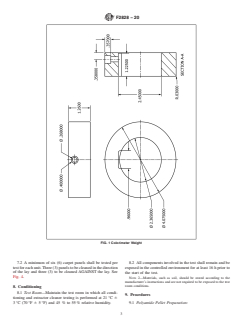
FIG. 1 Colorimeter Weight
7.2 A minimum of six (6) carpet panels shall be tested per 8.2 All components involved in the test shall remain and be
testforeachunit.Three(3)panelstobecleanedinthedirection
exposed in the controlled environment for at least 16 h prior to
of the lay and three (3) to be cleaned AGAINST the lay. See the start of the test.
Fig. 4.
NOTE 2—Materials, such as soil, should be stored according to the
manufacturer’s instructions and are not required to be exposed to the test
room conditions.
8. Conditioning
8.1 Test Room—Maintain the test room in which all condi-
9. Procedures
tioning and extractor cleaner testing is performed at 21 °C 6
3 °C (70 °F 6 5 °F) and 45 % to 55 % relative humidity. 9.1 Polyamide Pellet Preparation:
F2828 − 20
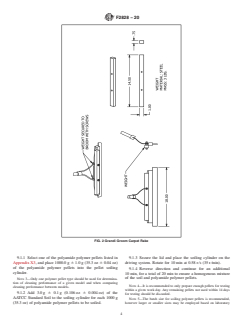
FIG. 2 Grandi Groom Carpet Rake
9.1.1 Select one of the polyamide polymer pellets listed in 9.1.3 Secure the lid and place the soiling cylinder on the
Appendix X3, and place 1000.0 g 6 1.0 g (35.3 oz 6 0.04 oz)
driving system. Rotate for 10 min at 0.58 r⁄s (35 r⁄min).
of the polyamide polymer pellets into the pellet soiling
9.1.4 Reverse direction and continue for an additional
cylinder.
10 min, for a total of 20 min to ensure a homogenous mixture
of the soil and polyamide polymer pellets.
NOTE 3—Only one polymer pellet type should be used for determina-
tion of cleaning performance of a given model and when comparing
NOTE 4—It is recommended to only prepare enough pellets for testing
cleaning performance between models.
within a given work day. Any remaining pellets not used within 14 days
9.1.2 Add 3.0 g 6 0.1 g (0.106 oz 6 0.004 oz) of the
for testing should be discarded.
AATCC Standard Soil to the soiling cylinder for each 1000 g
NOTE 5—The batch size for soiling polymer pellets is recommended,
(35.3 oz) of polyamide polymer pellets to be soiled. however larger or smaller sizes may be employed based on laboratory
F2828 − 20
FIG. 3 Orientation of Carpet Panel in the Soiling Cylinder
preference. Soiling cylinder rotation times are also flexible to ensure
that the entire area is cleaned with agitation. The first forward
homogeneous transfer of the soil to the polymer pellets.
stroke should be AGAINST the lay of the carpet in all cases.
9.2 Test Carpet Preparation: 9.2.3 Using the procedure described in 9.3, evaluate the
9.2.1 Cut the carpet specimen into carpet panels 45.7 cm carpet to determine the initial, virgin readings.
(18 in.) wide and 91.4 cm (36 in.) long, with the long dimen-
9.3 Colorimetric Evaluation Procedure:
sion in the direction of carpet lay.The lay of the carpet must be
9.3.1 Carpet Grooming Procedure—Prior to measuring the
oriented to result in six (6) panels for each test. Three (3)
L*, a*, and b* values for the carpet panels, the fibers shall be
panels with the “top” marked such that they will be cleaned
groomed using the weighted carpet grooming rake. Readings
WITH the lay, and the other three (3) panels marked with the
shall be made for each carpet in its virgin, soiled, and cleaned
“top” such that they will be cleaned AGAINST the lay as
state.
shown in Fig. 4. The carpet panels should be numbered for
9.3.2 Place the rake on the carpet such that the stroke
reference.
directionisonlyinthedirectionWITHthelayinallcases.Pull
the rake across the carpet at 0.20 m⁄s (8.0 in.⁄s) taking care to
NOTE 6—Flexibility in carpet dimensions is permitted as long as the
carpet swath is wider than the cleaning nozzle of the unit being tested and
keep the tines perpendicular to the carpet surface. Repeat this
is larger than the color measurement template.
step for a total of 5 strokes with no indexing. Note that all
9.2.2 Prepare the carpet panels for testing by vacuuming strokes begin at the same end of the carpet.
each to remove loose fibers with the VIRGIN CARPET 9.3.3 Using the carpet color measurement template and the
rotating agitator vacuum cleaner for 16 strokes at 0.55 m⁄s colorimetric measuring equipment, measure the L*, a*, and b*
(1.8 ft⁄s). Eight strokes on each side of the carpet starting on values of the carpet panel at the same ten (10) measurement
the right side and indexing after the eighth stroke to the locations on each carpet panel.The colorimeter weight shall be
opposite side.Allowance should be made for the belt guard so added to the instrument during measurements to provide
F2828 − 20
FIG. 4 Carpet Lay Direction and Orientation
consistent pressure of the glass plate on the measurement orientation of the cylinder in order to rotate in the opposite
surface per section 5.6. direction for an additional 15 min.
NOTE 7—Care should be taken to minimize disturbance of the carpet NOTE 8—The amount of soiled pellets must be predetermined to
fibers after grooming if carpet panels are to be transported from the floor provide a∆E of 12.0 6 1.0 between “virgin” and “soiled” conditions. See
to a bench top to perform color measurements. 10.1 for determining ∆E.
9.4 Carpet Soiling Procedure: 9.4.4 Remove the chrome alloy steel balls and pellets from
9.4.1 Ensure that the carpet soiling cylinders and chrome the cylinder. The steel balls may be re-used. The pellets shall
alloy steel balls are clean and dry. not be re-used.
9.4.2 Each carpet panel is fitted into a soiling cylinder. Care 9.4.5 Carefully remove the carpet panel from the soiling
must be taken to orient the panels correctly in the soiling
...
This document is not an ASTM standard and is intended only to provide the user of an ASTM standard an indication of what changes have been made to the previous version. Because
it may not be technically possible to adequately depict all changes accurately, ASTM recommends that users consult prior editions as appropriate. In all cases only the current version
of the standard as published by ASTM is to be considered the official document.
Designation: F2828 − 12 F2828 − 20 An American National Standard
Standard Test Method for
Assessing Carpet Cleaning Effectiveness in Terms of Visual
Appearance Change When Cleaned with a Wet Extraction
Cleaning System
This standard is issued under the fixed designation F2828; the number immediately following the designation indicates the year of
original adoption or, in the case of revision, the year of last revision. A number in parentheses indicates the year of last reapproval. A
superscript epsilon (´) indicates an editorial change since the last revision or reapproval.
1. Scope
1.1 This test method provides only a laboratory test for visually determining the relative carpet cleaning effectiveness of a wet
extraction cleaning system when tested under standard conditions.
1.2 This test method is applicable to types of upright, canister, and combination wet extraction cleaners and their recommended
chemical cleaning formulas intended for cleaning carpets as a primary or secondary function. This test method excludes pre-spray
systems or pre-spray treatments.
1.3 This test method is not applicable to upholstery cleaning or bare floor cleaning.
1.4 This test method applies only to the cleaning of embedded soil from carpet, not the removal of surface litter and debris.
1.5 This test method does not directly quantify the amount of soil removed but is visually assessed by employing colorimetric
instrumentation.
1.6 Units—The values stated in either SI units or inch-pound units are to be regarded separately as standard. The values stated
in each system may not be exact equivalents; therefore, each system shall be used independently of the other. Combining values
from the two systems may result in non-conformance with the standard.
1.7 This standard does not purport to address all of the safety concerns, if any, associated with its use. It is the responsibility
of the user of this standard to establish appropriate safety safety, health, and healthenvironmental practices and determine the
applicability of regulatory limitations prior to use.
1.8 This international standard was developed in accordance with internationally recognized principles on standardization
established in the Decision on Principles for the Development of International Standards, Guides and Recommendations issued
by the World Trade Organization Technical Barriers to Trade (TBT) Committee.
2. Referenced Documents
2.1 ASTM Standards:
D6540 Test Method for Accelerated Soiling of Pile Yarn Floor Covering
E177 Practice for Use of the Terms Precision and Bias in ASTM Test Methods
E691 Practice for Conducting an Interlaboratory Study to Determine the Precision of a Test Method
F608 Test Method for Evaluation of Carpet Embedded Dirt Removal Effectiveness of Household/Commercial Vacuum Cleaners
F655 Specification for Test Carpets and Pads for Vacuum Cleaner Testing
3. Terminology
3.1 Definitions:
3.1.1 cleaning effectiveness, wet, n—the potential of a wet extractor cleaner to restore the appearance of a soiled carpet.
3.1.2 cleaning system, n—wet extraction appliance coupled with its included or recommended chemical cleaning formula.
3.1.3 Delta-E (ΔE), n—a single number representing the distance in color space between two colors; Delta-E is derived
mathematically and is used in colorimetry to evaluate the extent of color differences and change.
This test method is under the jurisdiction of ASTM Committee F11 on Vacuum Cleaners and is the direct responsibility of Subcommittee F11.35 on Extractor Cleaners.
Current edition approved July 1, 2012Jan. 1, 2020. Published August 2012February 2020. Originally approved in 2012. Last previous edition approved in 2012 as
F2828 – 12. DOI: 10.1520/F2828-12.10.1520/F2828-20.
For referenced ASTM standards, visit the ASTM website, www.astm.org, or contact ASTM Customer Service at service@astm.org. For Annual Book of ASTM Standards
volume information, refer to the standard’s Document Summary page on the ASTM website.
Copyright © ASTM International, 100 Barr Harbor Drive, PO Box C700, West Conshohocken, PA 19428-2959. United States
F2828 − 20
3.1.4 dry stroke, n—a single pass across the test carpet in one direction without the application of any cleaning solution.
3.1.5 model, n—the designation of a group of wet extraction cleaners having identical mechanical and electrical construction
with only cosmetic or nonfunctional differences.
3.1.6 nozzle width, n—the measured outside width of the cleaning nozzle in inches.
3.1.7 population, n—the total of all units of a particular model wet extraction cleaner being tested.
3.1.8 sample, n—a group of extraction cleaners taken from a large collection of extraction cleaners of one particular model
which serves to provide information that may be used as a basis for making a decision concerning the larger collection.
3.1.9 test run, n—the definitive procedure that produces a singular measured result.
3.1.10 unit, n—a single wet extraction cleaner of the model being tested.
3.1.11 wet stroke, n—a single pass across the test carpet in one direction with the application of the cleaning solution.
3.1.9 dry stroke, n—a single pass across the test carpet in one direction without the application of any cleaning solution.
3.1.10 Delta-E (ΔE), n—a single number representing the distance in color space between two colors. Delta-E is derived
mathematically and is used in colorimetry to evaluate the extent of color differences and change.
4. Significance and Use
4.1 This test method will provide an indication of the effectiveness of the cleaning system at restoring the appearance of an
artificially soiled carpet by wet extraction cleaning. The cleaning effectiveness in the laboratory test may not be the same as in
home cleaning due to variations in the homes, carpets, soils, and other factors.
4.2 In order to provide a uniform basis for measuring the performance described in section 1.1, standardized test carpet, test
pad, and test soil are employed in this procedure.
5. Apparatus
5.1 Weighing Scale (for weighing test materials and carpets)—Accurate to 0.01 g (0.00035 oz) 0.01 g (0.00035 oz) and having
a weighing capacity of at least 2.0 kg (4.4 lb). 2.0 kg (4.4 lb).
5.2 Stroke Speed Regulator(s)—LED two way two-way timer bar(s) or other type of equipment capable of establishing the
specified rate of movement of the agitator vacuum, test cleaner, and carpet rake.
5.3 Voltmeter—To measure the input voltage to the cleaner, to provide measurements accurate to within 61 %. 61 %.
5.4 Voltage-Regulator System—To control input voltage to the cleaner. The regulator must be capable of maintaining the wet
extraction cleaner’s rated voltage 61 % 61 % and rated frequency having a waveform that is essentially sinusoidal with 3 % 3 %
max harmonic distortion for the duration of the test.
5.5 Soiling Apparatus:
5.5.1 Carpet and Pellet Soiling Cylinder—Able to be turned freely on a ball mill roller. See Appendix X1.
5.5.2 Driving System—Cradles the carpet and pellet soiling cylinder on rollers and keeps the axis of the cylinder level, rotates
at 0.580.58 r r/s⁄s (35 r (35 ⁄min 6 22 r rpm). ⁄min).
5.6 Color Measurement Equipment—Colorimeter capable of measuring the color of pile yarn floor covering and expressing the
results in L*, a*, b*. The device shall utilize a weight and glass plate to compress the instrument into the fibers to reduce variability
inherent in the measurement of textiles with pile such as carpet. The recommended pressure of the glass plate on the carpet surface
2 2
is to be 70.0 70.0 g 6 7.0 g/cm⁄cm (1.0 6 0.17.0 g ⁄cm psi). (1.0 psi 6 0.1 psi).
NOTE 1—All necessary adjustments to the color measurement equipment for using a glass plate must be made prior to taking readings. See the
manufacturer’s instructions for the specific equipment being used.
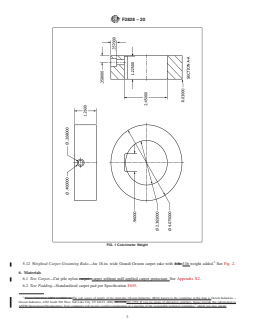
5.7 Colorimeter Weight—Weight to be added to the colorimeter to ensure that the compressing force defined in section 5.6 is
achieved. See Fig. 1. The amount of weight required will vary depending on the total weight and the measurement head dimensions
of the colorimeter employed.
5.8 Pyrometer—Or other temperature measurement device capable of measurements up to at least 5555 °C 6 0.1°C (1310.1 °C
(131 °F 6 0.1°F).0.1 °F).
5.9 Carpet Color Measurement Template—To be the same size as the test carpet with 10 holes of the same dimensions as the
measurement head of the color measuring device. See templates in Appendix X5.
5.10 Vacuum Cleaner(s)—With a rotating brush having a range of cleaning performance on ASTM Plushplush carpet between
3535 % and 45 % when evaluated per the Test Method F608 procedure. Multiple units of identical construction are required for
each of the carpet conditions (VIRGIN CARPET, SOILED CARPET, CLEANED CARPET)(virgin carpet, soiled carpet, cleaned
carpet) to avoid cross-contamination.
5.11 Carpet Support Template—A template which can receive the test carpet with no gaps or overlapping of material. The
material shall be of similar construction to the test carpet and mounted on the carpet pad.
F2828 − 20
FIG. 1 Colorimeter Weight
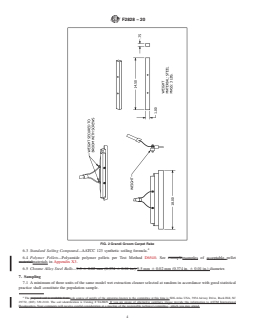
5.12 Weighted Carpet Grooming Rake—An 18-in. wide Grandi Groom carpet rake with 3 lb 3 lb weight added. See Fig. 2.
6. Materials
6.1 Test Carpet—Cut pile nylon carpet. carpet without mill applied carpet protectant. See Appendix X2.
6.2 Test Padding—Standardized carpet pad per Specification F655.
Groom Industries AB24 available at: The sole source of supply of the apparatus (Groom Industries AB24) known to the committee at this time is Groom Industries –
Groom Industries, 4282 South 590 West, Salt Lake City, UT 84123, (800) 397-3759397-3759. If you are aware of alternative suppliers, please provide this information to
ASTM International Headquarters. Your comments will receive careful consideration at a meeting of the responsible technical committee, which you may attend.
F2828 − 20
FIG. 2 Grandi Groom Carpet Rake
6.3 Standard Soiling Compound—AATCC 123 synthetic soiling formula.
6.4 Polymer Pellets—Polyamide polymer pellets per Test Method D6540. See exampleexamples of acceptable pellet
materialmaterials in Appendix X3.
6.5 Chrome Alloy Steel Balls—9.5 6 0.02 mm (0.374 6 0.01 in.) 9.5 mm 6 0.02 mm (0.374 in. 6 0.01 in.) diameter.
7. Sampling
7.1 A minimum of three units of the same model wet extraction cleaner selected at random in accordance with good statistical
practice shall constitute the population sample.
The prepared soil is available from sole source of supply of the apparatus known to the committee at this time is SDL Atlas USA, 3934 Airway Drive, Rock Hill, SC
29732, (803) 329-2110. The soil identification is Catalog # TA2M/9. If you are aware of alternative suppliers, please provide this information to ASTM International
Headquarters. Your comments will receive careful consideration at a meeting of the responsible technical committee, which you may attend.
F2828 − 20
FIG. 3 Orientation of Carpet Panel in the Soiling Cylinder
7.2 A minimum of six (6) carpet panels shall be tested per test for each unit. Three (3) panels to be cleaned in the direction of
the lay and three (3) to be cleaned AGAINST the lay. See Fig. 4.
8. Conditioning
8.1 Test Room—Maintain the test room in which all conditioning and extractor cleaner testing is performed at 2121 °C 6 3°C
(703 °C (70 °F 6 5°F)5 °F) and 4545 % to 55 % 55 % relative humidity.
8.2 All components involved in the test shall remain and be exposed in the controlled environment for at least 16 h prior to the
start of the test.
NOTE 2—Materials, such as soil, should be stored according to the manufacturer’s instructions and are not required to be exposed to the test room
conditions.
9. Procedures
9.1 Polyamide Pellet Preparation:
9.1.1 Place 1000.0 Select one of the polyamide polymer pellets listed in Appendix X36 1.0 g (35.3 6 0.04 oz) , and place
1000.0 g 6 1.0 g (35.3 oz 6 0.04 oz) of the polyamide polymer pellets into the pellet soiling cylinder.
NOTE 3—Only one polymer pellet type should be used for determination of cleaning performance of a given model and when comparing cleaning
performance between models.
9.1.2 Add 3.0 6 0.1 g (0.106 6 0.004 oz) 3.0 g 6 0.1 g (0.106 oz 6 0.004 oz) of the AATCC Standard Soil to the soiling
cylinder for each 1000 g (35.3 oz) 1000 g (35.3 oz) of polyamide polymer pellets to be soiled.
9.1.3 Secure the lid and place the soiling cylinder on the driving system. Rotate for 10 min 10 min at 0.580.58 r r/s⁄s (35 r (35
rpm). ⁄min).
F2828 − 20
FIG. 4 Carpet Lay Direction and Orientation
9.1.4 Reverse direction and continue for an additional 10 min, 10 min, for a total of 20 min 20 min to ensure a homogenous
mixture of the soil and polyamide polymer pellets.
9.1.5 Only prepare enough pellets for testing to be conducted within a given work day.
NOTE 4—It is recommended to only prepare enough pellets for testing within a given work day. Any remaining pellets not used within 14 days 14 days
for testing should be discarded.
NOTE 5—The batch size for soiling polymer pellets is recommended, however larger or smaller sizes may be employed based on laboratory preference.
Soiling cylinder rotation times are also flexible to ensure homogeneous transfer of the soil to the polymer pellets.
9.2 Test Carpet Preparation:
9.2.1 Cut the carpet specimen into carpet panels 45.7 cm (18 in.) wide and 91.4 cm (36 in.) 45.7 cm (18 in.) wide and 91.4 cm
(36 in.) long, with the long dimension in the direction of carpet lay. The lay of the carpet must be oriented to result in six (6) panels
for each test. Three (3) panels with the “top” marked such that they will be cleaned WITH the lay, and the other three (3) panels
marked with the “top” such that they will be cleaned AGAINST the lay as shown in Fig. 4. The carpet panels should be numbered
for reference.
NOTE 6—Flexibility in carpet dimensions is permitted as long as the carpet swath is wider than the cleaning nozzle of the unit being tested and is larger
than the color measurement template.
9.2.2 Prepare the carpet panels for testing by vacuuming each to remove loose fibers with the VIRGIN CARPET rotating
agitator vacuum cleaner for 16 strokes at 0.550.55 m m/s⁄s (1.8 ft (1.8 ft/s). ⁄s). Eight strokes on each side of the carpet starting
on the right side and indexing after the eighth stroke to the opposite side. Allowance should be made for the belt guard so that the
entire area is cleaned with agitation. The first forward stroke should be AGAINST the lay of the carpet in all cases.
F2828 − 20
9.2.3 Using the procedure described in 9.3, evaluate the carpet to determine the initial, virgin readings.
9.3 Colorimetric Evaluation Procedure:
9.3.1 Carpet Grooming Procedure—Prior to measuring the L*, a*, and b* values for the carpet panels, the fibers shall be
groomed using the Weighted Carpet Grooming Rake.weighted carpet grooming rake. Readings shall be made for each carpet in
its virgin, soiled, and cleaned state.
9.3.2 Place the rake on the carpet such that the stroke direction is only in the direction WITH the lay in all cases. Pull the rake
across the carpet at 0.200.20 m m/s⁄s (8.0 in. (8.0 in./s) ⁄s) taking care to keep the tines perpendicular to the carpet surface. Repeat
this step for a total of 5 strokes 5 strokes with no indexing. Note that all strokes begin at the same end of the carpet.
9.3.3 Using the carpet color measurement template and the colorimetric measuring equipment, measure the L*, a*, and b*
values of the carpet panel at the same ten (10) measurement locations on each carpet panel. The colorimeter weight shall be added
to the instrument during measurements to provide consistent pressure of the glass plate on the measurement surface per section
5.6.
NOTE 7—Care should be taken to minimize disturbance of the carpet fibers after grooming if carpet panels are to be transported from the floor to a
bench top to perform color measurements.
9.4 Carpet Soiling Procedure:
9.4.1 Ensure that the carpet soiling cylinders and chrome alloy steel balls are clean and dry.
9.4.2 Each carpet panel is fitted into a soiling cylinder. Care must be taken to orient the panels correctly in the soiling cylinder(s)
as shown in Fig. 3 to ensure prope
...