

ASTM 51026-23
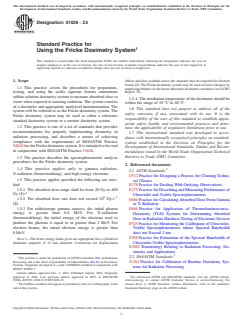
(Practice)Standard Practice for Using the Fricke Dosimetry System
General Information
- Abstract
SIGNIFICANCE AND USE
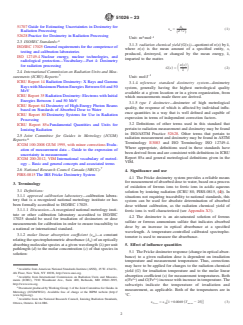
4.1 The Fricke dosimetry system provides a reliable means for measurement of absorbed dose to water, based on a process of oxidation of ferrous ions to ferric ions in acidic aqueous solution by ionizing radiation (ICRU 80, PIRS-0815, (4)). In situations not requiring traceability to national standards, this system can be used for absolute determination of absorbed dose without calibration, as the radiation chemical yield of ferric ions is well characterized (see Appendix X3).
4.2 The dosimeter is an air-saturated solution of ferrous sulfate or ferrous ammonium sulfate that indicates absorbed dose by an increase in optical absorbance at a specified wavelength. A temperature-controlled calibrated spectrophotometer is used to measure the absorbance.
SCOPE
1.1 This practice covers the procedures for preparation, testing, and using the acidic aqueous ferrous ammonium sulfate solution dosimetry system to measure absorbed dose to water when exposed to ionizing radiation. The system consists of a dosimeter and appropriate analytical instrumentation. The system will be referred to as the Fricke dosimetry system. The Fricke dosimetry system may be used as either a reference standard dosimetry system or a routine dosimetry system.
1.2 This practice is one of a set of standards that provides recommendations for properly implementing dosimetry in radiation processing, and describes a means of achieving compliance with the requirements of ISO/ASTM Practice 52628 for the Fricke dosimetry system. It is intended to be read in conjunction with ISO/ASTM Practice 52628.
1.3 The practice describes the spectrophotometric analysis procedures for the Fricke dosimetry system.
1.4 This practice applies only to gamma radiation, X-radiation (bremsstrahlung), and high-energy electrons.
1.5 This practice applies provided the following are satisfied:
1.5.1 The absorbed dose range shall be from 20 Gy to 400 Gy (1).2
1.5.2 The absorbed dose rate does not exceed 106 Gy·s−1 (2).
1.5.3 For radioisotope gamma sources, the initial photon energy is greater than 0.6 MeV. For X-radiation (bremsstrahlung), the initial energy of the electrons used to produce the photons is equal to or greater than 2 MeV. For electron beams, the initial electron energy is greater than 8 MeV.
Note 1: The lower energy limits given are appropriate for a cylindrical dosimeter ampoule of 12 mm diameter. Corrections for displacement effects and dose gradient across the ampoule may be required for electron beams (3). The Fricke dosimetry system may be used at lower energies by employing thinner (in the beam direction) dosimeter containers (see ICRU Report 35).
1.5.4 The irradiation temperature of the dosimeter should be within the range of 10 °C to 60 °C.
1.6 This standard does not purport to address all of the safety concerns, if any, associated with its use. It is the responsibility of the user of this standard to establish appropriate safety, health, and environmental practices and determine the applicability of regulatory limitations prior to use.
1.7 This international standard was developed in accordance with internationally recognized principles on standardization established in the Decision on Principles for the Development of International Standards, Guides and Recommendations issued by the World Trade Organization Technical Barriers to Trade (TBT) Committee.
- Status
- Published
- Publication Date
- 30-Nov-2023
- Technical Committee
- E61 - Radiation Processing
- Drafting Committee
- E61.02 - Dosimetry Systems
Overview
ASTM 51026-23: Standard Practice for Using the Fricke Dosimetry System establishes procedures for preparing, testing, and employing the Fricke dosimetry system to measure absorbed dose to water when exposed to ionizing radiation. Rooted in the chemical transformation of ferrous ions to ferric ions in acidic aqueous solutions, this measurement approach is widely recognized for its accuracy and reliability in radiation dosimetry, especially for gamma, X-radiation, and high-energy electron applications.
The Fricke dosimetry system can be utilized either as a reference standard dosimetry system or for routine operational dosimetry, playing a critical role in ensuring measurement consistency and compliance in radiation processing.
Key Topics
- Fricke Dosimetry Principle: Utilizes the oxidation of ferrous to ferric ions by ionizing radiation in acidic solutions, with dose measurement determined via increased optical absorbance using a calibrated spectrophotometer.
- Suitable Radiation Types: Applicable exclusively to gamma rays, X-ray (bremsstrahlung), and high-energy electrons within defined energy and dose ranges.
- Preparation and Calibration: Provides guidance on reagent purity, solution preparation, calibration protocols, and spectrophotometric measurement practices.
- Measurement and Uncertainty: Outlines procedures to ensure precise measurement of absorbed dose, including temperature control, absorbance correction, instrument calibration, and estimation of measurement uncertainty.
- Traceability and Compliance: Lists requirements for achieving compliance with ISO/ASTM Practice 52628, and discusses traceability options for measurements requiring national or international standard reference.
- Interferences and Handling: Addresses potential interferences from organic and metal impurities, solution oxidation, and storage conditions to ensure data accuracy and reproducibility.
Applications
The Fricke dosimetry system, as detailed in ASTM 51026-23, finds application in:
- Radiation Processing: Routine monitoring and validation of absorbed dose in processes involving sterilization, material modification, food irradiation, and research.
- Dosimetry Calibration: Serving as a reference dosimetry system in calibration laboratories and supporting the calibration of routine dosimeters used in radiation facilities.
- Research Environments: Providing a reliable and reproducible method for dose measurement in experimental setups, where understanding the effects of ionizing radiation is essential.
- Quality Assurance: Supporting compliance programs and audits in environments where precise radiation dose delivery is critical for regulatory or safety requirements.
Related Standards
Several international and ASTM standards support or are referenced by ASTM 51026-23:
- ISO/ASTM 52628: Practice for Dosimetry in Radiation Processing - covers the overall approach to implementing dosimetry systems, including the Fricke system.
- ASTM E170, E666, E668: Terminology and practices relating to radiation measurements, dose calculations, and thermoluminescence-dosimetry.
- ISO/IEC 17025: General requirements for the competence of testing and calibration laboratories, supporting dosimetry traceability.
- ICRU Reports: Guidance from the International Commission on Radiation Units and Measurements on dosimetry methods and fundamental units.
- ASTM Practice 51261: Calibration of routine dosimetry systems for radiation processing.
- ASTM Guide 51707: Guidelines for estimating uncertainties in dosimetry for radiation processing.
Summary
ASTM 51026-23 is a cornerstone standard for using the Fricke dosimetry system within the fields of radiation processing and dosimetry calibration. By detailing the methodologies for preparation, use, and quality assurance, this standard helps ensure that absorbed dose measurements are accurate, reproducible, and, where needed, traceable to international standards. Key advantages include reliable performance in defined energy and dose ranges and broad acceptance for both routine and reference dosimetry needs. Proper adherence to this standard also aids in regulatory compliance and enhances the overall quality of radiation processing operations.
Keywords: Fricke dosimeter, radiation dosimetry standard, absorbed dose measurement, ionizing radiation, reference standard, calibrated spectrophotometer, radiation processing compliance, ASTM 51026-23
Relations
- Effective Date
- 01-Dec-2023
Get Certified
Connect with accredited certification bodies for this standard

BSMI (Bureau of Standards, Metrology and Inspection)
Taiwan's standards and inspection authority.
Sponsored listings
Frequently Asked Questions
ASTM 51026-23 is a standard published by ASTM International. Its full title is "Standard Practice for Using the Fricke Dosimetry System". This standard covers: SIGNIFICANCE AND USE 4.1 The Fricke dosimetry system provides a reliable means for measurement of absorbed dose to water, based on a process of oxidation of ferrous ions to ferric ions in acidic aqueous solution by ionizing radiation (ICRU 80, PIRS-0815, (4)). In situations not requiring traceability to national standards, this system can be used for absolute determination of absorbed dose without calibration, as the radiation chemical yield of ferric ions is well characterized (see Appendix X3). 4.2 The dosimeter is an air-saturated solution of ferrous sulfate or ferrous ammonium sulfate that indicates absorbed dose by an increase in optical absorbance at a specified wavelength. A temperature-controlled calibrated spectrophotometer is used to measure the absorbance. SCOPE 1.1 This practice covers the procedures for preparation, testing, and using the acidic aqueous ferrous ammonium sulfate solution dosimetry system to measure absorbed dose to water when exposed to ionizing radiation. The system consists of a dosimeter and appropriate analytical instrumentation. The system will be referred to as the Fricke dosimetry system. The Fricke dosimetry system may be used as either a reference standard dosimetry system or a routine dosimetry system. 1.2 This practice is one of a set of standards that provides recommendations for properly implementing dosimetry in radiation processing, and describes a means of achieving compliance with the requirements of ISO/ASTM Practice 52628 for the Fricke dosimetry system. It is intended to be read in conjunction with ISO/ASTM Practice 52628. 1.3 The practice describes the spectrophotometric analysis procedures for the Fricke dosimetry system. 1.4 This practice applies only to gamma radiation, X-radiation (bremsstrahlung), and high-energy electrons. 1.5 This practice applies provided the following are satisfied: 1.5.1 The absorbed dose range shall be from 20 Gy to 400 Gy (1).2 1.5.2 The absorbed dose rate does not exceed 106 Gy·s−1 (2). 1.5.3 For radioisotope gamma sources, the initial photon energy is greater than 0.6 MeV. For X-radiation (bremsstrahlung), the initial energy of the electrons used to produce the photons is equal to or greater than 2 MeV. For electron beams, the initial electron energy is greater than 8 MeV. Note 1: The lower energy limits given are appropriate for a cylindrical dosimeter ampoule of 12 mm diameter. Corrections for displacement effects and dose gradient across the ampoule may be required for electron beams (3). The Fricke dosimetry system may be used at lower energies by employing thinner (in the beam direction) dosimeter containers (see ICRU Report 35). 1.5.4 The irradiation temperature of the dosimeter should be within the range of 10 °C to 60 °C. 1.6 This standard does not purport to address all of the safety concerns, if any, associated with its use. It is the responsibility of the user of this standard to establish appropriate safety, health, and environmental practices and determine the applicability of regulatory limitations prior to use. 1.7 This international standard was developed in accordance with internationally recognized principles on standardization established in the Decision on Principles for the Development of International Standards, Guides and Recommendations issued by the World Trade Organization Technical Barriers to Trade (TBT) Committee.
SIGNIFICANCE AND USE 4.1 The Fricke dosimetry system provides a reliable means for measurement of absorbed dose to water, based on a process of oxidation of ferrous ions to ferric ions in acidic aqueous solution by ionizing radiation (ICRU 80, PIRS-0815, (4)). In situations not requiring traceability to national standards, this system can be used for absolute determination of absorbed dose without calibration, as the radiation chemical yield of ferric ions is well characterized (see Appendix X3). 4.2 The dosimeter is an air-saturated solution of ferrous sulfate or ferrous ammonium sulfate that indicates absorbed dose by an increase in optical absorbance at a specified wavelength. A temperature-controlled calibrated spectrophotometer is used to measure the absorbance. SCOPE 1.1 This practice covers the procedures for preparation, testing, and using the acidic aqueous ferrous ammonium sulfate solution dosimetry system to measure absorbed dose to water when exposed to ionizing radiation. The system consists of a dosimeter and appropriate analytical instrumentation. The system will be referred to as the Fricke dosimetry system. The Fricke dosimetry system may be used as either a reference standard dosimetry system or a routine dosimetry system. 1.2 This practice is one of a set of standards that provides recommendations for properly implementing dosimetry in radiation processing, and describes a means of achieving compliance with the requirements of ISO/ASTM Practice 52628 for the Fricke dosimetry system. It is intended to be read in conjunction with ISO/ASTM Practice 52628. 1.3 The practice describes the spectrophotometric analysis procedures for the Fricke dosimetry system. 1.4 This practice applies only to gamma radiation, X-radiation (bremsstrahlung), and high-energy electrons. 1.5 This practice applies provided the following are satisfied: 1.5.1 The absorbed dose range shall be from 20 Gy to 400 Gy (1).2 1.5.2 The absorbed dose rate does not exceed 106 Gy·s−1 (2). 1.5.3 For radioisotope gamma sources, the initial photon energy is greater than 0.6 MeV. For X-radiation (bremsstrahlung), the initial energy of the electrons used to produce the photons is equal to or greater than 2 MeV. For electron beams, the initial electron energy is greater than 8 MeV. Note 1: The lower energy limits given are appropriate for a cylindrical dosimeter ampoule of 12 mm diameter. Corrections for displacement effects and dose gradient across the ampoule may be required for electron beams (3). The Fricke dosimetry system may be used at lower energies by employing thinner (in the beam direction) dosimeter containers (see ICRU Report 35). 1.5.4 The irradiation temperature of the dosimeter should be within the range of 10 °C to 60 °C. 1.6 This standard does not purport to address all of the safety concerns, if any, associated with its use. It is the responsibility of the user of this standard to establish appropriate safety, health, and environmental practices and determine the applicability of regulatory limitations prior to use. 1.7 This international standard was developed in accordance with internationally recognized principles on standardization established in the Decision on Principles for the Development of International Standards, Guides and Recommendations issued by the World Trade Organization Technical Barriers to Trade (TBT) Committee.
ASTM 51026-23 is classified under the following ICS (International Classification for Standards) categories: 17.240 - Radiation measurements. The ICS classification helps identify the subject area and facilitates finding related standards.
ASTM 51026-23 has the following relationships with other standards: It is inter standard links to ASTM ISO/ASTM51026-15. Understanding these relationships helps ensure you are using the most current and applicable version of the standard.
ASTM 51026-23 is available in PDF format for immediate download after purchase. The document can be added to your cart and obtained through the secure checkout process. Digital delivery ensures instant access to the complete standard document.
Standards Content (Sample)
This international standard was developed in accordance with internationally recognized principles on standardization established in the Decision on Principles for the
Development of International Standards, Guides and Recommendations issued by the World Trade Organization Technical Barriers to Trade (TBT) Committee.
Designation: 51026 − 23
Standard Practice for
Using the Fricke Dosimetry System
This standard is issued under the fixed designation 51026; the number immediately following the designation indicates the year of
original adoption or, in the case of revision, the year of last revision. A number in parentheses indicates the year of last reapproval. A
superscript epsilon (´) indicates an editorial change since the last revision or reapproval.
effects and dose gradient across the ampoule may be required for electron
1. Scope
beams (3). The Fricke dosimetry system may be used at lower energies by
1.1 This practice covers the procedures for preparation,
employing thinner (in the beam direction) dosimeter containers (see ICRU
testing, and using the acidic aqueous ferrous ammonium Report 35).
sulfate solution dosimetry system to measure absorbed dose to
1.5.4 The irradiation temperature of the dosimeter should be
water when exposed to ionizing radiation. The system consists
within the range of 10 °C to 60 °C.
of a dosimeter and appropriate analytical instrumentation. The
1.6 This standard does not purport to address all of the
system will be referred to as the Fricke dosimetry system. The
safety concerns, if any, associated with its use. It is the
Fricke dosimetry system may be used as either a reference
responsibility of the user of this standard to establish appro-
standard dosimetry system or a routine dosimetry system.
priate safety, health, and environmental practices and deter-
1.2 This practice is one of a set of standards that provides
mine the applicability of regulatory limitations prior to use.
recommendations for properly implementing dosimetry in
1.7 This international standard was developed in accor-
radiation processing, and describes a means of achieving
dance with internationally recognized principles on standard-
compliance with the requirements of ISO/ASTM Practice
ization established in the Decision on Principles for the
52628 for the Fricke dosimetry system. It is intended to be read
Development of International Standards, Guides and Recom-
in conjunction with ISO/ASTM Practice 52628.
mendations issued by the World Trade Organization Technical
Barriers to Trade (TBT) Committee.
1.3 The practice describes the spectrophotometric analysis
procedures for the Fricke dosimetry system.
2. Referenced documents
1.4 This practice applies only to gamma radiation,
2.1 ASTM Standards:
X-radiation (bremsstrahlung), and high-energy electrons.
C912 Practice for Designing a Process for Cleaning Techni-
1.5 This practice applies provided the following are satis-
cal Glasses
fied:
E178 Practice for Dealing With Outlying Observations
1.5.1 The absorbed dose range shall be from 20 Gy to 400
E275 Practice for Describing and Measuring Performance of
Gy (1).
Ultraviolet and Visible Spectrophotometers
6 −1
1.5.2 The absorbed dose rate does not exceed 10 Gy·s
E666 Practice for Calculating Absorbed Dose From Gamma
(2).
or X Radiation
1.5.3 For radioisotope gamma sources, the initial photon
E668 Practice for Application of Thermoluminescence-
energy is greater than 0.6 MeV. For X-radiation
Dosimetry (TLD) Systems for Determining Absorbed
(bremsstrahlung), the initial energy of the electrons used to
Dose in Radiation-Hardness Testing of Electronic Devices
produce the photons is equal to or greater than 2 MeV. For
E925 Practice for Monitoring the Calibration of Ultraviolet-
electron beams, the initial electron energy is greater than
Visible Spectrophotometers whose Spectral Bandwidth
8 MeV.
does not Exceed 2 nm
E958 Practice for Estimation of the Spectral Bandwidth of
NOTE 1—The lower energy limits given are appropriate for a cylindrical
Ultraviolet-Visible Spectrophotometers
dosimeter ampoule of 12 mm diameter. Corrections for displacement
E3083 Terminology Relating to Radiation Processing: Do-
simetry and Applications
1 2.2 ISO/ASTM Standards:
This practice is under the jurisdiction of ASTM Committee E61 on Radiation
Processing and is the direct responsibility of Subcommittee E61.02 on Dosimetry 51261 Practice for Calibration of Routine Dosimetry Sys-
Systems. Originally developed as a joint ASTM/ISO standard in conjunction with
tems for Radiation Processing
ISO/TC 85/WG 3.
Current edition approved Dec. 1, 2023. Published January 2024. Originally
approved in 1984. Last previous edition approved in 2015 as ISO/ASTM For referenced ASTM and ISO/ASTM standards, visit the ASTM webiste,
51026–2015(E). DOI:10.1520/51026-23. www.astm.org, or contact ASTM Customer Service at service@astm.org. For
The boldface numbers that appear in parentheses refer to a bibliography at the Annual Book of ASTM Standards volume information, refer to the standard’s
end of this practice. Document Summary page on the ASTM website.
Copyright © ASTM International, 100 Barr Harbor Drive, PO Box C700, West Conshohocken, PA 19428-2959. United States
51026 − 23
51707 Guide for Estimating Uncertainties in Dosimetry for A
λ
ε 5 (1)
m
Radiation Processing ~d × c!
52628 Practice for Dosimetry in Radiation Processing
2 –1
Unit: m ·mol
2.3 ISO/IEC Standards:
3.1.3 radiation chemical yield (G(x))—quotient of n(x) by ε,
¯
ISO/IEC 17025 General requirements for the competence of
where n(x) is the mean amount of a specified entity, x,
testing and calibration laboratories
produced, destroyed, or changed by the mean energy, ε¯,
ISO 12749-4 Nuclear energy, nuclear technologies, and
imparted to the matter.
radiological protection—Vocabulary—Part 4: Dosimetry
n~x!
for radiation processing
G x 5 (2)
~ ! S D
εH
2.4 International Commission on Radiation Units and Mea-
5 –1
surements (ICRU) Reports: Unit: mol·J
ICRU Report 14 Radiation Dosimetry: X Rays and Gamma
3.1.4 reference standard dosimetry system—dosimetry
Rays with Maximum Photon Energies Between 0.6 and 50
system, generally having the highest metrological quality
MeV
available at a given location or in a given organization, from
ICRU Report 35 Radiation Dosimetry: Electrons with Initial
which measurements made there are derived.
Energies Between 1 and 50 MeV
3.1.5 type I dosimeter—dosimeter of high metrological
ICRU Report 64 Dosimetry of High-Energy Photon Beams
quality, the response of which is affected by individual influ-
based on Standards of Absorbed Dose to Water
ence quantities in a way that is well defined and capable of
ICRU Report 80 Dosimetry Systems for Use in Radiation
expression in terms of independent correction factors.
Processing
3.2 Definitions of other terms used in this standard that
ICRU Report 85a Fundamental Quantities and Units for
pertain to radiation measurement and dosimetry may be found
Ionizing Radiation
in ISO/ASTM Practice 52628. Other terms that pertain to
2.5 Joint Committee for Guides in Metrology (JCGM)
6 radiation measurement and dosimetry may be found in ASTM
Reports:
Terminology E3083 and ISO Terminology ISO 12749-4.
JCGM 100:2008 GUM 1995, with minor corrections Evalu-
Where appropriate, definitions used in these standards have
ation of measurement data – Guide to the expression of
been derived from and are consistent with definitions in ICRU
uncertainty in measurement
Report 85a and general metrological definitions given in the
JCGM 200:2012, VIM International vocabulary of metrol-
VIM.
ogy – Basic and general concepts and associated terms
2.6 National Research Council Canada (NRCC):
4. Significance and use
PIRS-0815 The IRS Fricke Dosimetry System
4.1 The Fricke dosimetry system provides a reliable means
for measurement of absorbed dose to water, based on a process
3. Terminology
of oxidation of ferrous ions to ferric ions in acidic aqueous
3.1 Definitions:
solution by ionizing radiation (ICRU 80, PIRS-0815, (4)). In
3.1.1 approved calibration laboratory—calibration labora-
situations not requiring traceability to national standards, this
tory that is a recognized national metrology institute or has
system can be used for absolute determination of absorbed
been formally accredited to ISO/IEC 17025.
dose without calibration, as the radiation chemical yield of
3.1.1.1 Discussion—A recognized national metrology insti-
ferric ions is well characterized (see Appendix X3).
tute or other calibration laboratory accredited to ISO/IEC
4.2 The dosimeter is an air-saturated solution of ferrous
17025 should be used for irradiation of dosimeters or dose
sulfate or ferrous ammonium sulfate that indicates absorbed
measurements for calibration in order to ensure traceability to
dose by an increase in optical absorbance at a specified
a national or international standard.
wavelength. A temperature-controlled calibrated spectropho-
3.1.2 molar linear absorption coeffıcient (ε )—a constant
m
tometer is used to measure the absorbance.
relating the spectrophotometric absorbance (A ) of an optically
λ
absorbing molecular species at a given wavelength (λ) per unit
5. Effect of influence quantities
pathlength (d) to the molar concentration (c) of that species in
5.1 The Fricke dosimeter response (change in optical absor-
solution:
bance) to a given radiation dose is dependent on irradiation
temperature and measurement temperature. Thus, corrections
may have to be applied for changes to the radiation chemical
Available from American National Standards Institute (ANSI), 25 W. 43rd St.,
yield (G) for irradiation temperature and to the molar linear
4th Floor, New York, NY 10036, http://www.ansi.org.
5 absorption coefficient (ε) for measurement temperatures. Both
Available from International Commission on Radiation Units and Measure-
3+ 3+
ments (ICRU), 7910 Woodmont Ave., Suite 400, Bethesda, MD 20841-3095, ε(Fe ) and G(Fe ) increase with increase in temperature. The
http://www.icru.org.
subscripts indicate the temperature of irradiation and
Document produced by Working Group 1 of the Joint Committee for Guides in
measurement, as applicable. Both of the temperatures are in
Metrology (JCGM/WG1). Available free of charge at the BIPM website (http://
°C.
www.bipm.org).
Available from the National Research Council, Ionizing Radiation Standards,
ε 5 ε @110.0069 ~T 2 25!# (3)
Ottawa, Ontario. K1A 0R6. T 25 meas
meas
51026 − 23
G 5 G 110.0012 T 2 25 (4) 7.2.1 Store the cleaned glassware in a clean, dust-free
@ ~ !#
T 25 irrad
irrad
environment. For extreme accuracy, bake the glassware in
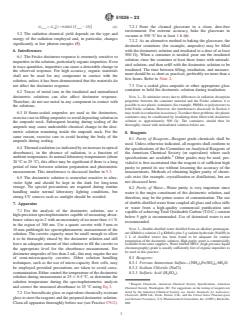
5.2 The radiation chemical yield depends on the type and
vacuum at 550 °C for at least 1 h (6).
energy of the radiation employed and, in particular, changes
7.2.2 As an alternative method to baking the glassware, the
significantly at low photon energies (5).
dosimeter containers (for example, ampoules) may be filled
6. Interferences with the dosimetric solution and irradiated to a dose of at least
500 Gy. When a container is needed, pour out the irradiated
6.1 The Fricke dosimeter response is extremely sensitive to
solution, rinse the container at least three times with unirradi-
impurities in the solution, particularly organic impurities. Even
ated solution, and then refill with the dosimetric solution to be
in trace quantities, impurities can cause a detectable change in
irradiated. The time between filling, irradiation, and measure-
the observed response. For high accuracy, organic materials
ment should be as short as practical, preferably no more than a
shall not be used for any component in contact with the
few hours. Refer to Note 2.
solution, unless it has been demonstrated that the materials do
not affect the dosimeter response. 7.3 Use a sealed glass ampoule or other appropriate glass
container to hold the dosimetric solution during irradiation.
6.2 Traces of metal ions in the irradiated and unirradiated
dosimetric solutions can also affect dosimeter response.
NOTE 2—To minimize errors due to differences in radiation absorption
properties between the container material and the Fricke solution, it is
Therefore, do not use metal in any component in contact with
possible to use plastic containers (for example, PMMA or polystyrene) to
the solutions.
hold Fricke solution. However, the interferences discussed in Section 6
6.3 If flame-sealed ampoules are used as the dosimeters,
may result in a reduction in accuracy. To reduce these problems, the plastic
containers may be conditioned by irradiating them filled with dosimetric
exercise care in filling ampoules to avoid depositing solution in
solution to approximately 500 Gy. The containers should then be
the ampoule neck. Subsequent heating during sealing of the
thoroughly rinsed with unirradiated solution before use.
ampoule may cause undesirable chemical change in the dosi-
metric solution remaining inside the ampoule neck. For the
8. Reagents
same reason, exercise care to avoid heating the body of the
8.1 Purity of Reagents—Reagent grade chemicals shall be
ampoule during sealing.
used. Unless otherwise indicated, all reagents shall conform to
6.4 Thermal oxidation (as indicated by an increase in optical
the specifications of the Committee on Analytical Reagents of
absorbance), in the absence of radiation, is a function of
the American Chemical Society (or equivalent) where such
ambient temperature. At normal laboratory temperatures (about
specifications are available. Other grades may be used, pro-
20 °C to 25 °C), this effect may be significant if there is a long
vided it is first ascertained that the reagent is of sufficient high
period of time between solution preparation and photometric
purity to permit its use without lessening the accuracy of the
measurement. This interference is discussed further in 9.3.
measurements. Methods of obtaining higher purity of chemi-
cals exist (for example, crystallization or distillation), but are
6.5 The dosimetric solution is somewhat sensitive to ultra-
not discussed here.
violet light and should be kept in the dark for long-term
storage. No special precautions are required during routine
8.2 Purity of Water—Water purity is very important since
handling under normal laboratory lighting conditions, but
water is the major constituent of the dosimetric solution, and
strong UV sources such as sunlight should be avoided.
therefore, may be the prime source of contamination. The use
of double-distilled water from coupled all-glass and silica stills
7. Apparatus
or water from a high-quality commercial purification unit
7.1 For the analysis of the dosimetric solution, use a
capable of achieving Total Oxidizable Carbon (T.O.C.) content
high-precision spectrophotometer capable of measuring absor-
below 5 ppb is recommended. Use of deionized water is not
bance values up to 2 with an uncertainty of no more than 61 %
recommended.
in the region of 300 nm. Use a quartz cuvette with 5 mm or
NOTE 3—Double-distilled water distilled from an alkaline permangan-
10 mm pathlength for spectrophotometric measurement of the
ate (KMnO ) solution (2 g KMnO plus 5 g sodium hydroxide (NaOH) in
4 4
solution. The cuvette capacity must be small enough to allow
2 L of distilled water) has been found to be adequate for routine
it to be thoroughly rinsed by the dosimeter solution and still
preparation of the dosimetric solution. High-purity water is commercially
leave an adequate amount of that solution to fill the cuvette to
available from some suppliers. Water labeled HPLC (high pressure liquid
chromatography) grade is usually sufficiently free of organic impurities to
the appropriate level for the absorbance measurement. For
be used in this practice.
dosimeter ampoules of less than 2 mL, this may require the use
of semi-microcapacity cuvettes. Other solution handling 8.3 Reagents:
techniques, such as the use of micro-capacity flow cells, may 8.3.1 Ferrous Ammonium Sulfate—(NH ) Fe(SO ) ·6H O.
4 2 4 2 2
be employed provided precautions are taken to avoid cross- 8.3.2 Sodium Chloride (NaCl).
contamination. Either control the temperature of the dosimetric 8.3.3 Sulfuric Acid (H SO ).
2 4
solution during measurement at 25 6 0.5 °C, or determine the
solution temperature during the spectrophotometric analysis
Reagent Chemicals, American Chemical Society Specifications, American
and correct the measured absorbance to 25 °C using Eq 3.
Chemical Society, Washington, DC. For suggestions on the testing of reagents not
listed by the American Chemical Society, see Analar Standards for Laboratory
7.2 Use borosilicate glass or equivalent chemically resistant
Chemicals, BDH Ltd., Poole, Dorset, U.K., and the United States Pharmacopeia
glass to store the reagents and the prepared dosimetric solution.
and National Formulary, U.S. Pharmaceutical Convention, Inc. (USPC), Rockville,
Clean all apparatus thoroughly before use (see Practice C912). MD.
51026 − 23
doses determined in this way cannot be considered traceable to national or
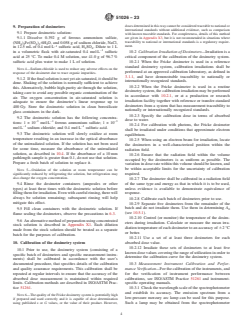
9. Preparation of dosimeters
international standards without additional evidence, such as comparison
9.1 Prepare dosimetric solution:
with known traceable standards. For completeness, details of this method
9.1.1 Dissolve 0.392 g of ferrous ammonium sulfate,
are given in Appendix X3, but it is not recommended in situations where
traceability to national or international standards is a regulatory require-
(NH ) Fe(SO ) ·6H O, and 0.058 g of sodium chloride, NaCl,
4 2 4 2 2
–1
ment.
in 12.5 mL of 0.4 mol·L sulfuric acid, H SO . Dilute to 1 L
2 4
–1
in a volumetric flask with air-saturated 0.4 mol·L sulfuric 10.2 Calibration Irradiation of Dosimeters—Irradiation is a
acid at 25 °C. To make 0.4 M solution, use 41.0 g of 96.7 %
critical component of the calibration of the dosimetry system.
sulfuric acid plus water to make 1 L of solution.
10.2.1 When the Fricke dosimeter is used in a reference
standard dosimetry system, calibration irradiations shall be
NOTE 4—Sodium chloride is used to reduce any adverse effects on the
performed at an approved calibration laboratory, as defined in
response of the dosimeter due to trace organic impurities.
3.1.1, and have demonstrable traceability to nationally or
9.1.2 If the final solution is not yet air-saturated, it should be
internationally recognized standards.
done. Shaking of the solution is normally sufficient to achieve
10.2.2 When the Fricke dosimeter is used in a routine
this. Alternatively, bubble high-purity air through the solution,
dosimetry system, the calibration irradiation may be performed
taking care to avoid any possible organic contamination of the
in accordance with 10.2.1, or at a production or research
air. The oxygen concentration in air-saturated solution is
irradiation facility together with reference or transfer-standard
adequate to ensure the dosimeter’s linear response up to
dosimeters from a system that has measurement traceability to
400 Gy. Store the dosimetric solution in clean borosilicate
nationally or internationally recognized standards.
glass containers in the dark.
10.2.3 Specify the calibration dose in terms of absorbed
9.2 The dosimetric solution has the following concentra-
dose to water.
–3 –1 –3
tions: 1 × 10 mol·L ferrous ammonium sulfate; 1 × 10
10.2.4 For calibration with photons, the Fricke dosimeter
–1 –1
mol·L sodium chloride; and 0.4 mol·L sulfuric acid.
shall be irradiated under conditions that approximate electron
9.3 The dosimetric solution will slowly oxidize at room
equilibrium.
temperature resulting in an increase in the optical absorbance
10.2.5 When using an electron beam for irradiation, locate
of the unirradiated solution. If the solution has not been used
the dosimeters in a well-characterized position within the
for some time, measure the absorbance of the unirradiated
radiation field.
solution, as described in 10.4. If the absorbance of a 10 mm
10.2.6 Ensure that the radiation field within the volume
pathlength sample is greater than 0.1, do not use that solution.
occupied by the dosimeters is as uniform as possible. The
Prepare a fresh batch of solution to replace it.
variation in dose rate within this volume should be known, and
be within acceptable limits for the uncertainty of calibration
NOTE 5—Oxidation of the solution at room temperature can be
significantly reduced by refrigerating the solution, but refrigeration may required.
also change the oxygen concentration.
10.2.7 The dosimeter shall be calibrated in a radiation field
9.4 Rinse the dosimeter containers (ampoules or other of the same type and energy as that in which it is to be used,
types) at least three times with the dosimetric solution before
unless evidence is available to demonstrate equivalence of
filling them for irradiation. Even with careful rinsing, there will response.
always be solution remaining; subsequent rinsing will help
10.2.8 Calibrate each batch of dosimeters prior to use.
mitigate this effect.
10.2.9 Separate five dosimeters from the remainder of the
batch and do not irradiate them. Use them in determining A
9.5 Fill clean containers with the dosimetric solution. If
(see 10.5.1).
flame sealing the dosimeters, observe the precautions in 6.3.
10.2.10 Control (or monitor) the temperature of the dosim-
9.6 An alternative method of preparation using concentrated
eters during irradiation. Calculate or measure the mean irra-
stock solution is described in Appendix X1. Each dilution
diation temperature of each dosimeter to an accuracy of 62 °C
made from the stock solution should be treated as a separate
or better.
batch for the purposes of calibration.
10.2.11 Use a set of at least three dosimeters for each
absorbed dose value.
10. Calibration of the dosimetry system
10.2.12 Irradiate these sets of dosimeters to at least five
10.1 Prior to use, the dosimetry system (consisting of a
known dose values covering the range of utilization in order to
specific batch of dosimeters and specific measurement instru-
determine the calibration curve for the dosimetry system.
ments) shall be calibrated in accordance with the user’s
documented procedure, that specifies details of the calibration 10.3 Measurement Instrument Calibration and Perfor-
and quality assurance requirements. This calibration shall be mance Verification—For the calibration of the instruments, and
repeated at regular intervals to ensure that the accuracy of the for the verification of instrument performance between
absorbed dose measurement is maintained within required calibrations, see ISO/ASTM Practice 51261 and instrument-
limits. Calibration methods are described in ISO/ASTM Prac- specific operating manuals.
tice 51261.
10.3.1 Check the wavelength scale of the spectrophotometer
and establish its accuracy. The emissi
...
This document is not an ASTM standard and is intended only to provide the user of an ASTM standard an indication of what changes have been made to the previous version. Because
it may not be technically possible to adequately depict all changes accurately, ASTM recommends that users consult prior editions as appropriate. In all cases only the current version
of the standard as published by ASTM is to be considered the official document.
Designation: ISO/ASTM 51026 − 2015(E) 51026 − 23
Standard Practice for
Using the Fricke Dosimetry System
This standard is issued under the fixed designation ISO/ASTM 51026; the number immediately following the designation indicates the
year of original adoption or, in the case of revision, the year of last revision. A number in parentheses indicates the year of last
reapproval. A superscript epsilon (´) indicates an editorial change since the last revision or reapproval.
1. Scope
1.1 This practice covers the procedures for preparation, testing, and using the acidic aqueous ferrous ammonium sulfate solution
dosimetry system to measure absorbed dose to water when exposed to ionizing radiation. The system consists of a dosimeter and
appropriate analytical instrumentation. The system will be referred to as the Fricke dosimetry system. The Fricke dosimetry system
may be used as either a reference standard dosimetry system or a routine dosimetry system.
1.2 This practice is one of a set of standards that provides recommendations for properly implementing dosimetry in radiation
processing, and describes a means of achieving compliance with the requirements of ISO/ASTM Practice 52628 for the Fricke
dosimetry system. It is intended to be read in conjunction with ISO/ASTM Practice 52628.
1.3 The practice describes the spectrophotometric analysis procedures for the Fricke dosimetry system.
1.4 This practice applies only to gamma radiation, X-radiation (bremsstrahlung), and high-energy electrons.
1.5 This practice applies provided the following are satisfied:
1.5.1 The absorbed dose range shall be from 20 Gy to 400 Gy (1).
6 −1
1.5.2 The absorbed-dose absorbed dose rate does not exceed 10 Gy·s (2).
1.5.3 For radioisotope gamma sources, the initial photon energy is greater than 0.6 MeV. For X-radiation (bremsstrahlung), the
initial energy of the electrons used to produce the photons is equal to or greater than 2 MeV. For electron beams, the initial electron
energy is greater than 8 MeV. 8 MeV.
NOTE 1—The lower energy limits given are appropriate for a cylindrical dosimeter ampoule of 12 mm diameter. Corrections for displacement effects and
dose gradient across the ampoule may be required for electron beams (3). The Fricke dosimetry system may be used at lower energies by employing
thinner (in the beam direction) dosimeter containers (see ICRU Report 35).
1.5.4 The irradiation temperature of the dosimeter should be within the range of 10 to 60°C.10 °C to 60 °C.
This practice is under the jurisdiction of ASTM Committee E61 on Radiation Processing and is the direct responsibility of Subcommittee E61.02 on Dosimetry Systems
and is also under the jurisdiction of . Originally developed as a joint ASTM/ISO standard in conjunction with ISO/TC 85/WG 3.
Current edition approved Feb. 9, 2015Dec. 1, 2023. Published January 2024June 2015. Originally published as ASTM E1026–84. Last previous ASTM . Originally
approved in 1984. Last previous edition E1026 – 13. The present International Standard ISO/ASTM 51026–2015(E) replaces ASTM approved in 2015 as ISO/ASTM
51026–2015(E). DOI:10.1520/51026-23.E1026 – 13.
The boldface numbers that appear in parentheses refer to a bibliography at the end of this practice.
Copyright © ASTM International, 100 Barr Harbor Drive, PO Box C700, West Conshohocken, PA 19428-2959. United States
51026 − 23
1.6 This standard does not purport to address all of the safety concerns, if any, associated with its use. It is the responsibility
of the user of this standard to establish appropriate safety and healthsafety, health, and environmental practices and determine
the applicability of regulatory limitations prior to use.
1.7 This international standard was developed in accordance with internationally recognized principles on standardization
established in the Decision on Principles for the Development of International Standards, Guides and Recommendations issued
by the World Trade Organization Technical Barriers to Trade (TBT) Committee.
2. Referenced documents
2.1 ASTM Standards:
C912 Practice for Designing a Process for Cleaning Technical Glasses
E170 Terminology Relating to Radiation Measurements and Dosimetry
E178 Practice for Dealing With Outlying Observations
E275 Practice for Describing and Measuring Performance of Ultraviolet and Visible Spectrophotometers
E666 Practice for Calculating Absorbed Dose From Gamma or X Radiation
E668 Practice for Application of Thermoluminescence-Dosimetry (TLD) Systems for Determining Absorbed Dose in
Radiation-Hardness Testing of Electronic Devices
E925 Practice for Monitoring the Calibration of Ultraviolet-Visible Spectrophotometers whose Spectral Bandwidth does not
Exceed 2 nm
E958 Practice for Estimation of the Spectral Bandwidth of Ultraviolet-Visible Spectrophotometers
E3083 Terminology Relating to Radiation Processing: Dosimetry and Applications
2.2 ISO/ASTM Standards:
51261 Practice for Calibration of Routine Dosimetry Systems for Radiation Processing
51707 Guide for Estimating Uncertainties in Dosimetry for Radiation Processing
52628 Practice for Dosimetry in Radiation Processing
2.3 ISO/IEC Standard:Standards:
ISO/IEC 17025 General requirements for the competence of testing and calibration laboratories
ISO 12749-4 Nuclear energy, nuclear technologies, and radiological protection—Vocabulary—Part 4: Dosimetry for radiation
processing
2.4 International Commission on Radiation Units and Measurements (ICRU) Reports:
ICRU Report 14 Radiation Dosimetry: X Rays and Gamma Rays with Maximum Photon Energies Between 0.6 and 50 MeV
ICRU Report 35 Radiation Dosimetry: Electrons with Initial Energies Between 1 and 50 MeV
ICRU Report 64 Dosimetry of High-Energy Photon Beams based on Standards of Absorbed Dose to Water
ICRU Report 80 Dosimetry Systems for Use in Radiation Processing
ICRU Report 85a Fundamental Quantities and Units for Ionizing Radiation
2.5 Joint Committee for Guides in Metrology (JCGM) Reports:
JCGM 100:2008 GUM 19951995, with minor corrections , with minor corrections, Evaluation of measurement data – Guide to
the expression of uncertainty in measurement
JCGM 200:2012, VIM International vocabulary of metrology – Basic and general concepts and associated terms
2.6 National Research Council Canada (NRCC):
PIRS-0815 The IRS Fricke Dosimetry System
3. Terminology
3.1 Definitions:
3.1.1 approved calibration laboratory—calibration laboratory that is a recognized national metrology institute;institute or has been
formally accredited to ISO/IEC 17025; or has a quality system consistent with the requirements of ISO/IEC 17025.
3.1.1.1 Discussion—
A recognized national metrology institute or other calibration laboratory accredited to ISO/IEC 17025 should be used in order to
ensure traceability to a national or international standard. A calibration certificate provided by a laboratory not having formal
For referenced ASTM and ISO/ASTM standards, visit the ASTM webiste, www.astm.org, or contact ASTM Customer Service at service@astm.org. For Annual Book
of ASTM Standards volume information, refer to the standard’s Document Summary page on the ASTM website.
Available from American National Standards Institute (ANSI), 25 W. 43rd St., 4th Floor, New York, NY 10036, http://www.ansi.org.
Available from International Commission on Radiation Units and Measurements (ICRU), 7910 Woodmont Ave., Suite 400, Bethesda, MD 20841-3095, http://
www.icru.org.
Document produced by Working Group 1 of the Joint Committee for Guides in Metrology (JCGM/WG1). Available free of charge at the BIPM website
(http://www.bipm.org).
Available from the National Research Council, Ionizing Radiation Standards, Ottawa, Ontario. K1A 0R6.
51026 − 23
recognition or accreditation will not necessarily be proof of for irradiation of dosimeters or dose measurements for calibration in
order to ensure traceability to a national or international standard.
3.1.2 molar linear absorption coeffıcient (ε )—a constant relating the spectrophotometric absorbance (A ) of an optically
m λ
absorbing molecular species at a given wavelength (λ) per unit pathlength (d) to the molar concentration (c) of that species in
solution:
A
λ
ε 5 (1)
m
d ×c
~ !
2 -1–1
Unit: m ·mol
3.1.3 radiation chemical yield (G(x))—quotient of n(x) by ε¯, where n(x) is the mean amount of a specified entity, x, produced,
destroyed, or changed by the mean energy, ε, imparted to the matter.
¯
n x
~ !
G x 5 (2)
~ ! S D
εH
-1–1
Unit: mol·J
3.1.4 reference standard dosimetry system—dosimetry system, generally having the highest metrological quality available at a
given location or in a given organization, from which measurements made there are derived.
3.1.5 type I dosimeter—dosimeter of high metrological quality, the response of which is affected by individual influence quantities
in a well-defined way that can be expressed way that is well defined and capable of expression in terms of independent correction
factors.
3.2 Definitions of other terms used in this standard that pertain to radiation measurement and dosimetry may be found in
Terminology ISO/ASTM Practice E17052628. Definitions in Other terms that pertain to radiation measurement and dosimetry may
be found in ASTM Terminology E170E3083 are compatible with ICRU 85a; that document, therefore, may be used as an
alternative reference.and ISO Terminology ISO 12749-4. Where appropriate, definitions used in these standards have been derived
from and are consistent with definitions in ICRU Report 85a and general metrological definitions given in the VIM.
4. Significance and use
4.1 The Fricke dosimetry system provides a reliable means for measurement of absorbed dose to water, based on a process of
oxidation of ferrous ions to ferric ions in acidic aqueous solution by ionizing radiation (ICRU 80, PIRS-0815, (4)). In situations
not requiring traceability to national standards, this system can be used for absolute determination of absorbed dose without
calibration, as the radiation chemical yield of ferric ions is well characterized (see Appendix X3).
4.2 The dosimeter is an air-saturated solution of ferrous sulfate or ferrous ammonium sulfate that indicates absorbed dose by an
increase in optical absorbance at a specified wavelength. A temperature-controlled calibrated spectrophotometer is used to measure
the absorbance.
5. Effect of influence quantities
5.1 The Fricke dosimeter response (change in optical absorbance) to a given radiation dose is dependent on irradiation temperature
and measurement temperature. Thus, corrections may have to be applied for changes to the radiation chemical yield (G) for
3+ 3+
irradiation temperature and to the molar linear absorption coefficient (ε) for measurement temperatures. Both ε(Fe ) and G(Fe )
increase with increase in temperature. The subscripts indicate the temperature of irradiation and measurement, as applicable. Both
of the temperatures are in °C.
ε 5 ε @110.0069 ~T 2 25!# (3)
T 25 meas
meas
G 5 G @110.0012 ~T 2 25!# (4)
T 25 irrad
irrad
5.2 The radiation chemical yield depends on the type and energy of the radiation employed and, in particular, changes significantly
at low photon energies (5).
51026 − 23
6. Interferences
6.1 The Fricke dosimeter response is extremely sensitive to impurities in the solution, particularly organic impurities. Even in trace
quantities, impurities can cause a detectable change in the observed response. For high accuracy, organic materials shall not be used
for any component in contact with the solution, unless it has been demonstrated that the materials do not affect the dosimeter
response.
6.2 Traces of metal ions in the irradiated and unirradiated dosimetric solutions can also affect dosimeter response. Therefore, do
not use metal in any component in contact with the solutions.
6.3 If flame sealed flame-sealed ampoules are used as the dosimeters, exercise care in filling ampoules to avoid depositing solution
in the ampoule neck. Subsequent heating during sealing of the ampoule may cause undesirable chemical change in the dosimetric
solution remaining inside the ampoule neck. For the same reason, exercise care to avoid heating the body of the ampoule during
sealing.
6.4 Thermal oxidation (as indicated by an increase in optical absorbance), in the absence of radiation, is a function of ambient
temperature. At normal laboratory temperatures (about 20 to 25°C),20 °C to 25 °C), this effect may be significant if there is a long
period of time between solution preparation and photometric measurement. This interference is discussed further in 9.3.
6.5 The dosimetric solution is somewhat sensitive to ultraviolet light and should be kept in the dark for long-term storage. No
special precautions are required during routine handling under normal laboratory lighting conditions, but strong UV sources such
as sunlight should be avoided.
7. Apparatus
7.1 For the analysis of the dosimetric solution, use a high-precision spectrophotometer capable of measuring absorbance values
up to 2 with an uncertainty of no more than 61 % in the region of 300 nm. Use a quartz cuvette with 5- or 10-mm5 mm or 10 mm
pathlength for spectrophotometric measurement of the solution. The cuvette capacity must be small enough to allow it to be
thoroughly rinsed by the dosimeter solution and still leave an adequate amount of that solution to fill the cuvette to the appropriate
level for the absorbance measurement. For dosimeter ampoules of less than 2 mL, this may require the use of semi-microcapacity
cuvettes. Other solution handling techniques, such as the use of micro-capacity flow cells, may be employed provided precautions
are taken to avoid cross-contamination. Either control the temperature of the dosimetric solution during measurement at 25 6
0.5°C,0.5 °C, or determine the solution temperature during the spectrophotometric analysis and correct the measured absorbance
to 25°C25 °C using Eq 3.
7.2 Use borosilicate glass or equivalent chemically-resistant chemically resistant glass to store the reagents and the prepared
dosimetric solution. Clean all apparatus thoroughly before use (see Practice C912).
7.2.1 Store the cleaned glassware in a clean, dust-free environment. For extreme accuracy, bake the glassware in vacuum at
550°C550 °C for at least 1 h (6).
7.2.2 As an alternative method to baking the glassware, the dosimeter containers (for example, ampoules) may be filled with the
dosimetric solution and irradiated to a dose of at least 500 Gy. When a container is needed, pour out the irradiated solution, rinse
the container at least three times with unirradiated solution, and then refill with the dosimetric solution to be irradiated. The time
between filling, irradiation, and measurement should be as short as practical, preferably no more than a few hours. Refer to Note
2.
7.3 Use a sealed glass ampoule or other appropriate glass container to hold the dosimetric solution during irradiation.
NOTE 2—To minimize errors due to differences in radiation absorption properties between the container material and the Fricke solution, it is possible
to use plastic containers (for example, PMMA or polystyrene) to hold Fricke solution. However, the interferences discussed in Section 6 may result in
a reduction in accuracy. To reduce these problems, the plastic containers may be conditioned by irradiating them filled with dosimetric solution to
approximately 500 Gy. The containers should then be thoroughly rinsed with unirradiated solution before use.
51026 − 23
8. Reagents
8.1 Purity of Reagents—Reagent grade chemicals shall be used. Unless otherwise indicated, all reagents shall conform to the
specifications of the Committee on Analytical Reagents of the American Chemical Society (or equivalent) where such
specifications are available. Other grades may be used, provided it is first ascertained that the reagent is of sufficient high purity
to permit its use without lessening the accuracy of the measurements. Methods of obtaining higher purity of chemicals exist (for
example, crystallization or distillation), but are not discussed here.
8.2 Purity of Water—Water purity is very important since water is the major constituent of the dosimetric solution, and therefore,
may be the prime source of contamination. The use of double-distilled water from coupled all-glass and silica stills or water from
a high-quality commercial purification unit capable of achieving Total Oxidizable Carbon (T.O.C.) content below 5 ppb is
recommended. Use of deionized water is not recommended.
NOTE 3—Double-distilled water distilled from an alkaline permanganate (KMnO ) solution (2 g KMnO plus 5 g sodium hydroxide (NaOH) in 2 L of
4 4
distilled water) has been found to be adequate for routine preparation of the dosimetric solution. High purity High-purity water is commercially available
from some suppliers. Water labelledlabeled HPLC (high pressure liquid chromatography) grade is usually sufficiently free of organic impurities to be used
in this practice.
8.3 Reagents:
8.3.1 Ferrous Ammonium Sulfate—(NH ) Fe(SO ) · 6H·6H O.
4 2 4 2 2
8.3.2 Sodium Chloride (NaCl).
8.3.3 Sulfuric Acid (H SO ).
2 4
9. Preparation of dosimeters
9.1 Prepare dosimetric solution:
9.1.1 Dissolve 0.392 g of ferrous ammonium sulfate, (NH ) Fe(SO ) · 6H·6H O, and 0.058 g of sodium chloride, NaCl, in 12.5
4 2 4 2 2
-1–1 -1–1
mL of 0.4 mol·L sulfuric acid, H SO . Dilute to 1 L in a volumetric flask with air-saturated 0.4 mol·L sulfuric acid at
2 4
25°C.25 °C. To make 0.4 M solution, use 41.0 g of 96.7 % sulfuric acid plus water to make 1 L of solution.
NOTE 4—Sodium chloride is used to reduce any adverse effects on the response of the dosimeter due to trace organic impurities.
9.1.2 If the final solution is not yet air-saturated, it should be done. Shaking of the solution is normally sufficient to achieve this.
Alternatively, bubble high-purity air through the solution, taking care to avoid any possible organic contamination of the air. The
oxygen concentration in air-saturated solution is adequate to ensure the dosimeter’s linear response up to 400 Gy. 400 Gy. Store
the dosimetric solution in clean borosilicate glass containers in the dark.
-3–3 -1–1 -3–3 -1–1
9.2 The dosimetric solution has the following concentrations: 1 × 10 mol·L ferrous ammonium sulfate; 1 × 10 mol·L
-1–1
sodium chloride; and 0.4 mol·L sulfuric acid.
9.3 The dosimetric solution will slowly oxidize at room temperature resulting in an increase in the optical absorbance of the
unirradiated solution. If the solution has not been used for some time, measure the absorbance of the unirradiated solution, as
described in 10.4. If the absorbance of a 10-mm10 mm pathlength sample is greater than 0.1, do not use that solution. Prepare a
fresh batch of solution to replace it.
NOTE 5—Oxidation of the solution at room temperature can be significantly reduced by refrigerating the solution, but refrigeration may also change the
oxygen concentration.
Reagent Chemicals, American Chemical Society Specifications, American Chemical Society, Washington, DC. For suggestions on the testing of reagents not listed by
the American Chemical Society, see Analar Standards for Laboratory Chemicals, BDH Ltd., Poole, Dorset, U.K., and the United States Pharmacopeia and National
Formulary, U.S. Pharmaceutical Convention, Inc. (USPC), Rockville, MD.
51026 − 23
9.4 Rinse the dosimeter containers (ampoules or other types) at least three times with the dosimetric solution before filling them
for irradiation. Even with careful rinsing, there will always be solution remaining; subsequent rinsing will help mitigate this effect.
9.5 Fill clean containers with the dosimetric solution. If flame sealing the dosimeters, observe the precautions in 6.3.
9.6 An alternative method of preparation using concentrated stock solution is described in Appendix X1. Each dilution made from
the stock solution should be treated as a separate batch for the purposes of calibration.
10. Calibration of the dosimetry system
10.1 Prior to use, the dosimetry system (consisting of a specific batch of dosimeters and specific measurement instruments) shall
be calibrated in accordance with the user’s documented procedure, that specifies details of the calibration and quality assurance
requirements. This calibration shall be repeated at regular intervals to ensure that the accuracy of the absorbed dose measurement
is maintained within required limits. Calibration methods are described in ISO/ASTM Practice 51261.
NOTE 6—The quality of the Fricke dosimetry system is potentially high if prepared and used correctly and it is capable of dose determination using
published ε or G values, or the value of their product. However, doses determined in this way cannot be considered traceable to national or international
standards without additional evidence, such as comparison with known traceable standards. For completeness, details of this method are given in
Appendix X3, but it is not recommended in situations where traceability to national or international standards is a regulatory requirement.
10.2 Calibration Irradiation of Dosimeters—Irradiation is a critical component of the calibration of the dosimetry system.
10.2.1 When the Fricke dosimeter is used in a reference standard dosimetry system, calibration irradiations shall be performed at
an approved calibration laboratory, as defined in 3.1.1, and have demonstrable traceability to nationally or internationally
recognized standards.
10.2.2 When the Fricke dosimeter is used in a routine dosimetry system, the calibration irradiation may be performed in
accordance with 10.2.1, or at a production or research irradiation facility together with reference-reference or transfer-standard
dosimeters from a system that has measurement traceability to nationally or internationally recognized standards.
10.2.3 Specify the calibration dose in terms of absorbed dose to water.
10.2.4 For calibration with photons, the Fricke dosimeter shall be irradiated under conditions that approximate electron
equilibrium.
10.2.5 When using an electron beam for irradiation, locate the dosimeters in a well-characterized position within the radiation
field.
10.2.6 Ensure that the radiation field within the volume occupied by the dosimeters is as uniform as possible. The variation in dose
rate within this volume should be known, and be within acceptable limits for the uncertainty of calibration required.
10.2.7 The dosimeter shall be calibrated in a radiation field of the same type and energy as that in which it is to be used, unless
evidence is available to demonstrate equivalence of response.
10.2.8 Calibrate each batch of dosimeters prior to use.
10.2.9 Separate five dosimeters from the remainder of the batch and do not irradiate them. Use them in determining A (see
10.5.1).
10.2.10 Control (or monitor) the temperature of the dosimeters during irradiation. Calculate or measure the mean irradiation
temperature of each dosimeter to an accuracy of 62°C,62 °C or better.
10.2.11 Use a set of at least three dosimeters for each absorbed dose value.
10.2.12 Irradiate these sets of dosimeters to at least five known dose values covering the range of utilization in order to determine
the calibration curve for the dosimetry system.
51026 − 23
10.3 Measurement Instrument Calibration and Performance Verification—For the calibration of the instruments, and for the
verification of instrument performance between calibrations, see ISO/ASTM Practice 51261 and instrument-specific operating
manuals.
10.3.1 Chec
...