


ASTM B743-12(2020)
(Specification)Standard Specification for Seamless Copper Tube in Coils
Standard Specification for Seamless Copper Tube in Coils
ABSTRACT
This standard specification establishes the requirements for seamless copper tube coils, suitable for use in refrigeration and air conditioning or other uses, such as oil lines and gasoline lines. The material of manufacture shall be cast billet, bar, tube and so forth of Copper Alloys No. C10200, C10300, C10800, C12000, or C12200. The tube shall be manufactured by such hot and cold working processes needed to produce a homogeneous, uniform wrought structure. The tube shall be cold drawn to the prescribed finish size and wall thickness. When the cold-drawn temper is required, the final drawing operation shall conform to the specified temper properties. When the annealed temper is required, the tube shall be annealed after the final cold draw to the specified temper properties. The product shall conform to the prescribed electrical mass resistivity, tensile strength, yield strength, Rockwell hardness, and expansion. Each tube shall be subjected to an eddy-current test. Particular coppers shall be tested to meet the cuprous oxide, embrittlement, and cleanness requirements.
SCOPE
1.1 This specification establishes the requirements for seamless copper tube in coils, suitable for use in refrigeration and air conditioning or other uses, such as oil lines and gasoline lines.
1.2 Units—The values stated in inch-pound units are to be regarded as standard. The values given in parentheses are mathematical conversions to SI units that are provided for information only and are not considered standard.
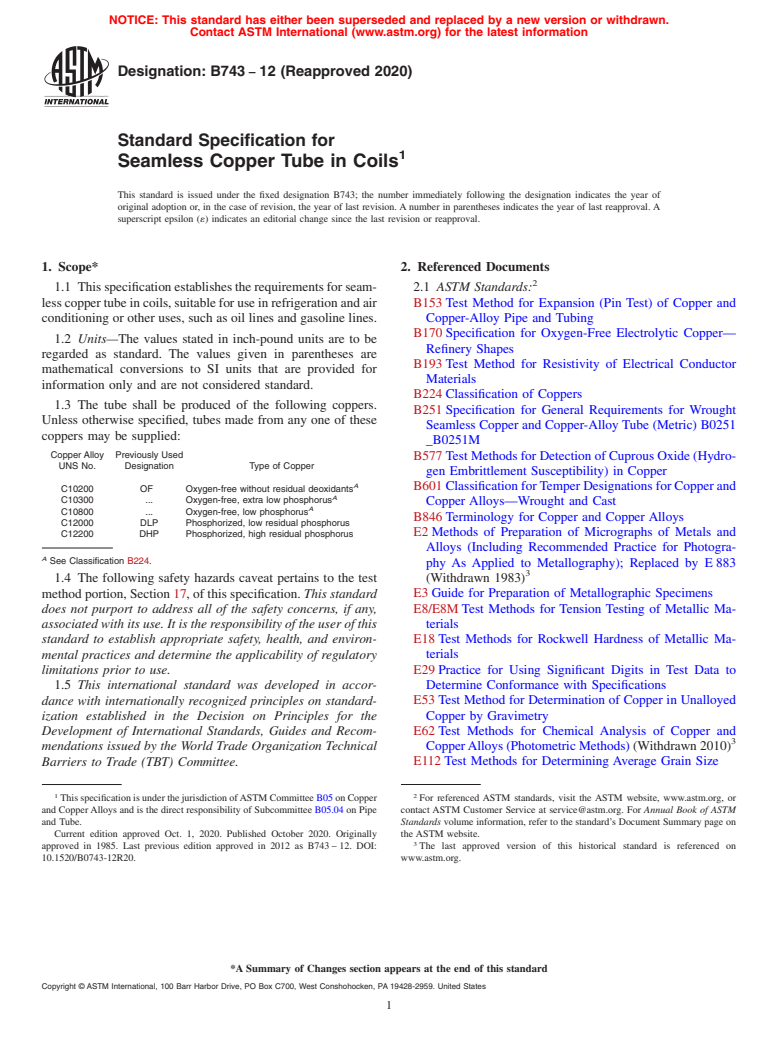
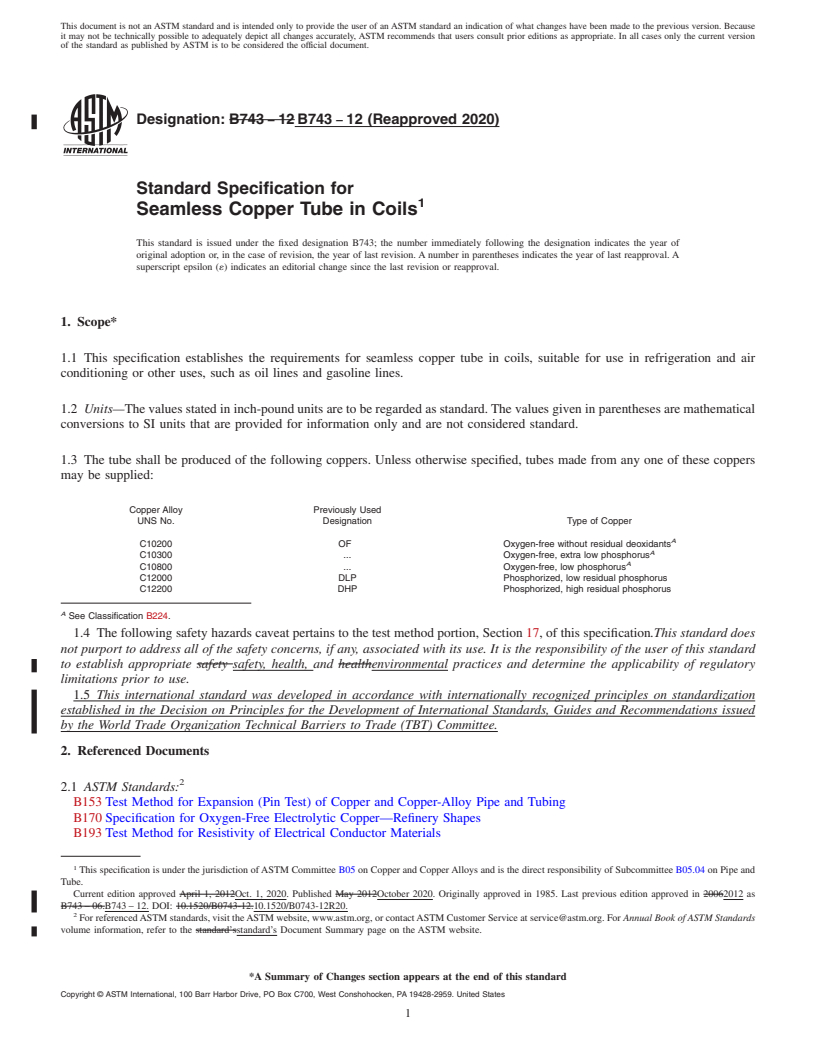
1.3 The tube shall be produced of the following coppers. Unless otherwise specified, tubes made from any one of these coppers may be supplied:
Copper Alloy
UNS No.
Previously Used
Designation
Type of Copper
C10200
OF
Oxygen-free without residual deoxidantsA
C10300
...
Oxygen-free, extra low phosphorusA
C10800
...
Oxygen-free, low phosphorusA
C12000
DLP
Phosphorized, low residual phosphorus
C12200
DHP
Phosphorized, high residual phosphorus
1.4 The following safety hazards caveat pertains to the test method portion, Section 17, of this specification. This standard does not purport to address all of the safety concerns, if any, associated with its use. It is the responsibility of the user of this standard to establish appropriate safety, health, and environmental practices and determine the applicability of regulatory limitations prior to use.
1.5 This international standard was developed in accordance with internationally recognized principles on standardization established in the Decision on Principles for the Development of International Standards, Guides and Recommendations issued by the World Trade Organization Technical Barriers to Trade (TBT) Committee.
General Information
Buy Standard
Standards Content (Sample)
NOTICE: This standard has either been superseded and replaced by a new version or withdrawn.
Contact ASTM International (www.astm.org) for the latest information
Designation: B743 − 12 (Reapproved 2020)
Standard Specification for
Seamless Copper Tube in Coils
This standard is issued under the fixed designation B743; the number immediately following the designation indicates the year of
original adoption or, in the case of revision, the year of last revision. A number in parentheses indicates the year of last reapproval. A
superscript epsilon (´) indicates an editorial change since the last revision or reapproval.
1. Scope* 2. Referenced Documents
1.1 This specification establishes the requirements for seam- 2.1 ASTM Standards:
less copper tube in coils, suitable for use in refrigeration and air B153 Test Method for Expansion (Pin Test) of Copper and
conditioning or other uses, such as oil lines and gasoline lines. Copper-Alloy Pipe and Tubing
B170 Specification for Oxygen-Free Electrolytic Copper—
1.2 Units—The values stated in inch-pound units are to be
Refinery Shapes
regarded as standard. The values given in parentheses are
B193 Test Method for Resistivity of Electrical Conductor
mathematical conversions to SI units that are provided for
Materials
information only and are not considered standard.
B224 Classification of Coppers
1.3 The tube shall be produced of the following coppers.
B251 Specification for General Requirements for Wrought
Unless otherwise specified, tubes made from any one of these
Seamless Copper and Copper-Alloy Tube (Metric) B0251
coppers may be supplied:
_B0251M
Copper Alloy Previously Used
B577 Test Methods for Detection of Cuprous Oxide (Hydro-
UNS No. Designation Type of Copper
gen Embrittlement Susceptibility) in Copper
A
B601 Classification for Temper Designations for Copper and
C10200 OF Oxygen-free without residual deoxidants
A
C10300 . Oxygen-free, extra low phosphorus
Copper Alloys—Wrought and Cast
A
C10800 . Oxygen-free, low phosphorus
B846 Terminology for Copper and Copper Alloys
C12000 DLP Phosphorized, low residual phosphorus
E2 Methods of Preparation of Micrographs of Metals and
C12200 DHP Phosphorized, high residual phosphorus
Alloys (Including Recommended Practice for Photogra-
A
See Classification B224.
phy As Applied to Metallography); Replaced by E 883
1.4 The following safety hazards caveat pertains to the test (Withdrawn 1983)
E3 Guide for Preparation of Metallographic Specimens
method portion, Section 17, of this specification. This standard
does not purport to address all of the safety concerns, if any, E8/E8M Test Methods for Tension Testing of Metallic Ma-
terials
associated with its use. It is the responsibility of the user of this
standard to establish appropriate safety, health, and environ- E18 Test Methods for Rockwell Hardness of Metallic Ma-
terials
mental practices and determine the applicability of regulatory
limitations prior to use. E29 Practice for Using Significant Digits in Test Data to
Determine Conformance with Specifications
1.5 This international standard was developed in accor-
dance with internationally recognized principles on standard- E53 Test Method for Determination of Copper in Unalloyed
ization established in the Decision on Principles for the Copper by Gravimetry
Development of International Standards, Guides and Recom- E62 Test Methods for Chemical Analysis of Copper and
mendations issued by the World Trade Organization Technical Copper Alloys (Photometric Methods) (Withdrawn 2010)
Barriers to Trade (TBT) Committee. E112 Test Methods for Determining Average Grain Size
1 2
This specification is under the jurisdiction of ASTM Committee B05 on Copper For referenced ASTM standards, visit the ASTM website, www.astm.org, or
and Copper Alloys and is the direct responsibility of Subcommittee B05.04 on Pipe contact ASTM Customer Service at service@astm.org. For Annual Book of ASTM
and Tube. Standards volume information, refer to the standard’s Document Summary page on
Current edition approved Oct. 1, 2020. Published October 2020. Originally the ASTM website.
approved in 1985. Last previous edition approved in 2012 as B743 – 12. DOI: The last approved version of this historical standard is referenced on
10.1520/B0743-12R20. www.astm.org.
*A Summary of Changes section appears at the end of this standard
Copyright © ASTM International, 100 Barr Harbor Drive, PO Box C700, West Conshohocken, PA 19428-2959. United States
B743 − 12 (2020)
E243 Practice for Electromagnetic (Eddy Current) Examina- 5.1.6 Type of coil (see 4.2); and
tion of Copper and Copper-Alloy Tubes
5.1.7 Total quantity of each item.
E255 Practice for Sampling Copper and Copper Alloys for
5.2 The following options are available and shall be speci-
the Determination of Chemical Composition
fied at the time of placing the order, when required:
E2575 Test Method for Determination of Oxygen in Copper
5.2.1 Embrittlement test (see 13.3),
and Copper Alloys by Inert Gas Fusion
5.2.2 Refrigeration or air-conditioning grade (see 13.4),
3. General Requirements
5.2.3 If coil ends are to be sealed (see 13.4.1.1),
3.1 The following sections of Specification B251 constitute
5.2.4 Eddy-current test (see 13.1.1),
a part of this specification:
5.2.5 Expansion test (see 12.1.1),
3.1.1 Sampling,
5.2.6 Electrical resistivity requirement (see 10.1),
3.1.2 Number of tests and retests,
5.2.7 Certification (see Section 21),
3.1.3 Dimensions and permissible variations,
5.2.8 Mill test report (see Section 22).
3.1.4 Test specimens, and
3.1.5 Significance of numerical limits.
6. Materials and Manufacture
3.2 In addition, when a section with a title identical to those
6.1 Material:
referenced in 3.1 appears in this specification, it contains
additional information that supplements those appearing in 6.1.1 The material of manufacture shall be cast billet, bar,
Specification B251. In case of conflict, this specification shall tube, and so forth of Copper Alloys Nos. C10200, C10300,
prevail. C10800, C12000, or C12200 and of such purity and soundness
as to be suitable for processing in to the product prescribed
4. Terminology
herein.
4.1 Definitions—For the definitions of terms related to
6.1.2 In the event heat identification or traceability is
copper and copper alloys, refer to Terminology B846. required, the purchaser shall specify the details desired.
4.2 Definitions of Terms Specific to This Standard:
NOTE 1—Due to the discontinuous nature of the processing of castings
4.2.1 level or traverse wound, adj—coil in which the turns
into wrought products, it is not always practical to identify a specific
are wound into layers parallel to the axis of the coil such that casting analysis with a specific quantity of finished material.
successive turns in a given layer are next to one another
6.2 Manufacture:
(sometimes called “helical coil”).
6.2.1 The product shall be manufactured by such hot and
4.2.2 single layer flat, adj—coil in which the product is
cold working processes needed to produce a homogenous,
spirally wound into a single disk-like layer (sometimes called
uniform wrought structure in the finished product.
“pan-cake coil” or “single layer spirally wound coil”).
6.2.1.1 The product shall be cold drawn to the finish size
4.2.3 double layer flat, adj—coil in which the product is
and wall thickness.
spirally wound into two connected disk-like layers such that
6.2.1.2 When the cold-drawn temper is required, the final
one layer is on top of the other (sometimes called “double layer
drawing operation shall be such as to meet the temper
pan-cake coil” or “double layer spirally wound coil”).
properties specified.
6.2.1.3 When the annealed temper is required, the tube shall
5. Ordering Information
be annealed after the final cold draw to meet the temper
5.1 Include the following information when placing orders
properties specified.
for product under this specification, as applicable:
5.1.1 ASTM designation and year of issue;
7. Chemical Composition
5.1.2 Copper UNS No. (for example, C12200), if required
7.1 The material shall conform to the compositional require-
(see 1.3 and Table 1);
ments listed in Table 1 for the copper UNS No. designation
5.1.3 Temper (see Section 8);
specified in the ordering information.
5.1.4 Dimensions, diameter, and wall thickness. Dimen-
sional tolerances, if other than those included in this 7.1.1 Results of analysis on a product (check) sample shall
specification, are required; conform to the composition requirements within the permitted
5.1.5 Length (see 14.1 and Table 2); analytical variance specified in Table 1.
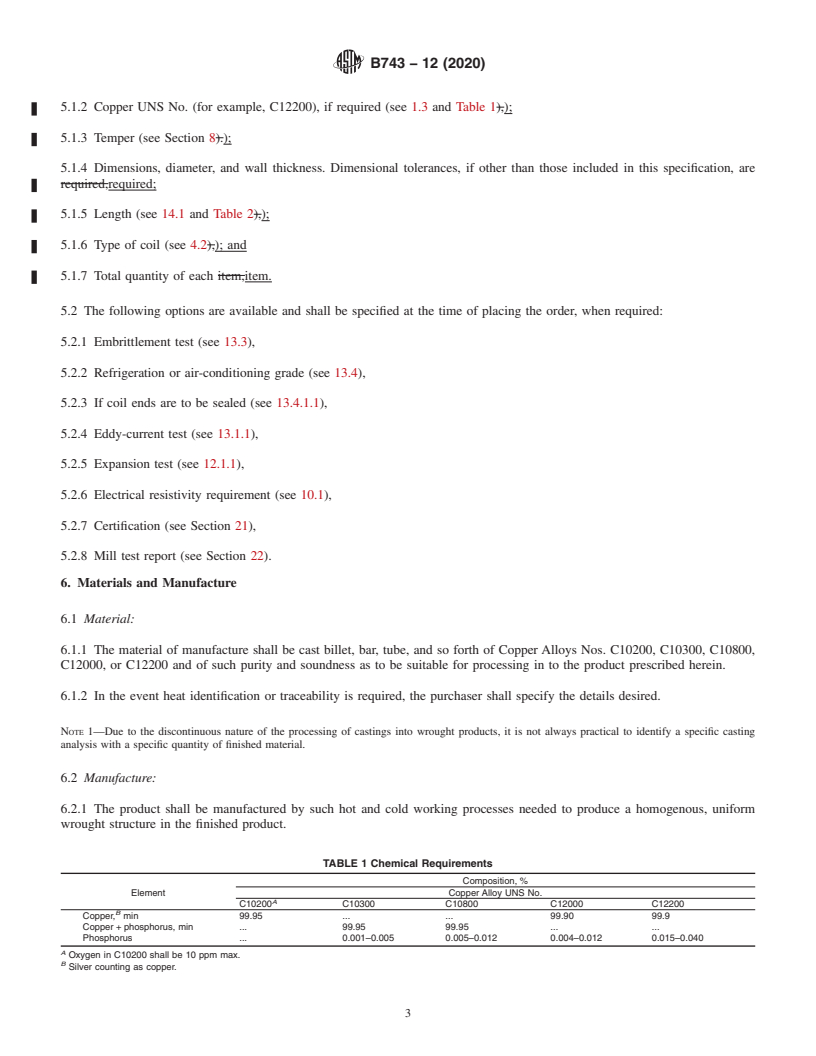
TABLE 1 Chemical Requirements
Composition, %
Element Copper Alloy UNS No.
A
C10200 C10300 C10800 C12000 C12200
B
Copper, min 99.95 . . 99.90 99.9
Copper + phosphorus, min . 99.95 99.95 . .
Phosphorus . 0.001–0.005 0.005–0.012 0.004–0.012 0.015–0.040
A
Oxygen in C10200 shall be 10 ppm max.
B
Silver counting as copper.
B743 − 12 (2020)
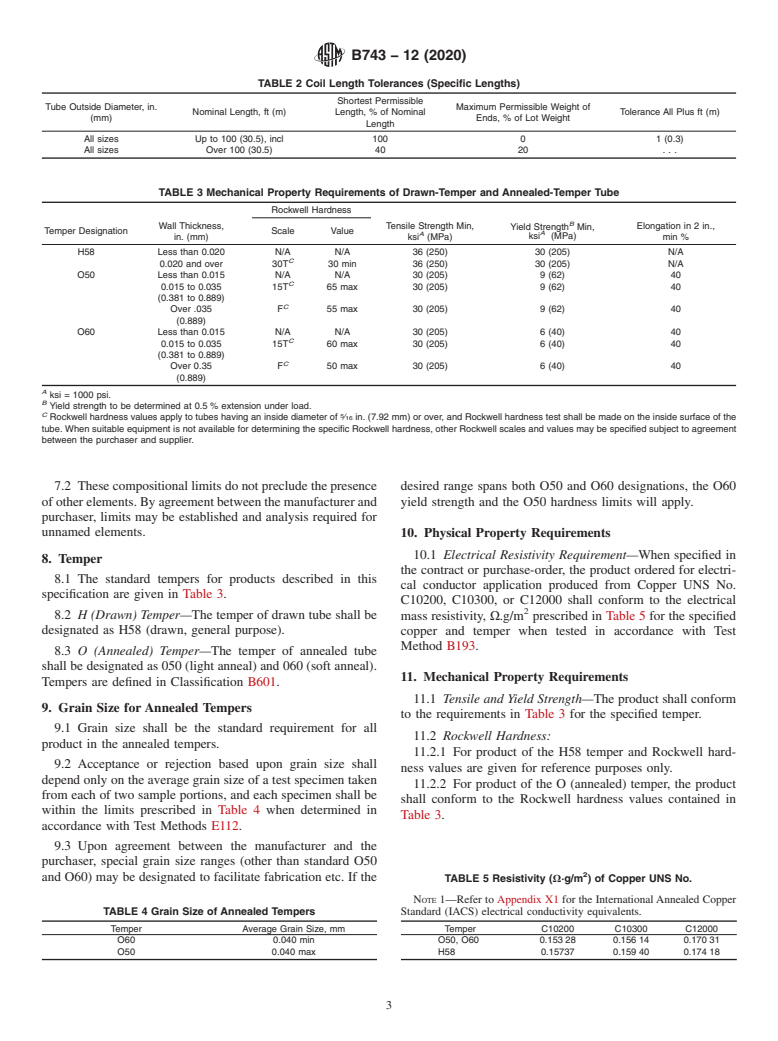
TABLE 2 Coil Length Tolerances (Specific Lengths)
Shortest Permissible
Tube Outside Diameter, in. Maximum Permissible Weight of
Nominal Length, ft (m) Length, % of Nominal Tolerance All Plus ft (m)
(mm) Ends, % of Lot Weight
Length
All sizes Up to 100 (30.5), incl 100 0 1 (0.3)
All sizes Over 100 (30.5) 40 20 . . .
TABLE 3 Mechanical Property Requirements of Drawn-Temper and Annealed-Temper Tube
Rockwell Hardness
B
Wall Thickness, Tensile Strength Min, Elongation in 2 in.,
Yield Strength Min,
Temper Designation Scale Value
A
A
in. (mm) ksi (MPa) ksi (MPa) min %
H58 Less than 0.020 N/A N/A 36 (250) 30 (205) N/A
C
0.020 and over 30T 30 min 36 (250) 30 (205) N/A
O50 Less than 0.015 N/A N/A 30 (205) 9 (62) 40
C
0.015 to 0.035 15T 65 max 30 (205) 9 (62) 40
(0.381 to 0.889)
C
Over .035 F 55 max 30 (205) 9 (62) 40
(0.889)
O60 Less than 0.015 N/A N/A 30 (205) 6 (40) 40
C
0.015 to 0.035 15T 60 max 30 (205) 6 (40) 40
(0.381 to 0.889)
C
Over 0.35 F 50 max 30 (205) 6 (40) 40
(0.889)
A
ksi = 1000 psi.
B
Yield strength to be determined at 0.5 % extension under load.
C
Rockwell hardness values apply to tubes having an inside diameter of ⁄16 in. (7.92 mm) or over, and Rockwell hardness test shall be made on the inside surface of the
tube. When suitable equipment is not available for determining the specific Rockwell hardness, other Rockwell scales and values may be specified subject to agreement
between the purchaser and supplier.
7.2 These compositional limits do not preclude the presence desired range spans both O50 and O60 designations, the O60
of other elements. By agreement between the manufacturer and yield strength and the O50 hardness limits will apply.
purchaser, limits may be established and analysis required for
unnamed elements. 10. Physical Property Requirements
10.1 Electrical Resistivity Requirement—When specified in
8. Temper
the contract or purchase-order, the product ordered for electri-
8.1 The standard tempers for products described in this
cal conductor application produced from Copper UNS No.
specification are given in Table 3.
C10200, C10300, or C12000 shall conform to the electrical
8.2 H (Drawn) Temper—The temper of drawn tube shall be mass resistivity, Ω.g/m prescribed in Table 5 for the specified
designated as H58 (drawn, general purpose).
copper and temper when tested in accordance with Test
Method B193.
8.3 O (Annealed) Temper—The temper of annealed tube
shall be designated as 050 (light anneal) and 060 (soft anneal).
11. Mechanical Property Requirements
Tempers are defined in Classification B601.
11.1 Tensile and Yield Strength—The product shall conform
9. Grain Size for Annealed Tempers
to the requirements in Table 3 for the specified temper.
9.1 Grain size shall be the standard requirement for all
11.2 Rockwell Hardness:
product in the annealed tempers.
11.2.1 For product of the H58 temper and Rockwell hard-
9.2 Acceptance or rejection based upon grain size shall
ness values are given for reference purposes only.
depend only on the average grain size of a test specimen taken
11.2.2 For product of the O (annealed) temper, the product
from each of two sample portions, and each specimen shall be
shall conform to the Rockwell hardness values contained in
within the limits prescribed in Table 4 when determined in
Table 3.
accordance with Test Methods E112.
9.3 Upon agreement between the manufacturer and the
purchaser, special grain size ranges (other than standard O50
and O60) may be designated to facilitate fabrication etc. If the
TABLE 5 Resistivity (Ω·g/m ) of Copper UNS No.
NOTE 1—Refer to Appendix X1 for the International Annealed Copper
TABLE 4 Grain Size of Annealed Tempers Standard (IACS) electrical conductivity equivalents.
Temper Average Grain Size, mm Temper C10200 C10300 C12000
O60 0.040 min O50, O60 0.153 28 0.156 14 0.170 31
O50 0.040 max H58 0.15737 0.159 40 0.174 18
B743 − 12 (2020)
12. Performance Requirements Methods B577. In case of dispute, a referee method in
accordance with Procedure C shall be used.
12.1 Expansion Requirement:
12.1.1 When specified in the contract or purchase order, 13.3 Embrittlement—Samples of Copper UNS Nos.
tube furnished in the annealed temper shall be capable of being C10200, C10300, C10800, C12000, and C12200 shall be
expanded in accordance with Test Method B153 with an capable of passing the embrittlement test of Procedure B of
expansion of the outside diameter in the following percentage: Test Methods B577. The actual performance of this test is not
mandatory under the terms of this specification unless specified
Outside Diameter, Expansion of Outside
in. (mm) Diameter, %
in the ordering information. In case of a dispute, a referee
method in accordance with Procedure C shall be used.
0.750 (19.1) and under 40
Over 0.750 (19.1) 30
13.4 Cleanness Requirement:
12.1.2 The expanded tube shall show no cracking or rupture 13.4.1 When refrigeration or air conditioning grade is
visible to the unaided eye. specified, the tube shall be capable of meeting the following
cleanness requirement described in 13.4.1.1.
13.4.1.1 The inside of the tube, with closed ends, shall be
13. Other Requirements
sufficiently clean such that when the interior of the tube is
13.1 Nondestructive Examination for Defects:
washed with a suitable solvent, such as re-distilled chloroform
13.1.1 Upon agreement between the manufacturer and the
or redistilled trichloroethylene, the residue remaining upon
purchaser, each tube shall be subjected to an eddy-current test.
evaporation of the solvent shall not exceed 0.0035 g/ft
13.1.2 Tubes shall be tested normally in the drawn temper;
(0.038 g ⁄m ) of interior surface. See 17.3 for the test method.
however, they may be tested in the annealed temper at the
option of the manufacturer.
14. Dimensions, Mass, and Permissible Variations
13.1.3 Testing shall follow the procedu
...
This document is not an ASTM standard and is intended only to provide the user of an ASTM standard an indication of what changes have been made to the previous version. Because
it may not be technically possible to adequately depict all changes accurately, ASTM recommends that users consult prior editions as appropriate. In all cases only the current version
of the standard as published by ASTM is to be considered the official document.
Designation: B743 − 12 B743 − 12 (Reapproved 2020)
Standard Specification for
Seamless Copper Tube in Coils
This standard is issued under the fixed designation B743; the number immediately following the designation indicates the year of
original adoption or, in the case of revision, the year of last revision. A number in parentheses indicates the year of last reapproval. A
superscript epsilon (´) indicates an editorial change since the last revision or reapproval.
1. Scope*
1.1 This specification establishes the requirements for seamless copper tube in coils, suitable for use in refrigeration and air
conditioning or other uses, such as oil lines and gasoline lines.
1.2 Units—The values stated in inch-pound units are to be regarded as standard. The values given in parentheses are mathematical
conversions to SI units that are provided for information only and are not considered standard.
1.3 The tube shall be produced of the following coppers. Unless otherwise specified, tubes made from any one of these coppers
may be supplied:
Copper Alloy Previously Used
UNS No. Designation Type of Copper
A
C10200 OF Oxygen-free without residual deoxidants
A
C10300 . Oxygen-free, extra low phosphorus
A
C10800 . Oxygen-free, low phosphorus
C12000 DLP Phosphorized, low residual phosphorus
C12200 DHP Phosphorized, high residual phosphorus
A
See Classification B224.
1.4 The following safety hazards caveat pertains to the test method portion, Section 17, of this specification.This standard does
not purport to address all of the safety concerns, if any, associated with its use. It is the responsibility of the user of this standard
to establish appropriate safety safety, health, and healthenvironmental practices and determine the applicability of regulatory
limitations prior to use.
1.5 This international standard was developed in accordance with internationally recognized principles on standardization
established in the Decision on Principles for the Development of International Standards, Guides and Recommendations issued
by the World Trade Organization Technical Barriers to Trade (TBT) Committee.
2. Referenced Documents
2.1 ASTM Standards:
B153 Test Method for Expansion (Pin Test) of Copper and Copper-Alloy Pipe and Tubing
B170 Specification for Oxygen-Free Electrolytic Copper—Refinery Shapes
B193 Test Method for Resistivity of Electrical Conductor Materials
This specification is under the jurisdiction of ASTM Committee B05 on Copper and Copper Alloys and is the direct responsibility of Subcommittee B05.04 on Pipe and
Tube.
Current edition approved April 1, 2012Oct. 1, 2020. Published May 2012October 2020. Originally approved in 1985. Last previous edition approved in 20062012 as
B743 – 06.B743 – 12. DOI: 10.1520/B0743-12.10.1520/B0743-12R20.
For referenced ASTM standards, visit the ASTM website, www.astm.org, or contact ASTM Customer Service at service@astm.org. For Annual Book of ASTM Standards
volume information, refer to the standard’sstandard’s Document Summary page on the ASTM website.
*A Summary of Changes section appears at the end of this standard
Copyright © ASTM International, 100 Barr Harbor Drive, PO Box C700, West Conshohocken, PA 19428-2959. United States
B743 − 12 (2020)
B224 Classification of Coppers
B251 Specification for General Requirements for Wrought Seamless Copper and Copper-Alloy Tube (Metric) B0251_B0251M
B577 Test Methods for Detection of Cuprous Oxide (Hydrogen Embrittlement Susceptibility) in Copper
B601 Classification for Temper Designations for Copper and Copper Alloys—Wrought and Cast
B846 Terminology for Copper and Copper Alloys
E2 Methods of Preparation of Micrographs of Metals and Alloys (Including Recommended Practice for Photography As Applied
to Metallography); Replaced by E 883 (Withdrawn 1983)
E3 Guide for Preparation of Metallographic Specimens
E8/E8M Test Methods for Tension Testing of Metallic Materials
E18 Test Methods for Rockwell Hardness of Metallic Materials
E29 Practice for Using Significant Digits in Test Data to Determine Conformance with Specifications
E53 Test Method for Determination of Copper in Unalloyed Copper by Gravimetry
E62 Test Methods for Chemical Analysis of Copper and Copper Alloys (Photometric Methods) (Withdrawn 2010)
E112 Test Methods for Determining Average Grain Size
E243 Practice for Electromagnetic (Eddy Current) Examination of Copper and Copper-Alloy Tubes
E255 Practice for Sampling Copper and Copper Alloys for the Determination of Chemical Composition
E2575 Test Method for Determination of Oxygen in Copper and Copper Alloys by Inert Gas Fusion
3. General Requirements
3.1 The following sections of Specification B251 constitute a part of this specification:
3.1.1 Sampling,
3.1.2 Number of tests and retests,
3.1.3 Dimensions and permissible variations,
3.1.4 Test specimens, and
3.1.5 Significance of numerical limits.
3.2 In addition, when a section with a title identical to those referenced in 3.1 appears in this specification, it contains additional
information whichthat supplements those appearing in Specification B251. In case of conflict, this specification shall prevail.
4. Terminology
4.1 Definitions—For the definitions of terms related to copper and copper alloys, refer to Terminology B846.
4.2 Definitions of Terms Specific to This Standard:
4.2.1 level or traverse wound, adj—coil in which the turns are wound into layers parallel to the axis of the coil such that successive
turns in a given layer are next to one another (sometimes called “helical coil”).
4.2.2 single layer flat, adj—coil in which the product is spirally wound into a single disk-like layer (sometimes called “pan-cake
coil” or “single layer spirally wound coil”).
4.2.3 double layer flat, adj—coil in which the product is spirally wound into two connected disk-like layers such that one layer
is on top of the other (sometimes called “double layer pan-cake coil” or “double layer spirally wound coil”).
5. Ordering Information
5.1 Include the following information when placing orders for product under this specification, as applicable:
5.1.1 ASTM designation and year of issue,issue;
The last approved version of this historical standard is referenced on www.astm.org.
B743 − 12 (2020)
5.1.2 Copper UNS No. (for example, C12200), if required (see 1.3 and Table 1),);
5.1.3 Temper (see Section 8).);
5.1.4 Dimensions, diameter, and wall thickness. Dimensional tolerances, if other than those included in this specification, are
required,required;
5.1.5 Length (see 14.1 and Table 2),);
5.1.6 Type of coil (see 4.2),); and
5.1.7 Total quantity of each item,item.
5.2 The following options are available and shall be specified at the time of placing the order, when required:
5.2.1 Embrittlement test (see 13.3),
5.2.2 Refrigeration or air-conditioning grade (see 13.4),
5.2.3 If coil ends are to be sealed (see 13.4.1.1),
5.2.4 Eddy-current test (see 13.1.1),
5.2.5 Expansion test (see 12.1.1),
5.2.6 Electrical resistivity requirement (see 10.1),
5.2.7 Certification (see Section 21),
5.2.8 Mill test report (see Section 22).
6. Materials and Manufacture
6.1 Material:
6.1.1 The material of manufacture shall be cast billet, bar, tube, and so forth of Copper Alloys Nos. C10200, C10300, C10800,
C12000, or C12200 and of such purity and soundness as to be suitable for processing in to the product prescribed herein.
6.1.2 In the event heat identification or traceability is required, the purchaser shall specify the details desired.
NOTE 1—Due to the discontinuous nature of the processing of castings into wrought products, it is not always practical to identify a specific casting
analysis with a specific quantity of finished material.
6.2 Manufacture:
6.2.1 The product shall be manufactured by such hot and cold working processes needed to produce a homogenous, uniform
wrought structure in the finished product.
TABLE 1 Chemical Requirements
Composition, %
Element Copper Alloy UNS No.
A
C10200 C10300 C10800 C12000 C12200
B
Copper, min 99.95 . . 99.90 99.9
Copper + phosphorus, min . 99.95 99.95 . .
Phosphorus . 0.001–0.005 0.005–0.012 0.004–0.012 0.015–0.040
A
Oxygen in C10200 shall be 10 ppm max.
B
Silver counting as copper.
B743 − 12 (2020)
TABLE 2 Coil Length Tolerances (Specific Lengths)
Shortest Permissible
Tube Outside Diameter, in. Maximum Permissible Weight of
Nominal Length, ft (m) Length, % of Nominal Tolerance All Plus ft (m)
(mm) Ends, % of Lot Weight
Length
All sizes Up to 100 (30.5), incl 100 0 1 (0.3)
All sizes Over 100 (30.5) 40 20 . . .
6.2.1.1 The product shall be cold drawn to the finish size and wall thickness.
6.2.1.2 When the cold-drawn temper is required, the final drawing operation shall be such as to meet the temper properties
specified.
6.2.1.3 When the annealed temper is required, the tube shall be annealed after the final cold draw to meet the temper properties
specified.
7. Chemical Composition
7.1 The material shall conform to the compositional requirements listed in Table 1 for the copper UNS No. designation specified
in the ordering information.
7.1.1 Results of analysis on a product (check) sample shall conform to the composition requirements within the permitted
analytical variance specified in Table 1.
7.2 These compositional limits do not preclude the presence of other elements. By agreement between the manufacturer and
purchaser, limits may be established and analysis required for unnamed elements.
8. Temper
8.1 The standard tempers for products described in this specification are given in Table 3.
8.2 H (Drawn) Temper—The temper of drawn tube shall be designated as H58 (drawn, general purpose).
8.3 O (Annealed) Temper—The temper of annealed tube shall be designated as 050 (light anneal) and 060 (soft anneal). Tempers
are defined in Classification B601.
TABLE 3 Mechanical Property Requirements of Drawn-Temper and Annealed-Temper Tube
Rockwell Hardness
B
Wall Thickness, Tensile Strength Min, Elongation in 2 in.,
Yield Strength Min,
Temper Designation Scale Value
A
A
in. (mm) ksi (MPa) ksi (MPa) min %
H58 Less than 0.020 N/A N/A 36 (250) 30 (205) N/A
C
0.020 and over 30T 30 min 36 (250) 30 (205) N/A
O50 Less than 0.015 N/A N/A 30 (205) 9 (62) 40
C
0.015 to 0.035 15T 65 max 30 (205) 9 (62) 40
(0.381 to 0.889)
C
Over .035 F 55 max 30 (205) 9 (62) 40
(0.889)
O60 Less than 0.015 N/A N/A 30 (205) 6 (40) 40
C
0.015 to 0.035 15T 60 max 30 (205) 6 (40) 40
(0.381 to 0.889)
C
Over 0.35 F 50 max 30 (205) 6 (40) 40
(0.889)
A
ksi = 1000 psi.
B
Yield strength to be determined at 0.5 % extension under load.
C
Rockwell hardness values apply to tubes having an inside diameter of ⁄16 in. (7.92 mm) or over, and Rockwell hardness test shall be made on the inside surface of the
tube. When suitable equipment is not available for determining the specific Rockwell hardness, other Rockwell scales and values may be specified subject to agreement
between the purchaser and supplier.
B743 − 12 (2020)
9. Grain Size for Annealed Tempers
9.1 Grain size shall be the standard requirement for all product in the annealed tempers.
9.2 Acceptance or rejection based upon grain size shall depend only on the average grain size of a test specimen taken from each
of two sample portions, and each specimen shall be within the limits prescribed in Table 4 when determined in accordance with
Test Methods E112.
9.3 Upon agreement between the manufacturer and the purchaser, special grain size ranges (other than standard O50 and O60) may
be designated to facilitate fabrication etc. If the desired range spans both O50 and O60 designations, the O60 yield strength and
the O50 hardness limits will apply.
10. Physical Property Requirements
10.1 Electrical Resistivity Requirement—When specified in the contract or purchase-order, the product ordered for electrical
conductor application produced from Copper UNS No. C10200, C10300, or C12000 shall conform to the electrical mass resistivity,
Ω.g/mΩ.g/m prescribed in Table 5 for the specified copper and temper when tested in accordance with Test Method B193.
11. Mechanical Property Requirements
11.1 Tensile and Yield Strength—The product shall conform to the requirements in Table 3 for the specified temper.
11.2 Rockwell Hardness:
11.2.1 For product of the H58 temper and Rockwell hardness values are given for reference purposes only.
11.2.2 For product of the O (annealed) temper, the product shall conform to the Rockwell hardness values contained in Table 3.
TABLE 4 Grain Size of Annealed Tempers
Temper Average Grain Size, mm
O60 0.040 min
O50 0.040 max
B743 − 12 (2020)
TABLE 5 Resistivity (Ω·g/m(·g/m ) of Copper UNS No.
NOTE 1—Refer to Appendix X1 for the International Annealed Copper
Standard (IACS) electrical conductivity equivalents.
Temper C10200 C10300 C12000
O50, O60 0.153 28 0.156 14 0.170 31
H58 0.15737 0.159 40 0.174 18
12. Performance Requirements
12.1 Expansion Requirement:
12.1.1 When specified in the contract or purchase order, tube furnished in the annealed temper shall be capable of being expanded
in accordance with Test Method B153 with an expansion of the outside diameter in the following percentage:
Outside Diameter, Expansion of Outside
in. (mm) Diameter, %
0.750 (19.1) and under 40
Over 0.750 (19.1) 30
12.1.2 The expanded tube shall show no cracking or rupture visible to the unaided eye.
13. Other Requirements
13.1 Nondestructive Examination for Defects:
13.1.1 Upon agreement between the manufacturer and the purchaser, each tube shall be subjected to an eddy-current test.
13.1.2 Tubes shall be tested normally in the drawn temper; however, they may be tested in the annealed temper at the option of
the manufacturer.
13.1.3 Testing shall follow the procedures of Practice E243 except for the determination of “end effect.”
NOTE 2—End effect is that length of the tube, which travels through the coil until the testing unit, has stabilized and is able to detect flaws. The magnitude
of the spike, generated when an end passes through the test coils is such that it disrupts testing momentarily.
13.1.4 Unless otherwise agreed upon between the manufacturer, or supplier, and the purchaser, the manufacturer shall have the
option of calibrating the test equipment using either notches or drilled holes. If agreement cannot be reached, drilled holes shall
be used.
13.1.4.1 Notch-depth standar
...
Questions, Comments and Discussion
Ask us and Technical Secretary will try to provide an answer. You can facilitate discussion about the standard in here.