

ASTM D4880-18
(Test Method)Standard Test Method for Salt Water Proofness of Insulating Varnishes Over Enamelled Magnet Wire
General Information
- Abstract
SIGNIFICANCE AND USE
4.1 This test method is useful in determining the performance of varnishes over enamelled magnet wire when subjected to the specified sodium chloride solution. It is useful in evaluating the resistance of varnished magnet wire to a diluted sodium chloride solution under applied voltage.
SCOPE
1.1 This test method covers the electrical performance in a specified water solution of an insulating varnish applied over enamelled magnet wire.
1.2 The values stated in SI units are to be regarded as standard. The values given in parentheses are mathematical conversions to inch-pound units that are provided for information only and are not considered standard.
1.3 This standard does not purport to address all of the safety concerns, if any, associated with its use. It is the responsibility of the user of this standard to establish appropriate safety, health, and environmental practices and determine the applicability of regulatory limitations prior to use. Specific precautionary statements are given in Section 6.
Note 1: There is no IEC method equivalent to this standard.
1.4 This international standard was developed in accordance with internationally recognized principles on standardization established in the Decision on Principles for the Development of International Standards, Guides and Recommendations issued by the World Trade Organization Technical Barriers to Trade (TBT) Committee.
- Status
- Published
- Publication Date
- 31-Oct-2018
- Technical Committee
- D09 - Electrical and Electronic Insulating Materials
- Drafting Committee
- D09.01 - Electrical Insulating Products
Buy Documents

ASTM D4880-18 - Standard Test Method for Salt Water Proofness of Insulating Varnishes Over Enamelled Magnet Wire

REDLINE ASTM D4880-18 - Standard Test Method for Salt Water Proofness of Insulating Varnishes Over Enamelled Magnet Wire
Overview
ASTM D4880-18 is the Standard Test Method for Salt Water Proofness of Insulating Varnishes Over Enamelled Magnet Wire. Developed by ASTM International, this standard provides a laboratory procedure to evaluate the electrical performance of insulating varnishes applied to enamelled magnet wire when immersed in a diluted sodium chloride solution under an applied voltage. This method is essential for determining the resistance of varnished magnet wire to saline environments, which is particularly relevant for applications involving exposure to salt water or other corrosive settings.
Key Topics
- Electrical Performance Evaluation: The standard describes how to assess the electrical protection provided by insulating varnishes on magnet wire exposed to a 3.5% sodium chloride solution.
- Testing Conditions: The test applies a specified direct current voltage (120 ± 5 V dc) between the specimen and the salt solution, observing the occurrence of insulation failure.
- Specimen Preparation: Procedures for preparing both varnished and unvarnished enamelled magnet wire specimens, including twisting, dipping, and curing, are detailed for consistent and accurate comparison.
- Failure Criteria: Failures are detected by current interruption devices such as fuses or indicator bulbs, ensuring objective results.
- Reporting Requirements: The standard specifies the data to be reported, including identification of varnish and wire, the number of failures, and elapsed time to failure.
Applications
This test method is widely used in industries where magnet wire-commonly found in motors, transformers, and electrical coils-may be exposed to moisture, salt spray, or marine environments. Its practical benefits include:
- Quality Assurance: Helps manufacturers verify the durability of insulating varnishes and ensures compliance with customer or regulatory requirements.
- Material Selection: Supports selection and optimization of varnishes for specified environmental conditions, especially those susceptible to salt-laden atmospheres.
- Product Development: Provides a benchmark during the development of new varnishes or insulation systems by allowing comparative analysis under controlled laboratory conditions.
- Maintenance and Performance Assessment: Useful for end users and specifiers who must assess long-term performance and reliability of magnet wire insulation in service environments.
Related Standards
Several ASTM standards are referenced within ASTM D4880-18 to maintain consistency and support proper terminology and testing methodology:
- ASTM D1676: Test Methods for Film-Insulated Magnet Wire - covers procedures for testing properties of enamelled magnet wire.
- ASTM D1711: Terminology Relating to Electrical Insulation - defines key terms used in the field for clarity and uniformity.
Note: There is currently no IEC (International Electrotechnical Commission) equivalent to ASTM D4880-18, underlining its unique role in standardizing salt water proofness testing for insulating varnishes on magnet wire.
Practical Value
Utilizing ASTM D4880-18 ensures:
- Product Reliability: Improved reliability of electrical equipment by verifying insulation resistance to salt water environments.
- Comparability: Consistent test results, enabling fair comparison between different insulating varnishes and wire types.
- International Best Practice: Alignment with globally recognized principles, supporting compliance with international trade and quality requirements.
By applying this standard, manufacturers, suppliers, and end users can ensure enhanced protection of magnet wire in challenging environmental conditions, contributing to longer equipment life and reduced maintenance costs.
Keywords: ASTM D4880-18, magnet wire, insulating varnish, salt water resistance, enamelled wire, electrical insulation test, sodium chloride solution, varnish performance, salt water proofness.
Relations
- Effective Date
- 01-Nov-2018
- Effective Date
- 01-Mar-2024
- Effective Date
- 01-Nov-2017
- Effective Date
- 01-Nov-2015
- Effective Date
- 01-Nov-2014
- Effective Date
- 01-May-2014
- Effective Date
- 01-Nov-2013
- Effective Date
- 01-Aug-2011
- Effective Date
- 01-Aug-2011
- Effective Date
- 01-May-2008
- Effective Date
- 10-Apr-2003
- Effective Date
- 10-Mar-2002
- Effective Date
- 10-Mar-2002
- Effective Date
- 10-Mar-2002
- Effective Date
- 10-Mar-2002
Buy Documents
ASTM D4880-18 - Standard Test Method for Salt Water Proofness of Insulating Varnishes Over Enamelled Magnet Wire
REDLINE ASTM D4880-18 - Standard Test Method for Salt Water Proofness of Insulating Varnishes Over Enamelled Magnet Wire
Get Certified
Connect with accredited certification bodies for this standard

IMQ S.p.A. (Certification)
Italian electrical product certification.

SLG Prüf- und Zertifizierungs GmbH
German testing and certification body.

UL Solutions
Global safety science company with testing, inspection and certification.
Sponsored listings
Frequently Asked Questions
ASTM D4880-18 is a standard published by ASTM International. Its full title is "Standard Test Method for Salt Water Proofness of Insulating Varnishes Over Enamelled Magnet Wire". This standard covers: SIGNIFICANCE AND USE 4.1 This test method is useful in determining the performance of varnishes over enamelled magnet wire when subjected to the specified sodium chloride solution. It is useful in evaluating the resistance of varnished magnet wire to a diluted sodium chloride solution under applied voltage. SCOPE 1.1 This test method covers the electrical performance in a specified water solution of an insulating varnish applied over enamelled magnet wire. 1.2 The values stated in SI units are to be regarded as standard. The values given in parentheses are mathematical conversions to inch-pound units that are provided for information only and are not considered standard. 1.3 This standard does not purport to address all of the safety concerns, if any, associated with its use. It is the responsibility of the user of this standard to establish appropriate safety, health, and environmental practices and determine the applicability of regulatory limitations prior to use. Specific precautionary statements are given in Section 6. Note 1: There is no IEC method equivalent to this standard. 1.4 This international standard was developed in accordance with internationally recognized principles on standardization established in the Decision on Principles for the Development of International Standards, Guides and Recommendations issued by the World Trade Organization Technical Barriers to Trade (TBT) Committee.
SIGNIFICANCE AND USE 4.1 This test method is useful in determining the performance of varnishes over enamelled magnet wire when subjected to the specified sodium chloride solution. It is useful in evaluating the resistance of varnished magnet wire to a diluted sodium chloride solution under applied voltage. SCOPE 1.1 This test method covers the electrical performance in a specified water solution of an insulating varnish applied over enamelled magnet wire. 1.2 The values stated in SI units are to be regarded as standard. The values given in parentheses are mathematical conversions to inch-pound units that are provided for information only and are not considered standard. 1.3 This standard does not purport to address all of the safety concerns, if any, associated with its use. It is the responsibility of the user of this standard to establish appropriate safety, health, and environmental practices and determine the applicability of regulatory limitations prior to use. Specific precautionary statements are given in Section 6. Note 1: There is no IEC method equivalent to this standard. 1.4 This international standard was developed in accordance with internationally recognized principles on standardization established in the Decision on Principles for the Development of International Standards, Guides and Recommendations issued by the World Trade Organization Technical Barriers to Trade (TBT) Committee.
ASTM D4880-18 is classified under the following ICS (International Classification for Standards) categories: 29.035.60 - Varnished fabrics. The ICS classification helps identify the subject area and facilitates finding related standards.
ASTM D4880-18 has the following relationships with other standards: It is inter standard links to ASTM D4880-14, ASTM D1711-24, ASTM D1676-17, ASTM D1711-15, ASTM D1711-14a, ASTM D1711-14, ASTM D1711-13, ASTM D1676-03(2011), ASTM D1711-11a, ASTM D1711-08, ASTM D1676-03, ASTM D1676-99, ASTM D1676-02, ASTM D1676-01, ASTM D1711-02. Understanding these relationships helps ensure you are using the most current and applicable version of the standard.
ASTM D4880-18 is available in PDF format for immediate download after purchase. The document can be added to your cart and obtained through the secure checkout process. Digital delivery ensures instant access to the complete standard document.
Standards Content (Sample)
This international standard was developed in accordance with internationally recognized principles on standardization established in the Decision on Principles for the
Development of International Standards, Guides and Recommendations issued by the World Trade Organization Technical Barriers to Trade (TBT) Committee.
Designation: D4880 − 18
Standard Test Method for
Salt Water Proofness of Insulating Varnishes Over
Enamelled Magnet Wire
This standard is issued under the fixed designation D4880; the number immediately following the designation indicates the year of
original adoption or, in the case of revision, the year of last revision. A number in parentheses indicates the year of last reapproval. A
superscript epsilon (´) indicates an editorial change since the last revision or reapproval.
1. Scope* 3.1.2 varnish, electrical insulating, n—aliquidresinsystem
that is applied to and cured on electrical components providing
1.1 This test method covers the electrical performance in a
electrical, mechanical, and environmental protection.
specified water solution of an insulating varnish applied over
3.1.2.1 Discussion—There are two types of electrical insu-
enamelled magnet wire.
lating varnish— solvent–containing and solventless. The
1.2 The values stated in SI units are to be regarded as
solvent-containing varnish is solution, dispersion, or emulsion
standard. The values given in parentheses are mathematical
of a polymer or a mixture of polymers in a volatile, nonre-
conversions to inch-pound units that are provided for informa-
actable liquid.The solventless type is a liquid resin system free
tion only and are not considered standard.
of volatile, nonreactable solvents.
1.3 This standard does not purport to address all of the
3.1.3 varnished, adj—referring to any item on to which
safety concerns, if any, associated with its use. It is the
varnish has been applied and cured.
responsibility of the user of this standard to establish appro-
priate safety, health, and environmental practices and deter-
4. Significance and Use
mine the applicability of regulatory limitations prior to use.
4.1 This test method is useful in determining the perfor-
Specific precautionary statements are given in Section 6.
mance of varnishes over enamelled magnet wire when sub-
jected to the specified sodium chloride solution. It is useful in
NOTE 1—There is no IEC method equivalent to this standard.
evaluating the resistance of varnished magnet wire to a diluted
1.4 This international standard was developed in accor-
sodium chloride solution under applied voltage.
dance with internationally recognized principles on standard-
ization established in the Decision on Principles for the
5. Apparatus
Development of International Standards, Guides and Recom-
5.1 Description of Electrical Apparatus :
mendations issued by the World Trade Organization Technical
5.1.1 The apparatus shall contain devices for limiting or
Barriers to Trade (TBT) Committee.
interrupting the current to each specimen whenever a failure
2. Referenced Documents occurs. In particular, 7.5Wlight bulbs or ⁄10Afuses have been
used. Lighting of the bulb or “blowing” of the fuse indicates
2.1 ASTM Standards:
failure.
D1676 Test Methods for Film-Insulated Magnet Wire
5.1.2 The power supply shall provide a source of filtered
D1711 Terminology Relating to Electrical Insulation
120 6 2 V dc which drops by less than 2 V when a current of
0.5 A is drawn.
3. Terminology
5.1.3 A positive polarity of 120 V dc is applied to the
3.1 Definitions:
specimens. The surrounding sodium chloride solution is at
3.1.1 For definitions of terms used in this test method refer
ground potential. The ground connection, using an immersed
to Terminology D1711.
electrode, is made using Nichrome, stainless steel, or other
non-corrosive wire. Do not use iron, carbon steel, copper, or
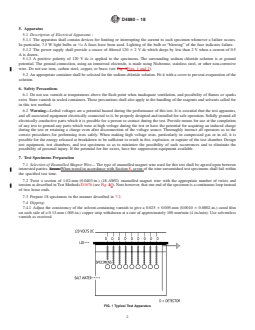
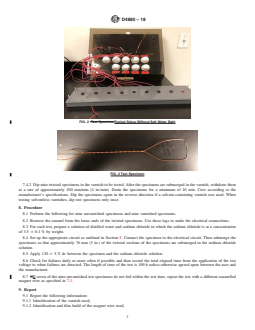
brass (see Figs. 1 and 2).
This test method is under the jurisdiction of ASTM Committee D09 on
Electrical and Electronic Insulating Materials and is the direct responsibility of
5.2 An appropriate container shall be selected for the
Subcommittee D09.01 on Electrical Insulating Products.
sodium chloride solution. Fit it with a cover to prevent
Current edition approved Nov. 1, 2018. Published November 2018. Originally
evaporation of the solution.
approved in 1988. Last previous edition approved in 2014 as D4880 – 14. DOI:
10.1520/D4880-18.
For referenced ASTM standards, visit the ASTM website, www.astm.org, or 6. Safety Precautions
contact ASTM Customer Service at service@astm.org. For Annual Book of ASTM
6.1 Do not use varnish at temperatures above the flash point
Standards volume information, refer to the standard’s Document Summary page on
the ASTM website. when inadequate ventilation, and possibility of flames or
*A Summary of Changes section appears at the end of this standard
Copyright © ASTM International, 100 Barr Harbor Drive, PO Box C700, West Conshohocken, PA 19428-2959. United States
D4880 − 18
withdrawn at a rate of approximately 100 mm/min (4 in./min).
Use solventless varnish as received.
7.4.2 Dip nine twisted specimens in the varnish to be tested.
After the specimens are submerged in the varnish, withdraw
them at a rate of approximately 100 mm/min (4 in./min). Drain
the specimens for a minimum of 10 min. Cure according to the
manufacturer’s specifications. Dip the specimens again in the
reverse direction if a solvent-containing varnish was used.
When testing solventless varnishes, dip test specimens only
once.
8. Procedure
8.1 Perform the following for nine unvarnished specimens
and nine varnished specimens.
8.2 Remove the enamel from the loose ends of the twisted
specimens. Use these legs to make the electrical connections.
FIG. 1 Typical Test Apparatus
8.3 For each test, prepare a solution of distilled water and
sodium chloride in which the sodium chloride is at a concen-
sparks exist. Store
...
This document is not an ASTM standard and is intended only to provide the user of an ASTM standard an indication of what changes have been made to the previous version. Because
it may not be technically possible to adequately depict all changes accurately, ASTM recommends that users consult prior editions as appropriate. In all cases only the current version
of the standard as published by ASTM is to be considered the official document.
Designation: D4880 − 14 D4880 − 18
Standard Test Method for
Salt Water Proofness of Insulating Varnishes Over
Enamelled Magnet Wire
This standard is issued under the fixed designation D4880; the number immediately following the designation indicates the year of
original adoption or, in the case of revision, the year of last revision. A number in parentheses indicates the year of last reapproval. A
superscript epsilon (´) indicates an editorial change since the last revision or reapproval.
1. Scope*
1.1 This test method covers the electrical performance in a specified water solution of an insulating varnish applied over
enamelled magnet wire.
1.2 The values stated in SI units are to be regarded as standard. The values given in parentheses are mathematical conversions
to inch-pound units that are provided for information only and are not considered standard.
1.3 This standard does not purport to address all of the safety concerns, if any, associated with its use. It is the responsibility
of the user of this standard to establish appropriate safety safety, health, and healthenvironmental practices and determine the
applicability of regulatory limitations prior to use. Specific precautionary statements are given in Section 6.
NOTE 1—There is no IEC method equivalent to this standard.
1.4 This international standard was developed in accordance with internationally recognized principles on standardization
established in the Decision on Principles for the Development of International Standards, Guides and Recommendations issued
by the World Trade Organization Technical Barriers to Trade (TBT) Committee.
2. Referenced Documents
2.1 ASTM Standards:
D1676 Test Methods for Film-Insulated Magnet Wire
D1711 Terminology Relating to Electrical Insulation
3. Terminology
3.1 Definitions:
3.1.1 For definitions of terms used in this test method refer to Terminology D1711.
3.1.2 varnish, electrical insulating, n— a liquid resin system that is applied to and cured on electrical components providing
electrical, mechanical, and environmental protection.
3.1.2.1 Discussion—
There are two types of electrical insulating varnish— solvent–containing and solventless. The solvent-containing varnish is
solution, dispersion, or emulsion of a polymer or a mixture of polymers in a volatile, nonreactable liquid. The solventless type is
a liquid resin system free of volatile, nonreactable solvents.
3.1.3 varnished, adj—referring to any item on to which varnish has been applied and cured.
4. Significance and Use
4.1 This test method is useful in determining the performance of varnishes over enamelled magnet wire when subjected to the
specified sodium chloride solution. It is useful in evaluating the resistance of varnished magnet wire to a diluted sodium chloride
solution under applied voltage.
This test method is under the jurisdiction of ASTM Committee D09 on Electrical and Electronic Insulating Materials and is the direct responsibility of Subcommittee
D09.01 on Electrical Insulating Varnishes, Powders and Encapsulating CompoundsProducts.
Current edition approved May 15, 2014Nov. 1, 2018. Published May 2014November 2018. Originally approved in 1988. Last previous edition approved in 20082014 as
D4880 – 08.D4880 – 14. DOI: 10.1520/D4880-14.10.1520/D4880-18.
For referenced ASTM standards, visit the ASTM website, www.astm.org, or contact ASTM Customer Service at service@astm.org. For Annual Book of ASTM Standards
volume information, refer to the standard’s Document Summary page on the ASTM website.
*A Summary of Changes section appears at the end of this standard
Copyright © ASTM International, 100 Barr Harbor Drive, PO Box C700, West Conshohocken, PA 19428-2959. United States
D4880 − 18
5. Apparatus
5.1 Description of Electrical Apparatus :
5.1.1 The apparatus shall contain devices for limiting or interrupting the current to each specimen whenever a failure occurs.
In particular, 7.5 W light bulbs or ⁄10 A fuses have been used. Lighting of the bulb or “blowing” of the fuse indicates failure.
5.1.2 The power supply shall provide a source of filtered 120 6 2 V dc which drops by less than 2 V when a current of 0.5
A is drawn.
5.1.3 A positive polarity of 120 V dc is applied to the specimens. The surrounding sodium chloride solution is at ground
potential. The ground connection, using an immersed electrode, is made using Nichrome, stainless steel, or other non-corrosive
wire. Do not use iron, carbon steel, copper, or brass (see Fig. 1Figs. 1 and 2).
5.2 An appropriate container shall be selected for the sodium chloride solution. Fit it with a cover to prevent evaporation of the
solution.
6. Safety Precautions
6.1 Do not use varnish at temperatures above the flash point when inadequate ventilation, and possibility of flames or sparks
exist. Store varnish in sealed containers. These precautions shall also apply to the handling of the reagents and solvents called for
in this test method.
6.2 Warning—Lethal voltages are a potential hazard during the performance of this test. It is essential that the test apparatus,
and all associated equipment electrically connected to it, be properly designed and installed for safe operation. Solidly ground all
electrically conductive parts which it is possible for a person to contact during the test. Provide means for use at the completion
of any test to ground any parts which were at high voltage during the test or have the potential for acquiring an induced charge
during the test or retaining a charge even after disconnection of the voltage source. Thoroughly instruct all operators as to the
correct procedures for performing tests sa
...