

ASTM D4567-19
(Test Method)Standard Test Method for Single-Point Determination of Specific Surface Area of Catalysts and Catalyst Carriers Using Nitrogen Adsorption by Continuous Flow Method
General Information
- Abstract
SIGNIFICANCE AND USE
5.1 This test method is useful for determining the specific surface area of catalysts and catalyst carriers for material specifications, manufacturing control, and research and development in the evaluation of catalysts.
SCOPE
1.1 This test method covers the single-point determination of the surface area of catalysts and catalyst carriers that exhibit Type II or Type IV nitrogen adsorption isotherms using a nitrogen-helium flowing gas mixture. This test method is applicable for the determination of total surface areas from 0.1 to 300 m2, where rapid surface area determinations are desired.
1.2 Because the single-point method uses an approximation of the BET equation, the multipoint BET method (Test Method D3663) is preferred to the single-point method.
1.3 The values stated in SI units are to be regarded as standard. No other units of measurement are included in this standard.
1.4 This standard does not purport to address all of the safety concerns, if any, associated with its use. It is the responsibility of the user of this standard to consult and establish appropriate safety, health, and environmental practices and determine the applicability of regulatory limitations prior to use.
1.5 This international standard was developed in accordance with internationally recognized principles on standardization established in the Decision on Principles for the Development of International Standards, Guides and Recommendations issued by the World Trade Organization Technical Barriers to Trade (TBT) Committee.
- Status
- Published
- Publication Date
- 30-Jun-2019
- Technical Committee
- D32 - Catalysts
- Drafting Committee
- D32.01 - Physical-Chemical Properties
Buy Documents

ASTM D4567-19 - Standard Test Method for Single-Point Determination of Specific Surface Area of Catalysts and Catalyst Carriers Using Nitrogen Adsorption by Continuous Flow Method
REDLINE ASTM D4567-19 - Standard Test Method for Single-Point Determination of Specific Surface Area of Catalysts and Catalyst Carriers Using Nitrogen Adsorption by Continuous Flow Method
Overview
ASTM D4567-19: Standard Test Method for Single-Point Determination of Specific Surface Area of Catalysts and Catalyst Carriers Using Nitrogen Adsorption by Continuous Flow Method provides a fast, reproducible procedure for determining the surface area of catalysts and catalyst carriers. Using nitrogen adsorption in a continuous flow system, this method is applicable to materials exhibiting Type II or Type IV nitrogen adsorption isotherms and is particularly useful for rapid assessment within the range of 0.1 to 300 m². Common uses include material specifications, process control in manufacturing, and R&D for catalyst evaluation.
Key Topics
- Single-Point Surface Area Analysis
This method uses a nitrogen-helium flowing gas mixture to estimate the surface area using a single-point calculation, which approximates the Brunauer-Emmett-Teller (BET) equation. - Applicability
Designed for catalysts and catalyst carriers, especially where quick measurements are necessary, this standard delivers consistent and comparable results for non-microporous materials. - Test Procedure
The procedure involves degassing the sample, immersing it in liquid nitrogen to facilitate adsorption, and detecting the nitrogen amount desorbed using changes in thermal conductivity. - Accuracy and Limitations
The single-point method provides a rapid alternative to multipoint BET methods but is considered less precise for microporous materials, for which ASTM D3663 is recommended. - Required Apparatus
Equipment includes flow controllers, thermal conductivity detectors, flow-through sample cells, balance with high sensitivity, and nitrogen-helium gas mixtures of known composition.
Applications
ASTM D4567-19 offers significant practical value for:
- Manufacturing Control: Quickly verifying that catalyst materials meet surface area specifications supports quality assurance and process control.
- Research and Development: Enables rapid screening and comparison of catalyst and catalyst carrier samples, assisting in material development and selection.
- Material Specifications: Provides a standardized approach recognized internationally for inclusion in purchasing and acceptance criteria.
- Quality Assurance Laboratories: Laboratories benefit from this widely accepted, reproducible method for benchmarking catalyst performance and consistency.
Typical industries utilizing this standard include:
- Chemical manufacturing
- Petroleum refining
- Environmental technology
- Industrial materials production
Related Standards
To ensure comprehensive surface area analysis and terminology consistency, the following ASTM standards are particularly relevant:
- ASTM D3663: Test Method for Surface Area of Catalysts and Catalyst Carriers (multipoint BET method, recommended for higher precision and microporous materials)
- ASTM D3766: Terminology Relating to Catalysts and Catalysis
- ASTM E177: Practice for Use of the Terms Precision and Bias in ASTM Test Methods
- ASTM E456: Terminology Relating to Quality and Statistics
- ASTM E691: Practice for Conducting an Interlaboratory Study to Determine the Precision of a Test Method
Keywords: nitrogen adsorption, catalyst surface area, catalyst carrier, continuous flow method, ASTM D4567, BET method, surface area analysis, process control, material specification, catalyst evaluation.
By following ASTM D4567-19, laboratories and manufacturers can efficiently determine the specific surface area of catalyst materials with high repeatability, supporting both operational excellence and scientific advancement.
Relations
- Effective Date
- 01-Jul-2019
- Effective Date
- 01-Feb-2024
- Effective Date
- 01-Jan-2024
- Effective Date
- 01-Apr-2022
- Effective Date
- 01-Nov-2018
- Effective Date
- 01-Oct-2017
- Effective Date
- 01-Oct-2017
- Effective Date
- 01-May-2014
- Effective Date
- 15-Nov-2013
- Effective Date
- 15-Nov-2013
- Effective Date
- 15-Nov-2013
- Effective Date
- 15-Nov-2013
- Effective Date
- 15-Aug-2013
- Effective Date
- 01-May-2013
- Effective Date
- 01-May-2013
Buy Documents
ASTM D4567-19 - Standard Test Method for Single-Point Determination of Specific Surface Area of Catalysts and Catalyst Carriers Using Nitrogen Adsorption by Continuous Flow Method
REDLINE ASTM D4567-19 - Standard Test Method for Single-Point Determination of Specific Surface Area of Catalysts and Catalyst Carriers Using Nitrogen Adsorption by Continuous Flow Method
Get Certified
Connect with accredited certification bodies for this standard

ECOCERT
Organic and sustainability certification.

Eurofins Food Testing Global
Global leader in food, environment, and pharmaceutical product testing.

Intertek Bangladesh
Intertek certification and testing services in Bangladesh.
Sponsored listings
Frequently Asked Questions
ASTM D4567-19 is a standard published by ASTM International. Its full title is "Standard Test Method for Single-Point Determination of Specific Surface Area of Catalysts and Catalyst Carriers Using Nitrogen Adsorption by Continuous Flow Method". This standard covers: SIGNIFICANCE AND USE 5.1 This test method is useful for determining the specific surface area of catalysts and catalyst carriers for material specifications, manufacturing control, and research and development in the evaluation of catalysts. SCOPE 1.1 This test method covers the single-point determination of the surface area of catalysts and catalyst carriers that exhibit Type II or Type IV nitrogen adsorption isotherms using a nitrogen-helium flowing gas mixture. This test method is applicable for the determination of total surface areas from 0.1 to 300 m2, where rapid surface area determinations are desired. 1.2 Because the single-point method uses an approximation of the BET equation, the multipoint BET method (Test Method D3663) is preferred to the single-point method. 1.3 The values stated in SI units are to be regarded as standard. No other units of measurement are included in this standard. 1.4 This standard does not purport to address all of the safety concerns, if any, associated with its use. It is the responsibility of the user of this standard to consult and establish appropriate safety, health, and environmental practices and determine the applicability of regulatory limitations prior to use. 1.5 This international standard was developed in accordance with internationally recognized principles on standardization established in the Decision on Principles for the Development of International Standards, Guides and Recommendations issued by the World Trade Organization Technical Barriers to Trade (TBT) Committee.
SIGNIFICANCE AND USE 5.1 This test method is useful for determining the specific surface area of catalysts and catalyst carriers for material specifications, manufacturing control, and research and development in the evaluation of catalysts. SCOPE 1.1 This test method covers the single-point determination of the surface area of catalysts and catalyst carriers that exhibit Type II or Type IV nitrogen adsorption isotherms using a nitrogen-helium flowing gas mixture. This test method is applicable for the determination of total surface areas from 0.1 to 300 m2, where rapid surface area determinations are desired. 1.2 Because the single-point method uses an approximation of the BET equation, the multipoint BET method (Test Method D3663) is preferred to the single-point method. 1.3 The values stated in SI units are to be regarded as standard. No other units of measurement are included in this standard. 1.4 This standard does not purport to address all of the safety concerns, if any, associated with its use. It is the responsibility of the user of this standard to consult and establish appropriate safety, health, and environmental practices and determine the applicability of regulatory limitations prior to use. 1.5 This international standard was developed in accordance with internationally recognized principles on standardization established in the Decision on Principles for the Development of International Standards, Guides and Recommendations issued by the World Trade Organization Technical Barriers to Trade (TBT) Committee.
ASTM D4567-19 is classified under the following ICS (International Classification for Standards) categories: 71.040.30 - Chemical reagents. The ICS classification helps identify the subject area and facilitates finding related standards.
ASTM D4567-19 has the following relationships with other standards: It is inter standard links to ASTM D4567-03(2013), ASTM D3766-24a, ASTM D3766-24, ASTM E456-13a(2022)e1, ASTM D3766-08(2018), ASTM E456-13A(2017)e1, ASTM E456-13A(2017)e3, ASTM E177-14, ASTM E456-13ae2, ASTM E456-13a, ASTM E456-13ae3, ASTM E456-13ae1, ASTM E456-13, ASTM E177-13, ASTM E691-13. Understanding these relationships helps ensure you are using the most current and applicable version of the standard.
ASTM D4567-19 is available in PDF format for immediate download after purchase. The document can be added to your cart and obtained through the secure checkout process. Digital delivery ensures instant access to the complete standard document.
Standards Content (Sample)
This international standard was developed in accordance with internationally recognized principles on standardization established in the Decision on Principles for the
Development of International Standards, Guides and Recommendations issued by the World Trade Organization Technical Barriers to Trade (TBT) Committee.
Designation:D4567 −19
Standard Test Method for
Single-Point Determination of Specific Surface Area of
Catalysts and Catalyst Carriers Using Nitrogen Adsorption
by Continuous Flow Method
This standard is issued under the fixed designation D4567; the number immediately following the designation indicates the year of
original adoption or, in the case of revision, the year of last revision.Anumber in parentheses indicates the year of last reapproval.A
superscript epsilon (´) indicates an editorial change since the last revision or reapproval.
1. Scope D3766Terminology Relating to Catalysts and Catalysis
E177Practice for Use of the Terms Precision and Bias in
1.1 This test method covers the single-point determination
ASTM Test Methods
ofthesurfaceareaofcatalystsandcatalystcarriersthatexhibit
E456Terminology Relating to Quality and Statistics
Type II or Type IV nitrogen adsorption isotherms using a
E691Practice for Conducting an Interlaboratory Study to
nitrogen-helium flowing gas mixture. This test method is
Determine the Precision of a Test Method
applicable for the determination of total surface areas from 0.1
to300m ,whererapidsurfaceareadeterminationsaredesired.
3. Terminology
1.2 Because the single-point method uses an approximation
3.1 Definitions—See Terminology D3766.
oftheBETequation,themultipointBETmethod(TestMethod
D3663) is preferred to the single-point method.
3.2 Symbols:
1.3 The values stated in SI units are to be regarded as
standard. No other units of measurement are included in this
−20 2
A = cross-sectional area of nitrogen, 16.2×10 m .
cs
standard.
C = integrator counts.
I
T
1.4 This standard does not purport to address all of the
C a = integrator counts corrected for ambient temperature.
I
P
safety concerns, if any, associated with its use. It is the C a = integrator counts corrected for ambient pressure.
I
N = Avogadro’s number, 6.02×10 , molecules/mole.
responsibility of the user of this standard to consult and
P = partial pressure of nitrogen, torr.
establish appropriate safety, health, and environmental prac-
P = ambient pressure, torr.
tices and determine the applicability of regulatory limitations a
P = saturated equilibrium vapor pressure of liquid
prior to use. o
nitrogen, torr.
1.5 This international standard was developed in accor-
R = gas constant, 82.1 cm atm/K mole.
dance with internationally recognized principles on standard-
T = ambient temperature, K.
a
ization established in the Decision on Principles for the
V = volume of nitrogen adsorbed at ambient temperature
Development of International Standards, Guides and Recom-
and pressure, cm .
mendations issued by the World Trade Organization Technical
W = tare of sample cell, g.
Barriers to Trade (TBT) Committee.
W = sample mass+tare of sample cell after analysis, g.
W = mass of sample, g.
s
2. Referenced Documents
2.1 ASTM Standards:
4. Summary of Test Method
D3663Test Method for Surface Area of Catalysts and
4.1 The sample is degassed by heating in a flow of inert gas
Catalyst Carriers
to remove adsorbed vapors from the surface. The sample is
then immersed in a liquid nitrogen bath causing adsorption of
nitrogen from a flowing mixture of a fixed concentration of
This test method is under the jurisdiction of Committee D32 on Catalysts and
nitrogeninhelium.Whenadsorptioniscomplete,thesampleis
is the direct responsibility of Subcommittee D32.01 on Physical-Chemical Proper-
ties.
allowed to warm to room temperature causing desorption,
Current edition approved July 1, 2019. Published August 2019. Originally
whichresultsinanincreaseinthenitrogenconcentrationinthe
approved in 1986. Last previous edition approved in 2013 as D4567–03(2013).
flowing mixture. The quantity of nitrogen gas desorbed is
DOI: 10.1520/D4567-19.
determined by sensing the change in thermal conductivity.
For referenced ASTM standards, visit the ASTM website, www.astm.org, or
contact ASTM Customer Service at service@astm.org. For Annual Book of ASTM
4.2 Calculation of the surface area is based on a modified
Standards volume information, refer to the standard’s Document Summary page on
the ASTM website. form of the BET equation.
Copyright © ASTM International, 100 Barr Harbor Drive, PO Box C700, West Conshohocken, PA 19428-2959. United States
D4567−19
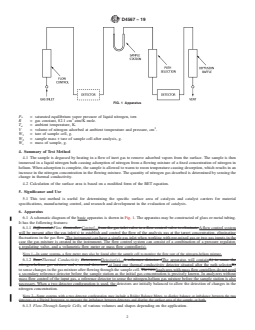
FIG. 1 Apparatus
5. Significance and Use 6.1.4 Equilibration Paths—The apparatus will have at least
two equilibration paths, selected by a selector valve or a
5.1 This test method is useful for determining the specific
combination of valves, between the sample cell and the down
surface area of catalysts and catalyst carriers for material
stream detector. Two or more paths allow for temperature and
specifications, manufacturing control, and research and devel-
pressure equilibration of a wide range of volumes of gases.
opment in the evaluation of catalysts.
6.1.5 Diffusion Baffle,topreventairfromdiffusingbackinto
6. Apparatus the system during cooling of the sample.
6.1.6 Septum or Fixed Loop, (not shown in Fig. 1) for
6.1 Aschematic diagram of the basic apparatus is shown in
injection of calibration gas. (Optional: only required on ana-
Fig. 1. The apparatus may be constructed of glass or metal
lyzers without precise mass flow control of input gas.)
tubing. It has the following features:
6.1.7 Degassing Station, (not shown in Fig. 1) with heating
6.1.1 Flow Control—A flow control system will be present
after the gas inlet(s) to establish and control the flow of the mantle, for removal of adsorbed vapors from the sample. (The
degassing station can either be integrated into the apparatus or
analysis gas at the target concentration, eliminating fluctua-
tionsinthegasflow.Theinstrumentcanhaveasinglegasinlet part of an independent sample preparation device.)
whenworkingwithpre-mixedgasortwogasinputsinthecase
6.1.8 Cold Trap, (not shown in Fig. 1) for removal of
the gas mixture is created in the instrument. The flow control
impurities in the gas mixture. (Optional: Cold trap is not
system can consist of a combination of a pressure regulator, a
required if gas purity meets noted specification.)
regulating valve, and a volumetric flow meter or mass flow
6.1.9 Thermal Equilibration Tube, (not shown in Fig. 1)to
controller(s).
allow the flowing gas mixture to reach temperature and
pressure equilibration before reaching the first detector, in two
NOTE 1—In some systems, a flow meter may also be found after the
sample cell to monitor the flow rate of the nitrogen-helium mixture. detector configuration systems, or the sample station.
6.1.2 Thermal Conductivity Detector(s)—The apparatus
NOTE 3—Instruments without a cold trap do not require a thermal
will contain at least one thermal conductivity detector situated
equilibration tube.
afterthepathselectortosensechangesinthegasmixtureafter
6.2 Dewar Flasks.
flowing through the sample cell. Analyzers with mass flow
−7
contollers do not need a secondary reference detector before
6.3 Laboratory Balance with 0.1 mg (10 kg) sensitivity.
the sample station as the initial gas concentration is precisely
6.4 Gas-Tight Syringe or Gas Sampling Loop, 1.00 cm .
known.Inanalyzerswithoutmassflowcontroloftheinputgas,
(Optional: only required on analyzers without precise mass
a reference detector to sense the nitrogen-helium gas mixture
flow control of input gas.)
before the sample station is also necessary. When a two
detector configuration is used, the detectors are initially bal-
NOTE 4—Commercial instruments are available for determining single
anced to allow the detection of changes in the nitrogen point BET area. These instruments typically conform to the schematic in
Fig. 1, and the manufacturer’s manual should be consulted for proper
concentration.
calibration and reporting of single point BET area.
NOTE 2—Some systems with a two detector configuration may include
a Bridge Balance Meter, to display balance or imbalance between the two
7. Reagents
detectors or a Digital Integrator, to measure the imbalance between
detectors and display the surface area of the sample, or both.
7.1 Liquid Nitrogen, of such purity that the saturated equi-
6.1.3 Flow-Through Sample Cells, of various volumes and librium vapor pressure is not more than 20 torr above ambient
shapes depending on the application. pressure.
D4567−19
7.2 Gas Cylinder(s) with pressure regulator, of high purity 9.10 Remove the empty cell from the sample station (if one
(>99.99%).Either30mole%nitrogeninheliumequivalentto was installed to complete the flow path).
a relative pressure of approximately 0.3, where the nitrogen
concentration is known to w
...
This document is not an ASTM standard and is intended only to provide the user of an ASTM standard an indication of what changes have been made to the previous version. Because
it may not be technically possible to adequately depict all changes accurately, ASTM recommends that users consult prior editions as appropriate. In all cases only the current version
of the standard as published by ASTM is to be considered the official document.
Designation: D4567 − 03 (Reapproved 2013) D4567 − 19
Standard Test Method for
Single-Point Determination of Specific Surface Area of
Catalysts and Catalyst Carriers Using Nitrogen Adsorption
by Continuous Flow Method
This standard is issued under the fixed designation D4567; the number immediately following the designation indicates the year of
original adoption or, in the case of revision, the year of last revision. A number in parentheses indicates the year of last reapproval. A
superscript epsilon (´) indicates an editorial change since the last revision or reapproval.
1. Scope
1.1 This test method covers the single-point determination of the surface area of catalysts and catalyst carriers that exhibit Type
II or Type IV nitrogen adsorption isotherms using a nitrogen-helium flowing gas mixture. This test method is applicable for the
determination of total surface areas from 0.1 to 300 m , where rapid surface area determinations are desired.
1.2 Because the single-point method uses an approximation of the BET equation, the multipoint BET method (Test Method
D3663) is preferred to the single-point method.
NOTE 1—This is particularly true when testing microporous materials.
1.3 The values stated in SI units are to be regarded as standard. No other units of measurement are included in this standard.
1.4 This standard does not purport to address all of the safety concerns, if any, associated with its use. It is the responsibility
of whoever uses the user of this standard to consult and establish appropriate safety safety, health, and healthenvironmental
practices and determine the applicability of regulatory limitations prior to use.
1.5 This international standard was developed in accordance with internationally recognized principles on standardization
established in the Decision on Principles for the Development of International Standards, Guides and Recommendations issued
by the World Trade Organization Technical Barriers to Trade (TBT) Committee.
2. Referenced Documents
2.1 ASTM Standards:
D3663 Test Method for Surface Area of Catalysts and Catalyst Carriers
D3766 Terminology Relating to Catalysts and Catalysis
E177 Practice for Use of the Terms Precision and Bias in ASTM Test Methods
E456 Terminology Relating to Quality and Statistics
E691 Practice for Conducting an Interlaboratory Study to Determine the Precision of a Test Method
3. Terminology
3.1 Definitions—See Terminology D3766.
3.2 Symbols:
−20 2
A = cross-sectional area of nitrogen, 16.2 × 10 m .
cs
C = integrator counts.
I
T
C a = integrator counts corrected for ambient temperature.
I
P
C a = integrator counts corrected for ambient pressure.
I
N = Avogadro’s number, 6.02 × 10 , molecules/mole.
P = partial pressure of nitrogen, torr.
P = ambient pressure, torr.
a
This test method is under the jurisdiction of Committee D32 on Catalysts and is the direct responsibility of Subcommittee D32.01 on Physical-Chemical Properties.
Current edition approved April 1, 2013July 1, 2019. Published August 2013August 2019. Originally approved in 1986. Last previous edition approved in 20082013 as
D4567 – 03(2008).(2013). DOI: 10.1520/D4567-03R13.10.1520/D4567-19.
For referenced ASTM standards, visit the ASTM website, www.astm.org, or contact ASTM Customer Service at service@astm.org. For Annual Book of ASTM Standards
volume information, refer to the standard’s Document Summary page on the ASTM website.
Copyright © ASTM International, 100 Barr Harbor Drive, PO Box C700, West Conshohocken, PA 19428-2959. United States
D4567 − 19
FIG. 1 Apparatus
P = saturated equilibrium vapor pressure of liquid nitrogen, torr.
o
R = gas constant, 82.1 cm atm/K mole.
T = ambient temperature, K.
a
V = volume of nitrogen adsorbed at ambient temperature and pressure, cm .
W = tare of sample cell, g.
W = sample mass + tare of sample cell after analysis, g.
W = mass of sample, g.
s
4. Summary of Test Method
4.1 The sample is degassed by heating in a flow of inert gas to remove adsorbed vapors from the surface. The sample is then
immersed in a liquid nitrogen bath causing adsorption of nitrogen from a flowing mixture of a fixed concentration of nitrogen in
helium. When adsorption is complete, the sample is allowed to warm to room temperature causing desorption, which results in an
increase in the nitrogen concentration in the flowing mixture. The quantity of nitrogen gas desorbed is determined by sensing the
change in thermal conductivity.
4.2 Calculation of the surface area is based on a modified form of the BET equation.
5. Significance and Use
5.1 This test method is useful for determining the specific surface area of catalysts and catalyst carriers for material
specifications, manufacturing control, and research and development in the evaluation of catalysts.
6. Apparatus
6.1 A schematic diagram of the basic apparatus is shown in Fig. 1. The apparatus may be constructed of glass or metal tubing.
It has the following features:
6.1.1 Differential Flow Controller Control—from the gas inlet valve to a flow control valve to eliminate A flow control system
will be present after the gas inlet(s) to establish and control the flow of the analysis gas at the target concentration, eliminating
fluctuations in the gas flow. The instrument can have a single gas inlet when working with pre-mixed gas or two gas inputs in the
case the gas mixture is created in the instrument. The flow control system can consist of a combination of a pressure regulator,
a regulating valve, and a volumetric flow meter or mass flow controller(s).
NOTE 1—In some systems, a flow meter may also be found after the sample cell to monitor the flow rate of the nitrogen-helium mixture.
6.1.2 Two Thermal Conductivity Detectors—Detector(s)—A reference detector (The apparatus will containA) to sense the
nitrogen-helium gas mixture and a second detector ( at least one thermal conductivity detector situated after the path selectorB)
to sense changes in the gas mixture after flowing through the sample cell. The two Analyzers with mass flow contollers do not need
a secondary reference detector before the sample station as the initial gas concentration is precisely known. In analyzers without
mass flow control of the input gas, a reference detector to sense the nitrogen-helium gas mixture before the sample station is also
necessary. When a two detector configuration is used, the detectors are initially balanced to allow the detection of changes in the
nitrogen concentration.
NOTE 2—Some systems with a two detector configuration may include a Bridge Balance Meter, to display balance or imbalance between the two
detectors or a Digital Integrator, to measure the imbalance between detectors and display the surface area of the sample, or both.
6.1.3 Flow-Through Sample Cells, of various volumes and shapes depending on the application.
D4567 − 19
6.1.4 Two Equilibration Tubes Paths—The apparatus will have at least two equilibration paths, selected by a selector valve,
valve or a combination of valves, between the sample cell and detector (B). The small volume tube has a volume of approximately
3 3
20 cm and the large volume tube has a 100 cmthe down stream detector. Two or more paths capacity to allow for temperature
and pressure equilibration of a wide range of volumes of gases.
6.1.5 Flow Meter, to monitor the flow rate of the nitrogen-helium mixture maintained at approximately 20 cm /min.
6.1.5 Diffusion Baffle, to prevent air from diffusing back into the system during cooling of the sample.
6.1.7 Bridge Balance Meter, to display balance or imbalance between detectors A and B.
6.1.8 Digital Integrator, to measure the imbalance between detectors A and B and display the surface area of the sample.
6.1.6 Septum or Fixed Loop, (not shown in Fig. 1) for injection of calibration gas. (Optional: only required on analyzers without
precise mass flow control of input gas.)
6.1.7 Degassing Station, (not shown in Fig. 1) with heating mantle, for removal of adsorbed vapors from the sample. (The
degassing station can either be integrated into the apparatus or part of an independent sample preparation device.)
6.1.8 Cold Trap, (not shown in Fig. 1) for removal of impurities in the gas mixture. (Optional: Cold trap is not required if gas
purity meets noted specification.)
6.1.9 Thermal Equilibration Tube, (not shown in Fig. 1) to allow the flowing gas mixture to reach temperature and pressure
equilibration before reaching detector (the first detector, in two detector configurationA). systems, or the sample station.
NOTE 3—Instruments without a cold trap do not require a thermal equilibration tube.
6.2 Heating Mantle.
6.2 Dewar Flasks.
−7
6.3 Laboratory Balance with 0.1 mg (10 kg) sensitivity.
6.4 Gas-Tight Syringe or Gas Sampling Loop, 1.00 cm . (Optional: only required on analyzers without precise mass flow control
of input gas.)
NOTE 4—Commercial instruments are available for determining single point BET area. These instruments typically conform to the schematic in Fig.
1, and the manufacturer’s manual should be consulted for proper calibration and reporting of single point BET area.
7. Reagents
7.1 Liquid Nitrogen, of such purity that the saturated equilibrium vapor pressure is not more than 20 torr above ambient
pressure.
7.2 Cylinder, Gas Cylinder(s) with pressure regulator, of high purity (>99.99 %). Either 30 mole % nitrogen in helium
equivalent to a relative pressure of approximately 0.3, where the n
...