

ASTM B1002-16(2020)
(Specification)Standard Specification for Refined Indium
General Information
- Abstract
ABSTRACT
This specification covers requirements for refined indium as ingot in six grades, namely: Grade 99.9 or 3N grade (indium with a purity of 99.90%); Grade 99.99 or 4N grade (indium with a purity of 99.99%); Grade 99.995 or 4N5 grade (indium with a purity of 99.995%); Grade 99.999 or 5N grade (indium with a purity of 99.999%); Grade 99.9999 or 6N grade (indium with a purity of 99.9999%); and Grade 99.99995 or 6N5 grade (indium with a purity of 99.99995%). Indium metal from ingot can be fabricated into shot, spheres, wire, sheet, foil, tubing, and other customized fabrications with purities up to and including Grade 99.999. Grades 99.9999 and 99.99995 are available in ingot form only.
This specification specifies the requirements for the manufacturing process; sampling; product marking; and maximum total metallic impurities for indium grades.
SCOPE
1.1 This specification covers refined indium as ingot in six grades as follows:
1.1.1 Grade 99.9—Indium having a purity of 99.90 %, also known as 3N grade,
1.1.2 Grade 99.99—Indium having a purity of 99.99 %, also known as 4N grade,
1.1.3 Grade 99.995—Indium having a purity of 99.995 %, also known as 4N5 grade,
1.1.4 Grade 99.999—Indium having a purity of 99.999 %, also known as 5N grade,
1.1.5 Grade 99.9999—Indium having a purity of 99.9999 %, also known as 6N grade, and
1.1.6 Grade 99.99995—Indium having a purity of 99.99995 %, also known as 6N5 grade.
1.2 Indium metal from ingot can be fabricated into shot, spheres, wire, sheet, foil, tubing, and other customized fabrications with purities up to and including Grade 99.999. Grades 99.9999 and 99.99995 are available in ingot form only.
1.3 The values stated in inch-pound units are to be regarded as standard. The values given in parentheses are mathematical conversions to SI units that are provided for information only and are not considered standard.
1.4 This standard does not purport to address all of the safety concerns, if any, associated with its use. It is the responsibility of the user of this standard to become familiar with all hazards including those identified in the appropriate Safety Data Sheet (SDS) for this product/material as provided by the manufacturer, to establish appropriate safety, health, and environmental practices, and determine the applicability of regulatory limitations prior to use.
1.5 This international standard was developed in accordance with internationally recognized principles on standardization established in the Decision on Principles for the Development of International Standards, Guides and Recommendations issued by the World Trade Organization Technical Barriers to Trade (TBT) Committee.
- Status
- Published
- Publication Date
- 30-Sep-2020
- Technical Committee
- B02 - Nonferrous Metals and Alloys


Overview
ASTM B1002-16(2020): Standard Specification for Refined Indium establishes the requirements for refined indium produced in ingot form across six recognized purity grades. Published by ASTM International, this standard provides guidelines on the chemical composition, allowable impurities, manufacturing processes, sampling procedures, product marking, and available fabrication methods for indium metal. Ensuring quality and consistency in the supply of high-purity indium, ASTM B1002-16(2020) is essential for industries requiring tracemetal control and verified purity in their indium materials.
Key Topics
Purity Grades: The standard defines six indium grades:
- Grade 99.9 (3N): 99.90% purity
- Grade 99.99 (4N): 99.99% purity
- Grade 99.995 (4N5): 99.995% purity
- Grade 99.999 (5N): 99.999% purity
- Grade 99.9999 (6N): 99.9999% purity
- Grade 99.99995 (6N5): 99.99995% purity
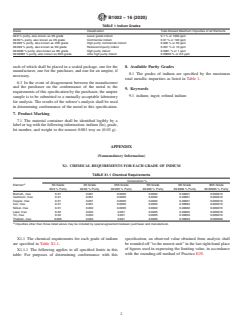
Impurities Control: Each grade specifies maximum allowed impurities, with overall totals ranging from 1000 ppm (3N) down to 0.5 ppm (6N5), highlighting stringent trace level control for high purity applications.
Manufacturing: Indium may be refined by any method that meets the specification's chemical requirements. Producers must disclose the refining process upon request.
Fabrication: Indium ingot can be fabricated into shot, spheres, wire, sheet, foil, tubing, and other custom forms for grades up to 99.999%. Higher grades (6N and 6N5) are available in ingot form only.
Sampling and Testing: Clear guidance is given for sampling procedures and agreement between purchaser and manufacturer to ensure accurate representation of indium quality.
Product Identification: Each product must be clearly labeled with grade, lot number, and weight to enforce traceability.
Safety and Compliance: Users must consult Safety Data Sheets (SDS) and adhere to relevant safety, health, and environmental practices.
Applications
Refined indium specified under ASTM B1002-16(2020) is used in applications where consistency, trace purity, and metallic control are critical:
- Electronics Industry: As an essential material in semiconductors, flat panel displays, and solder alloys where high purity is crucial for performance.
- Pharmaceutical and Medical Devices: Indium’s low toxicity at high purity grades enables its use in specialized devices and diagnostic systems.
- Research and Development: In laboratories and advanced materials science, specific grades of indium enable experimentation without contamination concerns.
- Optoelectronics and Photonics: Indium is used for laser diodes, light-emitting diodes (LEDs), and solar cells, relying on certified purity levels.
- Nuclear and Aerospace: High-purity indium properties are needed for neutron capture and protective coatings.
Related Standards
For comprehensive indium quality control and compatibility with broader supply chain standards, consult related documents such as:
- ASTM E29: Practice for Using Significant Digits in Test Data to Determine Conformance with Specifications
- ASTM B32: Standard Specification for Solder Metal
- Other ASTM B-Series Standards: Covering nonferrous metals and alloys pertinent to electronic and industrial use
- ISO/IEC Standards: For international requirements on material purity and test methods
By adhering to ASTM B1002-16(2020), manufacturers and end-users can ensure the reliable sourcing, processing, and application of refined indium metal in critical high-technology sectors. This standard is vital for procurement, quality assurance, and compliance across industries where performance depends on certified material purity.
Relations
- Effective Date
- 01-Oct-2008
- Effective Date
- 15-Nov-2006
- Effective Date
- 15-Sep-2006
- Effective Date
- 01-May-2006
- Effective Date
- 01-Dec-2004
- Effective Date
- 10-May-2002
- Effective Date
- 10-May-1999
Get Certified
Connect with accredited certification bodies for this standard

Element Materials Technology
Materials testing and product certification.

Inštitut za kovinske materiale in tehnologije
Institute of Metals and Technology. Materials testing, metallurgical analysis, NDT.
Sponsored listings
Frequently Asked Questions
ASTM B1002-16(2020) is a technical specification published by ASTM International. Its full title is "Standard Specification for Refined Indium". This standard covers: ABSTRACT This specification covers requirements for refined indium as ingot in six grades, namely: Grade 99.9 or 3N grade (indium with a purity of 99.90%); Grade 99.99 or 4N grade (indium with a purity of 99.99%); Grade 99.995 or 4N5 grade (indium with a purity of 99.995%); Grade 99.999 or 5N grade (indium with a purity of 99.999%); Grade 99.9999 or 6N grade (indium with a purity of 99.9999%); and Grade 99.99995 or 6N5 grade (indium with a purity of 99.99995%). Indium metal from ingot can be fabricated into shot, spheres, wire, sheet, foil, tubing, and other customized fabrications with purities up to and including Grade 99.999. Grades 99.9999 and 99.99995 are available in ingot form only. This specification specifies the requirements for the manufacturing process; sampling; product marking; and maximum total metallic impurities for indium grades. SCOPE 1.1 This specification covers refined indium as ingot in six grades as follows: 1.1.1 Grade 99.9—Indium having a purity of 99.90 %, also known as 3N grade, 1.1.2 Grade 99.99—Indium having a purity of 99.99 %, also known as 4N grade, 1.1.3 Grade 99.995—Indium having a purity of 99.995 %, also known as 4N5 grade, 1.1.4 Grade 99.999—Indium having a purity of 99.999 %, also known as 5N grade, 1.1.5 Grade 99.9999—Indium having a purity of 99.9999 %, also known as 6N grade, and 1.1.6 Grade 99.99995—Indium having a purity of 99.99995 %, also known as 6N5 grade. 1.2 Indium metal from ingot can be fabricated into shot, spheres, wire, sheet, foil, tubing, and other customized fabrications with purities up to and including Grade 99.999. Grades 99.9999 and 99.99995 are available in ingot form only. 1.3 The values stated in inch-pound units are to be regarded as standard. The values given in parentheses are mathematical conversions to SI units that are provided for information only and are not considered standard. 1.4 This standard does not purport to address all of the safety concerns, if any, associated with its use. It is the responsibility of the user of this standard to become familiar with all hazards including those identified in the appropriate Safety Data Sheet (SDS) for this product/material as provided by the manufacturer, to establish appropriate safety, health, and environmental practices, and determine the applicability of regulatory limitations prior to use. 1.5 This international standard was developed in accordance with internationally recognized principles on standardization established in the Decision on Principles for the Development of International Standards, Guides and Recommendations issued by the World Trade Organization Technical Barriers to Trade (TBT) Committee.
ABSTRACT This specification covers requirements for refined indium as ingot in six grades, namely: Grade 99.9 or 3N grade (indium with a purity of 99.90%); Grade 99.99 or 4N grade (indium with a purity of 99.99%); Grade 99.995 or 4N5 grade (indium with a purity of 99.995%); Grade 99.999 or 5N grade (indium with a purity of 99.999%); Grade 99.9999 or 6N grade (indium with a purity of 99.9999%); and Grade 99.99995 or 6N5 grade (indium with a purity of 99.99995%). Indium metal from ingot can be fabricated into shot, spheres, wire, sheet, foil, tubing, and other customized fabrications with purities up to and including Grade 99.999. Grades 99.9999 and 99.99995 are available in ingot form only. This specification specifies the requirements for the manufacturing process; sampling; product marking; and maximum total metallic impurities for indium grades. SCOPE 1.1 This specification covers refined indium as ingot in six grades as follows: 1.1.1 Grade 99.9—Indium having a purity of 99.90 %, also known as 3N grade, 1.1.2 Grade 99.99—Indium having a purity of 99.99 %, also known as 4N grade, 1.1.3 Grade 99.995—Indium having a purity of 99.995 %, also known as 4N5 grade, 1.1.4 Grade 99.999—Indium having a purity of 99.999 %, also known as 5N grade, 1.1.5 Grade 99.9999—Indium having a purity of 99.9999 %, also known as 6N grade, and 1.1.6 Grade 99.99995—Indium having a purity of 99.99995 %, also known as 6N5 grade. 1.2 Indium metal from ingot can be fabricated into shot, spheres, wire, sheet, foil, tubing, and other customized fabrications with purities up to and including Grade 99.999. Grades 99.9999 and 99.99995 are available in ingot form only. 1.3 The values stated in inch-pound units are to be regarded as standard. The values given in parentheses are mathematical conversions to SI units that are provided for information only and are not considered standard. 1.4 This standard does not purport to address all of the safety concerns, if any, associated with its use. It is the responsibility of the user of this standard to become familiar with all hazards including those identified in the appropriate Safety Data Sheet (SDS) for this product/material as provided by the manufacturer, to establish appropriate safety, health, and environmental practices, and determine the applicability of regulatory limitations prior to use. 1.5 This international standard was developed in accordance with internationally recognized principles on standardization established in the Decision on Principles for the Development of International Standards, Guides and Recommendations issued by the World Trade Organization Technical Barriers to Trade (TBT) Committee.
ASTM B1002-16(2020) is classified under the following ICS (International Classification for Standards) categories: 77.120.99 - Other non-ferrous metals and their alloys. The ICS classification helps identify the subject area and facilitates finding related standards.
ASTM B1002-16(2020) has the following relationships with other standards: It is inter standard links to ASTM E29-08, ASTM E29-06b, ASTM E29-06a, ASTM E29-06, ASTM E29-04, ASTM E29-02e1, ASTM E29-93a(1999). Understanding these relationships helps ensure you are using the most current and applicable version of the standard.
ASTM B1002-16(2020) is available in PDF format for immediate download after purchase. The document can be added to your cart and obtained through the secure checkout process. Digital delivery ensures instant access to the complete standard document.
Standards Content (Sample)
This international standard was developed in accordance with internationally recognized principles on standardization established in the Decision on Principles for the
Development of International Standards, Guides and Recommendations issued by the World Trade Organization Technical Barriers to Trade (TBT) Committee.
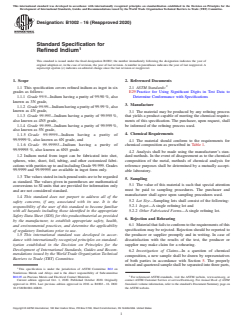
Designation: B1002 −16 (Reapproved 2020)
Standard Specification for
Refined Indium
This standard is issued under the fixed designation B1002; the number immediately following the designation indicates the year of
original adoption or, in the case of revision, the year of last revision. A number in parentheses indicates the year of last reapproval. A
superscript epsilon (´) indicates an editorial change since the last revision or reapproval.
1. Scope 2. Referenced Documents
1.1 This specification covers refined indium as ingot in six 2.1 ASTM Standards:
grades as follows: E29 Practice for Using Significant Digits in Test Data to
1.1.1 Grade 99.9—Indium having a purity of 99.90 %, also Determine Conformance with Specifications
known as 3N grade,
3. Manufacture
1.1.2 Grade 99.99—Indiumhavingapurityof99.99 %,also
known as 4N grade, 3.1 The material may be produced by any refining process
1.1.3 Grade 99.995—Indium having a purity of 99.995 %,
that yields a product capable of meeting the chemical require-
also known as 4N5 grade, ments of this specification. The purchaser, upon request, shall
1.1.4 Grade 99.999—Indium having a purity of 99.999 %,
be informed of the refining process used.
also known as 5N grade,
4. Chemical Requirements
1.1.5 Grade 99.9999—Indium having a purity of
99.9999 %, also known as 6N grade, and
4.1 The material should conform to the requirements for
1.1.6 Grade 99.99995—Indium having a purity of
chemical composition as prescribed in Table 1.
99.99995 %, also known as 6N5 grade.
4.2 Analysis shall be made using the manufacturer’s stan-
1.2 Indium metal from ingot can be fabricated into shot,
dard methods. In the event of disagreement as to the chemical
spheres, wire, sheet, foil, tubing, and other customized fabri-
composition of the metal, methods of chemical analysis for
cations with purities up to and including Grade 99.999. Grades
reference purposes shall be determined by a mutually accept-
99.9999 and 99.99995 are available in ingot form only.
able laboratory.
1.3 The values stated in inch-pound units are to be regarded
5. Sampling
as standard. The values given in parentheses are mathematical
5.1 The value of this material is such that special attention
conversions to SI units that are provided for information only
must be paid to sampling procedures. The purchaser and
and are not considered standard.
manufacturer shall agree upon sampling procedures used.
1.4 This standard does not purport to address all of the
5.2 Lot Size—Sampling lots shall consist of the following:
safety concerns, if any, associated with its use. It is the
5.2.1 Ingot—A single refining lot and
responsibility of the user of this standard to become familiar
5.2.2 Other Fabricated Forms—A single refining lot.
with all hazards including those identified in the appropriate
Safety Data Sheet (SDS) for this product/material as provided
6. Rejection and Rehearing
by the manufacturer, to establish appropriate safety, health,
6.1 Material that fails to conform to the requirements of this
and environmental practices, and determine the applicability
of regulatory limitations prior to use. specification may be rejected. Rejection should be reported to
the producer or supplier promptly and in writing. In case of
1.5 This international standard was developed in accor-
dance with internationally recognized principles on standard- dissatisfaction with the results of the test, the producer or
supplier may make claim for a rehearing.
ization established in the Decision on Principles for the
Development of International Standards, Guides and Recom-
6.2 Investigation of Claims—In a question of chemical
mendations issued by the World Trade Organization Technical
composition, a new sample shall be drawn by representatives
Barriers to Trade (TBT) Committee.
of both parties in accordance with Section 5. The properly
mixed and quartered sample shall be separated into three parts,
This specification is under the jurisdiction of ASTM Committee B02 on
Nonferrous Metals and Alloys and is the direct responsibility of Subcommittee
B02.05 on Precious Metals and Electrical Contact Materials. For referenced ASTM standards, visit the ASTM website, www.astm.org, or
Current edition approved Oct. 1, 2020. Published October 2020. Originally contact ASTM Customer Service at service@astm.org. For Annual Book of ASTM
approved in 2016. Last previous edition approved
...