

EN 13726:2023
(Main)Test methods for wound dressings - Aspects of absorption, moisture vapour transmission, waterproofness and extensibility
- Abstract
This document specifies test methods for the evaluation of aspects of absorption of wound dressings, test methods for the evaluation of moisture vapour transmission rate of permeable film wound and fixation dressings, and test methods to assess waterproofness and extensibility.
- Status
- Published
- Publication Date
- 19-Sep-2023
- Technical Committee
- CEN/TC 205 - Non-active medical devices
- Drafting Committee
- CEN/TC 205/WG 15 - Antimicrobial wound care dressings
- Current Stage
- 6060 - Definitive text made available (DAV) - Publishing
- Start Date
- 20-Sep-2023
- Due Date
- 22-May-2022
- Completion Date
- 20-Sep-2023

Overview
EN 13726:2023 (identical to EN 13726:2023) specifies standardized test methods for wound dressings focusing on key functional aspects: absorption, moisture vapour transmission, waterproofness, and extensibility. The document merges previous EN 13726 parts into a single European standard and provides both normative and informative annexes describing procedures, equipment and reporting for standardized performance testing of wound care products.
Key technical topics and requirements
This standard defines test procedures and reporting for multiple, practical performance metrics used in wound dressing evaluation:
- Absorption tests
- Free swell absorptive capacity
- Fluid retention capacity
- Absorption under compression
- Fluid handling capacity (absorption plus moisture vapour loss)
- Fluid donation and gel-forming behaviour
- Fluid donation for amorphous hydrogel dressings
- Dispersion characteristics of gelling dressings
- Moisture Vapour Transmission Rate (MVTR)
- MVTR when in contact with vapour
- MVTR when in contact with liquid
- Waterproofness testing
- Procedures to assess barrier performance against external liquid
- Extensibility and permanent set
- Methods to measure stretchability and residual deformation after strain
Annexes cover equipment (e.g., test cylinder), test solutions, calculation methods, test reports, sizing and pressure calculations, and rationale for revisions. The standard specifies what to measure, the significance of each test, and how to calculate and report results.
Practical applications and who uses the standard
EN 13726:2023 is used across the wound care ecosystem for:
- Manufacturers and R&D teams - product design, benchmarking, performance optimization (absorbent dressings, films, hydrogels, gelling dressings)
- Independent test laboratories - routine conformity testing, comparison of MVTR, absorption and waterproofness
- Regulatory and quality assurance professionals - supporting technical files, CE marking evidence and product specifications
- Procurement and clinical teams - evaluating supplier claims, selecting dressings for specific wound types based on objective performance data
Typical use cases include development of absorbent dressings, verification of moisture management (MVTR), waterproof dressing claims, stretch and fit evaluation, and quality control during production.
Related standards and context
- Supersedes EN 13726-1 to -4 (earlier separate parts); now consolidated into a single standard.
- Prepared by CEN/TC 205 for non‑active medical devices; intended for adoption as national standards (SIST national version).
Keywords: EN 13726, EN 13726:2023, wound dressings, absorption test methods, MVTR, moisture vapour transmission rate, waterproofness testing, extensibility, fluid handling capacity, hydrogel dressings, medical device testing.
Relations
- Effective Date
- 19-Jan-2023
- Effective Date
- 19-Jan-2023
- Effective Date
- 18-Jan-2023
- Replaces
EN 13726-1:2002/AC:2003 - Test methods for primary wound dressings - Part 1: Aspects of absorbency - Effective Date
- 25-Sep-2019
- Effective Date
- 25-Sep-2019
Get Certified
Connect with accredited certification bodies for this standard

BSI Group
BSI (British Standards Institution) is the business standards company that helps organizations make excellence a habit.

TÜV Rheinland
TÜV Rheinland is a leading international provider of technical services.

TÜV SÜD
TÜV SÜD is a trusted partner of choice for safety, security and sustainability solutions.
Sponsored listings
Frequently Asked Questions
EN 13726:2023 is a standard published by the European Committee for Standardization (CEN). Its full title is "Test methods for wound dressings - Aspects of absorption, moisture vapour transmission, waterproofness and extensibility". This standard covers: This document specifies test methods for the evaluation of aspects of absorption of wound dressings, test methods for the evaluation of moisture vapour transmission rate of permeable film wound and fixation dressings, and test methods to assess waterproofness and extensibility.
This document specifies test methods for the evaluation of aspects of absorption of wound dressings, test methods for the evaluation of moisture vapour transmission rate of permeable film wound and fixation dressings, and test methods to assess waterproofness and extensibility.
EN 13726:2023 is classified under the following ICS (International Classification for Standards) categories: 11.120.20 - Wound dressings and compresses. The ICS classification helps identify the subject area and facilitates finding related standards.
EN 13726:2023 has the following relationships with other standards: It is inter standard links to EN 13726-3:2003, EN 13726-4:2003, EN 13726-1:2002, EN 13726-1:2002/AC:2003, EN 13726-2:2002. Understanding these relationships helps ensure you are using the most current and applicable version of the standard.
EN 13726:2023 is available in PDF format for immediate download after purchase. The document can be added to your cart and obtained through the secure checkout process. Digital delivery ensures instant access to the complete standard document.
Standards Content (Sample)
SLOVENSKI STANDARD
01-marec-2024
Nadomešča:
SIST EN 13726-1:2002
SIST EN 13726-1:2002/AC:2004
SIST EN 13726-2:2002
SIST EN 13726-3:2003
SIST EN 13726-4:2003
Preskusne metode za sanitetni material za oskrbo rane - Vidiki absorpcije,
prepustnosti vodne pare, vodoodpornosti ter raztegljivosti
Test methods for wound dressings - Aspects of absorption, moisture vapour
transmission, waterproofness and extensibility
Prüfverfahren für Verbandstoffe (Wundauflagen) - Aspekte des Saugverhaltens, der
Feuchtigkeitsdurchdringung, Wasserdichtheit und Anpassungsfähigkeit
Méthodes d’essai pour pansements en contact avec la plaie - Absorption, perméabilité à
la vapeur d’eau, imperméabilité à l’eau et extensibilité
Ta slovenski standard je istoveten z: EN 13726:2023
ICS:
11.120.20 Sanitetni materiali, obveze in Wound dressings and
komprese compresses
2003-01.Slovenski inštitut za standardizacijo. Razmnoževanje celote ali delov tega standarda ni dovoljeno.
EN 13726
EUROPEAN STANDARD
NORME EUROPÉENNE
September 2023
EUROPÄISCHE NORM
ICS 11.120.20 Supersedes EN 13726-1:2002, EN 13726-2:2002, EN
13726-3:2003, EN 13726-4:2003
English Version
Test methods for wound dressings - Aspects of absorption,
moisture vapour transmission, waterproofness and
extensibility
Méthodes d'essai pour pansements en contact avec la Prüfverfahren für Verbandstoffe (Wundauflagen) -
plaie - Absorption, perméabilité à la vapeur d'eau, Aspekte des Saugverhaltens, der
imperméabilité à l'eau et extensibilité Feuchtigkeitsdurchdringung, Wasserdichtheit und
Anpassungsfähigkeit
This European Standard was approved by CEN on 17 April 2023.
CEN members are bound to comply with the CEN/CENELEC Internal Regulations which stipulate the conditions for giving this
European Standard the status of a national standard without any alteration. Up-to-date lists and bibliographical references
concerning such national standards may be obtained on application to the CEN-CENELEC Management Centre or to any CEN
member.
This European Standard exists in three official versions (English, French, German). A version in any other language made by
translation under the responsibility of a CEN member into its own language and notified to the CEN-CENELEC Management
Centre has the same status as the official versions.
CEN members are the national standards bodies of Austria, Belgium, Bulgaria, Croatia, Cyprus, Czech Republic, Denmark, Estonia,
Finland, France, Germany, Greece, Hungary, Iceland, Ireland, Italy, Latvia, Lithuania, Luxembourg, Malta, Netherlands, Norway,
Poland, Portugal, Republic of North Macedonia, Romania, Serbia, Slovakia, Slovenia, Spain, Sweden, Switzerland, Türkiye and
United Kingdom.
EUROPEAN COMMITTEE FOR STANDARDIZATION
COMITÉ EUROPÉEN DE NORMALISATION
EUROPÄISCHES KOMITEE FÜR NORMUNG
CEN-CENELEC Management Centre: Rue de la Science 23, B-1040 Brussels
© 2023 CEN All rights of exploitation in any form and by any means reserved Ref. No. EN 13726:2023 E
worldwide for CEN national Members.
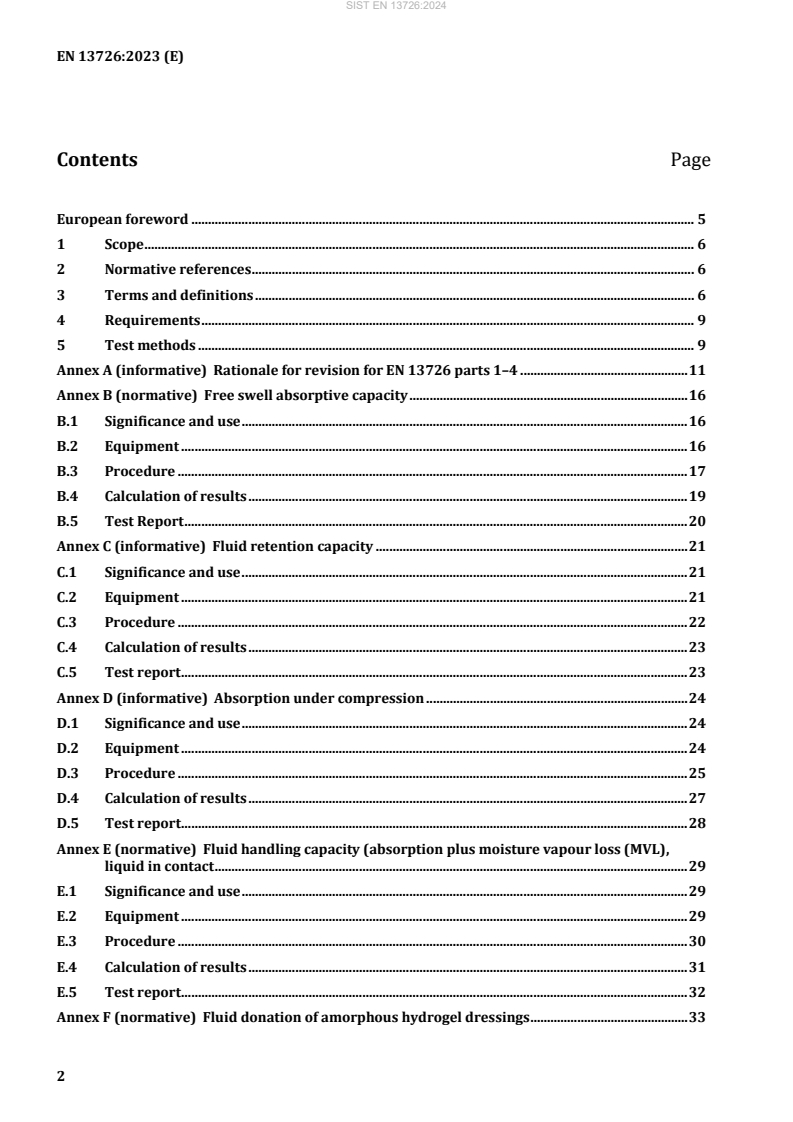
Contents Page
European foreword . 5
1 Scope . 6
2 Normative references . 6
3 Terms and definitions . 6
4 Requirements . 9
5 Test methods . 9
Annex A (informative) Rationale for revision for EN 13726 parts 1–4 . 11
Annex B (normative) Free swell absorptive capacity . 16
B.1 Significance and use . 16
B.2 Equipment . 16
B.3 Procedure . 17
B.4 Calculation of results . 19
B.5 Test Report . 20
Annex C (informative) Fluid retention capacity . 21
C.1 Significance and use . 21
C.2 Equipment . 21
C.3 Procedure . 22
C.4 Calculation of results . 23
C.5 Test report . 23
Annex D (informative) Absorption under compression . 24
D.1 Significance and use . 24
D.2 Equipment . 24
D.3 Procedure . 25
D.4 Calculation of results . 27
D.5 Test report . 28
Annex E (normative) Fluid handling capacity (absorption plus moisture vapour loss (MVL),
liquid in contact . 29
E.1 Significance and use . 29
E.2 Equipment . 29
E.3 Procedure . 30
E.4 Calculation of results . 31
E.5 Test report . 32
Annex F (normative) Fluid donation of amorphous hydrogel dressings . 33
F.1 Significance and use . 33
F.2 Equipment . 33
F.3 Procedure . 34
F.4 Calculation of results . 35
F.5 Test report . 35
Annex G (normative) Dispersion characteristics of gelling dressings . 37
G.1 Significance and use . 37
G.2 Equipment . 37
G.3 Procedure . 38
G.4 Calculation of results . 38
G.5 Test report . 38
Annex H (normative) Moisture Vapour Transmission Rate (MVTR) of a wound dressing
when in contact with vapour . 39
H.1 Significance and use . 39
H.2 Equipment . 39
H.3 Procedure . 40
H.4 Calculation of results . 41
H.5 Test report . 41
Annex I (normative) Moisture Vapour Transmission Rate (MVTR) of a wound dressing
when in contact with liquid. 42
I.1 Significance and use . 42
I.2 Equipment . 42
I.3 Procedure . 43
I.4 Calculation of results . 44
I.5 Test report . 44
Annex J (normative) Waterproofness . 46
J.1 Significance and use . 46
J.2 Equipment . 46
J.3 Procedure . 47
J.4 Calculation of results . 47
J.5 Test report . 47
Annex K (normative) Extensibility and Permanent Set . 49
K.1 Significance and use . 49
K.2 Equipment . 49
K.3 Procedure . 49
K.4 Calculation of results . 50
K.5 Test report . 51
Annex L (normative) Test Solution A — Significance and use . 53
Annex M (normative) Test cylinder for Fluid Handling Capacity and MVTR testing —
Equipment . 54
Annex N (informative) Gasket modification for test cylinder (Fluid Handling Capacity) . 56
N.1 Significance and use . 56
N.2 Equipment . 56
N.3 Procedure . 56
N.4 Test report . 57
Annex O (informative) Air Expulsion for Fluid Handling Capacity Testing . 58
O.1 Significance and use . 58
O.2 Equipment . 58
O.3 Procedure . 58
O.4 Test report . 59
Annex P (informative) Dressing Sizes for Pressure Calculations . 62
P.1 Significance and use . 62
P.2 Main elements of a dressing . 62
P.2.1 General. 62
P.2.2 Single area dressing . 62
P.2.3 Dual area dressings . 63
P.2.4 Multi area dressings . 64
P.3 Sizing method . 65
P.3.1 General. 65
P.3.2 Single area dressings (excluding film dressings) . 65
P.3.3 Dual area dressings . 66
P.3.4 Multi-area dressings . 66
Annex Q (informative) Future work . 68
Bibliography . 70
European foreword
This document (EN 13726:2023) has been prepared by Technical Committee CEN/TC 205 “Non-active
medical devices”, the secretariat of which is held by DIN.
This European Standard shall be given the status of a national standard, either by publication of an
identical text or by endorsement, at the latest by November 2023, and conflicting national standards
shall be withdrawn at the latest by November 2023.
Attention is drawn to the possibility that some of the elements of this document may be the subject of
patent rights. CEN shall not be held responsible for identifying any or all such patent rights.
This document supersedes EN 13726-1:2002, EN 13726-2:2002, EN 13726-3:2003 and
EN 13726-4:2003.
This document is a merger of the previously published individual parts of the EN 13726 standard series.
Annex A has been included which outlines the rationale for the major revisions of EN 13726 parts 1–4.
Any feedback and questions on this document should be directed to the users’ national standards body.
A complete listing of these bodies can be found on the CEN website.
According to the CEN-CENELEC Internal Regulations, the national standards organisations of the
following countries are bound to implement this European Standard: Austria, Belgium, Bulgaria,
Croatia, Cyprus, Czech Republic, Denmark, Estonia, Finland, France, Germany, Greece, Hungary, Iceland,
Ireland, Italy, Latvia, Lithuania, Luxembourg, Malta, Netherlands, Norway, Poland, Portugal, Republic of
North Macedonia, Romania, Serbia, Slovakia, Slovenia, Spain, Sweden, Switzerland, Türkiye and the
United Kingdom.
1 Scope
This document specifies test methods for the evaluation of aspects of absorption of wound dressings,
test methods for the evaluation of moisture vapour transmission rate of permeable film wound and
fixation dressings, and test methods to assess waterproofness and extensibility.
2 Normative references
There are no normative references in this document.
3 Terms and definitions
For the purposes of this document, the following terms and definitions apply.
ISO and IEC maintain terminology databases for use in standardization at the following addresses:
— ISO Online browsing platform: available at https://www.iso.org/obp
— IEC Electropedia: available at https://www.electropedia.org/
3.1
single absorbent layer dressing
wound dressing incorporating a single type of absorbing material
EXAMPLE This could include a dressing containing a single absorbing material, or one absorbing material
with a backing film and adhesive layer.
3.2
multi-absorbent layered dressing
wound dressing incorporating more than one type of absorbing material
EXAMPLE a dressing containing both a gelling fibre and foam layers
3.3
gelling fibre dressing
single absorbent layer wound dressings that ‘gel’ freely when in contact with physiological fluid
EXAMPLE alginates, hydrofibres and other gelling fibre dressings
3.4
foam dressing
single absorbent layer wound dressing incorporating an absorbent open cellular solid
EXAMPLE polyurethane based foams
3.5
film dressing
single component wound dressing consisting of a non-absorbing material which can also include an
adhesive layer
EXAMPLE semi-permeable film materials
3.6
super-absorbent dressing
single absorbent layer wound dressing incorporating super absorbent polymer particles to achieve
significant absorbent capacity of several times their weight in liquid
EXAMPLE a polyacrylate, that can absorb several times their weight in liquid
3.7
amorphous hydrogel dressing
semi-solid gel that contains hydrophilic polymers and water
3.8
hydrocolloid dressing
single absorbent layer gel-forming wound dressing
EXAMPLE a hydrocolloid would typically contain carboxymethyl-cellulose (CMC) as the principal gel forming
absorbent combined with elastomers and applied to a carrier – commonly consisting of a sheet of polyurethane
foam or film.
3.9
fixation dressing
wound dressing that is used to retain a product such as a medical device in place
EXAMPLE an intravenous catheter dressing
3.10
bordered dressing
consists of at least one absorbent layer that constitutes the wound pad, and one backing film layer
larger than the wound pad forming a border usually covered by an adhesive
3.11
free swell absorptive capacity
total absorptive capacity in the presence of excess test liquid and in the absence of any applied load
Note 1 to entry: expressed in g of the complete wound dressing and g/cm of the absorbent area for intact
wound dressings
Note 2 to entry: expressed in g/cm of the absorbent area for sectioned sheet wound dressings
Note 3 to entry: expressed in g/g of sample for rope/ribbon cavity wound dressings
3.12
fluid retention capacity
absorbed fluid retained in the wound dressing following application of load
Note 1 to entry: expressed in g of the intact wound dressing, g/cm of the absorbent area and percentage of the
fluid retained
3.13
fluid absorbed
fluid absorbed by the wound dressing
Note 1 to entry: expressed as ABS in g/cm of the absorbent area
3.14
moisture vapour loss
fluid transpired through the wound dressing
Note 1 to entry: expressed as MVL in g/cm of the absorbent area
3.15
fluid handling capacity
sum of the fluid absorbed (ABS) and the moisture vapour loss (MVL)
Note 1 to entry: expressed as FHC in g/cm of the absorbent area
3.16
moisture vapour transmission rate
rate of permeability of materials to the passage of moisture vapour molecules from the skin contact side
to the external atmosphere under controlled conditions of humidity and temperature
Note 1 to entry: expressed as MVTR in g/cm /24 h of the absorbent area
3.17
fluid donation of a wound dressing
ability to donate fluid to a simulated wound
3.18
waterproofness
ability to withstand a hydrostatic head of 500 mm
3.19
conformability of a wound dressing
ability to adapt to the shape and movement of the body
3.20
extensibility
force needed to stretch a dressing in one dimension to a known extension
Note 1 to entry: expressed in N/cm
3.21
permanent set
increase in length of a sample after stretching and relaxing in one direction
Note 1 to entry: expressed as a percentage (%) of the original length
3.22
fully saturated
when no further fluid can be absorbed
4 Requirements
When tested as described in Annex G, gelling wound dressings shall either be classified as a dispersion
or non-dispersion wound dressing.
When tested as described in Annex J, waterproof wound dressings shall not show any signs of fluid
penetration.
Wound dressings claiming compliance with any of Annex B, Annex E, Annex F, Annex H, Annex I and
Annex K shall be tested in accordance with the methods described in the relevant Annex. Optional
additional tests are presented in Annex C and Annex D.
Table 1 contains a list of suggested test methods and the corresponding list of dressings types which
can be tested using that method.
Table 1 — Indicative guide to test methods for wound dressings
Annexes
Wound dressing
a b
B C D F G H I K
E J
Single absorbent layer dressing x x x x x x
Multi-absorbent layered dressing x x x x x x
Gelling fibre dressing x x x x
Foam dressing x x x x x x
Film dressing x x x x
Hydrocolloid sheet dressing x x x
Super absorbent dressing x x x x x
Amorphous hydrogel dressing x
a
Wound dressings shall have a liquid impermeable backing film to be tested for this method.
b
Wound dressings should have a liquid impermeable backing film.
5 Test methods
The test methods in the present document are in vitro tests. The test results should always be evaluated
with caution considering the intended use of the tested product and the clinical situation simulated by
the test method.
Not all types of wound dressings are suitable to be tested to all of the Annexes in this standard. A list of
possible test methods for different types of wound dressings is presented in Table 1. This is intended to
be a guide for test method selection and is not comprehensive.
The pressures in Annex C and Annex D are reported in millimetres of mercury (mmHg) as this is the
standard pressure unit used by industry and recognized by clinicians for wound care products such as
compression garments. It is acknowledged that the SI unit of pressure is pascals (Pa) and a formula for
conversion of mmHg to Pa has been included for reference below:
1 mmHg = 133 Pa (to change pressure results from mmHg to Pa multiply by 133)
Dressings shall not be modified or mechanically treated before they are tested. Cutting of the dressing
where necessary is, however, allowed.
Any deviations from the test parameters listed in this standard shall be validated by the laboratory
undertaking the test, and deviations noted in the test report.
Annex A
(informative)
Rationale for revision for EN 13726 parts 1–4
Since EN 13726 parts 1, 2, 3 and 4 were published, dressings technology has changed significantly. Test
method parameters which seemed reasonable when the standard was first drafted are now causing
operational difficulties for test houses, manufacturers and purchasers.
During the same period, European procurement legislation has also changed, and it is increasingly
common for contracts to specify that data be provided in compliance with EN 13726. However, the
technical issues now inherent in the standard mean that the usefulness of some of this data is
questionable, and in fact can be misleading.
The technical issues include the following:
1. The term primary has been removed as the tests are applicable to both primary (direct contact with
wound) and secondary (indirect contact with wound) dressings. An example would be film
dressings, which are often used on top of an absorbent layer.
2. There is similarity between parts 1–4 of EN 13726, and therefore these have been merged into a
single document. Individual tests are now presented as separate Annexes.
3. The revised document now includes the following additional tests. These methods are informative
at present as inter-laboratory experiments have shown unexplained variation, especially between
laboratories.
— Fluid Retention Capacity (Annex C) – This test simulates a dressing which has absorbed and
then exposed to pressure such as a patient rolling over onto the dressing e.g. sacral or thigh
wound.
— Absorption Under Compression (Annex D) – Many dressings are now designed to be used
under compression bandages/hosiery, and have the ability to absorb under compression, but
EN 13726 had no option to test in this manner. The test method in Annex D simulates a
dressing under pressure before absorbing fluid e.g. dressings under compression bandages.
4. Some of the test methods in previous versions of the standard were being used for classes of
dressings where they are inappropriate. For example, the EN 13726-1:2002, 3.2 “Free Swell
Absorptive Capacity” test is being used for super-absorbent dressings. This requires sectioning of
the dressings which can cause leaching of the super-absorbent from the dressing and thus lower
than expected absorption results. The Free-Swell Absorption (Annex B) test in this revised
document has been modified to allow the testing of intact dressings.
5. Incubation times (30 min) for Annex B and Annex D are based on previous work the UK has
undertaken and a report is available online see [1] in Bibliography.
6. The dressing is now placed into the test solution obliquely (edgeways on) for testing to Annex B.
Testing undertaken by the working group has shown that this minimizes the possibility of air
pockets forming on the dressing surface during testing.
7. The tests in Annex B to Annex E are based on fully saturated dressings which is rarely the clinical
situation. Most dressings will leak long before they are fully saturated and the dressings will be
changed earlier. In addition, many dressings have a breathable backing film and will evaporate the
exudate (moisture vapour loss) resulting in a partly saturated dressing during use, which is not
considered in Annex B to Annex D.
8. Foams, hydrocolloids and super-absorbent wound dressings are now common in wound care, but
test parameters needed to be revised to make the tests appropriate. Definitions have been added
for these products.
9. When using the previous EN 13726-1:2002 Fluid Handling Capacity and EN 13726-2:2002
Moisture Vapour Transmission Rate test methods, the MVT of some new dressings was so high that
they created a partial vacuum in the test chamber, distorting the dressing and causing inverse
doming. This can stretch the dressing, thereby increasing the surface area of the dressing leading to
significant over-estimates of the dressing’s fluid handling capacity. In addition, challenge volumes
are too low for some dressings, resulting in misleading results. The UK have undertaken inter-
laboratory investigations which show that this issue can be resolved through the use of a plate
including a small vent hole (0,25 mm diameter) which allows pressure to equalize, thus stopping
dressing doming. A copy of this report is available online see [2] in Bibliography.
10. The test cylinder used in Fluid Handling Capacity (Annex E) and MVTR (Annex H and I) is listed
separately in Annex M. The design of the test cylinder has been updated to include the use of a
vented lid where appropriate (Annex E and Annex I testing), which resolves the issue discussed in
step A.9 above, and also the use of bolts which are tightened to 2 Nm torque to provide more
consistency in sealing the assembly.
11. A minimum air gap of 2 cm between the surface of the samples and the surface of the incubator
shelf has been standardized for Fluid Handling Capacity (Annex E) and MVTR (Annex H and I)
testing. Testing performed by the working group showed that this distance had no significant effect
on moisture vapour component and ensured unobstructed airflow across the surface of the
samples.
12. A modification of the test cylinder to accommodate testing multi absorbent layered dressings that
are prone to leakage using a gasket is detailed in the informative Annex N. This is based on round
robin experiments performed by the working group.
13. The test solution (Solution A) used for Free Swell Absorption (Annex B), Fluid Retention Capacity
(Annex C), Absorption Under Compression (Annex D), Fluid Handling Capacity (Annex E), Fluid
Donation (Annex F), Dispersion Characteristics (Annex G), and MVTR testing (Annex H and Annex I)
is specified separately in Annex L. The working group recognize that laboratories may wish to use
other test fluids that simulate wound exudate. If using alternative test fluids, then this is noted as a
deviation to the method and include the rationale for selection of that particular fluid. However, in
cases of dispute the reference Test Solution A shall be used.
14. The incubation time for Fluid Handling Capacity (Annex E) has been standardized to 24 h with the
option to perform the test over longer periods if needed. The requirement to allow the cylinders to
acclimatize before weighing has been removed as recent work has shown that the difference is
negligible. A copy of this report is available online see [3] in Bibliography.
15. The temperature and relative humidity for Fluid Handling Capacity (Annex E) and MVTR (Annex H
and Annex I) testing has remained at (37 ± 2) °C and 0 % to 20 % RH. The working group discussed
the performance of dressings at other temperatures and humidities and noted that a paper to
predict moisture vapour performance under different conditions has been previously published,
see [4] in Bibliography.
16. When some wound dressings are tested for fluid handling capacity, there is evidence of
delamination of the dressing layers which results in accumulation of trapped fluid between layers.
This is an artefact of the test, presumably due to clamping of the dressing in the test apparatus
which would not occur in clinical use. This results in artificially high absorption figures, and
therefore advice on how to free this fluid prior to measurement by splitting the dressing sample is
included.
17. An informative Annex O has been included which outlines a method to remove entrapped air in
dressings for Fluid Handling Capacity testing (Annex E).
18. Amorphous hydrogels are primarily used in clinical practise to donate moisture to dry tissue. As
such the previous EN 13726-1:2002 Fluid Affinity of Amorphous Hydrogels has been amended to
only assess the ability of the dressing to donate fluid i.e. fluid absorption using agar substrate has
been removed. The title of the test has been changed to Fluid Donation of Amorphous Hydrogels
(Annex F), and the previous associated example classification table has also been removed.
Amorphous hydrogels are often used to débride dry necrotic wounds. The surface temperature of
the dead tissue may be considerably lower than an open wound, and therefore the test is
performed at a temperature (25 °C) which is recognizably lower than body temperature.
19. Some consumables had been specified too tightly, leading to supply issues and an inability to follow
the standard, even though there is no effect on the test results. A note has been included in Annex F
Fluid Donation of Amorphous Hydrogels to validate the performance of different bloom gelatine
before use.
20. During the standard review it was apparent that the Gelling characteristics (previously
EN 13726-1:2002, 3.5) and Dispersion/Solubility of Hydrogel Dressings (previously
EN 13726-1:2002, 3.7) test methods are infrequently used and demonstrated little practical use,
and therefore these have been removed from the standard.
21. The Dispersion Characteristics of Gelling Dressings method (Annex G) has been modified to more
closely simulate clinical use of the wound dressings e.g. incubation temperature and incubation
period amended.
22. The number of replicates used in each test has been standardized to 5 samples.
23. The units used for reporting absorption, MVL, fluid handling capacity and MVTR results have been
standardized to mass of solution (g) per cm of dressing. The Project Group thought that reporting
per cm of dressing would enable users to perform a simple calculation to estimate results for
different size dressings. For example multiplying a result by 100 would equate to a 10 × 10 cm
dressing. Example calculations have also been included where appropriate.
24. Definitions for MVL and MVTR have been added to enable reports and discussions to be more
specific when assessing dressings performance, and reduce confusion.
25. Fluid Handling Capacity (Annex E) and MVTR (Annex H and Annex I) measure the MVL through
dressings by mass differential. Entrapment of fluid can lead to serious consequences for skin
integrity. Dressings should have sufficient permeability to moisture vapour to prevent fluid
collecting under the dressings.
26. Fluid Handling Capacity (Annex E) and MVTR (Annex H and Annex I) have an added check for test
validity if the chamber dries out.
27. Information clarifying the mode of action of exudate handling and which tests are appropriate for
dressings are included in Fluid Handling Capacity (Annex E) and MVTR (Annex H and Annex I).
28. Limits for the incubation times for relevant tests have been included.
29. The volume of test solution used in MVTR in Contact with Vapour test in Annex H has been
specified as approximately 20 ml. This is to minimize accidental fluid contact with the dressing
which can produce erroneously higher MVT results i.e. the 20 ml volume has been shown to be
sufficient when used with the test cylinder specified in Annex M.
30. The MVTR In Contact with Liquid test in Annex I has been amended so that the test is performed
only over 24 h, as recent data suggests that the majority of semi-permeable film dressings have
MVTR of below 1 000 g/m /24 h. The test is performed with 30 ml of test solution. For high MVTR
film products in which the test solution within the cylinder can dry out during the incubation
period, it may be appropriate to decrease the duration of the test. It is recognized that the MVTR for
film dressings is linear over time and therefore it is acceptable to use a shortened time period and
extrapolate the results to predict MVTR over 24 h. It is not acceptable to use a taller test cylinder
with a higher volume of test solution, as the extra volume may deform the film under test leading to
a larger surface area and therefore a larger than expected MVTR result.
31. The Waterproofness test in Annex J has been amended so that a different test solution (e.g. Annex L,
test Solution A) could be used, and also that the test duration could be increased. If the conditions
are changed then this needs to be reported as a deviation in the test report.
32. The Extensibility and Permanent Set test in Annex K has been amended to clarify which areas of the
dressing are tested, where to clamp/grip the dressing and also the requirement to state the size of
the dressing sample tested. The term conformability has been removed from the title of the
previously published method in EN 13726-1:2002, as this test is acknowledged to measure material
extensibility in one direction at a time, rather than assessing the 3-dimensional conformability of
the wound dressing that would be experienced in a clinical situation.
33. It is recognized that the results of the Extensibility and Permanent Set test will be dependent on the
size of the dressing tested. Therefore, the test reporting requirements now state that the size of the
dressing tested should be reported.
The measured pressures are reported in millimetres of mercury (mmHg) as this is the standard
pressure unit used by industry and recognized by clinicians for wound care and compression
garments. It is acknowledged that the SI unit of pressure is pascals (Pa) and a formula for
conversion of mmHg to Pa has been included for reference in Clause 5.
34. During the systematic review in 2012 it was apparent that no laboratory was performing the odour
control method published in EN 13726-6. The method assesses the dressing performance in a dry
state which is unlikely to occur in clinical use. Therefore, this part has been withdrawn per CEN/BT
decision c023/2020.
35. At present the value of the standard is in standardizing the methods of assessing dressing
performance, but the aim is to start to specify performance requirements for different classes of
dressings for future revisions. Therefore, we would welcome proposals from stakeholders once
they have gained experience and test data from the revised methods.
36. An informative Annex Q has been included that identifies a number of issues the Project Group
would like to address in future revisions of the standard.
37. Definitions (Clause 3) have been updated to reflect a range of wound dressings that are currently
available for use. Definitions are not mutually exclusive, and a wound dressing may fall into
multiple definitions.
Annex B
(normative)
Free swell absorptive capacity
B.1 Significance and use
The test is intended to assess the free swell absorptive capacity of whole intact sheet wound dressings
that will not disintegrate during the test (use Procedure B.3.1.a to prepare samples for testing). If
required, wound dressings can be sectioned into smaller sizes for testing, as long as the cutting these
samples will not have a detrimental effect on results (Procedure B.3.1.b for sample preparation). Cavity
dressings are often manufactured as a long rope or ribbon type construction and these samples are
prepared for testing using Procedure B.3.1.c.
The wound dressings are typically used on moderate to heavily exuding wounds, where total absorptive
capacity is an important feature.
See Table 1 for the types of wound dressing which are suitable for testing to Annex B.
Testing has shown that the majority of dressing types are fully hydrated within 30 minutes, however,
the laboratory may extend the immersion period if dressings are not fully hydrated within the specified
period. Test laboratories can use literature, in-house data and other sources to help make this decision.
In the absence of any other data, the laboratory will need to validate the time required for saturation.
The test report shall then include the details as variations from the standard conditions.
An optional additional test to assess the Fluid Retention Capacity of whole intact sheet wound dressings
is presented in Annex C. If re
...