

EN 12572-2:2017
(Main)Artificial climbing structures - Part 2: Safety requirements and test methods for bouldering walls
- Abstract
This European Standard specifies the safety requirements and calculation methods for bouldering walls, including the safety zone.
This European Standard is applicable when the bouldering is in normal use.
This European Standard is not applicable to ice climbing, dry tooling, playground equipment and deep water soloing.
- Status
- Published
- Publication Date
- 10-Jan-2017
- Withdrawal Date
- 30-Jul-2017
- Technical Committee
- CEN/TC 136 - Sports, playground and other recreational equipment
- Drafting Committee
- CEN/TC 136/WG 9 - Artificial climbing structures
- Current Stage
- 9092 - Decision on results of review/2YR ENQ - revise - Review Enquiry
- Start Date
- 30-Jan-2024
- Completion Date
- 21-Oct-2026

Overview
EN 12572-2:2017 is the CEN European Standard that defines safety requirements and test methods for bouldering walls (artificial climbing structures). It covers design, impact-absorbing systems, impact area dimensions, structural integrity, surface and panel tests, marking, documentation and inspection for bouldering walls used in normal climbing activities. The standard explicitly excludes ice climbing, dry tooling, playground equipment and deep water soloing.
Key topics and technical requirements
- Maximum bouldering height: up to 4 500 mm; limited to 4 000 mm where it is possible to stand on top.
- Impact absorbing material: must be suitable for the maximum fall height. Common materials:
- Foam safety mats - require testing per Annex C for shock absorption, deflection and resilience (must meet the standard’s specified performance table).
- Shingle - washed, rounded, grain size 8–16 mm, minimum depth 400 mm; for walls > 3 000 mm a warning must be posted about limited attenuation and use of supplementary protection (spotting, crash pads).
- Other materials (water, air cushion, rubber, bark, nets) - follow relevant material standards where applicable.
- Impact area (landing zone):
- For wall height ≤ 3 000 mm: extend 2 000 mm in front.
- For wall height > 3 000 mm up to 4 500 mm: extend 2 500 mm in front.
- Side impact area L2 can be reduced to 50% of wall height or 1 500 mm under certain conditions (vertical or <10° overhang and no side holds).
- Modular mat connections: elements must be securely joined or gaps covered to prevent entrapment; Annex G gives a test method.
- Structural integrity and stability: must be justified by calculation using characteristic loads (Annexes A and B); ensure supporting structures can accept imposed loads.
- Surface and panel tests:
- Impact resistance and deflection tested per Annex D; maximum panel deflection when fixed shall not exceed l/100 (l = distance between fixings).
- Panel insert resistance (Annex E): after specific test steps deformation shall not exceed 0.5 mm at 1.2 kN and no pull-out after final procedure; five samples required.
- Marking and documentation: visible marking with manufacturer, importer, EN number, installation and next inspection dates, and safety notes (e.g., shingle use). Instruction manual must include maintenance/inspection (Annex F), max loads, permitted number of climbers. Full technical documentation and test reports supplied to the client.
Applications and users
EN 12572-2:2017 is used by:
- Manufacturers and designers of bouldering walls (compliance, test protocols)
- Climbing gym owners and facility operators (installation, inspection, signage)
- Structural engineers and installers (stability calculations, site-specific adaptations)
- Inspectors, certifiers and public authorities (safety audits and compliance checks)
- Architects specifying indoor/outdoor bouldering installations
Related standards
- EN 12572 series (Part 1 and Part 3)
- Eurocodes referenced for loading and actions: EN 1991-1-3, EN 1991-1-4, EN 1991-1-5, and EN 1998-1
- EN 12503-4:2016 for sports mat shock absorption testing
EN 12572-2:2017 provides the practical safety and testing framework needed to design, install and operate bouldering walls in compliance with European regulatory practice.
Relations
- Effective Date
- 18-Jan-2017
- Refers
EN 1998-1-2:2026 - Eurocode 8 - Design of structures for earthquake resistance - Part 1-2: Buildings - Effective Date
- 25-Mar-2026
- Effective Date
- 25-Mar-2026
- Effective Date
- 28-Jan-2026
- Effective Date
- 28-Jan-2026
- Effective Date
- 28-Jan-2026
- Effective Date
- 28-Jan-2026
- Refers
EN 1991-1-4:2005 - Eurocode 1: Actions on structures - Part 1-4: General actions - Wind actions - Effective Date
- 28-Jan-2026
- Effective Date
- 28-Jan-2026
- Effective Date
- 28-Jan-2026
- Effective Date
- 07-Feb-2024
Frequently Asked Questions
EN 12572-2:2017 is a standard published by the European Committee for Standardization (CEN). Its full title is "Artificial climbing structures - Part 2: Safety requirements and test methods for bouldering walls". This standard covers: This European Standard specifies the safety requirements and calculation methods for bouldering walls, including the safety zone. This European Standard is applicable when the bouldering is in normal use. This European Standard is not applicable to ice climbing, dry tooling, playground equipment and deep water soloing.
This European Standard specifies the safety requirements and calculation methods for bouldering walls, including the safety zone. This European Standard is applicable when the bouldering is in normal use. This European Standard is not applicable to ice climbing, dry tooling, playground equipment and deep water soloing.
EN 12572-2:2017 is classified under the following ICS (International Classification for Standards) categories: 97.220.10 - Sports facilities. The ICS classification helps identify the subject area and facilitates finding related standards.
EN 12572-2:2017 has the following relationships with other standards: It is inter standard links to EN 12572-2:2008, EN 1998-1-2:2026, EN 1991-1-4:2026, EN 1991-1-3:2025, EN 12503-4:2016, EN 1998-1-1:2024, EN 1991-1-5:2025, EN 1991-1-4:2005, EN 17164:2018, EN 12572-3:2017, prEN 12572-2. Understanding these relationships helps ensure you are using the most current and applicable version of the standard.
EN 12572-2:2017 is available in PDF format for immediate download after purchase. The document can be added to your cart and obtained through the secure checkout process. Digital delivery ensures instant access to the complete standard document.
Standards Content (Sample)
2003-01.Slovenski inštitut za standardizacijo. Razmnoževanje celote ali delov tega standarda ni dovoljeno.Umetne plezalne stene - 2. del: Varnostne zahteve in preskusne metode za balvanske steneKünstliche Kletteranlagen - Teil 2: Sicherheitstechnische Anforderungen und Prüfverfahren für BoulderwändeStructures artificielles d'escalade - Partie 2 : Exigences de sécurité et méthodes d'essai relatives aux pans et blocs d'escaladeArtificial climbing structures - Part 2: Safety requirements and test methods for bouldering walls97.220.10Športni objektiSports facilitiesICS:Ta slovenski standard je istoveten z:EN 12572-2:2017SIST EN 12572-2:2017en,fr,de01-marec-2017SIST EN 12572-2:2017SLOVENSKI
STANDARDSIST EN 12572-2:20091DGRPHãþD
EUROPEAN STANDARD NORME EUROPÉENNE EUROPÄISCHE NORM
EN 12572-2
January
t r s y ICS
{ yä t t rä s r Supersedes EN
s t w y tæ tã t r r zEnglish Version
Artificial climbing structures æ Part
tã Safety requirements and test methods for bouldering walls Structures artificielles d 5escalade æ Partie
t ã Exigences de sécurité et méthodes d 5essai relatives aux pans et blocs d 5escalade
Künstliche Kletteranlagen æ Teil
tã Sicherheitstechnische Anforderungen und Prüfverfahren für Boulderwände This European Standard was approved by CEN on
t { October
t r s xä
egulations which stipulate the conditions for giving this European Standard the status of a national standard without any alterationä Upætoædate lists and bibliographical references concerning such national standards may be obtained on application to the CENæCENELEC Management Centre or to any CEN memberä
translation under the responsibility of a CEN member into its own language and notified to the CENæCENELEC Management Centre has the same status as the official versionsä
CEN members are the national standards bodies of Austriaá Belgiumá Bulgariaá Croatiaá Cyprusá Czech Republicá Denmarká Estoniaá Finlandá Former Yugoslav Republic of Macedoniaá Franceá Germanyá Greeceá Hungaryá Icelandá Irelandá Italyá Latviaá Lithuaniaá Luxembourgá Maltaá Netherlandsá Norwayá Polandá Portugalá Romaniaá Serbiaá Slovakiaá Sloveniaá Spainá Swedená Switzerlandá Turkey and United Kingdomä
EUROPEAN COMMITTEE FOR STANDARDIZATION COMITÉ EUROPÉEN DE NORMALISATION EUROPÄISCHES KOMITEE FÜR NORMUNG
CEN-CENELEC Management Centre:
Avenue Marnix 17,
B-1000 Brussels
t r s y CEN All rights of exploitation in any form and by any means reserved worldwide for CEN national Membersä Refä Noä EN
s t w y tæ tã t r s y ESIST EN 12572-2:2017
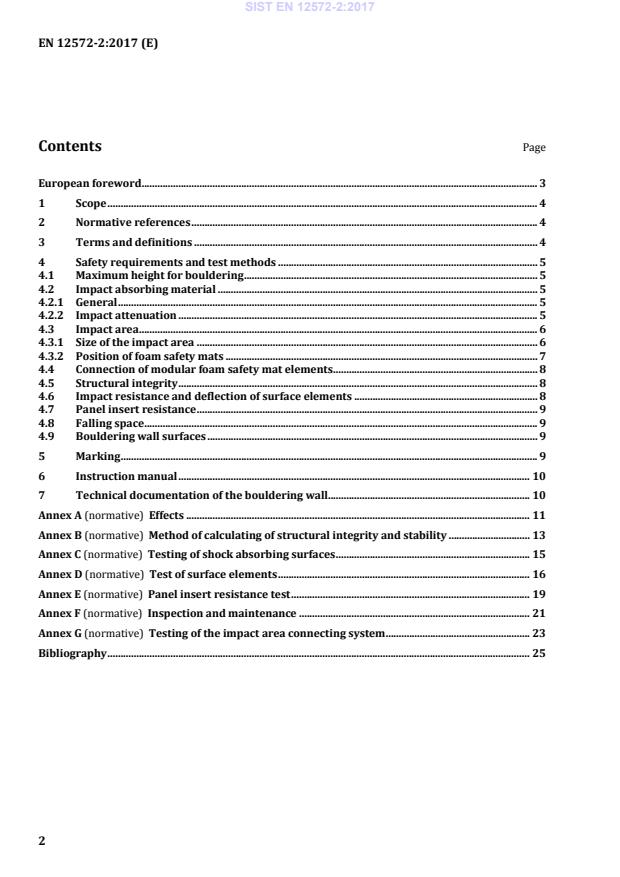
Effects . 11 Annex B (normative)
Method of calculating of structural integrity and stability . 13 Annex C (normative)
Testing of shock absorbing surfaces . 15 Annex D (normative)
Test of surface elements . 16 Annex E (normative)
Panel insert resistance test . 19 Annex F (normative)
Inspection and maintenance . 21 Annex G (normative)
Testing of the impact area connecting system . 23 Bibliography . 25 SIST EN 12572-2:2017
· 15 and
¶ 25
¶ 80
¶ 15 4.2.2.2 Impact attenuating capacity for shingle One of the most common outdoor impact absorbing materials is shingle. When shingle is used it shall be washed, rounded and be between 8 mm and 16 mm in diameter and have a minimum depth of 400 mm. SIST EN 12572-2:2017
· 2 000 mm; — if the height of the bouldering wall is greater than 3 000 mm, the ground projection of the bouldering wall shall be extended by L1
· 2 500 mm, see Figure 1. — if the bouldering wall is vertical or less than 10° overhanging with no holds on the side walls, the impact area either side of the bouldering wall L2 can be reduced to 50 % of the bouldering wall height or 1 500 mm. Table 2 — Size of the impact area Height of the wall Size of the impact area in front of the climbing wall Size of the side impact area for walls
10° and no holds on the side Size of the side impact area for walls > 10° H L1 L2 L2 0 to
¶ 3 000 mm 2 000 mm 50 % of the height 50 % of the height > 3 000 mm to
¶ 4 500 mm 2 500 mm 1 500 mm NOTE Holds in the area A given in Figure 1 are considered as a part of the front wall. SIST EN 12572-2:2017
Key 1 top of the impact area 2 projection of the bouldering wall H height of the highest possible holding point L1 length added to the ground projection of the bouldering wall in front of the bouldering wall L2 additional width of the impact area (under special circumstances) A lateral surface where climbing is possible considered as a part of the front wall Figure 1 — Example of the dimensions of the impact area at the base of a bouldering wall If a bouldering wall constructor can prevent through considered design the possibility of a climber falling to the side of the bouldering wall, the extent of the impact area may be reduced accordingly. 4.3.2 Position of foam safety mats Foam safety mats shall touch the base of the bouldering wall and shall be prevented from moving while in use, see Figure 2a). For steeply overhanging bouldering walls it is acceptable to use a thin or sloping mat installed between the base of a bouldering wall and the main foam safety mat to prevent injuries according to Figure 2b). SIST EN 12572-2:2017
a) Position of foam safety mat b) Optional foam safety mat position for “steeply overhanging bouldering walls” Key 1 main foam safety mat 2 thin or sloping mat Figure 2 — Position of the impact area 4.4 Connection of modular foam safety mat elements If the impact absorbing materials consist of modular elements, the sections shall be securely connected together or the gaps shall be covered so that it is impossible for the climber to enter into the gaps between modular elements. If the impact absorbing materials are beneath a continuous surface cover, the cover shall be in sufficient tension to hold the foam safety mats closely together. Informative Annex G describes one possible method of testing modular foam safety mat element connections. 4.5 Structural integrity The structural integrity, including stability, of a bouldering wall shall be justified by calculation using the characteristic loads given in Table A.1 in accordance with Annexes A and B. Panels shall not overly deflect (see D.5). In all cases where a bouldering wall transmits loads to an existing structure (building, concrete platforms, ground) it shall be ensured that the structure can safely accommodate the loads imposed by the bouldering wall. 4.6 Impact resistance and deflection of surface elements When tested in accordance with Annex D there shall be no breaking or splitting of the surface element. The deflection of the panels shall be calculated by using the load 0,8 kN (see Annex A) or be tested in accordance with Annex D, D.5. SIST EN 12572-2:2017
...