

EN 17396:2020
(Main)Resilient floor coverings - Quartz vinyl tiles - Specification
- Abstract
This document specifies the characteristics of homogeneous quartz vinyl tiles based on polyvinyl chloride binder, quartz sand as a sole or partial filler, with or without a transparent, non-PVC factory finish and supplied in tile form.
To encourage the consumer to make an informed choice, this document includes a classification system (see EN ISO 10874) based on intensity of use, which shows where these floor coverings will give satisfactory service. It also specifies requirements for marking.
- Status
- Published
- Publication Date
- 02-Jun-2020
- Withdrawal Date
- 30-Dec-2020
- Technical Committee
- CEN/TC 134 - Resilient and textile floor coverings
- Drafting Committee
- CEN/TC 134/WG 7 - Resilient floor coverings
- Current Stage
- 9093 - Decision to confirm - Review Enquiry
- Start Date
- 18-May-2026
- Completion Date
- 14-Oct-2026


Overview - EN 17396:2020 (Quartz vinyl tiles specification)
EN 17396:2020 is a CEN European Standard that specifies the characteristics and conformity requirements for homogeneous quartz vinyl tiles - a type of resilient floor covering based on a polyvinyl chloride (PVC) binder and quartz sand filler. The standard defines composition limits, performance requirements, testing references and labelling rules so manufacturers, specifiers and installers can ensure consistent quality and fit-for-purpose performance.
Key topics and technical requirements
- Product definition
- Quartz vinyl tile: PVC binder with quartz sand as sole or partial filler; minimum 50% of the filler system must be quartz sand.
- Tiles can be supplied with or without a transparent, non‑PVC factory finish (factory finish typically ≤ 0.03 mm).
- Binder content
- Minimum binder content ≥ 30% of total composition (PVC resin + plasticizers/stabilizers).
- Dimensional & mechanical limits
- Overall thickness tolerances and side length / squareness limits are specified (tested per EN ISO 24346 and EN ISO 24342).
- Residual indentation ≤ 0.10 mm (EN ISO 24343-1).
- Dimensional stability after heat ≤ 0.25% (EN ISO 23999).
- Flexibility: no cracking on Ø 80 mm mandrel (EN ISO 24344).
- Castor chair resistance: after 25 000 cycles no delamination or significant surface disturbance (ISO 4918).
- Colour fastness
- Colour fastness to artificial light: ≥ grade 6 (EN ISO 105-B02).
- Classification by use intensity
- Uses EN ISO 10874 classification (domestic, commercial, light industrial) with nominal thickness guidance (examples: domestic class 21 = 1.0 mm, classes 22–23 = 1.5 mm; commercial classes 31–34 = 1.5–2.0 mm).
- Marking & packaging
- Packages must show EN 17396:2020, manufacturer/supplier ID, product name, colour/pattern & batch, applicable class/symbols, tile dimensions and area per pack.
Practical applications and users
- Who uses EN 17396:2020:
- Flooring manufacturers (product design, quality control, CE / national compliance).
- Architects and specifiers (selecting appropriate quartz vinyl tiles by intensity of use and thickness).
- Contractors and installers (verifying product tolerances, installation suitability: dry‑joint or glued).
- Test laboratories and certification bodies (performing referenced test methods and conformity assessments).
- Procurement and facility managers (ensuring performance, durability and labelling traceability).
- Typical applications: commercial and domestic interiors requiring durable, low-profile resilient tiles - e.g., retail, healthcare, offices, and light-industrial areas where quartz-filled PVC tiles are appropriate.
Related standards
- EN ISO 10874 - classification of resilient, textile and laminate floor coverings
- EN ISO 24346 - overall thickness
- EN ISO 24342 - side length, squareness, straightness
- EN ISO 23997 / 23999 - mass per unit area / dimensional stability
- EN ISO 24343-1, EN ISO 24344, ISO 4918, EN ISO 105-B02 - referenced test methods
- Annex A (EN 17396) lists optional tests: electrical resistance (EN 1081), staining (EN ISO 26987), reaction to fire (EN ISO 9239-1, EN ISO 11925-2)
Keywords: EN 17396:2020, quartz vinyl tiles, resilient floor coverings, specification, PVC binder, quartz sand, EN ISO 10874, floor covering classification.
Relations
- Effective Date
- 27-May-2026
- Effective Date
- 28-Jan-2026
- Refers
EN ISO 23997:2012 - Resilient floor coverings - Determination of mass per unit area (ISO 23997:2007) - Effective Date
- 28-Jan-2026
- Effective Date
- 28-Jan-2026
- Effective Date
- 28-Jan-2026
- Refers
EN ISO 24346:2012 - Resilient floor coverings - Determination of overall thickness (ISO 24346:2006) - Effective Date
- 28-Jan-2026
- Effective Date
- 28-Jan-2026
- Effective Date
- 28-Jan-2026
- Effective Date
- 28-Jan-2026
- Effective Date
- 28-Jan-2026
Frequently Asked Questions
EN 17396:2020 is a standard published by the European Committee for Standardization (CEN). Its full title is "Resilient floor coverings - Quartz vinyl tiles - Specification". This standard covers: This document specifies the characteristics of homogeneous quartz vinyl tiles based on polyvinyl chloride binder, quartz sand as a sole or partial filler, with or without a transparent, non-PVC factory finish and supplied in tile form. To encourage the consumer to make an informed choice, this document includes a classification system (see EN ISO 10874) based on intensity of use, which shows where these floor coverings will give satisfactory service. It also specifies requirements for marking.
This document specifies the characteristics of homogeneous quartz vinyl tiles based on polyvinyl chloride binder, quartz sand as a sole or partial filler, with or without a transparent, non-PVC factory finish and supplied in tile form. To encourage the consumer to make an informed choice, this document includes a classification system (see EN ISO 10874) based on intensity of use, which shows where these floor coverings will give satisfactory service. It also specifies requirements for marking.
EN 17396:2020 is classified under the following ICS (International Classification for Standards) categories: 97.150 - Floor coverings. The ICS classification helps identify the subject area and facilitates finding related standards.
EN 17396:2020 has the following relationships with other standards: It is inter standard links to ISO 4918:2016, EN ISO 17231:2017, EN ISO 23997:2012, EN ISO 23999:2025, EN ISO 10874:2012, EN ISO 24346:2012, EN ISO 105-B02:2014, EN ISO 24342:2024, EN ISO 24343-1:2012, EN ISO 24344:2012. Understanding these relationships helps ensure you are using the most current and applicable version of the standard.
EN 17396:2020 is available in PDF format for immediate download after purchase. The document can be added to your cart and obtained through the secure checkout process. Digital delivery ensures instant access to the complete standard document.
Standards Content (Sample)
SLOVENSKI STANDARD
01-september-2020
Netekstilne talne obloge - Kremenove vinilne ploščice - Specifikacija
Resilient floor coverings - Quartz vinyl tiles - Specification
Elastische Bodenbeläge - Quartzvinylplatten - Spezifikation
Revêtements de sol résilients - Dalles en quartz-vinyle - Spécifications
Ta slovenski standard je istoveten z: EN 17396:2020
ICS:
97.150 Talne obloge Floor coverings
2003-01.Slovenski inštitut za standardizacijo. Razmnoževanje celote ali delov tega standarda ni dovoljeno.
EN 17396
EUROPEAN STANDARD
NORME EUROPÉENNE
June 2020
EUROPÄISCHE NORM
ICS 97.150
English Version
Resilient floor coverings - Quartz vinyl tiles - Specification
Revêtements de sol résilients - Dalles en quartz-vinyle Elastische Bodenbeläge - Quartzvinylplatten -
- Spécifications Spezifikation
This European Standard was approved by CEN on 3 May 2020.
CEN members are bound to comply with the CEN/CENELEC Internal Regulations which stipulate the conditions for giving this
European Standard the status of a national standard without any alteration. Up-to-date lists and bibliographical references
concerning such national standards may be obtained on application to the CEN-CENELEC Management Centre or to any CEN
member.
This European Standard exists in three official versions (English, French, German). A version in any other language made by
translation under the responsibility of a CEN member into its own language and notified to the CEN-CENELEC Management
Centre has the same status as the official versions.
CEN members are the national standards bodies of Austria, Belgium, Bulgaria, Croatia, Cyprus, Czech Republic, Denmark, Estonia,
Finland, France, Germany, Greece, Hungary, Iceland, Ireland, Italy, Latvia, Lithuania, Luxembourg, Malta, Netherlands, Norway,
Poland, Portugal, Republic of North Macedonia, Romania, Serbia, Slovakia, Slovenia, Spain, Sweden, Switzerland, Turkey and
United Kingdom.
EUROPEAN COMMITTEE FOR STANDARDIZATION
COMITÉ EUROPÉEN DE NORMALISATION
EUROPÄISCHES KOMITEE FÜR NORMUNG
CEN-CENELEC Management Centre: Rue de la Science 23, B-1040 Brussels
© 2020 CEN All rights of exploitation in any form and by any means reserved Ref. No. EN 17396:2020 E
worldwide for CEN national Members.
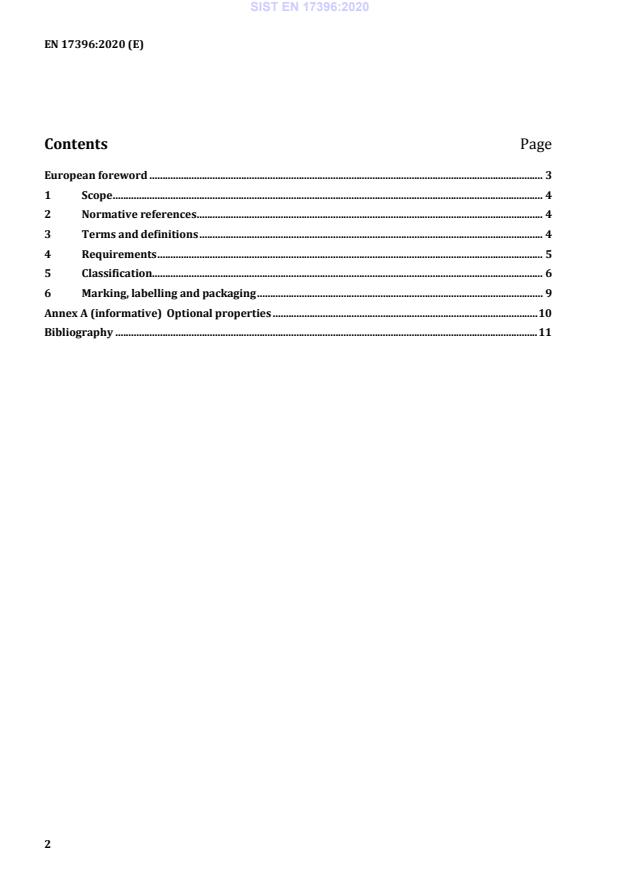
Contents Page
European foreword . 3
1 Scope . 4
2 Normative references . 4
3 Terms and definitions . 4
4 Requirements . 5
5 Classification. 6
6 Marking, labelling and packaging . 9
Annex A (informative) Optional properties . 10
Bibliography . 11
European foreword
This document (EN 17396:2020) has been prepared by Technical Committee CEN/TC 134 “Resilient,
textile and laminate floor covering”, the secretariat of which is held by NBN.
This European Standard shall be given the status of a national standard, either by publication of an
identical text or by endorsement, at the latest by December 2020, and conflicting national standards
shall be withdrawn at the latest by December 2020.
Attention is drawn to the possibility that some of the elements of this document may be the subject of
patent rights. CEN shall not be held responsible for identifying any or all such patent rights.
According to the CEN-CENELEC Internal Regulations, the national standards organisations of the
following countries are bound to implement this European Standard: Austria, Belgium, Bulgaria,
Croatia, Cyprus, Czech Republic, Denmark, Estonia, Finland, France, Germany, Greece, Hungary, Iceland,
Ireland, Italy, Latvia, Lithuania, Luxembourg, Malta, Netherlands, Norway, Poland, Portugal, Republic of
North Macedonia, Romania, Serbia, Slovakia, Slovenia, Spain, Sweden, Switzerland, Turkey and the
United Kingdom.
1 Scope
This document specifies the characteristics of homogeneous quartz vinyl tiles based on polyvinyl
chloride binder, quartz sand as a sole or partial filler, with or without a transparent, non-PVC factory
finish and supplied in tile form.
To encourage the consumer to make an informed choice, this document includes a classification system
(see EN ISO 10874) based on intensity of use, which shows where these floor coverings will give
satisfactory service. It also specifies requirements for marking.
2 Normative references
The following documents are referred to in the text in such a way that some or all of their content
constitutes requirements of this document. For dated references, only the edition cited applies. For
undated references, the latest edition of the referenced document (including any amendments) applies.
EN ISO 105-B02:2014, Textiles - Tests for colour fastness - Part B02: Colour fastness to artificial light:
Xenon arc fading lamp test (ISO 105-B02:2014)
EN ISO 10874, Resilient, textile and laminate floor coverings - Classification (ISO 10874)
EN ISO 23997, Resilient floor coverings - Determination of mass per unit area (ISO 23997)
EN ISO 23999, Resilient floor coverings - Determination of dimensional stability and curling after exposure
to heat (ISO 23999)
EN ISO 24342, Resilient and textile floor-coverings - Determination of side length, edge straightness and
squareness of tiles (ISO 24342)
EN ISO 24343-1, Resilient and laminate floor coverings - Determination of indentation and residual
indentation - Part 1: Residual indenta
...