

EN 88-2:2022+A1:2024
(Main + Amendment)Safety and control devices for gas burners and gas burning appliances - Part 2: Pressure regulators for inlet pressures above 50 kPa up to and including 500 kPa
- Abstract
EN 13611:2019, Clause 1 applies with the following modification and addition:
Modification:
The 1st paragraph of EN 13611:2019, Clause 1 is replaced by:
This document specifies the safety, design, construction, and performance requirements and testing for
pneumatic pressure regulators and safety devices for burners and appliances burning one or more
gaseous fuels, hereafter referred to as “pressure regulators”.
This document is applicable to pressure regulators with declared maximum inlet pressures above 50 kPa
up to and including 500 kPa and of nominal connection sizes up to and including DN 250.
Addition:
This document is applicable to:
— pressure regulators incorporating safety devices;
— pressure regulators and safety devices which use auxiliary energy;
— stand-alone pressure regulators or pressure regulators equipped with a control device for maximum
or minimum gas pressure.
This document is not applicable to:
— pressure regulators connected directly to a gas distribution network or to a container that maintains
a standard distribution pressure;
— pressure regulators intended for gas appliances to be installed in the open air and exposed to the
environment.
The 4th paragraph of EN 13611:2019, Clause 1 is removed.
- Status
- Published
- Publication Date
- 05-Nov-2024
- Technical Committee
- CEN/TC 58 - Safety and control devices for burners and appliances burning gaseous or liquid fuels
- Drafting Committee
- CEN/TC 58/WG 13 - Mechanics
- Current Stage
- 6060 - Definitive text made available (DAV) - Publishing
- Start Date
- 06-Nov-2024
- Completion Date
- 06-Nov-2024
- Directive
- 2016/426 - REGULATION (EU) 2016/426 OF THE EUROPEAN PARLIAMENT AND OF THE COUNCIL of 9 March 2016 on appliances burning gaseous fuels and repealing Directive 2009/142/ECOJ Ref: 2025/1793, OJ L, OJ L, 2025/1793 OJ Date: 11-Sep-2025

Overview
EN 88-2:2022+A1:2024 (equivalent to EN 88-2:2022+A1:2024) sets safety, design, construction and performance requirements and test methods for pneumatic pressure regulators and associated safety devices used with gas burners and gas-burning appliances. The standard applies to pressure regulators with declared maximum inlet pressures above 50 kPa up to and including 500 kPa and with nominal connection sizes up to and including DN 250. It incorporates Amendment A1 and modifies the scope of EN 13611:2019 to clarify applicability and exclusions.
Key topics and technical requirements
- Scope and applicability
- Regulates pneumatic pressure regulators for gaseous fuels, including regulators that incorporate safety devices, use auxiliary energy, or are supplied as stand-alone units or with maximum/minimum pressure controls.
- Not applicable to regulators directly connected to a gas distribution network or containers maintaining standard distribution pressure, or to regulators for appliances installed outdoors and exposed to the environment.
- Classification and control functions
- Defines classes and groups of control, control functions and types of DC-supplied controls.
- Design and construction
- Requirements for mechanical parts, moving parts, housings, materials (including pressurized parts), seals, breather holes, and presetting devices.
- Performance and testing
- Leak-tightness tests (volumetric and pressure loss methods), rated flow, torsion/bending, durability (including elastomer resistance), and long-term performance for electronic controls.
- Specific performance tests for pressure regulators and for over‑pressure and under‑pressure safety shut-off devices, plus endurance testing.
- Electrical and EMC requirements
- Electrical components, protection by enclosure, plug connections, and electromagnetic compatibility (EMC) immunity/surge tests.
- Functional safety
- Annexes provide methods for determining Safety Integrity Level (SIL) and Performance Level (PL), fault modes for electronic components, and reset functions.
- Marking and documentation
- Mandatory marking, user instructions and warning notices for safe installation and operation.
Practical applications and users
This standard is essential for:
- Manufacturers of pressure regulators and safety accessories for gas appliances (design, testing and certification).
- Test laboratories and conformity assessment bodies performing compliance and type testing.
- System integrators, OEMs and specifiers selecting regulators for commercial and industrial burners where inlet pressures exceed 50 kPa.
- Safety engineers, installers and procurement teams ensuring components meet regulatory and performance expectations.
Related standards and regulatory links
- Modifies scope of EN 13611:2019 (Clause 1) as noted in the standard text.
- Includes annexed requirements referencing EU Directive 2014/68/EU for pressure accessories.
- See EN 88 series for related requirements on other pressure ranges and device types.
Keywords: pressure regulators, gas burners, gas burning appliances, safety devices, EN 88-2, leak-tightness tests, SIL, PL, EMC, DN 250, inlet pressure 50–500 kPa.
Relations
- Effective Date
- 05-Oct-2024
- Effective Date
- 09-Feb-2026
- Refers
EN 60534-2-3:2016 - Industrial-process control valves - Part 2-3: Flow capacity - Test procedures - Effective Date
- 09-Feb-2026
- Effective Date
- 28-Jan-2026
- Effective Date
- 28-Jan-2026
- Effective Date
- 28-Jan-2026
- Effective Date
- 28-Jan-2026
- Refers
EN 549:2019+A2:2024 - Rubber materials for seals and diaphragms for gas appliances and gas equipment - Effective Date
- 28-Jan-2026
- Effective Date
- 28-Jan-2026
- Effective Date
- 28-Jan-2026
- Effective Date
- 28-Jan-2026
- Effective Date
- 28-Jan-2026
Get Certified
Connect with accredited certification bodies for this standard

Institut za varilstvo d.o.o. (Welding Institute)
Slovenia's leading welding institute since 1952. ISO 3834, EN 1090, pressure equipment certification, NDT personnel, welder qualification. Only IIW Au
Sponsored listings
Frequently Asked Questions
EN 88-2:2022+A1:2024 is a standard published by the European Committee for Standardization (CEN). Its full title is "Safety and control devices for gas burners and gas burning appliances - Part 2: Pressure regulators for inlet pressures above 50 kPa up to and including 500 kPa". This standard covers: EN 13611:2019, Clause 1 applies with the following modification and addition: Modification: The 1st paragraph of EN 13611:2019, Clause 1 is replaced by: This document specifies the safety, design, construction, and performance requirements and testing for pneumatic pressure regulators and safety devices for burners and appliances burning one or more gaseous fuels, hereafter referred to as “pressure regulators”. This document is applicable to pressure regulators with declared maximum inlet pressures above 50 kPa up to and including 500 kPa and of nominal connection sizes up to and including DN 250. Addition: This document is applicable to: — pressure regulators incorporating safety devices; — pressure regulators and safety devices which use auxiliary energy; — stand-alone pressure regulators or pressure regulators equipped with a control device for maximum or minimum gas pressure. This document is not applicable to: — pressure regulators connected directly to a gas distribution network or to a container that maintains a standard distribution pressure; — pressure regulators intended for gas appliances to be installed in the open air and exposed to the environment. The 4th paragraph of EN 13611:2019, Clause 1 is removed.
EN 13611:2019, Clause 1 applies with the following modification and addition: Modification: The 1st paragraph of EN 13611:2019, Clause 1 is replaced by: This document specifies the safety, design, construction, and performance requirements and testing for pneumatic pressure regulators and safety devices for burners and appliances burning one or more gaseous fuels, hereafter referred to as “pressure regulators”. This document is applicable to pressure regulators with declared maximum inlet pressures above 50 kPa up to and including 500 kPa and of nominal connection sizes up to and including DN 250. Addition: This document is applicable to: — pressure regulators incorporating safety devices; — pressure regulators and safety devices which use auxiliary energy; — stand-alone pressure regulators or pressure regulators equipped with a control device for maximum or minimum gas pressure. This document is not applicable to: — pressure regulators connected directly to a gas distribution network or to a container that maintains a standard distribution pressure; — pressure regulators intended for gas appliances to be installed in the open air and exposed to the environment. The 4th paragraph of EN 13611:2019, Clause 1 is removed.
EN 88-2:2022+A1:2024 is classified under the following ICS (International Classification for Standards) categories: 23.060.40 - Pressure regulators. The ICS classification helps identify the subject area and facilitates finding related standards.
EN 88-2:2022+A1:2024 has the following relationships with other standards: It is inter standard links to EN 88-2:2022, EN 175301-803:2006, EN 60534-2-3:2016, EN 13611:2019, EN 682:2002, EN 682:2002/A1:2005, EN 161:2022, EN 549:2019+A2:2024, EN 13278:2013, EN 676:2003+A2:2008, EN 203-1:2005+A1:2008, EN 203-1:2014. Understanding these relationships helps ensure you are using the most current and applicable version of the standard.
EN 88-2:2022+A1:2024 is associated with the following European legislation: EU Directives/Regulations: 2016/426; Standardization Mandates: M/595. When a standard is cited in the Official Journal of the European Union, products manufactured in conformity with it benefit from a presumption of conformity with the essential requirements of the corresponding EU directive or regulation.
EN 88-2:2022+A1:2024 is available in PDF format for immediate download after purchase. The document can be added to your cart and obtained through the secure checkout process. Digital delivery ensures instant access to the complete standard document.
Standards Content (Sample)
SLOVENSKI STANDARD
01-marec-2025
Nadomešča:
SIST EN 88-2:2022
Varnostne in nadzorne naprave za plinske gorilnike in plinske aparate - 2. del:
Regulatorji tlaka za vstopne tlake nad 50 kPa do vključno 500 kPa (vključno z
dopolnilom A1)
Safety and control devices for gas burners and gas burning appliances - Part 2: Pressure
regulators for inlet pressures above 50 kPa up to and including 500 kPa
Sicherheits- und Regeleinrichtungen für Gasbrenner und Gasgeräte - Teil 2: Druckregler
für Eingangsdrücke über 50 kPa bis einschließlich 500 kPa
Dispositifs de sécurité et de contrôle pour les brûleurs à gaz et appareils utilisant des
combustibles gazeux - Partie 2 : Régulateurs de pression pour pressions amont
comprises entre 50 kPa et 500 kPa
Ta slovenski standard je istoveten z: EN 88-2:2022+A1:2024
ICS:
23.060.40 Tlačni regulatorji Pressure regulators
27.060.20 Plinski gorilniki Gas fuel burners
2003-01.Slovenski inštitut za standardizacijo. Razmnoževanje celote ali delov tega standarda ni dovoljeno.
EN 88-2:2022+A1
EUROPEAN STANDARD
NORME EUROPÉENNE
November 2024
EUROPÄISCHE NORM
ICS 23.060.40
English Version
Safety and control devices for gas burners and gas burning
appliances - Part 2: Pressure regulators for inlet pressures
above 50 kPa up to and including 500 kPa
Dispositifs de sécurité et de contrôle pour les brûleurs Sicherheits- und Regeleinrichtungen für Gasbrenner
à gaz et appareils utilisant des combustibles gazeux - und Gasgeräte - Teil 2: Druckregler für Eingangsdrücke
Partie 2 : Régulateurs de pression pour pressions über 50 kPa bis einschließlich 500 kPa
amont comprises entre 50 kPa et 500 kPa
This European Standard was approved by CEN on 8 August 2022 and includes Amendment 1 approved by CEN on 3 July 2024.
CEN members are bound to comply with the CEN/CENELEC Internal Regulations which stipulate the conditions for giving this
European Standard the status of a national standard without any alteration. Up-to-date lists and bibliographical references
concerning such national standards may be obtained on application to the CEN-CENELEC Management Centre or to any CEN
member.
This European Standard exists in three official versions (English, French, German). A version in any other language made by
translation under the responsibility of a CEN member into its own language and notified to the CEN-CENELEC Management
Centre has the same status as the official versions.
CEN members are the national standards bodies of Austria, Belgium, Bulgaria, Croatia, Cyprus, Czech Republic, Denmark, Estonia,
Finland, France, Germany, Greece, Hungary, Iceland, Ireland, Italy, Latvia, Lithuania, Luxembourg, Malta, Netherlands, Norway,
Poland, Portugal, Republic of North Macedonia, Romania, Serbia, Slovakia, Slovenia, Spain, Sweden, Switzerland, Türkiye and
United Kingdom.
EUROPEAN COMMITTEE FOR STANDARDIZATION
COMITÉ EUROPÉEN DE NORMALISATION
EUROPÄISCHES KOMITEE FÜR NORMUNG
CEN-CENELEC Management Centre: Rue de la Science 23, B-1040 Brussels
© 2024 CEN All rights of exploitation in any form and by any means reserved Ref. No. EN 88-2:2022+A1:2024 E
worldwide for CEN national Members.
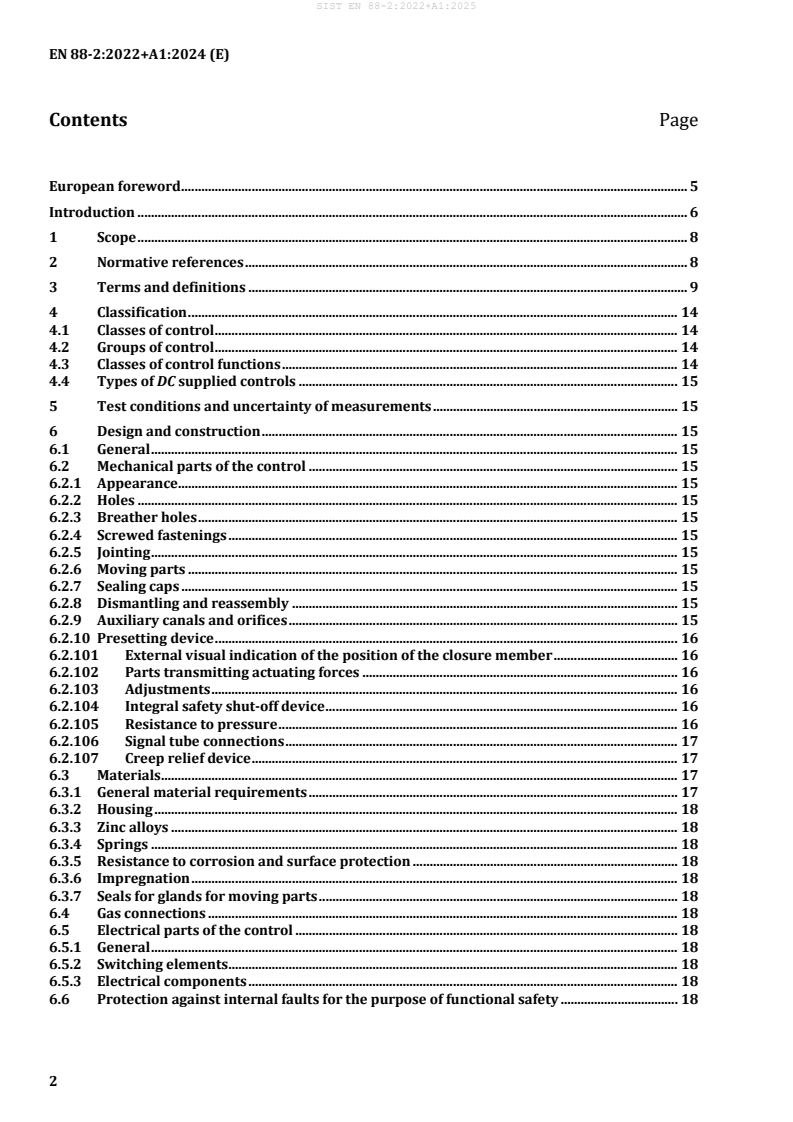
Contents Page
European foreword . 5
Introduction . 6
1 Scope . 8
2 Normative references . 8
3 Terms and definitions . 9
4 Classification . 14
4.1 Classes of control . 14
4.2 Groups of control . 14
4.3 Classes of control functions . 14
4.4 Types of DC supplied controls . 15
5 Test conditions and uncertainty of measurements . 15
6 Design and construction . 15
6.1 General . 15
6.2 Mechanical parts of the control . 15
6.2.1 Appearance . 15
6.2.2 Holes . 15
6.2.3 Breather holes . 15
6.2.4 Screwed fastenings . 15
6.2.5 Jointing . 15
6.2.6 Moving parts . 15
6.2.7 Sealing caps . 15
6.2.8 Dismantling and reassembly . 15
6.2.9 Auxiliary canals and orifices . 15
6.2.10 Presetting device . 16
6.2.101 External visual indication of the position of the closure member . 16
6.2.102 Parts transmitting actuating forces . 16
6.2.103 Adjustments . 16
6.2.104 Integral safety shut-off device . 16
6.2.105 Resistance to pressure . 16
6.2.106 Signal tube connections . 17
6.2.107 Creep relief device . 17
6.3 Materials . 17
6.3.1 General material requirements . 17
6.3.2 Housing . 18
6.3.3 Zinc alloys . 18
6.3.4 Springs . 18
6.3.5 Resistance to corrosion and surface protection . 18
6.3.6 Impregnation . 18
6.3.7 Seals for glands for moving parts . 18
6.4 Gas connections . 18
6.5 Electrical parts of the control . 18
6.5.1 General . 18
6.5.2 Switching elements . 18
6.5.3 Electrical components . 18
6.6 Protection against internal faults for the purpose of functional safety . 18
7 Performance . 18
7.1 General . 18
7.2 Leak-tightness . 19
7.2.1 Requirements . 19
7.2.2 Tests . 19
7.3 Torsion and bending . 19
7.4 Rated flow rate . 19
7.4.1 Requirements . 19
7.4.2 Test . 19
7.4.3 Conversion of air flow rate . 20
7.5 Durability. 20
7.5.1 Elastomers in contact with gas . 20
7.5.2 Marking . 20
7.5.3 Resistance to scratching . 20
7.5.4 Resistance to humidity . 20
7.6 Performance tests for electronic controls . 20
7.7 Long-term performance for electronic controls . 20
7.8 Data exchange . 20
7.101 Pressure regulator performance . 20
7.101.1 General . 20
7.101.2 General test procedure . 20
7.102 Safety devices . 26
7.102.1 Over-pressure safety shut-off devices . 26
7.102.2 Under-pressure safety shut-off devices . 30
7.102.3 Endurance of safety device . 30
8 Electrical requirements . 31
8.1 General . 31
8.2 Protection by enclosure . 31
8.101 Plug connections . 31
9 Electromagnetic compatibility (EMC) . 32
9.1 Protection against environmental influences . 32
9.2 Supply voltage variations below 85 % of rated voltage. 32
9.3 Voltage dips and interruptions . 32
9.4 Supply frequency variations . 32
9.5 Surge immunity tests . 32
9.6 Electrical fast transient/burst . 32
9.7 Immunity to conducted disturbances induced by radio frequency fields . 32
9.8 Immunity to radiated disturbances induced by radio frequency fields . 32
9.9 Electrostatic discharge tests . 32
9.10 Power frequency magnetic field immunity tests . 32
9.11 Harmonics and interharmonics including mains signalling at a. c. power port, low
frequency immunity tests . 32
10 Marking, instructions . 33
10.1 Marking . 33
10.2 Instructions . 33
10.3 Warning notice . 34
Annex A (informative) Abbreviations and Symbols . 35
Annex B (informative) Leak-tightness tests for gas controls – volumetric method . 36
Annex C (informative) Leak-tightness tests for gas controls – pressure loss method . 37
Annex D (normative) Conversion of pressure loss into leakage rate . 38
Annex E (normative) Electrical/electronic component fault modes . 39
Annex F (normative) Additional requirements for safety accessories and pressure
accessories as defined in EU Directive 2014/68/EU . 40
Annex G (normative) Materials for pressurized parts . 41
Annex H (normative) Additional materials for pressurized parts . 42
Annex I (normative) Requirements for controls used in DC supplied burners and
appliances burning gaseous or liquid fuels . 43
Annex J (normative) Method for the determination of a Safety Integrity Level (SIL) . 44
Annex K (normative) Method for the determination of a Performance Level (PL). 45
Annex L (informative) Relationship between Safety Integrity Level (SIL) and Performance
Level (PL) . 46
Annex M (normative) Reset functions . 47
Annex N (informative) Guidance document on Environmental Aspects . 48
Annex O (normative) Seals of elastomer, cork and synthetic fibre mixtures . 49
Annex AA (informative) Typical pressure regulators and safety devices . 50
AA.1 Main components of a pressure regulator . 50
AA.2 Main components of a safety shut-off device . 53
Annex BB (informative) Overview of requirements and test conditions (as given in 7.101),
and examples of performance curves for pressure regulators . 55
Annex CC (normative) Creep relief device . 58
CC.1 General . 58
CC.2 Design and construction . 58
CC.3 Performance requirements . 58
CC.4 Marking, instructions . 58
Annex DD (informative) Comparison between EN 334:2019 and !EN 88-
2:2022+A1:2024" . 59
Annex ZA (informative) Relationship between this European Standard and the essential
requirements of Regulation (EU) 2016/426 aimed to be covered . 60
Bibliography . 63
European foreword
This document (EN 88-2:2022+A1:2024) has been prepared by Technical Committee CEN/TC 58 “Safety
and control devices for burners and appliances burning gaseous or liquid fuels”, the secretariat of which
is held by BSI.
This European Standard shall be given the status of a national standard, either by publication of an
identical text or by endorsement, at the latest by May 2025, and conflicting national standards shall be
withdrawn at the latest by November 2027.
Attention is drawn to the possibility that some of the elements of this document may be the subject of
patent rights. CEN shall not be held responsible for identifying any or all such patent rights.
This document includes Amendment 1 approved by CEN on 3 July 2024.
The start and finish of text introduced or altered by amendment is indicated in the text by tags !".
This document supersedes !EN 88-2:2022.
This standard differs from EN 88:2022 as follows:
a) Annex ZA has been brought in line with Mandate M/595 and the normative references are updated."
!deleted text"
This document has been prepared under a Standardization Request given to CEN by the European
Commission and the European Free Trade Association, and supports essential requirements of EU
Directive(s) / Regulation(s).
For relationship with EU Directive(s) / Regulation(s), see informative Annex ZA, which is an integral part
of this document.
The EN 88 series consists of the following parts:
— EN 88-1, Safety and control devices for gas burners and gas burning appliances — Part 1: Pressure
regulators for inlet pressures up to and including 50 kPa;
— EN 88-2, Safety and control devices for gas burners and gas burning appliances — Part 2: Pressure
regulators for inlet pressures above 50 kPa up to and including 500 kPa;
— EN 88-3, Safety and control devices for gas burners and gas burning appliances — Part 3: Pressure
and/or flow rate regulators for inlet pressures up to and including 500 kPa, electronic types.
Any feedback and questions on this document should be directed to the users’ national standards body.
A complete listing of these bodies can be found on the CEN website.
According to the CEN-CENELEC Internal Regulations, the national standards organisations of the
following countries are bound to implement this European Standard: Austria, Belgium, Bulgaria, Croatia,
Cyprus, Czech Republic, Denmark, Estonia, Finland, France, Germany, Greece, Hungary, Iceland, Ireland,
Italy, Latvia, Lithuania, Luxembourg, Malta, Netherlands, Norway, Poland, Portugal, Republic of North
Macedonia, Romania, Serbia, Slovakia, Slovenia, Spain, Sweden, Switzerland, Türkiye and the United
Kingdom.
Introduction
This document is intended to be used in conjunction with EN 13611:2019.
EN 13611:2019 recognizes the safety level specified by CEN/TC 58 and is regarded as a horizontal
standard dealing with the safety, construction, performance and testing of controls for burners and
appliances burning gaseous and/or liquid fuels.
The general requirements for controls are given in EN 13611:2019, and methods for classification and
assessment for new controls and control functions are given in EN 14459:2021 (see Figure 1).
EN 126:2012 (see Figure 1) specifies multifunctional controls combining two or more controls and
Application Control Functions, one of which is a mechanical control function. The requirements for
controls and Application Control Functions are given in the specific control standard (see Figure 1,
control functions).
Figure 1 — Interrelation of control standards
EN 13611:2019 should be used in conjunction with the specific standard for a specific type of control (e.g.
!EN 88-1:2022+A1:2023", !EN 88-2:2022+A1:2024", !EN 88-3:2022+A1:2024",
!EN 125:2022+A1:2024", EN 126:2012, EN 161:2022, !EN 257:2022+A1:2023", EN 298:2022,
!EN 1106:2022+A1:2023", EN 1643:2022, !EN 1854:2022+A1:2023", EN 12067-2:2022,
!EN 16304:2022+A1:2024", EN 16340:2014, EN 16678:2022 and
!EN 16898:2022+A1:2023"), or for controls for specific applications.
EN 13611:2019 can also be applied, so far as reasonable, to controls not mentioned in a specific standard
and to controls designed on new principles, in which case additional requirements can be necessary.
EN 14459:2021 provides methods for classification and assessment of new control principles.
Primarily in industrial applications it is common practice to rate the safety of a plant based on values
describing the likelihood of a dangerous failure. These values are being used to determine Safety Integrity
Levels or Performance Levels when the system is being assessed in its entirety.
CEN/TC 58 standards for safety relevant controls do go beyond this approach, because for a certain life
time for which the product is specified, designed and tested a dangerous failure is not allowed at all.
Failure modes are described and assessed in greater detail.
Measures to prevent from dangerous situations are defined. Field experience over many decades is
reflected in the CEN/TC 58 standards. Requirements of EN 13611:2019 can be considered as proven in
practice.
This document refers to clauses of EN 13611:2019 or adapts clauses by stating “with the following
modification”, “with the following addition”, “is replaced by the following” or “is not applicable” in the
corresponding clause.
This document adds clauses or subclauses to the structure of EN 13611:2019 which are particular to this
document. Subclauses which are additional to those in EN 13611:2019 are numbered starting from 101.
Additional Annexes are designated as Annex AA, BB, CC, etc. It should be noted that these clauses,
subclauses and Annexes are not indicated as an addition.
If by reference to EN 13611:2019 the term “control” is given, this term should be read as “pressure
regulator”.
1 Scope
EN 13611:2019, Clause 1 applies with the following modification and addition:
Modification:
st
The 1 paragraph of EN 13611:2019, Clause 1 is replaced by:
This document specifies the safety, design, construction, and performance requirements and testing for
pneumatic pressure regulators and safety devices for burners and appliances burning one or more
gaseous fuels, hereafter referred to as “pressure regulators”.
This document is applicable to pressure regulators with declared maximum inlet pressures above 50 kPa
up to and including 500 kPa and of nominal connection sizes up to and including DN 250.
Addition:
This document is applicable to:
— pressure regulators incorporating safety devices;
— pressure regulators and safety devices which use auxiliary energy;
— stand-alone pressure regulators or pressure regulators equipped with a control device for maximum
or minimum gas pressure.
This document is not applicable to:
— pressure regulators connected directly to a gas distribution network or to a container that maintains
a standard distribution pressure;
— pressure regulators intended for gas appliances to be installed in the open air and exposed to the
environment.
th
The 4 paragraph of EN 13611:2019, Clause 1 is removed.
2 Normative references
The following documents are referred to in the text in such a way that some or all of their content
constitutes requirements of this document. For dated references, only the edition cited applies. For
undated references, the latest edition of the referenced document (including any amendments) applies.
EN 161:2022, Automatic shut-off valve for gas burners and gas appliances
!EN 549:2019+A2:2024", Rubber materials for seals and diaphragms for gas appliances and gas
equipment
EN 682:2002, Elastomeric seals — Materials requirements for seals used in pipes and fittings carrying gas
and hydrocarbon fluids
EN 13611:2019, Safety and control devices for burners and appliances burning gaseous and/or liquid fuels
— General requirements
As impacted by EN 682:2002/A1:2005.
As impacted by EN 13611:2019/AC:2021.
EN 60534-2-3:2016, Industrial-process control valves — Part 2-3: Flow capacity — Test procedures
(IEC 60534-2-3:2015)
EN 175301-803:2006, Detail Specification: Rectangular connectors — Flat contacts, 0,8 mm thickness,
locking screw not detachable
3 Terms and definitions
For the purposes of this document, the terms and definitions given in EN 13611:2019 and the following
apply.
ISO and IEC maintain terminological databases for use in standardization at the following addresses:
— IEC Electropedia: available at https://www.electropedia.org/
— ISO Online browsing platform: available at https://www.iso.org/obp
3.101
pressure regulator
device which maintains the outlet pressure constant independent of the variations in inlet pressure
and/or flow rate within defined limits
[SOURCE: !EN 88-1:2022+A1:2023", 3.101]
3.102
control member
movable part of the pressure regulator which varies flow rate and/or outlet pressure directly
[SOURCE: !EN 88-1:2022+A1:2023", 3.107]
3.103
safety shut-off device
SSD
device having the function of staying in the open position under normal operating conditions and to shut
off the gas flow automatically and completely when the monitored pressure deviates above or below the
pre-set value
3.104
housing
part of the pressure regulator and/or SSD that is the main pressure containing envelope
3.105
controller
device which normally includes a setting element, normally a spring, to obtain a set value of the outlet
pressure, and a pressure detector element, normally a diaphragm for the outlet pressure
3.106
actuator
device or mechanism which changes the signal from the controller into a corresponding movement
controlling the position of the control member
3.107
working diaphragm
flexible member which, under the influence of the forces arising from loading and pressure, operates the
control member
Note 1 to entry: Diaphragms used as a control member are not covered by this definition.
[SOURCE: !EN 88-1:2022+A1:2023", 3.122, modified – Note 1 to entry added]
3.108
pressure containing part
part where failure would result in release of gas to the atmosphere
Note 1 to entry: Such parts comprise housings, inner partition walls, control member, bonnets, the housing of the
actuator, blind flanges and pipes for process and sensing lines.
3.109
signal connection
connection that is used to convey pressure from part of an installation to the signal chamber
[SOURCE: !EN 88-1:2022+A1:2023", 3.128]
3.110
breather line
line between the controller and/or pilot regulator and atmosphere which equalizes the pressure on a
detector element when it changes its position
3.111
fixture
functional device connected to the main components of the pressure regulator or SSD
3.112
exhaust line
line to atmosphere between the pressure regulator or fixtures for the safe venting of gas in the event of a
working diaphragm failure
3.113
trip mechanism
mechanism that releases the closure member when activated by the controller
3.114
SSD-actuator
device that is activated by the trip mechanism which shuts the closure member
3.115
relatching device
device that enables the complete opening of an SSD
3.116
motorization chamber
chamber at the higher pressure of two chambers under pressure within the housing of actuator
3.117
monitored pressure
pressure monitored and safeguarded by the SSD
3.118
trip pressure
pressure value at which the closing member starts to move
3.119
upper trip pressure
p
2o
upper limit of the monitored over-pressure
3.120
lower trip pressure
p
2u
lower limit of the monitored under-pressure
3.121
outlet setting pressure
p
2s
outlet pressure at which the pressure regulator is set for test purposes
[SOURCE: !EN 88-1:2022+A1:2023", 3.115]
3.122
maximum outlet pressure
p
2max
upper limit of the outlet pressure, as stated in the instructions, at which the pressure regulator can be
operated
[SOURCE: !EN 88-1:2022+A1:2023", 3.111]
3.123
minimum outlet pressure
p
2min
lower limit of the outlet pressure, as stated in the instructions, at which the pressure regulator can be
operated
[SOURCE: !EN 88-1:2022+A1:2023", 3.112]
3.124
outlet pressure range
difference between maximum and minimum values of the outlet pressure, as stated in the instructions
[SOURCE: !EN 88-1:2022+A1:2023", 3.111]
3.125
maximum inlet pressure
p
1max
highest inlet pressure, as stated in the instructions, at which the pressure regulator can be operated
Note 1 to entry: The definition of “maximum inlet pressure” is also known as “maximum allowable pressure PS”.
Note 2 to entry: In accordance with the strength requirements of this document.
3.126
minimum inlet pressure
p
1min
lowest inlet pressure, as stated in the instructions, at which the pressure regulator can be operated
[SOURCE: !EN 88-1:2022+A1:2023", 3.110]
3.127
inlet pressure range
difference between the maximum and minimum values of the inlet pressure, as stated in the instructions
[SOURCE: !EN 88-1:2022+A1:2023", 3.108]
3.128
maximum rated flow rate
q
max
upper limit of the rated air flow rate, corrected to standard conditions, as stated in the instructions
[SOURCE: !EN 88-1:2022+A1:2023", 3.116]
3.129
minimum rated flow rate
q
min
lower limit of the rated air flow rate, corrected to standard conditions, as stated in the instructions
[SOURCE: !EN 88-1:2022+A1:2023", 3.117]
3.130
steady state value
outlet pressure measured after step response remains constant
[SOURCE: !EN 88-1:2022+A1:2023", 3.131, modified – Note 1 to entry removed]
3.131
settling tolerance
maximum difference between the current outlet pressure and its steady state value
[SOURCE: !EN 88-1:2022+A1:2023", 3.132 , modified – Note 1 to entry removed]
3.132
performance curve
graphic representation of the outlet pressure as a function of the rated flow rate
Note 1 to entry: This curve is determined by increasing and then decreasing the rated flow rate with constant
inlet pressure and constant outlet setting pressure (see Figure BB.1).
3.133
family of performance curves
set of the performance curves for each value of inlet pressure determined for a given outlet setting
pressure
Note 1 to entry: See Figure BB.2.
3.134
accuracy
percentage of the outlet pressure relative to the outlet setting pressure within the operation range
3.135
accuracy class
AC
maximum permissible value of the accuracy
3.136
lock-up time
t
f
time taken for the control member to move from an open position to the closed position
3.137
lock-up pressure
p
2f
outlet pressure at which a pressure regulator closes when the outlet of the pressure regulator is sealed
[SOURCE: !EN 88-1:2022+A1:2023", 3.124]
3.138
lock-up pressure class
SG
maximum permissible positive difference between the actual lock-up pressure(s) p and the
2f
corresponding outlet setting pressure(s) at a certain percentage of the maximum rated flow rate q ,
max
expressed as a percentage of the outlet setting pressure
Note 1 to entry: The lock-pressure pressure class SG is given by the following equation:
pp−
( )
2f 2s
SG 100⋅ (1)
p
2s
where
SG is the lock-up pressure class;
p is the lock-up pressure; and
2f
p is the outlet setting pressure.
2s
=
3.139
limit pressure
p
l
pressure at which yielding becomes apparent in any component of the pressure regulator or its fixtures
3.140
safety factor
S , S
b
ratio of the value of the limit pressure p to the value of the maximum allowable pressure PS
l
Note 1 to entry: This term applies to two separate discrete regions of the pressure regulator:
— applied to the pressure regulator housing: S ;
b
— applied to the other pressure containing parts of the pressure regulator: S.
3.141
creep relief device
CRD
small spring-loaded valve in the actuator of a direct acting pressure regulator which opens automatically
if the controlled pressure is higher than the lock-up pressure (including tolerance)
3.142
opening pressure
[creep relief device]
pressure at which the first internal leak occurs
3.143
closing pressure
[creep relief device]
pressure at which the creep relief device is leak tight after re-seating
4 Classification
4.1 Classes of control
EN 13611:2019, 4.1 is replaced by the following:
Pressure regulators shall be classified
— AC 1, AC 2,5, AC 5, AC 10, and AC 20 according to the pressure regulator accuracy class (7.101.2.4);
and / or
— SG 5, SG 10, SG 20, and SG 30 according to the lock-up pressure class (7.101.2.5); and / or
— AG 5, AG 10, AG 20, and AG 30 according to the over-pressure shut-off accuracy group (7.102.1).
4.2 Groups of control
Shall be according to EN 13611:2019, 4.2.
4.3 Classes of control functions
EN 13611:2019, 4.3 is not applicable.
4.4 Types of DC supplied controls
Shall be according to EN 13611:2019, 4.4.
5 Test conditions and uncertainty of measurements
Shall be according to EN 13611:2019, Clause 5.
6 Design and construction
6.1 General
Shall be according to EN 13611:2019, 6.1.
6.2 Mechanical parts of the control
6.2.1 Appearance
Shall be according to EN 13611:2019, 6.2.1.
6.2.2 Holes
Shall be according to EN 13611:2019, 6.2.2.
6.2.3 Breather holes
6.2.3.1 Requirements
Shall be according to EN 13611:2019, 6.2.3.1 with the following addition:
If the vented capacity is greater than 70 dm /h of air, a connection for a vent pipe shall be provided.
6.2.3.2 Test for leakage of breather holes
Shall be according to EN 13611:2019, 6.2.3.2.
6.2.4 Screwed fastenings
Shall be according to EN 13611:2019, 6.2.4.
6.2.5 Jointing
Shall be according to EN 13611:2019, 6.2.5.
6.2.6 Moving parts
Shall be according to EN 13611:2019, 6.2.6.
6.2.7 Sealing caps
Shall be according to EN 13611:2019, 6.2.7.
6.2.8 Dismantling and reassembly
Shall be according to EN 13611:2019, 6.2.8.
6.2.9 Auxiliary canals and orifices
Shall be according to EN 13611:2019, 6.2.9.
6.2.10 Presetting device
Shall be according to EN 13611:2019, 6.2.10.
6.2.101 External visual indication of the position of the closure member
If an external visual device to indicate the closure member position is fitted to an SSD, it shall clearly
indicate whether it is in the open or closed position.
6.2.102 Parts transmitting actuating forces
Parts transmitting actuating forces shall be metallic and designed with a safety factor of ≥ 3 against
permanent deformation.
6.2.103 Adjustments
The adjustments (e.g. outlet pressure, offset and gas/air ratio) shall be readily accessible to authorized
personal, but there shall be provision for sealing after adjustment. Means shall be provided to discourage
interference by unauthorized personal. If it is stated in the instructions that a pressure regulator can be
put out of action, appropriate means shall be provided to put the pressure regulator out of action, and the
information how to do this shall be given in the instructions.
6.2.104 Integral safety shut-off device
An integral safety shut-off device shall be functionally independent from the pressure regulator.
This requirement is met if the function of the safety shut-off device is not affected in the event of failure
and/or loss of functionality of one or more of the following pressure regulator components:
— control member;
— seat ring (see Figures AA.1 to AA.3);
— actuator;
— casing of actuator;
— controller;
— pilot (for pilot-controlled pressure regulator types);
— sensing and process lines.
If the pressure regulator incorporates more than one safety device the functional independence shall be
met by each device.
When the integral safety shut-off device utilizes pipework gas as a source of energy for its operation this
shall be taken from upstream pipework of the pressure regulator. For any kind of pneumatic automation
system there shall be no bypass around the safety shut-off device, also taking fault conditions into
account.
6.2.105 Resistance to pressure
6.2.105.1 Requirements
Parts of the pressure regulator that are subjected to inlet pressure under normal operating conditions,
or could be subjected to inlet pressure in the event of a failure, shall resist a pressure equal to the
maximum allowable pressure PS (see 3.125) multiplied by the safety factor f.
Following safety factors in Table 1 shall be used:
Table 1 — Minimum values of the safety factor f
Group of materials Minimum value of the safety factor f
For parts of the body stressed
by forces from torque and
bending moments (pipelines)
only
Rolled and forged steel 1,70 2,13
Cast steel 2,00 2,50
Spheroidal graphite cast iron 2,50 3,13
and malleable cast iron
Copper-zinc wrought alloys 2,00 2,50
and aluminium alloys
Copper-tin cast alloys and 2,50 3,13
copper-zinc cast alloys
Aluminium cast alloys 2,50 3,13
A 4 %
min
Aluminium cast alloys 3,20 4,00
A 1,5 %
min
6.2.105.2 Test
The hydrostatic pressure test is conducted after leakage and function tests. A pressure of f times the
maximum allowable pressure (PS) is applied to the control for a minimum of 5 min.
After the test there shall be no visible damage.
6.2.106 Signal tube connections
Requirements
...