

CEN/TR 16411:2022
(Main)Child care articles - Compiled interpretations of CEN/TC 252 standards
- Abstract
The purpose of this CEN Technical Report is to provide replies to requests for interpretations and clarifications of:
— EN 1273:2005, Child use and care articles — Baby walking frames — Safety requirements and test methods;
— EN 1888:2012, Child care articles — Wheeled child conveyances — Safety requirements and test methods;
— EN 1888-1:2018, Child care articles - Wheeled child conveyances - Part 1: Pushchairs and prams;
— EN 1930:2011, Child use and care articles — Safety barriers — Safety requirements and test methods;
— EN 12586:2007, Child use and care articles — Soother holder — Safety requirements and test methods;
— EN 12790:2009, Child use and care articles — Reclined cradles;
— EN 12221 1:2008, Changing units for domestic use — Part 1: Safety requirements;
— EN 12221 2:2008, Changing units for domestic use — Part 2: Test methods;
— EN 1466:2004+A1:2007, Child care articles — Carry cots and stands — Safety requirements and test methods;
— EN 14350 2:2004, Child use and care articles — Drinking equipment — Part 2: Chemical requirements and tests;
— EN 1400:2013+A1:2014, Child use and care articles — Soothers for babies and young children;
— EN 14372:2004, Child use and care articles — Cutlery and feeding utensils — Safety requirements and tests;
— EN 16120:2012, Child use and care articles — Chair mounted seat;
— EN 16120:2012+A2:2016, Child use and care articles — Chair mounted seat;
— EN 14350-1:2004, Child use and care articles — Drinking equipment - Part 1: General and mechanical requirements and tests;
— EN 16232:2013, Child use and care articles — Infant swings.
— EN 17022:2018, Child care articles - Bathing aids - Safety requirements and test methods;
— EN 17072:2018, Child care articles - Bath tubs, stands and non-standalone bathing aids - Safety requirements and test methods;
— EN 12586:2007+A1:2011, Child care articles - Soother holder – Safety requirements and test methods;
— EN 14350:2020, Child care articles – Drinking equipment - Safety requirements and test methods;
— EN 13209-1:2004, Child use and care articles - Baby carriers - Safety requirements and test methods - Part 1: Framed back carriers;
— EN 13209-1:2021, Child care articles - Child carriers - Safety requirements and test methods - Part 1: Framed back carrier.
- Status
- Published
- Publication Date
- 26-Apr-2022
- Technical Committee
- CEN/TC 252 - Child use and care articles
- Drafting Committee
- CEN/TC 252 - Child use and care articles
- Current Stage
- 6060 - Definitive text made available (DAV) - Publishing
- Start Date
- 27-Apr-2022
- Due Date
- 30-Dec-2022
- Completion Date
- 27-Apr-2022

Overview
CEN/TR 16411:2022 (identical to CEN/TR 16411:2022) is a Technical Report compiling official replies, interpretations and clarifications of standards developed by CEN/TC 252 - Child care articles. Rather than replacing EN standards, this report records expert guidance on how to apply specific clauses and test methods across a wide range of child care product standards. It supersedes the 2019 edition and is intended as a central reference for interpretation requests submitted through CEN member bodies.
Key topics and technical requirements
This Technical Report addresses interpretation requests and clarifications relating to the meaning and application of safety requirements and test methods, including examples such as:
- Test order and procedure clarifications - guidance on whether test sequences follow requirements (clause 5) or test methods (clause 6).
- Dynamic test situations - e.g., whether the tip-over test for baby walking frames (EN 1273) should start from the position where the product stops after the sideways step test.
- Packaging and labelling - interpretation of bag-thickness and warning-marking requirements for flexible plastic packaging used with child care articles.
- Mechanical and safety tests for wheeled child conveyances (EN 1888) including: principle of most onerous condition, irregular surface testing, handle strength, bite tests and choking/ingestion hazard considerations.
- Chemical and material requirements - clarifications for drinking equipment and soothers (EN 14350, EN 1400 and related amendments).
- Clarifications across many product-specific standards - from pushchairs, prams and infant swings to bathing aids, changing units, carry cots, reclining cradles, feeding utensils and child carriers.
Note: interpretations are guidance only. They do not supersede normative text of the standards nor change their legal status.
Practical applications - who uses this standard
- Manufacturers and product designers - to ensure safety design decisions meet the intended interpretation of EN clauses.
- Testing laboratories and conformity assessors - to align test set-up and procedures with authoritative clarifications and reduce inconsistent test results.
- National standards bodies and regulators - to resolve queries and decide on no-action or amendment proposals.
- Compliance officers and product safety consultants - to interpret requirements for CE marking, technical documentation and risk assessment.
Related standards (selected)
This TR provides interpretations for multiple EN standards developed by CEN/TC 252, including:
- EN 1273 (baby walking frames)
- EN 1888 / EN 1888‑1 (wheeled child conveyances, pushchairs & prams)
- EN 1930 (safety barriers)
- EN 1400 / EN 12586 (soothers and soother holders)
- EN 14350 / EN 14350‑1 / EN 14350‑2 (drinking equipment)
- EN 16232 (infant swings)
- EN 17022 / EN 17072 (bathing aids)
- EN 13209‑1 (child carriers)
Using CEN/TR 16411:2022 helps stakeholders interpret and apply child care articles’ safety requirements consistently, improving test reproducibility and product safety across the supply chain.
Relations
- Effective Date
- 09-Jun-2021
Frequently Asked Questions
CEN/TR 16411:2022 is a technical report published by the European Committee for Standardization (CEN). Its full title is "Child care articles - Compiled interpretations of CEN/TC 252 standards". This standard covers: The purpose of this CEN Technical Report is to provide replies to requests for interpretations and clarifications of: — EN 1273:2005, Child use and care articles — Baby walking frames — Safety requirements and test methods; — EN 1888:2012, Child care articles — Wheeled child conveyances — Safety requirements and test methods; — EN 1888-1:2018, Child care articles - Wheeled child conveyances - Part 1: Pushchairs and prams; — EN 1930:2011, Child use and care articles — Safety barriers — Safety requirements and test methods; — EN 12586:2007, Child use and care articles — Soother holder — Safety requirements and test methods; — EN 12790:2009, Child use and care articles — Reclined cradles; — EN 12221 1:2008, Changing units for domestic use — Part 1: Safety requirements; — EN 12221 2:2008, Changing units for domestic use — Part 2: Test methods; — EN 1466:2004+A1:2007, Child care articles — Carry cots and stands — Safety requirements and test methods; — EN 14350 2:2004, Child use and care articles — Drinking equipment — Part 2: Chemical requirements and tests; — EN 1400:2013+A1:2014, Child use and care articles — Soothers for babies and young children; — EN 14372:2004, Child use and care articles — Cutlery and feeding utensils — Safety requirements and tests; — EN 16120:2012, Child use and care articles — Chair mounted seat; — EN 16120:2012+A2:2016, Child use and care articles — Chair mounted seat; — EN 14350-1:2004, Child use and care articles — Drinking equipment - Part 1: General and mechanical requirements and tests; — EN 16232:2013, Child use and care articles — Infant swings. — EN 17022:2018, Child care articles - Bathing aids - Safety requirements and test methods; — EN 17072:2018, Child care articles - Bath tubs, stands and non-standalone bathing aids - Safety requirements and test methods; — EN 12586:2007+A1:2011, Child care articles - Soother holder – Safety requirements and test methods; — EN 14350:2020, Child care articles – Drinking equipment - Safety requirements and test methods; — EN 13209-1:2004, Child use and care articles - Baby carriers - Safety requirements and test methods - Part 1: Framed back carriers; — EN 13209-1:2021, Child care articles - Child carriers - Safety requirements and test methods - Part 1: Framed back carrier.
The purpose of this CEN Technical Report is to provide replies to requests for interpretations and clarifications of: — EN 1273:2005, Child use and care articles — Baby walking frames — Safety requirements and test methods; — EN 1888:2012, Child care articles — Wheeled child conveyances — Safety requirements and test methods; — EN 1888-1:2018, Child care articles - Wheeled child conveyances - Part 1: Pushchairs and prams; — EN 1930:2011, Child use and care articles — Safety barriers — Safety requirements and test methods; — EN 12586:2007, Child use and care articles — Soother holder — Safety requirements and test methods; — EN 12790:2009, Child use and care articles — Reclined cradles; — EN 12221 1:2008, Changing units for domestic use — Part 1: Safety requirements; — EN 12221 2:2008, Changing units for domestic use — Part 2: Test methods; — EN 1466:2004+A1:2007, Child care articles — Carry cots and stands — Safety requirements and test methods; — EN 14350 2:2004, Child use and care articles — Drinking equipment — Part 2: Chemical requirements and tests; — EN 1400:2013+A1:2014, Child use and care articles — Soothers for babies and young children; — EN 14372:2004, Child use and care articles — Cutlery and feeding utensils — Safety requirements and tests; — EN 16120:2012, Child use and care articles — Chair mounted seat; — EN 16120:2012+A2:2016, Child use and care articles — Chair mounted seat; — EN 14350-1:2004, Child use and care articles — Drinking equipment - Part 1: General and mechanical requirements and tests; — EN 16232:2013, Child use and care articles — Infant swings. — EN 17022:2018, Child care articles - Bathing aids - Safety requirements and test methods; — EN 17072:2018, Child care articles - Bath tubs, stands and non-standalone bathing aids - Safety requirements and test methods; — EN 12586:2007+A1:2011, Child care articles - Soother holder – Safety requirements and test methods; — EN 14350:2020, Child care articles – Drinking equipment - Safety requirements and test methods; — EN 13209-1:2004, Child use and care articles - Baby carriers - Safety requirements and test methods - Part 1: Framed back carriers; — EN 13209-1:2021, Child care articles - Child carriers - Safety requirements and test methods - Part 1: Framed back carrier.
CEN/TR 16411:2022 is classified under the following ICS (International Classification for Standards) categories: 97.190 - Equipment for children. The ICS classification helps identify the subject area and facilitates finding related standards.
CEN/TR 16411:2022 has the following relationships with other standards: It is inter standard links to CEN/TR 16411:2019. Understanding these relationships helps ensure you are using the most current and applicable version of the standard.
CEN/TR 16411:2022 is available in PDF format for immediate download after purchase. The document can be added to your cart and obtained through the secure checkout process. Digital delivery ensures instant access to the complete standard document.
Standards Content (Sample)
SLOVENSKI STANDARD
01-december-2023
Nadomešča:
SIST-TP CEN/TR 16411:2019
Izdelki za otroke - Zbrane interpretacije standardov CEN/TC 252
Child care articles - Compiled interpretations of CEN/TC 252 standards
Artikel für Säuglinge und Kleinkinder - Gesammelte Interpretationen der CEN/TC 252-
Normen
Articles de puériculture compilation des interprétations des normes du CEN/TC 252
Ta slovenski standard je istoveten z: CEN/TR 16411:2022
ICS:
97.190 Otroška oprema Equipment for children
2003-01.Slovenski inštitut za standardizacijo. Razmnoževanje celote ali delov tega standarda ni dovoljeno.
CEN/TR 16411
TECHNICAL REPORT
RAPPORT TECHNIQUE
April 2022
TECHNISCHER BERICHT
ICS 97.190 Supersedes CEN/TR 16411:2019
English Version
Child care articles - Compiled interpretations of CEN/TC
252 standards
Articles de puériculture ¿ compilation des Artikel für Säuglinge und Kleinkinder - Gesammelte
interprétations des normes du CEN/TC 252 Interpretationen der CEN/TC 252-Normen
This Technical Report was approved by CEN on 21 February 2022. It has been drawn up by the Technical Committee CEN/TC
252.
CEN members are the national standards bodies of Austria, Belgium, Bulgaria, Croatia, Cyprus, Czech Republic, Denmark, Estonia,
Finland, France, Germany, Greece, Hungary, Iceland, Ireland, Italy, Latvia, Lithuania, Luxembourg, Malta, Netherlands, Norway,
Poland, Portugal, Republic of North Macedonia, Romania, Serbia, Slovakia, Slovenia, Spain, Sweden, Switzerland, Turkey and
United Kingdom.
EUROPEAN COMMITTEE FOR STANDARDIZATION
COMITÉ EUROPÉEN DE NORMALISATION
EUROPÄISCHES KOMITEE FÜR NORMUNG
CEN-CENELEC Management Centre: Rue de la Science 23, B-1040 Brussels
© 2022 CEN All rights of exploitation in any form and by any means reserved Ref. No. CEN/TR 16411:2022 E
worldwide for CEN national Members.
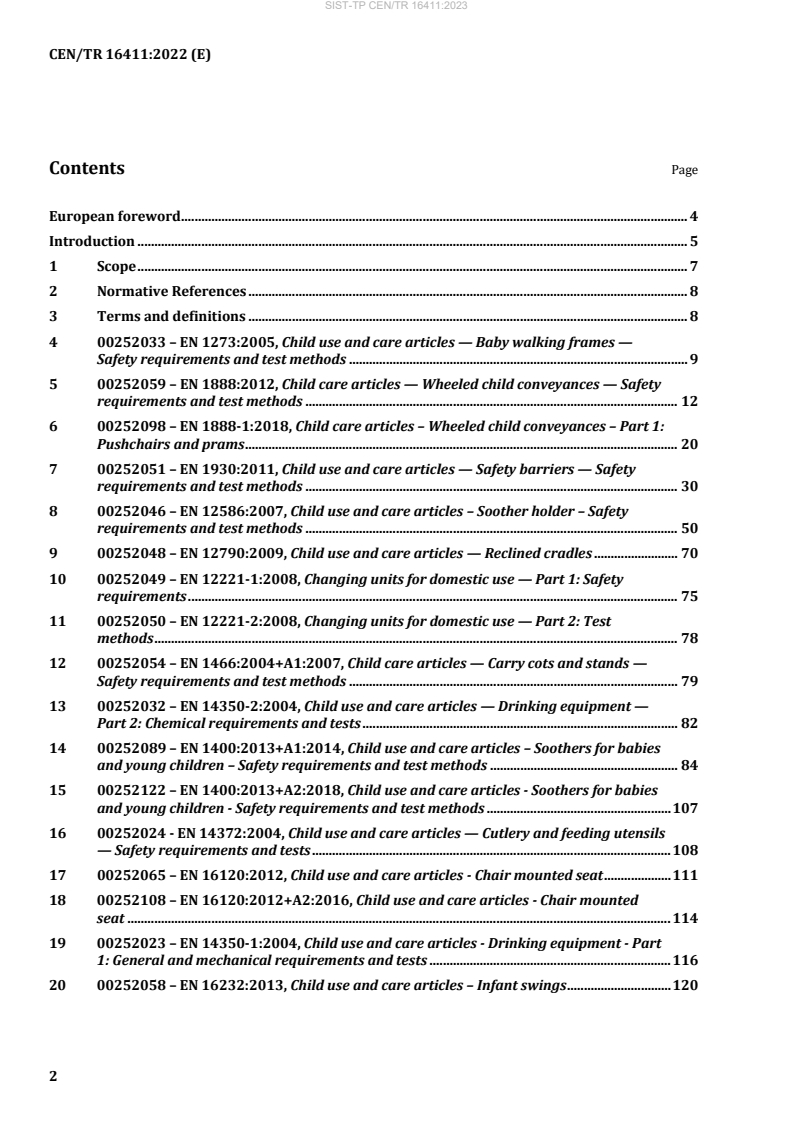
Contents Page
European foreword . 4
Introduction . 5
1 Scope . 7
2 Normative References . 8
3 Terms and definitions . 8
4 00252033 – EN 1273:2005, Child use and care articles — Baby walking frames —
Safety requirements and test methods . 9
5 00252059 – EN 1888:2012, Child care articles — Wheeled child conveyances — Safety
requirements and test methods . 12
6 00252098 – EN 1888-1:2018, Child care articles – Wheeled child conveyances – Part 1:
Pushchairs and prams . 20
7 00252051 – EN 1930:2011, Child use and care articles — Safety barriers — Safety
requirements and test methods . 30
8 00252046 – EN 12586:2007, Child use and care articles – Soother holder – Safety
requirements and test methods . 50
9 00252048 – EN 12790:2009, Child use and care articles — Reclined cradles . 70
10 00252049 – EN 12221-1:2008, Changing units for domestic use — Part 1: Safety
requirements . 75
11 00252050 – EN 12221-2:2008, Changing units for domestic use — Part 2: Test
methods . 78
12 00252054 – EN 1466:2004+A1:2007, Child care articles — Carry cots and stands —
Safety requirements and test methods . 79
13 00252032 – EN 14350-2:2004, Child use and care articles — Drinking equipment —
Part 2: Chemical requirements and tests . 82
14 00252089 – EN 1400:2013+A1:2014, Child use and care articles – Soothers for babies
and young children – Safety requirements and test methods . 84
15 00252122 – EN 1400:2013+A2:2018, Child use and care articles - Soothers for babies
and young children - Safety requirements and test methods . 107
16 00252024 - EN 14372:2004, Child use and care articles — Cutlery and feeding utensils
— Safety requirements and tests . 108
17 00252065 – EN 16120:2012, Child use and care articles - Chair mounted seat . 111
18 00252108 – EN 16120:2012+A2:2016, Child use and care articles - Chair mounted
seat . 114
19 00252023 – EN 14350-1:2004, Child use and care articles - Drinking equipment - Part
1: General and mechanical requirements and tests . 116
20 00252058 – EN 16232:2013, Child use and care articles – Infant swings . 120
21 00252099 – EN 17022:2018, Child care articles – Bathing aids – Safety requirements
and test methods. 123
22 00252100 – EN 17072:2018, Child care articles – Bath tubs, stands and non-
standalone bathing aids - Safety requirements and test methods . 127
23 00252069 – EN 12586:2007+A1:2011, Child care articles – Soother holder – Safety
requirements and test methods . 134
24 00252114 – EN 14350:2020, Child care articles — Drinking equipment — Safety
requirements and test methods . 140
25 00252036 – EN 13209-1:2004, Child use and care articles — Baby carriers - Safety
requirements and test methods - Part 1: Framed back carriers . 147
26 00252071 – EN 13209-1:2021, Child care articles — Child carriers - Safety
requirements and test methods - Part 1: Framed back carrier . 149
Annex A (informative) Interpretation 3 on 3.9 and 5.1.4.2 in EN 12586:2007, Child use and
care articles — Soother holder — Safety requirements and test methods (WI
00252046) . 151
Annex B (informative) Reply to interpretation 3 on 3.9 and 5.1.4.2 in EN 12586:2007, Child
use and care articles — Soother holder — Safety requirements and test methods (WI
00252046) . 154
Annex C (informative) Reply to interpretation 1 on 5.1.10 in EN 12586:2007 Child use and
care articles — Soother holder — Safety requirements and test methods
(WI 00252046) . 156
Bibliography . 162
European foreword
This document (CEN/TR 16411:2022) has been prepared by Technical Committee CEN/TC 252 “Child
care articles”, the secretariat of which is held by AFNOR.
Attention is drawn to the possibility that some of the elements of this document may be the subject of
patent rights. CEN shall not be held responsible for identifying any or all such patent rights.
This document supersedes CEN/TR 16411:2019.
Any feedback and questions on this document should be directed to the users’ national standards body.
A complete listing of these bodies can be found on the CEN website.
Introduction
This Technical Report contains replies to requests for interpretation and clarifications with regard to
the understanding of clauses in the standards elaborated within the CEN/TC 252. The replies concern
those requests which have resulted in an interpretation or the decision that no action is necessary.
An interpretation does not have the same status as the text of the standard, nor can it overrule the text
of the standard. However, following an interpretation should give assurance that the relevant clause of
the standard has been correctly applied. An interpretation will only be regarded as a clarification of the
meaning of the standard.
a) Disclaimer:
The interpretations and clarifications have been derived by expert groups of CEN/TC 252. The
information contained herein is for guidance only and does not reflect the formal approval by CEN or
CEN member bodies. It should be noted that the interpretations are neither part of any standard nor
have been referenced in the Official Journal of the European Union.
b) Requests for interpretation:
Requests for interpretations may be submitted by a CEN member body through its national committee
or by a CEN/TC 252 liaison (but not directly by an individual or a company) – in accordance with the
interpretation protocols agreed by CEN/TC 252. The requests are then channelled to the relevant
CEN/TC 252 working group which will deal with the request.
A request for an interpretation may lead to:
1) an interpretation of the standard:
this should reflect a reasonable interpretation of how the standard should be used, while taking
into account:
i) the wording of the standard;
ii) the rationale of the standard;
iii) the history of the standard;
2) a no-action decision:
this is applicable when it is agreed that the standard appropriately specifies how a child care article
should be assessed;
3) a proposal for an amendment of the standard:
this is applicable when it is agreed that the standard is deficient in some way.
NOTE Interpretations are published in CEN/TR 16411, which will be updated on a regular basis.
Proposals for amendments will be progressed as new work item proposals in accordance with CEN
rules.
c) Answers to requests for interpretations:
Since requests for interpretations are submitted through a CEN member body, it is assumed that the
member body will keep itself informed about decisions concerning the request and its progress and will
itself inform the originator of the request as appropriate.
Figure 1
1 Scope
The purpose of this document is to provide replies to requests for interpretations and clarifications of:
— EN 1273:2005, Child use and care articles — Baby walking frames — Safety requirements and test
methods;
— EN 1888:2012, Child care articles — Wheeled child conveyances — Safety requirements and test
methods;
— EN 1888-1:2018, Child care articles - Wheeled child conveyances - Part 1: Pushchairs and prams;
— EN 1930:2011, Child use and care articles — Safety barriers — Safety requirements and test methods;
— EN 12586:2007, Child use and care articles — Soother holder — Safety requirements and test
methods;
— EN 12790:2009, Child use and care articles — Reclined cradles;
— EN 12221-1:2008, Changing units for domestic use — Part 1: Safety requirements;
— EN 12221-2:2008, Changing units for domestic use — Part 2: Test methods;
— EN 1466:2004+A1:2007, Child care articles — Carry cots and stands — Safety requirements and test
methods;
— EN 14350-2:2004, Child use and care articles — Drinking equipment — Part 2: Chemical
requirements and tests;
— EN 1400:2013+A1:2014, Child use and care articles — Soothers for babies and young children;
— EN 14372:2004, Child use and care articles — Cutlery and feeding utensils — Safety requirements
and tests;
— EN 16120:2012, Child use and care articles — Chair mounted seat;
— EN 16120:2012+A2:2016, Child use and care articles — Chair mounted seat;
— EN 14350-1:2004, Child use and care articles — Drinking equipment - Part 1: General and
mechanical requirements and tests;
— EN 16232:2013, Child use and care articles — Infant swings.
— EN 17022:2018, Child care articles - Bathing aids - Safety requirements and test methods;
— EN 17072:2018, Child care articles - Bath tubs, stands and non-standalone bathing aids - Safety
requirements and test methods;
— EN 12586:2007+A1:2011, Child care articles - Soother holder – Safety requirements and test
methods;
— EN 14350:2020, Child care articles – Drinking equipment - Safety requirements and test methods;
— EN 13209-1:2004, Child use and care articles - Baby carriers - Safety requirements and test methods -
Part 1: Framed back carriers;
— EN 13209-1:2021, Child care articles - Child carriers - Safety requirements and test methods - Part 1:
Framed back carrier.
2 Normative References
There are no normative references in this document.
3 Terms and definitions
No terms and definitions are listed in this document.
4 00252033 – EN 1273:2005, Child use and care articles — Baby walking frames — Safety requirements and test
methods
Table 1 — Summary table of the request for interpretations classified in the order of the clauses/subclauses of EN 1273:2005
Clause/Subclause Title Interpretation n°
6.1.1 1/2013
6.6.2.3 2/2014
8 Packaging 3/2019
Table 2 — Table of the request for interpretation/clarification for EN 1273:2005
Clause/ Paragraph/
N° Subclause/ Figure/ Question Reply
Annex Table/Note
For the tests order shall we follow 6.1.1. but what is the “test order of
1 6.1.1 the standard” ? Is it the order of requirement §5 or order of tests
methods §6 ?. In one case the §5.9 should be done after §5.14.
Clause/ Paragraph/
N° Subclause/ Figure/ Question Reply
Annex Table/Note
In certain designs of baby walking frames (e.g. non-castor wheels in the
back), after the sideways step test in accordance with 6.6.2.3, the
product stops with only one front wheel off the platform and with the
rear wheels almost in the initial position (see picture).
As neither in 6.6.2.3 nor 6.6.3.2 there is
an indication to change the position of
the product from the position where it
has stopped after the test in 6.6.2.3, the
2 6.6.2.3 tip over test in 6.6.3.2 shall be performed
starting from the position in which the
The mirror committee has been made aware of a lab manually moving
product has stopped after the step test in
the product before performing the tip over test in 6.6.3.2 so that one
6.6.2.3 without changing the position of
front wheel and one back wheel will be off the platform.
the product or of its wheels.
Is the intention of the standard to perform the tip over test starting
from the position in which the product has stopped after the step test in
6.6.2.3 (see picture above) or is it correct to move the product between
6.6.2.3 and 6.6.3.2 so that both the front and the rear wheels on one
side are always off the platform?
Clause/ Paragraph/
N° Subclause/ Figure/ Question Reply
Annex Table/Note
The following wording (highlighted in red) has caused a problem with a
laboratory which insists that all bags, including screw bags of 50mm,
must be marked with the warning in all languages:
8 Packaging
Bags made of flexible plastics which are used for packaging and which
The term All bags should be read as
have an opening perimeter greater than 380 mm, shall have an average
referring to all bags mentioned in the
sheet thickness of not less than 0,038 mm, and their means of closing shall
first paragraph of this clause, i.e. bags
not be drawstring or cord. The average thickness shall be determined
made of flexible plastics which are used
from measurements taken at 10 places on the diagonal of a sample sheet.
for packaging and which have an opening
The requirements for thickness does not apply to the following: perimeter greater than 380 mm.
3 8
a) shrunk-on film packaging, which is normally destroyed when the To avoid possible interpretation issues
packaging is opened by the user; the clause has been revised in the draft of
the revised standard currently in
b) bags made of perforated film, which makes it possible for the child to
Enquiry stage to align with the most
breathe through the film, and which is unable to form a vacuum and stick
recent approach given in TR 13387-3.
to the face of the child. To comply with this requirement any area of
maximum dimensions 30 mm x 30 mm shall have a minimum hole area of
1 %.
All bags shall be conspicuously marked with:
WARNING — Keep covering away from children to avoid suffocation.
5 00252059 – EN 1888:2012, Child care articles — Wheeled child conveyances — Safety requirements and test
methods
Table 3 — Summary table of the request for interpretations classified in the order of the clauses/subclauses of EN 1888:2012
Clause/Subclause Title Interpretation n°
4.2 Principle of the most onerous condition 19/2018
8.4 17/2018
8.5 Choking and ingestion hazards 14/2017
18/2018
8.5.2.3 Bite test 16/2017
8.10.3 & 8.10.6 8.10.3 Irregular surface test 19/2018
8.10.6 Handle strength
10.3 Purchase information 20/2018
Table 4 — Table of the request for interpretation/clarification for EN 1888:2012
Clause/
N° Subclause/ Question Reply
Annex
Following label would be tested according to Torque test and Tensile
The current standard does not exclude any
test by some accredited labs, but according to others it's excepted from
kind of material from the requirement.
this requirement. Depending on material of the label, but criteria test
Therefore, all types of labels shall be tested,
or not test are not clear. Herewith the interpretations we received:
even if made of paper, fabric or any permeable
14 8.5
1. NO TEST because it’s made of fabric: Quotation Lab A: “This kind of material.
labels are usually made of fabric; we do not consider fabric as posing
The question will be raised to TC252/WG6 for
choking hazard (such as in EN71-1 on toys) and we do not test them. If
a common approach on this issue which
your label is covered with plastic however, we will test it as a small
concerns all childcare articles standards.
part”
Clause/
N° Subclause/ Question Reply
Annex
2. TEST Depends on permeability Quotation Lab B: “we use test method
for fabric permeability evaluation like defined in EK2 AK2.2 for toys
(see below) « If a drop of water is not entirely soaked up after 10
seconds, the “fabric” is considered as not enough permeable and is
considered as hazardous small part.”
How to interpret “pinch the materials of the bumper bar between
finger and thumb and attach the bite tester…”
Our understanding is that clause explicitly requires the tester to pinch
the materials between the thumb and forefinger and then apply the
This interpretation is correct. The standard
bite tester. We have experience with labs that only use the bite tester to
clearly says that the materials shall be pinched
determine the “smallest amount” and they do this by opening the bite
between thumb and forefinger.
tester slightly and then pushing it into the material until a small
16 8.5.2.3
The method used by the laboratory is not
amount of material is between the teeth after which they close the
correct. This method has been developed and
tester and perform the test. We believe that this method is both not
validated by the TC252/WG6 and introduced
realistic and in non-conformance with the test method. Additionally,
in all relevant standards.
we have experience with labs that do perform this method according to
our interpretation which causes confusion and inconsistency.
We would like to know what the commission says and how this method
should be interpreted.
Clause/
N° Subclause/ Question Reply
Annex
We are asking in prEN 1888-1 to look also for cords and loops which
originate outside of the occupant space but can be brought inside the
occupant space by pulling them with a force of 25N.
Is the intention of this requirement to fail stroller bags like these two
represented below (imagine the first picture with the seat unit instead
of the carry cot)?
If we want to keep the measurement approach, shouldn’t we define
that if the strap is larger than xx mm than it is not to be considered a
cord anymore? In fact we speak about narrow fabrics in 8.4.1, but we
do not give any specification of what narrow means…
No it was not the intention of the working
Can we please discuss this during the next WG3 meeting in June?
group to consider and fail such handles. The
main reason is that they are not part of the
17 8.4
product.
Clause/
N° Subclause/ Question Reply
Annex
“When tested in accordance with 8.5.2.1 and 8.5.2.2 any component or
part of a component within the protected volume that is removed,
whether intended to be removed without the use of a tool or not, shall
not fit entirely within the small parts cylinder (5.6) in any orientation
without compression.”
To assess if a cover can be removed by the
“When tested in accordance with 8.5.2.3 no filling, rubber, plastic, foam,
child during use; relevant conditions can be
etc. shall be detached from the bumper bar. If components indicate
found into the mattress standard, EN16890:
signs of detachment carry out tests in accordance with 8.5.2.1 and
2017, clause 8.3.2.2.3
8.5.2.2 at the position where the components show signs of
detachment.”
The bite test shall then be conducted in
accordance with the procedure described, on
Regarding 8.5.2.3 (Bite Test)
the inner cover.
1. How can “a cover that can be removed by the child during use” be
18 8.5.1
assessed?
The accessibility of the filling material through
2. How shall foam of the bumper bar be assessed, when it is covered
openings on both sides of the bumper bar
by a non-removable cover, but which is not fully closed at both ends?
(these openings can be more or less reduced
In the example below, where the bumper bar had 2 covers (one outer
by elastic straps or the like) is another concern
with zipper and an inner which enclosed the foam from one end to the
that needs to be addressed by amendment to
other), the lab has
the current wording of the standard.
1. Opened the zipper of the outer cover
2. Pushed the inner cover back to reach the foam
3. => Failed
Does this procedure correspond to the standard?
Clause/
N° Subclause/ Question Reply
Annex
If the cover is not removable (no zipper) but not completely closed at
both ends, shall the cover be partially removed to show direct access to
the foam inside?
(“Not completely closed” means in this case, that it is somehow
possible to push/pull it back)
4.2 Principle of the most onerous condition
The working group agrees that the most
onerous condition can only be determined by
Unless otherwise stated each test shall be conducted with the vehicle in
testing all different configuration, but we need
the most onerous condition for that test in terms of:
to ensure the test is reproducible. It is
- […]
reminded that in case of control of the market
only one sample is tested.
- the adjustment of seat units, pram bodies, handles, car seats, and any
4.2
other adjustable features or accessories, or any other optional
arrangement of the vehicle allowed in the manufacturer's instructions or
19 8.10.3
To ensure reproducibility the proposal is
otherwise approved by the manufacturer.
accepted:
8.10.6
- telescopic handle shall be positioned in its
8.10.3.2 Irregular surface test – Test method
highest position
The vehicle shall be placed on the irregular surface test equipment (5.10)
- adjustable (e.g. pivoting) part of the
in a position so that the vehicle handle(s) can be attached to the
handle shall be aligned with the handle frame
independent articulating arms (5.10.2). The handle(s) shall be attached
- in the pushchair configuration, the seat
to the articulating arms initially positioned horizontally so that the free
Clause/
N° Subclause/ Question Reply
Annex
movement of the handle(s) is not restricted unit is placed in the forward-facing direction
(corresponding to the most current use) –
or controlled by the articulating arms. Where there are more than two
where it is possible.
handles the articulating arms shall be attached to the outer pair of
handles.
[…] In the case of a simple pushchair with
reversible handle the number of cycles shall be
For vehicles having alternative arrangements, the test shall be carried
divided to test the product in each direction of
out for a total of 72 000 times, with a minimum of 48 000 cycles in the
use.
seat unit arrangement, and for the remaining 24 000 cycles, with an
equal number of cycles for each arrangement.
8.10.6.2.2 Handle strength – Durability test
Position the vehicle on a horizontal surface without the parking device
applied.
[…]
For vehicles having alternative arrangements the test shall be carried out
a total of 10 000 cycles, with an equal number of cycles for each
arrangement.
A vehicle may have different arrangements:
• seat unit;
• car seat or
• pram body.
Seat units, car seats and pram bodies can be placed in different
directions:
Clause/
N° Subclause/ Question Reply
Annex
• facing road, or
• facing mother
The handle can also be adjusted in various positions:
• reversible handle
• telescopic handle
• handle height adjustable
What is the best way to test a vehicle offering such a range of different
positions?
How should the number of cycles be divided?
10.3 Purchase information (A.12)
1. Yes a hanger visible at the point of sale is
sufficient as purchase information
The manufacturer, importer or organization responsible for the sale of
the vehicle shall provide the
following information to be clearly visible at the point of sale.
2. If the manufacturers web page is a point of
sale this does not fulfil the requirement.
NOTE If the product is sold through internet, the point of sale is the web
Purchase information shall be available on the
page where the product is sold.
web page.
10.3.1 Information concerning the weight of the child for which the
20 10.3
vehicle is suitable.
3. The manufacturer shall provide all
10.3.2 The warning
required purchase information to the vendor
“WARNING This product is not suitable for running or skating.”
or importer
Questions :
4. No. The laboratory can only check the
information which is delivered with the
1. Is a hanger with the relevant EN 1888 information and warning (see
Clause/
N° Subclause/ Question Reply
Annex
below) sufficient as purchase information ? sample submitted for testing (this information
can be given by a link to a web page). If this
A hanger is visible at the point of sale. Consumers can check the
information is not submitted to the laboratory
informations during their examination of the product in a shop.
this is not a failure but it shall be recorded that
this clause could not be verified.
5. No; the note is just a clarification of what
is a point of sale. The requirement applies to
web page as well.
2.Is it a fail which shall be mentioned in a test report when the
purchase information is provided with such hanger only and not
additionally on the importers web page which is maybe not a “sales
web page “ ?
3. How can an importer ensure that a vendors will provide the
available information on their web pages ?
4. Is it the intention of the standard that an expert in a laboratory has to
check the web pages of vendors to proof the compliance with the
requirements in § 10.3
5. EN 1888 shall be a safety standard. Is the note :
“If the product is sold through internet, the point of sale is the web page
where the product is sold “
a safety requirement or not? If not it should be cancelled
6 00252098 – EN 1888-1:2018, Child care articles – Wheeled child conveyances – Part 1: Pushchairs and prams
& 00252097 – EN1888-2: 2018, Child care articles – Wheeled child conveyances – Part 2: Pushchairs for children
above 15 kg up to 22 kg
Table 5 — Summary table of the request for interpretations classified in the order of the clauses/subclauses of EN 1888-1 & 2:2018
Clause/Subclause Title Interpretation n°
EN1888-1 – Pushchairs and prams
1 Scope 6/2019
8.1.3.2.3 Strength of fastener 9/2020
Completed 2021
8.3.5.4 Locking mechanisms – Requirements for the attachment of pram body and seat unit and car seat to the chassis 3/2019
7/2020
8.4.1 Entanglement hazards – Requirements 2/2018
5/2019
8.9.1.2.1 Stability – Positioning of the vehicle 10/2021
8.9.3 Stability hazards due to the position of swivelling wheels 1/2017
10 Product information 4/2019
EN1888-2 - Pushchairs for children above 15 kg up to 22 kg
6.1.3 & 6.1.4 Attachment of restraint system 8/2020
Strength of fasteners
Table 6 — Table of the request for interpretation/clarification for EN 1888-1 & 2:2018
Clause/
N° Subclause/ Question Reply
Annex
The test method proposed cannot be validated.
The requirement added in EN1888-1 says:
The working group decides the change
Stability hazards due to the position of swivelling wheels
introduced in the irregular surface test method
(EN1888: 2012 cl.8.10.3.2) that swiveling front
To avoid any hazards due to the swivelling wheels being in contact with
wheels shall be unlocked during test will allow
each other impairing the proper run of the wheeled child conveyance, any
to assess whether the wheels are likely to
swivelling wheel shall be able to rotate without blocking each other when
block each other during use on uneven
EN1888-1 orientated in the most onerous position.
surfaces or when the vehicle is driven down
8.9.3 This requirement shall be checked with and without placing the test mass
curbs/steps etc …
A, B or F respectively into the pram body, seat unit or car seat, and before
The blockage of the wheels will cause failure to
and after testing in accordance with 8.10.
the test and this is considered sufficient to
There is no way to assess if the wheels block each other, and this may
assess the risk.
cause discrepancies between labs.
This will be clarified in the rationale by
A test method should be proposed.
amendment to the standard.
The aim of the requirement was not to check
loops formed by the straps of the restraint
system as they are adjusted to the child when
in use and therefore do not create
Checking the prEN1888-1:2018 it seems that there is not any direct
entanglement hazards (as already considered
exclusion of the loop created by the restrain system in the
in the previous EN1888: 2012)
entanglement evaluation. The exclusion refers only to the free length of
EN1888-1
2 restrain system (so for cord, strings and other narrow fabrics)
8.4.1
This is not an interpretation but the wording
of the standard shall be amended to reflect
In the EN 1888:2012 the loop exclusion instead is clearly present
that.
This is mentioned in the draft A1 prepared by
the working group.
Clause/
N° Subclause/ Question Reply
Annex
[This shall be assessed with and without the test mass in the product. The
The rationale behind this was to avoid
pram body, the seat unit or the car seat shall not fall under their own
products where the seat unit/car seat or pram
weight when all the attachment devices are disengaged.]
body was literally suspended.
The idea was to avoid, if the parent had both
hands occupied to release the mechanism,
As far as it is written (and it was the same in EN 1888:2012), this
falling of the seat unit / car seat or pram body;
paragraph requires that, even when there are 2 locking mechanisms, eg
but not look for the most onerous condition
on each side of the seat unit / pram body fulfilling point b or c, the seat
(adjustment of a backrest, position of the test
unit / pram body shall not fall freely under its own weight when both
mass) that would lead to detachment or
mechanism are releases. To assess this, the mechanism must be
EN1888-1 tipping over.
blocked artificially.
8.3.5.4 The working group noted that this sentence
nd
was proposed during 2 enquiry and rejected
Apparently, laboratories are interpreting this requirement in different
(doc N503) but for unknown reasons it was
ways, as the same system is getting today opposite evaluations of pass
added into the draft sent out for formal vote
and fail.
(doc N501).
This issue will be solved in the amendment
currently drafted with the limiting the
Moreover, the rationale for this additional requirement is not clear as a
application of the sentence to pram bodies or
system fulfilling this requirement would not make it clear to a
car seat with a carrying function and therefore
consumer that both locking mechanism are broken, if ever this might
intended to be detached with the child inside.
happen.
The proposal from the French Delegation is
Since the publication of the EN 1888-1 standard we all noticed
correct.
differences between the initials warnings in GB / French translation in
the annex of the GB standard / Wrong translations in the French
Until the amendment is published, following
standard and also differences between annexes. (see table below).
EN1888-1 sentences can be used as they convey the same
meaning:
To summarize if a manufacturer follow the annex of the GB standard or
even made a perfect translation in French of the warnings, those
IMPORTANT – A LIRE ATTENTIVEMENT ET A
translations won’t be in line with the current French version.
CONSERVER POUR REFERENCE ULTERIEURE
Clause/
N° Subclause/ Question Reply
Annex
or
In parallel, if a manufacturer follow the French standard, in order to IMPORTANT : A LIRE ATTENTIVEMENT ET A
complies with the NF EN 1888-1, these warnings should be changed in CONSERVER POUR CONSULTATION
the next future because they will be aligned with the GB version. ULTERIEURE
We all know that the administration for the control of the market does Ne jamais laisser l’enfant sans surveillance
not accept deviation as soon as we are talking about warnings. The rule
or
is simple: a warning shall be given exactly under the form given in the
Ne jamais laisser un enfant sans surveillance
standard. Even if sometimes the differences are minors. (“a child”,
“your child” instead of “the child” for, example).
S’assurer que tous les dispositifs de
verrouillage sont enclenchés avant utilisation
We decided to introduce in the future draft of the EN 1888 these
corrections.
However, in the meantime, we must find a way and bring more
Pour éviter toute blessure, maintenir l’enfant à
flexibility during assessment, control and conformity of the products.
l’écart lors du dépliage et du pliage du produit
or
Pour éviter toute blessure, maintenir votre
enfant à l’écart lors du dépliage et du pliage du
produit
The standard has to be applied as it is written,
it is not possible to adapt a definition from
another standard.
EN1888-1
In accordance with the current wording this
8.4.1
kind of strap fails the requirement.
The Experts however, agree there is no real
hazard. A similar free length arising from the
Clause/
N° Subclause/ Question Reply
Annex
restraint system would pass the requirement
• New standard added the requirement for “cords, ribbons and other
and this is not consistent.
narrow fabrics” to be assessed, if they can extend into seat unit.
The issue can only be solved by amending the
• BUT the standard doesn’t specify what “narrow fabric” is, i.e.
standard.
dimension.
• This opens the door for various interpretations.
In the case below – SEE PHOTOS.
• The straps have 25mm width, same as harness straps that are
excluded from the same requirement.
• The straps can only get into protective volume only on purpose by
the parent – misuse, when canopy is removed and purposely routed
above the seat backrest – this is not any potential use situation.
• This construction has been sold over 2.000.000 pcs worldwide. No
single incident.
There is difference in interpretation of the standard between
accredited labs:
LAB A: considers backrest adjustment straps not as narrow fabrics, by
definition used in the other child care standard EN 13209 Baby Carrier
where narrow is defined <19mm,
LAB B: applies the EN1888 without explanation what “narrow” is,
considers no other standards.
Clause/
N° Subclause/ Question Reply
Annex
If the manufacturer claims the product is a
pushchair the EN1888-1 applies.
There are tricycles on the market that, in addition to the toy function
where the child can either propel the tricycle using the pedals or steer
EN1888-1
6 the tricycle when he is still not able to pedal, offer transportation
If the product is marketed as a tricycle with an
features with high backrest, restraint system, bumper bar and
additional function to transport young
including in some models a mom-facing position (see example below)
children for a short period (i.e 6 months) then
it is excluded from the scope of the standard.
Clause/
N° Subclause/ Question Reply
Annex
In such a case, a risk assessment and type
examination should be conducted to assess the
safety of the product, and the relevant clauses
of EN1888-1 can be used.
Some criteria to decide whether a tricycle
provides a transport function for young
children are:
- Marketing, age grade
- Seat unit with a high backrest, reclinable
or not
- Restrain system
- Ability to disengage child steering
- ….
The WG3 agrees safety requirements and test
methods shall be drafted to cover these
specific products. An adhoc group is created to
discuss and propose a draft.
Clause/
N° Subclause/ Question Reply
Annex
The Italian mirror committee requires a clarification about point d) of
the clause 8.3.5.4 of EN 1888-1:2018.
In the condition d) the word “release” has been
The point d) of the clause 8.3.5.4 requires more than two
replaced by “detach”, to clearly explain this
independent actions but it not specified that the action shall be on an
concerns the detachment of the seat unit/car
operating device that acts on a locking device.
EN1888-1
seat or pram body. And the last sentence of the
On the market there are products where it is necessary act on a button
requirement clause applies to this condition.
8.3.5.4
on one side of the pram body or seat unit or car seat then act on
“Detach” means “separate”. Therefore, the case
another button on the other side of the pram body or seat unit or car
described by the Italian mirror committee
seat and finally lift the pram body or seat unit or car seat.
would meet the condition d)
Both buttons require a force less than 50N to be activated and they do
not reengage automatically.
Clause/
N° Subclause/ Question Reply
Annex
In both clauses to test the strength of the attachment of the
restraint system, and of the fasteners, the standard says
6.1.3 Attachment of restraint system
Conduct the test in accordance with EN1888-1:2018, 8.1.3.2.2,
applying a 220 N force.
6.1.4 Strength of fasteners
The intention of the wording of EN1888-2 is to
Conduct the test in accordance with EN1888-1:2018, 8.1.3.2.3,
replace the forces used in 8.1.3.2.2 and
EN1888-2
applying a 250 N force.
8.1.3.2.3 by higher forces representing a
8 6.1.3
And clause 4.1 reads heavier child. Therefore, the components must
6.1.4
be tested just once, applying the forces given in
To meet the requirements of this standard the vehicle shall be tested
EN1888-2
additionally, in accordance with the clauses listed below and in the order
given in EN 1888-1 (see 4.2).
Therefore it is not clear, if the components have to be tested
- First in accordance with EN1888-1 (with a lower force)
- Then in accordance with EN1888-2
Or just once, applying the force given in EN1888-2
This test shall be carried out on the sample,
before other integrity tests, therefore, it is not
intended in the current wording of the
A tensile force of 200 N shall be gradually applied to the straps either side
standard, to remove the restraint system to
of the fastener. Maintain this force for 1 min.
test it separately.
EN1888-1
The standard does not clearly describe how the te
...