

prEN 3034
(Main)Aerospace series — Nuts, self-locking, hexagonal with captive washer, — In heat resisting steel FE-PA92HT (A286), silver coated Classification: 1100 MPa/425 °C
- Abstract
This document specifies the dimensions of self-locking, silver coated hexagonal nuts with captive washer and MJ-thread in heat resisting steel FE-PA92HT (A286) for aerospace applications.
Maximum test temperature of the parts is 425 °C.
- Status
- Not Published
- Publication Date
- 14-Sep-2027
- Technical Committee
- ASD-STAN - Aerospace
- Drafting Committee
- ASD-STAN/D 3/S 2 - Fasteners
- Current Stage
- 4060 - Closure of enquiry - Enquiry
- Start Date
- 16-Jul-2026
- Completion Date
- 16-Jul-2026

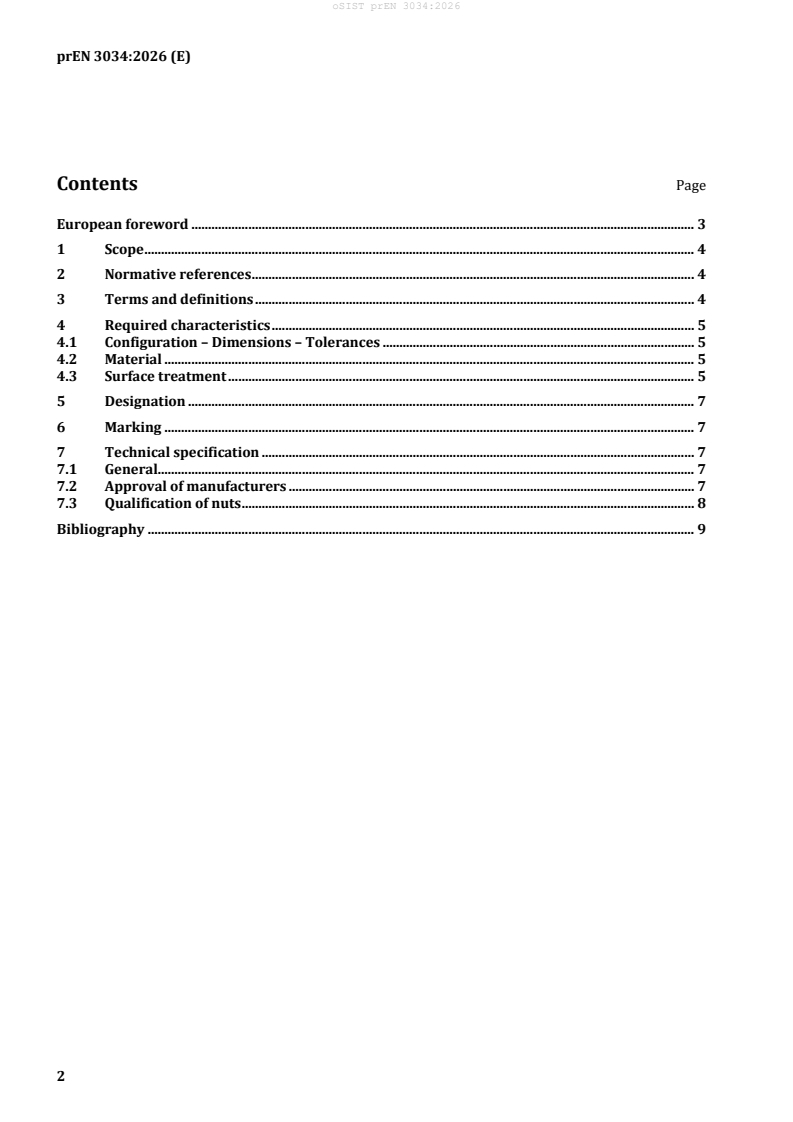
prEN 3034 is a CEN draft European Standard for aerospace self-locking hexagonal nuts with captive washer, silver coated, made in heat resisting steel FE-PA92HT (A286). It specifies the dimensions, material, surface treatment, marking and technical specification for MJ-thread nuts in the 1100 MPa/425 °C classification, for aerospace applications and for parts tested up to 425 °C.
What does prEN 3034 specify?
prEN 3034 specifies the dimensions of self-locking, silver coated hexagonal nuts with captive washer and MJ-thread in heat resisting steel FE-PA92HT (A286). It is organized as scope, normative references, terms and definitions, required characteristics, designation, marking and technical specification.
The document’s structure matters because it separates the product definition from the material, coating, identification and qualification rules. A buyer or engineer can use that layout to check whether a proposed nut matches the form, finish and approval basis expected for aerospace use.
What are the key requirements of prEN 3034?
prEN 3034 sets the core product requirements in Clause 4 and the technical acceptance rules in Clause 7. The most important points are the nut geometry, the permitted materials, the silver coating, and the qualification and manufacturer approval expectations.
Geometry, dimensions and fit
Clause 4.1 ties the configuration to Figure 1 and the dimensions, tolerances and mass to Figure 1 and Table 1. Dimensions apply after coating and are given in millimetres, while unspecified form details are left to the manufacturer.
In practice, this means the finished part must be checked after plating, not only before it. The table also gives the MJ thread codes and size range, and the finished nuts must fit a standard socket wrench.
Thread and self-locking features
Clause 4.1 states that the thread is in accordance with ISO 5855-1 and ISO 5855-2. The self-locking zone uses an out-of-round form to achieve the required locking torque, and the tolerance basis changes before that out-of-round forming.
This matters because the locking function is part of the design, not just the thread size. Suppliers need to control forming and inspection so the nut locks as intended without losing wrench engagement.
Material selection
Clause 4.2 specifies heat resisting steel for both the nut and the washer. For the nut, the permitted material routes include EN 2399, EN 3638, EN 3639 or TR 3791, with SAE AMS5525 also allowed for MJ3 and MJ4 at the manufacturer’s discretion; the washer uses EN 3638 or TR 3791.
For users, this is the traceability basis for procurement and certification. It tells the supplier which material specifications are acceptable for the fastener and its captive washer.
Surface treatment and coating control
Clause 4.3 requires silver coating in accordance with EN 2786, with coating thickness between 5 µm and 15 µm. For MJ6 and larger, the coating must be at least 5 µm at the pitch diameter; for MJ5 and smaller, the threads must be completely coated. The washer must be passivated in accordance with EN 2516.
This is important for corrosion protection and consistent performance of the self-locking feature. It also tells inspection teams where thickness and coverage must be verified.
Marking and designation
Clause 5 gives the designation format, with the thread code identifying the size in Table 1. Clause 6 requires marking in accordance with EN 2424, class F.
That means the product can be identified in procurement, inspection and traceability records using a common aerospace marking scheme.
Technical specification, approval and qualification
Clause 7 states that the nuts shall comply with EN 3152. It also requires the manufacturer to be an approved production organization for aerospace products and to maintain a quality management system such as EN 9100 or an equivalent aerospace accepted system.
Clause 7.3 requires qualification of nuts using a procedure such as EN 9133 or an equivalent aerospace accepted procedure, with tests documented unless otherwise agreed. For practice, this is the route for supplier approval, product qualification and controlled production release.
Who uses prEN 3034?
prEN 3034 is used by aerospace fastener manufacturers, quality managers, procurement teams, and inspection laboratories. It is also relevant to designers and buyers who need self-locking nuts with captive washers for aerospace assemblies.
In practice, these roles use it to specify the part correctly, verify material and coating compliance, approve suppliers, and qualify product families for temperature-classified aerospace service.
What changed in prEN 3034 from the previous edition?
prEN 3034:2026 will supersede EN 3034:2009 and EN 3034:2009/AC:2011. The stated changes are:
- Clause 3, Terms and definitions, added.
- Clause 4.2, Material, now includes TR 3791 and SAE AMS5525.
- Clause 7, Technical specification, has been editorially revised.
Which standards are used with prEN 3034?
The document refers to several standards that supply the detailed rules behind the nut specification:
- EN 2399, EN 3638, EN 3639 and TR 3791 - material references for the heat resisting steel used in the nut and washer.
- SAE AMS5525 - an additional permitted material route for MJ3 and MJ4 nuts.
- EN 2424 - marking of aerospace products.
- EN 2516 - passivation of the washer.
- EN 2786 - electrolytic silver plating of fasteners.
- EN 3152 - the main technical specification that these nuts shall meet.
- ISO 5855-1 and ISO 5855-2 - general requirements and limit dimensions for MJ threads.
- EN 9100 and EN 9133 - cited as examples for quality management and qualification practice in Clause 7 and the bibliography.
What does the prEN 3034 document contain?
The document contains one figure for the nut configuration and one table for dimensions, thread codes and mass. These are the main design references for checking size, fit and geometry.
It also contains clause text for material choice, silver coating, passivation, designation and marking. These parts support purchasing and incoming inspection.
Clause 7 provides the production approval and qualification framework used for aerospace supply. That makes the document useful for supplier control, product release and qualification records.
Relations
- Effective Date
- 20-Jan-2026
Get Certified
Connect with accredited certification bodies for this standard

BUREAU VERITAS Certification Germany
Bureau Veritas certification in Germany.

Element Materials Technology
Materials testing and product certification.

AQMS Ltd.
AQMS provides ISO certification to SMEs across the UK.
Sponsored listings
Frequently Asked Questions
prEN 3034 is a draft published by the European Committee for Standardization (CEN). Its full title is "Aerospace series — Nuts, self-locking, hexagonal with captive washer, — In heat resisting steel FE-PA92HT (A286), silver coated Classification: 1100 MPa/425 °C". This standard covers: This document specifies the dimensions of self-locking, silver coated hexagonal nuts with captive washer and MJ-thread in heat resisting steel FE-PA92HT (A286) for aerospace applications. Maximum test temperature of the parts is 425 °C.
This document specifies the dimensions of self-locking, silver coated hexagonal nuts with captive washer and MJ-thread in heat resisting steel FE-PA92HT (A286) for aerospace applications. Maximum test temperature of the parts is 425 °C.
prEN 3034 is classified under the following ICS (International Classification for Standards) categories: 49.030.30 - Nuts. The ICS classification helps identify the subject area and facilitates finding related standards.
prEN 3034 has the following relationships with other standards: It is inter standard links to EN 3034:2009. Understanding these relationships helps ensure you are using the most current and applicable version of the standard.
prEN 3034 is available in PDF format for immediate download after purchase. The document can be added to your cart and obtained through the secure checkout process. Digital delivery ensures instant access to the complete standard document.
Standards Content (Sample)
SLOVENSKI STANDARD
01-julij-2026
Aeronavtika - Matice, samozapiralne, šestrobe, z robljeno podložko - Iz
toplotnoodpornega jekla FE-PA92HT (A286), posrebrene - Klasifikacija: 1100
MPa/425 °C
Aerospace series - Nuts, self-locking, hexagonal with captive washer, - In heat resisting
steel FE-PA92HT (A286), silver coated Classification: 1100 MPa/425 °C
Luft‑ und Raumfahrt - Sechskantmutter, selbstsichernd mit Bördelscheibe - Aus
hochwarmfestem Stahl FE‑PA92HT (A286), versilbert - Klasse: 1 100 MPa/425 °C
Ta slovenski standard je istoveten z: prEN 3034
ICS:
49.025.10 Jekla Steels
49.030.30 Matice Nuts
2003-01.Slovenski inštitut za standardizacijo. Razmnoževanje celote ali delov tega standarda ni dovoljeno.
DRAFT
EUROPEAN STANDARD
NORME EUROPÉENNE
EUROPÄISCHE NORM
April 2026
ICS 49.030.30 Will supersede EN 3034:2009
English Version
Aerospace series - Nuts, self-locking, hexagonal with
captive washer, - In heat resisting steel FE-PA92HT
(A286), silver coated Classification: 1100 MPa/425 °C
Luft- und Raumfahrt ¿ Sechskantmutter, selbstsichernd
mit Bördelscheibe ¿ Aus hochwarmfestem Stahl FE-
PA92HT (A286), versilbert Klasse: 1 100 MPa/425 °C
This draft European Standard is submitted to CEN members for enquiry. It has been drawn up by the Technical Committee ASD-
STAN.
If this draft becomes a European Standard, CEN members are bound to comply with the CEN/CENELEC Internal Regulations
which stipulate the conditions for giving this European Standard the status of a national standard without any alteration.
This draft European Standard was established by CEN in three official versions (English, French, German). A version in any other
language made by translation under the responsibility of a CEN member into its own language and notified to the CEN-CENELEC
Management Centre has the same status as the official versions.
CEN members are the national standards bodies of Austria, Belgium, Bulgaria, Croatia, Cyprus, Czech Republic, Denmark, Estonia,
Finland, France, Germany, Greece, Hungary, Iceland, Ireland, Italy, Latvia, Lithuania, Luxembourg, Malta, Netherlands, Norway,
Poland, Portugal, Republic of North Macedonia, Romania, Serbia, Slovakia, Slovenia, Spain, Sweden, Switzerland, Türkiye and
United Kingdom.
Recipients of this draft are invited to submit, with their comments, notification of any relevant patent rights of which they are
aware and to provide supporting documentation.
Warning : This document is not a European Standard. It is distributed for review and comments. It is subject to change without
notice and shall not be referred to as a European Standard.
EUROPEAN COMMITTEE FOR STANDARDIZATION
COMITÉ EUROPÉEN DE NORMALISATION
EUROPÄISCHES KOMITEE FÜR NORMUNG
CEN-CENELEC Management Centre: Rue de la Science 23, B-1040 Brussels
© 2026 CEN All rights of exploitation in any form and by any means reserved Ref. No. prEN 3034:2026 E
worldwide for CEN national Members.
Contents Page
European foreword . 3
1 Scope . 4
2 Normative references . 4
3 Terms and definitions . 4
4 Required characteristics . 5
4.1 Configuration – Dimensions – Tolerances . 5
4.2 Material . 5
4.3 Surface treatment . 5
5 Designation . 7
6 Marking . 7
7 Technical specification . 7
7.1 General. 7
7.2 Approval of manufacturers . 7
7.3 Qualification of nuts . 8
Bibliography . 9
European foreword
This document (prEN 3034:2026) has been prepared by ASD-STAN.
After enquiries and votes carried out in accordance with the rules of this Association, this document has
received the approval of the National Associations and the Official Services of the member countries of
ASD-STAN, prior to its presentation to CEN.
This document is currently submitted to the CEN Enquiry.
This document will supersede EN 3034:2009 and EN 3034:2009/AC:2011.
EN 3034:2009/AC:2011:
— Clause 3, “Terms and definitions”, added;
— 4.2, “Material”, standards TR 3791 and SAE AMS5525 added;
— Clause 7, “Technical specification”, editorially revised.
1 Scope
This document specif
...