

EN 12327:2012
(Main)Gas infrastructure - Pressure testing, commissioning and decommissioning procedures - Functional requirements
- Abstract
This European Standard describes common principles for pressure testing, commissioning and decommissioning of gas infrastructures as covered by the functional European Standards of the Technical Committee CEN/TC 234, see Annex B. They have been extracted from the detailed codes of practice and operating manuals in the member countries.
This European Standard does not cover installation pipework which is covered by EN 1775.
The specified procedures are applicable to strength testing, tightness testing and combined testing. Test pressure levels, test periods and acceptance criteria are not covered by this European Standard.
Additional measures or different methods of testing, commissioning or decommissioning can be required by legislation of the individual member countries or at the discretion of the pipeline operator.
This European Standard specifies common basic principles for gas infrastructure. Users of this European Standard should be aware that more detailed national standards and/or code of practice may exist in the CEN member countries.
This European Standard is intended to be applied in association with these national standards and/or codes of practice setting out the above-mentioned basic principles.
In the event of conflicts in terms of more restrictive requirements in national legislation/regulation with the requirements of this European Standard, the national legislation/regulation should take precedence as illustrated in CEN/TR 13737.
CEN/TR 13737 gives:
- clarification of all legislations/regulations applicable in a member state;
- if appropriate, more restrictive national requirements;
- a national contact point for the latest information.
- Status
- Published
- Publication Date
- 31-Jul-2012
- Withdrawal Date
- 27-Feb-2013
- Technical Committee
- CEN/TC 234 - Gas infrastructure
- Current Stage
- 9092 - Decision on results of review/2YR ENQ - revise - Review Enquiry
- Start Date
- 15-Sep-2024
- Completion Date
- 21-Oct-2026
Buy Documents






Overview
EN 12327:2012 - published by CEN (Technical Committee CEN/TC 234) - sets out the functional requirements and common principles for pressure testing, commissioning and decommissioning of gas infrastructure. It applies to transmission and distribution pipeline systems (excluding installation pipework covered by EN 1775) and is intended to be used together with more detailed national standards and codes of practice.
Key topics and technical requirements
- Scope and application
- Applies to strength testing, tightness testing and combined testing of gas infrastructure components.
- Does not specify test pressure levels, test durations or detailed acceptance criteria - these are determined by national legislation or pipeline operators.
- Test media and methods
- Recognises hydrostatic testing (water), pneumatic testing (air or inert gas) and testing with gas at operating pressure.
- Allows a preliminary low‑pressure air/inert gas test (max 0.5 bar) before hydrostatic testing; this does not replace the tightness test.
- Pressure relationships
- Strength/combined tests: test pressure shall be higher than the system’s Maximum Incidental Pressure (MIP).
- Tightness tests: typically at or above Operating Pressure (OP) when no prior strength test has been done.
- Measurement, instrumentation and recording
- Pressure measurement equipment minimum accuracy class 0,6; recording devices may be class 1.
- Pressure gauges should comply with EN 837-1/2/3; instruments require valid calibration certificates.
- Temperature effects must be considered; temperature instruments should have minimum scale reading of 1 °C.
- Procedures, safety and documentation
- A written procedure must specify: test method, test pressure, period, test medium, acceptance criteria, allowable pressure/volume variation, leak detection, release/disposal of test media and water disposal.
- Tests must be performed by an authorized/competent person. Precautions against over‑pressure, movement of unrestrained pipework and safety of personnel/environment are required.
- Test report and commissioning or decommissioning records are required.
- Annexes
- Annex A: purging criteria (informative)
- Annex B: list of related CEN/TC 234 functional standards
Practical applications and users
Who uses EN 12327:2012:
- Pipeline operators and system owners
- Commissioning and testing engineers
- Contractors performing pressure tests and purging
- Competent authorities and inspectors
- Health, safety and environmental teams
Typical use cases:
- Commissioning new pipeline sections and stations
- Verifying mechanical strength and leak tightness after construction or repair
- Safe decommissioning and purging of gas-filled equipment
- Preparing test procedures and compliance documentation in line with national rules
Related standards
- EN 1775 - installation pipework (not covered by EN 12327)
- EN 837-1 / EN 837-2 / EN 837-3 - pressure gauge standards
- CEN/TR 13737 - guidance on national legislation and precedence of restrictive national requirements
EN 12327:2012 is a functional, high‑level European standard for safe, consistent pressure testing and operational procedures across gas infrastructure projects, intended to be applied in conjunction with national codes and detailed standards.
Relations
- Effective Date
- 08-Jun-2022
- Effective Date
- 28-Jan-2026
- Effective Date
- 28-Jan-2026
- Effective Date
- 28-Jan-2026
- Effective Date
- 28-Jan-2026
- Effective Date
- 28-Jan-2026
- Effective Date
- 28-Jan-2026
- Effective Date
- 28-Jan-2026
- Referred By
EN 1776:1998 - Gas supply systems - Natural gas measuring stations - Functional requirements - Effective Date
- 28-Jan-2026
- Effective Date
- 28-Jan-2026
- Effective Date
- 28-Jan-2026
- Effective Date
- 28-Jan-2026
- Effective Date
- 28-Jan-2026
- Effective Date
- 28-Jan-2026
- Effective Date
- 28-Jan-2026
Buy Documents
Get Certified
Connect with accredited certification bodies for this standard

DIBt (Deutsches Institut für Bautechnik)
German Institute for Building Technology.
DIN CERTCO
DIN Group product certification.

Aboma Certification B.V.
Specialized in construction, metal, and transport sectors.
Sponsored listings
Frequently Asked Questions
EN 12327:2012 is a standard published by the European Committee for Standardization (CEN). Its full title is "Gas infrastructure - Pressure testing, commissioning and decommissioning procedures - Functional requirements". This standard covers: This European Standard describes common principles for pressure testing, commissioning and decommissioning of gas infrastructures as covered by the functional European Standards of the Technical Committee CEN/TC 234, see Annex B. They have been extracted from the detailed codes of practice and operating manuals in the member countries. This European Standard does not cover installation pipework which is covered by EN 1775. The specified procedures are applicable to strength testing, tightness testing and combined testing. Test pressure levels, test periods and acceptance criteria are not covered by this European Standard. Additional measures or different methods of testing, commissioning or decommissioning can be required by legislation of the individual member countries or at the discretion of the pipeline operator. This European Standard specifies common basic principles for gas infrastructure. Users of this European Standard should be aware that more detailed national standards and/or code of practice may exist in the CEN member countries. This European Standard is intended to be applied in association with these national standards and/or codes of practice setting out the above-mentioned basic principles. In the event of conflicts in terms of more restrictive requirements in national legislation/regulation with the requirements of this European Standard, the national legislation/regulation should take precedence as illustrated in CEN/TR 13737. CEN/TR 13737 gives: - clarification of all legislations/regulations applicable in a member state; - if appropriate, more restrictive national requirements; - a national contact point for the latest information.
This European Standard describes common principles for pressure testing, commissioning and decommissioning of gas infrastructures as covered by the functional European Standards of the Technical Committee CEN/TC 234, see Annex B. They have been extracted from the detailed codes of practice and operating manuals in the member countries. This European Standard does not cover installation pipework which is covered by EN 1775. The specified procedures are applicable to strength testing, tightness testing and combined testing. Test pressure levels, test periods and acceptance criteria are not covered by this European Standard. Additional measures or different methods of testing, commissioning or decommissioning can be required by legislation of the individual member countries or at the discretion of the pipeline operator. This European Standard specifies common basic principles for gas infrastructure. Users of this European Standard should be aware that more detailed national standards and/or code of practice may exist in the CEN member countries. This European Standard is intended to be applied in association with these national standards and/or codes of practice setting out the above-mentioned basic principles. In the event of conflicts in terms of more restrictive requirements in national legislation/regulation with the requirements of this European Standard, the national legislation/regulation should take precedence as illustrated in CEN/TR 13737. CEN/TR 13737 gives: - clarification of all legislations/regulations applicable in a member state; - if appropriate, more restrictive national requirements; - a national contact point for the latest information.
EN 12327:2012 is classified under the following ICS (International Classification for Standards) categories: 91.140.40 - Gas supply systems. The ICS classification helps identify the subject area and facilitates finding related standards.
EN 12327:2012 has the following relationships with other standards: It is inter standard links to EN 12327:2000, EN 837-1:1996, EN 837-3:1996, EN 837-2:1997, EN 17649:2022, EN 12186:2025, CEN/TS 15399:2007, EN 1594:2009, EN 1776:1998, CEN/TR 13737-2:2014, EN 17928-1:2024, EN 1776:2025, EN 12007-5:2024, EN 1594:2024, EN 12007-2:2012. Understanding these relationships helps ensure you are using the most current and applicable version of the standard.
EN 12327:2012 is associated with the following European legislation: Standardization Mandates: M/017. When a standard is cited in the Official Journal of the European Union, products manufactured in conformity with it benefit from a presumption of conformity with the essential requirements of the corresponding EU directive or regulation.
EN 12327:2012 is available in PDF format for immediate download after purchase. The document can be added to your cart and obtained through the secure checkout process. Digital delivery ensures instant access to the complete standard document.
Standards Content (Sample)
2003-01.Slovenski inštitut za standardizacijo. Razmnoževanje celote ali delov tega standarda ni dovoljeno.UHQHKDQMHGasinfrastruktur - Druckprüfung, In- und Außerbetriebnahme - Funktionale AnforderungenInfrastructures gazières - Essaies de pression, modes opératoires de mise en service et de mise hors service des réseaux - Prescriptions fonctionnellesGas infrastructure - Pressure testing, commissioning and decommissioning procedures - Functional requirements91.140.40Sistemi za oskrbo s plinomGas supply systemsICS:Ta slovenski standard je istoveten z:EN 12327:2012SIST EN 12327:2013en,fr,de01-januar-2013SIST EN 12327:2013SLOVENSKI
STANDARDSIST EN 12327:20011DGRPHãþD
EUROPEAN STANDARD NORME EUROPÉENNE EUROPÄISCHE NORM
EN 12327
August 2012 ICS 91.140.40 Supersedes EN 12327:2000English Version
Gas infrastructure - Pressure testing, commissioning and decommissioning procedures - Functional requirements
Infrastructures gazières - Essais de pression, modes opératoires de mise en service et de mise hors service des réseaux - Prescriptions fonctionnelles
Gasinfrastruktur - Druckprüfung, In- und Außerbetriebnahme - Funktionale Anforderungen This European Standard was approved by CEN on 24 May 2012.
CEN members are bound to comply with the CEN/CENELEC Internal Regulations which stipulate the conditions for giving this European Standard the status of a national standard without any alteration. Up-to-date lists and bibliographical references concerning such national standards may be obtained on application to the CEN-CENELEC Management Centre or to any CEN member.
This European Standard exists in three official versions (English, French, German). A version in any other language made by translation under the responsibility of a CEN member into its own language and notified to the CEN-CENELEC Management Centre has the same status as the official versions.
CEN members are the national standards bodies of Austria, Belgium, Bulgaria, Croatia, Cyprus, Czech Republic, Denmark, Estonia, Finland, Former Yugoslav Republic of Macedonia, France, Germany, Greece, Hungary, Iceland, Ireland, Italy, Latvia, Lithuania, Luxembourg, Malta, Netherlands, Norway, Poland, Portugal, Romania, Slovakia, Slovenia, Spain, Sweden, Switzerland, Turkey and United Kingdom.
EUROPEAN COMMITTEE FOR STANDARDIZATION
COMITÉ EUROPÉEN DE NORMALISATION EUROPÄISCHES KOMITEE FÜR NORMUNG
Management Centre:
Avenue Marnix 17,
B-1000 Brussels © 2012 CEN All rights of exploitation in any form and by any means reserved worldwide for CEN national Members. Ref. No. EN 12327:2012: ESIST EN 12327:2013
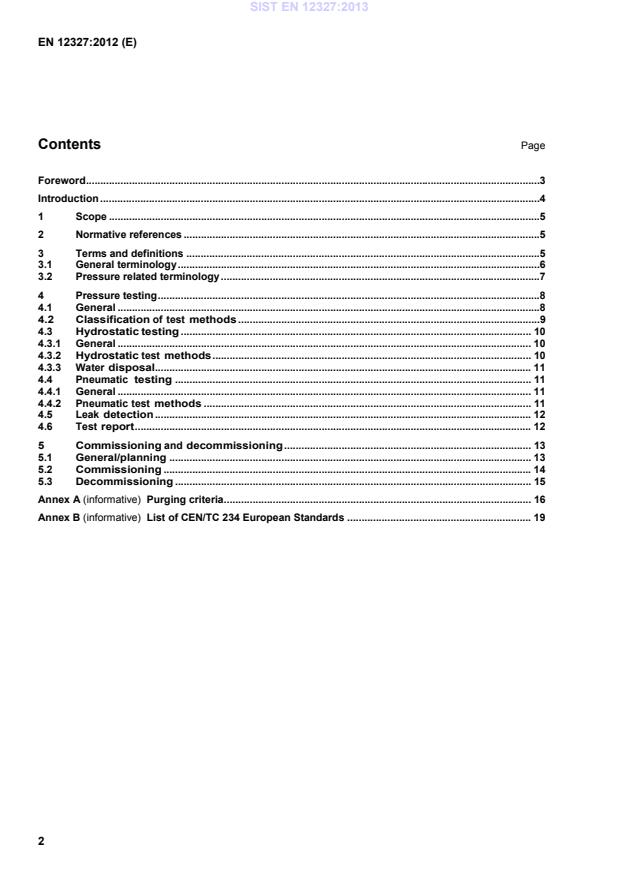
testing . 114.4.1 General . 114.4.2 Pneumatic test methods . 114.5 Leak detection . 124.6 Test report . 125 Commissioning and decommissioning . 135.1 General/planning . 135.2 Commissioning . 145.3 Decommissioning . 15Annex A (informative)
Purging criteria . 16Annex B (informative)
List of CEN/TC 234 European Standards . 19 SIST EN 12327:2013
Users of this European Standard should be aware that more detailed national standards and/or code of practice may exist in the CEN member countries. This European Standard is intended to be applied in association with these national standards and/or codes of practice setting out the above-mentioned basic principles. In the event of conflicts in terms of more restrictive requirements in national legislation/regulation with the requirements of this European Standard, the national legislation/regulation should take precedence as illustrated in CEN/TR 13737 (all parts). CEN/TR 13737 (all parts) give: clarification of all legislations/regulations applicable in a member state; if appropriate, more restrictive national requirements; a national contact point for the latest information. 2 Normative references The following documents, in whole or in part, are normatively referenced in this document and are indispensable for its application. For dated references, only the edition cited applies. For undated references, the latest edition of the referenced document (including any amendments) applies. EN 837-1, Pressure gauges
Part 1: Bourdon tube pressure gauges
Dimensions, metrology, requirements and testing EN 837-2, Pressure gauges
Part 2: Selection and installation recommendations for pressure gauges EN 837-3, Pressure gauges
Part 3: Diaphragm and capsule pressure gauges
Dimensions, metrology, requirements and testing 3 Terms and definitions For the purposes of this document, the following terms and definitions apply. SIST EN 12327:2013
EXAMPLE Polyethylene. SIST EN 12327:2013
Warning notices shall be displayed, where deemed necessary. 4.1.15 Only work related to the pressure test shall be carried out on the test section.
4.1.16 Pressure testing should not be carried out against closed valves. NOTE Valves in the closed position should not be assumed to be leak tight. 4.1.17 All pipework that does not have end load resistance shall be restrained against movement during the test by design or external means. 4.1.18 Upon satisfactory completion of the pressure test, the pipeline section should be commissioned as soon as possible. If there is a time lag between testing and commissioning, the pipeline section should be kept under pressure. Before commissioning, the pressure shall be checked to make sure that the pipeline section has not been damaged. 4.2 Classification of test methods Table 1 gives the relationship between test methods,
...
2003-01.Slovenski inštitut za standardizacijo. Razmnoževanje celote ali delov tega standarda ni dovoljeno.UHQHKDQMHGasinfrastruktur - Druckprüfung, In- und Außerbetriebnahme - Funktionale AnforderungenInfrastructures gazières - Essaies de pression, modes opératoires de mise en service et de mise hors service des réseaux - Prescriptions fonctionnellesGas infrastructure - Pressure testing, commissioning and decommissioning procedures - Functional requirements91.140.40Sistemi za oskrbo s plinomGas supply systemsICS:Ta slovenski standard je istoveten z:EN 12327:2012SIST EN 12327:2013en,fr,de01-januar-2013SIST EN 12327:2013SLOVENSKI
STANDARDSIST EN 12327:20011DGRPHãþD
EUROPÄISCHE NORM EUROPEAN STANDARD NORME EUROPÉENNE
EN 12327
August 2012 ICS 91.140.40 Ersatz für EN 12327:2000Deutsche Fassung
Gasinfrastruktur - Druckprüfung, In- und Außerbetriebnahme - Funktionale Anforderungen
Gas infrastructure - Pressure testing, commissioning and decommissioning procedures - Functional requirements
Infrastructures gazières - Essais de pression, modes opératoires de mise en service et de mise hors service des réseaux - Prescriptions fonctionnelles Diese Europäische Norm wurde vom CEN am 24. Mai 2012 angenommen.
Die CEN-Mitglieder sind gehalten, die CEN/CENELEC-Geschäftsordnung zu erfüllen, in der die Bedingungen festgelegt sind, unter denen dieser Europäischen Norm ohne jede Änderung der Status einer nationalen Norm zu geben ist. Auf dem letzten Stand befindliche Listen dieser nationalen Normen mit ihren bibliographischen Angaben sind beim Management-Zentrum des CEN-CENELEC oder bei jedem CEN-Mitglied auf Anfrage erhältlich.
Diese Europäische Norm besteht in drei offiziellen Fassungen (Deutsch, Englisch, Französisch). Eine Fassung in einer anderen Sprache, die von einem CEN-Mitglied in eigener Verantwortung durch Übersetzung in seine Landessprache gemacht und dem Management-Zentrum mitgeteilt worden ist, hat den gleichen Status wie die offiziellen Fassungen.
CEN-Mitglieder sind die nationalen Normungsinstitute von Belgien, Bulgarien, Dänemark, Deutschland, der ehemaligen jugoslawischen Republik Mazedonien, Estland, Finnland, Frankreich, Griechenland, Irland, Island, Italien, Kroatien, Lettland, Litauen, Luxemburg, Malta, den Niederlanden, Norwegen, Österreich, Polen, Portugal, Rumänien, Schweden, der Schweiz, der Slowakei, Slowenien, Spanien, der Tschechischen Republik, der Türkei, Ungarn, dem Vereinigten Königreich und Zypern.
EUROPÄISCHES KOMITEE FÜR NORMUNG EUROPEAN COMMITTEE FOR STANDARDIZATION
COMITÉ EUROPÉEN DE NORMALISATION
Management-Zentrum:
Avenue Marnix 17,
B-1000 Brüssel © 2012 CEN Alle Rechte der Verwertung, gleich in welcher Form und in welchem Verfahren, sind weltweit den nationalen Mitgliedern von CEN vorbehalten.Ref. Nr. EN 12327:2012 DSIST EN 12327:2013
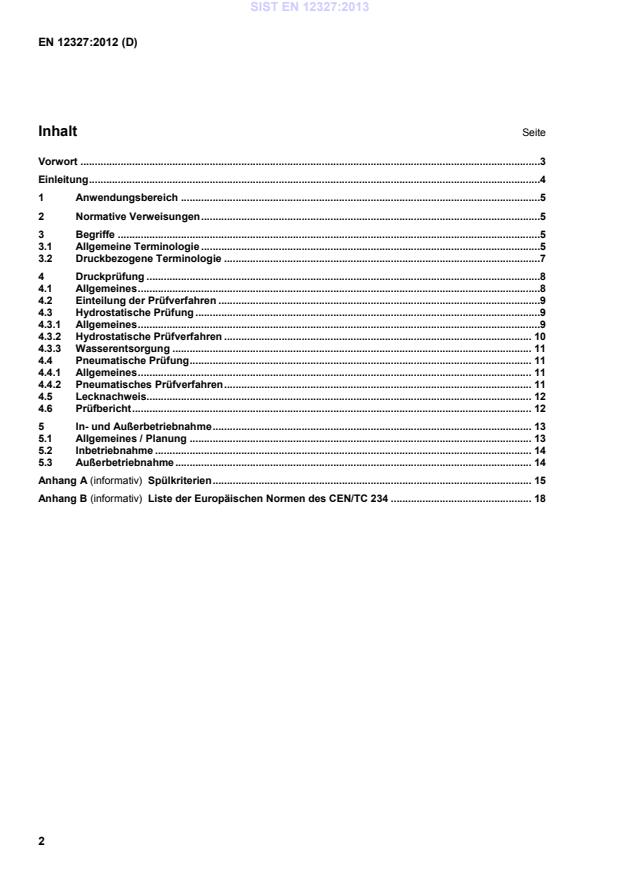
Spülkriterien . 15 Anhang B (informativ)
Liste der Europäischen Normen des CEN/TC 234 . 18
Gasinfrastrukturen sind komplex und die Wichtigkeit der Sicherheit in Bezug auf ihre Konstruktion sowie ihre Anwendung hat in den Mitgliedsländern zur Entwicklung sehr detaillierter Anwendungsregeln und Betriebsvorschriften geführt. Diese detaillierten Ausführungen umfassen anerkannte Regeln der Gastechnik sowie die spezifischen Anforderungen, die von den Gesetzesstrukturen der Mitgliedsländer auferlegt werden. SIST EN 12327:2013
Für die Anwendung dieses Dokuments gelten die folgenden Begriffe. 3.1 Allgemeine Terminologie 3.1.1 Gasinfrastruktur Rohrleitungssysteme einschließlich der Leitungsanlagen und Einrichtungen für den Transport und die Verteilung von Gas SIST EN 12327:2013
Anmerkung 1 zum Begriff: Folgende Verfahren werden unterschieden: direkte Spülung: die vollständige Verdrängung von Luft durch Gas oder umgekehrt; indirekte Spülung: die vollständige Verdrängung von Luft durch Inertgas und daran anschließend dessen vollständige Verdrängung durch Gas oder umgekehrt. Anmerkung 2 zum Begriff: Alternativ durch eine Trennschicht (aus Inertgas oder als Molch) zwischen der Luft und dem Gas oder umgekehrt. 3.2 Druckbezogene Terminologie 3.2.1 Auslegungsdruck DP Druck, auf dem die Auslegungsberechnung beruht 3.2.2 Betriebsdruck OP Druck, der in einem System unter normalen Betriebsbedingungen auftritt 3.2.3 maximal zulässiger Betriebsdruck MOP maximaler Druck, mit dem ein System unter normalen Betriebsbedingungen ständig betrieben werden kann Anmerkung 1 zum Begriff: Normale Betriebsbedingungen sind: keine Störung von Einrichtungen oder des Gasflusses. 3.2.4 Grenzdruck im Störungsfall MIP maximaler, durch Sicherheitseinrichtungen begrenzter Druck, der in einem System kurzzeitig auftreten kann SIST EN 12327:2013
Prüfverfahren; Prüfdruck; Prüfdauer; Prüfmedium; Akzeptanzkriterien; zulässige Schwankungen von Druck und Volumen; minimaler Druck in der existierenden Gasinfrastruktur; Lecknachweismethoden; Entleerung vom Prüfmedium; Entsorgung von Wasser. 4.1.4 Prüfverfahren und -druck hängen jeweils von den verwendeten Werkstoffen, den Verbindungen, dem beabsichtigten Einsatzgebiet und den Vorgaben der einschlägigen Funktionsnormen für Gasinfrastrukturen ab (siehe Anhang B). 4.1.5 Die maximal zulässige Druck-/Volumenschwankung hängt von Werkstoff, Druck, Durchmesser und örtlicher Lage des Prüfabschnitts ab. 4.1.6 Die Auswirkungen von atmosphärischen Druck- und/oder Temperaturschwankungen sind gegebenenfalls zu berücksichtigen, insbesondere dann, wenn ein Teil des Prüfabschnitts nicht vollständig erdbedeckt ist. 4.1.7 Wenn Kunststoff geprüft wird, sollten Auswirkungen des Kriechverhaltens während Druckaufbringung und Prüfphase berücksichtigt werden. BEISPIEL Polyäthylen 4.1.8 Die Höhe des Drucks wird mit Hilfe von Druckmessgeräten, Mindestanforderung Genauigkeitsklasse 0,6, mit einem maximalen Messbereich vom 1,1- bis 1,5-fachen des Prüfdruckes, gemessen. Druckaufzeichnungsgeräte der Klasse 1 dürfen, sofern geeignet, verwendet werden. Es muss sichergestellt werden, dass der vollständige Prüfabschnitt unter Druck steht. Um Temperaturschwankungen, die den Prüfdruck beeinflussen, zu berücksichtigen, kann ein Temperaturmessgerät mit einer Mindestgenauigkeit von 1 °C eingesetzt werden.
durch konstruktive oder externe Maßnahmen abgesichert werden. 4.1.18 Der Rohrleitungsabschnitt sollte im Anschluss an die erfolgreiche Druckprüfung möglichst umgehend in Betrieb genommen werden. Wenn es zu Verzögerungen zwischen Prüfung und Inbetriebnahme kommt, sollte der Rohrleitungsabschnitt unter Druck bleiben. Vor der Inbetriebnahme muss der Druck kontrolliert werden, um sicherzugehen, dass der Rohrleitungsabschnitt keine Schäden erlitten hat. 4.2 Einteilung der Prüfverfahren
...