

EN 13639:2017
(Main)Determination of total organic carbon in limestone
- Abstract
This European Standard specifies methods for the determination of the total organic carbon content (TOC) in limestone.
The standard describes the reference method and alternative methods which can be considered to be equivalent.
In the case of a dispute, only the reference method is used.
Any other methods may be used provided they are calibrated, either against the reference method or against internationally accepted reference materials, in order to demonstrate their equivalence.
- Status
- Published
- Publication Date
- 26-Sep-2017
- Withdrawal Date
- 30-Mar-2018
- Technical Committee
- CEN/TC 51 - Cement and building limes
- Drafting Committee
- CEN/TC 51/WG 15 - Revision of methods of testing cement
- Current Stage
- 9093 - Decision to confirm - Review Enquiry
- Start Date
- 05-Mar-2023
- Completion Date
- 21-Oct-2026



Overview
EN 13639:2017 (CEN) specifies standardized methods for the determination of total organic carbon (TOC) in limestone. The standard defines a reference method (gravimetric wet oxidation) and several alternative methods (gravimetric furnace oxidation; infrared detection with low‑ or high‑temperature furnace oxidation; conductivity or IR methods). Alternative methods are acceptable when calibrated against the reference method or internationally accepted reference materials. In dispute situations, only the reference method is used. The standard covers TOC determinations typically for contents below 1%.
Key topics and technical requirements
- Scope and principle: Methods measure organic carbon after decarbonation, oxidation of organics, purification of produced CO2 and CO2 measurement.
- Reference vs. alternative methods: Clause structure includes
- Gravimetric wet oxidation - reference method (Clause 6)
- Gravimetric furnace oxidation - alternative method No. 1 (Clause 7)
- IR detection with low‑temperature furnace oxidation - alternative No. 2 (Clause 8)
- IR detection or conductivity with high‑temperature furnace oxidation - alternatives No. 3 and No. 4 (Clauses 9–10)
- Sampling and preparation: Laboratory sample prepared per ISO 11464; ground to pass a 90 µm sieve (ISO 3310‑1). Drying may be modified for samples with volatile organic carbon.
- Reagents and apparatus: Lists analytical‑grade reagents (acids, oxidising mixtures, catalysts), carrier gases (CO2‑free air, O2, N2 or Ar), balances, ovens, crucibles and specialized analysers (combustion/IR carbon analysers).
- Quality and statistics: Specifies number of tests (minimum one for series under statistical control; two when not in a series; two in disputes), repeatability and reproducibility concepts, determination limit methodology (based on DIN 32645), and requirement for blank determinations and calibration.
- Reporting: Test report requirements and calculations are specified (see Clause 12).
Applications and typical users
- Who uses EN 13639:2017
- Cement, lime and mortar manufacturers
- Quarry operators and limestone producers
- Analytical and quality control laboratories
- Construction material R&D and certification bodies
- Practical uses
- Quality control of limestone feedstock for cement and lime production
- Ensuring compliance with material specifications where organic carbon affects processing or product performance
- Validating alternative TOC measurement systems through calibration to the reference method
- Resolving analytical disputes by applying the specified reference method and repeatability criteria
Related standards and references
- ISO 11464 - Soil quality - Pretreatment of samples for physico‑chemical analysis (sample prep guidance cited)
- ISO 3310‑1 - Test sieves (90 µm sieve specification)
- DIN 32645 - Statistical determination limit methodology referenced
Keywords: EN 13639:2017, total organic carbon, TOC in limestone, CEN standard, reference method, gravimetric method, infrared detection, furnace oxidation, sampling 90 µm, calibration, repeatability, reproducibility.
Relations
- Effective Date
- 04-Oct-2017
- Effective Date
- 04-Oct-2017
- Effective Date
- 25-Aug-2026
- Effective Date
- 09-Feb-2026
- Effective Date
- 28-Jan-2026
- Effective Date
- 12-Aug-2026
- Effective Date
- 28-Jan-2026
- Effective Date
- 28-Jan-2026
- Effective Date
- 28-Jan-2026
- Effective Date
- 28-Jan-2026
- Effective Date
- 28-Jan-2026
- Effective Date
- 28-Jan-2026
Get Certified
Connect with accredited certification bodies for this standard

DIBt (Deutsches Institut für Bautechnik)
German Institute for Building Technology.
DIN CERTCO
DIN Group product certification.

Aboma Certification B.V.
Specialized in construction, metal, and transport sectors.
Sponsored listings
Frequently Asked Questions
EN 13639:2017 is a standard published by the European Committee for Standardization (CEN). Its full title is "Determination of total organic carbon in limestone". This standard covers: This European Standard specifies methods for the determination of the total organic carbon content (TOC) in limestone. The standard describes the reference method and alternative methods which can be considered to be equivalent. In the case of a dispute, only the reference method is used. Any other methods may be used provided they are calibrated, either against the reference method or against internationally accepted reference materials, in order to demonstrate their equivalence.
This European Standard specifies methods for the determination of the total organic carbon content (TOC) in limestone. The standard describes the reference method and alternative methods which can be considered to be equivalent. In the case of a dispute, only the reference method is used. Any other methods may be used provided they are calibrated, either against the reference method or against internationally accepted reference materials, in order to demonstrate their equivalence.
EN 13639:2017 is classified under the following ICS (International Classification for Standards) categories: 91.100.10 - Cement. Gypsum. Lime. Mortar. The ICS classification helps identify the subject area and facilitates finding related standards.
EN 13639:2017 has the following relationships with other standards: It is inter standard links to EN 13639:2002/AC:2004, EN 13639:2002, ISO 11464:2006, ISO 3310-1:2016, EN 4681-002:2012, EN 18136:2026, EN 197-1:2011, EN 19694-5:2016, EN 14306:2015, EN 197-6:2023, EN 14306:2009, EN 14306:2009+A1:2013. Understanding these relationships helps ensure you are using the most current and applicable version of the standard.
EN 13639:2017 is available in PDF format for immediate download after purchase. The document can be added to your cart and obtained through the secure checkout process. Digital delivery ensures instant access to the complete standard document.
Standards Content (Sample)
2003-01.Slovenski inštitut za standardizacijo. Razmnoževanje celote ali delov tega standarda ni dovoljeno.Bestimmung des Gesamtgehalts an organishchem Kohlenstoff in KalksteinDetermination du carbone organique total dans le calcaireDetermination of total organic carbon in limestone91.100.10Cement. Mavec. Apno. MaltaCement. Gypsum. Lime. MortarICS:Ta slovenski standard je istoveten z:EN 13639:2017SIST EN 13639:2017en01-december-2017SIST EN 13639:2017SLOVENSKI
STANDARDSIST EN 13639:2004/AC:2004SIST EN 13639:20041DGRPHãþD
EUROPEAN STANDARD NORME EUROPÉENNE EUROPÄISCHE NORM
EN 13639
September
t r s y ICS
{ sä s r rä s r Supersedes EN
s u x u {ã t r r tEnglish Version
Determination of total organic carbon in limestone Determination du carbone organique total dans le calcaire
Bestimmung des Gesamtgehalts an organischem Kohlenstoff in Kalkstein This European Standard was approved by CEN on
t x June
t r s yä
egulations which stipulate the conditions for giving this European Standard the status of a national standard without any alterationä Upætoædate lists and bibliographical references concerning such national standards may be obtained on application to the CENæCENELEC Management Centre or to any CEN memberä
translation under the responsibility of a CEN member into its own language and notified to the CENæCENELEC Management Centre has the same status as the official versionsä
CEN members are the national standards bodies of Austriaá Belgiumá Bulgariaá Croatiaá Cyprusá Czech Republicá Denmarká Estoniaá Finlandá Former Yugoslav Republic of Macedoniaá Franceá Germanyá Greeceá Hungaryá Icelandá Irelandá Italyá Latviaá Lithuaniaá Luxembourgá Maltaá Netherlandsá Norwayá Polandá Portugalá Romaniaá Serbiaá Slovakiaá Sloveniaá Spainá Swedená Switzerlandá Turkey and United Kingdomä
EUROPEAN COMMITTEE FOR STANDARDIZATION COMITÉ EUROPÉEN DE NORMALISATION EUROPÄISCHES KOMITEE FÜR NORMUNG
CEN-CENELEC Management Centre:
Avenue Marnix 17,
B-1000 Brussels
t r s y CEN All rights of exploitation in any form and by any means reserved worldwide for CEN national Membersä Refä Noä EN
s u x u {ã t r s y ESIST EN 13639:2017
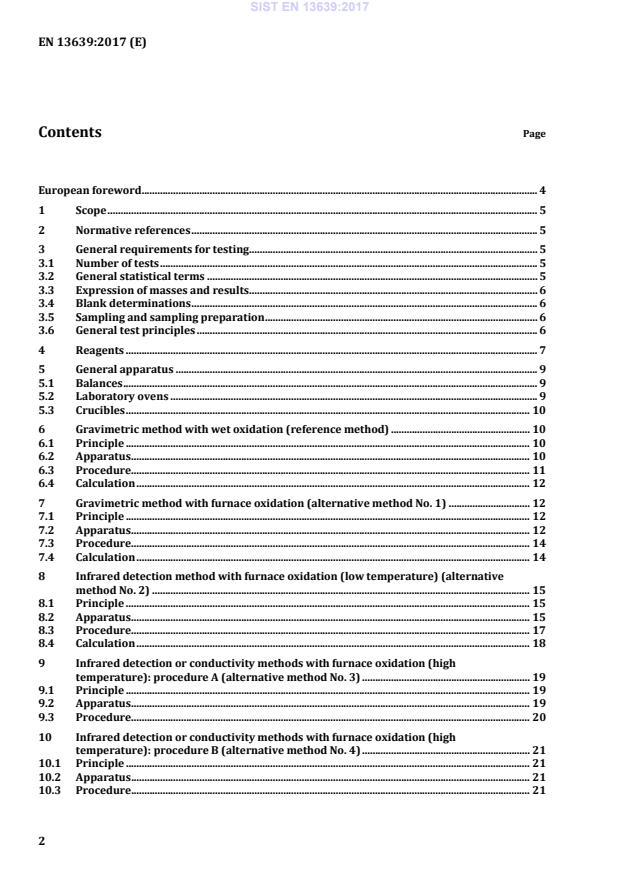
European foreword . 4 1 Scope . 5 2 Normative references . 5 3 General requirements for testing . 5 3.1 Number of tests . 5 3.2 General statistical terms . 5 3.3 Expression of masses and results . 6 3.4 Blank determinations . 6 3.5 Sampling and sampling preparation . 6 3.6 General test principles . 6 4 Reagents . 7 5 General apparatus . 9 5.1 Balances . 9 5.2 Laboratory ovens . 9 5.3 Crucibles . 10 6 Gravimetric method with wet oxidation (reference method) . 10 6.1 Principle . 10 6.2 Apparatus . 10 6.3 Procedure. 11 6.4 Calculation . 12 7 Gravimetric method with furnace oxidation (alternative method No. 1) . 12 7.1 Principle . 12 7.2 Apparatus . 12 7.3 Procedure. 14 7.4 Calculation . 14 8 Infrared detection method with furnace oxidation (low temperature) (alternative method No. 2) . 15 8.1 Principle . 15 8.2 Apparatus . 15 8.3 Procedure. 17 8.4 Calculation . 18 9 Infrared detection or conductivity methods with furnace oxidation (high temperature): procedure A (alternative method No. 3) . 19 9.1 Principle . 19 9.2 Apparatus . 19 9.3 Procedure. 20 10 Infrared detection or conductivity methods with furnace oxidation (high temperature): procedure B (alternative method No. 4) . 21 10.1 Principle . 21 10.2 Apparatus . 21 10.3 Procedure. 21 SIST EN 13639:2017
Features of commercial HF (High Frequency) combustion/infrared carbon analyzers . 23 A.1 Combustion . 23 A.2 Infrared gas analyser . 24 Annex B (informative)
Assignment of reagents to methods . 25 Bibliography . 27
is the probability level f is the variability (number of degrees of freedom) DlDlxxk∆=1 is the relative uncertainty ∑=−=niixxxQ12)( is the number of calibration samples n number of test results p is the number of analyses of each calibration sample sxD is the standard deviation of the procedure t is the quantile of the t-distribution (f = n
xi is the analysed content assigned to a calibration sample x is the arithmetic mean of the contents assigned to all calibration samples xDl is the determination limit
¿xDl is half width of the two-side prognosis interval
NOTE This determination limit is based on DIN 32645 [2]. 3.3 Expression of masses and results Express masses in grams to an accuracy of ± 0,000 5 g. Express the results as a percentage to at least two decimal places, if the difference between the individual test results exceeds two times the repeatability standard deviation given in Clause 10, the test shall be repeated. 3.4 Blank determinations Carry out a blank determination without a sample following the same procedure and using the same amounts of reagents. Correct the results obtained for the analytical determination. 3.5 Sampling and sampling preparation Depending on the size of the raw material, a sample of at least 1 kg up to 10 kg shall be taken by the procedure described in ISO 11464, dried, crushed, reduced and ground to form a representative laboratory sample for analysis. The laboratory sample shall pass a sieve of 90 µm mesh size conforming to ISO 3310-1. The drying process shall be modified, if necessary, to accommodate samples known to contain high contents of volatile organic carbon. 3.6 General test principles In general, all the methods consist of the following procedures: a) decarbonation of the original limestone sample; b) purification of the carrier gas, if it is not of high purified quality; SIST EN 13639:2017
0,88 to 0,91 hydrochloric acid
1,18 to 1,19 hydrogen peroxide
1,11 nitric acid
1,40 to 1,42 phosphoric acid
1,71 to 1,75 sulfuric acid
1,84
The degree of dilution is always given as a volumetric sum, for example: dilute hydrochloric acid 1 + 2 means that 1 volume of concentrated hydrochloric acid is to be mixed with 2 volumes of water. 4.2 Ammonia solution (NH3 × H2O) 4.3 Calcium chloride, anhydrous (CaCI2) 4.4 Calibration reagent, metal For example iron with known carbon content. 4.5 Carbon dioxide in oxygen Concentrations, 0,95 vol.% and 19 vol.% 4.6 Carrier gases Air, oxygen, nitrogen or argon, free of carbon dioxide and hydrocarbons, depending on application. 4.7 Chromic acid Dissolve 5 g of chromium trioxide (4.8) in 10 ml of water. Add sulfuric acid (4.13) with stirring, until the chromium trioxide, which initially precipitates, is just re-dissolved. SIST EN 13639:2017
1 Where substances are listed in REACH Regulation Annex XIV List of substances subject to authorisation, Article 56(3) of REACH provides a generic exemption from authorisation for listed substances for use in scientific research and development.
Scientific research and development includes use of listed substances as reagents for analysis and quality control purposes as long as use is carried out under controlled conditions and the amount does not exceed one tonne per year, per legal entity.
See FAQ [585] on ECHA's website. SIST EN 13639:2017
Key 1 drying tower for carrier gas containing a carbon dioxide absorbent (4.34) 2 safety trap 3 inlet tube for the oxidising mixture (4.26) with glass rod stopper 4 150 ml round bottom distillation flask 5 100 ml sharp bottomed flask with 50 ml chromic acid (4.7) 6 absorption tube filled (in order upwards) with zinc wool (4.38), lead chromate (4.19) and silver gauze (4.32). The materials are fixed in place with cotton wool plugs 7 absorption tube filled with magnesium perchlorate (4.20), fixed in place with cotton wool 8 absorption tube with a total volume of approximately 11 cm3 containing, in order, absorbent for carbon dioxide (4.34), and magnesium perchlorate (4.20), fixed in place with cotton wool plugs 9 bubble counter, containing concentrated sulfuric acid (4.13) 10 vacuum Figure 1 – Apparatus for TOC determination by wet oxidation method WARNING — Use of acid resistant fume cupboards and acid resistant gloves is obligatory 6.3 Procedure Weigh, to an accuracy of ± 0,000 5 g, (1,00 ± 0,05) g of limestone (m1). Transfer to the 150 ml round flask, add 2 ml of water and 30 ml of phosphoric acid (4.12). Heat the mixture and boil gently for 4 min to expel the carbon dioxide. Cool the mixture and connect the flask to the apparatus. Substitute for the absorption tube (see Figure 1, no. 8) a glass tube and pass 2 I of carrier gas (4.6) through the apparatus to clear the system of any carbon dioxide. Fit the weighed absorption tube again to the apparatus and SIST EN 13639:2017
is the mass of the absorption tube before absorption of carbon dioxide in grams; mu2 is the mass of the absorption tube after absorption of carbon dioxide in grams; m1 is the mass of the sample in grams. 7 Gravimetric method with furnace oxidation (alternative method No. 1) 7.1 Principle The carbon dioxide in the limestone is driven off by use of hydrochloric acid (4.9) at approximately 130 °C. The insolubl
...