

EN 197-6:2023
(Main)Cement - Part 6: Cement with recycled building materials
- Abstract
This document specifies cement with recycled concrete fines whose intended use is the preparation of concrete, mortar, grout, etc.
- Status
- Published
- Publication Date
- 20-Jun-2023
- Technical Committee
- CEN/TC 51 - Cement and building limes
- Drafting Committee
- CEN/TC 51/WG 6 - Definitions and terminology of cement
- Current Stage
- 6060 - Definitive text made available (DAV) - Publishing
- Start Date
- 21-Jun-2023
- Due Date
- 01-May-2024
- Completion Date
- 21-Jun-2023

Overview
EN 197-6:2023 is a European standard developed by CEN that specifies requirements for cement incorporating recycled concrete fines. This innovative standard targets sustainable construction by defining cement types that include recycled building materials, enabling concrete, mortar, grout, and similar products to be manufactured with reduced environmental impact. The standard was officially approved in April 2023 and applies across all CEN member countries, supporting circular economy principles and minimizing natural resource consumption in cement production.
Key Topics
Scope and Application
EN 197-6:2023 covers cement formulations containing recycled concrete fines intended for concrete, mortar, and grout preparation. It complements existing cement standards by enabling the use of secondary raw materials in line with sustainability goals.Constituents and Composition
The standard details the constituents of cement, including recycled concrete fines sourced from recycled aggregates, concrete production by-products, or reclaimed crushed aggregates as defined in EN 206. These fines must meet strict quality criteria such as low organic content, controlled sulfate and chloride levels, and limits on clay and other impurities. Other cement ingredients adhere to the composition requirements from EN 197-1 with specific provisions for limestone content.Performance and Requirements
The standard specifies tests for cement properties including setting time, strength, soundness, and heat of hydration. Additional limits for sulfate and chloride contents ensure durability and structural integrity. Reactive properties of recycled fines are considered negligible, maintaining compatibility with existing concrete standards.Designation and Labelling
Standardized cement designations under EN 197-6 clearly identify the strength class, the presence of recycled fines, and early strength characteristics (L for low, N for normal, R for rapid). This facilitates traceability and regulatory compliance in construction projects.Conformity and Quality Control
Conformity criteria align with EN 197-1 and EN 197-2, ensuring consistent performance and quality through factory production control and regular testing. Manufacturers are required to monitor total alkali content and other parameters critical to cement functionality.
Applications
Sustainable Construction Materials
EN 197-6 enables the incorporation of recycled concrete fines into cement, promoting sustainability by reducing landfill waste and conserving natural resources.Concrete & Mortar Production
Cement complying with EN 197-6 can be used for structural and non-structural concrete, mortar for masonry, grouts, and other cement-based products while meeting performance and durability requirements.Circular Economy Initiatives
Specifiers and manufacturers can leverage this standard to develop eco-friendly cement formulations that support recycling and reuse of construction and demolition waste, aligning with green building regulations.Compliance with Regional Regulations
The standard supports compliance with local performance and safety standards for cementitious materials by harmonizing chemical and physical requirements for recycled materials.
Related Standards
- EN 197-1:2011 – Composition, specifications, and conformity criteria for common cements; foundational to defining constituents used in EN 197-6.
- EN 206:2013+A2:2021 – Concrete specifications, production, and conformity; outlines definitions and requirements for recycled aggregates used in cement.
- EN 196 Series – Methods for testing chemical composition, fineness, sampling, and other cement properties supporting quality assurance.
- EN 933-9 – Testing for fines assessment via methylene blue tests, relevant for clay content determination in recycled fines.
- EN 13639 – Method for determining total organic carbon, ensuring recycled fines meet contamination limits.
EN 197-6:2023 establishes clear, practical guidelines for the use of recycled concrete fines in cement production, combining rigorous quality control with sustainability objectives. This standard plays a crucial role in advancing eco-friendly construction materials while ensuring reliable performance in concrete and mortar applications.
Relations
- Effective Date
- 28-Jan-2026
- Effective Date
- 28-Jan-2026
- Effective Date
- 28-Jan-2026
- Effective Date
- 28-Jan-2026
- Effective Date
- 28-Jan-2026
- Effective Date
- 28-Jan-2026
- Effective Date
- 28-Jan-2026
- Effective Date
- 28-Jan-2026
- Effective Date
- 15-Apr-2026
Get Certified
Connect with accredited certification bodies for this standard

DIBt (Deutsches Institut für Bautechnik)
German Institute for Building Technology.
DIN CERTCO
DIN Group product certification.

Aboma Certification B.V.
Specialized in construction, metal, and transport sectors.
Sponsored listings
Frequently Asked Questions
EN 197-6:2023 is a standard published by the European Committee for Standardization (CEN). Its full title is "Cement - Part 6: Cement with recycled building materials". This standard covers: This document specifies cement with recycled concrete fines whose intended use is the preparation of concrete, mortar, grout, etc.
This document specifies cement with recycled concrete fines whose intended use is the preparation of concrete, mortar, grout, etc.
EN 197-6:2023 is classified under the following ICS (International Classification for Standards) categories: 91.100.10 - Cement. Gypsum. Lime. Mortar. The ICS classification helps identify the subject area and facilitates finding related standards.
EN 197-6:2023 has the following relationships with other standards: It is inter standard links to EN 196-6:2018, EN 196-7:2007, EN 197-2:2020, EN 196-2:2025, EN 13639:2017, EN 206:2013+A2:2021, EN 197-1:2011, EN 933-9:2022, EN 206-1:2026. Understanding these relationships helps ensure you are using the most current and applicable version of the standard.
EN 197-6:2023 is available in PDF format for immediate download after purchase. The document can be added to your cart and obtained through the secure checkout process. Digital delivery ensures instant access to the complete standard document.
Standards Content (Sample)
SLOVENSKI STANDARD
01-oktober-2023
Cement - 6. del: Cement z recikliranim gradbenim materialom
Cement - Part 6: Cement with recycled building materials
Zement - Teil 6: Zement mit rezyklierten Baustoffen
Ciment - Partie 6 : Ciment à base de matériaux de construction recyclés
Ta slovenski standard je istoveten z: EN 197-6:2023
ICS:
91.100.10 Cement. Mavec. Apno. Malta Cement. Gypsum. Lime.
Mortar
2003-01.Slovenski inštitut za standardizacijo. Razmnoževanje celote ali delov tega standarda ni dovoljeno.
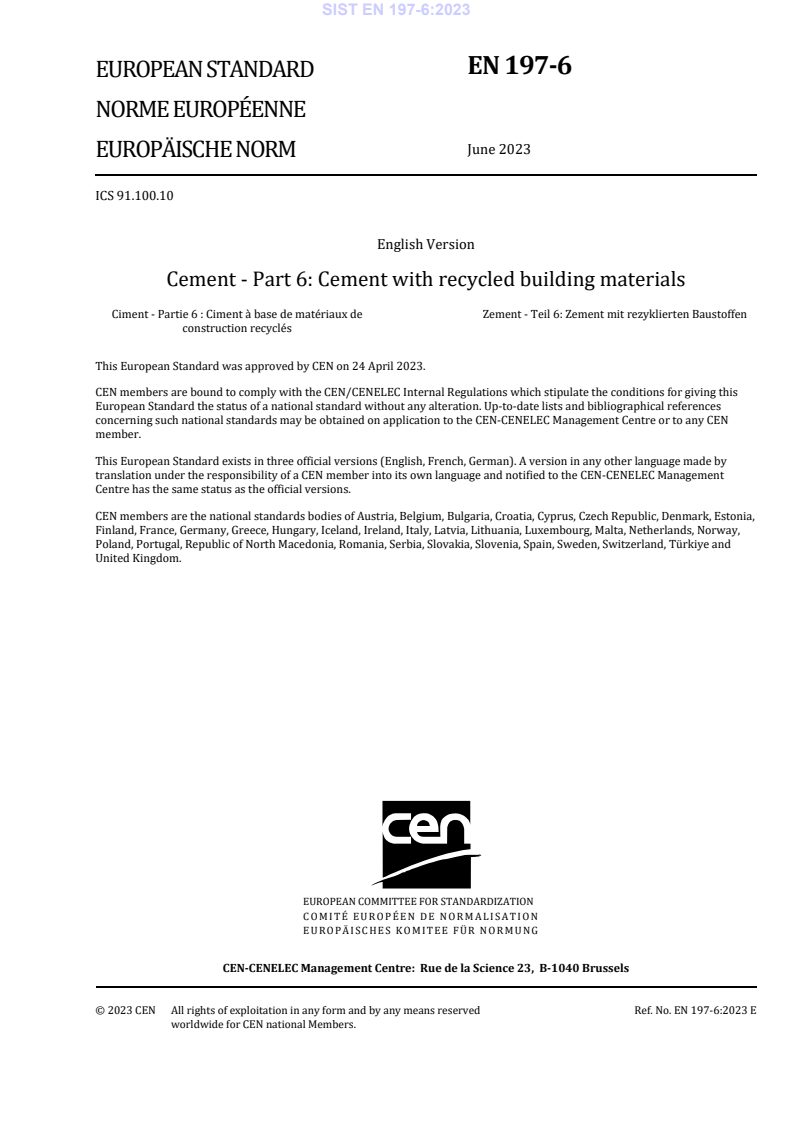
EN 197-6
EUROPEAN STANDARD
NORME EUROPÉENNE
June 2023
EUROPÄISCHE NORM
ICS 91.100.10
English Version
Cement - Part 6: Cement with recycled building materials
Ciment - Partie 6 : Ciment à base de matériaux de Zement - Teil 6: Zement mit rezyklierten Baustoffen
construction recyclés
This European Standard was approved by CEN on 24 April 2023.
CEN members are bound to comply with the CEN/CENELEC Internal Regulations which stipulate the conditions for giving this
European Standard the status of a national standard without any alteration. Up-to-date lists and bibliographical references
concerning such national standards may be obtained on application to the CEN-CENELEC Management Centre or to any CEN
member.
This European Standard exists in three official versions (English, French, German). A version in any other language made by
translation under the responsibility of a CEN member into its own language and notified to the CEN-CENELEC Management
Centre has the same status as the official versions.
CEN members are the national standards bodies of Austria, Belgium, Bulgaria, Croatia, Cyprus, Czech Republic, Denmark, Estonia,
Finland, France, Germany, Greece, Hungary, Iceland, Ireland, Italy, Latvia, Lithuania, Luxembourg, Malta, Netherlands, Norway,
Poland, Portugal, Republic of North Macedonia, Romania, Serbia, Slovakia, Slovenia, Spain, Sweden, Switzerland, Türkiye and
United Kingdom.
EUROPEAN COMMITTEE FOR STANDARDIZATION
COMITÉ EUROPÉEN DE NORMALISATION
EUROPÄISCHES KOMITEE FÜR NORMUNG
CEN-CENELEC Management Centre: Rue de la Science 23, B-1040 Brussels
© 2023 CEN All rights of exploitation in any form and by any means reserved Ref. No. EN 197-6:2023 E
worldwide for CEN national Members.
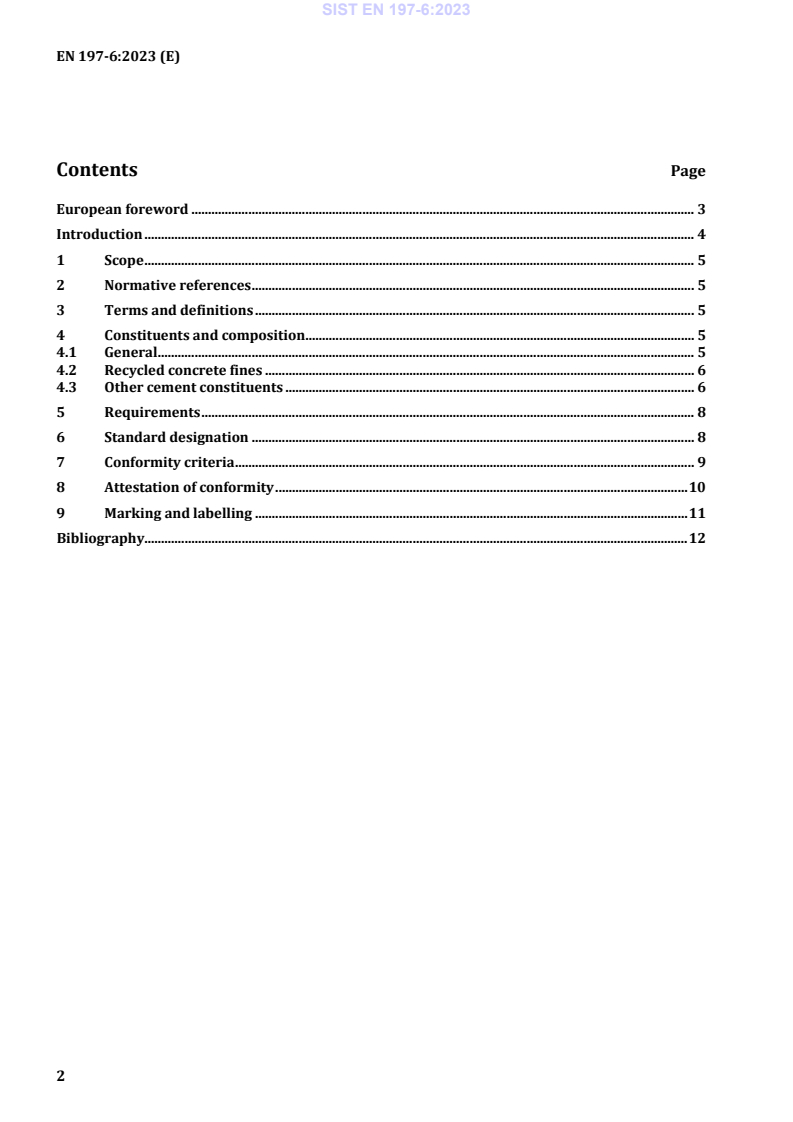
Contents Page
European foreword . 3
Introduction . 4
1 Scope . 5
2 Normative references . 5
3 Terms and definitions . 5
4 Constituents and composition . 5
4.1 General . 5
4.2 Recycled concrete fines . 6
4.3 Other cement constituents . 6
5 Requirements . 8
6 Standard designation . 8
7 Conformity criteria . 9
8 Attestation of conformity . 10
9 Marking and labelling . 11
Bibliography. 12
European foreword
This document (EN 197-6:2023) has been prepared by Technical Committee CEN/TC 51 “Cement and
building lime”, the secretariat of which is held by NBN.
This European Standard shall be given the status of a national standard, either by publication of an
identical text or by endorsement, at the latest by December 2023, and conflicting national standards shall
be withdrawn at the latest by December 2023.
Attention is drawn to the possibility that some of the elements of this document may be the subject of
patent rights. CEN shall not be held responsible for identifying any or all such patent rights.
Any feedback and questions on this document should be directed to the users’ national standards body.
A complete listing of these bodies can be found on the CEN website.
According to the CEN-CENELEC Internal Regulations, the national standards organisations of the
following countries are bound to implement this European Standard: Austria, Belgium, Bulgaria, Croatia,
Cyprus, Czech Republic, Denmark, Estonia, Finland, France, Germany, Greece, Hungary, Iceland, Ireland,
Italy, Latvia, Lithuania, Luxembourg, Malta, Netherlands, Norway, Poland, Portugal, Republic of North
Macedonia, Romania, Serbia, Slovakia, Slovenia, Spain, Sweden, Switzerland, Türkiye and the United
Kingdom.
Introduction
The purpose of this document is to specify the requirements for cement with recycled concrete fines.
Different cements have different properties and performance. The performance tests available at the time
of publication of this document (i.e. for the determination of setting time, strength, soundness and heat
of hydration) have been included in this document. In addition, work is being carried out by CEN/TC 51
to identify any additional tests which are needed to specify further performance characteristics of
cement. Until further performance tests are available, it is necessary that the choice of cement, especially
the type and/or strength class in relation to the requirements for durability depending on exposure class
and type of construction in which it is incorporated, follows the appropriate standards and/or regulations
for concrete, mortar, grout, etc. valid in the place of use.
The fitness of cement with recycled concrete fines for the intended use to produce structural concrete
(reinforced or not) has been experimentally assessed by testing programs, the results of which have been
included in a dossier [1] approved by CEN/TC 51.
The cement types and strength classes defined in this document allow the specifier and/or the user to
contribute to objectives of sustainability for cement-based constructions and of circular economy and to
minimize the use of natural resources in accordance with local conditions of production.
1 Scope
This document specifies cement with recycled concrete fines whose intended use is the preparation of
concrete, mortar, grout, etc.
2 Normative references
The following documents are referred to in the text in such a way that some or all of their content
constitutes requirements of this document. For dated references, only the edition cited applies. For
undated references, the latest edition of the referenced document (including any amendments) applies.
EN 196-2, Method of testing cement — Part 2: Chemical analysis of cement
EN 196-6, Methods of testing cement — Part 6: Determination of fineness
EN 196-7:2007, Methods of testing cement — Part 7: Methods of taking and preparing samples of cement
EN 197-1:2011, Cement — Part 1: Composition, specifications and conformity criteria for common cements
EN 197-2:2020, Cement — Part 2: Assessment and verification of constancy of performance
EN 206:2013+A2:2021, Concrete — Specification, performance, production and conformity
EN 933-9, Tests for geometrical properties of aggregates — Part 9: Assessment of fines — Methylene blue
test
EN 13639, Determination of total organic carbon in limestone
3 Terms and definitions
For the purposes of this document, the terms and definitions given in EN 197-1:2011 apply.
ISO and IEC maintain terminology databases for use in standardization at the following addresses:
— ISO Online browsing platform: available at https://www.iso.org/obp
— IEC Electropedia: available at https://www.electropedia.org/
4 Constituents and composition
4.1 General
Cement covered by this document contains recycled concrete fines and cement constituents covered by
EN 197-1.
The requirements on constituents are specified in 4.2 and 4.3.
The composition of cement covered by this document is specified in Table 1.
Provisions valid in the place of use may specify requirements for the content and the release of dangerous
substances from recycled concrete fines.
4.2 Recycled concrete fines
Recycled concrete fines is a specially selected and prepared mineral material
— coming from plants or units producing coarse, all-in and/or fine recycled concrete aggregates; or
— reclaimed from concrete production operations; or
— coming from reclaimed crushed aggregates as defined in EN 206:2013+A2:2021.
NOTE Recycled concrete fines can be considered to be suitable if the recycled coarse concrete aggregates
produced in the recycling plants or units fulfil the constituent requirements for R , Rb , Ra , FL and XR
CU90 10- 1- 2- g1-
according to EN 12620:2002+A1:2008, Table 20:
— R : ≥ 90 % by mass concrete, concrete products, mortar, concrete masonry units, unbound aggregate,
CU90
natural stone, hydraulically bound aggregate;
— Rb : ≤ 10 % by mass clay masonry units (i.e. bricks and tiles), calcium silicate masonry units, aerated
10-
non-floating concrete;
— Ra : ≤ 1 % by mass bituminous materials;
1-
— FL : ≤ 2 cm³/kg floating material in volume;
2-
— XR : ≤ 1 % by mass glass and other materials.
g1-
Recycled concrete fines are mainly non-reactive. A residual hydraulic or pozzolanic reactivity is possible
but does not contribute substantially to the cement reactivity.
The recycled concrete fines may be further processed in the cement plant, if necessary.
Recycled concrete fines shall fulfil the following requirements:
a) TOC content ≤ 0,8 % by mass, tested in accordance with EN 13639;
b) Sulfate content (as SO ) ≤ 2,0 % by mass, test
...