

EN 2157-1:1993
(Main)Aerospace series - Steel - Forging stock and forgings - Technical specification - Part 1: General requirements
- Abstract
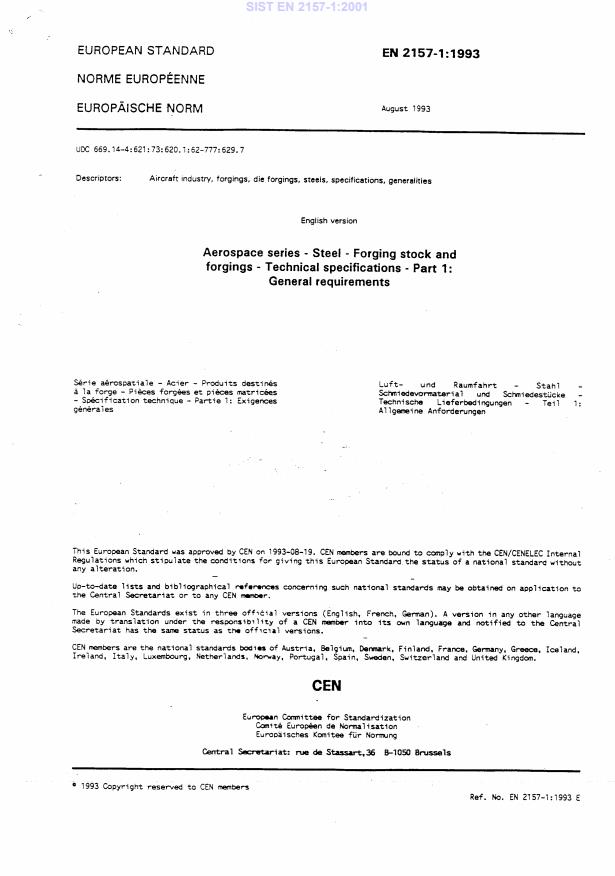
This standard defines the general requirements for the manufacture, inspection and testing of forging stock, hand forgings, including forged blocks and rings, die forgings and rolled rings in steel. The specific requirements are defined in EN 2157-2 and 2157-3. The three standards E? 2157-1, EN 2157-2 and EN 2157-3 define the inspection level and the sampling frequencies to be applied unless otherwise specified on the drawing, order or inspection schedule.
- Status
- Published
- Publication Date
- 19-Aug-1993
- Withdrawal Date
- 27-Feb-1994
- Technical Committee
- ASD-STAN - Aerospace
- Drafting Committee
- ASD-STAN/D 4 - Metallic
- Current Stage
- 9093 - Decision to confirm - Review Enquiry
- Start Date
- 21-Jan-2024
- Completion Date
- 14-Oct-2026

Overview
EN 2157-1:1993 is a critical standard within the aerospace series focused on steel forgings. Issued by CEN (European Committee for Standardization), this document specifies the general requirements for the manufacture, inspection, and testing of steel forging stock and forgings. It covers a range of products including hand forgings, forged blocks, rings, die forgings, and rolled rings.
This standard serves as Part 1 in a series, complemented by EN 2157-2 and EN 2157-3, which provide more detailed, specific requirements. Together, these standards ensure a harmonized approach to quality, inspection levels, and sampling frequencies in the aerospace industry.
Key Topics
- Scope of Application: Defines the general requirements applicable to forging stock and various types of steel forgings, emphasizing aerospace-grade steel materials.
- Manufacture Guidelines: Specifies the processes to ensure consistent quality in forging production, including stock preparation and forging techniques.
- Inspection Requirements: Establishes criteria for inspection procedures, including visual and dimensional checks essential for aerospace components.
- Testing Protocols: Outlines standard testing methods that must be adhered to, supporting mechanical properties verification and material integrity.
- Sampling Frequencies: Details the inspection frequency and sampling plans for quality control, referencing accompanying parts EN 2157-2 and EN 2157-3.
- Documentation and Compliance: Highlights the importance of documentation, traceability, and compliance with drawing, order, or inspection schedule specifications.
Practical Applications
EN 2157-1:1993 is vital for manufacturers and quality assurance teams involved with steel forgings in the aerospace sector. The standard's requirements help ensure that components such as structural parts, engine elements, and critical mechanical assemblies meet stringent aerospace safety and performance demands.
- Aerospace Manufacturers: Use the standard for consistent production and quality verification of steel forgings.
- Quality Control Units: Implement inspection and testing procedures aligned with the standard to maintain regulatory compliance.
- Suppliers of Forging Stock: Follow the general requirements to certify the material quality before delivery.
- Design Engineers: Reference the standard to specify material and quality prerequisites for forging components in aerospace designs.
- Regulatory Audits: Facilitate compliance verification through standardized documentation and testing records.
Applying EN 2157-1:1993 helps reduce material failure risks, enhances reliability, and maintains high standards necessary for safety-critical aerospace applications.
Related Standards
To fully comply with aerospace forging specifications, EN 2157-1:1993 is used in conjunction with:
- EN 2157-2: Specifies special technical requirements for forged steel products, including detailed inspection criteria.
- EN 2157-3: Covers acceptance criteria, sampling methods, and additional testing protocols to supplement general requirements.
- Other Aerospace Materials Standards: Complementary standards governing steel grades, heat treatments, and mechanical testing methods.
Using this family of standards ensures a comprehensive approach to the production and certification of steel forgings tailored for the aerospace industry’s demanding specifications.
Keywords: EN 2157-1, aerospace standard, steel forgings, forging stock, aerospace steel forgings, forging inspection, forging testing, forging technical specifications, forged steel components, aerospace manufacturing standards, European standards for forging
Relations
- Effective Date
- 28-Jan-2026
- Effective Date
- 28-Jan-2026
- Referred By
EN 2279:2018 - Aerospace series - Steel FE-PM37 - 900 MPa ≤ Rm ≤ 1 100 MPa - Forgings - De ≤ 150 mm - Effective Date
- 28-Jan-2026
Get Certified
Connect with accredited certification bodies for this standard

BUREAU VERITAS Certification Germany
Bureau Veritas certification in Germany.

Element Materials Technology
Materials testing and product certification.

AQMS Ltd.
AQMS provides ISO certification to SMEs across the UK.
Sponsored listings
Frequently Asked Questions
EN 2157-1:1993 is a standard published by the European Committee for Standardization (CEN). Its full title is "Aerospace series - Steel - Forging stock and forgings - Technical specification - Part 1: General requirements". This standard covers: This standard defines the general requirements for the manufacture, inspection and testing of forging stock, hand forgings, including forged blocks and rings, die forgings and rolled rings in steel. The specific requirements are defined in EN 2157-2 and 2157-3. The three standards E? 2157-1, EN 2157-2 and EN 2157-3 define the inspection level and the sampling frequencies to be applied unless otherwise specified on the drawing, order or inspection schedule.
This standard defines the general requirements for the manufacture, inspection and testing of forging stock, hand forgings, including forged blocks and rings, die forgings and rolled rings in steel. The specific requirements are defined in EN 2157-2 and 2157-3. The three standards E? 2157-1, EN 2157-2 and EN 2157-3 define the inspection level and the sampling frequencies to be applied unless otherwise specified on the drawing, order or inspection schedule.
EN 2157-1:1993 is classified under the following ICS (International Classification for Standards) categories: 49.025.10 - Steels. The ICS classification helps identify the subject area and facilitates finding related standards.
EN 2157-1:1993 has the following relationships with other standards: It is inter standard links to EN 2135:2017, EN 2503:2019, EN 2279:2018. Understanding these relationships helps ensure you are using the most current and applicable version of the standard.
EN 2157-1:1993 is available in PDF format for immediate download after purchase. The document can be added to your cart and obtained through the secure checkout process. Digital delivery ensures instant access to the complete standard document.
Standards Content (Sample)
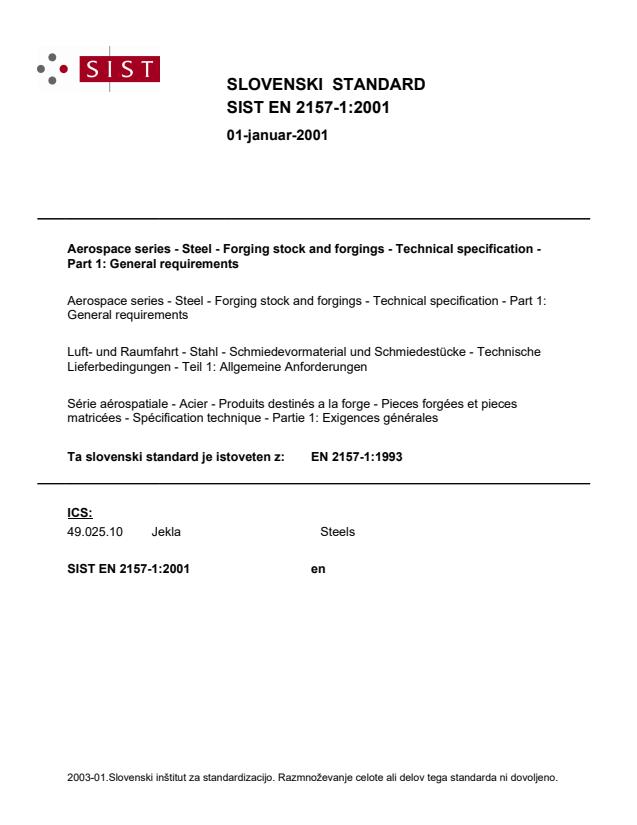
2003-01.Slovenski inštitut za standardizacijo. Razmnoževanje celote ali delov tega standarda ni dovoljeno.Aerospace series - Steel - Forging stock and forgings - Technical specification - Part 1: General requirementsLuft- und Raumfahrt - Stahl - Schmiedevormaterial und Schmiedestücke - Technische Lieferbedingungen - Teil 1: Allgemeine AnforderungenSérie aérospatiale - Acier - Produits destinés a la forge - Pieces forgées et pieces matricées - Spécification technique - Partie 1: Exigences
...