

EN 313-1:1996
(Main)Plywood - Classification and terminology - Part 1: Classification
- Abstract
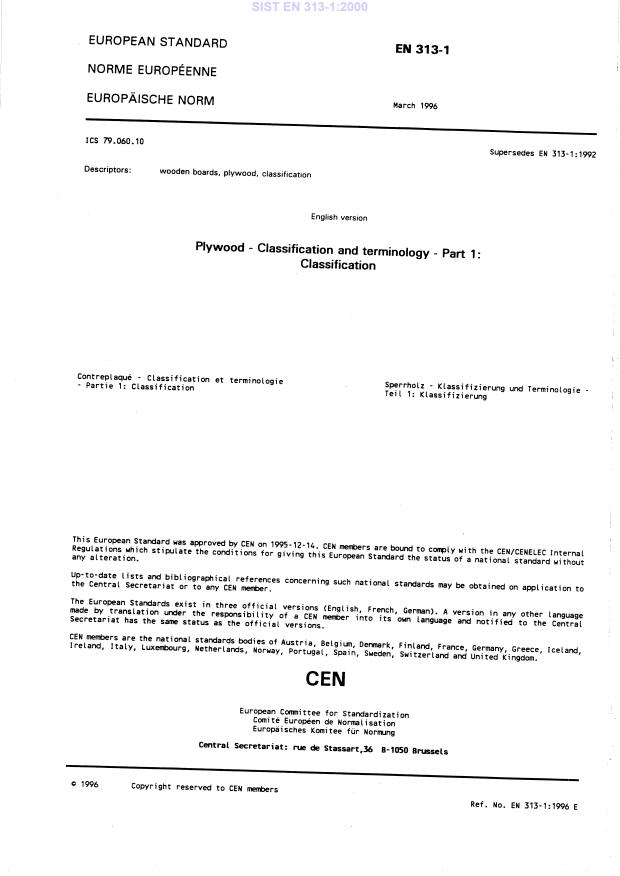
This European standard gives a classification of plywood panels.
- Status
- Published
- Publication Date
- 19-Mar-1996
- Technical Committee
- CEN/TC 112 - Woodbased panels
- Drafting Committee
- CEN/TC 112 - Woodbased panels
- Current Stage
- 9060 - Closure of 2 Year Review Enquiry - Review Enquiry
- Start Date
- 04-Jun-2026
- Completion Date
- 04-Jun-2026

Overview
EN 313-1:1996 is a European standard established by the Comité Européen de Normalisation (CEN) that focuses on the classification and terminology of plywood panels. This standard provides a clear framework for categorizing plywood based on its construction, quality, and performance characteristics. As plywood is widely used across various industries, this standard ensures uniformity and consistency in how plywood products are identified and specified.
The classification outlined in EN 313-1:1996 aids manufacturers, suppliers, and end-users in selecting the right type of plywood for specific applications, promoting quality assurance and enhancing communication within the supply chain.
Key Topics
Plywood Classification System
EN 313-1:1996 defines a systematic approach to categorizing plywood panels based on criteria such as face and core veneer quality, bonding performance, and intended use.Terminology Standardization
The document establishes uniform terminology relevant to plywood manufacturing and classification, facilitating consistent industry communication across different languages and regions.Panel Quality Grades
Different quality grades for plywood surfaces and cores are specified, which help determine the suitability of panels for structural, non-structural, or decorative uses.Bonding Performance Criteria
The standard addresses the bonding quality of plywood layers, which directly impacts durability, moisture resistance, and overall panel integrity.
Applications
EN 313-1:1996 serves as a fundamental reference in multiple industries where plywood usage is prominent:
Construction Industry
Helps architects, engineers, and builders specify plywood grades that meet safety and durability requirements for flooring, roofing, and wall sheathing.Furniture Manufacturing
Enables furniture makers to select plywood with appropriate surface quality and bonding strength for both visible and hidden components.Packaging and Pallet Production
Ensures plywood panels used in packaging meet performance criteria necessary for load-bearing and protection during transport.Marine and Transportation
Assists in identifying plywood suited for moisture-prone environments, enhancing longevity and safety for marine crafts and vehicle interiors.
Related Standards
EN 314-1 and EN 314-2 - Standards related to the bonding quality requirements and testing methods of plywood, complementing the classification provided in EN 313-1:1996.
EN 13986 - Pertains to wood-based panels for construction, including plywood, covering performance requirements, which align with classification foundations of EN 313-1.
ISO 2426 - Describes plywood specifications and classification at an international level and serves as a useful resource alongside EN 313-1.
Practical Value
By adhering to EN 313-1:1996, manufacturers and buyers of plywood guarantee a measurable and recognized standard of quality and classification clarity. This harmonization supports:
- Reliable product specification and procurement decisions
- Streamlined cross-border trade within EU member countries
- Enhanced product tracing and quality control processes
- Improved end-user confidence in plywood performance suitability
For professionals seeking consistency and precision in plywood classification, EN 313-1:1996 is the essential standard that brings standardized terminology and grading systems to the forefront of plywood manufacturing and application.
Relations
- Effective Date
- 22-Dec-2008
- Effective Date
- 28-Jan-2026
- Effective Date
- 28-Jan-2026
Get Certified
Connect with accredited certification bodies for this standard

Gozdarski inštitut Slovenije
Slovenian Forestry Institute. Forest management certification support, timber testing.
Sponsored listings
Frequently Asked Questions
EN 313-1:1996 is a standard published by the European Committee for Standardization (CEN). Its full title is "Plywood - Classification and terminology - Part 1: Classification". This standard covers: This European standard gives a classification of plywood panels.
This European standard gives a classification of plywood panels.
EN 313-1:1996 is classified under the following ICS (International Classification for Standards) categories: 79.060.10 - Plywood. The ICS classification helps identify the subject area and facilitates finding related standards.
EN 313-1:1996 has the following relationships with other standards: It is inter standard links to EN 313-1:1992, EN 1995-1-2:2004, EN 13810-1:2002. Understanding these relationships helps ensure you are using the most current and applicable version of the standard.
EN 313-1:1996 is associated with the following European legislation: EU Directives/Regulations: 305/2011, 89/106/EEC. When a standard is cited in the Official Journal of the European Union, products manufactured in conformity with it benefit from a presumption of conformity with the essential requirements of the corresponding EU directive or regulation.
EN 313-1:1996 is available in PDF format for immediate download after purchase. The document can be added to your cart and obtained through the secure checkout process. Digital delivery ensures instant access to the complete standard document.
Standards Content (Sample)
2003-01.Slovenski inštitut za standardizacijo. Razmnoževanje celote ali delov tega standarda ni dovoljeno.Vezan les - Razvrstitev in terminologija - 1. del: RazvrstitevSperrholz - Klassifizierung und Terminologie - Teil 1: KlassifizierungContreplaqué - Classification et terminologie - Partie 1: ClassificationPlywood - Classifi
...