

EN 131-2:2010+A2:2017
(Main + Amendment)Ladders - Part 2: Requirements, testing, marking
- Abstract
This European Standard specifies the general design features, requirements and test methods for portable ladders.
It does not apply to step stools or ladders for specific professional use such as firebrigade ladders, roof ladders and mobile ladders.
It does not apply to ladders used for work on or near live electrical systems or installations. For this purpose EN 61478 applies.
NOTE For insulating ladders for use on or near low voltage electrical installations EN 50528 applies.
This European Standard is intended to be used in conjunction with EN 131 1.
For single or multiple hinge joint ladders EN 131 4 applies.
For telescopic ladders EN 131-6 applies.
For mobile ladders with a platform EN 131 7 applies.
- Status
- Withdrawn
- Publication Date
- 10-Jan-2017
- Withdrawal Date
- 06-Oct-2026
- Technical Committee
- CEN/TC 93 - Ladders
- Drafting Committee
- CEN/TC 93/WG 10 - Revision of EN 131-2
- Current Stage
- 9960 - Withdrawal effective - Withdrawal
- Start Date
- 06-Aug-2025
- Completion Date
- 07-Oct-2026
- Directive
- 2001/95/EC - General product safety


Relations
- Effective Date
- 18-Jan-2017
- Effective Date
- 25-Jun-2025
- Effective Date
- 19-Jan-2023
- Effective Date
- 07-Sep-2016
- Effective Date
- 01-Apr-2026
- Effective Date
- 18-Mar-2026
- Effective Date
- 09-Feb-2026
- Effective Date
- 28-Jan-2026
- Refers
EN 572-2:2012 - Glass in building - Basic soda lime silicate glass products - Part 2: Float glass - Effective Date
- 28-Jan-2026
- Effective Date
- 28-Jan-2026
- Effective Date
- 28-Jan-2026
- Effective Date
- 28-Jan-2026
- Effective Date
- 28-Jan-2026
- Effective Date
- 28-Jan-2026
- Effective Date
- 28-Jan-2026
Frequently Asked Questions
EN 131-2:2010+A2:2017 is a standard published by the European Committee for Standardization (CEN). Its full title is "Ladders - Part 2: Requirements, testing, marking". This standard covers: This European Standard specifies the general design features, requirements and test methods for portable ladders. It does not apply to step stools or ladders for specific professional use such as firebrigade ladders, roof ladders and mobile ladders. It does not apply to ladders used for work on or near live electrical systems or installations. For this purpose EN 61478 applies. NOTE For insulating ladders for use on or near low voltage electrical installations EN 50528 applies. This European Standard is intended to be used in conjunction with EN 131 1. For single or multiple hinge joint ladders EN 131 4 applies. For telescopic ladders EN 131-6 applies. For mobile ladders with a platform EN 131 7 applies.
This European Standard specifies the general design features, requirements and test methods for portable ladders. It does not apply to step stools or ladders for specific professional use such as firebrigade ladders, roof ladders and mobile ladders. It does not apply to ladders used for work on or near live electrical systems or installations. For this purpose EN 61478 applies. NOTE For insulating ladders for use on or near low voltage electrical installations EN 50528 applies. This European Standard is intended to be used in conjunction with EN 131 1. For single or multiple hinge joint ladders EN 131 4 applies. For telescopic ladders EN 131-6 applies. For mobile ladders with a platform EN 131 7 applies.
EN 131-2:2010+A2:2017 is classified under the following ICS (International Classification for Standards) categories: 97.145 - Ladders. The ICS classification helps identify the subject area and facilitates finding related standards.
EN 131-2:2010+A2:2017 has the following relationships with other standards: It is inter standard links to CEN/TS 16665:2014, EN 131-2:2010+A3:2025, EN 131-2:2010+A1:2012, EN 131-2:2010+A1:2012/FprA2, EN ISO 179-1:2026, EN 301:2023+A1:2026, EN 61478:2001, EN 59:2016, EN 572-2:2012, EN ISO 14644-1:2015, EN ISO 527-1:2019, EN 131-3:2018+A1:2025, EN 204:2016, EN ISO 3834-1:2021, EN ISO 6892-1:2019. Understanding these relationships helps ensure you are using the most current and applicable version of the standard.
EN 131-2:2010+A2:2017 is associated with the following European legislation: EU Directives/Regulations: 2001/95/EC; Standardization Mandates: M/285. When a standard is cited in the Official Journal of the European Union, products manufactured in conformity with it benefit from a presumption of conformity with the essential requirements of the corresponding EU directive or regulation.
EN 131-2:2010+A2:2017 is available in PDF format for immediate download after purchase. The document can be added to your cart and obtained through the secure checkout process. Digital delivery ensures instant access to the complete standard document.
Standards Content (Sample)
2003-01.Slovenski inštitut za standardizacijo. Razmnoževanje celote ali delov tega standarda ni dovoljeno.Leitern - Teil 2: Anforderungen, Prüfung, KennzeichnungÉchelles - Partie 2: Exigences, essais, marquageLadders - Part 2: Requirements, testing, marking97.145LestveLaddersICS:Ta slovenski standard je istoveten z:EN 131-2:2010+A2:2017SIST EN 131-2:2010+A2:2017en,fr,de01-marec-2017SIST EN 131-2:2010+A2:2017SLOVENSKI
STANDARDSIST-TS CEN/TS 16665:20141DGRPHãþD
EUROPEAN STANDARD NORME EUROPÉENNE EUROPÄISCHE NORM
EN 131-2:2010+A2
January
t r s y ICS
{ yä s v w Supersedes EN
s u sæ tã t r s r ªA sã t r s tEnglish Version
Ladders æ Part
tã Requirementsá testingá marking Échelles æ Partie
tã Exigencesá essaisá marquage
Leitern æ Teil
tã Anforderungená Prüfungá Kennzeichnung This European Standard was approved by CEN on
s x April
t r s t and includes Amendment
t approved by CEN on
s y September
t r s xä
egulations which stipulate the conditions for giving this European Standard the status of a national standard without any alterationä Upætoædate lists and bibliographical references concerning such national standards may be obtained on application to the CENæCENELEC Management Centre or to any CEN memberä
translation under the responsibility of a CEN member into its own language and notified to the CENæCENELEC Management Centre has the same status as the official versionsä
CEN members are the national standards bodies of Austriaá Belgiumá Bulgariaá Croatiaá Cyprusá Czech Republicá Denmarká Estoniaá Finlandá Former Yugoslav Republic of Macedoniaá Franceá Germanyá Greeceá Hungaryá Icelandá Irelandá Italyá Latviaá Lithuaniaá Luxembourgá Maltaá Netherlandsá Norwayá Polandá Portugalá Romaniaá Serbiaá Slovakiaá Sloveniaá Spainá Swedená Switzerlandá Turkey and United Kingdomä
EUROPEAN COMMITTEE FOR STANDARDIZATION COMITÉ EUROPÉEN DE NORMALISATION EUROPÄISCHES KOMITEE FÜR NORMUNG
CEN-CENELEC Management Centre:
Avenue Marnix 17,
B-1000 Brussels
t r s y CEN All rights of exploitation in any form and by any means reserved worldwide for CEN national Membersä Refä Noä EN
s u sæ tã t r s r ªA tã t r s y ESIST EN 131-2:2010+A2:2017
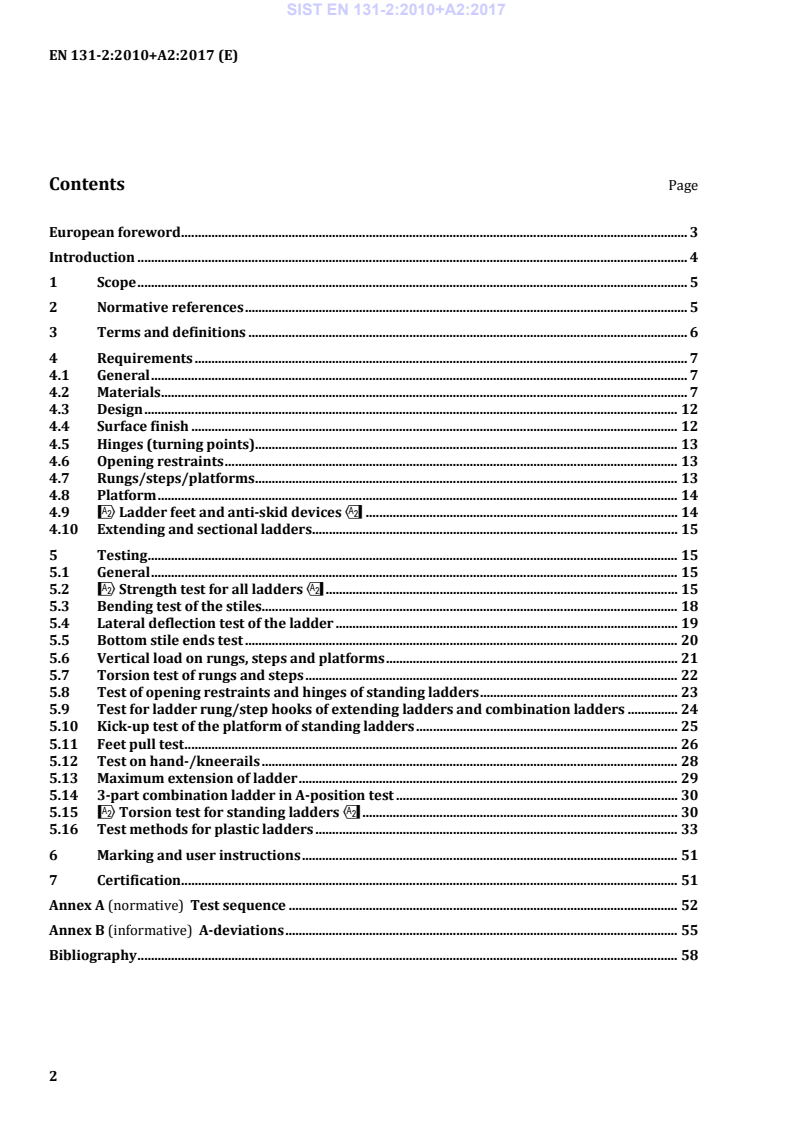
Test sequence . 52 Annex B (informative)
A-deviations . 55 Bibliography . 58
(ISO 6892-1:2009) EN ISO 14125, Fibre-reinforced plastic composites — Determination of flexural properties (ISO 14125:1998) #EN ISO 14644-1, Cleanrooms and associated controlled environments — Part 1: Classification of air cleanliness by particle concentration (ISO 14644-1)$ EN ISO 14731, Welding coordination — Tasks and responsibilities (ISO 14731:2006) 3 Terms and definitions For the purposes of this document, the terms and definitions given in #EN 131-1:2015$and the following apply. 3.1 thermoset plastic plastic that has been cured by heat or by other means such as radiation, catalysts, etc., into a substantially infusible and insoluble state [EN ISO 472:2001] SIST EN 131-2:2010+A2:2017
— splitsa not permitted
— checksa < 100 mm length
Lightning/frost shakes, Ring shake not permitted
5. Colour
X Blue stain Permitted
X Red streakes permitted up to 25 % of the surface
X Red rot, brown rot not permitted X
Red heart of beech, brown heart of ash Permitted X
Doty wood not permitted X X 6. Reaction wood admissible until 1/5 of the cross section or of the surface X X 7. Pith not permitted X
8. Defects caused by insects not permitted X X 9. Mistletoe traces not permitted
X 10. Resin pockets
not continuous permitted until 4 mm width and 1,5 × width of the stiles (see Figure 3)
Continuous not permitted X X 11. Spiral grain A deviation of the grain direction from the longitudinal edges of the wood of not more than 50 mm per 1 000 mm, measured either with the help of shrinkage shakes or the scratching method is admissible (see Figure 4). The measurement is to be carried out in two faces perpendicular to each other. The largest deviation is decisive. In the case of rungs and steps, the grain ends, with the exception of knots, shall be at the rung or step ends. a Definitions see EN 844-9:1997 SIST EN 131-2:2010+A2:2017
Dimensions in millimetres
Figure 1 — Admissible wane Dimensions in millimetres
Figure 2 — Admissible deviation of the slope of annual rings to the longitudinal edges Dimensions in millimetres
Figure 3 — Admissible resin pockets Dimensions in millimetres
Figure 4 — Admissible deviation of the grain direction related to the longitudinal edges
(spiral grain) SIST EN 131-2:2010+A2:2017
Figure 5 — Inadmissible knot Pin knots2) (including black pin knots) with a diameter of less than or equal to 5 mm are permitted. In the upper and lower third of the stile or supporting element, one sound, intergrown knot1), of diameter d, less than or equal to 0,2 × b (the width of the stile) is permitted per metre. The diameter of the knot is measured in accordance with EN 1310. The knot shall be a minimum of 10 mm from the edges of the stile or supporting element and a minimum of 50 mm from any rung holes, tenons and milled recesses for treads. (see Figure 6). Dimensions in millimetres
Figure 6 — Admissible knot For ladders made of laminated wood the above mentioned number, size and position of knots are allowed over the total length of the ladder. 4.2.4.3.2 Knots in rungs, steps, braces Intergrown pin knots up to a maximum diameter of 3 mm are admissible. 4.2.4.4 Moisture content (Related to the kiln-dry weight) at time of manufacture The moisture content shall be determined by means of hygrometer; in critical or referee cases in accordance with the oven-dry method. The moisture content of the wood is to be chosen according to the equilibrium moisture content resulting from open air drying, normally in Europe 12 % to 20 %.
1) Definitions see EN 844-9:1997 2) Pin knots are knots having approximately a circular cross section SIST EN 131-2:2010+A2:2017
EN ISO 3834-1 to EN ISO 3834-4 have to be observed. 4.4 Surface finish In order to avoid injuries, accessible edges, corners, and protruding parts shall be free of burrs, for example chamfered or rounded. Metal parts susceptible to corrosion shall be protected by means of a paint coating or other coating. Under normal conditions aluminium alloys are not susceptible to corrosion. Wooden parts shall be smoothed and coated on all sides. The coating shall be transparent and permeable to water vapour. SIST EN 131-2:2010+A2:2017
Key 1 stile 2 rung Figure 7 — Example of a concealed joint SIST EN 131-2:2010+A2:2017
Key 1 stile 2 rung Figure 8 — Example of an open joint
Key 1 stile 2 rung Figure 9 — Example of a concealed joint Round rungs shall have a diameter greater than or equal to 25 mm. The top surface of flat standing surfaces shall have an angle less than or equal to 25° to the horizontal. For leaning ladders the angle related to the stile shall be 65° to 90° for rungs and 60° to 70° for steps. Rungs/steps/platforms shall satisfy the tests according to 5.6 and 5.7. 4.8 Platform If the topmost walking surface of a standing ladder is designed as a foldable platform, the latter shall be lifted up by a device when the ladder is folded. The platform shall satisfy the kick-up test according to 5.10. 4.9 #Ladder feet and anti-skid devices$ Bottom ends of the ladder shall be slip resistant. # NOTE A test for the base slip resistance of leaning ladders is contained in 5.18.$ SIST EN 131-2:2010+A2:2017
Dimensions in millimetres
a) Strength test for leaning ladder SIST EN 131-2:2010+A2:2017
b) Strength test for standing ladder with platform
c) Strength test for combination ladder SIST EN 131-2:2010+A2:2017
d) Strength test for standing ladder Key F test load 1 restraint Figure 10 — Strength test for all ladders Figure 10 shows an example of the strength test for all ladders. NOTE The differentiator for classification is a safety factor incorporated in the strength test load F. For the non-professional class a safety factor of 1,2 is used to establish the test load F as follows: 150 kg (rated load) × 1,7 (dynamic factor) × 9,81 (gravity) × 1,2 (safety factor) × 1,1 (material factor) × 0,6814 (simultaneous occurrence factor of 0,08 × 4 factors) = 2 250 N For the professional class a safety factor of 1,44 is used to establish the test loaf F as follows: 150 kg (rated load) × 1,7 (dynamic factor) × 9,81 (gravity) × 1,44 (safety factor) × 1,1 (material factor) × 0,6814 (simultaneous occurrence factor of 0,08 × 4 factors) = 2 700 N.$ 5.3 Bending test of the stiles The test shall be carried out on the complete ladder. In the case of extending ladders and combination ladders the test shall be carried out on the complete extended ladder. Sectional ladders shall be tested at full length with all permitted pieces. The test shall be carried out without supporting legs if not permanently fixed to the ladder. Where the ascendable side cannot be determined by the construction of the product, or where it is a multiple part combination ladder the ladder shall be tested twice. For the second test the ladder shall be rotated 180° about the longitudinal axis. The ladder shall be placed horizontally on supports situated 200 mm from each end of the ladder. SIST EN 131-2:2010+A2:2017
« 90 mm for ladders of length more than 5 m and less than or equal to 12 m; — fmax = 0,06 × l
« 294 mm for ladders of length more than 12 m. Dimensions in millimetres
Figure 11 — Bending test 5.4 Lateral deflection test of the ladder This test shall be conducted on all one-piece ladders as well as on each ascendable part of multiple-piece ladders (standing ladders, sectional ladders, combination ladders, extending ladders) and on the supporting-legs of standing rung- or step-ladders. The ladder shall be placed horizontally on supports situated 200 mm from each end of the ladder. The supports shall be cylindrical with diameters between 25 mm and 100 mm and one shall be free to rotate the other shall be fixed. The ladder shall be placed in the lateral position. A pre-load of 100 N shall be applied for the duration of one minute. The position of the ladder after removal of the pre-load is the origin for measurement. A load F of 250 N (see Figure 12) shall be applied to the lower stile equidistant from the supports. The deflection is measured equidistant from the supports 1 minute after loading. Thereby the maximum permissible deflection fmax as a function of the distance l between the supports shall be lf005,0max=, in millimetres SIST EN 131-2:2010+A2:2017
Figure 12 — Lateral deflection test 5.5 Bottom stile ends test Place the ladder laterally, with the longitudinal axis of the ladder in the horizontal position. The lower stile is to be fixed to the support so that the stile ends overhang the supporting surface (see Figure 13). If the rungs/steps are bolted, riveted, or similarly fixed to the stile the edge of the support shall be in line with the bottom lower edge of the assembling hole. If the rungs/steps are fixed to the stile without the stile being penetrated the edge of the support shall be in line with the lower edge of the rung/step. #If the ladder has a bar type stabilizer then this test is not carried out.$ A rigid load block 50 mm wide is placed with its end up to and parallel with the end of the stile. The load block shall rest on the stile and shall effect the whole width of the stile. The lateral deflection f of the stile end is measured at the outer edge of the load block in the longitudinal axis. NOTE To be able to obtain a good rest against the stile it is permitted to cut off a part of a slip resistant material, if any. A vertical force F of 1 100 N (see Figure 13 and 14) is placed in the middle of the load block and is maintained for one min. The permanent deflection after removal of the test load together with any damages are noted. The test is repeated on the lower stile without turning the ladder. Requirement: The permanent deflection f in each test shall not exceed 2 mm. Neither fracture nor visible cracks are allowed. This test shall also be performed on supporting legs. SIST EN 131-2:2010+A2:2017
Figure 13 — Test method of the bottom stile ends Dimensions in millimetres
Figure 14 — Test method of the bottom stile ends (variations) 5.6 Vertical load on rungs, steps and platforms 5.6.1 General A pre-load F of 200 N shall be applied for the duration of one minute. The position of the rung/step/platform after removal of the pre-load is the origin for measurement. 5.6.2 Rungs and steps In the position of use of the ladder a test load F of 2 600 N (see Figure 15) shall be applied vertically on the mid-point of the weakest rung or step of any design evenly distributed over a width of 100 mm and a depth equal to the rung/step and for the duration of one min. The maximum permanent deformation after removal of the test-load shall be less than or equal to 0,5 % of the inner width b1 (see EN 131-1), measured underneath the tested step. SIST EN 131-2:2010+A2:2017
Figure 15 — Vertical load test on rungs/steps/platform
Key 1 position of load 1 2 position of load 2 Figure 16 — Positions of load 5.7 Torsion test of rungs and steps A torque M of 50 Nm (see Figure 17) shall be applied on the midpoint of the rung or step via a 100 mm wide clamping device. The torque shall be applied alternately 10 times in clockwise and 10 times in counter-clockwise direction for a period of 10 s each. SIST EN 131-2:2010+A2:2017
Figure 17 — Torsion test of rungs and steps 5.8 Test of opening restraints and hinges of standing ladders 5.8.1 General This test is for standing ladders or combination ladders used as standing ladders. For the purpose of this test, the working position for these ladders is two parts connected at the top and secured against sliding away from each other. Where a ladder is fitted with both automatic and manual restraint devices, only the automatic device shall be employed. The engagement of a ladders manual restraint device is only permitted where no automatic device is fitted. NOTE 1 In some countries the use of only manual restraint devices is not permitted. NOTE 2 A locking hinge is considered an automatic restraint device. Each leg of the ladder in the working position is placed on a platform provided with multidirectional rollers (see Figure 18). The effects of friction, from both the rollers and floor surface, shall be negligible. The test is to be conducted on a clean, smooth finish concrete floor. After removal of the test loads of the tests according to 5.8.2 to 5.8.4 no visible permanent deformation shall occur on the hinge joints, opening restraint devices and their attachments. The ladder shall not show any visible damages such as cracks, indentations, etc. Permanent deformation is acceptable only if it does not impair the fitness for use of the ladder. SIST EN 131-2:2010+A2:2017
Figure 18 — Test of opening restraint devices and hinges of standing ladders 5.8.2 Bilaterally ascendable ladder The test load F of 2 600 N is divided into two loads of 1 300 N (see Figure 18), distributed over two plates each 100 mm long with a width at least equal to the surface of the rung or step to be applied to the uppermost rung or step as close as possible to the stiles for a duration of 1 min. This test is then repeated on the other leg. 5.8.3 Standing ladder with platform The test load F of 2 600 N is divided into two loads of 1 300 N, distributed over two plates that are each 100 mm × 100 mm to be applied to front edge of the platform as close as possible to the stiles for a duration of 1 min. This test is then repeated on the rear edge of the platform. 5.8.4 Unilaterally ascendable ladder The test load F of 2 600 N is divided into two loads of 1 300 N, distributed over two plates each 100 mm long with a width at least equal to the surface of the rung or step to be applied to the uppermost rung or step of the ascending leg as close as possible to the stiles for a duration of 1 min. 5.9 Test for ladder rung/step hooks of extending ladders and combination ladders The ladder is extended by at least one rung/step distance and placed in a vertical position. The length of the test piece will be left to the choice of the tester. A uniformly distributed test load F of 3 500 N (see Figure 19) shall be applied vertically to the upper part of the ladder for a period of 1 min. After removal of the test load, there shall be no permanent deformation which impairs the fitness for use of the ladder. SIST EN 131-2:2010+A2:2017
Figure 19 — Test for locking devices 5.10 Kick-up test of the platform of standing ladders Place the standing ladder in the working position on a level surface and apply a force F of 100 N over a 100 mm width to the pivoted edge of the platform at an angle of 90° to the horizontal towards the vertical centre line of the steps (see Figure 20). The platform shall not lift from its stop by more than 6°. Dimensions in millimetres
Key F
= 100 N 1 load pad Figure 20 — Kick-up test of the platform of standing step ladders SIST EN 131-2:2010+A2:2017
Figure 21 — Testing of the ladder feet which are fixed to the ladder 5.11.2 For feet made of one part on stabilizer bars supplied by the ladder manufacturer Prevent the ladder from moving by placing stops around one pair of feet. Apply the force to a free foot in the position and direction most likely to separate the foot from the stabilizer bar. A load of 150 N shall be applied for 1 min (see Figure 22). After the test, the foot shall remain functional and show a movement from its original position of less than or equal to 4 mm. SIST EN 131-2:2010+A2:2017
Figure 22 — Testing of the ladder feet which are fixed to the stabilizer bar 5.11.3 For ladder feet and feet of stabilizer bars made of more than one part The relevant test in 5.11.1 or 5.11.2 shall be performed. Additionally, the section of the foot that generates resistance to movement relative to the ground shall have a load of 150 N applied for 1 min in a location and direction that is likely to be the most critical, as determined by the tester (see Figure 23). After the test, there shall be no indication of separation between the different parts of the foot. If the sections of the ladder foot that provide the friction between the ladder and the ground are loosened or lost, this shall be clearly visible when the ladder is in the position of use. When these sections are worn through, this shall also be visible during the pre-use inspection of the ladder. The sections of the ladder foot that are designed to provide the friction between the ladder and the ground shall be the only part of the foot in contact with the ground under user or test load with in the position of use. This part of the ladder foot, even when worn, shall not be capable of being pushed inside the upper part of the foot when the ladder is in the position of use.
Key 1 upper part 2 lower part Figure 23 — Testing of ladder feet made of more than one part SIST EN 131-2:2010+A2:2017
...