

EN 125:2022
(Main)Flame supervision devices for gas burning appliances - Thermoelectric flame supervision devices
- Abstract
EN 13611:2019, Clause 1 applies with the following modification and addition:
Modification:
The 1st paragraph of EN 13611:2019, Clause 1 is replaced by:
This document specifies the safety, design, construction, and performance requirements and testing for thermoelectric flame supervision devices, energized by a thermocouple intended for use with burners and appliances burning one or more gaseous fuels, hereafter referred to as “controls”.
This document is applicable to controls with declared maximum inlet pressures up to and including 500 kPa and of nominal connection sizes up to and including DN 50.
Addition:
This document is not applicable to:
- the thermocouple;
- controls which use auxiliary energy (e.g. electrical energy supplied externally).
The 4th paragraph of EN 13611:2019, Clause 1 is removed.
- Status
- Withdrawn
- Publication Date
- 11-Oct-2022
- Withdrawal Date
- 06-Oct-2026
- Technical Committee
- CEN/TC 58 - Safety and control devices for burners and appliances burning gaseous or liquid fuels
- Drafting Committee
- CEN/TC 58/WG 13 - Mechanics
- Current Stage
- 9960 - Withdrawal effective - Withdrawal
- Start Date
- 06-Nov-2024
- Completion Date
- 07-Oct-2026

Relations
- Effective Date
- 21-Aug-2019
- Effective Date
- 05-Oct-2024
- Effective Date
- 28-Jan-2026
- Effective Date
- 28-Jan-2026
- Effective Date
- 28-Jan-2026
Get Certified
Connect with accredited certification bodies for this standard

DNV
DNV is an independent assurance and risk management provider.

Lloyd's Register
Lloyd's Register is a global professional services organisation specialising in engineering and technology.
DNV Energy Systems
Energy and renewable energy certification.
Sponsored listings
Frequently Asked Questions
EN 125:2022 is a standard published by the European Committee for Standardization (CEN). Its full title is "Flame supervision devices for gas burning appliances - Thermoelectric flame supervision devices". This standard covers: EN 13611:2019, Clause 1 applies with the following modification and addition: Modification: The 1st paragraph of EN 13611:2019, Clause 1 is replaced by: This document specifies the safety, design, construction, and performance requirements and testing for thermoelectric flame supervision devices, energized by a thermocouple intended for use with burners and appliances burning one or more gaseous fuels, hereafter referred to as “controls”. This document is applicable to controls with declared maximum inlet pressures up to and including 500 kPa and of nominal connection sizes up to and including DN 50. Addition: This document is not applicable to: - the thermocouple; - controls which use auxiliary energy (e.g. electrical energy supplied externally). The 4th paragraph of EN 13611:2019, Clause 1 is removed.
EN 13611:2019, Clause 1 applies with the following modification and addition: Modification: The 1st paragraph of EN 13611:2019, Clause 1 is replaced by: This document specifies the safety, design, construction, and performance requirements and testing for thermoelectric flame supervision devices, energized by a thermocouple intended for use with burners and appliances burning one or more gaseous fuels, hereafter referred to as “controls”. This document is applicable to controls with declared maximum inlet pressures up to and including 500 kPa and of nominal connection sizes up to and including DN 50. Addition: This document is not applicable to: - the thermocouple; - controls which use auxiliary energy (e.g. electrical energy supplied externally). The 4th paragraph of EN 13611:2019, Clause 1 is removed.
EN 125:2022 is classified under the following ICS (International Classification for Standards) categories: 27.060.20 - Gas fuel burners. The ICS classification helps identify the subject area and facilitates finding related standards.
EN 125:2022 has the following relationships with other standards: It is inter standard links to EN 125:2010+A1:2015, EN 125:2022+A1:2024, EN 13611:2019, EN 17942:2024, EN 509:2024. Understanding these relationships helps ensure you are using the most current and applicable version of the standard.
EN 125:2022 is associated with the following European legislation: EU Directives/Regulations: 2014/68/EU, 2016/426; Standardization Mandates: M/327, M/BC/CEN/89/6. When a standard is cited in the Official Journal of the European Union, products manufactured in conformity with it benefit from a presumption of conformity with the essential requirements of the corresponding EU directive or regulation.
EN 125:2022 is available in PDF format for immediate download after purchase. The document can be added to your cart and obtained through the secure checkout process. Digital delivery ensures instant access to the complete standard document.
Standards Content (Sample)
SLOVENSKI STANDARD
01-december-2022
Nadomešča:
SIST EN 125:2010+A1:2016
Naprave za nadzor plamena pri plinskih aparatih - Termoelektrična varovala
Flame supervision devices for gas burning appliances - Thermoelectric flame supervision
devices
Flammenüberwachungseinrichtungen für Gasgeräte - Thermoelektrische
Zündsicherungen
Dispositifs de surveillance de flamme pour appareils à gaz - Dispositifs
thermoélectriques de surveillance de flamme
Ta slovenski standard je istoveten z: EN 125:2022
ICS:
27.060.20 Plinski gorilniki Gas fuel burners
2003-01.Slovenski inštitut za standardizacijo. Razmnoževanje celote ali delov tega standarda ni dovoljeno.
EN 125
EUROPEAN STANDARD
NORME EUROPÉENNE
October 2022
EUROPÄISCHE NORM
ICS 27.060.20 Supersedes EN 125:2010+A1:2015
English Version
Flame supervision devices for gas burning appliances -
Thermoelectric flame supervision devices
Dispositifs de surveillance de flamme pour appareils à Flammenüberwachungseinrichtungen für Gasgeräte -
gaz - Dispositifs thermoélectriques de surveillance de Thermoelektrische Zündsicherungen
flamme
This European Standard was approved by CEN on 8 August 2022.
CEN members are bound to comply with the CEN/CENELEC Internal Regulations which stipulate the conditions for giving this
European Standard the status of a national standard without any alteration. Up-to-date lists and bibliographical references
concerning such national standards may be obtained on application to the CEN-CENELEC Management Centre or to any CEN
member.
This European Standard exists in three official versions (English, French, German). A version in any other language made by
translation under the responsibility of a CEN member into its own language and notified to the CEN-CENELEC Management
Centre has the same status as the official versions.
CEN members are the national standards bodies of Austria, Belgium, Bulgaria, Croatia, Cyprus, Czech Republic, Denmark, Estonia,
Finland, France, Germany, Greece, Hungary, Iceland, Ireland, Italy, Latvia, Lithuania, Luxembourg, Malta, Netherlands, Norway,
Poland, Portugal, Republic of North Macedonia, Romania, Serbia, Slovakia, Slovenia, Spain, Sweden, Switzerland, Türkiye and
United Kingdom.
EUROPEAN COMMITTEE FOR STANDARDIZATION
COMITÉ EUROPÉEN DE NORMALISATION
EUROPÄISCHES KOMITEE FÜR NORMUNG
CEN-CENELEC Management Centre: Rue de la Science 23, B-1040 Brussels
© 2022 CEN All rights of exploitation in any form and by any means reserved Ref. No. EN 125:2022 E
worldwide for CEN national Members.
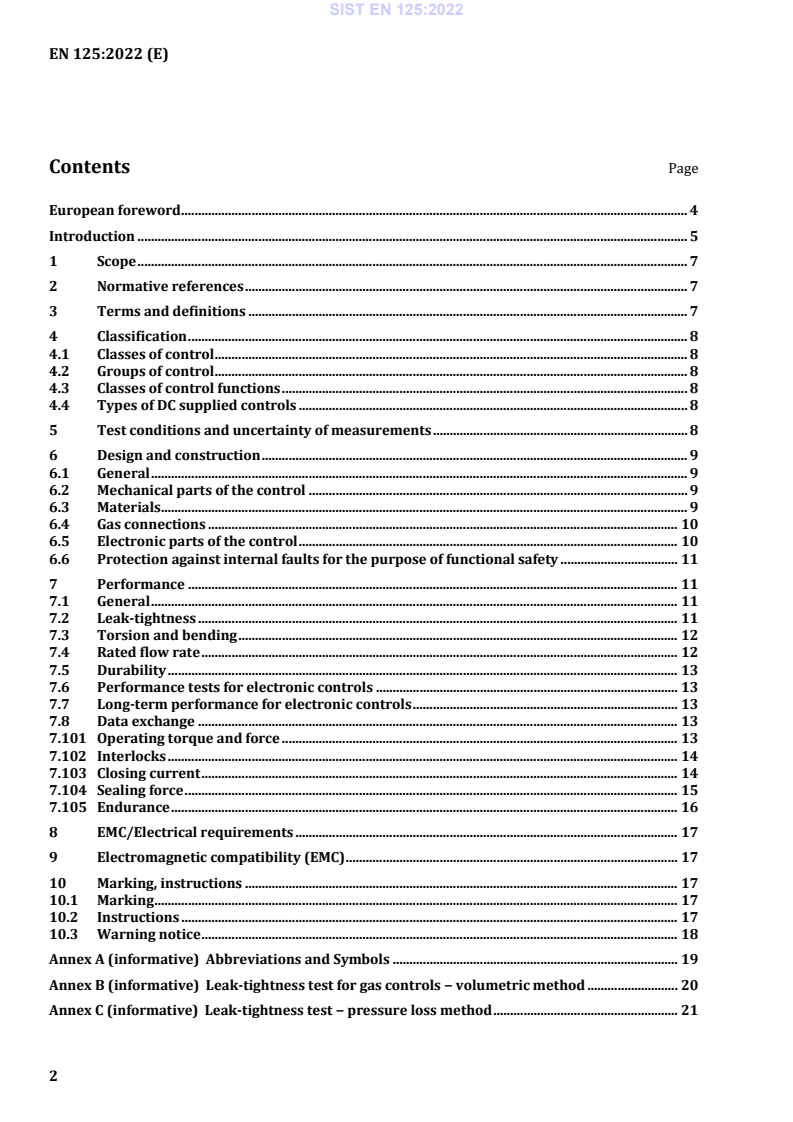
Contents Page
European foreword . 4
Introduction . 5
1 Scope . 7
2 Normative references . 7
3 Terms and definitions . 7
4 Classification . 8
4.1 Classes of control . 8
4.2 Groups of control . 8
4.3 Classes of control functions . 8
4.4 Types of DC supplied controls . 8
5 Test conditions and uncertainty of measurements . 8
6 Design and construction . 9
6.1 General . 9
6.2 Mechanical parts of the control . 9
6.3 Materials . 9
6.4 Gas connections . 10
6.5 Electronic parts of the control . 10
6.6 Protection against internal faults for the purpose of functional safety . 11
7 Performance . 11
7.1 General . 11
7.2 Leak-tightness . 11
7.3 Torsion and bending . 12
7.4 Rated flow rate . 12
7.5 Durability . 13
7.6 Performance tests for electronic controls . 13
7.7 Long-term performance for electronic controls . 13
7.8 Data exchange . 13
7.101 Operating torque and force . 13
7.102 Interlocks . 14
7.103 Closing current . 14
7.104 Sealing force . 15
7.105 Endurance . 16
8 EMC/Electrical requirements . 17
9 Electromagnetic compatibility (EMC) . 17
10 Marking, instructions . 17
10.1 Marking . 17
10.2 Instructions . 17
10.3 Warning notice . 18
Annex A (informative) Abbreviations and Symbols . 19
Annex B (informative) Leak-tightness test for gas controls − volumetric method . 20
Annex C (informative) Leak-tightness test − pressure loss method . 21
Annex D (normative) Calculation of pressure loss into leakage rate . 22
Annex E (normative) Electrical/electronic component fault modes . 23
Annex F (normative) Additional requirements for safety accessories and pressure
accessories as defined in EU Directive 2014/68/EU. 24
Annex G (normative) Materials for pressurized parts . 25
Annex H (normative) Additional materials for pressurized parts . 26
Annex I (normative) Requirements for controls used in DC supplied burners and burning
gaseous or liquid fuels appliances . 27
Annex J (normative) Method for the determination of the Safety Integrity Level (SIL) . 28
Annex K (normative) Method for the determination of a Performance Level (PL) . 29
Annex L (informative) Relationship between Safety Integrity Level (SIL) and
Performance Level (PL) . 30
Annex M (normative) Reset functions . 31
Annex N (informative) Guidance document on Environmental Aspects . 32
Annex O (normative) Seals of elastomers, cork and synthetic fibre mixtures . 33
Annex AA (informative) Types of flame supervision devices . 34
Bibliography . 39
European foreword
This document (EN 125:2022) has been prepared by Technical Committee CEN/TC 58 “Safety and control
devices for burners and appliances burning gaseous or liquid fuels”, the secretariat of which is held by
BSI.
This European Standard shall be given the status of a national standard, either by publication of an
identical text or by endorsement, at the latest by April 2023, and conflicting national standards shall be
withdrawn at the latest by October 2025.
Attention is drawn to the possibility that some of the elements of this document may be the subject of
patent rights. CEN shall not be held responsible for identifying any or all such patent rights.
This document supersedes EN 125:2010+A1:2015.
The following significant changes compared to the previous edition have been incorporated in this
document:
a) alignment with EN 13611:2019;
b) requirements from EU Directive 2014/68/EU were not adopted;
c) terms and definitions are aligned with EN 13611:2019;
d) reference to EN 437 removed;
e) clarification regarding sealing forces in the same and opposite direction of closing member.
This document has been prepared under a Standardization Request given to CEN by the European
Commission and the European Free Trade Association, and supports essential requirements of
EU Directive(s) / Regulation(s).
For relationship with EU Directive(s) / Regulation(s), see informative Annex ZA, which is an integral part
of this document.
Any feedback and questions on this document should be directed to the users’ national standards body.
A complete listing of these bodies can be found on the CEN website.
According to the CEN-CENELEC Internal Regulations, the national standards organisations of the
following countries are bound to implement this European Standard: Austria, Belgium, Bulgaria, Croatia,
Cyprus, Czech Republic, Denmark, Estonia, Finland, France, Germany, Greece, Hungary, Iceland, Ireland,
Italy, Latvia, Lithuania, Luxembourg, Malta, Netherlands, Norway, Poland, Portugal, Republic of North
Macedonia, Romania, Serbia, Slovakia, Slovenia, Spain, Sweden, Switzerland, Türkiye and the United
Kingdom.
Introduction
This document is intended to be used in conjunction with EN 13611:2019.
EN 13611:2019 recognizes the safety level specified by CEN/TC 58 and is regarded as a horizontal
standard dealing with the safety, construction, performance and testing of controls for burners and
appliances burning gaseous and/or liquid fuels.
The general requirements for controls are given in EN 13611:2019, and methods for classification and
assessment for new controls and control functions are given in EN 14459:2021 (see Figure 1).
EN 126:2012 (see Figure 1) specifies multifunctional controls combining two or more controls and
Application Control Functions, one of which is a mechanical control function. The requirements for
controls and Application Control Functions are given in the specific control standard (see Figure 1,
control functions).
Figure 1 — Interrelation of control standards
EN 13611:2019 should be used in conjunction with the specific standard for a specific type of control (e.g.
EN 88-1:2022, EN 88-2:2022, EN 88-3:2022, EN 125:2022, EN 126:2012, EN 161:2022, EN 257:2022,
EN 298:2022, EN 1106:2022, EN 1643:2022, EN 1854:— , EN 12067-2:2022, EN 16304:2022,
EN 16340:2014, EN 16678:2022 and EN 16898:2022), or for controls for specific applications.
EN 13611:2019 can also be applied, so far as reasonable, to controls not mentioned in a specific standard
and to controls designed on new principles, in which case additional requirements can be necessary.
EN 14459:2021 provides methods for classification and assessment of new control principles.
Primarily in industrial applications it is common practice to rate the safety of a plant based on values
describing the likelihood of a dangerous failure. These values are being used to determine Safety Integrity
Levels or Performance Levels when the system is being assessed in its entirety.
CEN/TC 58 standards for safety relevant controls do go beyond this approach, because for a certain life
time for which the product is specified, designed and tested a dangerous failure is not allowed at all.
Failure modes are described and assessed in greater detail.
Under preparation. Stage at the time of publication: FprEN 1854:2022.
Measures to prevent from dangerous situations are defined. Field experience over many decades is
reflected in the CEN/TC 58 standards. Requirements of EN 13611:2019 can be considered as proven in
practice.
This document refers to clauses of EN 13611:2019 or adapts clauses by stating “with the following
modification”, “with the following addition”, “is replaced by the following” or “is not applicable” in the
corresponding clause.
This document adds clauses or subclauses to the structure of EN 13611:2019 which are particular to this
document. Subclauses which are additional to those in EN 13611:2019 are numbered starting from 101.
Additional Annexes are designed as Annex AA, BB, CC, etc. It should be noted that these clauses,
subclauses and Annexes are not indicated as an addition.
1 Scope
EN 13611:2019, Clause 1 applies with the following modification and addition:
Modification:
st
The 1 paragraph of EN 13611:2019, Clause 1 is replaced by:
This document specifies the safety, design, construction, and performance requirements and testing for
thermoelectric flame supervision devices, energized by a thermocouple intended for use with burners
and appliances burning one or more gaseous fuels, hereafter referred to as “controls”.
This document is applicable to controls with declared maximum inlet pressures up to and including
500 kPa and of nominal connection sizes up to and including DN 50.
Addition:
This document is not applicable to:
— the thermocouple;
— controls which use auxiliary energy (e.g. electrical energy supplied externally).
th
The 4 paragraph of EN 13611:2019, Clause 1 is removed.
2 Normative references
The following documents are referred to in the text in such a way that some or all of their content
constitutes requirements of this document. For dated references, only the edition cited applies. For
undated references, the latest edition of the referenced document (including any amendments) applies.
EN 13611:2019 , Safety and control devices for burners and appliances burning gaseous and/or liquid fuels
— General requirements
3 Terms and definitions
For the purposes of this document, the terms and definitions given in EN 13611:2019 and the following
apply.
ISO and IEC maintain terminological databases for use in standardization at the following addresses:
— ISO Online browsing platform: available at https://www.iso.org/obp
— IEC Electropedia: available at https://www.electropedia.org/
3.101
thermocouple
thermoelectric flame sensing element that responds to the temperature of the supervised flame, and in
which the flame effect produces an electromotive force (e.m.f.)
As impacted by EN 13611:2019/AC:2021.
3.102
thermoelectric flame supervision device
control which, in response to the e.m.f. produced by the thermocouple, maintains the gas way to the main
burner or the main burner and the pilot burner open and which shuts off the gas way to the main burner
at least, after extinction of the supervised flame
Note 1 to entry: For further reference, see Figure AA.1 and Figure AA.2.
3.103
ignition interlock
part which prevents the igniter from operating as long as the main gas way is open
3.104
re-start interlock
mechanism which prevents the re-opening of the gas way to the main burner or to the main burner and
the pilot burner until the armature plate has separated from the magnetic element
Note 1 to entry: For further information, see Figure AA.1 and Figure AA.2.
3.105
sealing force
force acting on the closure member when the closure member is in the closed position, independent of
any force provided by fuel gas pressure
3.106
closed position
position of the closure member(s) in the absence of the thermoelectric energy
4 Classification
4.1 Classes of control
EN 13611:2019, 4.1 is replaced by the following:
Controls shall be classified A, B or C according to the number of operations as tested in 7.105.2.2.
4.2 Groups of control
Shall be according to EN 13611:2019, 4.2.
4.3 Classes of control functions
EN 13611:2019, 4.3 is not applicable.
4.4 Types of DC supplied controls
EN 13611:2019, 4.4 is not applicable.
5 Test conditions and uncertainty of measurements
Shall be according to EN 13611:2019, Clause 5.
6 Design and construction
6.1 General
Shall be according to EN 13611:2019, 6.1 with the following modification and addition:
rd
The 3 paragraph of EN 13611:2019, 6.1 is not applicable.
Controls shall shut off the gas way to the burner automatically with at least the sealing force specified in
7.104 in case of failure in the thermoelectric current. Controls shall also be designed so that during
ignition either the gas way to the main burner is open, if there is no pilot burner, or the gas way to the
main burner is closed and that to the pilot burner is open.
6.2 Mechanical parts of the control
6.2.1 Appearance
Shall be according to EN 13611:2019, 6.2.1.
6.2.2 Holes
Shall be according to EN 13611:2019, 6.2.2.
6.2.3 Breather holes
EN 13611:2019, 6.2.3 is not applicable.
6.2.4 Screwed fastenings
Shall be according to EN 13611:2019, 6.2.4.
6.2.5 Jointing
Shall be according to EN 13611:2019, 6.2.5.
6.2.6 Moving parts
Shall be according to EN 13611:2019, 6.2.6.
6.2.7 Sealing caps
Shall be according to EN 13611:2019, 6.2.7.
6.2.8 Dismantling and reassembly
Shall be according to EN 13611:2019, 6.2.8.
6.2.9 Auxiliary canals and orifices
Shall be according to EN 13611:2019, 6.2.9.
6.2.10 Presetting device
Shall be according to EN 13611:2019, 6.2.10.
6.3 Materials
6.3.1 General material requirements
Shall be according to EN 13611:2019, 6.3.1.
6.3.2 Housing
Shall be according to EN 13611:2019, 6.3.2.
6.3.3 Zinc alloys
Shall be according to EN 13611:2019, 6.3.3.
6.3.4 Springs
Shall be according to EN 13611:2019, 6.3.4.
6.3.5 Resistance to corrosion and surface protection
Shall be according to EN 13611:2019, 6.3.5.
6.3.6 Impregnation
Shall be according to EN 13611:2019, 6.3.6.
6.3.7 Seals for glands for moving parts
Shall be according to EN 13611:2019, 6.3.7.
6.4 Gas connections
6.4.1 Making connections
Shall be according to EN 13611:2019, 6.4.1.
6.4.2 Connection sizes
Shall be according to EN 13611:2019, 6.4.2.
6.4.3 Threads
Shall be according to EN 13611:2019, 6.4.3.
6.4.4 Union joints
Shall be according to EN 13611:2019, 6.4.4.
6.4.5 Flanges
Shall be according to EN 13611:2019, 6.4.5.
6.4.6 Compression fittings
Shall be according to EN 13611:2019, 6.4.6.
6.4.7 Nipples for pressure test
Shall be according to EN 13611:2019, 6.4.7.
6.4.8 Strainers
Shall be according to EN 13611:2019, 6.4.8 with the following addition:
Strainers fitted to controls of DN 25 and above shall be accessible for cleaning or replacement without
the need to remove the control body by dismantling threaded or welded pipe work.
6.5 Electronic parts of the control
EN 13611:2019, 6.5 is not applicable.
6.6 Protection against internal faults for the purpose of functional safety
EN 13611:2019, 6.6 is not applicable.
7 Performance
7.1 General
Shall be according to EN 13611:2019, 7.1 with the following addition:
Tests shall be conducted in the sequence shown in Table 1.
Table 1 — Sequence of testing
Clauses no. Type of test
7.2 Test for leak-tightness
7.4 Test for
...