

ETSI EN 301 502 V12.5.2 (2017-03)
Global System for Mobile communications (GSM); Base Station (BS) equipment; Harmonised Standard covering the essential requirements of article 3.2 of Directive 2014/53/EU
General Information
- Abstract
REN/MSG-0019-RED-C1
- Status
- Published
- Publication Date
- 11-Apr-2017
- Technical Committee
- MSG - Mobile Standards Group
- Current Stage
- 12 - Citation in the OJ
- Due Date
- 15-Jun-2017
- Completion Date
- 12-Apr-2017
Buy Documents

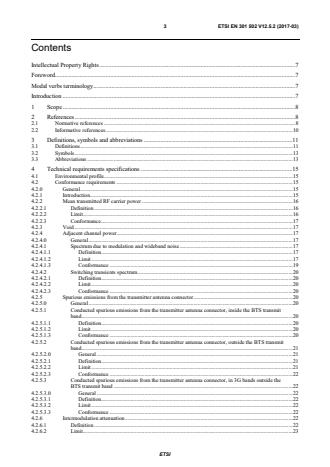
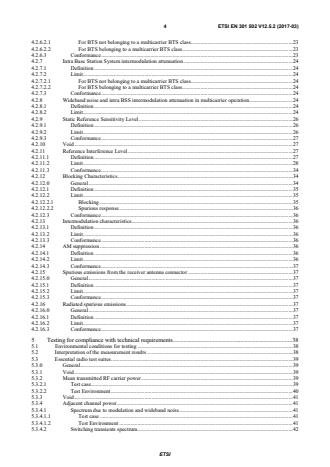
ETSI EN 301 502 V12.5.2 (2017-03) - Global System for Mobile communications (GSM); Base Station (BS) equipment; Harmonised Standard covering the essential requirements of article 3.2 of Directive 2014/53/EU

Overview
ETSI EN 301 502 V12.5.2 (2017-03) (identical to ETSI EN 301 502 V12.5.2 (2017-03)) is a harmonised European standard for GSM Base Station (BS) equipment. It implements the essential requirements of Article 3.2 of Directive 2014/53/EU (Radio Equipment Directive) related to electromagnetic compatibility (EMC) and radio spectrum use. The standard’s primary aim is to demonstrate that GSM base stations effectively use and support the efficient use of radio spectrum to avoid harmful interference with other services, including adjacent bands (guidance for which is given in ECC Report 146).
Key topics and technical requirements
The standard defines technical requirements, test methods and conformance criteria for GSM BS equipment. Major topics include:
- Mean transmitted RF carrier power - definitions, limits and conformance procedures for transmitter power control.
- Adjacent channel power (ACP) - spectrum due to modulation, wideband noise and switching transients; measurement and limits to protect adjacent-band systems.
- Spurious emissions (conducted and radiated) - requirements for emissions both inside and outside the BTS transmit band to prevent harmful interference.
- Intermodulation attenuation - requirements for single-carrier and multicarrier base stations; intra-BSS intermodulation and multicarrier wideband noise controls.
- Reference interference level & static reference sensitivity - definitions and conformance to ensure robust receiver performance in real-world interference environments.
- Blocking, spurious response and AM suppression - receiver linearity and immunity specifications.
- Testing and measurement - environmental profiles, test suites, measurement conditions and interpretation of results required for conformity assessment.
Note: the standard provides procedural requirements and references normative/informative documents rather than prescribing specific deployment parameters beyond EMC/emission limits; numerical limits and detailed test set-ups are contained in the full ETSI text.
Practical applications and users
This harmonised standard is intended for:
- Base station manufacturers (design verification, product development, pre-compliance and type approval)
- Network operators and integrators (equipment acceptance testing and interference mitigation planning)
- Test and certification laboratories (conformity assessment to Directive 2014/53/EU)
- Regulators and spectrum managers (evaluating equipment impact on adjacent bands)
- EMC and RF engineers (designing RF front-ends, filters and mitigation measures for GSM and multicarrier BTS)
Adopting this standard helps demonstrate regulatory compliance, reduce risk of harmful interference, and support efficient spectrum sharing in GSM/ER‑GSM/R‑GSM deployments.
Related standards and references
- Directive 2014/53/EU (Radio Equipment Directive) - Article 3.2 (EMC)
- ECC Report 146 - guidance on interference to adjacent bands for single- and multi-carrier BTS
- ETSI EN series for GSM equipment and RF test methods
Keywords: GSM base station, BS equipment, harmonised standard, ETSI EN 301 502, Directive 2014/53/EU, adjacent channel power, spurious emissions, intermodulation, EMC testing, spectrum efficiency.
Buy Documents
ETSI EN 301 502 V12.5.2 (2017-03) - Global System for Mobile communications (GSM); Base Station (BS) equipment; Harmonised Standard covering the essential requirements of article 3.2 of Directive 2014/53/EU
Frequently Asked Questions
ETSI EN 301 502 V12.5.2 (2017-03) is a standard published by the European Telecommunications Standards Institute (ETSI). Its full title is "Global System for Mobile communications (GSM); Base Station (BS) equipment; Harmonised Standard covering the essential requirements of article 3.2 of Directive 2014/53/EU". This standard covers: REN/MSG-0019-RED-C1
REN/MSG-0019-RED-C1
ETSI EN 301 502 V12.5.2 (2017-03) is available in PDF format for immediate download after purchase. The document can be added to your cart and obtained through the secure checkout process. Digital delivery ensures instant access to the complete standard document.
Standards Content (Sample)
HARMONISED EUROPEAN STANDARD
Global System for Mobile communications (GSM);
Base Station (BS) equipment;
Harmonised Standard covering the essential requirements
of article 3.2 of Directive 2014/53/EU
2 ETSI EN 301 502 V12.5.2 (2017-03)
Reference
REN/MSG-0019-RED-C1
Keywords
base station, cellular, ER-GSM, GSM, R-GSM
ETSI
650 Route des Lucioles
F-06921 Sophia Antipolis Cedex - FRANCE
Tel.: +33 4 92 94 42 00 Fax: +33 4 93 65 47 16
Siret N° 348 623 562 00017 - NAF 742 C
Association à but non lucratif enregistrée à la
Sous-Préfecture de Grasse (06) N° 7803/88
Important notice
The present document can be downloaded from:
http://www.etsi.org/standards-search
The present document may be made available in electronic versions and/or in print. The content of any electronic and/or
print versions of the present document shall not be modified without the prior written authorization of ETSI. In case of any
existing or perceived difference in contents between such versions and/or in print, the only prevailing document is the
print of the Portable Document Format (PDF) version kept on a specific network drive within ETSI Secretariat.
Users of the present document should be aware that the document may be subject to revision or change of status.
Information on the current status of this and other ETSI documents is available at
https://portal.etsi.org/TB/ETSIDeliverableStatus.aspx
If you find errors in the present document, please send your comment to one of the following services:
https://portal.etsi.org/People/CommiteeSupportStaff.aspx
Copyright Notification
No part may be reproduced or utilized in any form or by any means, electronic or mechanical, including photocopying
and microfilm except as authorized by written permission of ETSI.
The content of the PDF version shall not be modified without the written authorization of ETSI.
The copyright and the foregoing restriction extend to reproduction in all media.
© European Telecommunications Standards Institute 2017.
All rights reserved.
TM TM TM
DECT , PLUGTESTS , UMTS and the ETSI logo are Trade Marks of ETSI registered for the benefit of its Members.
TM
3GPP and LTE™ are Trade Marks of ETSI registered for the benefit of its Members and
of the 3GPP Organizational Partners.
GSM® and the GSM logo are Trade Marks registered and owned by the GSM Association.
ETSI
3 ETSI EN 301 502 V12.5.2 (2017-03)
Contents
Intellectual Property Rights . 7
Foreword . 7
Modal verbs terminology . 7
Introduction . 7
1 Scope . 8
2 References . 8
2.1 Normative references . 8
2.2 Informative references . 10
3 Definitions, symbols and abbreviations . 11
3.1 Definitions . 11
3.2 Symbols . 13
3.3 Abbreviations . 13
4 Technical requirements specifications . 15
4.1 Environmental profile . 15
4.2 Conformance requirements . 15
4.2.0 General . 15
4.2.1 Introduction. 15
4.2.2 Mean transmitted RF carrier power . 16
4.2.2.1 Definition . 16
4.2.2.2 Limit . 16
4.2.2.3 Conformance . 17
4.2.3 Void . 17
4.2.4 Adjacent channel power . 17
4.2.4.0 General . 17
4.2.4.1 Spectrum due to modulation and wideband noise . 17
4.2.4.1.1 Definition. 17
4.2.4.1.2 Limit . 17
4.2.4.1.3 Conformance . 19
4.2.4.2 Switching transients spectrum . 20
4.2.4.2.1 Definition. 20
4.2.4.2.2 Limit . 20
4.2.4.2.3 Conformance . 20
4.2.5 Spurious emissions from the transmitter antenna connector . 20
4.2.5.0 General . 20
4.2.5.1 Conducted spurious emissions from the transmitter antenna connector, inside the BTS transmit
band . 20
4.2.5.1.1 Definition. 20
4.2.5.1.2 Limit . 20
4.2.5.1.3 Conformance . 20
4.2.5.2 Conducted spurious emissions from the transmitter antenna connector, outside the BTS transmit
band . 21
4.2.5.2.0 General . 21
4.2.5.2.1 Definition. 21
4.2.5.2.2 Limit . 21
4.2.5.2.3 Conformance . 22
4.2.5.3 Conducted spurious emissions from the transmitter antenna connector, in 3G bands outside the
BTS transmit band . 22
4.2.5.3.0 General . 22
4.2.5.3.1 Definition. 22
4.2.5.3.2 Limit . 22
4.2.5.3.3 Conformance . 22
4.2.6 Intermodulation attenuation . 22
4.2.6.1 Definition . 22
4.2.6.2 Limit . 23
ETSI
4 ETSI EN 301 502 V12.5.2 (2017-03)
4.2.6.2.1 For BTS not belonging to a multicarrier BTS class . 23
4.2.6.2.2 For BTS belonging to a multicarrier BTS class . 23
4.2.6.3 Conformance . 23
4.2.7 Intra Base Station System intermodulation attenuation . 24
4.2.7.1 Definition . 24
4.2.7.2 Limit . 24
4.2.7.2.1 For BTS not belonging to a multicarrier BTS class . 24
4.2.7.2.2 For BTS belonging to a multicarrier BTS class . 24
4.2.7.3 Conformance . 24
4.2.8 Wideband noise and intra BSS intermodulation attenuation in multicarrier operation . 24
4.2.8.1 Definition . 24
4.2.8.2 Limit . 24
4.2.9 Static Reference Sensitivity Level . 26
4.2.9.1 Definition . 26
4.2.9.2 Limit . 26
4.2.9.3 Conformance . 27
4.2.10 Void . 27
4.2.11 Reference Interference Level . 27
4.2.11.1 Definition . 27
4.2.11.2 Limit . 28
4.2.11.3 Conformance . 34
4.2.12 Blocking Characteristics . 34
4.2.12.0 General . 34
4.2.12.1 Definition . 35
4.2.12.2 Limit . 35
4.2.12.2.1 Blocking . 35
4.2.12.2.2 Spurious response . 36
4.2.12.3 Conformance . 36
4.2.13 Intermodulation characteristics . 36
4.2.13.1 Definition . 36
4.2.13.2 Limit . 36
4.2.13.3 Conformance . 36
4.2.14 AM suppression . 36
4.2.14.1 Definition . 36
4.2.14.2 Limit . 36
4.2.14.3 Conformance . 37
4.2.15 Spurious emissions from the receiver antenna connector . 37
4.2.15.0 General . 37
4.2.15.1 Definition . 37
4.2.15.2 Limit . 37
4.2.15.3 Conformance . 37
4.2.16 Radiated spurious emissions . 37
4.2.16.0 General . 37
4.2.16.1 Definition . 37
4.2.16.2 Limit . 37
4.2.16.3 Conformance . 37
5 Testing for compliance with technical requirements . 38
5.1 Environmental conditions for testing . 38
5.2 Interpretation of the measurement results . 38
5.3 Essential radio test suites . 39
5.3.0 General . 39
5.3.1 Void . 39
5.3.2 Mean transmitted RF carrier power . 39
5.3.2.1 Test case . 39
5.3.2.2 Test Environment . 40
5.3.3 Void . 41
5.3.4 Adjacent channel power . 41
5.3.4.1 Spectrum due to modulation and wideband noise . 41
5.3.4.1.1 Test case . 41
5.3.4.1.2 Test Environment . 41
5.3.4.2 Switching transients spectrum . 42
ETSI
5 ETSI EN 301 502 V12.5.2 (2017-03)
5.3.4.2.1 Test case . 42
5.3.4.2.2 Test Environment . 43
5.3.5 Spurious emissions from the transmitter antenna connector . 43
5.3.5.1 Conducted spurious emissions from the transmitter antenna connector, inside the BTS transmit
band . 43
5.3.5.1.1 Test case . 43
5.3.5.1.2 Test Environment . 43
5.3.5.2 Conducted spurious emissions from the transmitter antenna connector, outside the BTS transmit
band . 44
5.3.5.2.0 General . 44
5.3.5.2.1 For BTS not belonging to a multicarrier BTS class . 44
5.3.5.2.2 For BTS belonging to a multicarrier BTS class . 45
5.3.5.3 Conducted spurious emissions from the transmitter antenna connector, in 3G bands outside the
BTS transmit band . 47
5.3.5.3.0 General . 47
5.3.5.3.1 Test case . 47
5.3.5.3.2 Test Environment . 47
5.3.6 Intermodulation attenuation . 47
5.3.6.1 Test case . 47
5.3.6.2 Test Environment . 49
5.3.7 Intra Base Station System intermodulation attenuation . 49
5.3.7.1 Test case . 49
5.3.7.2 Test Environment . 50
5.3.8 Wideband noise and intra BSS intermodulation attenuation in multicarrier operation . 50
5.3.8.1 Test case . 50
5.3.8.2 Test Environment . 53
5.3.9 Static reference sensitivity level . 53
5.3.9.1 Test case . 53
5.3.9.2 Test Environment . 54
5.3.10 Void . 54
5.3.11 Reference Interference Level . 54
5.3.11.1 Test case . 54
5.3.11.2 Test Environment . 63
5.3.12 Blocking Characteristics . 63
5.3.12.0 General . 63
5.3.12.1 Test case . 63
5.3.12.2 Test Environment . 69
5.3.13 Intermodulation characteristics . 69
5.3.13.1 Test case . 69
5.3.13.2 Test Environment . 70
5.3.14 AM suppression . 70
5.3.14.1 Test case . 70
5.3.14.2 Test Environment . 72
5.3.15 Spurious emissions from the receiver antenna connector . 72
5.3.15.0 General . 72
5.3.15.1 Test case . 72
5.3.15.2 Test Environment . 72
5.3.16 Radiated spurious emissions . 73
5.3.16.0 General . 73
5.3.16.1 Test case . 74
5.3.16.2 Test Environment . 75
Annex A (informative): Relationship between the present document and the essential
requirements of Directive 2014/53/EU . 76
Annex B (normative): General test conditions and declarations . 78
B.1 Declaration by manufacturer . 78
B.1.0 General . 78
B.1.1 Output power and determination of power class . 78
B.1.2 Specified frequency range . 79
B.1.3 Frequency hopping . 79
ETSI
6 ETSI EN 301 502 V12.5.2 (2017-03)
B.1.4 Void . 79
B.1.5 Downlink discontinuous transmission (DTX) . 79
B.2 BTS Configurations . 80
B.2.0 General . 80
B.2.1 Receiver diversity . 80
B.2.2 Duplexers . 80
B.2.3 Power supply options . 81
B.2.4 Ancillary RF amplifiers . 81
B.2.5 BSS using antenna arrays . 82
B.2.6 BTS supporting 8-PSK modulation . 83
B.2.7 BTS supporting additional modulations in EGPRS2 . 83
B.2.8 Supported Symbol Rate . 83
B.2.9 Support of RTTI and/or FANR . 83
B.2.10 Multicarrier BTS . 84
B.2.11 BTS supporting VAMOS . 85
B.2.12 BTS supporting ER-GSM . 85
Annex C (normative): Test environments . 86
C.0 General . 86
C.1 Normal test environment . 86
C.2 Extreme test environment . 86
C.2.0 General . 86
C.2.1 Extreme temperature . 86
C.3 Void . 87
C.4 Power supply . 87
Annex D (informative): Void . 88
Annex E (informative): Change History . 89
History . 90
ETSI
7 ETSI EN 301 502 V12.5.2 (2017-03)
Intellectual Property Rights
IPRs essential or potentially essential to the present document may have been declared to ETSI. The information
pertaining to these essential IPRs, if any, is publicly available for ETSI members and non-members, and can be found
in ETSI SR 000 314: "Intellectual Property Rights (IPRs); Essential, or potentially Essential, IPRs notified to ETSI in
respect of ETSI standards", which is available from the ETSI Secretariat. Latest updates are available on the ETSI Web
server (https://ipr.etsi.org/).
Pursuant to the ETSI IPR Policy, no investigation, including IPR searches, has been carried out by ETSI. No guarantee
can be given as to the existence of other IPRs not referenced in ETSI SR 000 314 (or the updates on the ETSI Web
server) which are, or may be, or may become, essential to the present document.
Foreword
This Harmonised European Standard (EN) has been produced by ETSI Technical Committee Mobile Standards Group
(MSG).
For non EU countries the present document may be used for regulatory (Type Approval) purposes.
The present document has been prepared under the Commission's standardisation request C(2015) 5376 final [i.10] to
provide one voluntary means of conforming to the essential requirements of Directive 2014/53/EU on the harmonisation
of the laws of the Member States relating to the making available on the market of radio equipment and repealing
Directive 1999/5/EC [i.1].
Once the present document is cited in the Official Journal of the European Union under that Directive, compliance with
the normative clauses of the present document given in table A.1 confers, within the limits of the scope of the present
document, a presumption of conformity with the corresponding essential requirements of that Directive, and associated
EFTA regulations.
National transposition dates
Date of latest announcement of this EN (doa): 30 June 2017
Date of latest publication of new National Standard
or endorsement of this EN (dop/e): 31 December 2017
Date of withdrawal of any conflicting National Standard (dow): 31 December 2017
Modal verbs terminology
In the present document "shall", "shall not", "should", "should not", "may", "need not", "will", "will not", "can" and
"cannot" are to be interpreted as described in clause 3.2 of the ETSI Drafting Rules (Verbal forms for the expression of
provisions).
"must" and "must not" are NOT allowed in ETSI deliverables except when used in direct citation.
Introduction
The present document is part of a set of standards developed by ETSI that are designed to fit in a modular structure to
cover radio equipment within the scope of the Radio Equipment Directive [i.1]. The present document is produced
following the guidance in ETSI EG 203 336 [i.2] as applicable.
ETSI
8 ETSI EN 301 502 V12.5.2 (2017-03)
1 Scope
The present document applies to the following radio equipment type:
1) GSM base stations.
Table 1-1: GSM Base Station System frequency bands
GSM band Direction of GSM Base Station System relevant frequency bands
transmission
P-GSM 900 Transmit 935 MHz to 960 MHz
Receive 890 MHz to 915 MHz
E-GSM 900 Transmit 925 MHz to 960 MHz
Receive 880 MHz to 915 MHz
R-GSM 900 Transmit 921 MHz to 960 MHz
Receive 876 MHz to 915 MHz
ER-GSM 900 Transmit 918 MHz to 960 MHz
Receive 873 MHz to 915 MHz
DCS 1 800 Transmit 1 805 MHz to 1 880 MHz
Receive 1 710 MHz to 1 785 MHz
GSM 450 Transmit 460,4 MHz to 467,6 MHz
Receive 450,4 MHz to 457,6 MHz
GSM 480 Transmit 488,8 MHz to 496 MHz
Receive 478,8 MHz to 486 MHz
The present document contains requirements aiming to demonstrate that that radio equipment both effectively uses and
supports the efficient use of radio spectrum in order to avoid harmful interference.
In regards to interference to systems operating in adjacent bands guidance for single carrier BTS and multicarrier BTS
is provided in ECC Report 146 [i.3].
2 References
2.1 Normative references
References are specific, identified by date of publication and/or edition number or version number. Only the cited
version applies.
Referenced documents which are not found to be publicly available in the expected location might be found at
https://docbox.etsi.org/Reference/.
NOTE: While any hyperlinks included in this clause were valid at the time of publication, ETSI cannot guarantee
their long term validity.
The following referenced documents are necessary for the application of the present document.
[1] ETSI EN 301 908-18 (V11.1.1) (07-2016): "IMT cellular networks; Harmonised Standard
covering the essential requirements of article 3.2 of the Radio Equipment Directive 2014/53/EU;
Part 18: E-UTRA, UTRA and GSM/EDGE Multi-Standard Radio (MSR) Base Station (BS)".
[2] ETSI TS 151 021 (V12.3.0) (01-2015): "Digital cellular telecommunications system (Phase 2+);
Base Station System (BSS) equipment specification; Radio aspects (3GPP TS 51.021
version 12.3.0 Release 12)".
[3] ETSI TS 145 002 (V12.4.0) (04-2015): "Digital cellular telecommunications system (Phase 2+);
Multiplexing and multiple access on the radio path (3GPP TS 45.002 version 12.4.0 Release 12)".
[4] ETSI TS 145 004 (V12.0.0) (10-2014): "Digital cellular telecommunications system (Phase 2+);
Modulation (3GPP TS 45.004 version 12.0.0 Release 12)".
ETSI
9 ETSI EN 301 502 V12.5.2 (2017-03)
[5] ETSI TS 145 005 (V12.5.0) (04-2015): "Digital cellular telecommunications system (Phase 2+);
Radio Transmission and reception (3GPP TS 45.005 version 12.5.0 Release 12)".
[6] ETSI TS 145 010 (V12.0.0) (10-2014): "Digital cellular telecommunications system (Phase 2+);
Radio subsystem synchronization (3GPP TS 45.010 version 12.0.0 Release 12)".
[7] ETSI EN 300 019-1-0 (V2.1.2) (09-2003): "Environmental Engineering (EE); Environmental
conditions and environmental tests for telecommunications equipment; Part 1-0: Classification of
environmental conditions; Introduction".
[8] ETSI EN 300 019-1-3 (V2.4.1) (04-2014): "Environmental Engineering (EE); Environmental
conditions and environmental tests for telecommunications equipment; Part 1-3: Classification of
environmental conditions; Stationary use at weather protected locations".
[9] ETSI EN 300 019-1-4 (V2.2.1) (04-2014): "Environmental Engineering (EE); Environmental
conditions and environmental tests for telecommunications equipment; Part 1-4: Classification of
environmental conditions; Stationary use at non-weather protected locations".
[10] ETSI TS 124 022 (V12.0.0) (10-2014): "Digital cellular telecommunications system (Phase 2+);
Universal Mobile Telecommunications System (UMTS); Radio Link Protocol (RLP) for circuit
switched bearer and teleservices (3GPP TS 24.022 version 12.0.0 Release 12)".
[11] ETSI TS 148 020 (V12.0.0) (10-2014): "Digital cellular telecommunications system (Phase 2+);
Rate adaption on the Base Station System - Mobile-services Switching Centre (BSS-MSC)
interface (3GPP TS 48.020 version 12.0.0 Release 12)".
[12] Recommendation ITU-T O.153 (10-1992): "Basic Parameters for the measurement of error
performance at bit rates below the primary rate".
[13] Recommendation ITU-R SM.329-12 (09-2012): "Unwanted emissions in the spurious domain".
[14] ETSI EN 300 019-2-3 (V2.3.1) (04-2013): "Environmental Engineering (EE); Environmental
conditions and environmental tests for telecommunications equipment; Part 2-3: Specification of
environmental tests; Stationary use at weather protected locations".
[15] ETSI EN 300 019-2-4 (V2.3.1) (08-2013): "Environmental Engineering (EE); Environmental
conditions and environmental tests for telecommunications equipment; Part 2-4: Specification of
environmental tests; Stationary use at non-weather protected locations".
[16] IEC EN 60721-1 (ed.2.2, 10-2002): "Classification of environmental conditions:
Part 1: Environmental parameters and their severities".
[17] IEC EN 60721-2-1 (ed.2.0, 06-2013): "Classification of environmental conditions -
Part 2-1: Environmental conditions appearing in nature - Temperature and humidity".
[18] IEC EN 60721-2-4 (ed.1.1, 10-2002): "Classification of environmental conditions -
Part 2-4: Environmental conditions appearing in nature - Solar radiation and temperature".
[19] IEC EN 60721-3-0 (ed.1.1, 10-2002): "Classification of environmental conditions -
Part 3: Classification of groups of environmental parameters and their severities - Introduction".
[20] ETSI EN 301 908-1 (V11.1.1) (07-2016): "IMT cellular networks; Harmonised Standard covering
the essential requirements of article 3.2 of the Radio Equipment Directive 2014/53/EU;
Part 1: Introduction and common requirements".
[21] ETSI TS 145 008 (V12.4.0) (01-2015): "Digital cellular telecommunications system (Phase 2+);
Radio subsystem link control (3GPP TS 45.008 version 12.4.0 Release 12)".
ETSI
10 ETSI EN 301 502 V12.5.2 (2017-03)
2.2 Informative references
References are either specific (identified by date of publication and/or edition number or version number) or
non-specific. For specific references, only the cited version applies. For non-specific references, the latest version of the
referenced document (including any amendments) applies.
NOTE: While any hyperlinks included in this clause were valid at the time of publication, ETSI cannot guarantee
their long term validity.
The following referenced documents are not necessary for the application of the present document but they assist the
user with regard to a particular subject area.
[i.1] Directive 2014/53/EU of the European parliament and of the council of 16 April 2014 on the
harmonisation of the laws of the Member States relating to the making available on the market of
radio equipment and repealing Directive 1999/5/EC.
[i.2] ETSI EG 203 336: "Electromagnetic compatibility and Radio spectrum Matters (ERM); Guide for
the selection of technical parameters for the production of Harmonised Standards covering
article 3.1(b) and article 3.2 of Directive 2014/53/EU".
th
[i.3] E
...
2003-01.Slovenski inštitut za standardizacijo. Razmnoževanje celote ali delov tega standarda ni dovoljeno.Global System for Mobile communications (GSM) - Base Station (BS) equipment - Harmonised Standard covering the essential requirements of article 3.2 of Directive 2014/53/EU33.070.50Globalni sistem za mobilno telekomunikacijo (GSM)Global System for Mobile Communication (GSM)ICS:Ta slovenski standard je istoveten z:ETSI EN 301 502 V12.5.2 (2017-03)SIST EN 301 502 V12.5.2:2017en01-maj-2017SIST EN 301 502 V12.5.2:2017SLOVENSKI
STANDARD
HARMONISED EUROPEAN STANDARD SIST EN 301 502 V12.5.2:2017
ETSI ETSI EN 301 502 V12.5.2 (2017-03) 2
Reference REN/MSG-0019-RED-C1 Keywords base station, cellular, ER-GSM, GSM, R-GSM ETSI 650 Route des Lucioles F-06921 Sophia Antipolis Cedex - FRANCE
Tel.: +33 4 92 94 42 00
Fax: +33 4 93 65 47 16
Siret N° 348 623 562 00017 - NAF 742 C Association à but non lucratif enregistrée à la Sous-Préfecture de Grasse (06) N° 7803/88
Important notice The present document can be downloaded from: http://www.etsi.org/standards-search The present document may be made available in electronic versions and/or in print. The content of any electronic and/or print versions of the present document shall not be modified without the prior written authorization of ETSI. In case of any existing or perceived difference in contents between such versions and/or in print, the only prevailing document is the print of the Portable Document Format (PDF) version kept on a specific network drive within ETSI Secretariat. Users of the present document should be aware that the document may be subject to revision or change of status. Information on the current status of this and other ETSI documents is available at https://portal.etsi.org/TB/ETSIDeliverableStatus.aspx If you find errors in the present document, please send your comment to one of the following services: https://portal.etsi.org/People/CommiteeSupportStaff.aspx Copyright Notification No part may be reproduced or utilized in any form or by any means, electronic or mechanical, including photocopying and microfilm except as authorized by written permission of ETSI. The content of the PDF version shall not be modified without the written authorization of ETSI. The copyright and the foregoing restriction extend to reproduction in all media.
© European Telecommunications Standards Institute 2017. All rights reserved.
DECTTM, PLUGTESTSTM, UMTSTM and the ETSI logo are Trade Marks of ETSI registered for the benefit of its Members. 3GPPTM and LTE™ are Trade Marks of ETSI registered for the benefit of its Members and of the 3GPP Organizational Partners. GSM® and the GSM logo are Trade Marks registered and owned by the GSM Association. SIST EN 301 502 V12.5.2:2017
ETSI ETSI EN 301 502 V12.5.2 (2017-03) 3 Contents Intellectual Property Rights . 7 Foreword . 7 Modal verbs terminology . 7 Introduction . 7 1 Scope . 8 2 References . 8 2.1 Normative references . 8 2.2 Informative references . 10 3 Definitions, symbols and abbreviations . 11 3.1 Definitions . 11 3.2 Symbols . 13 3.3 Abbreviations . 13 4 Technical requirements specifications . 15 4.1 Environmental profile . 15 4.2 Conformance requirements . 15 4.2.0 General . 15 4.2.1 Introduction. 15 4.2.2 Mean transmitted RF carrier power . 16 4.2.2.1 Definition . 16 4.2.2.2 Limit . 16 4.2.2.3 Conformance . 17 4.2.3 Void . 17 4.2.4 Adjacent channel power . 17 4.2.4.0 General . 17 4.2.4.1 Spectrum due to modulation and wideband noise . 17 4.2.4.1.1 Definition. 17 4.2.4.1.2 Limit . 17 4.2.4.1.3 Conformance . 19 4.2.4.2 Switching transients spectrum . 20 4.2.4.2.1 Definition. 20 4.2.4.2.2 Limit . 20 4.2.4.2.3 Conformance . 20 4.2.5 Spurious emissions from the transmitter antenna connector . 20 4.2.5.0 General . 20 4.2.5.1 Conducted spurious emissions from the transmitter antenna connector, inside the BTS transmit band . 20 4.2.5.1.1 Definition. 20 4.2.5.1.2 Limit . 20 4.2.5.1.3 Conformance . 20 4.2.5.2 Conducted spurious emissions from the transmitter antenna connector, outside the BTS transmit band . 21 4.2.5.2.0 General . 21 4.2.5.2.1 Definition. 21 4.2.5.2.2 Limit . 21 4.2.5.2.3 Conformance . 22 4.2.5.3 Conducted spurious emissions from the transmitter antenna connector, in 3G bands outside the BTS transmit band . 22 4.2.5.3.0 General . 22 4.2.5.3.1 Definition. 22 4.2.5.3.2 Limit . 22 4.2.5.3.3 Conformance . 22 4.2.6 Intermodulation attenuation . 22 4.2.6.1 Definition . 22 4.2.6.2 Limit . 23 SIST EN 301 502 V12.5.2:2017
ETSI ETSI EN 301 502 V12.5.2 (2017-03) 4 4.2.6.2.1 For BTS not belonging to a multicarrier BTS class . 23 4.2.6.2.2 For BTS belonging to a multicarrier BTS class . 23 4.2.6.3 Conformance . 23 4.2.7 Intra Base Station System intermodulation attenuation . 24 4.2.7.1 Definition . 24 4.2.7.2 Limit . 24 4.2.7.2.1 For BTS not belonging to a multicarrier BTS class . 24 4.2.7.2.2 For BTS belonging to a multicarrier BTS class . 24 4.2.7.3 Conformance . 24 4.2.8 Wideband noise and intra BSS intermodulation attenuation in multicarrier operation . 24 4.2.8.1 Definition . 24 4.2.8.2 Limit . 24 4.2.9 Static Reference Sensitivity Level . 26 4.2.9.1 Definition . 26 4.2.9.2 Limit . 26 4.2.9.3 Conformance . 27 4.2.10 Void . 27 4.2.11 Reference Interference Level . 27 4.2.11.1 Definition . 27 4.2.11.2 Limit . 28 4.2.11.3 Conformance . 34 4.2.12 Blocking Characteristics . 34 4.2.12.0 General . 34 4.2.12.1 Definition . 35 4.2.12.2 Limit . 35 4.2.12.2.1 Blocking . 35 4.2.12.2.2 Spurious response . 36 4.2.12.3 Conformance . 36 4.2.13 Intermodulation characteristics . 36 4.2.13.1 Definition . 36 4.2.13.2 Limit . 36 4.2.13.3 Conformance . 36 4.2.14 AM suppression . 36 4.2.14.1 Definition . 36 4.2.14.2 Limit . 36 4.2.14.3 Conformance . 37 4.2.15 Spurious emissions from the receiver antenna connector . 37 4.2.15.0 General . 37 4.2.15.1 Definition . 37 4.2.15.2 Limit . 37 4.2.15.3 Conformance . 37 4.2.16 Radiated spurious emissions . 37 4.2.16.0 General . 37 4.2.16.1 Definition . 37 4.2.16.2 Limit . 37 4.2.16.3 Conformance . 37 5 Testing for compliance with technical requirements . 38 5.1 Environmental conditions for testing . 38 5.2 Interpretation of the measurement results . 38 5.3 Essential radio test suites . 39 5.3.0 General . 39 5.3.1 Void . 39 5.3.2 Mean transmitted RF carrier power . 39 5.3.2.1 Test case . 39 5.3.2.2 Test Environment . 40 5.3.3 Void . 41 5.3.4 Adjacent channel power . 41 5.3.4.1 Spectrum due to modulation and wideband noise . 41 5.3.4.1.1 Test case . 41 5.3.4.1.2 Test Environment . 41 5.3.4.2 Switching transients spectrum . 42 SIST EN 301 502 V12.5.2:2017
ETSI ETSI EN 301 502 V12.5.2 (2017-03) 5 5.3.4.2.1 Test case . 42 5.3.4.2.2 Test Environment . 43 5.3.5 Spurious emissions from the transmitter antenna connector . 43 5.3.5.1 Conducted spurious emissions from the transmitter antenna connector, inside the BTS transmit band . 43 5.3.5.1.1 Test case . 43 5.3.5.1.2 Test Environment . 43 5.3.5.2 Conducted spurious emissions from the transmitter antenna connector, outside the BTS transmit band . 44 5.3.5.2.0 General . 44 5.3.5.2.1 For BTS not belonging to a multicarrier BTS class . 44 5.3.5.2.2 For BTS belonging to a multicarrier BTS class . 45 5.3.5.3 Conducted spurious emissions from the transmitter antenna connector, in 3G bands outside the BTS transmit band . 47 5.3.5.3.0 General . 47 5.3.5.3.1 Test case . 47 5.3.5.3.2 Test Environment . 47 5.3.6 Intermodulation attenuation . 47 5.3.6.1 Test case . 47 5.3.6.2 Test Environment . 49 5.3.7 Intra Base Station System intermodulation attenuation . 49 5.3.7.1 Test case . 49 5.3.7.2 Test Environment . 50 5.3.8 Wideband noise and intra BSS intermodulation attenuation in multicarrier operation . 50 5.3.8.1 Test case . 50 5.3.8.2 Test Environment . 53 5.3.9 Static reference sensitivity level . 53 5.3.9.1 Test case . 53 5.3.9.2 Test Environment . 54 5.3.10 Void . 54 5.3.11 Reference Interference Level . 54 5.3.11.1 Test case . 54 5.3.11.2 Test Environment . 63 5.3.12 Blocking Characteristics . 63 5.3.12.0 General . 63 5.3.12.1 Test case . 63 5.3.12.2 Test Environment . 69 5.3.13 Intermodulation characteristics . 69 5.3.13.1 Test case . 69 5.3.13.2 Test Environment . 70 5.3.14 AM suppression . 70 5.3.14.1 Test case . 70 5.3.14.2 Test Environment . 72 5.3.15 Spurious emissions from the receiver antenna connector . 72 5.3.15.0 General . 72 5.3.15.1 Test case . 72 5.3.15.2 Test Environment . 72 5.3.16 Radiated spurious emissions . 73 5.3.16.0 General . 73 5.3.16.1 Test case . 74 5.3.16.2 Test Environment . 75 Annex A (informative): Relationship between the present document and the essential requirements of Directive 2014/53/EU . 76 Annex B (normative): General test conditions and declarations . 78 B.1 Declaration by manufacturer . 78 B.1.0 General . 78 B.1.1 Output power and determination of power class . 78 B.1.2 Specified frequency range . 79 B.1.3 Frequency hopping . 79 SIST EN 301 502 V12.5.2:2017
ETSI ETSI EN 301 502 V12.5.2 (2017-03) 6 B.1.4 Void . 79 B.1.5 Downlink discontinuous transmission (DTX) . 79 B.2 BTS Configurations . 80 B.2.0 General . 80 B.2.1 Receiver diversity . 80 B.2.2 Duplexers . 80 B.2.3 Power supply options . 81 B.2.4 Ancillary RF amplifiers . 81 B.2.5 BSS using antenna arrays . 82 B.2.6 BTS supporting 8-PSK modulation . 83 B.2.7 BTS supporting additional modulations in EGPRS2 . 83 B.2.8 Supported Symbol Rate . 83 B.2.9 Support of RTTI and/or FANR . 83 B.2.10 Multicarrier BTS . 84 B.2.11 BTS supporting VAMOS . 85 B.2.12 BTS supporting ER-GSM . 85 Annex C (normative): Test environments . 86 C.0 General . 86 C.1 Normal test environment . 86 C.2 Extreme test environment . 86 C.2.0 General . 86 C.2.1 Extreme temperature . 86 C.3 Void . 87 C.4 Power supply . 87 Annex D (informative): Void . 88 Annex E (informative): Change History . 89 History . 90
ETSI ETSI EN 301 502 V12.5.2 (2017-03) 7 Intellectual Property Rights IPRs essential or potentially essential to the present document may have been declared to ETSI. The information pertaining to these essential IPRs, if any, is publicly available for ETSI members and non-members, and can be found in ETSI SR 000 314: "Intellectual Property Rights (IPRs); Essential, or potentially Essential, IPRs notified to ETSI in respect of ETSI standards", which is available from the ETSI Secretariat. Latest updates are available on the ETSI Web server (https://ipr.etsi.org/). Pursuant to the ETSI IPR Policy, no investigation, including IPR searches, has been carried out by ETSI. No guarantee can be given as to the existence of other IPRs not referenced in ETSI SR 000 314 (or the updates on the ETSI Web server) which are, or may be, or may become, essential to the present document. Foreword This Harmonised European Standard (EN) has been produced by ETSI Technical Committee Mobile Standards Group (MSG). For non EU countries the present document may be used for regulatory (Type Approval) purposes. The present document has been prepared under the Commission's standardisation request C(2015) 5376 final [i.10] to provide one voluntary means of conforming to the essential requirements of Directive 2014/53/EU on the harmonisation of the laws of the Member States relating to the making available on the market of radio equipment and repealing Directive 1999/5/EC [i.1]. Once the present document is cited in the Official Journal of the European Union under that Directive, compliance with the normative clauses of the present document given in table A.1 confers, within the limits of the scope of the present document, a presumption of conformity with the corresponding essential requirements of that Directive, and associated EFTA regulations.
National transposition dates Date of latest announcement of this EN (doa): 30 June 2017 Date of latest publication of new National Standard or endorsement of this EN (dop/e):
31 December 2017 Date of withdrawal of any conflicting National Standard (dow): 31 December 2017
Modal verbs terminology In the present document "shall", "shall not", "should", "should not", "may", "need not", "will", "will not", "can" and "cannot" are to be interpreted as described in clause 3.2 of the ETSI Drafting Rules (Verbal forms for the expression of provisions). "must" and "must not" are NOT allowed in ETSI deliverables except when used in direct citation. Introduction The present document is part of a set of standards developed by ETSI that are designed to fit in a modular structure to cover radio equipment within the scope of the Radio Equipment Directive [i.1]. The present document is produced following the guidance in ETSI EG 203 336 [i.2] as applicable.
ETSI ETSI EN 301 502 V12.5.2 (2017-03) 8 1 Scope The present document applies to the following radio equipment type: 1) GSM base stations. Table 1-1: GSM Base Station System frequency bands GSM band Direction of transmission GSM Base Station System relevant frequency bands P-GSM 900 Transmit 935 MHz to 960 MHz Receive 890 MHz to 915 MHz E-GSM 900 Transmit 925 MHz to 960 MHz Receive 880 MHz to 915 MHz R-GSM 900 Transmit 921 MHz to 960 MHz Receive 876 MHz to 915 MHz ER-GSM 900 Transmit 918 MHz to 960 MHz Receive 873 MHz to 915 MHz DCS 1 800 Transmit 1 805 MHz to 1 880 MHz Receive 1 710 MHz to 1 785 MHz GSM 450 Transmit 460,4 MHz to 467,6 MHz Receive 450,4 MHz to 457,6 MHz GSM 480 Transmit 488,8 MHz to 496 MHz Receive 478,8 MHz to 486 MHz
The present document contains requirements aiming to demonstrate that that radio equipment both effectively uses and supports the efficient use of radio spectrum in order to avoid harmful interference. In regards to interference to systems operating in adjacent bands guidance for single carrier BTS and multicarrier BTS is provided in ECC Report 146 [i.3]. 2 References 2.1 Normative references References are specific, identified by date of publication and/or edition number or version number. Only the cited version applies.
Referenced documents which are not found to be publicly available in the expected location might be found at https://docbox.etsi.org/Reference/. NOTE: While any hyperlinks included in this clause were valid at the time of publication, ETSI cannot guarantee their long term validity. The following referenced documents are necessary for the application of the present document. [1] ETSI EN 301 908-18 (V11.1.1) (07-2016): "IMT cellular networks; Harmonised Standard covering the essential requirements of article 3.2 of the Radio Equipment Directive 2014/53/EU; Part 18: E-UTRA, UTRA and GSM/EDGE Multi-Standard Radio (MSR) Base Station (BS)". [2] ETSI TS 151 021 (V12.3.0) (01-2015): "Digital cellular telecommunications system (Phase 2+); Base Station System (BSS) equipment specification; Radio aspects (3GPP TS 51.021 version 12.3.0 Release 12)". [3] ETSI TS 145 002 (V12.4.0) (04-2015): "Digital cellular telecommunications system (Phase 2+); Multiplexing and multiple access on the radio path (3GPP TS 45.002 version 12.4.0 Release 12)". [4] ETSI TS 145 004 (V12.0.0) (10-2014): "Digital cellular telecommunications system (Phase 2+); Modulation (3GPP TS 45.004 version 12.0.0 Release 12)". SIST EN 301 502 V12.5.2:2017
ETSI ETSI EN 301 502 V12.5.2 (2017-03) 9 [5] ETSI TS 145 005 (V12.5.0) (04-2015): "Digital cellular telecommunications system (Phase 2+); Radio Transmission and reception (3GPP TS 45.005 version 12.5.0 Release 12)". [6] ETSI TS 145 010 (V12.0.0) (10-2014): "Digital cellular telecommunications system (Phase 2+); Radio subsystem synchronization (3GPP TS 45.010 version 12.0.0 Release 12)". [7] ETSI EN 300 019-1-0 (V2.1.2) (09-2003): "Environmental Engineering (EE); Environmental conditions and environmental tests for telecommunications equipment; Part 1-0: Classification of environmental conditions; Introduction". [8] ETSI EN 300 019-1-3 (V2.4.1) (04-2014): "Environmental Engineering (EE); Environmental conditions and environmental tests for telecommunications equipment; Part 1-3: Classification of environmental conditions; Stationary use at weather protected locations". [9] ETSI EN 300 019-1-4 (V2.2.1) (04-2014): "Environmental Engineering (EE); Environmental conditions and environmental tests for telecommunications equipment; Part 1-4: Classification of environmental conditions; Stationary use at non-weather protected locations". [10] ETSI TS 124 022 (V12.0.0) (10-2014): "Digital cellular telecommunications system (Phase 2+); Universal Mobile Telecommunications System (UMTS); Radio Link Protocol (RLP) for circuit switched bearer and teleservices (3GPP TS 24.022 version 12.0.0 Release 12)". [11] ETSI TS 148 020 (V12.0.0) (10-2014): "Digital cellular telecommunications system (Phase 2+); Rate adaption on the Base Station System - Mobile-services Switching Centre (BSS-MSC) interface (3GPP TS 48.020 version 12.0.0 Release 12)". [12] Recommendation ITU-T O.153 (10-1992): "Basic Parameters for the measurement of error performance at bit rates below the primary rate". [13] Recommendation ITU-R SM.329-12 (09-2012): "Unwanted emissions in the spurious domain". [14] ETSI EN 300 019-2-3 (V2.3.1) (04-2013): "Environmental Engineering (EE); Environmental conditions and environmental tests for telecommunications equipment; Part 2-3: Specification of environmental tests; Stationary use at weather protected locations". [15] ETSI EN 300 019-2-4 (V2.3.1) (08-2013): "Environmental Engineering (EE); Environmental conditions and environmental tests for telecommunications equipment; Part 2-4: Specification of environmental tests; Stationary use at non-weather protected locations". [16] IEC EN 60721-1 (ed.2.2, 10-2002): "Classification of environmental conditions: Part 1: Environmental parameters and their severities". [17] IEC EN 60721-2-1 (ed.2.0, 06-2013): "Classification of environmental conditions - Part 2-1: Environmental conditions appearing in nature - Temperature and humidity". [18] IEC EN 60721-2-4 (ed.1.1, 10-2002): "Classification of environmental conditions - Part 2-4: Environmental conditions appearing in nature - Solar radiation and temperature". [19] IEC EN 60721-3-0 (ed.1.1, 10-2002): "Classification of environmental conditions - Part 3: Classification of groups of environmental parameters and their severities - Introduction". [20] ETSI EN 301 908-1 (V11.1.1) (07-2016): "IMT cellular networks; Harmonised Standard covering the essential requirements of article 3.2 of the Radio Equipment Directive 2014/53/EU; Part 1: Introduction and common requirements". [21] ETSI TS 145 008 (V12.4.0) (01-2015): "Digital cellular telecommunications system (Phase 2+); Radio subsystem link control (3GPP TS 45.008 version 12.4.0 Release 12)". SIST EN 301 502 V12.5.2:2017
ETSI ETSI EN 301 502 V12.5.2 (2017-03) 10 2.2 Informative references References are either specific (identified by date of publication and/or edition number or version number) or non-specific. For specific references, only the cited version applies. For non-specific references, the latest version of the referenced document (including any amendments) applies. NOTE: While any hyperlinks included in this clause were valid at the time of publication, ETSI cannot guarantee their long term validity. The following referenced documents are not necessary for the application of the present document but they assist the user with regard to a particular subject area. [i.1] Directive 2014/53/EU of the European parliament and of the council of 16 April 2014 on the harmonisation of the laws of the Member States relating to the making available on the market of radio equipment and repealing Directive 1999/5/EC. [i.2] ETSI EG 203 336: "Electromagnetic compatibility and Radio spectrum Matters (ERM); Guide for the selection of technical parameters for the production of Harmonised Standards covering article 3.1(b) and article 3.2 of Directive 2014/53/EU". [i.3] ECC Report 146, 6th July 2010: "Compatibility between GSM MCBTS and other services (TRR, RSBN
...