

ETSI EN 304 199 V1.1.1 (2026-11)
Data Solutions (DATA); Data catalogue implementation framework; Guidelines for Data Catalogue Framework
- Abstract
DEN/DATA-00304199
- Status
- Not Published
- Technical Committee
- DATA - Data Solutions
- Current Stage
- 0 - TA adoption of WI (auto-insert)
- Due Date
- 12-Nov-2026
- Completion Date
- 09-Nov-2026
Buy Documents
ETSI EN 304 199 V1.0.0 (2026-03) - Data Solutions (DATA); Data catalogue implementation framework; Guidelines for Data Catalogue Framework
ETSI EN 304 199 V1.1.0 (2026-10) - Data Solutions (DATA); Data catalogue implementation framework; Guidelines for Data Catalogue Framework
ETSI EN 304 199 V1.1.1 (2026-11) - Data Solutions (DATA); Data catalogue implementation framework; Guidelines for Data Catalogue Framework

Buy Documents
ETSI EN 304 199 V1.0.0 (2026-03) - Data Solutions (DATA); Data catalogue implementation framework; Guidelines for Data Catalogue Framework
ETSI EN 304 199 V1.1.0 (2026-10) - Data Solutions (DATA); Data catalogue implementation framework; Guidelines for Data Catalogue Framework
ETSI EN 304 199 V1.1.1 (2026-11) - Data Solutions (DATA); Data catalogue implementation framework; Guidelines for Data Catalogue Framework
Frequently Asked Questions
ETSI EN 304 199 V1.1.1 (2026-11) is a standard published by the European Telecommunications Standards Institute (ETSI). Its full title is "Data Solutions (DATA); Data catalogue implementation framework; Guidelines for Data Catalogue Framework". This standard covers: DEN/DATA-00304199
DEN/DATA-00304199
ETSI EN 304 199 V1.1.1 (2026-11) is available in PDF format for immediate download after purchase. The document can be added to your cart and obtained through the secure checkout process. Digital delivery ensures instant access to the complete standard document.
Standards Content (Sample)
Draft ETSI EN 304 199 V1.0.0 (2026-03)
EUROPEAN STANDARD
Data Solutions (DATA);
Data catalogue implementation framework;
Guidelines for Data Catalogue Framework
2 Draft ETSI EN 304 199 V1.0.0 (2026-03)
Reference
DEN/DATA-00304199
Keywords
DATA, data collection, data interoperability, data
sharing, semantic, terms, vocabulary
ETSI
650 Route des Lucioles
F-06921 Sophia Antipolis Cedex - FRANCE
Tel.: +33 4 92 94 42 00 Fax: +33 4 93 65 47 16
Siret N° 348 623 562 00017 - APE 7112B
Association à but non lucratif enregistrée à la
Sous-Préfecture de Grasse (06) N° w061004871
Important notice
The present document can be downloaded from the
ETSI Search & Browse Standards application.
The present document may be made available in electronic versions and/or in print. The content of any electronic and/or
print versions of the present document shall not be modified without the prior written authorization of ETSI. In case of any
existing or perceived difference in contents between such versions and/or in print, the prevailing version of an ETSI
deliverable is the one made publicly available in PDF format on ETSI deliver repository.
Users should be aware that the present document may be revised or have its status changed,
this information is available in the Milestones listing.
If you find errors in the present document, please send your comments to
the relevant service listed under Committee Support Staff.
If you find a security vulnerability in the present document, please report it through our
Coordinated Vulnerability Disclosure (CVD) program.
Notice of disclaimer & limitation of liability
The information provided in the present deliverable is directed solely to professionals who have the appropriate degree of
experience to understand and interpret its content in accordance with generally accepted engineering or
other professional standard and applicable regulations.
No recommendation as to products and services or vendors is made or should be implied.
In no event shall ETSI be held liable for loss of profits or any other incidental or consequential damages.
Any software contained in this deliverable is provided "AS IS" with no warranties, express or implied, including but not
limited to, the warranties of merchantability, fitness for a particular purpose and non-infringement of intellectual property
rights and ETSI shall not be held liable in any event for any damages whatsoever (including, without limitation, damages
for loss of profits, business interruption, loss of information, or any other pecuniary loss) arising out of or related to the use
of or inability to use the software.
Copyright Notification
No part may be reproduced or utilized in any form or by any means, electronic or mechanical, including photocopying and
microfilm except as authorized by written permission of ETSI.
The content of the PDF version shall not be modified without the written authorization of ETSI.
The copyright and the foregoing restriction extend to reproduction in all media.
© ETSI 2026.
All rights reserved.
ETSI
3 Draft ETSI EN 304 199 V1.0.0 (2026-03)
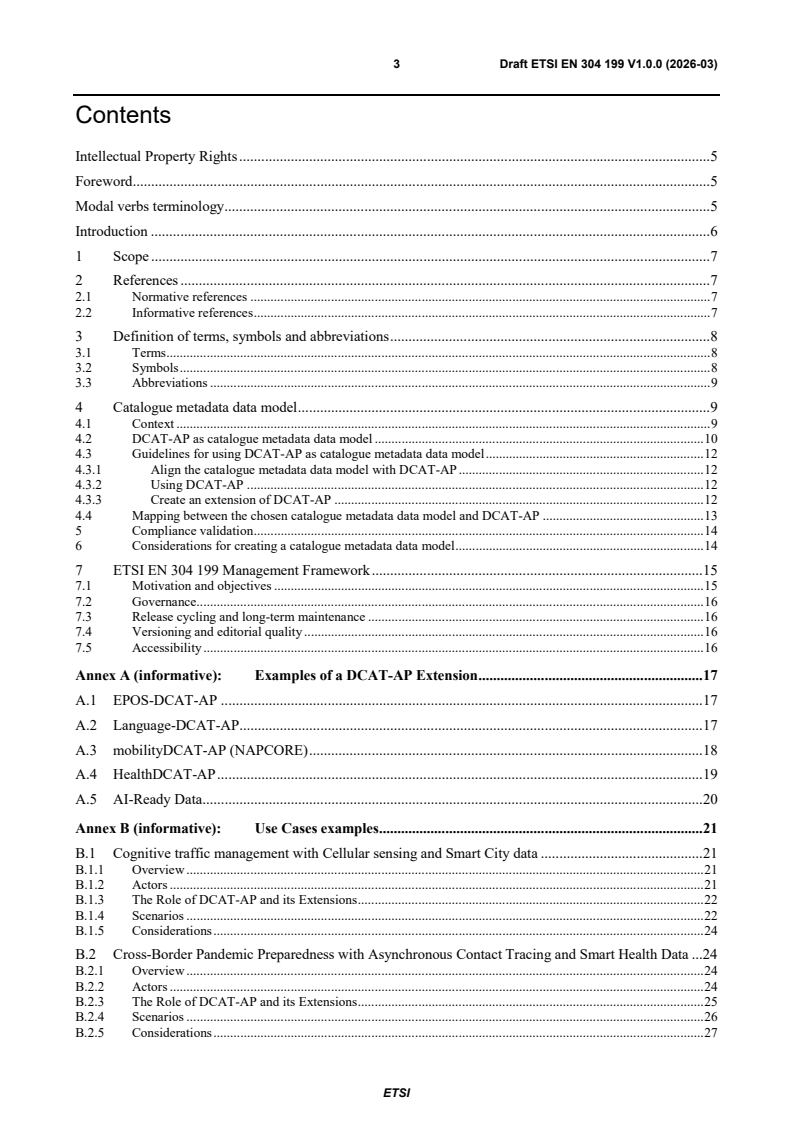
Contents
Intellectual Property Rights . 5
Foreword . 5
Modal verbs terminology . 5
Introduction . 6
1 Scope . 7
2 References . 7
2.1 Normative references . 7
2.2 Informative references . 7
3 Definition of terms, symbols and abbreviations . 8
3.1 Terms . 8
3.2 Symbols . 8
3.3 Abbreviations . 9
4 Catalogue metadata data model . 9
4.1 Context . 9
4.2 DCAT-AP as catalogue metadata data model . 10
4.3 Guidelines for using DCAT-AP as catalogue metadata data model . 12
4.3.1 Align the catalogue metadata data model with DCAT-AP . 12
4.3.2 Using DCAT-AP . 12
4.3.3 Create an extension of DCAT-AP . 12
4.4 Mapping between the chosen catalogue metadata data model and DCAT-AP . 13
5 Compliance validation . 14
6 Considerations for creating a catalogue metadata data model . 14
7 ETSI EN 304 199 Management Framework . 15
7.1 Motivation and objectives . 15
7.2 Governance. 16
7.3 Release cycling and long-term maintenance . 16
7.4 Versioning and editorial quality . 16
7.5 Accessibility . 16
Annex A (informative): Examples of a DCAT-AP Extension . 17
A.1 EPOS-DCAT-AP . 17
A.2 Language-DCAT-AP. 17
A.3 mobilityDCAT-AP (NAPCORE) . 18
A.4 HealthDCAT-AP . 19
A.5 AI-Ready Data . 20
Annex B (informative): Use Cases examples . 21
B.1 Cognitive traffic management with Cellular sensing and Smart City data . 21
B.1.1 Overview . 21
B.1.2 Actors . 21
B.1.3 The Role of DCAT-AP and its Extensions . 22
B.1.4 Scenarios . 22
B.1.5 Considerations . 24
B.2 Cross-Border Pandemic Preparedness with Asynchronous Contact Tracing and Smart Health Data . 24
B.2.1 Overview . 24
B.2.2 Actors . 24
B.2.3 The Role of DCAT-AP and its Extensions . 25
B.2.4 Scenarios . 26
B.2.5 Considerations . 27
ETSI
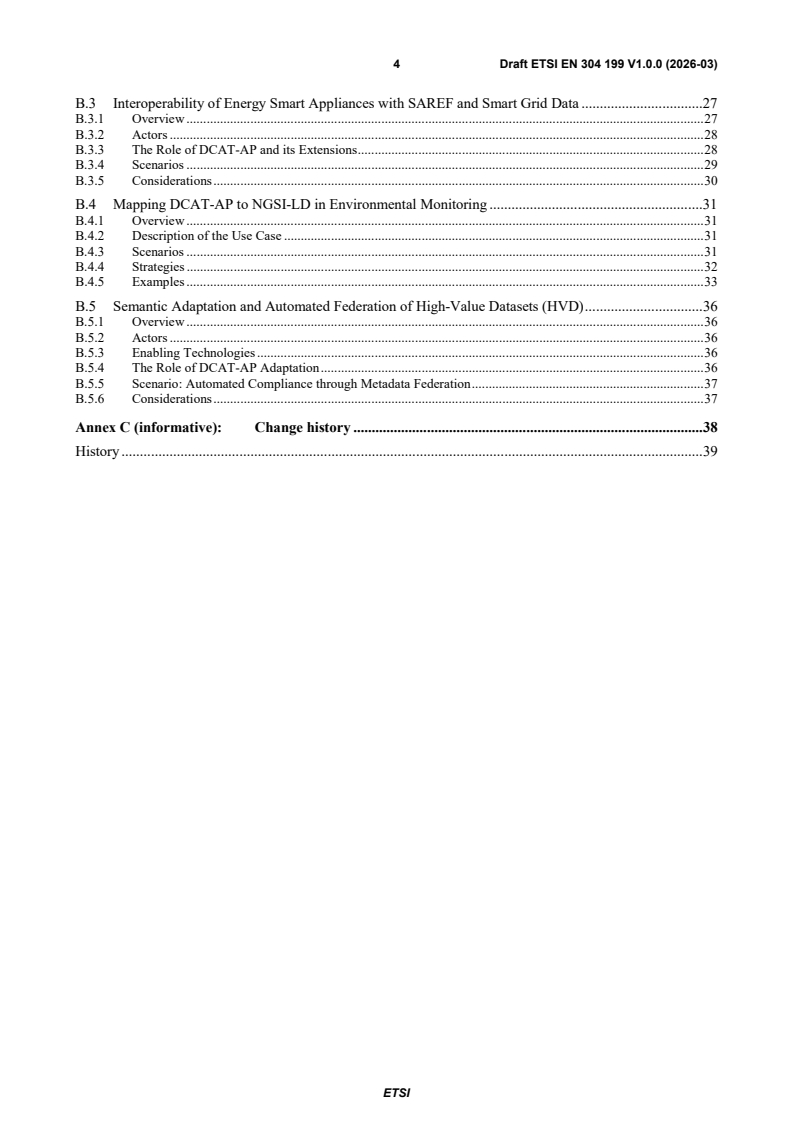
4 Draft ETSI EN 304 199 V1.0.0 (2026-03)
B.3 Interoperability of Energy Smart Appliances with SAREF and Smart Grid Data . 27
B.3.1 Overview . 27
B.3.2 Actors . 28
B.3.3 The Role of DCAT-AP and its Extensions . 28
B.3.4 Scenarios . 29
B.3.5 Considerations . 30
B.4 Mapping DCAT-AP to NGSI-LD in Environmental Monitoring . 31
B.4.1 Overview . 31
B.4.2 Description of the Use Case . 31
B.4.3 Scenarios . 31
B.4.4 Strategies . 32
B.4.5 Examples . 33
B.5 Semantic Adaptation and Automated Federation of High-Value Datasets (HVD) . 36
B.5.1 Overview . 36
B.5.2 Actors . 36
B.5.3 Enabling Technologies . 36
B.5.4 The Role of DCAT-AP Adaptation . 36
B.5.5 Scenario: Automated Compliance through Metadata Federation . 37
B.5.6 Considerations . 37
Annex C (informative): Change history . 38
History . 39
ETSI
5 Draft ETSI EN 304 199 V1.0.0 (2026-03)
Intellectual Property Rights
Essential patents
IPRs essential or potentially essential to normative deliverables may have been declared to ETSI. The declarations
pertaining to these essential IPRs, if any, are publicly available for ETSI members and non-members, and can be
found in ETSI SR 000 314: "Intellectual Property Rights (IPRs); Essential, or potentially Essential, IPRs notified to
ETSI in respect of ETSI standards", which is available from the ETSI Secretariat. Latest updates are available on the
ETSI IPR online database.
Pursuant to the ETSI Directives including the ETSI IPR Policy, no investigation regarding the essentiality of IPRs,
including IPR searches, has been carried out by ETSI. No guarantee can be given as to the existence of other IPRs not
referenced in ETSI SR 000 314 (or the updates on the ETSI Web server) which are, or may be, or may become,
essential to the present document.
Trademarks
The present document may include trademarks and/or tradenames which are asserted and/or registered by their owners.
ETSI claims no ownership of these except for any which are indicated as being the property of ETSI, and conveys no
right to use or reproduce any trademark and/or tradename. Mention of those trademarks in the present document does
not constitute an endorsement by ETSI of products, services or organizations associated with those trademarks.
DECT™, PLUGTESTS™, UMTS™ and the ETSI logo are trademarks of ETSI registered for the benefit of its
Members. 3GPP™, LTE™ and 5G™ logo are trademarks of ETSI registered for the benefit of its Members and of the
3GPP Organizational Partners. oneM2M™ logo is a trademark of ETSI registered for the benefit of its Members and of ®
the oneM2M Partners. GSM and the GSM logo are trademarks registered and owned by the GSM Association.
Foreword
This draft European Standard (EN) has been produced by ETSI Technical Committee Data Solutions (DATA), and is
now submitted for the combined Public Enquiry and Vote phase of the ETSI Standardisation Request deliverable
Approval Procedure (SRdAP).
Proposed national transposition dates
Date of latest announcement of this EN (doa): 3 months after ETSI publication
Date of latest publication of new National Standard
or endorsement of this EN (dop/e): 6 months after doa
Date of withdrawal of any conflicting National Standard (dow): 6 months after doa
Modal verbs terminology
In the present document "shall", "shall not", "should", "should not", "may", "need not", "will", "will not", "can" and
"cannot" are to be interpreted as described in clause 3.2 of the ETSI Drafting Rules (Verbal forms for the expression of
provisions).
"must" and "must not" are NOT allowed in ETSI deliverables except when used in direct citation.
ETSI
6 Draft ETSI EN 304 199 V1.0.0 (2026-03)
Introduction
The present document is developed in the context of the European Commission's Standardisation
Request C(2025) 4135 [i.1] addressing article 33 of the Data Act (Regulation (EU) 2023/2854).
This standardization request foresees the joint development by ETSI and CEN/CENELEC of seven deliverables, ETSI
is primarily responsible for deliverables 4 and 5, while the other deliverables have a primary responsibility of
CEN/CENELEC.
th
The present document addresses the 4 deliverable (The Data Catalogue Implementation Framework), and it aims at
making the data within European data spaces visible, findable, and therefore ready for supporting the trusted data
transactions concept.
It ensures that data products, including data catalogues, datasets, and their distributions, are described in a consistent
way.
Its relation to the other deliverables is sequential and interdependent:
• The Harmonised standards on Trusted Data Transactions (Parts 1-3) define how to share data securely and
fairly. The present document ensures that data products are structured, described, and listed in a consistent way
across all sectors. It is an essential precursor to enable the automated execution of transactions (the goal of
Deliverables 1-3).
• Regarding the implementation framework for semantic assets (Deliverable 5): the present document
standardizes the metadata for discovery (e.g. title, publisher, availability), the subsequent deliverable on
semantic assets provides the meaning of the data itself. They are complementary: the catalogue framework
allows one to find a data product, while the semantic assets framework ensures its content can be correctly
interpreted. Both are critical for full data and semantic interoperability.
• Regarding Quality and Maturity (Deliverables 6 and 7), a standardized catalogue is a key indicator of mature
internal data governance (Deliverable 6) and is a measurable feature for assessing the maturity of a data space
itself (Deliverable 7). A participant's ability to register and manage assets in a shared catalogue reflects the
quality of their data governance.
ETSI
7 Draft ETSI EN 304 199 V1.0.0 (2026-03)
1 Scope
The present document provides a framework for standardized catalogue metadata in data spaces, in support of the
publication and discovery of data products and to assure findability of data products within and across data spaces.
The present document:
a) sets out the common catalogue metadata, the minimum set to be applied across all common European data
spaces;
b) establishes rules on the setting out of catalogue metadata extensions, specific to a domain-specific data space
or to a specific data spaces set.
2 References
2.1 Normative references
References are either specific (identified by date of publication and/or edition number or version number) or
non-specific. For specific references, only the cited version applies. For non-specific references, the latest version of the
referenced document (including any amendments) applies.
Referenced documents which are not found to be publicly available in the expected location might be found in the
ETSI docbox.
NOTE: While any hyperlinks included in this clause were valid at the time of publication, ETSI cannot guarantee
their long-term validity.
The following referenced documents are necessary for the application of the present document.
[1] European Commission: "DCAT Application Profile for data portals in Europe".
[2] European Commission: "DCAT-AP reuse guidelines".
2.2 Informative references
References are either specific (identified by date of publication and/or edition number or version number) or
non-specific. For specific references, only the cited version applies. For non-specific references, the latest version of the
referenced document (including any amendments) applies.
NOTE: While any hyperlinks included in this clause were valid at the time of publication, ETSI cannot guarantee
their long-term validity.
The following referenced documents may be useful in implementing an ETSI deliverable or add to the reader's
understanding, but are not required for conformance to the present document.
[i.1] Commission Implementing Decision C(2025)4135 of 1.7.2025 on a standardisation request to the
European standardisation organisations as regards a European Trusted Data Framework in support
of Regulation (EU) 2023/2854 of the European Parliament and of the Council.
[i.2] SEMIC - Interoperable Europe.
[i.3] European Commission: "GeoDCAT Application Profile for data portals in Europe".
[i.4] mobilityDCAT-AP: "A mobility extension for the DCAT application profile for data portals in
Europe".
[i.5] European Union: "StatDCAT Application Profile for data portals in Europe".
[i.6] HealthDCAT-AP.
ETSI
8 Draft ETSI EN 304 199 V1.0.0 (2026-03)
[i.7] European Data Portal.
[i.8] EPOS-DCAT-AP: "An extension of the DCAT Application Profile for Research Infrastructures in
the solid-Earth domain".
[i.9] ETSI TS 103 757: "SmartM2M; Asynchronous Contact Tracing System; Fighting pandemic
disease with Internet of Things (IoT)".
[i.10] Language-DCAT-AP. ®
[i.11] W3C Recommendation 22 August 2024: "Data Catalog Vocabulary (DCAT)".
[i.12] ETSI TR 104 244: "Data Solutions (DATA); Implementation of Data Catalogues with NGSI-LD
and DCAT-AP". ®
[i.13] W3C Recommendation 16 July 2020: "JSON-LD 1.1". ®
[i.14] W3C Recommendation 25 February 2014: "RDF 1.1 Turtle". ®
[i.15] W3C Recommendation 20 July 2017: "Shapes Constraint Language (SHACL)".
[i.16] Commission Implementing Regulation (EU) 2023/138 of 21 December 2022 laying down a list of
specific high-value datasets and the arrangements for their publication and re-use. ®
[i.17] W3C Recommendation 15 February 2018: "ODRL Information Model 2.2".
[i.18] EN 18235-1: "Trusted Data Transactions - Part 1: Terminology, concepts and mechanisms",
(produced by CEN).
3 Definition of terms, symbols and abbreviations
3.1 Terms
For the purposes of the present document, the following terms apply:
NOTE: The following terms are defined in EN 18235-1 [i.18]: data, data user, data sharing/data exchange, data
licence term, data product, data producer, data provider, data rights holder, data space, data transaction,
metadata, data sharing contract, trust service, trust anchor, data intermediary, data intermediation service,
data catalogue, data usage consent, trust, trusted data transaction, data space participant/data space
participant/ participant, data space participant role/data space participant role/participant role, party, data
use, data sharing process/data exchange process.
catalogue metadata data model: data model describing the catalogue metadata used in a data space to increase the
discoverability of data products within the data space and across other data spaces
data catalogue: organized inventory of data products published by one or more data providers that can be searched by
data users
data product: data sharing unit, packaging data and metadata, and any associated licence term
data space: environment enabling trusted data sharing between participating parties, based on an agreed governance
framework, along with an agreed set of policies, semantic models, standardized protocols, processes, and facilitating
services
data space rulebook: publicly available data space register where the data space guidelines and any other governance
agreement are registered and maintained
metadata: data defining and describing other data
3.2 Symbols
Void.
ETSI
9 Draft ETSI EN 304 199 V1.0.0 (2026-03)
3.3 Abbreviations
For the purposes of the present document, the following abbreviations apply:
ACT Asynchronous Contact Tracing
AI Artificial Intelligence
API Advanced Programming Interface
CEN European Committee for Standardization
CENELEC European Committee for Electrotechnical Standardization
CoC Code of Conduct
CSV Comma-Separated Value document
CSW Catalogue Service Web
DCAT Data Catalogue vocabulary
DCAT-AP Data Catalog vocabulary - Application Profile
DSO Distribution System Operator
ECDC European Centre for Disease Prevention and Control
EHDS European Health Data Space
EMS Energy Management Systems
EPOS European Plate Observing System
EPREL European Product Registry for Energy Labelling
ESA Energy Smart Appliances
ETSI European Telecommunication Standards Institute
EU European Union
EV Electrical Vehicle
GDPR General Data Protection Regulation
GeoDCAT-AP Geospatial DCAT-AP
HDAB Health Data Access Bodies
HEMS Home Energy Management Systems
HTML HyperText Markup Language,
HVAC Heating, Ventilation, Air-Conditioning
HVD High Value Datasets
ICS Integrated Core Services
INSPIRE INfrastructure for SPatial InfoRmation in the European community
ISAC Integrated Sensing and Communication
ISO International Organization for Standardization
JSON-LD JavaScript Object Notation for Linked Data
LDS Language Data Space
LLM Large Language Model
ML Machine Learning
NAP National Access Points
NGSI-LD Next Generation Service Interfaces - Linked Data
NUTS Nomenclature of Territorial Units for Statistics
ODRL Open Digital Rights Language
PM Post Meridiem
RDF Resource Description Framework
SAREF Smart Applications REFerence ontology
SEMIC Semantic Interoperability Community
SHACL SHApes Constraint Language
TCS Thematic Core Services
TURTLE Terse RDF Triple Language
URI Uniform Resource Identifier
URL Uniform Resource Locator
URLLC Ultra-Reliable Low-Latency Communication
4 Catalogue metadata data model
4.1 Context
Data spaces [2] are environments designed to enable trusted data sharing between participants.
ETSI
10 Draft ETSI EN 304 199 V1.0.0 (2026-03)
A fundamental requirement for realizing trusted data transactions within a data space is that participants can publish and
discover data products. To meet this requirement, a data space provides guidelines consisting of:
• a catalogue metadata data model for describing data products; and
• a catalogue infrastructure for fair discoverability.
These guidelines and any other data governance agreement shall be registered in a publicly available data space
rulebook.
The term catalogue metadata refers to the machine-readable representation of a description of a data product.
Data products are often described in data catalogues by a combination of dataset, dataset series, data service and
distribution concepts.
Data products are usually not bound to a single data space. Other data users participating in other data spaces can take
benefit from the provided data. Therefore, it is beneficial that data products can be discovered beyond the borders of a
data space with a minimal publication effort. The present document sets a common basis for the metadata data model
across data spaces.
To satisfy the requirements for a common metadata data model, the present document provides a reference metadata
model. The present document shows how data spaces can make use of the reference metadata model to meet their
needs.
The presented approach is not limited to data spaces. Any party involved in the development and implementation of
data catalogues and metadata frameworks, aiming to make data assets discoverable, interoperable, and reusable, can
find guidance in the presented approach.
4.2 DCAT-AP as catalogue metadata data model
To ensure interoperability between data spaces, a common data model is needed. This data model provides the formal
semantic underpinning of the metadata. Having a common data model does not exclude the presence, nor the use of
alternative metadata representations. However, data spaces that opt for this choice are required to provide all necessary
means to make their metadata interoperable with the data model.
General provisions for a metadata data model in a data space are given in provisions 4.2.1 to 4.2.5. Provisions 4.2-6 to
4.2-9 subsequently establish DCAT-AP as the reference data model.
Provision 4.2-1: A data space shall have a common catalogue metadata data model to describe a catalogue of data
products.
The catalogue metadata data model contains at minimum the metadata required for the data space to function. This
includes, but is not limited to, information on the data access methods supported by the data product and licence terms
determining the legal usage conditions of the data product. Depending on the needs, the catalogue metadata data model
should be able to capture provenance information, including aspects such as data collection methodology, data lineage
or data quality.
Provision 4.2-2: The choice of a catalogue metadata data model for a data space is part of the data space governance
and shall be included in the data space rulebook.
This catalogue metadata data model is primarily used for metadata describing data products listed in the data spaces'
data catalogues, but it is also used in messages exchanged during the negotiation phase of a data transaction.
Provision 4.2-3: Every data catalogue in the data space shall conform to the catalogue metadata data model of the data
space.
Provision 4.2-4: Metadata exchanged to establish or to execute a trusted data transaction in a data space shall conform
to the metadata data model of the data space.
The choice of a catalogue metadata data model for a data space is independent of the data format, access protocol, and
access policy for metadata within the data space. It, however, shall be machine-readable and should be unambiguously
transformable into RDF.
ETSI
11 Draft ETSI EN 304 199 V1.0.0 (2026-03)
Provision 4.2-5: The machine-readable data format, access protocol, and access policy for catalogue metadata within a
data space are part of its data space governance and shall be included the data space rulebook.
The Data Catalogue Application Profile (DCAT-AP) [1], developed and maintained by the SEMIC [i.2] community
under the Interoperable Europe initiative, provides a mature, sustainable, and standardized framework for metadata
description that enables different parties to interoperate at the semantic level. Its governance is organized as a public
community guaranteeing access to the data model and enabling participation by any data space.
DCAT-AP [1] is a DCAT [i.11] profile. DCAT provides the universal terminology with minimal constraints. DCAT-AP
augments DCAT with minimal metadata quality expectations, profiling and implementation guidelines for Europe.
DCAT-AP [1] is a data model for sharing information about catalogues containing dataset and data service descriptions
in Europe. The core classes are the classes catalogue, dataset, distribution and data service. Dataset series enable
further organizing datasets within a catalogue. Using these entities as building blocks, data products are usually a
composition of the classes' dataset, distribution and data service. As data products will evolve over time, a modular
approach for the description of data products facilitates the management of the information.
Provision 4.2-6: DCAT-AP [1] shall be used as the common data model.
A minimal model documenting the mandatory information for DCAT-AP can be found here [1].
Provision 4.2-7: The catalogue metadata data model shall be based on the terminology expressed in DCAT-AP for their
metadata data model. Deviations or improvements shall be aligned with the DCAT-AP community. This common
semantic basis guarantees interoperability across data spaces.
EXAMPLE: In DCAT-AP, a dataset is a conceptual entity, and a distribution is a downloadable expression of a
dataset. Data spaces should not merge both notions into one entity in their metadata vocabulary.
Provision 4.2-8: Data spaces shall align their catalogue metadata data model with DCAT-AP. The alignment can be
either:
a) by using DCAT-AP; or
b) by using an extension of DCAT-AP; or
c) by mapping to DCAT-AP.
Dataspaces shall include the chosen approach(es) as part of the data space governance in the data space rulebook.
A data space is strictly aligned with DCAT-AP when all the metadata is exchanged according to DCAT-AP. Typically
this is implemented by enforcing DCAT-AP based exchange of metadata by all the data catalogues present in the data
space.
Further elaborations of the three alignment approaches are respectively provided in clauses 4.3.1, 4.3.2 and 4.3.3 of the
present document.
Provision 4.2-9: The catalogue metadata data model shall be versioned to support the evolution of the data space and
its alignment with new releases of DCAT-AP. The creation of the catalogue metadata data model should start from the
most recent version of DCAT-AP. The catalogue metadata data model should include the version of DCAT-AP is it
based upon. DCAT-AP guarantees the persistency of its versions.
Provision 4.2-10:
The data space rule book shall include:
• the catalogue metadata data model allowed according to the choice made in provision 4.2-8;
• the roles and responsibilities of the publishers of the catalogue metadata;
• the data catalogues for the metadata;
• the methodology and the KPI used to monitor the quality of the catalogue metadata.
Data product publishers shall keep the metadata of the data products up to date and ensure their quality, to assure the
well-functioning of the data space.
ETSI
12 Draft ETSI EN 304 199 V1.0.0 (2026-03)
4.3 Guidelines for using DCAT-AP as catalogue metadata data
model
4.3.1 Align the catalogue metadata data model with DCAT-AP
Clause 4.3 provides the guidance to data spaces to align their catalogue metadata data model with DCAT-AP.
The easiest and most straightforward approach is to use DCAT-AP directly. Data spaces shall first explore whether this
option satisfies their needs. DCAT-AP is a broad and flexible catalogue metadata data model addressing many needs
already. Data space may, however, add additional guidance for their data product publishers to tailor the model for
specific purposes.
4.3.2 Using DCAT-AP
The exploration can be done in various ways; here follows the description of a high-level constructive step-by-step
process that incrementally creates a catalogue metadata data model for the data space strictly based on DCAT-AP.
The process starts with a data model consisting only of the DCAT-AP main classes and their mandatory attributes. This
is the minimal information any DCAT-AP conformant data catalogue shall provide. (See DCAT-AP reuse
guidelines [2], Step 1 (https://semiceu.github.io/DCAT-AP-reuse-guidelines/#step-1-familiarise-with-dcat-ap)).
Then, iteratively:
1) Evaluate the metadata requirements of the data space w.r.t. the data model:
a) Note down for each class and attribute additional guidelines for the data product publishers where
needed.
b) Record any detected unclarity or potential deviation the data space wants to make.
2) Select a use case requiring to use metadata that is not yet in the data model:
a) Add all DCAT-AP attributes and guidelines fitting the use case.
This process shall be performed until all use cases are considered. The result is an annotated DCAT-AP specification
describing the catalogue metadata data model with instructions tailored to the purpose of the data space.
Having established the semantic underpinning of the catalogue metadata, the data space decides the machine-readable
data format, access protocol, and access policy for the catalogue metadata (provision 4.2-5) to be used. To a large
extend these are independent considerations of the data model. DCAT-AP is a Semantic Web data specification.
Despite that the DCAT-AP does not enforce the data exchange in implementations to be in native Linked Data formats
(RDF serializations), this is expected. To ensure cross data space interoperability, the decision on the used data format
shall be validated against the guidelines for DCAT-AP implementations, and in particular the use of identifiers (such as
for example https://semiceu.github.io/DCAT-AP/releases/3.0.1/#identifiers).
4.3.3 Create an extension of DCAT-AP
Based on the gap analysis described clause 4.3.2 an extension of DCAT-AP for the data space can be created.
Before deciding how to resolve these gaps, the data space shall reach out to the DCAT-AP community to determine if
any identified gaps are already addressed by DCAT-AP itself or another known DCAT-AP extension. The advice and
suggestions received should be incorporated. If, after this consultation, the decision is still to create an extension, follow
the DCAT-AP guidelines for creating extensions (See DCAT-AP reuse guidelines [2], Steps 2, 3 and 4
(https://semiceu.github.io/DCAT-AP-reuse-guidelines/)).
The data space governance for the catalogue metadata data model shall build consensus for the proposed resolutions for
each identified gap. The decisions shall be recorded and published to all data space participants.
To maintain DCAT-AP alignment the data space shall engage itself in the DCAT-AP community. A concurrent benefit
of this participation is the reduction of duplicate effort for publishers operating across several data spaces.
ETSI
13 Draft ETSI EN 304 199 V1.0.0 (2026-03)
4.4 Mapping between the chosen catalogue metadata data
model and DCAT-AP
As stated in provision 4.2-8, data spaces can adopt a catalogue metadata data model other than DCAT-AP. Motivations
for this choice are multiple, but typically, it has its roots in the presence of tools and agreements already available in the
ecosystem that initiates the data space. Switching to a new metadata data model and the associated supportive tools it
can be considered too impactful.
To ensure the interoperability between data spaces, and in particular to ensure the discoverability of data products
across data spaces, the use of another metadata representation than DCAT-AP mandates the need for a mapping
between the chosen metadata representation and DCAT-AP.
Provision 4.4-1: Data spaces that adopt a catalogue metadata data models other than DCAT-AP shall develop and
maintain a mapping between the chosen catalogue metadata data model and DCAT-AP. The mapping methodology and
any semantic loss incurred during the process shall be documented.
Mappings between two data models A and B express how information encoded in one data model is to be interpreted in
the other data model. A mapping is directional from A to B when this describes a deterministic, unambiguous method
for converting formatted data according to data model A into an equivalent encoding in data model B.
The implementation of a mapping can be clearer or more straightforward in one direction than the other. A typical
challenge arises when a single entity in data model A corresponds to multiple entities in data model B. In such cases,
the mapping from B to A is often easier to implement, as merging multiple entities into an aggregate is generally
simpler than splitting a single entity into its constituent parts.
Given that in general mappings rarely are one to one, providing documentation of the mapping decisions is essential.
Provision 4.4-2: Data spaces shall provide at least a mapping from the chosen catalogue metadata data model to
DCAT-AP.
This direction enables the possibility that data products from the data space are discoverable by other data spaces.
Enabling the mapping in the other direction eases the use of external data products by the data space.
Provision 4.4-3: The mapping shall cover the minimum DCAT-AP; all its main classes and their mandatory attributes.
To ensure that the data products from the data space are effectively discoverable by other data spaces, data space are
expected to implement the mapping.
Provision 4.4-4: The Data Space should provide and maintain a conversion tool that implements the mapping.
EXAMPLE: The geospatial data space using the INSPIRE ISO XML metadata maintains a GeoDCAT-AP
extension to DCAT-AP, which includes:
- The extra elements specific to geospatial data beyond the core DCAT-AP information.
- Guidelines for providing quality metadata.
- An XSLT transformation providing a reference implementation of a mapping from INSPIRE
ISO XML.
Creating a mapping may follow a similar process as described before on the use of DCAT-AP:
1) First, the catalogue metadata data model is compared to the minimal DCAT-AP model:
a) Note down for each class and attribute the mapping that needs to be performed.
b) Record any detected unclarity or potential blocking point in the conversion.
2) Select a non-addressed class:
a) Add all DCAT-AP attributes and guidelines fitting the use case.
This process shall be performed until all the metadata of the chosen data model is processed. The result is an annotated
comparison where for each class and attribute in the catalogue metadata data model a conversion guideline to
DCAT-AP is formulated.
ETSI
14 Draft ETSI EN 304 199 V1.0.0 (2026-03)
5 Compliance validation
Data spaces shall ensure the compliance of the exchanged data product metadata with the made data space agreements
(i.e. provision 4.2-1).
Provision 5-1: Data spaces shall provide the necessary means for data space participants to validate the conformity of
the shared data product metadata with respect to the data space catalogue metadata data model.
When the data space adopts DCAT-AP as catalogue metadata data model, these necessary means may be provided by
the DCAT-AP community. When the data space adopts the mapping approach, the data space may rely on the chosen
metadata data model community.
Multiple, complementary testing methods exist to verify the compliance with DCAP-AP. Some target directly the
metadata data model; others test whether the exchanged metadata is compliant with the metadata data model. These
methods are complementary to each other in order to create evidence of the correct intended behaviour.
As part of the governance of the catalogue metadata data model, data spaces shall provide the means to discuss on the
detected compliance issues.
Compliance of the metadata data model
Provision 5-2: Data spaces shall share the compliance assessment of the catalogue metadata data model (e.g. including
the compliance assessment in the catalogue metadata data model).
Provision 5-3: The compliance with DCAT-AP should be provided by adding references to the corresponding
DCAT-AP terms.
The inclusion of these references in the DCAT-AP usage guidelines for the data space is not only valuable for the
compliance check, but also aids in future updates to align with newer versions of DCAT-AP.
Testing whether one data model is compliant with another data model is, in general, a process involving human activity.
Each aspect of data model has to be compared, and this activity is also part of the creation process of metadata data
model. That information is thus valuable knowledge for the compliance assessment.
Complementary automated checks should also be applied, e.g. using the SHACL [i.15] shapes associated with the
distinct profiles in order to identify differences. For compliance checks, each detected difference should correspond to a
valid extension of DCAT-AP introduced by the data space's metadata model.
Compliance through implementation of a compliant catalogue metadata exchange
A metadata exchange occurs when
...
Final draft ETSI EN 304 199 V1.1.0 (2026-10)
EUROPEAN STANDARD
Data Solutions (DATA);
Data catalogue implementation framework;
Guidelines for Data Catalogue Framework
2 Final draft ETSI EN 304 199 V1.1.0 (2026-10)
Reference
DEN/DATA-00304199
Keywords
DATA, data collection, data interoperability,
data sharing, semantic, terms, vocabulary
ETSI
650 Route des Lucioles
F-06921 Sophia Antipolis Cedex - FRANCE
Tel.: +33 4 92 94 42 00 Fax: +33 4 93 65 47 16
Siret N° 348 623 562 00017 - APE 7112B
Association à but non lucratif enregistrée à la
Sous-Préfecture de Grasse (06) N° w061004871
Important notice
The present document can be downloaded from the
ETSI Search & Browse Standards application.
The present document may be made available in electronic versions and/or in print. The content of any electronic and/or
print versions of the present document shall not be modified without the prior written authorization of ETSI. In case of any
existing or perceived difference in contents between such versions and/or in print, the prevailing version of an ETSI
deliverable is the one made publicly available in PDF format on ETSI deliver repository.
Users should be aware that the present document may be revised or have its status changed,
this information is available in the Milestones listing.
If you find errors in the present document, please send your comments to
the relevant service listed under Committee Support Staff.
If you find a security vulnerability in the present document, please report it through our
Coordinated Vulnerability Disclosure (CVD) program.
Notice of disclaimer & limitation of liability
The information provided in the present deliverable is directed solely to professionals who have the appropriate degree of
experience to understand and interpret its content in accordance with generally accepted engineering or
other professional standard and applicable regulations.
No recommendation as to products and services or vendors is made or should be implied.
In no event shall ETSI be held liable for loss of profits or any other incidental or consequential damages.
Any software contained in this deliverable is provided "AS IS" with no warranties, express or implied, including but not
limited to, the warranties of merchantability, fitness for a particular purpose and non-infringement of intellectual property
rights and ETSI shall not be held liable in any event for any damages whatsoever (including, without limitation, damages
for loss of profits, business interruption, loss of information, or any other pecuniary loss) arising out of or related to the use
of or inability to use the software.
Copyright Notification
No part of this document may be reproduced in any form, by any means and in any media, without the prior written
authorization of ETSI and except as expressly permitted below.
By way of exception and when the document is a normative deliverable (European Standard (EN),
Technical Specification (TS), Group Specification (GS) or ETSI Standard (ES)), ETSI authorizes to reproduce
and incorporate into products, services and technical documentation only those extracts (e.g. templates) that are strictly
necessary for the technical implementation of the normative deliverable, to ensure compliance with the latter.
Nothing in this notice shall be construed as limiting any mandatory exceptions to copyright provided by applicable law.
© ETSI 2026.
All rights reserved.
ETSI
3 Final draft ETSI EN 304 199 V1.1.0 (2026-10)
Contents
Intellectual Property Rights . 5
Foreword . 5
Modal verbs terminology . 5
Introduction . 6
1 Scope . 7
2 References . 7
2.1 Normative references . 7
2.2 Informative references . 7
3 Definition of terms, symbols, abbreviations and prefixes . 8
3.1 Terms . 8
3.2 Symbols . 9
3.3 Abbreviations . 9
3.4 Prefixes . 10
4 Catalogue metadata data model . 10
4.1 Context . 10
4.2 DCAT-AP as catalogue metadata data model . 11
4.3 Guidelines for using DCAT-AP as catalogue metadata data model . 12
4.3.1 Align the catalogue metadata data model with DCAT-AP . 12
4.3.2 Using DCAT-AP . 12
4.3.3 Create an extension of DCAT-AP . 13
4.4 Mapping between the chosen catalogue metadata data model and DCAT-AP . 13
5 Compliance validation . 14
6 Considerations for creating a catalogue metadata data model . 15
7 ETSI EN 304 199 Management Framework . 16
7.1 Motivation and objectives . 16
7.2 Governance. 16
7.3 Release cycling and long-term maintenance . 17
7.4 Versioning and editorial quality . 17
7.5 Accessibility . 17
Annex A (informative): Examples of a DCAT-AP Extension . 18
A.1 EPOS-DCAT-AP . 18
A.2 LanguageDCAT-AP . 18
A.3 mobilityDCAT-AP (NAPCORE) . 19
A.4 HealthDCAT-AP . 20
A.5 AI-Ready Data . 21
Annex B (informative): Use Cases examples . 22
B.1 Cognitive traffic management with Cellular sensing and Smart City data . 22
B.1.1 Overview . 22
B.1.2 Actors . 22
B.1.3 The Role of DCAT-AP and its Extensions . 23
B.1.4 Scenarios . 23
B.1.5 Considerations . 25
B.2 Cross-Border Pandemic Preparedness with Asynchronous Contact Tracing and Smart Health Data . 25
B.2.1 Overview . 25
B.2.2 Actors . 25
B.2.3 The Role of DCAT-AP and its Extensions . 26
ETSI
4 Final draft ETSI EN 304 199 V1.1.0 (2026-10)
B.2.4 Scenarios . 27
B.2.5 Considerations . 28
B.3 Interoperability of Energy Smart Appliances with SAREF and Smart Grid Data . 28
B.3.1 Overview . 28
B.3.2 Actors . 29
B.3.3 The Role of DCAT-AP and its Extensions . 29
B.3.4 Scenarios . 30
B.3.5 Considerations . 31
B.4 Mapping DCAT-AP to NGSI-LD in Environmental Monitoring . 32
B.4.1 Overview . 32
B.4.2 Description of the Use Case . 32
B.4.3 Scenarios . 32
B.4.4 Stras . 33
B.4.5 Examples . 34
B.5 Semantic Adaptation and Automated Federation of High-Value Datasets (HVD) . 37
B.5.1 Overview . 37
B.5.2 Actors . 37
B.5.3 Enabling Technologies . 37
B.5.4 The Role of DCAT-AP Adaptation . 37
B.5.5 Scenario: Automated Compliance through Metadata Federation . 38
B.5.6 Considerations . 38
Annex C (informative): Change history . 39
History . 40
ETSI
5 Final draft ETSI EN 304 199 V1.1.0 (2026-10)
Intellectual Property Rights
Essential patents
IPRs essential or potentially essential to normative deliverables (European Standard (EN), Technical Specification (TS),
Group Specification (GS) or ETSI Standard (ES)) may have been declared to ETSI. The declarations pertaining to these
essential IPRs, if any, are publicly available for ETSI members and non-members, and can be found in
ETSI SR 000 314: "Intellectual Property Rights (IPRs); Essential, or potentially Essential, IPRs notified to ETSI in
respect of ETSI standards", which is available from the ETSI Secretariat. Latest updates are available on the
ETSI IPR online database.
Pursuant to the ETSI Directives including the ETSI IPR Policy, no investigation regarding the essentiality of IPRs,
including IPR searches, has been carried out by ETSI. No guarantee can be given as to the existence of other IPRs not
referenced in ETSI SR 000 314 (or the updates on the ETSI Web server) which are, or may be, or may become,
essential to the present document.
Trademarks
The present document may include trademarks and/or tradenames which are asserted and/or registered by their owners.
ETSI claims no ownership of these except for any which are indicated as being the property of ETSI, and conveys no
right to use or reproduce any trademark and/or tradename. Mention of those trademarks in the present document does
not constitute an endorsement by ETSI of products, services or organizations associated with those trademarks.
DECT™, PLUGTESTS™, UMTS™ and the ETSI logo are trademarks of ETSI registered for the benefit of its
Members. 3GPP™, LTE™ and 5G™ logo are trademarks of ETSI registered for the benefit of its Members and of the
3GPP Organizational Partners. oneM2M™ logo is a trademark of ETSI registered for the benefit of its Members and of ®
the oneM2M Partners. GSM and the GSM logo are trademarks registered and owned by the GSM Association.
Foreword
This final draft European Standard (EN) has been produced by ETSI Technical Committee Data Solutions (DATA), and
is now submitted for the Vote phase of the ETSI Standardisation Request deliverable Approval Procedure (SRdAP).
Proposed national transposition dates
Date of latest announcement of this EN (doa): 3 months after ETSI publication
Date of latest publication of new National Standard
or endorsement of this EN (dop/e): 6 months after doa
Date of withdrawal of any conflicting National Standard (dow): 6 months after doa
Modal verbs terminology
In the present document "shall", "shall not", "should", "should not", "may", "need not", "will", "will not", "can" and
"cannot" are to be interpreted as described in clause 3.2 of the ETSI Drafting Rules (Verbal forms for the expression of
provisions).
"must" and "must not" are NOT allowed in ETSI deliverables except when used in direct citation.
ETSI
6 Final draft ETSI EN 304 199 V1.1.0 (2026-10)
Introduction
The present document is developed in the context of the European Commission's Standardisation
Request C(2025) 4135 [i.1] addressing article 33 of the Data Act (Regulation (EU) 2023/2854 [i.22]).
This standardization request foresees the joint development by ETSI and CEN/CENELEC of seven deliverables, ETSI
is primarily responsible for deliverables 4 and 5, while the other deliverables have a primary responsibility of
CEN/CENELEC.
th
The present document addresses the 4 deliverable (The Data Catalogue Implementation Framework), and it aims at
making the data within European data spaces visible, findable, and therefore ready for supporting the trusted data
transactions concept.
It ensures that data products, including data catalogues, datasets, and their distributions, are described in a consistent
way.
Its relation to the other deliverables is sequential and interdependent:
• The Harmonised standards on Trusted Data Transactions (Deliverables 1-3) define how to share data securely
and fairly. The present document ensures that data products are structured, described, and listed in a consistent
way across all sectors. It is an essential precursor to enable the automated execution of transactions (the goal
of Deliverables 1-3).
• Regarding the implementation framework for semantic assets (Deliverable 5): the present document
standardizes the metadata for discovery (e.g. title, publisher, availability), the subsequent deliverable on
semantic assets provides the meaning of the data itself. They are complementary: the catalogue framework
allows one to find a data product, while the semantic assets framework ensures its content can be correctly
interpreted. Both are critical for full data and semantic interoperability.
• Regarding Quality and Maturity (Deliverables 6 and 7), a standardized catalogue is a key indicator of mature
internal data governance (Deliverable 6) and is a measurable feature for assessing the maturity of a data space
itself (Deliverable 7). A participant's ability to register and manage assets in a shared catalogue reflects the
quality of their data governance.
ETSI
7 Final draft ETSI EN 304 199 V1.1.0 (2026-10)
1 Scope
The present document provides a framework for standardized catalogue metadata in data spaces, in support of the
publication and discovery of data products and to assure findability of data products within and across data spaces.
The present document:
a) sets out the common catalogue metadata, the minimum set to be applied across all common European data
spaces;
b) establishes rules on the setting out of catalogue metadata extensions, specific to a domain-specific data space
or to a specific data spaces set.
2 References
2.1 Normative references
References are either specific (identified by date of publication and/or edition number or version number) or
non-specific. For specific references, only the cited version applies. For non-specific references, the latest version of the
referenced document (including any amendments) applies.
Referenced documents which are not found to be publicly available in the expected location might be found in the
ETSI docbox.
NOTE: While any hyperlinks included in this clause were valid at the time of publication, ETSI cannot guarantee
their long-term validity.
The following referenced documents are necessary for the application of the present document.
[1] European Commission: "DCAT Application Profile for data portals in Europe".
[2] European Commission: "DCAT-AP reuse guidelines".
2.2 Informative references
References are either specific (identified by date of publication and/or edition number or version number) or
non-specific. For specific references, only the cited version applies. For non-specific references, the latest version of the
referenced document (including any amendments) applies.
NOTE: While any hyperlinks included in this clause were valid at the time of publication, ETSI cannot guarantee
their long-term validity.
The following referenced documents may be useful in implementing an ETSI deliverable or add to the reader's
understanding, but are not required for conformance to the present document.
[i.1] Commission Implementing Decision C(2025)4135 of 1.7.2025 on a standardisation request to the
European standardisation organisations as regards a European Trusted Data Framework in support
of Regulation (EU) 2023/2854 of the European Parliament and of the Council.
[i.2] SEMIC - Interoperable Europe.
[i.3] European Commission: "GeoDCAT Application Profile for data portals in Europe".
[i.4] mobilityDCAT-AP: "A mobility extension for the DCAT application profile for data portals in
Europe".
[i.5] European Union: "StatDCAT Application Profile for data portals in Europe".
[i.6] HealthDCAT-AP Literacy.
ETSI
8 Final draft ETSI EN 304 199 V1.1.0 (2026-10)
[i.7] European Data Portal.
[i.8] EPOS-DCAT-AP: "An extension of the DCAT Application Profile for Research Infrastructures in
the solid-Earth domain".
[i.9] ETSI TS 103 757: "SmartM2M; Asynchronous Contact Tracing System; Fighting pandemic
disease with Internet of Things (IoT)".
[i.10] LanguageDCAT-AP. ®
[i.11] W3C Recommendation 22 August 2024: "Data Catalog Vocabulary (DCAT) - Version 3".
[i.12] ETSI TR 104 244: "Data Solutions (DATA); Implementation of Data Catalogues with NGSI-LD
and DCAT-AP". ®
[i.13] W3C Recommendation 16 July 2020: "JSON-LD 1.1". ®
[i.14] W3C Recommendation 25 February 2014: "RDF 1.1 Turtle". ®
[i.15] W3C Recommendation 20 July 2017: "Shapes Constraint Language (SHACL)".
[i.16] Commission Implementing Regulation (EU) 2023/138 of 21 December 2022 laying down a list of
specific high-value datasets and the arrangements for their publication and re-use. ®
[i.17] W3C Recommendation 15 February 2018: "ODRL Information Model 2.2".
[i.18] EN 18235-1: "Trusted Data Transactions - Part 1: Terminology, concepts and mechanisms",
(produced by CEN).
[i.19] EN 18235-2: "Trusted Data Transactions - Part 2: Trustworthiness requirements", (produced by
CEN).
[i.20] Language Data Space (LDS) procurement action CNECT/LUX/2022/OP/0026.
[i.21] The European Health Data Space (EHDS) Regulation.
[i.22] Regulation (EU) 2023/2854 of the European Parliament and of the Council of 13 December 2023
on harmonised rules on fair access to and use of data and amending Regulation (EU) 2017/2394
and Directive (EU) 2020/1828 (Data Act).
[i.23] Commission Regulation (EC) No 1205/2008 of 3 December 2008 implementing Directive
2007/2/EC of the European Parliament and of the Council as regards metadata.
3 Definition of terms, symbols, abbreviations and
prefixes
3.1 Terms
For the purposes of the present document, the following terms apply:
catalogue metadata data model: data model describing the catalogue metadata used in a data space to increase the
discoverability of data products within the data space and across other data spaces
data space rulebook: structured set of principles, processes, standards, protocols, rules and practices that guide and
regulate the governance, management and operations within a data space to ensure effective and responsible leadership,
control, and oversight
NOTE: See latest definition in EN 18235-2 [i.19].
The following terms are defined in EN 18235-1 [i.18]: data, data catalogue, data user, data sharing/data exchange,
data space participant, data product, data provider, data space, data transaction, metadata, trust, trusted data
transaction.
ETSI
9 Final draft ETSI EN 304 199 V1.1.0 (2026-10)
3.2 Symbols
Void.
3.3 Abbreviations
For the purposes of the present document, the following abbreviations apply:
ACT Asynchronous Contact Tracing
AI Artificial Intelligence
API Advanced Programming Interface
BSSID Basic Service Set Identifier
CEN European Committee for Standardization
CENELEC European Committee for Electrotechnical Standardization
CKAN Comprehensive Knowledge Archive Network
CMEMS Copernicus Marine Environment Monitoring Service
CNECT Directorate-General for Communications Networks, Content and Technology
CoC Code of Conduct
CSV Comma-Separated Value
CSVW Comma-Separated Value on the Web
CSW Catalogue Service Web
CV Controlled Vocabulary
DCAT Data Catalogue vocabulary
DCAT-AP Data Catalog vocabulary - Application Profile
DPV Data Privacy Vocabulary
DQV Data Quality Vocabulary
DSO Distribution System Operator
ECDC European Centre for Disease Prevention and Control
EHDS European Health Data Space
EMS Energy Management Systems
EPOS European Plate Observing System
EPREL European Product Registry for Energy Labelling
ESA Energy Smart Appliances
EV Electrical Vehicle
FAIR Findable, Accessible, Interoperable, Reusable
GDPR General Data Protection Regulation
GeoDCAT-AP Geospatial DCAT-AP
GIS Geographic Information System
HDAB Health Data Access Bodies
HEMS Home Energy Management Systems
HTML HyperText Markup Language
HVAC Heating, Ventilation, Air-Conditioning
HVD High-Value Datasets
JSON JavaScript Object Notation
LD Linked Data
LDS Language Data Space
LLM Large Language Model
ML Machine Learning
NAP National Access Point
NAPCORE National Access Point Coordination Organisation for Europe
NGO Non-Governmental Organization
NGSI Next Generation Service Interface
NGSI-LD Next Generation Service Interface - Linked Data
OAI Open Archives Initiative
ODRL Open Digital Rights Language
PMH Protocol for Metadata Harvesting
PROV Provenance (Ontology)
RDF Resource Description Framework
SAREF Smart Applications REFference ontology
SHACL Shapes Constraint Language
SKOS Simple Knowledge Organization System
ETSI
10 Final draft ETSI EN 304 199 V1.1.0 (2026-10)
SST Sea Surface Temperature
TS Technical Specification
UI User Interface
URI Uniform Resource Identifier
W3C World Wide Web Consortium
XSLT Extensible Stylesheet Language Transformations
3.4 Prefixes
For the purposes of the present document, the following prefixes apply:
This table is provided for information.
dcat: http://www.w3.org/ns/dcat#
dcatap: http://data.europa.eu/r5r/
dct: http://purl.org/dc/terms/
s4ener: https://saref.etsi.org/saref4ener/
epos: https://www.epos-eu.org/epos-dcat-ap#
foaf: http://xmlns.com/foaf/0.1/
rdf: http://www.w3.org/1999/02/22-rdf-syntax-ns#
saref: https://saref.etsi.org/core/
schema: https://schema.org/
xsd: http://www.w3.org/2001/XMLSchema#
4 Catalogue metadata data model
4.1 Context
Data spaces [2] are environments designed to enable trusted data sharing between participants.
A fundamental requirement for realizing trusted data transactions within a data space is that participants can publish and
discover data products. To meet this requirement, a data space provides guidelines consisting of:
• a catalogue metadata data model for describing data products; and
• a catalogue infrastructure for fair discoverability.
Provision 4.1-1: These guidelines and any other data governance agreement shall be registered in a publicly available
data space rulebook.
The term catalogue metadata refers to the machine-readable representation of a description of a data product.
Data products are often described in data catalogues by a combination of dataset, dataset series, data service and
distribution concepts.
Data products are usually not bound to a single data space. Other data users participating in other data spaces can
benefit from the provided data. Therefore, it is beneficial that data products can be discovered beyond the borders of a
data space with a minimal publication effort. The present document sets a common basis for the metadata data model
across data spaces.
To satisfy the requirements for a common metadata data model, the present document provides a reference metadata
model. The present document shows how data spaces can make use of the reference metadata model to meet their
needs.
The presented approach is not limited to data spaces. Any party involved in the development and implementation of
data catalogues and metadata frameworks, aiming to make data assets discoverable, interoperable, and reusable, can
find guidance in the presented approach.
ETSI
11 Final draft ETSI EN 304 199 V1.1.0 (2026-10)
4.2 DCAT-AP as catalogue metadata data model
To ensure interoperability between data spaces, a common data model is needed. This data model provides the formal
semantic underpinning of the metadata. Having a common data model does not exclude the presence, nor the use of
alternative metadata representations. However, data spaces that opt for this choice are required to provide all necessary
means to make their metadata interoperable with the data model.
General provisions for a metadata data model in a data space are given in provisions 4.2-1 to 4.2-5. Provisions 4.2-6 to
4.2-9 subsequently establish DCAT-AP as the reference data model.
Provision 4.2-1: A data space shall have a common catalogue metadata data model to describe a catalogue of data
products.
The catalogue metadata data model contains at minimum the metadata required for the data space to function. This
includes, but is not limited to, information on the data access methods supported by the data product and licence terms
determining the legal usage conditions of the data product. Depending on the needs, the catalogue metadata data model
should be able to capture provenance information, including aspects such as data collection methodology, data lineage
or data quality.
Provision 4.2-2: The choice of a catalogue metadata data model for a data space is part of the data space governance
and shall be included in the data space rulebook.
This catalogue metadata data model is primarily used for metadata describing data products listed in the data spaces'
data catalogues, but it is also used in messages exchanged during the negotiation phase of a data transaction.
Provision 4.2-3: Every data catalogue in the data space shall support the catalogue metadata data model of the data
space.
Provision 4.2-4: Metadata exchanged to establish or to execute a trusted data transaction in a data space shall conform
to the metadata data model of the data space.
The choice of a catalogue metadata data model for a data space is independent of the data format, access protocol, and
access policy for metadata within the data space. It, however, shall be machine-readable and should be unambiguously
transformable into RDF.
Provision 4.2-5: The machine-readable data format, access protocol, and access policy for catalogue metadata within a
data space are part of its data space governance and shall be included in the data space rulebook.
The Data Catalogue Application Profile (DCAT-AP) [1], developed and maintained by the SEMIC [i.2] community
under the Interoperable Europe initiative, provides a mature, sustainable, and standardized framework for metadata
description that enables different parties to interoperate at the semantic level. Its governance is organized as a public
community guaranteeing access to the data model and enabling participation by any data space.
DCAT-AP [1] is a DCAT [i.11] profile. DCAT provides the universal terminology with minimal constraints. DCAT-AP
augments DCAT with minimal metadata quality expectations, profiling and implementation guidelines for Europe.
DCAT-AP [1] is a data model for sharing information about catalogues containing dataset and data service descriptions
in Europe. The core classes are the classes catalogue, dataset, distribution and data service. Dataset series enable
further organizing datasets within a catalogue. Using these entities as building blocks, data products are usually a
composition of the classes' dataset, distribution and data service. As data products will evolve over time, a modular
approach for the description of data products facilitates the management of the information.
Provision 4.2-6: DCAT-AP [1] shall be used as the common data model.
A minimal model documenting the mandatory information for DCAT-AP can be found in [1].
Provision 4.2-7: The catalogue metadata data model shall be based on the terminology expressed in DCAT-AP for their
metadata data model. Deviations or improvements shall be aligned with the DCAT-AP community. This common
semantic basis guarantees interoperability across data spaces.
EXAMPLE: In DCAT-AP, a dataset is a conceptual entity, and a distribution is a downloadable expression of a
dataset. Data spaces should not merge both notions into one entity in their metadata vocabulary.
ETSI
12 Final draft ETSI EN 304 199 V1.1.0 (2026-10)
Provision 4.2-8: Data spaces shall align their catalogue metadata data model with DCAT-AP. The alignment can be
either:
a) by using DCAT-AP; or
b) by using an extension of DCAT-AP; or
c) by mapping to DCAT-AP.
Dataspaces shall include the chosen approach(es) as part of the data space governance in the data space rulebook.
A data space is strictly aligned with DCAT-AP when all the metadata is exchanged according to DCAT-AP. Typically
this is implemented by enforcing DCAT-AP based exchange of metadata by all the data catalogues present in the data
space.
Further elaborations of the three alignment approaches are respectively provided in clauses 4.3.1, 4.3.2 and 4.3.3 of the
present document.
Provision 4.2-9: The catalogue metadata data model shall be versioned to support the evolution of the data space and
its alignment with new releases of DCAT-AP. The creation of the catalogue metadata data model should start from the
most recent version of DCAT-AP. The catalogue metadata data model should include the version of DCAT-AP on
which it is based. DCAT-AP guarantees the persistency of its versions.
Provision 4.2-10:
The data space rule book shall include:
• the catalogue metadata data model allowed according to the choice made in provision 4.2-8;
• the roles and responsibilities of the publishers of the catalogue metadata;
• the data catalogues for the metadata;
• the methodology and the KPI used to monitor the quality of the catalogue metadata.
Data product publishers shall keep the metadata of the data products up to date and ensure their quality, to assure the
well-functioning of the data space.
4.3 Guidelines for using DCAT-AP as catalogue metadata data
model
4.3.1 Align the catalogue metadata data model with DCAT-AP
Clause 4.3 provides the guidance to data spaces to align their catalogue metadata data model with DCAT-AP.
The easiest and most straightforward approach is to use DCAT-AP directly.
Provision 4.3-1: Data spaces shall first explore whether this option satisfies their needs. DCAT-AP is a broad and
flexible catalogue metadata data model addressing many needs already. Data space may, however, add additional
guidance for their data product publishers to tailor the model for specific purposes.
4.3.2 Using DCAT-AP
The exploration can be done in various ways; here follows the description of a high-level constructive step-by-step
process that incrementally creates a catalogue metadata data model for the data space strictly based on DCAT-AP.
The process starts with a data model consisting only of the DCAT-AP main classes and their mandatory attributes. This
is the minimal information any DCAT-AP conformant data catalogue need to provide. (See DCAT-AP reuse
guidelines [2], Step 1 (https://semiceu.github.io/DCAT-AP-reuse-guidelines/#step-1-familiarise-with-dcat-ap).)
ETSI
13 Final draft ETSI EN 304 199 V1.1.0 (2026-10)
Then, iteratively:
1) Evaluate the metadata requirements of the data space with respect to the data model:
a) Note down for each class and attribute additional guidelines for the data product publishers where
needed.
b) Record any detected unclarity or potential deviation the data space wants to make.
2) Select a use case requiring to use metadata that is not yet in the data model:
a) Add all DCAT-AP attributes and guidelines fitting the use case.
This process would be performed until all use cases are considered. The result is an annotated DCAT-AP specification
describing the catalogue metadata data model with instructions tailored to the purpose of the data space.
Having established the semantic underpinning of the catalogue metadata, the data space decides the machine-readable
data format, access protocol, and access policy for the catalogue metadata (provision 4.2-5) to be used. To a large extent
these are independent considerations of the data model. DCAT-AP is a Semantic Web data specification. Despite that
the DCAT-AP does not enforce the data exchange in implementations to be in native Linked Data formats (RDF
serializations), this is expected. To ensure cross data space interoperability, the decision on the used data format shall be
validated against the guidelines for DCAT-AP implementations, and in particular the use of identifiers (such as for
example https://semiceu.github.io/DCAT-AP/releases/3.0.1/#identifiers).
4.3.3 Create an extension of DCAT-AP
Based on the gap analysis described in clause 4.3.2 an extension of DCAT-AP for the data space can be created.
Provision 4.3-2: Before deciding how to resolve these gaps, the data space shall reach out to the DCAT-AP community
to determine if any identified gaps are already addressed by DCAT-AP itself or another known DCAT-AP extension.
The advice and suggestions received should be incorporated. If, after this consultation, the decision is still to create an
extension, follow the DCAT-AP guidelines for creating extensions, including backward compatibility aspects (See
DCAT-AP reuse guidelines [2], Steps 2, 3 and 4 (https://semiceu.github.io/DCAT-AP-reuse-guidelines/).)
The data space governance for the catalogue metadata data model shall build consensus for the proposed resolutions for
each identified gap. The decisions shall be recorded and published to all data space participants.
To maintain DCAT-AP alignment the data space shall engage itself in the DCAT-AP community. A concurrent benefit
of this participation is the reduction of duplicate effort for publishers operating across several data spaces.
4.4 Mapping between the chosen catalogue metadata data
model and DCAT-AP
As stated in provision 4.2-8, data spaces can adopt a catalogue metadata data model other than DCAT-AP. Motivations
for this choice are multiple, but typically, it has its roots in the presence of tools and agreements already available in the
ecosystem that initiates the data space. Switching to a new metadata data model and the associated supportive tools it
can be considered too impactful.
To ensure the interoperability between data spaces, and in particular to ensure the discoverability of data products
across data spaces, the use of another metadata representation than DCAT-AP mandates the need for a mapping
between the chosen metadata representation and DCAT-AP.
Provision 4.4-1: Data spaces that adopt a catalogue metadata data models other than DCAT-AP shall develop and
maintain a mapping between the chosen catalogue metadata data model and DCAT-AP. The mapping methodology and
any semantic loss incurred during the process shall be documented.
Mappings between two data models A and B express how information encoded in one data model is to be interpreted in
the other data model. A mapping is directional from A to B when this describes a deterministic, unambiguous method
for converting formatted data according to data model A into an equivalent encoding in data model B.
ETSI
14 Final draft ETSI EN 304 199 V1.1.0 (2026-10)
The implementation of a mapping can be clearer or more straightforward in one direction than the other. A typical
challenge arises when a single entity in data model A corresponds to multiple entities in data model B. In such cases,
the mapping from B to A is often easier to implement, as merging multiple entities into an aggregate is generally
simpler than splitting a single entity into its constituent parts.
Given that in general mappings rarely are one to one, providing documentation of the mapping decisions is essential.
Provision 4.4-2: Data spaces shall provide at least a mapping from the chosen catalogue metadata data model to
DCAT-AP.
This direction enables the possibility that data products from the data space are discoverable by other data spaces.
Enabling the mapping in the other direction eases the use of external data products by the data space.
Provision 4.4-3: The mapping shall cover the minimum DCAT-AP; all its main classes and their mandatory attributes.
To ensure that the data products from the data space are effectively discoverable by other data spaces, data space are
expected to implement the mapping.
Provision 4.4-4: The Data Space should provide and maintain a conversion tool that implements the mapping.
EXAMPLE: The geospatial data space using the INSPIRE ISO XML metadata maintains a GeoDCAT-AP
extension to DCAT-AP, which includes:
- The extra elements specific to geospatial data beyond the core DCAT-AP information.
- Guidelines for providing quality metadata.
- An XSLT transformation providing a reference implementation of a mapping from INSPIRE
ISO XML.
Creating a mapping may follow a similar process as described before on the use of DCAT-AP:
1) First, the catalogue metadata data model is compared to the minimal DCAT-AP model:
a) Note down for each class and attribute the mapping that needs to be performed.
b) Record any detected unclarity or potential blocking point in the conversion.
2) Select a non-addressed class:
a) Add all DCAT-AP attributes and guidelines fitting the use case.
This process shall be performed until all the metadata of the chosen data model is processed. The result is an annotated
comparison where for each class and attribute in the catalogue metadata data model a conversion guideline to
DCAT-AP is formulated.
5 Compliance validation
Provision 5-1: Data spaces shall ensure the compliance of the exchanged data product metadata with the made data
space agreements (i.e. provision 4.2-1).
Provision 5-2: Data spaces shall provide the necessary means for data space participants to validate the conformity of
the shared data product metadata with respect to the data space catalogue metadata data model.
When the data space adopts DCAT-AP as catalogue metadata data model, these necessary means may be provided by
the DCAT-AP community. When the data space adopts the mapping approach, the data space may rely on the chosen
metadata data model community.
Multiple, complementary testing methods exist to verify the compliance with DCAT-AP. Some target directly the
metadata data model; others test whether the exchanged met
...
EUROPEAN STANDARD
Data Solutions (DATA);
Data catalogue implementation framework;
Guidelines for Data Catalogue Framework
2 ETSI EN 304 199 V1.1.1 (2026-11)
Reference
DEN/DATA-00304199
Keywords
DATA, data collection, data interoperability,
data sharing, semantic, terms, vocabulary
ETSI
650 Route des Lucioles
F-06921 Sophia Antipolis Cedex - FRANCE
Tel.: +33 4 92 94 42 00 Fax: +33 4 93 65 47 16
Siret N° 348 623 562 00017 - APE 7112B
Association à but non lucratif enregistrée à la
Sous-Préfecture de Grasse (06) N° w061004871
Important notice
The present document can be downloaded from the
ETSI Search & Browse Standards application.
The present document may be made available in electronic versions and/or in print. The content of any electronic and/or
print versions of the present document shall not be modified without the prior written authorization of ETSI. In case of any
existing or perceived difference in contents between such versions and/or in print, the prevailing version of an ETSI
deliverable is the one made publicly available in PDF format on ETSI deliver repository.
Users should be aware that the present document may be revised or have its status changed,
this information is available in the Milestones listing.
If you find errors in the present document, please send your comments to
the relevant service listed under Committee Support Staff.
If you find a security vulnerability in the present document, please report it through our
Coordinated Vulnerability Disclosure (CVD) program.
Notice of disclaimer & limitation of liability
The information provided in the present deliverable is directed solely to professionals who have the appropriate degree of
experience to understand and interpret its content in accordance with generally accepted engineering or
other professional standard and applicable regulations.
No recommendation as to products and services or vendors is made or should be implied.
In no event shall ETSI be held liable for loss of profits or any other incidental or consequential damages.
Any software contained in this deliverable is provided "AS IS" with no warranties, express or implied, including but not
limited to, the warranties of merchantability, fitness for a particular purpose and non-infringement of intellectual property
rights and ETSI shall not be held liable in any event for any damages whatsoever (including, without limitation, damages
for loss of profits, business interruption, loss of information, or any other pecuniary loss) arising out of or related to the use
of or inability to use the software.
Copyright Notification
No part of this document may be reproduced in any form, by any means and in any media, without the prior written
authorization of ETSI and except as expressly permitted below.
By way of exception and when the document is a normative deliverable (European Standard (EN),
Technical Specification (TS), Group Specification (GS) or ETSI Standard (ES)), ETSI authorizes to reproduce
and incorporate into products, services and technical documentation only those extracts (e.g. templates) that are strictly
necessary for the technical implementation of the normative deliverable, to ensure compliance with the latter.
Nothing in this notice shall be construed as limiting any mandatory exceptions to copyright provided by applicable law.
© ETSI 2026.
All rights reserved.
ETSI
3 ETSI EN 304 199 V1.1.1 (2026-11)
Contents
Intellectual Property Rights . 5
Foreword . 5
Modal verbs terminology . 5
Introduction . 6
1 Scope . 7
2 References . 7
2.1 Normative references . 7
2.2 Informative references . 7
3 Definition of terms, symbols, abbreviations and prefixes . 8
3.1 Terms . 8
3.2 Symbols . 9
3.3 Abbreviations . 9
3.4 Prefixes . 10
4 Catalogue metadata data model . 10
4.1 Context . 10
4.2 DCAT-AP as catalogue metadata data model . 11
4.3 Guidelines for using DCAT-AP as catalogue metadata data model . 12
4.3.1 Align the catalogue metadata data model with DCAT-AP . 12
4.3.2 Using DCAT-AP . 12
4.3.3 Create an extension of DCAT-AP . 13
4.4 Mapping between the chosen catalogue metadata data model and DCAT-AP . 13
5 Compliance validation . 14
6 Considerations for creating a catalogue metadata data model . 15
7 ETSI EN 304 199 Management Framework . 16
7.1 Motivation and objectives . 16
7.2 Governance. 16
7.3 Release cycling and long-term maintenance . 17
7.4 Versioning and editorial quality . 17
7.5 Accessibility . 17
Annex A (informative): Examples of a DCAT-AP Extension . 18
A.1 EPOS-DCAT-AP . 18
A.2 LanguageDCAT-AP . 18
A.3 mobilityDCAT-AP (NAPCORE) . 19
A.4 HealthDCAT-AP . 20
A.5 AI-Ready Data . 21
Annex B (informative): Use Cases examples . 22
B.1 Cognitive traffic management with Cellular sensing and Smart City data . 22
B.1.1 Overview . 22
B.1.2 Actors . 22
B.1.3 The Role of DCAT-AP and its Extensions . 23
B.1.4 Scenarios . 23
B.1.5 Considerations . 25
B.2 Cross-Border Pandemic Preparedness with Asynchronous Contact Tracing and Smart Health Data . 25
B.2.1 Overview . 25
B.2.2 Actors . 25
B.2.3 The Role of DCAT-AP and its Extensions . 26
ETSI
4 ETSI EN 304 199 V1.1.1 (2026-11)
B.2.4 Scenarios . 27
B.2.5 Considerations . 28
B.3 Interoperability of Energy Smart Appliances with SAREF and Smart Grid Data . 28
B.3.1 Overview . 28
B.3.2 Actors . 29
B.3.3 The Role of DCAT-AP and its Extensions . 29
B.3.4 Scenarios . 30
B.3.5 Considerations . 31
B.4 Mapping DCAT-AP to NGSI-LD in Environmental Monitoring . 32
B.4.1 Overview . 32
B.4.2 Description of the Use Case . 32
B.4.3 Scenarios . 32
B.4.4 Stras . 33
B.4.5 Examples . 34
B.5 Semantic Adaptation and Automated Federation of High-Value Datasets (HVD) . 37
B.5.1 Overview . 37
B.5.2 Actors . 37
B.5.3 Enabling Technologies . 37
B.5.4 The Role of DCAT-AP Adaptation . 37
B.5.5 Scenario: Automated Compliance through Metadata Federation . 38
B.5.6 Considerations . 38
Annex C (informative): Change history . 39
History . 40
ETSI
5 ETSI EN 304 199 V1.1.1 (2026-11)
Intellectual Property Rights
Essential patents
IPRs essential or potentially essential to normative deliverables (European Standard (EN), Technical Specification (TS),
Group Specification (GS) or ETSI Standard (ES)) may have been declared to ETSI. The declarations pertaining to these
essential IPRs, if any, are publicly available for ETSI members and non-members, and can be found in
ETSI SR 000 314: "Intellectual Property Rights (IPRs); Essential, or potentially Essential, IPRs notified to ETSI in
respect of ETSI standards", which is available from the ETSI Secretariat. Latest updates are available on the
ETSI IPR online database.
Pursuant to the ETSI Directives including the ETSI IPR Policy, no investigation regarding the essentiality of IPRs,
including IPR searches, has been carried out by ETSI. No guarantee can be given as to the existence of other IPRs not
referenced in ETSI SR 000 314 (or the updates on the ETSI Web server) which are, or may be, or may become,
essential to the present document.
Trademarks
The present document may include trademarks and/or tradenames which are asserted and/or registered by their owners.
ETSI claims no ownership of these except for any which are indicated as being the property of ETSI, and conveys no
right to use or reproduce any trademark and/or tradename. Mention of those trademarks in the present document does
not constitute an endorsement by ETSI of products, services or organizations associated with those trademarks.
DECT™, PLUGTESTS™, UMTS™ and the ETSI logo are trademarks of ETSI registered for the benefit of its
Members. 3GPP™, LTE™ and 5G™ logo are trademarks of ETSI registered for the benefit of its Members and of the
3GPP Organizational Partners. oneM2M™ logo is a trademark of ETSI registered for the benefit of its Members and of ®
the oneM2M Partners. GSM and the GSM logo are trademarks registered and owned by the GSM Association.
Foreword
This European Standard (EN) has been produced by ETSI Technical Committee Data Solutions (DATA).
National transposition dates
Date of adoption of this EN: 2 November 2026
Date of latest announcement of this EN (doa): 28 February 2027
Date of latest publication of new National Standard
or endorsement of this EN (dop/e): 31 August 2027
Date of withdrawal of any conflicting National Standard (dow): 31 August 2027
Modal verbs terminology
In the present document "shall", "shall not", "should", "should not", "may", "need not", "will", "will not", "can" and
"cannot" are to be interpreted as described in clause 3.2 of the ETSI Drafting Rules (Verbal forms for the expression of
provisions).
"must" and "must not" are NOT allowed in ETSI deliverables except when used in direct citation.
ETSI
6 ETSI EN 304 199 V1.1.1 (2026-11)
Introduction
The present document is developed in the context of the European Commission's Standardisation
Request C(2025) 4135 [i.1] addressing article 33 of the Data Act (Regulation (EU) 2023/2854 [i.22]).
This standardization request foresees the joint development by ETSI and CEN/CENELEC of seven deliverables, ETSI
is primarily responsible for deliverables 4 and 5, while the other deliverables have a primary responsibility of
CEN/CENELEC.
th
The present document addresses the 4 deliverable (The Data Catalogue Implementation Framework), and it aims at
making the data within European data spaces visible, findable, and therefore ready for supporting the trusted data
transactions concept.
It ensures that data products, including data catalogues, datasets, and their distributions, are described in a consistent
way.
Its relation to the other deliverables is sequential and interdependent:
• The Harmonised standards on Trusted Data Transactions (Deliverables 1-3) define how to share data securely
and fairly. The present document ensures that data products are structured, described, and listed in a consistent
way across all sectors. It is an essential precursor to enable the automated execution of transactions (the goal
of Deliverables 1-3).
• Regarding the implementation framework for semantic assets (Deliverable 5): the present document
standardizes the metadata for discovery (e.g. title, publisher, availability), the subsequent deliverable on
semantic assets provides the meaning of the data itself. They are complementary: the catalogue framework
allows one to find a data product, while the semantic assets framework ensures its content can be correctly
interpreted. Both are critical for full data and semantic interoperability.
• Regarding Quality and Maturity (Deliverables 6 and 7), a standardized catalogue is a key indicator of mature
internal data governance (Deliverable 6) and is a measurable feature for assessing the maturity of a data space
itself (Deliverable 7). A participant's ability to register and manage assets in a shared catalogue reflects the
quality of their data governance.
ETSI
7 ETSI EN 304 199 V1.1.1 (2026-11)
1 Scope
The present document provides a framework for standardized catalogue metadata in data spaces, in support of the
publication and discovery of data products and to assure findability of data products within and across data spaces.
The present document:
a) sets out the common catalogue metadata, the minimum set to be applied across all common European data
spaces;
b) establishes rules on the setting out of catalogue metadata extensions, specific to a domain-specific data space
or to a specific data spaces set.
2 References
2.1 Normative references
References are either specific (identified by date of publication and/or edition number or version number) or
non-specific. For specific references, only the cited version applies. For non-specific references, the latest version of the
referenced document (including any amendments) applies.
Referenced documents which are not found to be publicly available in the expected location might be found in the
ETSI docbox.
NOTE: While any hyperlinks included in this clause were valid at the time of publication, ETSI cannot guarantee
their long-term validity.
The following referenced documents are necessary for the application of the present document.
[1] European Commission: "DCAT Application Profile for data portals in Europe".
[2] European Commission: "DCAT-AP reuse guidelines".
2.2 Informative references
References are either specific (identified by date of publication and/or edition number or version number) or
non-specific. For specific references, only the cited version applies. For non-specific references, the latest version of the
referenced document (including any amendments) applies.
NOTE: While any hyperlinks included in this clause were valid at the time of publication, ETSI cannot guarantee
their long-term validity.
The following referenced documents may be useful in implementing an ETSI deliverable or add to the reader's
understanding, but are not required for conformance to the present document.
[i.1] Commission Implementing Decision C(2025)4135 of 1.7.2025 on a standardisation request to the
European standardisation organisations as regards a European Trusted Data Framework in support
of Regulation (EU) 2023/2854 of the European Parliament and of the Council.
[i.2] SEMIC - Interoperable Europe.
[i.3] European Commission: "GeoDCAT Application Profile for data portals in Europe".
[i.4] mobilityDCAT-AP: "A mobility extension for the DCAT application profile for data portals in
Europe".
[i.5] European Union: "StatDCAT Application Profile for data portals in Europe".
[i.6] HealthDCAT-AP Literacy.
ETSI
8 ETSI EN 304 199 V1.1.1 (2026-11)
[i.7] European Data Portal.
[i.8] EPOS-DCAT-AP: "An extension of the DCAT Application Profile for Research Infrastructures in
the solid-Earth domain".
[i.9] ETSI TS 103 757: "SmartM2M; Asynchronous Contact Tracing System; Fighting pandemic
disease with Internet of Things (IoT)".
[i.10] LanguageDCAT-AP. ®
[i.11] W3C Recommendation 22 August 2024: "Data Catalog Vocabulary (DCAT) - Version 3".
[i.12] ETSI TR 104 244: "Data Solutions (DATA); Implementation of Data Catalogues with NGSI-LD
and DCAT-AP". ®
[i.13] W3C Recommendation 16 July 2020: "JSON-LD 1.1". ®
[i.14] W3C Recommendation 25 February 2014: "RDF 1.1 Turtle". ®
[i.15] W3C Recommendation 20 July 2017: "Shapes Constraint Language (SHACL)".
[i.16] Commission Implementing Regulation (EU) 2023/138 of 21 December 2022 laying down a list of
specific high-value datasets and the arrangements for their publication and re-use. ®
[i.17] W3C Recommendation 15 February 2018: "ODRL Information Model 2.2".
[i.18] EN 18235-1: "Trusted Data Transactions - Part 1: Terminology, concepts and mechanisms",
(produced by CEN).
[i.19] EN 18235-2: "Trusted Data Transactions - Part 2: Trustworthiness requirements", (produced by
CEN).
[i.20] Language Data Space (LDS) procurement action CNECT/LUX/2022/OP/0026.
[i.21] The European Health Data Space Regulation (EHDS).
[i.22] Regulation (EU) 2023/2854 of the European Parliament and of the Council of 13 December 2023
on harmonised rules on fair access to and use of data and amending Regulation (EU) 2017/2394
and Directive (EU) 2020/1828 (Data Act).
[i.23] Commission Regulation (EC) No 1205/2008 of 3 December 2008 implementing Directive
2007/2/EC of the European Parliament and of the Council as regards metadata.
3 Definition of terms, symbols, abbreviations and
prefixes
3.1 Terms
For the purposes of the present document, the following terms apply:
catalogue metadata data model: data model describing the catalogue metadata used in a data space to increase the
discoverability of data products within the data space and across other data spaces
data space rulebook: structured set of principles, processes, standards, protocols, rules and practices that guide and
regulate the governance, management and operations within a data space to ensure effective and responsible leadership,
control, and oversight
NOTE: See latest definition in EN 18235-2 [i.19].
The following terms are defined in EN 18235-1 [i.18]: data, data catalogue, data user, data sharing/data exchange,
data space participant, data product, data provider, data space, data transaction, metadata, trust, trusted data
transaction.
ETSI
9 ETSI EN 304 199 V1.1.1 (2026-11)
3.2 Symbols
Void.
3.3 Abbreviations
For the purposes of the present document, the following abbreviations apply:
ACT Asynchronous Contact Tracing
AI Artificial Intelligence
API Advanced Programming Interface
BSSID Basic Service Set Identifier
CEN European Committee for Standardization
CENELEC European Committee for Electrotechnical Standardization
CKAN Comprehensive Knowledge Archive Network
CMEMS Copernicus Marine Environment Monitoring Service
CNECT Directorate-General for Communications Networks, Content and Technology
CoC Code of Conduct
CSV Comma-Separated Value
CSVW Comma-Separated Value on the Web
CSW Catalogue Service Web
CV Controlled Vocabulary
DCAT Data Catalogue vocabulary
DCAT-AP Data Catalog vocabulary - Application Profile
DPV Data Privacy Vocabulary
DQV Data Quality Vocabulary
DSO Distribution System Operator
ECDC European Centre for Disease Prevention and Control
EHDS European Health Data Space
EMS Energy Management Systems
EPOS European Plate Observing System
EPREL European Product Registry for Energy Labelling
ESA Energy Smart Appliances
EV Electrical Vehicle
FAIR Findable, Accessible, Interoperable, Reusable
GDPR General Data Protection Regulation
GeoDCAT-AP Geospatial DCAT-AP
GIS Geographic Information System
HDAB Health Data Access Bodies
HEMS Home Energy Management Systems
HTML HyperText Markup Language
HVAC Heating, Ventilation, Air-Conditioning
HVD High-Value Datasets
JSON JavaScript Object Notation
LD Linked Data
LDS Language Data Space
LLM Large Language Model
ML Machine Learning
NAP National Access Point
NAPCORE National Access Point Coordination Organisation for Europe
NGO Non-Governmental Organization
NGSI Next Generation Service Interface
NGSI-LD Next Generation Service Interface - Linked Data
OAI Open Archives Initiative
ODRL Open Digital Rights Language
PMH Protocol for Metadata Harvesting
PROV Provenance (Ontology)
RDF Resource Description Framework
SAREF Smart Applications REFference ontology
SHACL Shapes Constraint Language
SKOS Simple Knowledge Organization System
ETSI
10 ETSI EN 304 199 V1.1.1 (2026-11)
SST Sea Surface Temperature
TS Technical Specification
UI User Interface
URI Uniform Resource Identifier
W3C World Wide Web Consortium
XSLT Extensible Stylesheet Language Transformations
3.4 Prefixes
For the purposes of the present document, the following prefixes apply:
This table is provided for information.
dcat: http://www.w3.org/ns/dcat#
dcatap: http://data.europa.eu/r5r/
dct: http://purl.org/dc/terms/
s4ener: https://saref.etsi.org/saref4ener/
epos: https://www.epos-eu.org/epos-dcat-ap#
foaf: http://xmlns.com/foaf/0.1/
rdf: http://www.w3.org/1999/02/22-rdf-syntax-ns#
saref: https://saref.etsi.org/core/
schema: https://schema.org/
xsd: http://www.w3.org/2001/XMLSchema#
4 Catalogue metadata data model
4.1 Context
Data spaces [2] are environments designed to enable trusted data sharing between participants.
A fundamental requirement for realizing trusted data transactions within a data space is that participants can publish and
discover data products. To meet this requirement, a data space provides guidelines consisting of:
• a catalogue metadata data model for describing data products; and
• a catalogue infrastructure for fair discoverability.
Provision 4.1-1: These guidelines and any other data governance agreement shall be registered in a publicly available
data space rulebook.
The term catalogue metadata refers to the machine-readable representation of a description of a data product.
Data products are often described in data catalogues by a combination of dataset, dataset series, data service and
distribution concepts.
Data products are usually not bound to a single data space. Other data users participating in other data spaces can
benefit from the provided data. Therefore, it is beneficial that data products can be discovered beyond the borders of a
data space with a minimal publication effort. The present document sets a common basis for the metadata data model
across data spaces.
To satisfy the requirements for a common metadata data model, the present document provides a reference metadata
model. The present document shows how data spaces can make use of the reference metadata model to meet their
needs.
The presented approach is not limited to data spaces. Any party involved in the development and implementation of
data catalogues and metadata frameworks, aiming to make data assets discoverable, interoperable, and reusable, can
find guidance in the presented approach.
ETSI
11 ETSI EN 304 199 V1.1.1 (2026-11)
4.2 DCAT-AP as catalogue metadata data model
To ensure interoperability between data spaces, a common data model is needed. This data model provides the formal
semantic underpinning of the metadata. Having a common data model does not exclude the presence, nor the use of
alternative metadata representations. However, data spaces that opt for this choice are required to provide all necessary
means to make their metadata interoperable with the data model.
General provisions for a metadata data model in a data space are given in provisions 4.2-1 to 4.2-5. Provisions 4.2-6 to
4.2-9 subsequently establish DCAT-AP as the reference data model.
Provision 4.2-1: A data space shall have a common catalogue metadata data model to describe a catalogue of data
products.
The catalogue metadata data model contains at minimum the metadata required for the data space to function. This
includes, but is not limited to, information on the data access methods supported by the data product and licence terms
determining the legal usage conditions of the data product. Depending on the needs, the catalogue metadata data model
should be able to capture provenance information, including aspects such as data collection methodology, data lineage
or data quality.
Provision 4.2-2: The choice of a catalogue metadata data model for a data space is part of the data space governance
and shall be included in the data space rulebook.
This catalogue metadata data model is primarily used for metadata describing data products listed in the data spaces'
data catalogues, but it is also used in messages exchanged during the negotiation phase of a data transaction.
Provision 4.2-3: Every data catalogue in the data space shall support the catalogue metadata data model of the data
space.
Provision 4.2-4: Metadata exchanged to establish or to execute a trusted data transaction in a data space shall conform
to the metadata data model of the data space.
The choice of a catalogue metadata data model for a data space is independent of the data format, access protocol, and
access policy for metadata within the data space. It, however, shall be machine-readable and should be unambiguously
transformable into RDF.
Provision 4.2-5: The machine-readable data format, access protocol, and access policy for catalogue metadata within a
data space are part of its data space governance and shall be included in the data space rulebook.
The Data Catalogue Application Profile (DCAT-AP) [1], developed and maintained by the SEMIC [i.2] community
under the Interoperable Europe initiative, provides a mature, sustainable, and standardized framework for metadata
description that enables different parties to interoperate at the semantic level. Its governance is organized as a public
community guaranteeing access to the data model and enabling participation by any data space.
DCAT-AP [1] is a DCAT [i.11] profile. DCAT provides the universal terminology with minimal constraints. DCAT-AP
augments DCAT with minimal metadata quality expectations, profiling and implementation guidelines for Europe.
DCAT-AP [1] is a data model for sharing information about catalogues containing dataset and data service descriptions
in Europe. The core classes are the classes catalogue, dataset, distribution and data service. Dataset series enable
further organizing datasets within a catalogue. Using these entities as building blocks, data products are usually a
composition of the classes' dataset, distribution and data service. As data products will evolve over time, a modular
approach for the description of data products facilitates the management of the information.
Provision 4.2-6: DCAT-AP [1] shall be used as the common data model.
A minimal model documenting the mandatory information for DCAT-AP can be found in [1].
Provision 4.2-7: The catalogue metadata data model shall be based on the terminology expressed in DCAT-AP for their
metadata data model. Deviations or improvements shall be aligned with the DCAT-AP community. This common
semantic basis guarantees interoperability across data spaces.
EXAMPLE: In DCAT-AP, a dataset is a conceptual entity, and a distribution is a downloadable expression of a
dataset. Data spaces should not merge both notions into one entity in their metadata vocabulary.
ETSI
12 ETSI EN 304 199 V1.1.1 (2026-11)
Provision 4.2-8: Data spaces shall align their catalogue metadata data model with DCAT-AP. The alignment can be
either:
a) by using DCAT-AP; or
b) by using an extension of DCAT-AP; or
c) by mapping to DCAT-AP.
Dataspaces shall include the chosen approach(es) as part of the data space governance in the data space rulebook.
A data space is strictly aligned with DCAT-AP when all the metadata is exchanged according to DCAT-AP. Typically
this is implemented by enforcing DCAT-AP based exchange of metadata by all the data catalogues present in the data
space.
Further elaborations of the three alignment approaches are respectively provided in clauses 4.3.1, 4.3.2 and 4.3.3 of the
present document.
Provision 4.2-9: The catalogue metadata data model shall be versioned to support the evolution of the data space and
its alignment with new releases of DCAT-AP. The creation of the catalogue metadata data model should start from the
most recent version of DCAT-AP. The catalogue metadata data model should include the version of DCAT-AP on
which it is based. DCAT-AP guarantees the persistency of its versions.
Provision 4.2-10:
The data space rule book shall include:
• the catalogue metadata data model allowed according to the choice made in provision 4.2-8;
• the roles and responsibilities of the publishers of the catalogue metadata;
• the data catalogues for the metadata;
• the methodology and the KPI used to monitor the quality of the catalogue metadata.
Data product publishers shall keep the metadata of the data products up to date and ensure their quality, to assure the
well-functioning of the data space.
4.3 Guidelines for using DCAT-AP as catalogue metadata data
model
4.3.1 Align the catalogue metadata data model with DCAT-AP
Clause 4.3 provides the guidance to data spaces to align their catalogue metadata data model with DCAT-AP.
The easiest and most straightforward approach is to use DCAT-AP directly.
Provision 4.3-1: Data spaces shall first explore whether this option satisfies their needs. DCAT-AP is a broad and
flexible catalogue metadata data model addressing many needs already. Data space may, however, add additional
guidance for their data product publishers to tailor the model for specific purposes.
4.3.2 Using DCAT-AP
The exploration can be done in various ways; here follows the description of a high-level constructive step-by-step
process that incrementally creates a catalogue metadata data model for the data space strictly based on DCAT-AP.
The process starts with a data model consisting only of the DCAT-AP main classes and their mandatory attributes. This
is the minimal information any DCAT-AP conformant data catalogue need to provide. (See DCAT-AP reuse
guidelines [2], Step 1 (https://semiceu.github.io/DCAT-AP-reuse-guidelines/#step-1-familiarise-with-dcat-ap).)
ETSI
13 ETSI EN 304 199 V1.1.1 (2026-11)
Then, iteratively:
1) Evaluate the metadata requirements of the data space with respect to the data model:
a) Note down for each class and attribute additional guidelines for the data product publishers where
needed.
b) Record any detected unclarity or potential deviation the data space wants to make.
2) Select a use case requiring to use metadata that is not yet in the data model:
a) Add all DCAT-AP attributes and guidelines fitting the use case.
This process would be performed until all use cases are considered. The result is an annotated DCAT-AP specification
describing the catalogue metadata data model with instructions tailored to the purpose of the data space.
Having established the semantic underpinning of the catalogue metadata, the data space decides the machine-readable
data format, access protocol, and access policy for the catalogue metadata (provision 4.2-5) to be used. To a large extent
these are independent considerations of the data model. DCAT-AP is a Semantic Web data specification. Despite that
the DCAT-AP does not enforce the data exchange in implementations to be in native Linked Data formats (RDF
serializations), this is expected. To ensure cross data space interoperability, the decision on the used data format shall be
validated against the guidelines for DCAT-AP implementations, and in particular the use of identifiers (such as for
example https://semiceu.github.io/DCAT-AP/releases/3.0.1/#identifiers).
4.3.3 Create an extension of DCAT-AP
Based on the gap analysis described in clause 4.3.2 an extension of DCAT-AP for the data space can be created.
Provision 4.3-2: Before deciding how to resolve these gaps, the data space shall reach out to the DCAT-AP community
to determine if any identified gaps are already addressed by DCAT-AP itself or another known DCAT-AP extension.
The advice and suggestions received should be incorporated. If, after this consultation, the decision is still to create an
extension, follow the DCAT-AP guidelines for creating extensions, including backward compatibility aspects. (See
DCAT-AP reuse guidelines [2], Steps 2, 3 and 4 (https://semiceu.github.io/DCAT-AP-reuse-guidelines/).)
The data space governance for the catalogue metadata data model shall build consensus for the proposed resolutions for
each identified gap. The decisions shall be recorded and published to all data space participants.
To maintain DCAT-AP alignment the data space shall engage itself in the DCAT-AP community. A concurrent benefit
of this participation is the reduction of duplicate effort for publishers operating across several data spaces.
4.4 Mapping between the chosen catalogue metadata data
model and DCAT-AP
As stated in provision 4.2-8, data spaces can adopt a catalogue metadata data model other than DCAT-AP. Motivations
for this choice are multiple, but typically, it has its roots in the presence of tools and agreements already available in the
ecosystem that initiates the data space. Switching to a new metadata data model and the associated supportive tools it
can be considered too impactful.
To ensure the interoperability between data spaces, and in particular to ensure the discoverability of data products
across data spaces, the use of another metadata representation than DCAT-AP mandates the need for a mapping
between the chosen metadata representation and DCAT-AP.
Provision 4.4-1: Data spaces that adopt a catalogue metadata data models other than DCAT-AP shall develop and
maintain a mapping between the chosen catalogue metadata data model and DCAT-AP. The mapping methodology and
any semantic loss incurred during the process shall be documented.
Mappings between two data models A and B express how information encoded in one data model is to be interpreted in
the other data model. A mapping is directional from A to B when this describes a deterministic, unambiguous method
for converting formatted data according to data model A into an equivalent encoding in data model B.
ETSI
14 ETSI EN 304 199 V1.1.1 (2026-11)
The implementation of a mapping can be clearer or more straightforward in one direction than the other. A typical
challenge arises when a single entity in data model A corresponds to multiple entities in data model B. In such cases,
the mapping from B to A is often easier to implement, as merging multiple entities into an aggregate is generally
simpler than splitting a single entity into its constituent parts.
Given that in general mappings rarely are one to one, providing documentation of the mapping decisions is essential.
Provision 4.4-2: Data spaces shall provide at least a mapping from the chosen catalogue metadata data model to
DCAT-AP.
This direction enables the possibility that data products from the data space are discoverable by other data spaces.
Enabling the mapping in the other direction eases the use of external data products by the data space.
Provision 4.4-3: The mapping shall cover the minimum DCAT-AP; all its main classes and their mandatory attributes.
To ensure that the data products from the data space are effectively discoverable by other data spaces, data space are
expected to implement the mapping.
Provision 4.4-4: The Data Space should provide and maintain a conversion tool that implements the mapping.
EXAMPLE: The geospatial data space using the INSPIRE ISO XML metadata maintains a GeoDCAT-AP
extension to DCAT-AP, which includes:
- The extra elements specific to geospatial data beyond the core DCAT-AP information.
- Guidelines for providing quality metadata.
- An XSLT transformation providing a reference implementation of a mapping from INSPIRE
ISO XML.
Creating a mapping may follow a similar process as described before on the use of DCAT-AP:
1) First, the catalogue metadata data model is compared to the minimal DCAT-AP model:
a) Note down for each class and attribute the mapping that needs to be performed.
b) Record any detected unclarity or potential blocking point in the conversion.
2) Select a non-addressed class:
a) Add all DCAT-AP attributes and guidelines fitting the use case.
This process shall be performed until all the metadata of the chosen data model is processed. The result is an annotated
comparison where for each class and attribute in the catalogue metadata data model a conversion guideline to
DCAT-AP is formulated.
5 Compliance validation
Provision 5-1: Data spaces shall ensure the compliance of the exchanged data product metadata with the made data
space agreements (i.e. provision 4.2-1).
Provision 5-2: Data spaces shall provide the necessary means for data space participants to validate the conformity of
the shared data product metadata with respect to the data space catalogue metadata data model.
When the data space adopts DCAT-AP as catalogue metadata data model, these necessary means may be provided by
the DCAT-AP community. When the data space adopts the mapping approach, the data space may rely on the chosen
metadata data model community.
Multiple, complementary testing methods exist to verify the compliance with DCAT-AP. Some target directly the
metadata data model; others test whether the exchanged metadata is compliant with the metadata data model. These
methods are complementary to each other in order to create evidence of the correct intended behaviour.
As part of the governance of the catalogue metadata data model, data spaces shall provide the means to discus
...
SLOVENSKI STANDARD
01-januar-2027
Rešitve za podatke (DATA) - Okvir za vzpostavitev kataloga podatkov - Smernice
za okvir kataloga podatkov
Data Solutions (DATA) - Data catalogue implementation framework - Guidelines for Data
Catalogue Framework
Ta slovenski standard je istoveten z: ETSI EN 304 199 V1.1.1 (2026-11)
ICS:
33.020 Telekomunikacije na splošno Telecommunications in
general
2003-01.Slovenski inštitut za standardizacijo. Razmnoževanje celote ali delov tega standarda ni dovoljeno.
EUROPEAN STANDARD
Data Solutions (DATA);
Data catalogue implementation framework;
Guidelines for Data Catalogue Framework
2 ETSI EN 304 199 V1.1.1 (2026-11)
Reference
DEN/DATA-00304199
Keywords
DATA, data collection, data interoperability,
data sharing, semantic, terms, vocabulary
ETSI
650 Route des Lucioles
F-06921 Sophia Antipolis Cedex - FRANCE
Tel.: +33 4 92 94 42 00 Fax: +33 4 93 65 47 16
Siret N° 348 623 562 00017 - APE 7112B
Association à but non lucratif enregistrée à la
Sous-Préfecture de Grasse (06) N° w061004871
Important notice
The present document can be downloaded from the
ETSI Search & Browse Standards application.
The present document may be made available in electronic versions and/or in print. The content of any electronic and/or
print versions of the present document shall not be modified without the prior written authorization of ETSI. In case of any
existing or perceived difference in contents between such versions and/or in print, the prevailing version of an ETSI
deliverable is the one made publicly available in PDF format on ETSI deliver repository.
Users should be aware that the present document may be revised or have its status changed,
this information is available in the Milestones listing.
If you find errors in the present document, please send your comments to
the relevant service listed under Committee Support Staff.
If you find a security vulnerability in the present document, please report it through our
Coordinated Vulnerability Disclosure (CVD) program.
Notice of disclaimer & limitation of liability
The information provided in the present deliverable is directed solely to professionals who have the appropriate degree of
experience to understand and interpret its content in accordance with generally accepted engineering or
other professional standard and applicable regulations.
No recommendation as to products and services or vendors is made or should be implied.
In no event shall ETSI be held liable for loss of profits or any other incidental or consequential damages.
Any software contained in this deliverable is provided "AS IS" with no warranties, express or implied, including but not
limited to, the warranties of merchantability, fitness for a particular purpose and non-infringement of intellectual property
rights and ETSI shall not be held liable in any event for any damages whatsoever (including, without limitation, damages
for loss of profits, business interruption, loss of information, or any other pecuniary loss) arising out of or related to the use
of or inability to use the software.
Copyright Notification
No part of this document may be reproduced in any form, by any means and in any media, without the prior written
authorization of ETSI and except as expressly permitted below.
By way of exception and when the document is a normative deliverable (European Standard (EN),
Technical Specification (TS), Group Specification (GS) or ETSI Standard (ES)), ETSI authorizes to reproduce
and incorporate into products, services and technical documentation only those extracts (e.g. templates) that are strictly
necessary for the technical implementation of the normative deliverable, to ensure compliance with the latter.
Nothing in this notice shall be construed as limiting any mandatory exceptions to copyright provided by applicable law.
© ETSI 2026.
All rights reserved.
ETSI
3 ETSI EN 304 199 V1.1.1 (2026-11)
Contents
Intellectual Property Rights . 5
Foreword . 5
Modal verbs terminology . 5
Introduction . 6
1 Scope . 7
2 References . 7
2.1 Normative references . 7
2.2 Informative references . 7
3 Definition of terms, symbols, abbreviations and prefixes . 8
3.1 Terms . 8
3.2 Symbols . 9
3.3 Abbreviations . 9
3.4 Prefixes . 10
4 Catalogue metadata data model . 10
4.1 Context . 10
4.2 DCAT-AP as catalogue metadata data model . 11
4.3 Guidelines for using DCAT-AP as catalogue metadata data model . 12
4.3.1 Align the catalogue metadata data model with DCAT-AP . 12
4.3.2 Using DCAT-AP . 12
4.3.3 Create an extension of DCAT-AP . 13
4.4 Mapping between the chosen catalogue metadata data model and DCAT-AP . 13
5 Compliance validation . 14
6 Considerations for creating a catalogue metadata data model . 15
7 ETSI EN 304 199 Management Framework . 16
7.1 Motivation and objectives . 16
7.2 Governance. 16
7.3 Release cycling and long-term maintenance . 17
7.4 Versioning and editorial quality . 17
7.5 Accessibility . 17
Annex A (informative): Examples of a DCAT-AP Extension . 18
A.1 EPOS-DCAT-AP . 18
A.2 LanguageDCAT-AP . 18
A.3 mobilityDCAT-AP (NAPCORE) . 19
A.4 HealthDCAT-AP . 20
A.5 AI-Ready Data . 21
Annex B (informative): Use Cases examples . 22
B.1 Cognitive traffic management with Cellular sensing and Smart City data . 22
B.1.1 Overview . 22
B.1.2 Actors . 22
B.1.3 The Role of DCAT-AP and its Extensions . 23
B.1.4 Scenarios . 23
B.1.5 Considerations . 25
B.2 Cross-Border Pandemic Preparedness with Asynchronous Contact Tracing and Smart Health Data . 25
B.2.1 Overview . 25
B.2.2 Actors . 25
B.2.3 The Role of DCAT-AP and its Extensions . 26
ETSI
4 ETSI EN 304 199 V1.1.1 (2026-11)
B.2.4 Scenarios . 27
B.2.5 Considerations . 28
B.3 Interoperability of Energy Smart Appliances with SAREF and Smart Grid Data . 28
B.3.1 Overview . 28
B.3.2 Actors . 29
B.3.3 The Role of DCAT-AP and its Extensions . 29
B.3.4 Scenarios . 30
B.3.5 Considerations . 31
B.4 Mapping DCAT-AP to NGSI-LD in Environmental Monitoring . 32
B.4.1 Overview . 32
B.4.2 Description of the Use Case . 32
B.4.3 Scenarios . 32
B.4.4 Stras . 33
B.4.5 Examples . 34
B.5 Semantic Adaptation and Automated Federation of High-Value Datasets (HVD) . 37
B.5.1 Overview . 37
B.5.2 Actors . 37
B.5.3 Enabling Technologies . 37
B.5.4 The Role of DCAT-AP Adaptation . 37
B.5.5 Scenario: Automated Compliance through Metadata Federation . 38
B.5.6 Considerations . 38
Annex C (informative): Change history . 39
History . 40
ETSI
5 ETSI EN 304 199 V1.1.1 (2026-11)
Intellectual Property Rights
Essential patents
IPRs essential or potentially essential to normative deliverables (European Standard (EN), Technical Specification (TS),
Group Specification (GS) or ETSI Standard (ES)) may have been declared to ETSI. The declarations pertaining to these
essential IPRs, if any, are publicly available for ETSI members and non-members, and can be found in
ETSI SR 000 314: "Intellectual Property Rights (IPRs); Essential, or potentially Essential, IPRs notified to ETSI in
respect of ETSI standards", which is available from the ETSI Secretariat. Latest updates are available on the
ETSI IPR online database.
Pursuant to the ETSI Directives including the ETSI IPR Policy, no investigation regarding the essentiality of IPRs,
including IPR searches, has been carried out by ETSI. No guarantee can be given as to the existence of other IPRs not
referenced in ETSI SR 000 314 (or the updates on the ETSI Web server) which are, or may be, or may become,
essential to the present document.
Trademarks
The present document may include trademarks and/or tradenames which are asserted and/or registered by their owners.
ETSI claims no ownership of these except for any which are indicated as being the property of ETSI, and conveys no
right to use or reproduce any trademark and/or tradename. Mention of those trademarks in the present document does
not constitute an endorsement by ETSI of products, services or organizations associated with those trademarks.
DECT™, PLUGTESTS™, UMTS™ and the ETSI logo are trademarks of ETSI registered for the benefit of its
Members. 3GPP™, LTE™ and 5G™ logo are trademarks of ETSI registered for the benefit of its Members and of the
3GPP Organizational Partners. oneM2M™ logo is a trademark of ETSI registered for the benefit of its Members and of ®
the oneM2M Partners. GSM and the GSM logo are trademarks registered and owned by the GSM Association.
Foreword
This European Standard (EN) has been produced by ETSI Technical Committee Data Solutions (DATA).
National transposition dates
Date of adoption of this EN: 2 November 2026
Date of latest announcement of this EN (doa): 28 February 2027
Date of latest publication of new National Standard
or endorsement of this EN (dop/e): 31 August 2027
Date of withdrawal of any conflicting National Standard (dow): 31 August 2027
Modal verbs terminology
In the present document "shall", "shall not", "should", "should not", "may", "need not", "will", "will not", "can" and
"cannot" are to be interpreted as described in clause 3.2 of the ETSI Drafting Rules (Verbal forms for the expression of
provisions).
"must" and "must not" are NOT allowed in ETSI deliverables except when used in direct citation.
ETSI
6 ETSI EN 304 199 V1.1.1 (2026-11)
Introduction
The present document is developed in the context of the European Commission's Standardisation
Request C(2025) 4135 [i.1] addressing article 33 of the Data Act (Regulation (EU) 2023/2854 [i.22]).
This standardization request foresees the joint development by ETSI and CEN/CENELEC of seven deliverables, ETSI
is primarily responsible for deliverables 4 and 5, while the other deliverables have a primary responsibility of
CEN/CENELEC.
th
The present document addresses the 4 deliverable (The Data Catalogue Implementation Framework), and it aims at
making the data within European data spaces visible, findable, and therefore ready for supporting the trusted data
transactions concept.
It ensures that data products, including data catalogues, datasets, and their distributions, are described in a consistent
way.
Its relation to the other deliverables is sequential and interdependent:
• The Harmonised standards on Trusted Data Transactions (Deliverables 1-3) define how to share data securely
and fairly. The present document ensures that data products are structured, described, and listed in a consistent
way across all sectors. It is an essential precursor to enable the automated execution of transactions (the goal
of Deliverables 1-3).
• Regarding the implementation framework for semantic assets (Deliverable 5): the present document
standardizes the metadata for discovery (e.g. title, publisher, availability), the subsequent deliverable on
semantic assets provides the meaning of the data itself. They are complementary: the catalogue framework
allows one to find a data product, while the semantic assets framework ensures its content can be correctly
interpreted. Both are critical for full data and semantic interoperability.
• Regarding Quality and Maturity (Deliverables 6 and 7), a standardized catalogue is a key indicator of mature
internal data governance (Deliverable 6) and is a measurable feature for assessing the maturity of a data space
itself (Deliverable 7). A participant's ability to register and manage assets in a shared catalogue reflects the
quality of their data governance.
ETSI
7 ETSI EN 304 199 V1.1.1 (2026-11)
1 Scope
The present document provides a framework for standardized catalogue metadata in data spaces, in support of the
publication and discovery of data products and to assure findability of data products within and across data spaces.
The present document:
a) sets out the common catalogue metadata, the minimum set to be applied across all common European data
spaces;
b) establishes rules on the setting out of catalogue metadata extensions, specific to a domain-specific data space
or to a specific data spaces set.
2 References
2.1 Normative references
References are either specific (identified by date of publication and/or edition number or version number) or
non-specific. For specific references, only the cited version applies. For non-specific references, the latest version of the
referenced document (including any amendments) applies.
Referenced documents which are not found to be publicly available in the expected location might be found in the
ETSI docbox.
NOTE: While any hyperlinks included in this clause were valid at the time of publication, ETSI cannot guarantee
their long-term validity.
The following referenced documents are necessary for the application of the present document.
[1] European Commission: "DCAT Application Profile for data portals in Europe".
[2] European Commission: "DCAT-AP reuse guidelines".
2.2 Informative references
References are either specific (identified by date of publication and/or edition number or version number) or
non-specific. For specific references, only the cited version applies. For non-specific references, the latest version of the
referenced document (including any amendments) applies.
NOTE: While any hyperlinks included in this clause were valid at the time of publication, ETSI cannot guarantee
their long-term validity.
The following referenced documents may be useful in implementing an ETSI deliverable or add to the reader's
understanding, but are not required for conformance to the present document.
[i.1] Commission Implementing Decision C(2025)4135 of 1.7.2025 on a standardisation request to the
European standardisation organisations as regards a European Trusted Data Framework in support
of Regulation (EU) 2023/2854 of the European Parliament and of the Council.
[i.2] SEMIC - Interoperable Europe.
[i.3] European Commission: "GeoDCAT Application Profile for data portals in Europe".
[i.4] mobilityDCAT-AP: "A mobility extension for the DCAT application profile for data portals in
Europe".
[i.5] European Union: "StatDCAT Application Profile for data portals in Europe".
[i.6] HealthDCAT-AP Literacy.
ETSI
8 ETSI EN 304 199 V1.1.1 (2026-11)
[i.7] European Data Portal.
[i.8] EPOS-DCAT-AP: "An extension of the DCAT Application Profile for Research Infrastructures in
the solid-Earth domain".
[i.9] ETSI TS 103 757: "SmartM2M; Asynchronous Contact Tracing System; Fighting pandemic
disease with Internet of Things (IoT)".
[i.10] LanguageDCAT-AP. ®
[i.11] W3C Recommendation 22 August 2024: "Data Catalog Vocabulary (DCAT) - Version 3".
[i.12] ETSI TR 104 244: "Data Solutions (DATA); Implementation of Data Catalogues with NGSI-LD
and DCAT-AP". ®
[i.13] W3C Recommendation 16 July 2020: "JSON-LD 1.1". ®
[i.14] W3C Recommendation 25 February 2014: "RDF 1.1 Turtle". ®
[i.15] W3C Recommendation 20 July 2017: "Shapes Constraint Language (SHACL)".
[i.16] Commission Implementing Regulation (EU) 2023/138 of 21 December 2022 laying down a list of
specific high-value datasets and the arrangements for their publication and re-use. ®
[i.17] W3C Recommendation 15 February 2018: "ODRL Information Model 2.2".
[i.18] EN 18235-1: "Trusted Data Transactions - Part 1: Terminology, concepts and mechanisms",
(produced by CEN).
[i.19] EN 18235-2: "Trusted Data Transactions - Part 2: Trustworthiness requirements", (produced by
CEN).
[i.20] Language Data Space (LDS) procurement action CNECT/LUX/2022/OP/0026.
[i.21] The European Health Data Space Regulation (EHDS).
[i.22] Regulation (EU) 2023/2854 of the European Parliament and of the Council of 13 December 2023
on harmonised rules on fair access to and use of data and amending Regulation (EU) 2017/2394
and Directive (EU) 2020/1828 (Data Act).
[i.23] Commission Regulation (EC) No 1205/2008 of 3 December 2008 implementing Directive
2007/2/EC of the European Parliament and of the Council as regards metadata.
3 Definition of terms, symbols, abbreviations and
prefixes
3.1 Terms
For the purposes of the present document, the following terms apply:
catalogue metadata data model: data model describing the catalogue metadata used in a data space to increase the
discoverability of data products within the data space and across other data spaces
data space rulebook: structured set of principles, processes, standards, protocols, rules and practices that guide and
regulate the governance, management and operations within a data space to ensure effective and responsible leadership,
control, and oversight
NOTE: See latest definition in EN 18235-2 [i.19].
The following terms are defined in EN 18235-1 [i.18]: data, data catalogue, data user, data sharing/data exchange,
data space participant, data product, data provider, data space, data transaction, metadata, trust, trusted data
transaction.
ETSI
9 ETSI EN 304 199 V1.1.1 (2026-11)
3.2 Symbols
Void.
3.3 Abbreviations
For the purposes of the present document, the following abbreviations apply:
ACT Asynchronous Contact Tracing
AI Artificial Intelligence
API Advanced Programming Interface
BSSID Basic Service Set Identifier
CEN European Committee for Standardization
CENELEC European Committee for Electrotechnical Standardization
CKAN Comprehensive Knowledge Archive Network
CMEMS Copernicus Marine Environment Monitoring Service
CNECT Directorate-General for Communications Networks, Content and Technology
CoC Code of Conduct
CSV Comma-Separated Value
CSVW Comma-Separated Value on the Web
CSW Catalogue Service Web
CV Controlled Vocabulary
DCAT Data Catalogue vocabulary
DCAT-AP Data Catalog vocabulary - Application Profile
DPV Data Privacy Vocabulary
DQV Data Quality Vocabulary
DSO Distribution System Operator
ECDC European Centre for Disease Prevention and Control
EHDS European Health Data Space
EMS Energy Management Systems
EPOS European Plate Observing System
EPREL European Product Registry for Energy Labelling
ESA Energy Smart Appliances
EV Electrical Vehicle
FAIR Findable, Accessible, Interoperable, Reusable
GDPR General Data Protection Regulation
GeoDCAT-AP Geospatial DCAT-AP
GIS Geographic Information System
HDAB Health Data Access Bodies
HEMS Home Energy Management Systems
HTML HyperText Markup Language
HVAC Heating, Ventilation, Air-Conditioning
HVD High-Value Datasets
JSON JavaScript Object Notation
LD Linked Data
LDS Language Data Space
LLM Large Language Model
ML Machine Learning
NAP National Access Point
NAPCORE National Access Point Coordination Organisation for Europe
NGO Non-Governmental Organization
NGSI Next Generation Service Interface
NGSI-LD Next Generation Service Interface - Linked Data
OAI Open Archives Initiative
ODRL Open Digital Rights Language
PMH Protocol for Metadata Harvesting
PROV Provenance (Ontology)
RDF Resource Description Framework
SAREF Smart Applications REFference ontology
SHACL Shapes Constraint Language
SKOS Simple Knowledge Organization System
ETSI
10 ETSI EN 304 199 V1.1.1 (2026-11)
SST Sea Surface Temperature
TS Technical Specification
UI User Interface
URI Uniform Resource Identifier
W3C World Wide Web Consortium
XSLT Extensible Stylesheet Language Transformations
3.4 Prefixes
For the purposes of the present document, the following prefixes apply:
This table is provided for information.
dcat: http://www.w3.org/ns/dcat#
dcatap: http://data.europa.eu/r5r/
dct: http://purl.org/dc/terms/
s4ener: https://saref.etsi.org/saref4ener/
epos: https://www.epos-eu.org/epos-dcat-ap#
foaf: http://xmlns.com/foaf/0.1/
rdf: http://www.w3.org/1999/02/22-rdf-syntax-ns#
saref: https://saref.etsi.org/core/
schema: https://schema.org/
xsd: http://www.w3.org/2001/XMLSchema#
4 Catalogue metadata data model
4.1 Context
Data spaces [2] are environments designed to enable trusted data sharing between participants.
A fundamental requirement for realizing trusted data transactions within a data space is that participants can publish and
discover data products. To meet this requirement, a data space provides guidelines consisting of:
• a catalogue metadata data model for describing data products; and
• a catalogue infrastructure for fair discoverability.
Provision 4.1-1: These guidelines and any other data governance agreement shall be registered in a publicly available
data space rulebook.
The term catalogue metadata refers to the machine-readable representation of a description of a data product.
Data products are often described in data catalogues by a combination of dataset, dataset series, data service and
distribution concepts.
Data products are usually not bound to a single data space. Other data users participating in other data spaces can
benefit from the provided data. Therefore, it is beneficial that data products can be discovered beyond the borders of a
data space with a minimal publication effort. The present document sets a common basis for the metadata data model
across data spaces.
To satisfy the requirements for a common metadata data model, the present document provides a reference metadata
model. The present document shows how data spaces can make use of the reference metadata model to meet their
needs.
The presented approach is not limited to data spaces. Any party involved in the development and implementation of
data catalogues and metadata frameworks, aiming to make data assets discoverable, interoperable, and reusable, can
find guidance in the presented approach.
ETSI
11 ETSI EN 304 199 V1.1.1 (2026-11)
4.2 DCAT-AP as catalogue metadata data model
To ensure interoperability between data spaces, a common data model is needed. This data model provides the formal
semantic underpinning of the metadata. Having a common data model does not exclude the presence, nor the use of
alternative metadata representations. However, data spaces that opt for this choice are required to provide all necessary
means to make their metadata interoperable with the data model.
General provisions for a metadata data model in a data space are given in provisions 4.2-1 to 4.2-5. Provisions 4.2-6 to
4.2-9 subsequently establish DCAT-AP as the reference data model.
Provision 4.2-1: A data space shall have a common catalogue metadata data model to describe a catalogue of data
products.
The catalogue metadata data model contains at minimum the metadata required for the data space to function. This
includes, but is not limited to, information on the data access methods supported by the data product and licence terms
determining the legal usage conditions of the data product. Depending on the needs, the catalogue metadata data model
should be able to capture provenance information, including aspects such as data collection methodology, data lineage
or data quality.
Provision 4.2-2: The choice of a catalogue metadata data model for a data space is part of the data space governance
and shall be included in the data space rulebook.
This catalogue metadata data model is primarily used for metadata describing data products listed in the data spaces'
data catalogues, but it is also used in messages exchanged during the negotiation phase of a data transaction.
Provision 4.2-3: Every data catalogue in the data space shall support the catalogue metadata data model of the data
space.
Provision 4.2-4: Metadata exchanged to establish or to execute a trusted data transaction in a data space shall conform
to the metadata data model of the data space.
The choice of a catalogue metadata data model for a data space is independent of the data format, access protocol, and
access policy for metadata within the data space. It, however, shall be machine-readable and should be unambiguously
transformable into RDF.
Provision 4.2-5: The machine-readable data format, access protocol, and access policy for catalogue metadata within a
data space are part of its data space governance and shall be included in the data space rulebook.
The Data Catalogue Application Profile (DCAT-AP) [1], developed and maintained by the SEMIC [i.2] community
under the Interoperable Europe initiative, provides a mature, sustainable, and standardized framework for metadata
description that enables different parties to interoperate at the semantic level. Its governance is organized as a public
community guaranteeing access to the data model and enabling participation by any data space.
DCAT-AP [1] is a DCAT [i.11] profile. DCAT provides the universal terminology with minimal constraints. DCAT-AP
augments DCAT with minimal metadata quality expectations, profiling and implementation guidelines for Europe.
DCAT-AP [1] is a data model for sharing information about catalogues containing dataset and data service descriptions
in Europe. The core classes are the classes catalogue, dataset, distribution and data service. Dataset series enable
further organizing datasets within a catalogue. Using these entities as building blocks, data products are usually a
composition of the classes' dataset, distribution and data service. As data products will evolve over time, a modular
approach for the description of data products facilitates the management of the information.
Provision 4.2-6: DCAT-AP [1] shall be used as the common data model.
A minimal model documenting the mandatory information for DCAT-AP can be found in [1].
Provision 4.2-7: The catalogue metadata data model shall be based on the terminology expressed in DCAT-AP for their
metadata data model. Deviations or improvements shall be aligned with the DCAT-AP community. This common
semantic basis guarantees interoperability across data spaces.
EXAMPLE: In DCAT-AP, a dataset is a conceptual entity, and a distribution is a downloadable expression of a
dataset. Data spaces should not merge both notions into one entity in their metadata vocabulary.
ETSI
12 ETSI EN 304 199 V1.1.1 (2026-11)
Provision 4.2-8: Data spaces shall align their catalogue metadata data model with DCAT-AP. The alignment can be
either:
a) by using DCAT-AP; or
b) by using an extension of DCAT-AP; or
c) by mapping to DCAT-AP.
Dataspaces shall include the chosen approach(es) as part of the data space governance in the data space rulebook.
A data space is strictly aligned with DCAT-AP when all the metadata is exchanged according to DCAT-AP. Typically
this is implemented by enforcing DCAT-AP based exchange of metadata by all the data catalogues present in the data
space.
Further elaborations of the three alignment approaches are respectively provided in clauses 4.3.1, 4.3.2 and 4.3.3 of the
present document.
Provision 4.2-9: The catalogue metadata data model shall be versioned to support the evolution of the data space and
its alignment with new releases of DCAT-AP. The creation of the catalogue metadata data model should start from the
most recent version of DCAT-AP. The catalogue metadata data model should include the version of DCAT-AP on
which it is based. DCAT-AP guarantees the persistency of its versions.
Provision 4.2-10:
The data space rule book shall include:
• the catalogue metadata data model allowed according to the choice made in provision 4.2-8;
• the roles and responsibilities of the publishers of the catalogue metadata;
• the data catalogues for the metadata;
• the methodology and the KPI used to monitor the quality of the catalogue metadata.
Data product publishers shall keep the metadata of the data products up to date and ensure their quality, to assure the
well-functioning of the data space.
4.3 Guidelines for using DCAT-AP as catalogue metadata data
model
4.3.1 Align the catalogue metadata data model with DCAT-AP
Clause 4.3 provides the guidance to data spaces to align their catalogue metadata data model with DCAT-AP.
The easiest and most straightforward approach is to use DCAT-AP directly.
Provision 4.3-1: Data spaces shall first explore whether this option satisfies their needs. DCAT-AP is a broad and
flexible catalogue metadata data model addressing many needs already. Data space may, however, add additional
guidance for their data product publishers to tailor the model for specific purposes.
4.3.2 Using DCAT-AP
The exploration can be done in various ways; here follows the description of a high-level constructive step-by-step
process that incrementally creates a catalogue metadata data model for the data space strictly based on DCAT-AP.
The process starts with a data model consisting only of the DCAT-AP main classes and their mandatory attributes. This
is the minimal information any DCAT-AP conformant data catalogue need to provide. (See DCAT-AP reuse
guidelines [2], Step 1 (https://semiceu.github.io/DCAT-AP-reuse-guidelines/#step-1-familiarise-with-dcat-ap).)
ETSI
13 ETSI EN 304 199 V1.1.1 (2026-11)
Then, iteratively:
1) Evaluate the metadata requirements of the data space with respect to the data model:
a) Note down for each class and attribute additional guidelines for the data product publishers where
needed.
b) Record any detected unclarity or potential deviation the data space wants to make.
2) Select a use case requiring to use metadata that is not yet in the data model:
a) Add all DCAT-AP attributes and guidelines fitting the use case.
This process would be performed until all use cases are considered. The result is an annotated DCAT-AP specification
describing the catalogue metadata data model with instructions tailored to the purpose of the data space.
Having established the semantic underpinning of the catalogue metadata, the data space decides the machine-readable
data format, access protocol, and access policy for the catalogue metadata (provision 4.2-5) to be used. To a large extent
these are independent considerations of the data model. DCAT-AP is a Semantic Web data specification. Despite that
the DCAT-AP does not enforce the data exchange in implementations to be in native Linked Data formats (RDF
serializations), this is expected. To ensure cross data space interoperability, the decision on the used data format shall be
validated against the guidelines for DCAT-AP implementations, and in particular the use of identifiers (such as for
example https://semiceu.github.io/DCAT-AP/releases/3.0.1/#identifiers).
4.3.3 Create an extension of DCAT-AP
Based on the gap analysis described in clause 4.3.2 an extension of DCAT-AP for the data space can be created.
Provision 4.3-2: Before deciding how to resolve these gaps, the data space shall reach out to the DCAT-AP community
to determine if any identified gaps are already addressed by DCAT-AP itself or another known DCAT-AP extension.
The advice and suggestions received should be incorporated. If, after this consultation, the decision is still to create an
extension, follow the DCAT-AP guidelines for creating extensions, including backward compatibility aspects. (See
DCAT-AP reuse guidelines [2], Steps 2, 3 and 4 (https://semiceu.github.io/DCAT-AP-reuse-guidelines/).)
The data space governance for the catalogue metadata data model shall build consensus for the proposed resolutions for
each identified gap. The decisions shall be recorded and published to all data space participants.
To maintain DCAT-AP alignment the data space shall engage itself in the DCAT-AP community. A concurrent benefit
of this participation is the reduction of duplicate effort for publishers operating across several data spaces.
4.4 Mapping between the chosen catalogue metadata data
model and DCAT-AP
As stated in provision 4.2-8, data spaces can adopt a catalogue metadata data model other than DCAT-AP. Motivations
for this choice are multiple, but typically, it has its roots in the presence of tools and agreements already available in the
ecosystem that initiates the data space. Switching to a new metadata data model and the associated supportive tools it
can be considered too impactful.
To ensure the interoperability between data spaces, and in particular to ensure the discoverability of data products
across data spaces, the use of another metadata representation than DCAT-AP mandates the need for a mapping
between the chosen metadata representation and DCAT-AP.
Provision 4.4-1: Data spaces that adopt a catalogue metadata data models other than DCAT-AP shall develop and
maintain a mapping between the chosen catalogue metadata data model and DCAT-AP. The mapping methodology and
any semantic loss incurred during the process shall be documented.
Mappings between two data models A and B express how information encoded in one data model is to be interpreted in
the other data model. A mapping is directional from A to B when this describes a deterministic, unambiguous method
for converting formatted data according to data model A into an equivalent encoding in data model B.
ETSI
14 ETSI EN 304 199 V1.1.1 (2026-11)
The implementation of a mapping can be clearer or more straightforward in one direction than the other. A typical
challenge arises when a single entity in data model A corresponds to multiple entities in data model B. In such cases,
the mapping from B to A is often easier to implement, as merging multiple entities into an aggregate is generally
simpler than splitting a single entity into its constituent parts.
Given that in general mappings rarely are one to one, providing documentation of the mapping decisions is essential.
Provision 4.4-2: Data spaces shall provide at least a mapping from the chosen catalogue metadata data model to
DCAT-AP.
This direction enables the possibility that data products from the data space are discoverable by other data spaces.
Enabling the mapping in the other direction eases the use of external data products by the data space.
Provision 4.4-3: The mapping shall cover the minimum DCAT-AP; all its main classes and their mandatory attributes.
To ensure that the data products from the data space are effectively discoverable by other data spaces, data space are
expected to implement the mapping.
Provision 4.4-4: The Data Space should provide and maintain a conversion tool that implements the mapping.
EXAMPLE: The geospatial data space using the INSPIRE ISO XML metadata maintains a GeoDCAT-AP
extension to DCAT-AP, which includes:
- The extra elements specific to geospatial data beyond the core DCAT-AP information.
- Guidelines for providing quality metadata.
- An XSLT transformation providing a reference implementation of a mapping from INSPIRE
ISO XML.
Creating a mapping may follow a similar process as described before on the use of DCAT-AP:
1) First, the catalogue metadata data model is compared to the minimal DCAT-AP model:
a) Note down for each class and attribute the mapping that needs to be performed.
b) Record any detected unclarity or potential blocking point in the conversion.
2) Select a non-addressed class:
a) Add all DCAT-AP attributes and guidelines fitting the use case.
This process shall be performed until all the metadata of the chosen data model is processed. The result is an annotated
comparison where for each class and attribute in the catalogue metadata data model a conversion guideli
...