

IEC 63536:2025
(Main)Railway applications - Signalling and control systems for non UGTMS urban rail systems
General Information
- Abstract
IEC 63536:2025 specifies minimum functional requirements for urban rail signalling and control systems (for use in urban guided passenger transport lines and networks)
- which operate on line-of-sight or using automatic interlock signalling with intermittent supervision,
- not covered by the existing UGTMS standard IEC 62290 series, and
- not forming a part of an urban traffic control system but possibly interfaced with such systems.
The document is restricted to minimum functional requirements which allow users to define more specific requirements based on the given framework of the system requirements at top level. This document is not applicable to command and control systems for urban rail using continuous data transmission and continuous supervision of train movements by train protection profile (already covered by the IEC 62290 series).
- Status
- Published
- Publication Date
- 22-Jul-2025
- Technical Committee
- TC 9 - Electrical equipment and systems for railways
Buy Documents

IEC 63536:2025 - Railway applications - Signalling and control systems for non UGTMS urban rail systems Released:7/23/2025
IEC 63536:2025 - Applications ferroviaires - Systemes de signalisation et de contrôle/commande des transports guidés urbains non UGTMS Released:7/23/2025

IEC 63536:2025 - Railway applications - Signalling and control systems for non UGTMS urban rail systems Released:7/23/2025
Overview
IEC 63536:2025 - "Railway applications - Signalling and control systems for non UGTMS urban rail systems" defines the minimum functional requirements for signalling and control systems used on urban guided passenger transport lines and networks that:
- operate by line-of-sight (TOS/GOA0) or automatic interlock with intermittent supervision (NTO/GOA1a),
- are not covered by the UGTMS (IEC 62290) series, and
- do not form part of an urban traffic control system, although they may interface with one.
This standard provides a top-level framework so users can specify more detailed requirements. It is explicitly not applicable to continuous supervision/continuous data transmission systems already covered by IEC 62290.
Key topics and technical requirements
IEC 63536 focuses on functional safety and operational safeguards tailored to urban rail/tramway contexts. Key technical topics include:
- Functional requirement scope: Minimum functions for signalling and control (route setting, securing, display of movement authority).
- Operational modes: Coverage of on‑sight operations (TOS/GOA0) and non‑automated intermittent supervision (NTO/GOA1a).
- Control areas and boundary conditions: Independent point control, single‑track section control, level crossing control, and route control.
- Hazard analysis: Identification of hazards for each control area (independent points, single‑track sections, level crossings, routes).
- Interface requirements: Interaction with external devices and road traffic controllers (signalling of crossings, exchange of requests/demands).
- Minimum signalling functions: Request, set and secure operations for points, single‑track sections and level crossings; signalling aspects for rail traffic; display of movement authority.
The document emphasizes functional definitions and boundary conditions rather than prescriptive architectures or operational rules.
Applications and who uses it
IEC 63536 is intended for professionals involved in urban rail systems that require more capability than standard traffic signal controllers but do not require full rail OCS/continuous supervision. Typical users:
- System owners and operators of tramways, metro extensions, and light rail systems
- Signalling engineers and integrators designing point control, route control and level crossing interfaces
- Procurement teams specifying minimum functional requirements for signalling equipment
- Safety assessors and regulators evaluating conformity and hazard mitigation for non‑UGTMS urban rail
- Traffic planners coordinating interfaces between rail signalling and urban traffic controllers
Related standards
- IEC 62290 series (UGTMS) - covers continuous supervision and train protection profiles; IEC 63536 is complementary and applies where IEC 62290 is not applicable.
- Developed by IEC Technical Committee 9 (Electrical equipment and systems for railways).
Keywords: IEC 63536:2025, urban rail signalling, non UGTMS, TOS/GOA0, NTO/GOA1a, line‑of‑sight signalling, intermittent supervision, level crossing control, single‑track section control, independent point control.
Buy Documents
IEC 63536:2025 - Railway applications - Signalling and control systems for non UGTMS urban rail systems Released:7/23/2025
IEC 63536:2025 - Applications ferroviaires - Systemes de signalisation et de contrôle/commande des transports guidés urbains non UGTMS Released:7/23/2025
IEC 63536:2025 - Railway applications - Signalling and control systems for non UGTMS urban rail systems Released:7/23/2025
Get Certified
Connect with accredited certification bodies for this standard

IRIS Certification (UNIFE)
International Railway Industry Standard certification.

TÜV SÜD Rail GmbH
TÜV SÜD railway certification services.

Bureau Veritas Railway Certification
Railway and transportation certification.
Sponsored listings
Frequently Asked Questions
IEC 63536:2025 is a standard published by the International Electrotechnical Commission (IEC). Its full title is "Railway applications - Signalling and control systems for non UGTMS urban rail systems". This standard covers: IEC 63536:2025 specifies minimum functional requirements for urban rail signalling and control systems (for use in urban guided passenger transport lines and networks) - which operate on line-of-sight or using automatic interlock signalling with intermittent supervision, - not covered by the existing UGTMS standard IEC 62290 series, and - not forming a part of an urban traffic control system but possibly interfaced with such systems. The document is restricted to minimum functional requirements which allow users to define more specific requirements based on the given framework of the system requirements at top level. This document is not applicable to command and control systems for urban rail using continuous data transmission and continuous supervision of train movements by train protection profile (already covered by the IEC 62290 series).
IEC 63536:2025 specifies minimum functional requirements for urban rail signalling and control systems (for use in urban guided passenger transport lines and networks) - which operate on line-of-sight or using automatic interlock signalling with intermittent supervision, - not covered by the existing UGTMS standard IEC 62290 series, and - not forming a part of an urban traffic control system but possibly interfaced with such systems. The document is restricted to minimum functional requirements which allow users to define more specific requirements based on the given framework of the system requirements at top level. This document is not applicable to command and control systems for urban rail using continuous data transmission and continuous supervision of train movements by train protection profile (already covered by the IEC 62290 series).
IEC 63536:2025 is classified under the following ICS (International Classification for Standards) categories: 45.060.01 - Railway rolling stock in general. The ICS classification helps identify the subject area and facilitates finding related standards.
IEC 63536:2025 is available in PDF format for immediate download after purchase. The document can be added to your cart and obtained through the secure checkout process. Digital delivery ensures instant access to the complete standard document.
Standards Content (Sample)
IEC 63536 ®
Edition 1.0 2025-07
INTERNATIONAL
STANDARD
Railway applications - Signalling and control systems for non UGTMS urban rail
systems
ICS 45.060.01 ISBN 978-2-8327-0520-9
All rights reserved. Unless otherwise specified, no part of this publication may be reproduced or utilized in any form or
by any means, electronic or mechanical, including photocopying and microfilm, without permission in writing from either
IEC or IEC's member National Committee in the country of the requester. If you have any questions about IEC copyright
or have an enquiry about obtaining additional rights to this publication, please contact the address below or your local
IEC member National Committee for further information.
IEC Secretariat Tel.: +41 22 919 02 11
3, rue de Varembé info@iec.ch
CH-1211 Geneva 20 www.iec.ch
Switzerland
About the IEC
The International Electrotechnical Commission (IEC) is the leading global organization that prepares and publishes
International Standards for all electrical, electronic and related technologies.
About IEC publications
The technical content of IEC publications is kept under constant review by the IEC. Please make sure that you have the
latest edition, a corrigendum or an amendment might have been published.
IEC publications search - IEC Products & Services Portal - products.iec.ch
webstore.iec.ch/advsearchform Discover our powerful search engine and read freely all the
The advanced search enables to find IEC publications by a publications previews, graphical symbols and the glossary.
variety of criteria (reference number, text, technical With a subscription you will always have access to up to date
committee, …). It also gives information on projects, content tailored to your needs.
replaced and withdrawn publications.
Electropedia - www.electropedia.org
The world's leading online dictionary on electrotechnology,
IEC Just Published - webstore.iec.ch/justpublished
Stay up to date on all new IEC publications. Just Published containing more than 22 500 terminological entries in English
details all new publications released. Available online and and French, with equivalent terms in 25 additional languages.
once a month by email. Also known as the International Electrotechnical Vocabulary
(IEV) online.
IEC Customer Service Centre - webstore.iec.ch/csc
If you wish to give us your feedback on this publication or
need further assistance, please contact the Customer
Service Centre: sales@iec.ch.
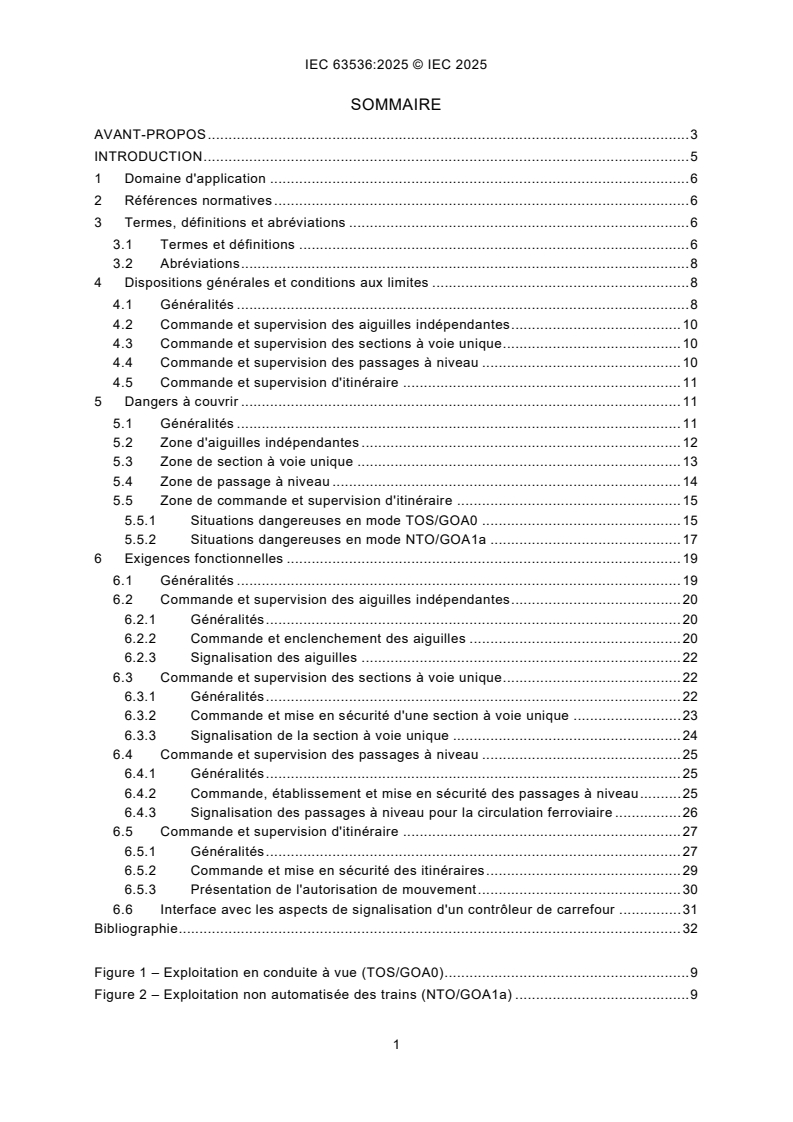
CONTENTS
FOREWORD . 3
INTRODUCTION . 5
1 Scope . 6
2 Normative references . 6
3 Terms, definitions and abbreviated terms . 6
3.1 Terms and definitions. 6
3.2 Abbreviated terms . 8
4 General provisions and boundary conditions . 8
4.1 General . 8
4.2 Independent point control . 10
4.3 Single-track section control . 10
4.4 Level crossing control . 10
4.5 Route control . 10
5 Hazards to be covered . 11
5.1 General . 11
5.2 Independent point area . 11
5.3 Single-track section area . 12
5.4 Level crossing area . 13
5.5 Route control area . 14
5.5.1 Hazardous situations in TOS/GOA0 . 14
5.5.2 Hazardous situations in NTO/GOA1a . 15
6 Functional requirements . 17
6.1 General . 17
6.2 Independent point control . 17
6.2.1 General . 17
6.2.2 Set and interlock points . 18
6.2.3 Signalling of points . 19
6.3 Single-track section control . 19
6.3.1 General . 19
6.3.2 Set and secure single-track section . 20
6.3.3 Signalling of single-track section . 21
6.4 Level crossing control . 22
6.4.1 General . 22
6.4.2 Request, set and secure level crossings . 22
6.4.3 Signalling of level crossings for rail traffic . 23
6.5 Route control . 24
6.5.1 General . 24
6.5.2 Set and secure routes . 25
6.5.3 Display movement authority . 27
6.6 Interface with signal aspects of road traffic controller . 28
Bibliography . 29
Figure 1 – On-sight train operations (TOS/GOA0) . 9
Figure 2 – Non-automated train operations (NTO/GOA1a) . 9
Figure 3 – Combined on-sight (TOS/GOA0) and non-automated train operations
(NTO/GOA1a) . 9
Figure 4 – Independent point control and boundary conditions . 17
Figure 5 – Single-track section control and boundary conditions . 20
Figure 6 – Level crossing control and boundary conditions . 22
Figure 7 – Route control and boundary conditions (TOS/GOA0 applications) . 25
Figure 8 – Route control and boundary conditions (NTO/GOA1a applications) . 25
Table 1 – Hazard analysis for independent point area . 11
Table 2 – Hazard analysis for single-track section area . 12
Table 3 – Hazard analysis for level crossing area . 13
Table 4 – Hazard analysis for TOS/GOA0 route control area. 14
Table 5 – Hazard analysis for NTO/GOA1a route control area . 15
INTERNATIONAL ELECTROTECHNICAL COMMISSION
____________
Railway applications -
Signalling and control systems for non UGTMS urban rail systems
FOREWORD
1) The International Electrotechnical Commission (IEC) is a worldwide organization for standardization comprising
all national electrotechnical committees (IEC National Committees). The object of IEC is to promote international
co-operation on all questions concerning standardization in the electrical and electronic fields. To this end and
in addition to other activities, IEC publishes International Standards, Technical Specifications, Technical Reports,
Publicly Available Specifications (PAS) and Guides (hereafter referred to as "IEC Publication(s)"). Their
preparation is entrusted to technical committees; any IEC National Committee interested in the subject dealt with
may participate in this preparatory work. International, governmental and non-governmental organizations liaising
with the IEC also participate in this preparation. IEC collaborates closely with the International Organization for
Standardization (ISO) in accordance with conditions determined by agreement between the two organizations.
2) The formal decisions or agreements of IEC on technical matters express, as nearly as possible, an international
consensus of opinion on the relevant subjects since each technical committee has representation from all
interested IEC National Committees.
3) IEC Publications have the form of recommendations for international use and are accepted by IEC National
Committees in that sense. While all reasonable efforts are made to ensure that the technical content of IEC
Publications is accurate, IEC cannot be held responsible for the way in which they are used or for any
misinterpretation by any end user.
4) In order to promote international uniformity, IEC National Committees undertake to apply IEC Publications
transparently to the maximum extent possible in their national and regional publications. Any divergence between
any IEC Publication and the corresponding national or regional publication shall be clearly indicated in the latter.
5) IEC itself does not provide any attestation of conformity. Independent certification bodies provide conformity
assessment services and, in some areas, access to IEC marks of conformity. IEC is not responsible for any
services carried out by independent certification bodies.
6) All users should ensure that they have the latest edition of this publication.
7) No liability shall attach to IEC or its directors, employees, servants or agents including individual experts and
members of its technical committees and IEC National Committees for any personal injury, property damage or
other damage of any nature whatsoever, whether direct or indirect, or for costs (including legal fees) and
expenses arising out of the publication, use of, or reliance upon, this IEC Publication or any other IEC
Publications.
8) Attention is drawn to the Normative references cited in this publication. Use of the referenced publications is
indispensable for the correct application of this publication.
9) IEC draws attention to the possibility that the implementation of this document may involve the use of (a)
patent(s). IEC takes no position concerning the evidence, validity or applicability of any claimed patent rights in
respect thereof. As of the date of publication of this document, IEC had not received notice of (a) patent(s), which
may be required to implement this document. However, implementers are cautioned that this may not represent
the latest information, which may be obtained from the patent database available at https://patents.iec.ch. IEC
shall not be held responsible for identifying any or all such patent rights.
IEC 63536 has been prepared by IEC technical committee 9: Electrical equipment and systems
for railways. It is an International Standard.
The text of this International Standard is based on the following documents:
Draft Report on voting
9/3211/FDIS 9/3236/RVD
Full information on the voting for its approval can be found in the report on voting indicated in
the above table.
The language used for the development of this International Standard is English.
This document was drafted in accordance with ISO/IEC Directives, Part 2, and developed in
accordance with ISO/IEC Directives, Part 1 and ISO/IEC Directives, IEC Supplement, available
at www.iec.ch/members_experts/refdocs. The main document types developed by IEC are
described in greater detail at www.iec.ch/publications.
The committee has decided that the contents of this document will remain unchanged until the
stability date indicated on the IEC website under webstore.iec.ch in the data related to the
specific document. At this date, the document will be
– reconfirmed,
– withdrawn, or
– revised.
INTRODUCTION
This document covers systems restricted to on-sight train operation and non-automated train
operations (respectively TOS/GOA0 and NTO/GOA1 with intermittent supervision as defined in
the IEC 62290 series) and covers signalling on tramways and other urban rail systems which
do not fall directly within either existing railway or highway standards. This would typically be
for parts of systems which are along off-street alignment, and which operate to line-of-sight, or
automatic interlock signalling with intermittent supervision. This document does not conflict with
the scope and requirements of the IEC 62290 series.
This document proposes the minimum required functions for signalling systems for guided urban
systems operating line-of-sight and non-automated operations.
This document does not set any operational rules, any system architecture rules or any rules
on the application conditions of technical systems for the different categories of urban rail
systems.
In this document, GOA1a describes a GOA1 with intermittent supervision systems.
This document covers all GOA0 and GOA1a urban guided transport systems.
Such systems require more functionalities and better safety levels than those provided by traffic
signal controllers but avoid the requirements inherent in railway signalling systems which can
be restrictive both operationally and financially from a tramway perspective.
Numerous countries use these systems to control points, manage train movements along single
lines and prevent conflicts at junctions as well as on grade crossings with road and pedestrian
traffic. Whilst adopting much of the functional requirements and safeguards used in standard
traffic signal controllers, there is additional functionality required and currently in use to fulfil
the needs of urban rail.
Mainline railway signalling systems include a lot of such additional functionality, but in terms of
this and the required safety integrity, they are not ideally suited to the needs of urban rail.
The two fundamentally different approaches for the design of signalling systems, both of which
are currently in use to some extent on most systems, are:
– technology as used for traffic signal controllers, or
– technology as used for signalling systems to be developed in accordance with safety
integrity levels sufficient for tramways and urban rail.
This could leave system owners and operators vulnerable to challenge, particularly after an
incident, because there is no relevant accepted international standard to justify appropriate use
of such equipment.
1 Scope
This document specifies minimum functional requirements for urban rail signalling and control
systems (for use in urban guided passenger transport lines and networks)
– which operate on line-of-sight or using automatic interlock signalling with intermittent
supervision,
– not covered by the existing UGTMS standard IEC 62290 series, and
– not forming a part of an urban traffic control system but possibly interfaced with such
systems.
The document is restricted to minimum functional requirements which allow users to define
more specific requirements based on the given framework of the system requirements at top
level. This document is not applicable to command-and-control systems for urban rail using
continuous data transmission and continuous supervision of train movements by train protection
profile (already covered by the IEC 62290 series).
2 Normative references
There are no normative references in this document.
3 Terms, definitions and abbreviated terms
For the purposes of this document, the following terms and definitions apply.
ISO and IEC maintain terminology databases for use in standardization at the following
addresses:
– IEC Electropedia: available at https://www.electropedia.org/
– ISO Online browsing platform: available at https://www.iso.org/obp
3.1 Terms and definitions
3.1.1
external device
device providing external demand inputs to signalling control elements
Note 1 to entry: The methods of making these demand inputs can vary from simple manual inputs to automatic data
derived inputs from train-borne equipment.
EXAMPLE Remote inputs from control rooms, input from road traffic controller, request transmitted from a train.
3.1.2
level crossing
level grade crossing
crossing of an urban rail system and a road at the same level
Note 1 to entry: In some EU member states when a tramway on its own alignment crosses a road used by other
traffic, it is not normally termed a "level crossing" as defined in national road and rail traffic legislation, but is usually
termed a "road junction" or "crossing at grade". References to level crossing in this document equate to a crossing
at grade when the urban rail system under consideration is a tramway.
Note 2 to entry: The term "road" covers walkways, cycle paths, highways, etc.
[SOURCE: IEC 60050-821:2017, 821-07-01, modified – "a railway" has been replaced with "an
urban rail system". Notes 1 and 2 to entry have been added.]
3.1.3
level crossing area
portion of the level crossing between the road stop lines on either side of the urban rail system
3.1.4
movement authority
permission for a train to run safely, within the constraints of the infrastructure, up to a specific
location
[SOURCE: IEC 60050-821:2017, 821-01-63]
3.1.5
point machine
assembly, within a casing, of the apparatus for operating blades from a source of power, usually
electric
[SOURCE: IEC 60050-821:2017, 821-04-22]
3.1.6
road traffic
road vehicles, pedestrians, equestrians, bicycles and any other road users
3.1.7
route
predefined path for a traffic movement
Note 1 to entry: This is as distinct from the meaning in railway signalling of a route. With respect to TOS/GOA0, the
driver is the person in charge of the vehicle and is required to be able to stop the train within his/her sighting distance.
[SOURCE: IEC 60050-821:2017, 821-01-22, modified – Note 1 to entry has been added.]
3.1.8
signal
apparatus by means of which a conventional indication is given
Note 1 to entry: This conventional indication, visual or acoustic, generally concerning the movements of urban rail
vehicles, is transmitted to the staff entrusted to observe it.
Note 2 to entry: When a tramway track or part of a tramway route is in an area which is part of the highway or public
road it may not be called a signal under some national legislation unless it complies with prescribed diagrams and
usage to control traffic. Equipment used only to confirm such things as the position and interlocking of points may
therefore described in some countries as a point indicator. In this document where the terms "point signal" or "point
interlocking signal" appear, it shall be taken that these refer to a "point indicator" or "point interlocking indicator" as
appropriate.
Note 3 to entry: In urban guided passenger transport lines and networks in some countries, a level crossing signal
is not called a "signal" but rather an "indicator". In this document where the term "level crossing signal" appears, it
shall be taken that this refers to a level crossing indicator as appropriate.
[SOURCE: IEC 60050-821:2017, 821-02-01, modified – In Note 1 to entry, "railway vehicles"
has been replaced with "urban rail vehicles", Notes 2 and 3 to entry have been added.]
3.1.9
train
combination of rolling stock coupled together
Note 1 to entry: Rolling stock includes banking locomotives.
Note 2 to entry: The term is used in this document for all categories of urban rail, such as trams, or GOA0 or GOA1a
systems for example light rail, etc.
[SOURCE: IEC 60050-821:2017, 811-01-08, modified – Note 2 to entry has been added.]
3.2 Abbreviated terms
For the purposes of this document, the following abbreviated terms apply.
GOA grade of automation
GOA0 grade of automation 0
GOA1a grade of automation 1 with intermittent supervision
HMI human machine interface
NTO non-automated train operation
(O) optional
TOS train operations on sight
UGTMS urban guided transport management and command/control system
4 General provisions and boundary conditions
4.1 General
The signalling systems covered by this document and their components should be suitable for
use on street alignment or off-street alignment.
Figure 1 to Figure 3 provide an overview of the areas of non UGTMS urban rail systems for
which operational scenarios shall be considered. In each area a train passes through, a specific
functionality is required.
This document covers the following areas (and their related boundary conditions):
a) independent points (stand-alone) used for TOS/GOA0 operations, to direct trains to different
tracks of the network;
b) single-track sections used for TOS/GOA0 operations where the guideway layout is restricted
to a single track for train movements in either direction of travel;
c) level crossings (crossings at grade) used for both TOS/GOA0 and NTO/GOA1a operation,
where a guideway crosses public streets or footpaths;
d) route control area used for
1) TOS/GOA0 where the guideway layout has a higher complexity than for independent
point areas and where it is reasonable to set a route consisting of various route elements
for passage of the train, to ease operation, or
2) NTO/GOA1a where train movements on safe routes are compulsory.
Figure 1 – On-sight train operations (TOS/GOA0)
Figure 2 – Non-automated train operations (NTO/GOA1a)
Figure 3 – Combined on-sight (TOS/GOA0) and non-automated
train operations (NTO/GOA1a)
4.2 Independent point control
Independent point control is used to set points in different positions and to avoid points moving
under trains by
– setting and securing points, and
– checking and displaying the position of points.
Independent point control is used for on-sight train operation (TOS/GOA0) and covers
independent points which may be linked together, but this independent point control is not part
of a route control area.
4.3 Single-track section control
Single-track section control is to prevent concurrent use of a single-track section by trains
travelling in opposite directions by
– ensuring the routes associated with single-track sections are set and secured, and
– signalling of single-track sections.
Single-track section control is used for TOS/GOA0 operations. The control of points is treated
separately.
4.4 Level crossing control
Level crossing control is to prevent concurrent use of the guideway by rail and crossing
road/pedestrian traffic by
– signalling or signage of level crossings for rail and road traffic, and
– when signalled, closing the way to road/pedestrian traffic and holding level crossing for use
by rail traffic.
Level crossing control is used for both TOS/GOA0 and NTO/GOA1a operations.
Some level crossing control functionalities are covered by route control for NTO/GOA1a
operation.
4.5 Route control
Route control is used to set routes via various route elements for
a) TOS/GOA0
the prevention of conflicting movements and points moving under trains, by
1) setting and securing all routes via switchable (e.g. points) and non-switchable (e.g. track
sections) route elements and optionally level crossings, and
2) signalling of routes;
b) NTO/GOA1a
the prevention of conflicting movements and points moving under trains, by
1) setting and securing all routes via switchable (e.g. points) and non-switchable (e.g. track
sections) route elements and optionally level crossings,
2) ensuring safe separation of trains, and
3) signalling of routes and controlling of train movements at specific locations.
5 Hazards to be covered
5.1 General
Boundary conditions depend on grades of automation.
a) In TOS/GOA0 operation, it is assumed that
1) whilst operating on street alignment, conflicts with other road and pedestrian traffic are
covered by highway/public road legislation and means of prevention (e.g. traffic signs,
road traffic signals and controllers) are therefore not covered by this hazard
identification,
2) the train driver is responsible for carrying out such functions, within the boundary
conditions defined by national or operational rules,
3) the train driver is responsible for carrying out conflict with road and pedestrian traffic,
4) the train driver is responsible for ensuring the separation of trains,
5) the train driver is responsible for determining the appropriate speed to avoid collisions,
and
6) the train driver is responsible for observing the appropriate speed to avoid derailment.
b) In NTO/GOA1a operation,
1) trains operate on a segregated guideway,
2) train separation is managed through the signalling system, and
3) speed supervision is part of the signalling system (O).
The hazard analysis described in 5.2, 5.3, 5.4, and 5.5 is general and is used to support any
specific hazard analysis performed in a project.
5.2 Independent point area
Boundary conditions for the independent point area are:
– for locally-set points, the driver is responsible for checking that the switching of the point is
permissible, for observing that the point is correctly positioned and for observing the
permitted speed relative to the position of the points;
– there are no conflicting train movements; only the hazards due to the point are considered.
Table 1 shows the hazard analysis for independent point area.
Table 1 – Hazard analysis for independent point area
Cases Hazardous situations Unwanted Possible Functions Remarks
occurrences mitigations
1 Remotely-set point in Collision with Independent Set and interlock
unexpected position road traffic point control points
– point – detect
machine position of
point
2 Remotely-set point moves Derailment Independent Set and interlock Point
under the train point control points for interlocking
passage of a train equipment
– interlock
including train
point
detection and
physical locks
Cases Hazardous situations Unwanted Possible Functions Remarks
occurrences mitigations
a
3 Train passes point at Derailment Independent Signalling of
inappropriate speed point control points
Displayed
position
– point – display
supports the
indicator position of
points speed relative
to the position
of the points
4 Train moves on guideway Collision with Independent Signalling of Optional
TOS/GOA0 road traffic point control points
– road traffic controller – interface – consistency of
displays movement with road road traffic
authority in direction traffic controller
divergent from point controller aspect
signal, train driver
continues train
movement wrongly
based on road traffic
controller authorization
a
The use of point indicators is not necessary if, in defined cases of low-speed operation over remotely-set
points, the train driver is responsible for observing that the point is correctly positioned and for observing the
permitted speed relative to the position of the points.
5.3 Single-track section area
Boundary conditions for a single-track section area are:
– hazard analysis is limited to the section of track which is designated for bidirectional use.
Table 2 shows the hazard analysis for single-track section area.
Table 2 – Hazard analysis for single-track section area
Cases Hazardous situations Unwanted Possible Functions Remarks
occurrences mitigations
a
1 Conflicting train Collision Single-track Set and secure single-
movement while trains section control track section
are approaching at the
– secure track section
same time from both
in opposite direction
directions
a
2 Entry of a train on the Collision Signal for on- Ensure section signals
section with a train sight train are set to stop.
already on the section operation and
– Activate warning
optional
elements
warning
elements
3 Train moves on Collision with Single-track Signalling of single-track
guideway TOS/GOA0 another train or section control section
with road traffic
– road traffic – Interface to – consistency with
controller displays road traffic road traffic
movement controller controller aspect
authority
divergent from
signal for single-
track section, train
driver continues
train movement
wrongly based on
road traffic
controller
authorization
Cases Hazardous situations Unwanted Possible Functions Remarks
occurrences mitigations
4 Train moves on Derailment or Route control Signalling of route
guideway without collision
– Train stop – monitor movement
movement authority
device at route entrance
and at discrete
locations
a
The use of single-track section control is not necessary, if
• the single-track section is sufficiently short to be observed end-to-end by drivers and movement speeds
are low, or
• movement authority is granted by operational procedures (e.g. secured by token) for temporary single-
track sections (e.g. track works).
5.4 Level crossing area
Boundary conditions for a level crossing area are:
– hazard analysis is limited to events affecting train movements;
– on level crossings on which priority to rail traffic is given, the road traffic should obey the
road traffic signals/signage.
Table 3 shows the hazard analysis for level crossing area.
Table 3 – Haza
...
IEC 63536 ®
Edition 1.0 2025-07
NORME
INTERNATIONALE
Applications ferroviaires - Systèmes de signalisation et de contrôle/commande
des transports guidés urbains non UGTMS
ICS 45.060.01 ISBN 978-2-8327-0520-9
Droits de reproduction réservés. Sauf indication contraire, aucune partie de cette publication ne peut être reproduite ni
utilisée sous quelque forme que ce soit et par aucun procédé, électronique ou mécanique, y compris la photocopie et
les microfilms, sans l'accord écrit de l'IEC ou du Comité national de l'IEC du pays du demandeur. Si vous avez des
questions sur le copyright de l'IEC ou si vous désirez obtenir des droits supplémentaires sur cette publication, utilisez
les coordonnées ci-après ou contactez le Comité national de l'IEC de votre pays de résidence.
IEC Secretariat Tel.: +41 22 919 02 11
3, rue de Varembé info@iec.ch
CH-1211 Geneva 20 www.iec.ch
Switzerland
A propos de l'IEC
La Commission Electrotechnique Internationale (IEC) est la première organisation mondiale qui élabore et publie des
Normes internationales pour tout ce qui a trait à l'électricité, à l'électronique et aux technologies apparentées.
A propos des publications IEC
Le contenu technique des publications IEC est constamment revu. Veuillez vous assurer que vous possédez l’édition la
plus récente, un corrigendum ou amendement peut avoir été publié.
Recherche de publications IEC - IEC Products & Services Portal - products.iec.ch
webstore.iec.ch/advsearchform Découvrez notre puissant moteur de recherche et consultez
La recherche avancée permet de trouver des publications gratuitement tous les aperçus des publications, symboles
IEC en utilisant différents critères (numéro de référence, graphiques et le glossaire. Avec un abonnement, vous aurez
texte, comité d’études, …). Elle donne aussi des toujours accès à un contenu à jour adapté à vos besoins.
informations sur les projets et les publications remplacées
ou retirées. Electropedia - www.electropedia.org
Le premier dictionnaire d'électrotechnologie en ligne au
IEC Just Published - webstore.iec.ch/justpublished monde, avec plus de 22 500 articles terminologiques en
Restez informé sur les nouvelles publications IEC. Just anglais et en français, ainsi que les termes équivalents
dans 25 langues additionnelles. Egalement appelé
Published détaille les nouvelles publications parues.
Disponible en ligne et une fois par mois par email. Vocabulaire Electrotechnique International (IEV) en ligne.
Service Clients - webstore.iec.ch/csc
Si vous désirez nous donner des commentaires sur cette
publication ou si vous avez des questions contactez-
nous: sales@iec.ch.
SOMMAIRE
AVANT-PROPOS . 3
INTRODUCTION . 5
1 Domaine d'application . 6
2 Références normatives . 6
3 Termes, définitions et abréviations . 6
3.1 Termes et définitions . 6
3.2 Abréviations . 8
4 Dispositions générales et conditions aux limites . 8
4.1 Généralités . 8
4.2 Commande et supervision des aiguilles indépendantes . 10
4.3 Commande et supervision des sections à voie unique . 10
4.4 Commande et supervision des passages à niveau . 10
4.5 Commande et supervision d'itinéraire . 11
5 Dangers à couvrir . 11
5.1 Généralités . 11
5.2 Zone d'aiguilles indépendantes . 12
5.3 Zone de section à voie unique . 13
5.4 Zone de passage à niveau . 14
5.5 Zone de commande et supervision d'itinéraire . 15
5.5.1 Situations dangereuses en mode TOS/GOA0 . 15
5.5.2 Situations dangereuses en mode NTO/GOA1a . 17
6 Exigences fonctionnelles . 19
6.1 Généralités . 19
6.2 Commande et supervision des aiguilles indépendantes . 20
6.2.1 Généralités . 20
6.2.2 Commande et enclenchement des aiguilles . 20
6.2.3 Signalisation des aiguilles . 22
6.3 Commande et supervision des sections à voie unique . 22
6.3.1 Généralités . 22
6.3.2 Commande et mise en sécurité d'une section à voie unique . 23
6.3.3 Signalisation de la section à voie unique . 24
6.4 Commande et supervision des passages à niveau . 25
6.4.1 Généralités . 25
6.4.2 Commande, établissement et mise en sécurité des passages à niveau . 25
6.4.3 Signalisation des passages à niveau pour la circulation ferroviaire . 26
6.5 Commande et supervision d'itinéraire . 27
6.5.1 Généralités . 27
6.5.2 Commande et mise en sécurité des itinéraires . 29
6.5.3 Présentation de l'autorisation de mouvement . 30
6.6 Interface avec les aspects de signalisation d'un contrôleur de carrefour . 31
Bibliographie . 32
Figure 1 – Exploitation en conduite à vue (TOS/GOA0) . 9
Figure 2 – Exploitation non automatisée des trains (NTO/GOA1a) . 9
Figure 3 – Exploitation en conduite à vue (TOS/GOA0) et exploitation non
automatisée des trains (NTO/GOA1a) combinées . 10
Figure 4 – Commande et supervision des aiguilles indépendantes et conditions aux
limites . 20
Figure 5 – Commande et supervision des sections à voie unique et conditions aux
limites . 23
Figure 6 – Commande et supervision des passages à niveau et conditions aux limites . 25
Figure 7 – Commande et supervision d'itinéraire et conditions aux limites (applications
TOS/GOA0) . 28
Figure 8 – Commande et supervision d'itinéraire et conditions aux limites (applications
NTO/GOA1a) . 29
Tableau 1 – Analyse des dangers de la zone d'aiguilles indépendantes . 12
Tableau 2 – Analyse des dangers de la zone de section à voie unique . 13
Tableau 3 – Analyse des dangers de la zone de passage à niveau . 14
Tableau 4 – Analyse des dangers de la zone de commande et supervision d'itinéraire
TOS/GOA0 . 16
Tableau 5 – Analyse des dangers de la zone de commande et supervision d'itinéraire
NTO/GOA1a . 18
COMMISSION ÉLECTROTECHNIQUE INTERNATIONALE
____________
Applications ferroviaires -
Systèmes de signalisation et de contrôle/commande des transports
guides urbains non UGTMS
AVANT-PROPOS
1) La Commission Électrotechnique Internationale (IEC) est une organisation mondiale de normalisation composée
de l'ensemble des comités électrotechniques nationaux (Comités nationaux de l'IEC). L'IEC a pour objet de
favoriser la coopération internationale pour toutes les questions de normalisation dans les domaines de
l'électricité et de l'électronique. A cet effet, l'IEC – entre autres activités – publie des Normes internationales,
des Spécifications techniques, des Rapports techniques, des Spécifications accessibles au public (PAS) et des
Guides (ci-après dénommés "Publication(s) de l'IEC"). Leur élaboration est confiée à des comités d'études, aux
travaux desquels tout Comité national intéressé par le sujet traité peut participer. Les organisations
internationales, gouvernementales et non gouvernementales, en liaison avec l'IEC, participent également aux
travaux. L'IEC collabore étroitement avec l'Organisation Internationale de Normalisation (ISO), selon des
conditions fixées par accord entre les deux organisations.
2) Les décisions ou accords officiels de l'IEC concernant les questions techniques représentent, dans la mesure du
possible, un accord international sur les sujets étudiés, étant donné que les Comités nationaux de l'IEC intéressés
sont représentés dans chaque comité d'études.
3) Les Publications de l'IEC se présentent sous la forme de recommandations internationales et sont agréées
comme telles par les Comités nationaux de l'IEC. Tous les efforts raisonnables sont entrepris afin que l'IEC
s'assure de l'exactitude du contenu technique de ses publications; l'IEC ne peut pas être tenue responsable de
l'éventuelle mauvaise utilisation ou interprétation qui en est faite par un quelconque utilisateur final.
4) Dans le but d'encourager l'uniformité internationale, les Comités nationaux de l'IEC s'engagent, dans toute la
mesure possible, à appliquer de façon transparente les Publications de l'IEC dans leurs publications nationales
et régionales. Toutes divergences entre toutes Publications de l'IEC et toutes publications nationales ou
régionales correspondantes doivent être indiquées en termes clairs dans ces dernières.
5) L'IEC elle-même ne fournit aucune attestation de conformité. Des organismes de certification indépendants
fournissent des services d'évaluation de conformité et, dans certains secteurs, accèdent aux marques de
conformité de l'IEC. L'IEC n'est responsable d'aucun des services effectués par les organismes de certification
indépendants.
6) Tous les utilisateurs doivent s'assurer qu'ils sont en possession de la dernière édition de cette publication.
7) Aucune responsabilité ne doit être imputée à l'IEC, à ses administrateurs, employés, auxiliaires ou mandataires,
y compris ses experts particuliers et les membres de ses comités d'études et des Comités nationaux de l'IEC,
pour tout préjudice causé en cas de dommages corporels et matériels, ou de tout autre dommage de quelque
nature que ce soit, directe ou indirecte, ou pour supporter les coûts (y compris les frais de justice) et les dépenses
découlant de la publication ou de l'utilisation de cette Publication de l'IEC ou de toute autre Publication de l'IEC,
ou au crédit qui lui est accordé.
8) L'attention est attirée sur les références normatives citées dans cette publication. L'utilisation de publications
référencées est obligatoire pour une application correcte de la présente publication.
L'IEC attire l'attention sur le fait que la mise en application du présent document peut entraîner l'utilisation d'un ou
de plusieurs brevets. L'IEC ne prend pas position quant à la preuve, à la validité et à l'applicabilité de tout droit
de brevet revendiqué à cet égard. À la date de publication du présent document, l'IEC n'avait pas reçu notification
qu'un ou plusieurs brevets pouvaient être nécessaires à sa mise en application. Toutefois, il y a lieu d'avertir les
responsables de la mise en application du présent document que des informations plus récentes sont
susceptibles de figurer dans la base de données de brevets, disponible à l'adresse https://patents.iec.ch. L'IEC
ne saurait être tenue pour responsable de ne pas avoir identifié de tels droits de propriété et averti de leur
existence.
L'IEC 63536 a été établie par le comité d'études 9 de l'IEC : Matériels et systèmes électriques
ferroviaires. Il s'agit d'une Norme internationale.
Le texte de cette Norme internationale est issu des documents suivants :
Projet Rapport de vote
9/3211/FDIS 9/3236/RVD
Le rapport de vote indiqué dans le tableau ci-dessus donne toute information sur le vote ayant
abouti à l'approbation de cette norme.
La langue employée pour l'élaboration de cette Norme internationale est l'anglais.
Cette publication a été rédigée selon les Directives ISO/IEC, Partie 2, et élaborée selon les
Directives ISO/IEC, Partie 1 et les Directives ISO/IEC, Supplément IEC, disponibles à l'adresse
suivante : www.iec.ch/members_experts/refdocs. Les principaux types de documents élaborés
par l'IEC sont décrits plus en détail sur le site internet : www.iec.ch/publications.
Le comité a décidé que le contenu de cette publication ne sera pas modifié avant la date de
stabilité indiquée sur le site web de l'IEC sous webstore.iec.ch dans les données relatives au
document recherché. A cette date, la publication sera
– reconduite,
– supprimée, ou
– révisée.
INTRODUCTION
Le présent document couvre les systèmes ferroviaires destinés à l'exploitation en conduite à
vue et à l'exploitation non automatisée des trains (respectivement TOS/GOA0 et NTO/GOA1 à
supervision ponctuelle, définies dans la série IEC 62290), et couvre la signalisation des
tramways et autres systèmes de transport guidé urbain qui ne relèvent pas directement des
normes ferroviaires ou routières existantes. Cela concerne particulièrement les situations où
ces systèmes sont implantés en site propre et exploités en conduite à vue, ou avec une
signalisation de cantonnement automatique à supervision ponctuelle. Le présent document
n'est pas en chevauchement avec le domaine d'application et les exigences de la série
IEC 62290.
Le présent document établit les exigences fonctionnelles minimales des systèmes de
signalisation destinés à l'exploitation en conduite à vue et à l'exploitation non automatisée des
transports guidés urbains.
Le présent document n'a pas pour objet de définir les règles d'exploitation, ni l'architecture
système ou les règles pour la mise en œuvre des systèmes de signalisation pour les différents
types de systèmes de transport guidé urbains.
Dans le présent document, le mode GOA1a décrit les systèmes GOA1 à supervision ponctuelle.
Le présent document couvre l'ensemble des transports guidés urbains GOA0 et GOA1a.
Ces systèmes exigent davantage de fonctionnalités et un niveau de sécurité supérieur à ceux
fournis par les contrôleurs de carrefour, sans nécessiter l'application des exigences inhérentes
aux systèmes de signalisation ferroviaire qui peuvent être contraignantes sur le plan
opérationnel et financier.
De nombreux pays utilisent ces systèmes pour commander et superviser les aiguilles, gérer les
mouvements des trains sur les sections à voie unique, mais aussi gérer les conflits avec la
circulation routière et piétonne aux carrefours et aux passages à niveau. Tout en adoptant la
plupart des exigences fonctionnelles et des dispositifs de protection utilisés dans les
contrôleurs de carrefour standards, des fonctionnalités supplémentaires sont requises, et sont
d'ores et déjà mises en œuvre pour répondre aux besoins des transports guidés urbains.
Les systèmes de signalisation ferroviaire Grandes lignes incorporent nombre de telles
fonctionnalités supplémentaires, mais en raison de cela et en ce qui concerne le niveau
d'intégrité de sécurité exigé, elles ne conviennent pas parfaitement aux besoins des transports
guidés urbains.
La conception des systèmes de signalisation s'effectue selon deux approches
fondamentalement différentes, qui sont toutes les deux actuellement utilisées à des degrés
divers sur la plupart des systèmes. Il s'agit :
– des technologies mises en œuvre dans les contrôleurs de carrefour ; ou
– des technologies des systèmes de signalisation, qui doivent être élaborées en offrant des
niveaux d'intégrité de sécurité suffisants pour les tramways et les transports guidés urbains.
Cela peut mettre les gestionnaires d'infrastructure et les exploitants dans une situation délicate,
en particulier après un incident, car il n'existe aucune norme internationale pertinente admise
pour justifier l'usage adéquat de tels équipements.
1 Domaine d'application
Le présent document spécifie les exigences fonctionnelles minimales pour les systèmes de
signalisation et de contrôle/commande des transports guidés urbains (destinés à être utilisés
sur les lignes et les réseaux de transports guidés urbains de voyageurs)
– qui circulent en conduite à vue ou qui utilisent des signaux de cantonnement automatiques
à supervision ponctuelle ;
– qui ne sont pas couverts par la série IEC 62290 relative aux systèmes de
contrôle/commande et de gestion des transports guidés urbains (UGTMS) ; et
– qui ne relèvent pas d'un contrôleur de carrefour, mais qui peuvent être interfacés avec de
tels systèmes.
Le présent document se limite aux exigences fonctionnelles minimales qui permettent aux
utilisateurs de définir des exigences plus spécifiques en fonction de la démonstration de
sécurité globale du système. Le présent document ne s'applique pas aux systèmes de
contrôle/commande des transports guidés urbains qui assurent en continu la transmission des
données et le contrôle des mouvements des trains par courbe de contrôle de vitesse (ces
systèmes étant déjà couverts par la série IEC 62290).
2 Références normatives
Le présent document ne contient aucune référence normative.
3 Termes, définitions et abréviations
Pour les besoins du présent document, les termes et définitions suivants s'appliquent.
L'ISO et l'IEC tiennent à jour des bases de données terminologiques destinées à être utilisées
en normalisation, consultables aux adresses suivantes :
– IEC Electropedia : disponible à l'adresse https://www.electropedia.org/
– ISO Online browsing platform : disponible à l'adresse https://www.iso.org/obp
3.1 Termes et définitions
3.1.1
dispositif externe
dispositif qui transmet des informations d'entrée externes aux éléments de
commande/signalisation
Note 1 à l'article: Les sources de ces informations d'entrée peuvent aller de la simple saisie manuelle aux
informations dérivées des données transmises automatiquement par les équipements embarqués.
EXEMPLE Informations transmises à distance par les postes de commandes centralisées ; une entrée transmise
par le contrôleur de carrefour ; une commande transmise par un train.
3.1.2
passage à niveau
croisement d'un réseau ferroviaire urbain et d'une route au même niveau
Note 1 à l'article: Dans certains États membres de l'UE, lorsqu'un tramway circulant sur son tracé franchit une voie
empruntée par d'autres usagers, le franchissement n'est généralement pas considéré comme un "passage à niveau"
au sens de la réglementation routière et ferroviaire nationale, mais est habituellement qualifié de "carrefour" ou
"croisement à niveau". Lorsque le présent document emploie le terme "passage à niveau", cela équivaut à un
croisement à niveau lorsque le système de transport guidé urbain considéré est un tramway.
Note 2 à l'article: Le terme "route" couvre les allées piétonnes, les pistes cyclables, les voies de circulation, etc.
[SOURCE : IEC 60050-821:2017, 821-07-01, modifiée – "chemin de fer" a été remplacé par
"réseau ferroviaire urbain". Les Notes 1 et 2 à l'article ont été ajoutées.]
3.1.3
zone de passage à niveau
portion du passage à niveau comprise entre les marquages au sol (stop) situés de part et d'autre
du réseau ferroviaire urbain
3.1.4
domaine de marche
autorisation de mouvement
domaine alloué à un train pour se déplacer en sécurité, selon les contraintes liées à
l'infrastructure, jusqu'à un point précis
[SOURCE : IEC 60050-821:2017, 821-01-63]
3.1.5
mécanisme de manœuvre d'aiguillage
moteur d'aiguillage
ensemble, enfermé dans un carter, des organes assurant la manœuvre des lames d'aiguille
sous l'action d'une source d'énergie, généralement électrique
[SOURCE : IEC 60050-821:2017, 821-04-22]
3.1.6
circulation routière
mouvement des véhicules routiers, piétons, cavaliers, cyclistes, motocyclistes et autres
usagers de la route
3.1.7
itinéraire
chemin prédéterminé pour une circulation
Note 1 à l'article: Ce terme n'a pas la même signification dans le domaine de la signalisation ferroviaire d'une ligne.
En mode TOS/GOA0, le conducteur assume entièrement la conduite du véhicule et doit être capable d'arrêter le train
dans les limites de sa distance de visibilité.
[SOURCE : IEC 60050-821:2017, 821-01-22, modifiée – La Note 1 à l'article a été ajoutée.]
3.1.8
signal
appareil avec lequel une indication conventionnelle est donnée
Note 1 à l'article: Cette indication conventionnelle, optique ou acoustique, concernant en général le mouvement
des systèmes de transport guidé urbains, est transmise aux agents chargés de l'observer.
Note 2 à l'article: Lorsqu'une voie de tramway ou qu'une partie d'un itinéraire de tramway traverse une zone de
l'infrastructure routière ou de la voie publique, le signal ne peut pas être qualifié de "signal" au sens de certaines
réglementations nationales, à moins de respecter les schémas et l'usage prescrits en ce qui concerne la régulation
de la circulation. Les équipements utilisés dans le seul but de confirmer certains aspects, comme la position et la
commande des aiguilles, peuvent donc être décrits dans certains pays par le terme "indicateur d'aiguille". Dans le
présent document, lorsque le terme "signal d'aiguille" ou "signal d'enclenchement d'aiguille" apparaît, on doit
considérer qu'il se rapporte à un "indicateur d'aiguille" ou à un "indicateur d'enclenchement d'aiguille", selon le cas.
Note 3 à l'article: Sur les lignes et les réseaux de transports guidés urbains de voyageurs de certains pays, un
signal de passage à niveau n'est pas désigné par le terme "signal", mais plutôt par "indicateur". Dans le présent
document, lorsque le terme "signal de passage à niveau" apparaît, on doit considérer qu'il se rapporte à un indicateur
de passage à niveau, selon le cas.
[SOURCE : IEC 60050-821:2017, 821-02-01, modifiée – Dans la Note 1 à l'article, "véhicules
ferroviaires" a été remplacé par "systèmes de transport guidé urbains". Les Notes 2 et 3 à
l'article ont été ajoutées.]
3.1.9
train
combinaison de matériels roulants attelés
Note 1 à l'article: Le matériel roulant comprend les locomotives de pousse.
Note 2 à l'article: Le terme est utilisé dans le présent document pour désigner l'ensemble des systèmes de transport
guidé urbains tels que les tramways ou les systèmes GOA0 et GOA1a, par exemple systèmes ferroviaires légers,
etc.
[SOURCE : IEC 60050-821:2017, 811-01-08, modifiée – La Note 2 à l'article a été ajoutée.]
3.2 Abréviations
Pour les besoins du présent document, les abréviations suivantes s'appliquent :
GOA (grade of automation) Niveau d'automatisation
GOA0 (grade of automation 0) Niveau d'automatisation 0
GOA1a (grade of automation 1 with Niveau d'automatisation 1 à supervision
intermittent supervision) ponctuelle
IHM Interface homme-machine
NTO (non-automated train operation) Exploitation non automatisée des trains
(O) Optionnel
TOS (train operations on sight) Exploitation en conduite à vue
UGTMS (urban guided transport Système de contrôle/commande et de
management and command/control system) gestion des transports guidés urbains
4 Dispositions générales et conditions aux limites
4.1 Généralités
Les systèmes de signalisation couverts par le présent document et leurs composants doivent
être adaptés à une utilisation en site partagé ou en site propre.
Les Figure 1 à Figure 3 ci-après représentent les zones des transports guidés urbains non
UGTMS pour lesquels des scénarios d'exploitation doivent être considérés. Dans chaque zone
traversée par un train, une fonctionnalité spécifique est exigée.
Le présent document couvre les zones suivantes (et leurs conditions aux limites respectives):
a) les aiguilles indépendantes (autonomes) utilisées pour l'exploitation TOS/GOA0 afin
d'envoyer les trains vers différentes voies du réseau ;
b) les sections à voie unique utilisées pour l'exploitation TOS/GOA0 lorsque le tracé de la voie
est réduit à une voie unique, pour la circulation des trains dans les deux sens ;
c) les passages à niveau (croisements à niveau) utilisés pour l'exploitation TOS/GOA0 et
NTO/GOA1a lorsqu'une voie traverse des voies publiques ou des cheminements piétons ;
d) la zone de commande et supervision d'itinéraire utilisée pour
1) l'exploitation TOS/GOA0 lorsque le tracé de la voie est d'une complexité importante pour
les zones d'aiguilles indépendantes, et où il est raisonnable d'établir un itinéraire à partir
de différents éléments pour permettre le passage du train et ainsi faciliter l'exploitation,
ou
2) l'exploitation NTO/GOA1a lorsque la circulation des trains doit se faire obligatoirement
sur des itinéraires mis en sécurité.
Figure 1 – Exploitation en conduite à vue (TOS/GOA0)
Figure 2 – Exploitation non automatisée des trains (NTO/GOA1a)
Figure 3 – Exploitation en conduite à vue (TOS/GOA0)
et exploitation non automatisée des trains (NTO/GOA1a) combinées
4.2 Commande et supervision des aiguilles indépendantes
La commande et supervision des aiguilles indépendantes a pour objet de manœuvrer des
aiguilles dans différentes positions, et d'éviter leur mouvement sous les trains par
– la commande des aiguilles et leur enclenchement, ou
– le contrôle de position des aiguilles (présentation de la position des aiguilles).
La commande et supervision des aiguilles indépendantes est utilisée pour l'exploitation en
conduite à vue (TOS/GOA0) et couvre les aiguilles indépendantes qui peuvent être reliées
ensemble, mais cette commande et supervision des aiguilles indépendantes ne fait pas partie
d'une zone de commande et supervision d'itinéraire.
4.3 Commande et supervision des sections à voie unique
La commande et supervision des sections à voie unique a pour objet d'empêcher l'utilisation
simultanée d'une section à voie unique par des trains circulant en sens opposés par
– l'assurance que les itinéraires associés aux sections à voie unique sont commandés et mis
en sécurité, et
– la signalisation des sections à voie unique.
Les sections à voie unique sont commandées et supervisées en mode TOS/GOA0. La
commande et la supervision des aiguilles sont traitées séparément.
4.4 Commande et supervision des passages à niveau
La commande et supervision des passages à niveau a pour objet d'empêcher l'utilisation
simultanée de la voie par le trafic ferroviaire et celui routier/piéton par
– la signalisation des passages à niveau ou l'emploi d'une signalétique aux abords des
passages à niveau pour le trafic ferroviaire et routier ; et
– dans le cas d'usage d'une signalisation, l'arrêt de la circulation routière/piétonne et la
fermeture du passage à niveau pour permettre le trafic ferroviaire.
La commande et la supervision des passages à niveau est utilisée pour l'exploitation
TOS/GOA0 et celle NTO/GOA1a.
Certaines fonctionnalités de la commande et supervision des passages à niveau sont couvertes
par la commande et supervision d'itinéraire en mode NTO/GOA1a.
4.5 Commande et supervision d'itinéraire
La commande et supervision d'itinéraire a pour objet d'établir des itinéraires à l'aide de
différents éléments d'itinéraires pour
a) TOS/GOA0
prévenir les mouvements antagonistes et le mouvement des aiguilles sous les trains par
1) la commande et la mise en sécurité de tous les itinéraires avec l'emploi d'éléments
d'itinéraires mobiles (aiguilles, par exemple), d'éléments d'itinéraires fixes (cantons, par
exemple) et éventuellement de passages à niveau, et
2) la signalisation des itinéraires ;
b) NTO/GOA1a
prévenir les mouvements antagonistes et le mouvement des aiguilles sous les trains par
1) la commande et la mise en sécurité de tous les itinéraires avec l'emploi d'éléments
d'itinéraires mobiles (aiguilles, par exemple), d'éléments d'itinéraires fixes (cantons, par
exemple) et éventuellement de passages à niveau,
2) la garantie de la séparation en sécurité des trains, et
3) la signalisation des itinéraires et la supervision des mouvements des trains à des
endroits spécifiques.
5 Dangers à couvrir
5.1 Généralités
Les conditions aux limites dépendent des niveaux d'automatisation.
a) En mode TOS/GOA0, les hypothèses suivantes sont prises :
1) lors de la circulation en site partagé, les conflits avec la circulation routière et piétonne
sont couverts par le Code de la route et les dispositifs de prévention (signalisation,
signaux et contrôleurs de carrefour, par exemple) ne relèvent donc pas de cette analyse
des dangers,
2) l'accomplissement de ces fonctions est sous la responsabilité du conducteur, et ce dans
les conditions aux limites définies par les règles nationales ou d'exploitation ; la gestion
des conflits avec la circulation routière et piétonne est la responsabilité du conducteur,
3) la séparation des trains est la responsabilité du conducteur,
4) la détermination de la vitesse adéquate pour éviter une collision est sous la
responsabilité du conducteur du train, et
5) le respect de la vitesse adéquate pour éviter un déraillement est sous la responsabilité
du conducteur du train.
b) En mode NTO/GOA1a,
1) les trains circulent en site propre,
2) la séparation des trains est gérée par le système de signalisation, et
3) le contrôle de vitesse est assuré par le système de signalisation (O).
L'analyse des dangers décrite aux 5.2, 5.3, 5.4 et 5.5 vient en général à l'appui d'une analyse
de dangers spécifiques réalisée dans le cadre d'un projet global.
5.2 Zone d'aiguilles indépendantes
Les conditions aux limites pour la zone d'aiguilles indépendantes sont les suivantes :
– pour les aiguilles manœuvrées à pied d'œuvre, le conducteur a la responsabilité de vérifier
que la manœuvre de l'aiguille est permise, de s'assurer que l'aiguille est correctement
positionnée et de respecter la vitesse autorisée par rapport à la position des aiguilles ;
– il n'y a aucun mouvement de train antagoniste, seuls les dangers associés à l'aiguille sont
pris en considération.
Le Tableau 1 illustre une analyse des dangers de la zone d'aiguilles indépendantes.
Tableau 1 – Analyse des dangers de la zone d'aiguilles indépendantes
Scénario Situation Événement Mesure de réduction Fonction Remarques
dangereuse redouté possible
1 Une aiguille Collision Commande et Commande et
commandée à avec la supervision des enclenchement des
distance n'est circulation aiguilles aiguilles
pas dans la routière indépendantes
– détecter la
position prévue
– moteur d'aiguille position de
l'aiguille
2 Une aiguille Déraillement Commande et Commande et Appareils
commandée à supervision des enclenchement des d'enclenchement
distance bouge aiguilles aiguilles pour d'aiguilles, y
sous le train indépendantes permettre le compris
passage d'un train détection de
– enclenchement de
trains et verrous
l'aiguille
physiques
a
Un train franchit Commande et Signalisation des
3 Déraillement
une aiguille à une supervision des aiguilles
Présentation de
vitesse aiguilles
la position y
– présenter la
inadéquate indépendantes
position des compris la
– indicateur aiguilles vitesse
d'aiguille autorisée par
rapport à la
position des
aiguilles
4 Un train circule Collision Commande et Signalisation des Optionnel
sur la voie en avec la supervision des aiguilles
mode TOS/GOA0 circulation aiguilles
– homogénéité
routière indépendantes
– le contrôleur avec les
de carrefour – interface avec le aspects de
présente contrôleur de signalisation du
l'autorisation carrefour contrôleur de
de carrefour
mouvement
dans un sens
contradictoire
avec le
signal
d'aiguille, le
conducteur
du train
continue de
circuler en se
fondant à tort
sur
l'autorisation
fournie par le
contrôleur de
carrefour
a
L'utilisation d'indicateurs d'aiguille n'est pas nécessaire si, dans certains cas précis de circulation à faible
vitesse sur des aiguilles commandées à distance, le conducteur du train a la responsabilité de s'assurer que
l'aiguille est correctement positionnée et de respecter la vitesse autorisée par rapport à la position des aiguilles.
5.3 Zone de section à voie unique
Les conditions aux limites pour une zone de section à voie unique sont les suivantes :
– l'analyse des dangers se limite à la section destinée à être empruntée dans les deux sens.
Le Tableau 2 illustre une analyse des dangers de la zone de section à voie unique.
Tableau 2 – Analyse des dangers de la zone de section à voie unique
Scénario Situation Événement Mesure de Fonction Remarques
dangereuse redouté réduction
possible
a
1 Mouvements de Collision Commande et Commande et mise en
trains antagonistes – supervision des sécurité d'une section
des trains sections à voie à voie unique
s'approchent au unique
– mettre en sécurité
même moment dans
la section à voie
les deux sens
unique dans le
(risque de nez à nez)
sens opposé
a
2 Entrée d'un train sur Collision Signal Commande d'une
la section alors d'exploitation en indication d'arrêt sur
qu'un train est déjà conduite à vue les signaux de
présent sur la et équipements cantonnement
section d'alerte
– activer les
optionnels
équipements
d'alerte
3 Un train circule sur Collision avec Commande et Signalisation de la
la voie en mode un autre train supervision des section à voie unique
TOS/GOA0 ou avec la sections à voie
– homogénéité avec
circulation unique
– le contrôleur de les aspects de
routière
carrefour – interface signalisation du
présente une avec le contrôleur de
autorisation de contrôleur carrefour
mouvement de
contradictoire carrefour
avec le signal de
section à voie
unique, le
conducteur du
train continue de
circuler en se
fondant à tort
sur l'autorisation
fournie par le
contrôleur de
carrefour
4 Un train circule sur Déraillement ou Commande et Signalisation de
la voie, sans collision supervision l'itinéraire
autorisation de d'itinéraire
– supervision
mouvement
– dispositif ponctuelle des
d'arrêt du mouvements en
train début d'itinéraire
et à des endroits
spécifiques
a
Les sections à voie unique n'ont pas besoin d'être commandées et supervisées si
• la section à voie unique est suffisamment courte pour offrir aux conducteurs une visibilité sur toute la
longueur de la section et les vitesses de circulation sont faibles, ou
• l'autorisation de mouvement est accordée par des procédures d'exploitation (sécurisées par jeton, par
exemple) pour les sections à voie unique temporaire (réalisation de travaux sur la voie, par exemple).
5.4 Zone de passage à niveau
Les conditions aux limites pour une zone de passage à niveau sont les suivantes :
– l'analyse des dangers se limite aux événements qui affectent les mouvements des trains ;
– sur les passages à niveau où la priorité est donnée au trafic ferroviaire, il convient que la
circulation routière respecte les signaux routiers/la signalétique routière.
Le Tableau 3 illustre une analyse des dangers de la zone de passage à niveau.
Tableau 3 – Analyse des dangers de la zone de passage à niveau
Scénario Situation Événement Mesure de Fonction Remarques
dangereuse redouté réduction
possible
a
1 Un train circule sur la Collision avec la Commande et Fermeture des
voie, à l'approche circulation supervision des passages à niveau à
d'un passage à routière passages à la circulation routière
niveau niveau
– le trafic routier – signaux
franchit le routiers de
passage à passage à
niveau niveau
– barrières
b
2 Un train circule sur la Collision avec la Commande et Fermeture et
voie circulation supervision des enclenchement des
routière sur le passages à passages à niveau
– un embouteillage
passage à niveau
empêche le trafic – interface
niveau
routier d'évacuer – interface possible avec
le passage à avec le les contrôleurs
niveau système de de carrefour
régulation de voisins
la circulation
routière
c
3 Les signaux routiers Collision avec la Commande et Signalisation du
autorisent le circulation supervision des passage à niveau
franchissement du routière passages à pour la circulation
passage à niveau
niveau ferroviaire
alors qu'un train est à
– signal – autoriser la
l'approche
d'exploitation circulation des
en conduite trains
à vue
– signal de
contrôle du
passage à
niveau
Scénario Situation Événement Mesure de Fonction Remarques
dangereuse redouté réduction
possible
4 Un train circule sur la Déraillement ou Commande et Signalisation de
voie, sans collision supervision l'itinéraire
autorisation de d'itinéraire
– supervision
mouvement
– dispositif ponctuelle des
d'arrêt du mouvements en
train début
d'itinéraire et à
des endroits
spécifiques
a
Les passages à niveau n'ont pas besoin d'être commandés et supervisés si
• la visibilité est bonne entre le train en approche et la circulation routière et les vitesses de circulation sont
faibles, et
• les signaux de passage à niveau destinés au trafic routier donnent la priorité à la circulation des trains.
b
Ce scénario ne concerne que le mode GOA1. En mode GOA0, le conducteur doit arrêter le train dans une telle
situation.
c
Ce scénario concerne les situations spécifiques, où il n'y a pas de signaux ferroviaires ni routiers.
5.5 Zone de commande et supervision d'itinéraire
5.5.1 Situations dangereuses en mode TOS/GOA0
Les conditions aux limites pour les situations dangereuses en mode TOS/GOA0 sont les
suivantes :
– la séparation des trains en mode TOS/GOA0 est sous la responsabilité du conducteur du
train, y compris l'évitement d'obstacles présents sur le parcours du train ;
– la détermination de la vitesse en mode TOS/GOA0 est sous la responsabilité du conducteur
du train par observation des règles d'exploitation (connaissance des vitesses autorisées,
de la signalisation de vitesse ou des indicateurs de position d'aiguilles, des aspects de
signaux s'appliquant à l'exploitation en conduite à vue).
Le Tableau 4 illustre une analyse des dangers de la zone de commande et supervision
d'itinéraire TOS/GOA0.
Tableau 4 – Analyse des dangers de la zone de commande et supervision d'itinéraire
TOS/GOA0
Scénario Situation dangereuse Événement Mesure de Fonction Remarques
redouté réduction
possible
1 Un train circule sur la Déraillement Enclenchement Commande et mise
voie des aiguilles en sécurité des
itinéraires
– le train franchit une Dispositif de
aiguille détection de train – détecter les
commandée trains présents
électriquement qui sur l'itinéraire
est cours de
manœuvre
2 Un train circule à Collision Commande et Commande et mise
contresens par rapport supervision en sécurité des
au sens actuellement d'itinéraire itinéraires
autorisé
– commander et
superviser les
éléments
d'itinéraires,
mettre en
sécurité la
section à voie
unique dans le
sens demandé
3 Un train circule à Collision Commande et Commande et mise
contresens par rapport supervision en sécurité des
au sens actuellement d'itinéraire itinéraires
autorisé
Dispositif de – occuper les
détection de train sections
d'itinéraires /
sections à voie
unique
(détecter les
trains non
autorisés)
4 Un train circule sur la Collision Commande et Commande et mise
supervision en sécurité des
voie
d'itinéraire itinéraires
– mouvement
convergent – aiguilles / – fournir une
antagoniste non signaux protection
autorisé (risque de contre le
prise en écharpe) risque de prise
en écharpe
5 Un train circule sur la Collision avec Commande et Commande et mise
voie la circulation supervision en sécurité des
routière d'itinéraire itinéraires
– le trafic routier
franchit le passage – signaux – contrôler les
à niveau routiers de passages à
passage à niveau
niveau
– enclencher les
– barrières passages à
niveau
6 Un train circule sur la Déraillement ou Commande et Signalisation de
voie collision avec la supervision l'itinéraire
circulation d'itinéraire
– éléments – autorisation du
routière sur le
d'itinéraires non – signal train à circuler
passage à
enclenchés d'exploitation uniquement si
niveau
en conduite les éléments
à vue d'itinéraires
sont
supervisés
Scénario Situation dangereuse Événement Mesure de Fonction Remarques
redouté réduction
possible
7 Un train circule sur un Déraillement Indicateur
itinéraire mis en d'aiguille et
sécurité signalétique
associée
– franchissement
d'éléments de voie
à une vitesse
inadéquate
8 Un train circule sur la Collision Indicateur Commande et mise
voie causée par un d'aiguille et en sécurité des
conflit avec un signalétique itinéraires
– une aiguille n'est
train circulant associée
pas dans la
sur la voie
position prévue ; Commande et
correspondante
...
IEC 63536 ®
Edition 1.0 2025-07
INTERNATIONAL
STANDARD
NORME
INTERNATIONALE
Railway applications - Signalling and control systems for non UGTMS urban rail
systems
Applications ferroviaires - Systèmes de signalisation et de contrôle/commande
des transports guidés urbains non UGTMS
ICS 45.060.01 ISBN 978-2-8327-0520-9
All rights reserved. Unless otherwise specified, no part of this publication may be reproduced or utilized in any form or
by any means, electronic or mechanical, including photocopying and microfilm, without permission in writing from either
IEC or IEC's member National Committee in the country of the requester. If you have any questions about IEC copyright
or have an enquiry about obtaining additional rights to this publication, please contact the address below or your local
IEC member National Committee for further information.
Droits de reproduction réservés. Sauf indication contraire, aucune partie de cette publication ne peut être reproduite ni
utilisée sous quelque forme que ce soit et par aucun procédé, électronique ou mécanique, y compris la photocopie et
les microfilms, sans l'accord écrit de l'IEC ou du Comité national de l'IEC du pays du demandeur. Si vous avez des
questions sur le copyright de l'IEC ou si vous désirez obtenir des droits supplémentaires sur cette publication, utilisez
les coordonnées ci-après ou contactez le Comité national de l'IEC de votre pays de résidence.
IEC Secretariat Tel.: +41 22 919 02 11
3, rue de Varembé info@iec.ch
CH-1211 Geneva 20 www.iec.ch
Switzerland
About the IEC
The International Electrotechnical Commission (IEC) is the leading global organization that prepares and publishes
International Standards for all electrical, electronic and related technologies.
About IEC publications
The technical content of IEC publications is kept under constant review by the IEC. Please make sure that you have the
latest edition, a corrigendum or an amendment might have been published.
IEC publications search - IEC Products & Services Portal - products.iec.ch
webstore.iec.ch/advsearchform Discover our powerful search engine and read freely all the
The advanced search enables to find IEC publications by a publications previews, graphical symbols and the glossary.
variety of criteria (reference number, text, technical With a subscription you will always have access to up to date
committee, …). It also gives information on projects, content tailored to your needs.
replaced and withdrawn publications.
Electropedia - www.electropedia.org
IEC Just Published - webstore.iec.ch/justpublished The world's leading online dictionary on electrotechnology,
Stay up to date on all new IEC publications. Just Published containing more than 22 500 terminological entries in English
details all new publications released. Available online and and French, with equivalent terms in 25 additional languages.
once a month by email. Also known as the International Electrotechnical Vocabulary
(IEV) online.
IEC Customer Service Centre - webstore.iec.ch/csc
If you wish to give us your feedback on this publication or
need further assistance, please contact the Customer
Service Centre: sales@iec.ch.
A propos de l'IEC
La Commission Electrotechnique Internationale (IEC) est la première organisation mondiale qui élabore et publie des
Normes internationales pour tout ce qui a trait à l'électricité, à l'électronique et aux technologies apparentées.
A propos des publications IEC
Le contenu technique des publications IEC est constamment revu. Veuillez vous assurer que vous possédez l’édition la
plus récente, un corrigendum ou amendement peut avoir été publié.
Recherche de publications IEC - IEC Products & Services Portal - products.iec.ch
webstore.iec.ch/advsearchform Découvrez notre puissant moteur de recherche et consultez
La recherche avancée permet de trouver des publications gratuitement tous les aperçus des publications, symboles
IEC en utilisant différents critères (numéro de référence, graphiques et le glossaire. Avec un abonnement, vous aurez
texte, comité d’études, …). Elle donne aussi des toujours accès à un contenu à jour adapté à vos besoins.
informations sur les projets et les publications remplacées
ou retirées. Electropedia - www.electropedia.org
Le premier dictionnaire d'électrotechnologie en ligne au
IEC Just Published - webstore.iec.ch/justpublished monde, avec plus de 22 500 articles terminologiques en
Restez informé sur les nouvelles publications IEC. Just anglais et en français, ainsi que les termes équivalents
Published détaille les nouvelles publications parues. dans 25 langues additionnelles. Egalement appelé
Disponible en ligne et une fois par mois par email. Vocabulaire Electrotechnique International (IEV) en ligne.
Service Clients - webstore.iec.ch/csc
Si vous désirez nous donner des commentaires sur cette
publication ou si vous avez des questions contactez-
nous: sales@iec.ch.
CONTENTS
FOREWORD . 3
INTRODUCTION . 5
1 Scope . 6
2 Normative references . 6
3 Terms, definitions and abbreviated terms . 6
3.1 Terms and definitions. 6
3.2 Abbreviated terms . 8
4 General provisions and boundary conditions . 8
4.1 General . 8
4.2 Independent point control . 10
4.3 Single-track section control . 10
4.4 Level crossing control . 10
4.5 Route control . 10
5 Hazards to be covered . 11
5.1 General . 11
5.2 Independent point area . 11
5.3 Single-track section area . 12
5.4 Level crossing area . 13
5.5 Route control area . 14
5.5.1 Hazardous situations in TOS/GOA0 . 14
5.5.2 Hazardous situations in NTO/GOA1a . 15
6 Functional requirements . 17
6.1 General . 17
6.2 Independent point control . 17
6.2.1 General . 17
6.2.2 Set and interlock points . 18
6.2.3 Signalling of points . 19
6.3 Single-track section control . 19
6.3.1 General . 19
6.3.2 Set and secure single-track section . 20
6.3.3 Signalling of single-track section . 21
6.4 Level crossing control . 22
6.4.1 General . 22
6.4.2 Request, set and secure level crossings . 22
6.4.3 Signalling of level crossings for rail traffic . 23
6.5 Route control . 24
6.5.1 General . 24
6.5.2 Set and secure routes . 25
6.5.3 Display movement authority . 27
6.6 Interface with signal aspects of road traffic controller . 28
Bibliography . 29
Figure 1 – On-sight train operations (TOS/GOA0) . 9
Figure 2 – Non-automated train operations (NTO/GOA1a) . 9
Figure 3 – Combined on-sight (TOS/GOA0) and non-automated train operations
(NTO/GOA1a) . 9
Figure 4 – Independent point control and boundary conditions . 17
Figure 5 – Single-track section control and boundary conditions . 20
Figure 6 – Level crossing control and boundary conditions . 22
Figure 7 – Route control and boundary conditions (TOS/GOA0 applications) . 25
Figure 8 – Route control and boundary conditions (NTO/GOA1a applications) . 25
Table 1 – Hazard analysis for independent point area . 11
Table 2 – Hazard analysis for single-track section area . 12
Table 3 – Hazard analysis for level crossing area . 13
Table 4 – Hazard analysis for TOS/GOA0 route control area. 14
Table 5 – Hazard analysis for NTO/GOA1a route control area . 15
INTERNATIONAL ELECTROTECHNICAL COMMISSION
____________
Railway applications -
Signalling and control systems for non UGTMS urban rail systems
FOREWORD
1) The International Electrotechnical Commission (IEC) is a worldwide organization for standardization comprising
all national electrotechnical committees (IEC National Committees). The object of IEC is to promote international
co-operation on all questions concerning standardization in the electrical and electronic fields. To this end and
in addition to other activities, IEC publishes International Standards, Technical Specifications, Technical Reports,
Publicly Available Specifications (PAS) and Guides (hereafter referred to as "IEC Publication(s)"). Their
preparation is entrusted to technical committees; any IEC National Committee interested in the subject dealt with
may participate in this preparatory work. International, governmental and non-governmental organizations liaising
with the IEC also participate in this preparation. IEC collaborates closely with the International Organization for
Standardization (ISO) in accordance with conditions determined by agreement between the two organizations.
2) The formal decisions or agreements of IEC on technical matters express, as nearly as possible, an international
consensus of opinion on the relevant subjects since each technical committee has representation from all
interested IEC National Committees.
3) IEC Publications have the form of recommendations for international use and are accepted by IEC National
Committees in that sense. While all reasonable efforts are made to ensure that the technical content of IEC
Publications is accurate, IEC cannot be held responsible for the way in which they are used or for any
misinterpretation by any end user.
4) In order to promote international uniformity, IEC National Committees undertake to apply IEC Publications
transparently to the maximum extent possible in their national and regional publications. Any divergence between
any IEC Publication and the corresponding national or regional publication shall be clearly indicated in the latter.
5) IEC itself does not provide any attestation of conformity. Independent certification bodies provide conformity
assessment services and, in some areas, access to IEC marks of conformity. IEC is not responsible for any
services carried out by independent certification bodies.
6) All users should ensure that they have the latest edition of this publication.
7) No liability shall attach to IEC or its directors, employees, servants or agents including individual experts and
members of its technical committees and IEC National Committees for any personal injury, property damage or
other damage of any nature whatsoever, whether direct or indirect, or for costs (including legal fees) and
expenses arising out of the publication, use of, or reliance upon, this IEC Publication or any other IEC
Publications.
8) Attention is drawn to the Normative references cited in this publication. Use of the referenced publications is
indispensable for the correct application of this publication.
9) IEC draws attention to the possibility that the implementation of this document may involve the use of (a)
patent(s). IEC takes no position concerning the evidence, validity or applicability of any claimed patent rights in
respect thereof. As of the date of publication of this document, IEC had not received notice of (a) patent(s), which
may be required to implement this document. However, implementers are cautioned that this may not represent
the latest information, which may be obtained from the patent database available at https://patents.iec.ch. IEC
shall not be held responsible for identifying any or all such patent rights.
IEC 63536 has been prepared by IEC technical committee 9: Electrical equipment and systems
for railways. It is an International Standard.
The text of this International Standard is based on the following documents:
Draft Report on voting
9/3211/FDIS 9/3236/RVD
Full information on the voting for its approval can be found in the report on voting indicated in
the above table.
The language used for the development of this International Standard is English.
This document was drafted in accordance with ISO/IEC Directives, Part 2, and developed in
accordance with ISO/IEC Directives, Part 1 and ISO/IEC Directives, IEC Supplement, available
at www.iec.ch/members_experts/refdocs. The main document types developed by IEC are
described in greater detail at www.iec.ch/publications.
The committee has decided that the contents of this document will remain unchanged until the
stability date indicated on the IEC website under webstore.iec.ch in the data related to the
specific document. At this date, the document will be
– reconfirmed,
– withdrawn, or
– revised.
INTRODUCTION
This document covers systems restricted to on-sight train operation and non-automated train
operations (respectively TOS/GOA0 and NTO/GOA1 with intermittent supervision as defined in
the IEC 62290 series) and covers signalling on tramways and other urban rail systems which
do not fall directly within either existing railway or highway standards. This would typically be
for parts of systems which are along off-street alignment, and which operate to line-of-sight, or
automatic interlock signalling with intermittent supervision. This document does not conflict with
the scope and requirements of the IEC 62290 series.
This document proposes the minimum required functions for signalling systems for guided urban
systems operating line-of-sight and non-automated operations.
This document does not set any operational rules, any system architecture rules or any rules
on the application conditions of technical systems for the different categories of urban rail
systems.
In this document, GOA1a describes a GOA1 with intermittent supervision systems.
This document covers all GOA0 and GOA1a urban guided transport systems.
Such systems require more functionalities and better safety levels than those provided by traffic
signal controllers but avoid the requirements inherent in railway signalling systems which can
be restrictive both operationally and financially from a tramway perspective.
Numerous countries use these systems to control points, manage train movements along single
lines and prevent conflicts at junctions as well as on grade crossings with road and pedestrian
traffic. Whilst adopting much of the functional requirements and safeguards used in standard
traffic signal controllers, there is additional functionality required and currently in use to fulfil
the needs of urban rail.
Mainline railway signalling systems include a lot of such additional functionality, but in terms of
this and the required safety integrity, they are not ideally suited to the needs of urban rail.
The two fundamentally different approaches for the design of signalling systems, both of which
are currently in use to some extent on most systems, are:
– technology as used for traffic signal controllers, or
– technology as used for signalling systems to be developed in accordance with safety
integrity levels sufficient for tramways and urban rail.
This could leave system owners and operators vulnerable to challenge, particularly after an
incident, because there is no relevant accepted international standard to justify appropriate use
of such equipment.
1 Scope
This document specifies minimum functional requirements for urban rail signalling and control
systems (for use in urban guided passenger transport lines and networks)
– which operate on line-of-sight or using automatic interlock signalling with intermittent
supervision,
– not covered by the existing UGTMS standard IEC 62290 series, and
– not forming a part of an urban traffic control system but possibly interfaced with such
systems.
The document is restricted to minimum functional requirements which allow users to define
more specific requirements based on the given framework of the system requirements at top
level. This document is not applicable to command-and-control systems for urban rail using
continuous data transmission and continuous supervision of train movements by train protection
profile (already covered by the IEC 62290 series).
2 Normative references
There are no normative references in this document.
3 Terms, definitions and abbreviated terms
For the purposes of this document, the following terms and definitions apply.
ISO and IEC maintain terminology databases for use in standardization at the following
addresses:
– IEC Electropedia: available at https://www.electropedia.org/
– ISO Online browsing platform: available at https://www.iso.org/obp
3.1 Terms and definitions
3.1.1
external device
device providing external demand inputs to signalling control elements
Note 1 to entry: The methods of making these demand inputs can vary from simple manual inputs to automatic data
derived inputs from train-borne equipment.
EXAMPLE Remote inputs from control rooms, input from road traffic controller, request transmitted from a train.
3.1.2
level crossing
level grade crossing
crossing of an urban rail system and a road at the same level
Note 1 to entry: In some EU member states when a tramway on its own alignment crosses a road used by other
traffic, it is not normally termed a "level crossing" as defined in national road and rail traffic legislation, but is usually
termed a "road junction" or "crossing at grade". References to level crossing in this document equate to a crossing
at grade when the urban rail system under consideration is a tramway.
Note 2 to entry: The term "road" covers walkways, cycle paths, highways, etc.
[SOURCE: IEC 60050-821:2017, 821-07-01, modified – "a railway" has been replaced with "an
urban rail system". Notes 1 and 2 to entry have been added.]
3.1.3
level crossing area
portion of the level crossing between the road stop lines on either side of the urban rail system
3.1.4
movement authority
permission for a train to run safely, within the constraints of the infrastructure, up to a specific
location
[SOURCE: IEC 60050-821:2017, 821-01-63]
3.1.5
point machine
assembly, within a casing, of the apparatus for operating blades from a source of power, usually
electric
[SOURCE: IEC 60050-821:2017, 821-04-22]
3.1.6
road traffic
road vehicles, pedestrians, equestrians, bicycles and any other road users
3.1.7
route
predefined path for a traffic movement
Note 1 to entry: This is as distinct from the meaning in railway signalling of a route. With respect to TOS/GOA0, the
driver is the person in charge of the vehicle and is required to be able to stop the train within his/her sighting distance.
[SOURCE: IEC 60050-821:2017, 821-01-22, modified – Note 1 to entry has been added.]
3.1.8
signal
apparatus by means of which a conventional indication is given
Note 1 to entry: This conventional indication, visual or acoustic, generally concerning the movements of urban rail
vehicles, is transmitted to the staff entrusted to observe it.
Note 2 to entry: When a tramway track or part of a tramway route is in an area which is part of the highway or public
road it may not be called a signal under some national legislation unless it complies with prescribed diagrams and
usage to control traffic. Equipment used only to confirm such things as the position and interlocking of points may
therefore described in some countries as a point indicator. In this document where the terms "point signal" or "point
interlocking signal" appear, it shall be taken that these refer to a "point indicator" or "point interlocking indicator" as
appropriate.
Note 3 to entry: In urban guided passenger transport lines and networks in some countries, a level crossing signal
is not called a "signal" but rather an "indicator". In this document where the term "level crossing signal" appears, it
shall be taken that this refers to a level crossing indicator as appropriate.
[SOURCE: IEC 60050-821:2017, 821-02-01, modified – In Note 1 to entry, "railway vehicles"
has been replaced with "urban rail vehicles", Notes 2 and 3 to entry have been added.]
3.1.9
train
combination of rolling stock coupled together
Note 1 to entry: Rolling stock includes banking locomotives.
Note 2 to entry: The term is used in this document for all categories of urban rail, such as trams, or GOA0 or GOA1a
systems for example light rail, etc.
[SOURCE: IEC 60050-821:2017, 811-01-08, modified – Note 2 to entry has been added.]
3.2 Abbreviated terms
For the purposes of this document, the following abbreviated terms apply.
GOA grade of automation
GOA0 grade of automation 0
GOA1a grade of automation 1 with intermittent supervision
HMI human machine interface
NTO non-automated train operation
(O) optional
TOS train operations on sight
UGTMS urban guided transport management and command/control system
4 General provisions and boundary conditions
4.1 General
The signalling systems covered by this document and their components should be suitable for
use on street alignment or off-street alignment.
Figure 1 to Figure 3 provide an overview of the areas of non UGTMS urban rail systems for
which operational scenarios shall be considered. In each area a train passes through, a specific
functionality is required.
This document covers the following areas (and their related boundary conditions):
a) independent points (stand-alone) used for TOS/GOA0 operations, to direct trains to different
tracks of the network;
b) single-track sections used for TOS/GOA0 operations where the guideway layout is restricted
to a single track for train movements in either direction of travel;
c) level crossings (crossings at grade) used for both TOS/GOA0 and NTO/GOA1a operation,
where a guideway crosses public streets or footpaths;
d) route control area used for
1) TOS/GOA0 where the guideway layout has a higher complexity than for independent
point areas and where it is reasonable to set a route consisting of various route elements
for passage of the train, to ease operation, or
2) NTO/GOA1a where train movements on safe routes are compulsory.
Figure 1 – On-sight train operations (TOS/GOA0)
Figure 2 – Non-automated train operations (NTO/GOA1a)
Figure 3 – Combined on-sight (TOS/GOA0) and non-automated
train operations (NTO/GOA1a)
4.2 Independent point control
Independent point control is used to set points in different positions and to avoid points moving
under trains by
– setting and securing points, and
– checking and displaying the position of points.
Independent point control is used for on-sight train operation (TOS/GOA0) and covers
independent points which may be linked together, but this independent point control is not part
of a route control area.
4.3 Single-track section control
Single-track section control is to prevent concurrent use of a single-track section by trains
travelling in opposite directions by
– ensuring the routes associated with single-track sections are set and secured, and
– signalling of single-track sections.
Single-track section control is used for TOS/GOA0 operations. The control of points is treated
separately.
4.4 Level crossing control
Level crossing control is to prevent concurrent use of the guideway by rail and crossing
road/pedestrian traffic by
– signalling or signage of level crossings for rail and road traffic, and
– when signalled, closing the way to road/pedestrian traffic and holding level crossing for use
by rail traffic.
Level crossing control is used for both TOS/GOA0 and NTO/GOA1a operations.
Some level crossing control functionalities are covered by route control for NTO/GOA1a
operation.
4.5 Route control
Route control is used to set routes via various route elements for
a) TOS/GOA0
the prevention of conflicting movements and points moving under trains, by
1) setting and securing all routes via switchable (e.g. points) and non-switchable (e.g. track
sections) route elements and optionally level crossings, and
2) signalling of routes;
b) NTO/GOA1a
the prevention of conflicting movements and points moving under trains, by
1) setting and securing all routes via switchable (e.g. points) and non-switchable (e.g. track
sections) route elements and optionally level crossings,
2) ensuring safe separation of trains, and
3) signalling of routes and controlling of train movements at specific locations.
5 Hazards to be covered
5.1 General
Boundary conditions depend on grades of automation.
a) In TOS/GOA0 operation, it is assumed that
1) whilst operating on street alignment, conflicts with other road and pedestrian traffic are
covered by highway/public road legislation and means of prevention (e.g. traffic signs,
road traffic signals and controllers) are therefore not covered by this hazard
identification,
2) the train driver is responsible for carrying out such functions, within the boundary
conditions defined by national or operational rules,
3) the train driver is responsible for carrying out conflict with road and pedestrian traffic,
4) the train driver is responsible for ensuring the separation of trains,
5) the train driver is responsible for determining the appropriate speed to avoid collisions,
and
6) the train driver is responsible for observing the appropriate speed to avoid derailment.
b) In NTO/GOA1a operation,
1) trains operate on a segregated guideway,
2) train separation is managed through the signalling system, and
3) speed supervision is part of the signalling system (O).
The hazard analysis described in 5.2, 5.3, 5.4, and 5.5 is general and is used to support any
specific hazard analysis performed in a project.
5.2 Independent point area
Boundary conditions for the independent point area are:
– for locally-set points, the driver is responsible for checking that the switching of the point is
permissible, for observing that the point is correctly positioned and for observing the
permitted speed relative to the position of the points;
– there are no conflicting train movements; only the hazards due to the point are considered.
Table 1 shows the hazard analysis for independent point area.
Table 1 – Hazard analysis for independent point area
Cases Hazardous situations Unwanted Possible Functions Remarks
occurrences mitigations
1 Remotely-set point in Collision with Independent Set and interlock
unexpected position road traffic point control points
– point – detect
machine position of
point
2 Remotely-set point moves Derailment Independent Set and interlock Point
under the train point control points for interlocking
passage of a train equipment
– interlock
including train
point
detection and
physical locks
Cases Hazardous situations Unwanted Possible Functions Remarks
occurrences mitigations
a
3 Train passes point at Derailment Independent Signalling of
inappropriate speed point control points
Displayed
position
– point – display
supports the
indicator position of
points speed relative
to the position
of the points
4 Train moves on guideway Collision with Independent Signalling of Optional
TOS/GOA0 road traffic point control points
– road traffic controller – interface – consistency of
displays movement with road road traffic
authority in direction traffic controller
divergent from point controller aspect
signal, train driver
continues train
movement wrongly
based on road traffic
controller authorization
a
The use of point indicators is not necessary if, in defined cases of low-speed operation over remotely-set
points, the train driver is responsible for observing that the point is correctly positioned and for observing the
permitted speed relative to the position of the points.
5.3 Single-track section area
Boundary conditions for a single-track section area are:
– hazard analysis is limited to the section of track which is designated for bidirectional use.
Table 2 shows the hazard analysis for single-track section area.
Table 2 – Hazard analysis for single-track section area
Cases Hazardous situations Unwanted Possible Functions Remarks
occurrences mitigations
a
1 Conflicting train Collision Single-track Set and secure single-
movement while trains section control track section
are approaching at the
– secure track section
same time from both
in opposite direction
directions
a
2 Entry of a train on the Collision Signal for on- Ensure section signals
section with a train sight train are set to stop.
already on the section operation and
– Activate warning
optional
elements
warning
elements
3 Train moves on Collision with Single-track Signalling of single-track
guideway TOS/GOA0 another train or section control section
with road traffic
– road traffic – Interface to – consistency with
controller displays road traffic road traffic
movement controller controller aspect
authority
divergent from
signal for single-
track section, train
driver continues
train movement
wrongly based on
road traffic
controller
authorization
Cases Hazardous situations Unwanted Possible Functions Remarks
occurrences mitigations
4 Train moves on Derailment or Route control Signalling of route
guideway without collision
– Train stop – monitor movement
movement authority
device at route entrance
and at discrete
locations
a
The use of single-track section control is not necessary, if
• the single-track section is sufficiently short to be observed end-to-end by drivers and movement speeds
are low, or
• movement authority is granted by operational procedures (e.g. secured by token) for temporary single-
track sections (e.g. track works).
5.4 Level crossing area
Boundary conditions for a level crossing area are:
– hazard analysis is limited to events affecting train movements;
– on level crossings on which priority to rail traffic is given, the road traffic should obey the
road traffic signals/signage.
Table 3 shows the hazard analysis for level crossing area.
Table 3 – Hazard analysis for level crossing area
Cases Hazardous situations Unwanted Possible Functions Remarks
occurrences mitigations
a
1 Train moves on Collision with road Level crossing Closing level
guideway approaching traffic control crossings to road
level crossing traffic
– road traffic
– road traffic passes level
through a level crossing
crossing signals
– barriers
b
Train moves on Collision with road Level crossing Closing and holding
guideway traffic on level control level crossings
crossing
– road traffic is not – interface – potential
able to leave the with road interface to
level crossing due traffic adjacent road
to traffic management traffic controllers
congestion
c
3 Road traffic has Collision with road Level crossing Signalling of level
authorization to cross traffic control crossing for rail traffic
the level crossing and a
– signal for on- – authorize train
train is arriving
sight train movement
operation
– level
crossing
supervision
signal
Cases Hazardous situations Unwanted Possible Functions Remarks
occurrences mitigations
4 Train moves on Derailment or Route control Signalling of route
guideway without collision
– train stop – monitor
movement authority
device movement at
route entrance
and at discrete
locations
a
It is possible that the use of level crossing control is not necessary, if
• visibility between an approaching train and the road traffic is ensured and movement speeds are low, and
• road traffic signs for level crossing give priority to train movements.
b
This scenario only applies to GOA1. For GOA0, the driver shall stop the train in such a case.
c
This scenario only applies where there are no signals for trains or road traffic.
5.5 Route control area
5.5.1 Hazardous situations in TOS/GOA0
Boundary conditions for hazardous situations in TOS/GOA0 are:
– separation of trains in TOS/GOA0 is the responsibility of the train driver, which includes
avoidance of anything in conflict with the path of a train;
– determination of speed in TOS/GOA0 is the responsibility of the train driver following
operational rules (knowledge of permitted speed, speed signs or point indicators, signal
aspects for on-sight train operation).
Table 4 shows the hazard analysis for TOS/GOA0 route control area.
Table 4 – Hazard analysis for TOS/GOA0 route control area
Cases Hazardous situations Unwanted Possible Functions Remarks
occurrences mitigations
1 Train moves on guideway Derailment Interlock points Set and secure
routes
– power operated point Train detection
moves while train device – detect trains in
passes point route
2 Train moves on guideway Collision Route control Set and secure
against the currently routes
authorized direction of
– control route
traffic
elements
secure track
section in
requested
direction
3 Train moves on guideway Collision Route control Set and secure
against the currently routes
Train detection
authorized direction of
device – occupy route
traffic
sections/track
section (detect
unauthorized
trains)
4 Train moves on guideway Collision Route control Set and secure
routes
– conflicting – points/signals
unauthorized flank – provide flank
movement protection
Cases Hazardous situations Unwanted Possible Functions Remarks
occurrences mitigations
5 Train moves on guideway Collision with Route control Set and secure
road traffic routes
– road traffic passes – road traffic
level crossing level crossing – control
signals crossings
– barriers – interlock level
crossings
6 Train moves on guideway Derailment or Route control Signalling of route
collision with
– route elements not – signal for on- – authorize train
road traffic on
interlocked sight train movements only
level crossing
operation if route
elements are
supervised
7 Train moves on safe route - Derailment Point indicator
passing guideway elements and associated
at inappropriate speed signage
8 Train moves on guideway Collision due Point indicator Set and secure
to conflict and associated routes
– point not in assumed
with train on signage
position; train moves in
corresponding
wrong direction – Route control
track or with
road traffic
9 Train moves on guideway Collision due Route control Signalling of route
to flank
– road traffic controller – interface with – consistency of
movement
displays movement road traffic road traffic
with train on
authority in direction controller controller
corresponding
divergent from signal aspects
track or with
of route control, train
road traffic
driver continues train
movement wrongly
based on road traffic
controller authorization
5.5.2 Hazardous situations in NTO/GOA1a
Boundary conditions for hazardous situations in NTO/GOA1a are:
– adherence to permitted speed in NTO/GOA1a is the responsibility of the train driver
according to operational rules; speed can be supervised at discrete locations which are
regarded as potentially dangerous;
– separation of trains for movements from a safe route towards the end of the line or stabling
areas for trains is the responsibility of the driver.
Table 5 shows the hazard analysis for NTO/GOA1a route control area.
Table 5 – Hazard analysis for NTO/GOA1a route control area
Cases Hazardous Unwanted Possible Functions Remarks
situations occurrences mitigations
1 Train moves on Derailment Route control Set and secure
guideway routes
– Continuous
– point moves train detection – detect trains
under train devices
2 Train moves on Derailment Route control Set and secure
guideway routes
– Interlock
– point moves points – control route
while train is elements
approaching
Cases Hazardous Unwanted Possible Functions Remarks
situations occurrences mitigations
3 Derailment Route control Set and secure
Train moves on routes
– point machine
guideway without
– control route
movement authority
elements,
– point is not in supervise
correct final position of
position points
4 Train moves on Collision Route control Set and secure
guideway against routes
– trap point;
the currently
– control route
authorized direction
– signal;
elements,
of traffic
secure track
– train stop
section in
device
requested
direction
5 Train moves on Collision Route control Separation of
guideway trains
– Continuous
– preceding train train detection – locate trains
on guideway devices by track
sections
6 Train moves on Derailment Route control Signalling of Under degraded
guideway route operation,
– signal
restricted
– route elements – authorize
movement could
not interlocked train
be allowed if the
for train movement
route is
movement only if route
monitored under
elements are
controlled
supervised
conditions
defined by the
operator
7 Train moves on Collision Route control Signalling of Under degraded
guideway route operation,
– signal
restricted
– route – authorize
movement could
occupancy train
be allowed if the
unknown movement
route is
only if route
supervised
not occupied
under controlled
conditions
defined by the
operator
8 Train moves on Derailment or Route control Signalling of
collision with road
guideway route
– signal
traffic on level
– route elements – authorize
crossing
are not train
interlocked movement
only if route
elements are
interlocked
9 Train moves on Derailment Route control Signalling of
safe route route
– speed
– passing signalling – monitor
guideway speed at
– speed
elements at discrete
supervision
inappropriate locations
device
speed (e.g. at route
entrance)
– signal
aspect
considers
safe speed
Cases Hazardous Unwanted Possible Functions Remarks
situations occurrences mitigations
10 Train moves on Derailment or Route control Signalling of
guideway without collision route
– train stop
movement authority
device – monitor
movement at
route
entrance
and at
discrete
locations
6 Functional requirements
6.1 General
Clause 6 describes functional requirements based on the hazard analysis contained in Clause 5.
6.2 Independent point control
6.2.1 General
a) Independent point control for on-sight train operation (TOS/GOA0) covers
1) functionality for points which are not part of a route control area, and
2) the mitigation of hazardous situations identified in 5.2.
b) The boundary conditions as shown in Figure 4 for a typical application to be taken into
account are as follows:
1) input of a request through an external device;
2) input from a train detection system;
3) input/output of one or two point machines to determine the actual position of each point
and to command switching;
4) output to point indication signal displaying the actual position of the point and optionally
to a signal displaying if a train is occupying the point;
5) output of the actual point position to an external road traffic controller to avoid diverging
signal aspects provided to the train driver (O).
Figure 4 – Independent point control and boundary conditions
6.2.2 Set and interlock points
6.2.2.1 General
This function receives requests for the required position of points, moves the points to the
requested set position, and holds them in this position un
...