


ISO/IEC 24739-3:2010
(Main)Information technology - AT attachment with packet interface-7 - Part 3: Serial transport protocols and physical interconnect (ATA/ATAPI-7 V3)
Information technology - AT attachment with packet interface-7 - Part 3: Serial transport protocols and physical interconnect (ATA/ATAPI-7 V3)
ISO/IEC 24739-3:2010(E) specifies the connectors and cables for physical interconnection between host and storage device, the electrical and logical characteristics of the interconnecting signals, and the protocols for the transporting of commands, data, and status over the interface for the serial interface.
This publication is to be read in conjunction with ISO/IEC 24739-1:2009 and ISO/IEC 24739-2:2009. The contents of the corrigendum of August 2013 have been included in this copy.
General Information
- Status
- Published
- Publication Date
- 17-Mar-2010
- Technical Committee
- ISO/IEC JTC 1/SC 25 - Interconnection of information technology equipment
- Current Stage
- PPUB - Publication issued
- Start Date
- 18-Mar-2010
- Completion Date
- 15-Mar-2010
Relations
- Effective Date
- 05-Sep-2023
Overview
ISO/IEC 24739-3:2010 (ATA/ATAPI-7 V3) defines the serial transport protocols and physical interconnect for AT attachment with packet interface (ATA/ATAPI) storage devices. This part of the ISO/IEC 24739 family specifies the physical connectors and cables between host and storage device, the electrical and logical signal characteristics, and the protocols used to transport commands, data, and status over the serial interface. This edition incorporates the August 2013 corrigendum and is intended to be read together with ISO/IEC 24739-1:2009 and ISO/IEC 24739-2:2009.
Key topics and technical requirements
The standard provides detailed requirements across the full stack of the serial interface, including:
- Physical layer and connectors
- Connector drawings, pinouts, backplane and blind‑mating tolerances
- Cable assembly guidance and connector conformance requirements
- Electrical specifications and signal conventions
- Differential/common‑mode behavior, rise/fall times, matching and common‑mode biasing
- Test regimes for bit error rate (BER) and frame error rate (FER)
- PHY features and tests
- Built‑in self test (BIST), loopback testing, and test frame patterns
- Elasticity buffer management and out‑of‑band signalling
- Link layer
- Encoding methods, primitives (e.g., ALIGN, CONT, EOF, R_RDY), CRC calculation and scrambling
- Frame transmission/reception rules and state diagrams
- Transport layer
- Frame Information Structure (FIS) types and payloads
- Host/device transport state machines, FIS decomposition/construction and DMA/PIO behaviors
- General operational and protocol rules
- I/O register and command descriptions, timing conventions and byte ordering
Practical applications
ISO/IEC 24739-3 is used to ensure interoperability, reliability and testability of serial host–storage interfaces. Typical applications include:
- Designing and manufacturing storage device interfaces and host controllers
- Specifying connector and cable assemblies for servers, workstations and storage appliances
- Developing firmware stacks that implement link and transport layers (FIS handling, primitives)
- Qualification and conformance testing in test labs (BER/FER, loopback, BIST)
- System integration where precise electrical and protocol behavior is required for interoperability
Who should use this standard
- Hardware engineers (connector, PCB and cable designers)
- Firmware and systems developers (transport/link layer implementers)
- Test engineers and QA labs (conformance and reliability testing)
- Product managers and integrators specifying host‑storage interfaces
Related standards
- ISO/IEC 24739-1:2009 (general requirements)
- ISO/IEC 24739-2:2009 (parallel interface specifics)
- Corrigendum included (August 2013)
Keywords: ISO/IEC 24739-3:2010, ATA/ATAPI-7 V3, serial transport protocols, physical interconnect, host-storage interface, connectors and cables, electrical specifications, link layer, transport layer, FIS, PHY testing.
Get Certified
Connect with accredited certification bodies for this standard

BSI Group
BSI (British Standards Institution) is the business standards company that helps organizations make excellence a habit.

NYCE
Mexican standards and certification body.
Sponsored listings
Frequently Asked Questions
ISO/IEC 24739-3:2010 is a standard published by the International Electrotechnical Commission (IEC). Its full title is "Information technology - AT attachment with packet interface-7 - Part 3: Serial transport protocols and physical interconnect (ATA/ATAPI-7 V3)". This standard covers: ISO/IEC 24739-3:2010(E) specifies the connectors and cables for physical interconnection between host and storage device, the electrical and logical characteristics of the interconnecting signals, and the protocols for the transporting of commands, data, and status over the interface for the serial interface. This publication is to be read in conjunction with ISO/IEC 24739-1:2009 and ISO/IEC 24739-2:2009. The contents of the corrigendum of August 2013 have been included in this copy.
ISO/IEC 24739-3:2010(E) specifies the connectors and cables for physical interconnection between host and storage device, the electrical and logical characteristics of the interconnecting signals, and the protocols for the transporting of commands, data, and status over the interface for the serial interface. This publication is to be read in conjunction with ISO/IEC 24739-1:2009 and ISO/IEC 24739-2:2009. The contents of the corrigendum of August 2013 have been included in this copy.
ISO/IEC 24739-3:2010 is classified under the following ICS (International Classification for Standards) categories: 35.200 - Interface and interconnection equipment. The ICS classification helps identify the subject area and facilitates finding related standards.
ISO/IEC 24739-3:2010 has the following relationships with other standards: It is inter standard links to ISO/IEC 24739-3:2010/COR1:2013. Understanding these relationships helps ensure you are using the most current and applicable version of the standard.
ISO/IEC 24739-3:2010 is available in PDF format for immediate download after purchase. The document can be added to your cart and obtained through the secure checkout process. Digital delivery ensures instant access to the complete standard document.
Standards Content (Sample)
ISO/IEC 24739-3
Edition 1.0 2010-03
INTERNATIONAL
STANDARD
Information technology – AT attachment with packet interface-7 –
Part 3: Serial transport protocols and physical interconnect (ATA/ATAPI-7 V3)
All rights reserved. Unless otherwise specified, no part of this publication may be reproduced or utilized in any form
or by any means, electronic or mechanical, including photocopying and microfilm, without permission in writing from
either IEC or IEC's member National Committee in the country of the requester.
If you have any questions about ISO/IEC copyright or have an enquiry about obtaining additional rights to this
publication, please contact the address below or your local IEC member National Committee for further information.
IEC Central Office
3, rue de Varembé
CH-1211 Geneva 20
Switzerland
Email: inmail@iec.ch
Web: www.iec.ch
About the IEC
The International Electrotechnical Commission (IEC) is the leading global organization that prepares and publishes
International Standards for all electrical, electronic and related technologies.
About IEC publications
The technical content of IEC publications is kept under constant review by the IEC. Please make sure that you have the
latest edition, a corrigenda or an amendment might have been published.
ƒ Catalogue of IEC publications: www.iec.ch/searchpub
The IEC on-line Catalogue enables you to search by a variety of criteria (reference number, text, technical committee,…).
It also gives information on projects, withdrawn and replaced publications.
ƒ IEC Just Published: www.iec.ch/online_news/justpub
Stay up to date on all new IEC publications. Just Published details twice a month all new publications released. Available
on-line and also by email.
ƒ Electropedia: www.electropedia.org
The world's leading online dictionary of electronic and electrical terms containing more than 20 000 terms and definitions
in English and French, with equivalent terms in additional languages. Also known as the International Electrotechnical
Vocabulary online.
ƒ Customer Service Centre: www.iec.ch/webstore/custserv
If you wish to give us your feedback on this publication or need further assistance, please visit the Customer Service
Centre FAQ or contact us:
Email: csc@iec.ch
Tel.: +41 22 919 02 11
Fax: +41 22 919 03 00
ISO/IEC 24739-3
Edition 1.0 2010-03
INTERNATIONAL
STANDARD
Information technology – AT attachment with packet interface-7 –
Part 3: Serial transport protocols and physical interconnect (ATA/ATAPI-7 V3)
INTERNATIONAL
ELECTROTECHNICAL
COMMISSION
PRICE CODE
XC
ICS 35.200 ISBN 2-8318-1083-6
– 2 – 24739-3 © ISO/IEC:2010(E)
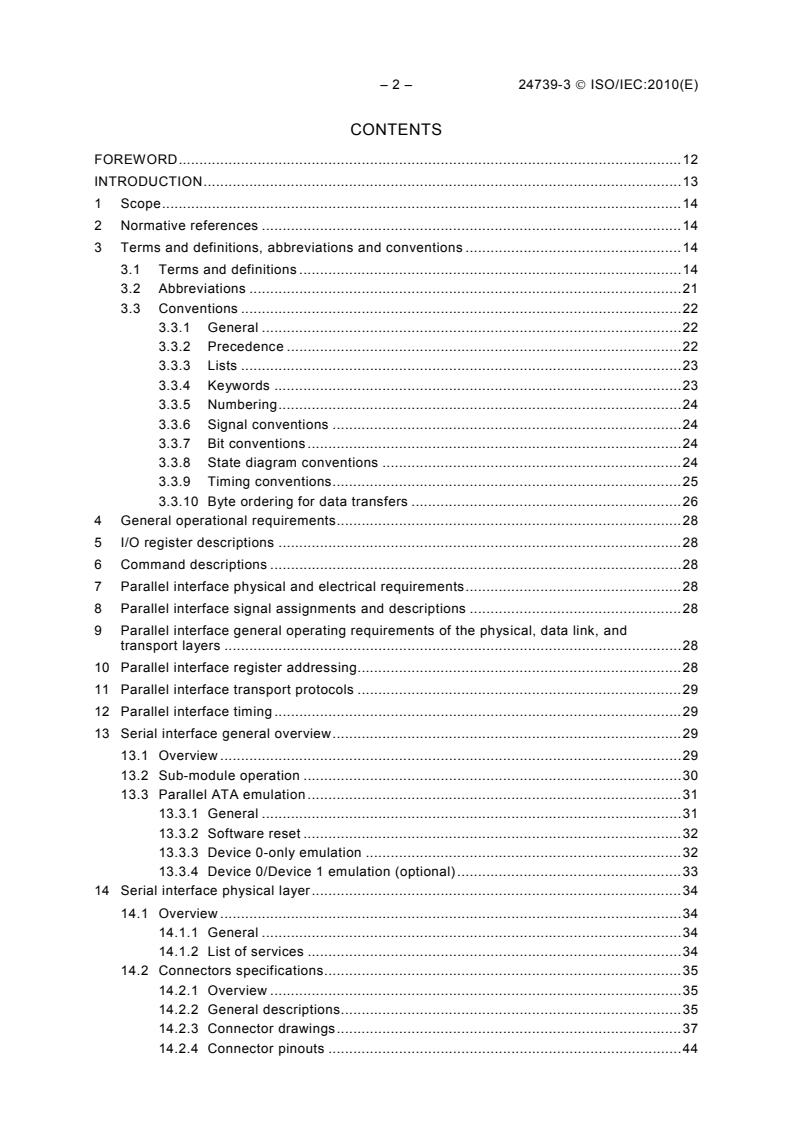
CONTENTS
FOREWORD.12
INTRODUCTION.13
1 Scope.14
2 Normative references .14
3 Terms and definitions, abbreviations and conventions .14
3.1 Terms and definitions .14
3.2 Abbreviations .21
3.3 Conventions .22
3.3.1 General .22
3.3.2 Precedence .22
3.3.3 Lists .23
3.3.4 Keywords .23
3.3.5 Numbering.24
3.3.6 Signal conventions .24
3.3.7 Bit conventions .24
3.3.8 State diagram conventions .24
3.3.9 Timing conventions.25
3.3.10 Byte ordering for data transfers .26
4 General operational requirements.28
5 I/O register descriptions .28
6 Command descriptions .28
7 Parallel interface physical and electrical requirements.28
8 Parallel interface signal assignments and descriptions .28
9 Parallel interface general operating requirements of the physical, data link, and
transport layers .28
10 Parallel interface register addressing.28
11 Parallel interface transport protocols .29
12 Parallel interface timing .29
13 Serial interface general overview.29
13.1 Overview .29
13.2 Sub-module operation .30
13.3 Parallel ATA emulation .31
13.3.1 General .31
13.3.2 Software reset .32
13.3.3 Device 0-only emulation .32
13.3.4 Device 0/Device 1 emulation (optional).33
14 Serial interface physical layer.34
14.1 Overview .34
14.1.1 General .34
14.1.2 List of services .34
14.2 Connectors specifications.35
14.2.1 Overview .35
14.2.2 General descriptions.35
14.2.3 Connector drawings.37
14.2.4 Connector pinouts .44
24739-3 ISO/IEC:2010(E) – 3 –
14.2.5 Backplane connector configuration and blind-mating tolerance . 45
14.2.6 Connector locations . 45
14.2.7 Connector conformance requirements . 49
14.3 Cable assemblies . 55
14.4 Phy (physical layer electronics) . 56
14.4.1 Physical plant as a system . 56
14.4.2 Bit error rate testing . 60
14.4.3 Frame error rate testing . 61
14.4.4 Test requirements, non-compliant patterns . 62
14.4.5 Test requirements, compliant frame patterns . 62
14.4.6 Test requirements, loopback . 62
14.4.7 Void . 63
14.4.8 Block diagram . 63
14.4.9 Electrical specifications . 65
14.4.10 Frame error-rate measurements . 68
14.4.11 Receiver Differential voltage . 68
14.4.12 Receiver Common-mode voltage . 68
14.4.13 Transmitter Differential voltage . 68
14.4.14 Transmitter Common-mode voltage . 68
14.4.15 Rise/fall times . 68
14.5 Electrical features . 69
14.5.1 Definitions . 69
14.5.2 Differential voltage/timing (EYE) diagram. 70
14.5.3 Spread spectrum clocking (SSC) . 73
14.5.4 Common-mode biasing . 75
14.5.5 Mat c hing . 75
14.5.6 Out of band signalling . 76
14.6 Elasticity buffer management . 94
14.7 BIST (Built in self test) . 94
14.7.1 General . 94
14.7.2 Loopback testing . 94
15 Serial interface Link layer . 97
15.1 Overview . 97
15.1.1 General . 97
15.1.2 Frame transmission . 97
15.1.3 Frame receipt . 97
15.2 Encoding method . 98
15.2.1 General . 98
15.2.2 Notation and conventions . 98
15.2.3 Character code . 99
15.2.4 Transmission summary . 106
15.2.5 Reception . 107
15.3 Transmission method . 108
15.4 Primitives . 109
15.4.1 Overview . 109
15.4.2 Primitive descriptions . 110
15.4.3 Primitive encoding . 111
15.4.4 ALIGN primitive . 111
15.4.5 CONT primitive . 112
– 4 – 24739-3 © ISO/IEC:2010(E)
15.4.6 DMAT primitive.113
15.4.7 EOF primitive .114
15.4.8 HOLD/HOLDA primitives .114
15.4.9 PMREQ_P, PMREQ_S, PMACK, and PMNAK primitives . 116
15.4.10 R_ERR primitive.116
15.4.11 R_IP primitive.116
15.4.12 R_OK primitive .116
15.4.13 R_RDY primitive.116
15.4.14 SOF primitive .116
15.4.15 SYNC primitive.116
15.4.16 WTRM primitive.116
15.4.17 X_RDY primitive.116
15.4.18 Examples .116
15.5 CRC calculation .120
15.6 Scrambling .121
15.6.1 Frame content scrambling .121
15.6.2 Repeated primitive suppression.121
15.6.3 Link layer state diagrams.121
16 Serial interface Transport layer.139
16.1 Transport layer overview .139
16.1.1 General .139
16.1.2 FIS construction .139
16.1.3 FIS decomposition.139
16.2 Frame Information Structure (FIS) .139
16.2.1 Overview .139
16.2.2 Payload content .139
16.2.3 FIS types.140
16.2.4 Register, Device to Host.141
16.2.5 Set Device Bits - Device to Host.143
16.2.6 DMA Activate, Device to Host.144
16.2.7 First Party DMA Setup, Device to Host or Host to Device
(bidirectional) .145
16.2.8 BIST Activate, bidirectional .146
16.2.9 PIO Setup, Device to Host.148
16.2.10 Data, Host to Device or Device to Host (bidirectional) . 150
16.3 Host transport states .151
16.3.1 Host transport idle state diagram.151
16.3.2 Host Transport transmit command FIS diagram .153
16.3.3 Host Transport transmit control FIS diagram . 154
16.3.4 Host Transport transmit First Party DMA Setup, Device to Host or
Host to Device FIS state diagram .155
16.3.5 Host Transport transmit BIST Activate FIS . 156
16.3.6 Host Transport decompose Register FIS diagram.157
16.3.7 Host Transport decompose a Set Device Bits FIS state diagram . 158
16.3.8 Host Transport decompose a DMA Activate FIS diagram and DMA
Data Transfer .158
16.3.9 Host Transport decompose a PIO Setup FIS state diagram . 161
16.3.10 Host Transport decompose a First Party DMA Setup FIS state
diagram.164
16.3.11 Host transport decompose a BIST Activate FIS state diagram .165
24739-3 © ISO/IEC:2010(E) – 5 –
16.4 Device transport states.167
16.4.1 Device transport idle state diagram .167
16.4.2 Device Transport send Register, Device to Host state diagram. 168
16.4.3 Device Transport send Set Device Bits FIS state diagram . 169
16.4.4 Device Transport transmit PIO Setup, Device to Host FIS state
diagram.170
16.4.5 Device Transport transmit DMA Activate FIS state diagram . 170
16.4.6 Device Transport transmit First Party DMA Setup, Device to Host
FIS state diagram.171
16.4.7 Device Transport transmit Data, Device to Host FIS diagram .172
16.4.8 Device Transport transmit BIST Activate FIS diagram . 174
16.4.9 Device Transport decompose Register, Host to Device state
diagram.176
16.4.10 Device Transport decompose Data (Host to Device) FIS state
diagram.177
16.4.11 Device Transport decompose First Party DMA Setup FIS, Host to
Device or Device to Host state diagram.178
16.4.12 Device Transport decompose a BIST Activate FIS state diagram. 179
17 Serial interface Device Command Layer Protocol .180
17.1 COMRESET or SRST sent by Host.180
17.2 Power-on and COMRESET protocol diagram . 180
17.3 Device Idle protocol .182
17.4 Software reset protocol.185
17.5 EXECUTE DEVICE DIAGNOSTIC command protocol . 187
17.6 DEVICE RESET command protocol .188
17.7 Non-data command protocol .188
17.8 PIO data-in command protocol.189
17.9 PIO data-out command protocol.190
17.10 DMA data-in command protocol . 192
17.11 DMA data out command protocol .193
17.12 PACKET protocol.195
17.13 READ DMA QUEUED command protocol. 200
17.14 WRITE DMA QUEUED command protocol .201
18 Host command layer state diagram. 204
18.1 Overview .204
18.2 Device Emulation of nIEN with Interrupt Pending.207
19 Serial interface host adapter register interface .208
19.1 Overview .208
19.2 SStatus, SError and SControl registers .209
19.2.1 General .209
19.2.2 SStatus register.209
19.2.3 SError register.210
19.2.4 SControl register .211
20 Serial interface error handling .212
20.1 Architecture.212
20.2 Phy error handling overview .213
20.2.1 Error detection.213
20.2.2 Error control actions .214
20.2.3 Error reporting .214
– 6 – 24739-3 © ISO/IEC:2010(E)
20.3 Link error handling overview.214
20.3.1 Error detection.214
20.3.2 Error control actions .215
20.3.3 Error reporting .216
20.4 Transport error handling. 216
20.4.1 Overview .216
20.4.2 Error detection.216
20.4.3 Error control actions .217
20.4.4 Error reporting .218
20.5 Software error handling overview .218
20.5.1 General .218
20.5.2 Error detection.218
20.5.3 Error control actions .219
Annex A (informative) Command Set summary .220
Annex B (informative) Design and programming considerations for large physical
sector devices.220
Annex C (informative) Device determination of cable type.220
Annex D (informative) Signal integrity and UDMA guide.220
Annex E (informative) Register selection address summary . 220
Annex F (informative) SAMPLE code for Serial CRC Scrambling .221
F.1 CRC calculation.221
F.1.1 Overview .221
F.1.2 Maximum frame size .221
F.1.3 Example code for CRC algorithm. 221
F.1.4 Example CRC implementation output . 224
F.2 Scrambling calculation.224
F.2.1 Overview .224
F.2.2 Example code for scrambling algorithm . 224
F.2.3 Example scrambler implementation .227
F.3 Example frame .228
Annex G (ínformative) FIS Type field value selection .229
G.1 Overview .229
G.2 Type field values .229
Annex H (informative) Physical Layer implementation examples . 230
H.1 Cable construction example.230
H.2 Contact material and plating .231
H.3 Relationship of frequency to the jitter specification .231
H.4 Sampling BER and jitter formulas .232
H.5 DC and AC coupled transmitter examples.233
H.6 OOB signal and squelch detector examples. 235
Annex I (informative) Command Processing example. 238
I.1 Non-data commands.238
I.1.1 General .238
I.1.2 Legacy DMA read by host from device.238
I.1.3 Legacy DMA write by host to device .238
I.1.4 PIO data read from the device.239
24739-3 © ISO/IEC:2010(E) – 7 –
I.1.5 PIO data write to the device .239
I.1.6 READ DMA QUEUED example.240
I.1.7 WRITE DMA QUEUED example .241
I.1.8 ATAPI PACKET commands with PIO data-in .241
I.1.9 ATAPI PACKET commands with PIO data out . 242
I.1.10 ATAPI PACKET commands with DMA data-in.243
I.1.11 ATAPI PACKET commands with DMA data-out. 244
I.1.12 First Party DMA read of host memory by device . 245
I.1.13 First Party DMA write of host memory by device. 245
I.2 Odd word count considerations.245
I.2.1 General .245
I.2.2 Legacy DMA read from target for odd word count .246
I.2.3 Legacy DMA write by host to target for odd word count .246
I.2.4 PIO data read from the device.246
I.2.5 PIO data write to the device .247
I.2.6 First Party DMA read of host memory by device . 247
I.2.7 First Party DMA write of host memory by device. 247
Bibliography.249
Figure 1 – ATA document relationships.13
Figure 2 – State diagram convention.25
Figure 3 – Byte, word and DWORD relationships .28
Figure 4 – Standard ATA device connectivity .29
Figure 5 – The serial implementation of ATA connectivity .30
Figure 6 – Communication layers.31
Figure 7 – Serial implementation connector examples.36
Figure 8 – Device plug connector part 1 of 2.37
Figure 9 – Device plug connector part 2 of 2.38
Figure 10 – Non-Latching Signal Cable receptacle connector interface dimensions .39
Figure 11 – Optional Latching Signal Cable Receptacle connector interface dimensions.40
Figure 12 – Host plug connector interface dimension .41
Figure 13 – Host receptacle connector interface dimensions.42
Figure 14 – Non-Latching Power cable receptacle connector interface dimensions .43
Figure 15 – Optional Latching Power Cable Receptacle .43
Figure 16 – Connector pair blind-mate misalignment tolerance .45
Figure 17 – Device-backplane mating configuration .45
Figure 18 – Device plug connector location on 95 mm (3.5”) device.46
Figure 19 – Device plug connector location on 65 mm (2.5”) device.47
Figure 20 – Recommended host plug spacing for Non-Latching Connectors .48
Figure 21 – Recommended host plug connector clearance and Orientation for Optional
Latching Connectors .49
Figure 22 – Signals and grounds assigned in direct connect and cabled .56
Figure 23 – Low transition density pattern.58
Figure 24 – Half-rate / quarter-rate high transition density pattern .58
Figure 25 – Low-frequency spectral content pattern.59
Figure 26 – Simultaneous switching outputs patterns.59
– 8 – 24739-3 © ISO/IEC:2010(E)
Figure 27 – Composite patterns .60
Figure 28 – Compliant test patterns .62
Figure 29 – Physical plant overall block diagram.64
Figure 30 – Signal rise and fall times .68
Figure 31 – Transmit test fixture .69
Figure 32 – Receive test fixture .69
Figure 33 – Voltage / timing margin base diagram .70
Figure 34 – Jitter output/tolerance mask .71
Figure 35 – Jitter measurement example .73
Figure 36 – Triangular frequency modulation profile.74
Figure 37 – Spectral fundamental frequency comparison .74
Figure 38 – Out of band signals .76
Figure 39 – Host phy initialization state machine (States HP1-HP13).78
Figure 40 – Device phy initialization state machine (States DP1-DP12) .83
Figure 41 – COMRESET sequence .87
Figure 42 – COMINIT sequence.89
Figure 43 – Power-on sequence .91
Figure 44 – ON to Partial/Slumber, host initiated .92
Figure 45 – ON to Partial/Slumber, device initiated .93
Figure 46 – Loopback, far-end retimed.95
Figure 47 – Loopback, far-end analog.96
Figure 48 – Loopback, near-end analog .97
Figure 49 – Bit designations .98
Figure 50 – Nomenclature reference .99
Figure 51 – Conversion examples .99
Figure 52 – Coding examples .102
Figure 53 – Bit ordering and significance .107
Figure 54 – Single bit error with two character delay.108
Figure 55 – Single bit error with one character delay .108
Figure 56 – Transmission structures .109
Figure 57 – CONT usage example .117
Figure 58 – Link idle state diagram (States L1, LS1-LS3).122
Figure 59 – Link transmit state diagram (States LT1-LT9) .125
Figure 60 – Link receive state diagram (States LR1-LR9) .131
Figure 61 – Link power mode state diagram (States LPM1-LPM8) . 136
Figure 62 – Register, Host to Device FIS layout.140
Figure 63 – Register, Device to Host FIS layout.141
Figure 64 – Set Device Bit, Device to Host FIS layout.143
Figure 65 – DMA Activate, Device to Host FIS layout.144
Figure 66 – First Party DMA Setup – Device to Host FIS layout . 145
Figure 67 – BIST Activate, Bidirectional .146
Figure 68 – PIO Setup, Device to Host FIS layout.148
Figure 69 – Data, Host to Device or Device to Host FIS layout.150
24739-3 © ISO/IEC:2010(E) – 9 –
Figure 70 – Host transport idle state diagram (States HTI1-HTI2) .151
Figure 71 – Host transport transmit command FIS diagram (States HTCM1-HTCM2) .153
Figure 72 – Host transport transmit control FIS diagram (States HTCR1-HTCR2) .154
Figure 73 – Host transport transmit First Party DMA setup – Device to host or host to
device FIS (States HTDMASTUP0-HTDMASTUP1).155
Figure 74 – Host transport transmit BIST activate FIS (States HTXBIST0-HTXBIST1) .156
Figure 75 – Host transport decompose register FIS diagram (States HTR1- HTR2). 157
Figure 76 – Host transport decompose Set Device Bits FIS state diagram (States
HTDB0-HTDB1) .158
Figure 77 – Host transport decompose DMA activate FIS diagram (States HTDA1-
HTDA5) .159
Figure 78 – Host transport decompose PIO setup FIS state diagram (States HTPS1-
HTPS6).162
Figure 79 – Host transport decompose First Party DMA Setup FIS state diagram (State
HTDS1) .165
Figure 80 – Host transport decompose BIST activate FIS state diagram (State
HTRBIST0-HTRBIST1) .166
Figure 81 – Device transport idle state diagram (States DTI0-DTI1).167
Figure 82 – Device transport send register – Device to host state diagram (DTR0-
DTR1).168
Figure 83 – Device transport send set device bits FIS state diagram (DTDB0-DTDB1). 169
Figure 84 – Device transport transmit PIO setup – Device to Host FIS state diagram
(States DTPIOSTUP0-DTPIOSTUP1).170
Figure 85 – Device transport transmit DMA activate FIS state diagram (States
DTDMAACT0-DTDMAACT1) .171
Figure 86 – Device transport transmit First Party DMA setup – Device to Host state
diagram (States DTDMASTUP0-DTDMASTUP1).172
Figure 87 – Device transport transmit data – Device to Host FIS diagram (State
DTDATAI0-DTDATAI2) .173
Figure 88 – Device transport transmit BIST activate FIS diagram (States DTXBIST0-
DTXBIST1) .175
Figure 89 – Device transport decompose register – Host to Device state diagram
(State DTCMD0) .176
Figure 90 – Device transport decompose data (host to device) FIS state diagram
(States DTDATAO0-DTDATAO2) .177
Figure 91 – Device transport decompose First Party DMA Setup FIS – Host to Device
or device to host state diagram (State DTDMASTUP0) .178
Figure 92 – Device transport decompose BIST activate FIS (States DTRBIST0-
DTRBIST1) .179
Figure 93 – Power on and COMRESET protocol (States DHR0-DHR3) . 180
Figure 94 – Device idle protocol (States DI0-DI7) .182
Figure 95 – Software reset protocol (States DSR0-DSR3).185
Figure 96 – EXECUTE DEVICE DIAGNOSTIC command protocol (States DEDD0-
DED
...
Questions, Comments and Discussion
Ask us and Technical Secretary will try to provide an answer. You can facilitate discussion about the standard in here.
Loading comments...