


IEC 61076-4-108:2002
(Main)Connectors for electronic equipment - Part 4-108: Printed board connectors with assessed quality - Detail specification for cable-to-board connectors, with a modular pitch of 25 mm and integrated shielding function, applicable for transverse packing density of 15 mm, having a basic grid of 2,5 mm in accordance with IEC 60917-1
Connectors for electronic equipment - Part 4-108: Printed board connectors with assessed quality - Detail specification for cable-to-board connectors, with a modular pitch of 25 mm and integrated shielding function, applicable for transverse packing density of 15 mm, having a basic grid of 2,5 mm in accordance with IEC 60917-1
This publication also bears the number QC 480301XX0009 which is the specification number in the IEC Quality Assessment System for Electronic Components (IECQ).
General Information
- Status
- Published
- Publication Date
- 13-Feb-2002
- Technical Committee
- SC 48B - Electrical connectors
- Current Stage
- PPUB - Publication issued
- Start Date
- 14-Feb-2002
- Completion Date
- 31-Mar-2002
Overview
IEC 61076-4-108:2002 is an IEC detail specification for printed board cable-to-board connectors with assessed quality (IECQ). It defines mechanical, electrical and EMC-related requirements for connectors having a modular pitch of 25 mm, an applicable transverse packing density of 15 mm, and a basic grid of 2.5 mm in accordance with IEC 60917-1. The publication also appears as IECQ specification QC 480301XX0009 and is intended for manufacturers, testers and designers who require a quality-assured connector family with integrated shielding.
Key topics and requirements
The standard provides comprehensive technical coverage including:
- General data and mounting recommendations (max contacts, mounting methods).
- Dimensional information and detailed drawings for fixed board and free cable connectors, contacts and accessories.
- Mechanical features: engagement/separation direction, coding, latching and retention requirements.
- Electrical characteristics: voltage proof, current carrying capacity, contact and insulation resistance, creepage and clearance.
- Shielding and EMC: integrated shielding function, grounding interfaces and an informative annex on shielding effectiveness.
- Environmental and mechanical tests: climatic categories, vibration, shock, mechanical endurance and flammability.
- Quality assessment procedures: qualification approval testing methods, lot-by-lot and periodic inspection schedules.
- Test schedules and gauges: specific test groupings (dynamic, climatic, mechanical, electrical, chemical, EMC) and test arrangements.
Applications and practical use
IEC 61076-4-108 is used by:
- Connector manufacturers to design and certify cable-to-board product families that meet assessed-quality requirements.
- PCB and system designers specifying connectors for equipment requiring robust shielding and predictable packing density.
- Quality/Compliance teams and procurement to reference accepted tests and IECQ conformity (QC 480301XX0009).
- Test laboratories executing qualification and lot-conformance testing according to the detailed test schedules. Typical applications include backplane and front-panel interconnects in telecom, industrial control, instrumentation and other electronic equipment where controlled mechanical pitch, high packing density and EMC performance are critical.
Related standards
- IEC 60917-1 – basic grid specification referenced for grid/spacing adherence.
- IEC 61076-1 – general requirements for printed board connectors (referenced for assessed quality and detail-specification format).
- IECQ documentation for electronic components of assessed quality (QC numbering and assessment system).
Keywords: IEC 61076-4-108, printed board connectors, cable-to-board connectors, modular pitch 25 mm, shielding, IECQ, transverse packing density 15 mm, IEC 60917-1, connector specification, EMC testing.
Buy Documents
IEC 61076-4-108:2002 - Connectors for electronic equipment - Part 4-108: Printed board connectors with assessed quality - Detail specification for cable-to-board connectors, with a modular pitch of 25 mm and integrated shielding function, applicable for transverse packing density of 15 mm, having a basic grid of 2,5 mm in accordance with IEC 60917-1 Released:2/14/2002
Frequently Asked Questions
IEC 61076-4-108:2002 is a standard published by the International Electrotechnical Commission (IEC). Its full title is "Connectors for electronic equipment - Part 4-108: Printed board connectors with assessed quality - Detail specification for cable-to-board connectors, with a modular pitch of 25 mm and integrated shielding function, applicable for transverse packing density of 15 mm, having a basic grid of 2,5 mm in accordance with IEC 60917-1". This standard covers: This publication also bears the number QC 480301XX0009 which is the specification number in the IEC Quality Assessment System for Electronic Components (IECQ).
This publication also bears the number QC 480301XX0009 which is the specification number in the IEC Quality Assessment System for Electronic Components (IECQ).
IEC 61076-4-108:2002 is classified under the following ICS (International Classification for Standards) categories: 31.220.10 - Plug-and-socket devices. Connectors. The ICS classification helps identify the subject area and facilitates finding related standards.
IEC 61076-4-108:2002 is available in PDF format for immediate download after purchase. The document can be added to your cart and obtained through the secure checkout process. Digital delivery ensures instant access to the complete standard document.
Standards Content (Sample)
INTERNATIONAL IEC
STANDARD
61076-4-108
QC 480301XX0009
First edition
2002-02
Connectors for electronic equipment –
Part 4-108:
Printed board connectors with assessed quality –
Detail specification for cable-to-board connectors,
with a modular pitch of 25 mm and integrated
shielding function, applicable for transverse
packing density of 15 mm, having a basic grid
of 2,5 mm in accordance with IEC 60917-1
Reference number
Publication numbering
As from 1 January 1997 all IEC publications are issued with a designation in the
60000 series. For example, IEC 34-1 is now referred to as IEC 60034-1.
Consolidated editions
The IEC is now publishing consolidated versions of its publications. For example,
edition numbers 1.0, 1.1 and 1.2 refer, respectively, to the base publication, the
base publication incorporating amendment 1 and the base publication incorporating
amendments 1 and 2.
Further information on IEC publications
The technical content of IEC publications is kept under constant review by the IEC,
thus ensuring that the content reflects current technology. Information relating to
this publication, including its validity, is available in the IEC Catalogue of
publications (see below) in addition to new editions, amendments and corrigenda.
Information on the subjects under consideration and work in progress undertaken
by the technical committee which has prepared this publication, as well as the list
of publications issued, is also available from the following:
• IEC Web Site (www.iec.ch)
• Catalogue of IEC publications
The on-line catalogue on the IEC web site (www.iec.ch/catlg-e.htm) enables
you to search by a variety of criteria including text searches, technical
committees and date of publication. On-line information is also available on
recently issued publications, withdrawn and replaced publications, as well as
corrigenda.
• IEC Just Published
This summary of recently issued publications (www.iec.ch/JP.htm) is also
available by email. Please contact the Customer Service Centre (see below) for
further information.
• Customer Service Centre
If you have any questions regarding this publication or need further assistance,
please contact the Customer Service Centre:
Email: custserv@iec.ch
Tel: +41 22 919 02 11
Fax: +41 22 919 03 00
INTERNATIONAL IEC
STANDARD
61076-4-108
QC 480301XX0009
First edition
2002-02
Connectors for electronic equipment –
Part 4-108:
Printed board connectors with assessed quality –
Detail specification for cable-to-board connectors,
with a modular pitch of 25 mm and integrated
shielding function, applicable for transverse
packing density of 15 mm, having a basic grid
of 2,5 mm in accordance with IEC 60917-1
IEC 2002 Copyright - all rights reserved
No part of this publication may be reproduced or utilized in any form or by any means, electronic or
mechanical, including photocopying and microfilm, without permission in writing from the publisher.
International Electrotechnical Commission, 3, rue de Varembé, PO Box 131, CH-1211 Geneva 20, Switzerland
Telephone: +41 22 919 02 11 Telefax: +41 22 919 03 00 E-mail: inmail@iec.ch Web: www.iec.ch
PRICE CODE
Commission Electrotechnique Internationale
XB
International Electrotechnical Commission
Международная Электротехническая Комиссия
For price, see current catalogue
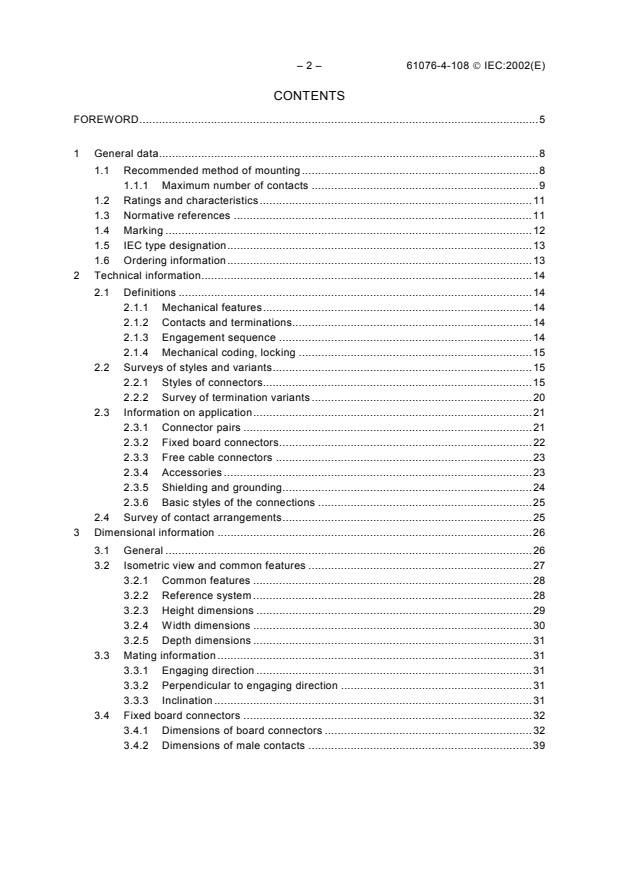
– 2 – 61076-4-108 IEC:2002(E)
CONTENTS
FOREWORD.5
1 General data.8
1.1 Recommended method of mounting.8
1.1.1 Maximum number of contacts .9
1.2 Ratings and characteristics.11
1.3 Normative references .11
1.4 Marking .12
1.5 IEC type designation.13
1.6 Ordering information.13
2 Technical information.14
2.1 Definitions .14
2.1.1 Mechanical features.14
2.1.2 Contacts and terminations.14
2.1.3 Engagement sequence .14
2.1.4 Mechanical coding, locking .15
2.2 Surveys of styles and variants.15
2.2.1 Styles of connectors.15
2.2.2 Survey of termination variants .20
2.3 Information on application.21
2.3.1 Connector pairs .21
2.3.2 Fixed board connectors.22
2.3.3 Free cable connectors .23
2.3.4 Accessories .23
2.3.5 Shielding and grounding.24
2.3.6 Basic styles of the connections .25
2.4 Survey of contact arrangements.25
3 Dimensional information .26
3.1 General .26
3.2 Isometric view and common features .27
3.2.1 Common features .28
3.2.2 Reference system .28
3.2.3 Height dimensions .29
3.2.4 Width dimensions .30
3.2.5 Depth dimensions .31
3.3 Mating information .31
3.3.1 Engaging direction .31
3.3.2 Perpendicular to engaging direction .31
3.3.3 Inclination .31
3.4 Fixed board connectors .32
3.4.1 Dimensions of board connectors .32
3.4.2 Dimensions of male contacts .39
61076-4-108 © IEC:2002(E) – 3 –
3.5 Free cable connectors .41
3.5.1 Dimensions of cable connectors.41
3.5.2 Dimensions of female contacts.45
3.6 Accessories.46
3.6.1 Coding devices .46
3.6.2 Shielding / ground contact.47
3.7 Mounting information for fixed board connectors .48
3.7.1 Hole pattern on backplane .48
3.7.2 Hole pattern on printed board (front) .49
3.8 Mounting information for free cable connectors .49
3.9 Gauges .50
3.9.1 Sizing and retention force gauges .50
3.9.2 Test gauge for shield / ground contact.50
4 Characteristics.51
4.1 Climatic categories .51
4.2 Electrical .51
4.2.1 Creepage and clearance distances.51
4.2.2 Voltage proof .51
4.2.3 Current carrying capacity .52
4.2.4 Initial contact resistance .52
4.2.5 Initial insulation resistance .52
4.3 Mechanical .53
4.3.1 Mechanical operation .53
4.3.2 Engaging and separating forces .53
4.3.3 Contact retention in insert .53
4.3.4 Static load, transverse .53
4.3.5 Withdrawal force with gauge .53
4.3.6 Vibration (sinusoidal) .54
4.3.7 Shock .54
4.3.8 Polarizing method .54
4.3.9 Mechanical coding .54
4.3.10 Latching force in male connector body .55
4.3.11 Cable clamp resistance to cable rotation .55
4.3.12 Cable connector drop test .55
4.4 Electromagnetic compatibility (EMC) .55
4.4.1 Shielding effectiveness .55
5 Test schedule .56
5.1 General .56
5.1.1 Arrangement for contact resistance measurement.57
5.1.2 Arrangement for dynamic stress tests .57
5.1.3 Arrangement for testing static load, transverse.58
5.1.4 Arrangement for testing insulation resistance, voltage proof and
polarization voltage.59
5.1.5 Arrangement for flammability test.59
5.2 Test schedule tables.60
5.2.1 Group P – Preliminary.60
5.2.2 Group AP – Dynamic / Climatic .61
5.2.3 Group BP – Mechanical endurance .64
– 4 – 61076-4-108 IEC:2002(E)
5.2.4 Group CP – Moisture .65
5.2.5 Group DP – Electrical load .65
5.2.6 Group EP – Mechanical resistivity .66
5.2.7 Group FP – Chemical resistivity .67
5.2.8 Group GP – Connections .67
5.2.9 Group HP – Electromagnetic compatibility.67
6 Quality assessment procedures .67
6.1 Qualification approval testing .67
6.1.1 Method 1 .67
6.1.2 Method 2 .67
6.2 Quality conformance inspection .68
6.2.1 Lot-by-lot tests.68
6.2.2 Periodic tests.69
6.3 Delayed delivery, re-inspection .69
Annex A (informative) Shielding effectiveness
61076-4-108 © IEC:2002(E) – 5 –
INTERNATIONAL ELECTROTECHNICAL COMMISSION
___________
CONNECTORS FOR ELECTRONIC EQUIPMENT –
Part 4-108: Printed board connectors with assessed quality –
Detail specification for cable-to-board connectors, with a modular pitch
of 25 mm and integrated shielding function, applicable for transverse
packing density of 15 mm, having a basic grid of 2,5 mm
in accordance with IEC 60917-1
FOREWORD
1) The IEC (International Electrotechnical Commission) is a worldwide organization for standardization comprising
all national electrotechnical committees (IEC National Committees). The object of the IEC is to promote
international co-operation on all questions concerning standardization in the electrical and electronic fields. To
this end and in addition to other activities, the IEC publishes International Standards. Their preparation is
entrusted to technical committees; any IEC National Committee interested in the subject dealt with may
participate in this preparatory work. International, governmental and non-governmental organizations liaising
with the IEC also participate in this preparation. The IEC collaborates closely with the International Organization
for Standardization (ISO) in accordance with conditions determined by agreement between the two
organizations.
2) The formal decisions or agreements of the IEC on technical matters express, as nearly as possible, an
international consensus of opinion on the relevant subjects since each technical committee has representation
from all interested National Committees.
3) The documents produced have the form of recommendations for international use and are published in the form
of standards, technical specifications, technical reports or guides and they are accepted by the National
Committees in that sense.
4) In order to promote international unification, IEC National Committees undertake to apply IEC International
Standards transparently to the maximum extent possible in their national and regional standards. Any
divergence between the IEC Standard and the corresponding national or regional standard shall be clearly
indicated in the latter.
5) The IEC provides no marking procedure to indicate its approval and cannot be rendered responsible for any
equipment declared to be in conformity with one of its standards.
6) Attention is drawn to the possibility that some of the elements of this International Standard may be the subject
of patent rights. The IEC shall not be held responsible for identifying any or all such patent rights.
International Standard IEC 61076-4-108 has been prepared by subcommittee 48B: Connectors,
of IEC technical committee 48: Electromechanical components and mechanical structures for
electronic equipment.
The text of this standard is based on the following documents:
FDIS Report on voting
48B/1122/FDIS 48B/1170/RVD
Full information on the voting for the approval of this standard can be found in the report on
voting indicated in the above table.
Future standards in this series will carry the new general title as cited above. Titles of existing
standards in this series will be updated when a new edition is prepared.
– 6 – 61076-4-108 IEC:2002(E)
The QC number that appears on the front cover of this publication is the specification number
in the IEC Quality Assessment System for Electronic Components (IECQ).
This publication has been drafted in accordance with the ISO/IEC Directives, Part 3.
Annex A is for information only.
The committee has decided that the contents of this publication will remain unchanged until
2004. At this date, the publication will be
• reconfirmed;
• withdrawn;
• replaced by a revised edition, or
• amended.
61076-4-108 © IEC:2002(E) – 7 –
CONNECTORS FOR ELECTRONIC EQUIPMENT –
Part 4-108: Printed board connectors with assessed quality –
Detail specification for cable-to-board connectors, with a modular pitch
of 25 mm and integrated shielding function, applicable for transverse
packing density of 15 mm, having a basic grid of 2,5 mm
in accordance with IEC 60917-1
IEC SC 48B – Connectors
IEC 61076-4-108
QC 480301XX0009
Specification available from:
IEC Central Office
or from the addresses shown on the inside cover.
ELECTRONIC COMPONENTS OF ASSESSED QUALITY
DETAIL SPECIFICATION in accordance with IEC 61076-1:1995.
Cable connector system,
– 15 mm mounting pitch –,
for printed boards and backplanes,
grid of 2,5 mm in accordance
with IEC 60917-1,
integrated shielding function.
Modular, five row connector,
with shielding,
ground contacts and coding features.
Fixed board connectors
50 mm to 250 mm length
Free cable connectors,
25 mm to 100 mm length.
Performance levels (PL): 1, 2
Assessment level: G
IEC 395/02
Information on the availability of components qualified to this detail specification is given in the qualified products
list.
– 8 – 61076-4-108 IEC:2002(E)
1 General data
This specification describes adapter connectors of modular metric construction in conformance
with IEC 60917-1.
Interface connectors and cable connectors are used to make the electrical connection between
a closed functional unit, for example a subrack, and its environment. The modular construction
and the various connector styles enable a suitable connector to be used in equipment practices
for electronic equipment such as data systems, communications technology, telecom-
munications engineering and safety and security systems, power engineering and automation
technology.
Throughout this specification all dimensions are in millimetres.
1.1 Recommended method of mounting
The connectors are used for connecting a printed board to a cable (see also figure 1).
The connectors are matched to the 2,5 mm contact grid. They can be mounted in an existing
grid coordinate system horizontally or vertically or overlapping from module to module or from
subrack to subrack. Care shall be taken to ensure that the contact areas of the male contacts
match the position of the female contacts. The engaging areas of the male contacts on the rear
of a backplane correspond to the male contact dimensions according to IEC 61076-4-100.
NOTE In view of the large number of different mounting and application options, the contact quality between male
and female contacts must be guaranteed.
In the case of a subrack, for example, there are three mounting options:
a) Rear of the backplane
b) Module side of the backplane
c) Front of the module
Fixed connectors:
For application on the rear of a backplane, a male connector body (preferably of flanged cons-
truction) is pushed over the rear plug-in connections of male contacts which have already been
pressed in, for example over the terminals of a male connector according to IEC 61076-4-100,
and secured in position.
For use on the module side of a backplane, a male connector body can be mounted in the
same way over press-in male contacts.
Apart from flange mounting, the male connector body can also be fixed unsupported or directly
to the male contacts.
For application on the side of a module or at the rear of a backplane, an interface male
connector (preferably without flange) can be pressed into metal-plated holes in the backplane.
For application at the front of a module, a male connector body shall be equipped with male
contacts which are mounted, for example pressed in, on the module printed board with
terminals bent at right angles.
Free connectors:
The female connector equipped with female contacts is secured in a connector housing at
which the cable is mounted with strain relief. The shielding braid of a cable shall be
conductively connected to the connector housing consisting of shielded metal caps. The
individual wires of a cable shall be connected at the female contacts directly by means of
crimped or insulation displacement connections.
61076-4-108 © IEC:2002(E) – 9 –
1.1.1 Maximum number of contacts
Fixed board connector
Table 1 – Maximum number of contacts – fixed connector
System units 1 SU 2 SU 4 SU 9 SU 10 SU
(Height = Coordination dimension)
(25) (50) (100) (225) (250)
Styles (see 2.2.1.1) J B;P;K D;L;R G;U H;V
Signal contacts 41 82 164 369 410
Ground contacts 4 8 16 36 40
Free cable connector
Table 2 – Maximum number of contacts – free cable connector
System units 1 SU 2 SU 4 SU
(Height = Coordination dimension) (25) (50) (100)
Styles (see 2.2.1.1) AB D
Signal contacts 41 82 164
Ground contacts 4 8 16
– 10 – 61076-4-108 IEC:2002(E)
Free cable connector
on rear side
Row
Fixed connector body
Backplane
Datum plane
Fixed board connector
Row
Fixed board connector
according to IEC 61076-4-100
Free cable connector on
module side
Module according to
IEC 60917-2-2
Fixed board connector,
rectangular connection
Row
Free cable connector
on front side of PCB
IEC 396/02
Installation options:
1 Rear of the backplane
2 Module side of the backplane
3 Front of the module
Figure 1 – Recommended installation
61076-4-108 © IEC:2002(E) – 11 –
1.2 Ratings and characteristics
Proof voltage: contact/ground > 750 V r.m.s. (according to table 15)
Current rating: 2,1 A (grid 2,5 mm × 2,5 mm)
(at 70 °C) 2,2 A (grid 2,5 mm × 5 mm “chess”)
2,7 A (grid 5 mm × 5 mm)
Insulation resistance: 10 MΩ
Climatic category: PL1: 40/100/56
PL2: 40/100/21
Printed board thickness: Backplane 1,6 mm to 4,5 mm
Plug-in unit 1,6 mm to 3,2 mm
Metal-plated hole: 0,94 mm – 1,09 mm
Contact gap: 2,5 mm × 2,5 mm
Shielding effectiveness: 4 contacts/25 mm Style: A (1 SU) : 10 dB (at 300 MHz)
(arrangement 4, table 7) B (2 SU) : 14 dB (at 300 MHz)
D (4 SU) : 20 dB (at 300 MHz)
1.3 Normative references
The following normative documents contain provisions which, through reference in this text,
constitute provisions of this part of IEC 61076. For dated references, subsequent amendments
to, or revisions of, any of these publications do not apply. However, parties to agreements
based on this part of IEC 61076 are encouraged to investigate the possibility of applying the
most recent editions of the normative documents indicated below. For undated references, the
latest edition of the normative document referred to applies. Members of IEC and ISO maintain
registers of currently valid International Standards.
IEC 60068-1:1988, Environmental testing – Part 1: General and guidance
IEC 60068-2-21:1999, Environmental testing – Part 2-21: Tests – Test U: Robustness of
terminations and integral mounting devices
IEC 60326-3:1991, Printed boards – Part 3: Design and use of printed boards
IEC 60352-1:1997, Solderless connections – Part 1: Wrapped connections – General require-
ments, test methods and practical guidance
IEC 60352-2:1990: Solderless connections – Part 2: Solderless crimped connections – General
requirements, test methods and practical guidance
Amendment 1:1996
IEC 60352-3:1993, Solderless connections – Part 3: Solderless accessible insulation displace-
ment connections – General requirements, test methods and practical guidance
IEC 60352-5:1995, Solderless connections – Part 5: Solderless press-in connections – General
requirements, test methods and practical guidance
IEC 60410:1973, Sampling plans and procedures for inspection by attributes
IEC 60512 (all parts), Connectors for electronic equipment – Tests and measurements
IEC 60512-1-100:2001, Connectors for electronic equipment – Tests and measurements –
Part 1-100: General – Applicable publications
– 12 – 61076-4-108 IEC:2002(E)
IEC 60917-1:1998, Modular order for the development of mechanical structures for electronic
equipment practices – Part 1: Generic standard
IEC 60917-2-2:1994, Modular order for the development of mechanical structures for electronic
equipment practices – Part 2: Sectional specification – Interface co-ordination dimensions for
the 25 mm equipment practice – Section 2: Detail specification – Dimensions for subracks,
chassis, backplanes, front panels and plug-in units
IEC 61076-1:1995, Connectors with assessed quality for use in d.c., low-frequency analogue
and digital high-speed data applications – Part 1: Generic specification
IEC 61076-4:1995, Connectors with assessed quality for use in d.c., low-frequency analogue
and digital high-speed data applications – Part 4: Sectional specification – Printed board
connectors
IEC 61076-4-001:1996, Connectors with assessed quality for use in d.c., low-frequency
analogue and digital high-speed data applications – Part 4: Printed board connectors –
Section 001: Blank detail specification
IEC 61076-4-100:2001, Connectors for electronic equipment – Part 4-100: Printed board
connectors with assessed quality – Detail specification for two-part connector modules having
a grid of 2,5 mm for printed boards and backplanes
ISO 1302:1992, Technical drawings – Method of indicating surface texture
1.4 Marking
The marking of the connector and the package shall be in accordance with 2.6 of IEC 61076-4.
Marking examples (according to 1.5)
Fixed board connector
Style 4 SU male connector, male contacts equipped in “chess” pattern, press-in termination
with rear plug-up cable connection, with ground contacts, surface of the signal and ground
contacts gold-plated, meeting performance level 1 and assessment level G:
IEC 61076-4-108 – R088M – 24 – R1 – 1 – 1G
Free cable connector
Style 1 SU, female contacts equipped in 2,5 mm × 2,5 mm grid pattern, without ground
contacts, surface of the signal contacts palladium alloy, cable with solid conductors, with crimp
termination (AWG 30 – 24), meeting performance level 2 and assessment level G:
IEC 61076-4-108 – A041F – 10 – C3 – 2 – 2G
61076-4-108 © IEC:2002(E) – 13 –
1.5 IEC type designation
The designation of plug-in connectors shall be defined as follows in accordance with this
standard:
L stands for letter, N stands for number.
IEC 61076 - 4 - 108 - L N N N L - N N - L N - N - N L
Reference to
this standard
Styles
Fixed connector
Male connector body
2 SU B
Assessment level
4 SU D
9 SU G
G Assessment level G
10 SU H
Male connector,
straight
Performance level
2 SU P
1 Performance level 1
4 SU R
2 Performance level 2
9 SU U
10 SU V
Male connector,
right-angled
Contact finish of signal/ground contacts
1 SU J
0 Without finish
2 SU K
1 Gold, gold alloy
4 SU L
2 Palladium, palladium alloy
Free connector
Type and variant of termination (see also table 6)
Cable connector
P1 Press-in connection.
1 SU A
P2 -"-
2 SU B
R1 -"-
4 SU D
U1 -"-
U2 -"-
Number of contacts
L1 -"-
S1 Soldering connection
Without contacts 000
C1 Crimp connection.
1 SU: Signal contacts 041
C2 -"-
with ground contacts 045
C3 -"-
2 SU: Signal contacts 082
I1 ID connection.
with ground contacts 090
I2 -"-
4 SU: Signal contacts 164
with ground contacts 180
Contact arrangement
9 SU: Signal contacts 369
with ground contacts 405 00 No contacts
10 SU: Signal contacts 410 10
Signal contacts without ground contacts 2,5 x 2,5
with ground contacts 450 -"- Chess pattern
30 -"- 5,0 x 5,0
Contact type
Signal contacts with ground contacts 2,5 x 2,5
Male M
-"- Chess pattern
Female F
-"- 5,0 x 5,0
1.6 Ordering information
For ordering connectors according to this detail specification, the IEC type designation
described in 1.5 shall be used.
– 14 – 61076-4-108 IEC:2002(E)
2 Technical information
2.1 Definitions
2.1.1 Mechanical features
2.1.1.1
system unit (SU)
modular pitch of 25 mm, which is the basis for the design of all mechanical features
2.1.1.2
mounting code
special marks on the connector housings simplify correct installation of male connectors (fixed
connectors) or male connector bodies and contact equipment in the case of cable connectors
(free connectors).
2.1.2 Contacts and terminations
2.1.2.1
engaging range
the minimum to maximum distance between the reference planes of the fixed and free
connectors, within which reliable contact making is guaranteed
2.1.2.2
equipment grid
the equipment grid can be freely selected within the basic grid of 2,5 mm × 2,5 mm. The
male/female contacts can be arranged according to the application. A system unit (SU) can be
equipped with a maximum of 41 signal contacts and a maximum of four ground contacts.
2.1.2.3
standard equipment
full grid: contact arrangement in which all grid positions are equipped.
chess pattern grid: contact arrangement in which the grid positions are equipped alternately
like the squares on a chess board.
2.1.2.4
rear plug-up contact
termination post, usually being pressed-in into the backplane and provided at the rear of the
backplane with a contact area, to which a free connector (cable connector) can be connected
2.1.2.5
press-in shoulders
areas of the male contact, by means of which the contact can be pressed into the backplane
2.1.3 Engagement sequence
2.1.3.1
contact range
range of all contacts which engage/separate simultaneously, within the limits of the required
reliable engaging range
2.1.3.2
engaging cycles
an engaging cycle comprises the engaging/separating process for a connector
61076-4-108 © IEC:2002(E) – 15 –
2.1.3.3
first possible contact point
depth dimension of the first point on the female contact, which can possibly be touched by the
incoming male contact
2.1.3.4
contact point
depth dimension of the point on the female contact, from where the specified contact
resistance with the incoming male contact is met
2.1.4 Mechanical coding, locking
2.1.4.1
coding devices
accessories allowing pairs of connectors to be assigned to each other non-reversible, i.e. only
connector pairs equipped with matching coding devices can mate. Mating of pairs with different
coding is reliably prevented.
2.1.4.2
180° polarization
housing parts of the fixed and free connector have a 180° polarization to prevent incorrect
insertion
2.1.4.3
locking
protrusions on the side of the housing of the free cable connector used for latching in the male
connector body of the fixed board connector
2.2 Surveys of styles and variants
2.2.1 Styles of connectors
2.2.1.1 Survey of connector style designations
Table 3 – Connector style designations
(System units) (1 SU) (2 SU) (4 SU) (9 SU) (10 SU)
Styles
Printed board connectors
Male connector body – B D G H
Male connector, straight connection
– P R U V
Male connector, right-angled
connection
J K L – –
Cable connectors
AB D – –
– 16 – 61076-4-108 IEC:2002(E)
2.2.1.2 Fixed board connectors
Table 4 – Styles – fixed connectors
IEC 397/02
Male connector (without flange) PR U V
Length L (coordination dimension) 50 100 225 250
IEC 398/02
Male connector body (with flange) BD G H
Length L (coordination dimension) 50 100 225 250
60 110 235 260
Length L = L + 2 × 5 (coordination dimension)
61076-4-108 © IEC:2002(E) – 17 –
Table 4 (continued)
IEC 399/02
Male connector for front installation JK L
Length L (coordination dimension) 25 50 100
30 55 105
Length L = L + 2 × 2,5 (coordination dimension)
– 18 – 61076-4-108 IEC:2002(E)
2.2.1.3 Free cable connectors
Table 5 – Styles – free connectors
Style Cable outlet
(Height) Bottom Top
A
(25)
IEC 400/02
B
(50)
IEC 401/02
61076-4-108 © IEC:2002(E) – 19 –
D
(100)
IEC 402/02
– 20 – 61076-4-108 IEC:2002(E)
2.2.2 Survey of termination variants
Table 6 – Termination variants
Basic type of termination Variant Lengths (see also 3.4.2)
Press-in connection for plated through-hole 4,5 mm
P P1
∅ 1 mm, straight, according to
IEC 60352-5
6,0 mm
P2
R Press-in connection for plated through-hole R1 14,0 mm / 15,75 mm
∅ 1 mm, straight, with rear plug-up
(standard / premating)
connection according to IEC 60352-5
Male U Press-in connection for plated through-hole U1 17,75 mm / 19,5 mm
con- ∅ 1 mm, straight, with rear plug-up and wrap
(standard / premating)
tact connection according to IEC 60352-5
21,5 mm / 23,25 mm
U2
(standard / premating)
L 90° angled press-in connection for plated- L1 3 mm
through hole ∅ 1 mm, according to
IEC 60352-5
S 90° angled solder connection according to S1 3 mm
IEC 60352-1
Basic type of termination Variant Wire gauges
Crimp connection according to
C C1 1 × stranded wire: 0,14 mm² to 0,35 mm²
IEC 60352-2 (AWG 26 to AWG 22)
C2
1 × stranded wire: 0,05 mm² to 0,14 mm²
(AWG 30 to AWG 26)
C3
1 × solid wire: ∅ 0,25 mm to 0,50 mm
(AWG 30 to AWG 24)
Fe- I Insulation displacement connection I1 Stranded wire: 0,09 mm² to 0,14 mm²
according to IEC 60352-3 (AWG 28 to AWG 26)
male
con-
Solid wire: ∅ 0,25 mm to 0,40 mm
tact
(AWG 30 to AWG 26)
Stranded wire: 0,22 mm² to 0,35 mm²
I2
(AWG 24 to AWG 22)
Solid wire: ∅ 0,40 mm to 0,63 mm
(AWG 26 to AWG 22)
61076-4-108 © IEC:2002(E) – 21 –
2.3 Information on application
2.3.1 Connector pairs
Description
Male connectors or male connector bodies connected to the rear contact areas of male
contacts shall be arranged in any position – horizontally or vertically – in the backplane of a
subrack.
The male connector bodies are subdivided into individual SU areas into which the various cable
connector types – mounted side by side – can be plugged. In the plugged-in position, the cable
connectors engage in the male connector bodies.
Contact designation
The methods of mounting described in 1.1 and shown in figure 1 allow the use of connectors in
opposite mating directions. The contact designation (rows and position) shall be designated in
the viewing and mating direction onto the module side of the backplane and assigned to the
individual components in this way (male contacts in the backplane). When a cable connector is
inserted on the rear of a backplane, the contact row designation of the male connector or male
connector body is – theoretically – reversed. This “reversal” of the contact row designation
shall be taken into account in the electrical assignment between fixed board connector and free
cable connector at the rear of the backplane. See also figure 2.
– 22 – 61076-4-108 IEC:2002(E)
Free cable connector on
rear side of backplane
Fixed connector body or
fixed connector on rear
side of backplane
Fixed connector (male) on
backplane (IEC 61076-4-100)
Fixed connector (female)
(IEC 61076-4-100)
PCB
Fixed connector
(rectangular)
Free cable
connector
Free cable connector on
module side of backplane
Backplane
Fixed cable connector on
module side of backplane
IEC 403/02
Figure 2 – Method of numbering contacts
2.3.2 Fixed board connectors
Mounting
Male connector bodies are generally pushed onto a suitable connection area of the male
contacts which are pressed into the backplane, for example a male connector according to
IEC 61076-4-100. They can be fixed to the subrack, the backplane or to the pressed-in male
contacts directly; the requirements of the test schedule shall be guaranteed. The male
connector bodies shall be provided with visual indications in the form of different outside
contours, for example in the area of the lateral walls of the male connector body to ensure
installation in the correct position in a male contact field. In case of direct fixing to the male
contacts – in the full grid contact arrangement – the male contact geometry according to
IEC 61076-4-100 shall be observed.
61076-4-108 © IEC:2002(E) – 23 –
Mounting position
The male connectors or male connector bodies can be mounted primarily in the vertical
position, but also horizontally, for example in a full grid of 2,5 mm. The smallest mounting pitch
is 15 mm.
Mounting of a male connector body at the rear of a backplane:
The depth stop for setting the correct contact engaging range shall be guaranteed by male
contacts in the area of the lateral walls of the male connector body (see also 3.4.2).
Mounting of a male connector body on the module side of a backplane:
The male connector body is flush-mounted. Premating male contacts shall be used to ensure
the correct contact engaging range.
Connector styles without a flange can be installed side by side flush – without loss of pitch.
Overlapping connection of modules and subracks is possible, for example at the rear of a
backplane.
Contact levels and sequencing
Reliable contacting between the fixed and free connector shall be guaranteed by the contact
level which is defined in the engaging areas of the various male contact lengths, for example
by a depth stop in the male connector body.
Different contact levels should be staggered by at least 1,75 mm in order to ensure an
electrically reliable engaging sequence.
2.3.3 Free cable connectors
Mounting
Cable connectors are usually delivered as separate piece parts, consisting primarily of one or
more female connector bodies, female contacts, single-section or multi-section housing and a
cable clamp, together with an insertion and extraction tool. When assembling a plug-in cable,
these parts shall always be combined to form a complete cable connector using suitable tools
and the manufacturer’s instructions. Care shall be taken to ensure that the completed cable
connector fulfils the specified requirements.
Polarization
The sides of the receptacle shall have polarized contours, which prevent a wrong engagement
in the male connector body.
Engaging sequence
The first possible contact point between the female and male contacts during the connection
process shall comply with the requirements of 3.5.2.
2.3.4 Accessories
2.3.4.1 Special contacts
Four shielding/ground contacts shall be arranged along the sides or at the corners of the
female connector body. These contacts connect a fully shielded female connector housing with
the male contacts of a fixed board connector.
– 24 – 61076-4-108 IEC:2002(E)
2.3.4.2 Coding devices
Description
All slots of a printed board connector can be coded. Each SU partition of a male connector
body shall have nine possible coding positions. The coding device is a plastic element which is
inserted in grooves on the female connector body.
Mounting
At least two coding grooves of a female connector body shall be closed with coding devices
and the associated coding keys on the male connector body shall be removed. The coding
devices shall, if possible, be placed on the two outer sides of a cable connector.
Blocking
Coded slots on a printed board connector shall reliably prevent a cable connector being
inserted and any electrical connection being made.
Optical identification for mounting position:
right: vertical
above: horizontal mounting
Position
Row
IEC 404/02
Figure 3 – Designation of the coding keys
2.3.4.3 Installation aids
Removal of the coding keys from printed board connectors shall be performed with a simple
tool.
2.3.5 Shielding and grounding
For shielding/grounding purposes, the ground potential shall be routed from the shielding of a
cable via a conductive shield housing of the cable connector and four female contacts at the
corners of the female connector body to four male contacts in the backplane which are
electrically connected to a shielding/grounding layer.
The shield/ground contacts are at grid positions A1, A9, E1, E9 of a SU partition (see also
arrangement 4, table 7).
61076-4-108 © IEC:2002(E) – 25 –
2.3.6 Basic styles of the connections
The cable connector system is specified for use primarily in conjunction with the male contact
types described in IEC 61076-4-100.
2.4 Survey of contact arrangements
Table 7 – Contact arrangements
Signal contacts Ground contacts
Arrangement 1 2 3 4
2,5 mm × 2,5 mm Chess pattern 5 mm × 5 mm
full grid grid grid
Row
IEC 406/02 IEC 407/02 IEC 408/02
IEC 405/02
Styles
(System
units)
A
(1 SU) 41 22 12 4
B 82 44 24 8
(2 SU)
D 164 88 48 16
(4 SU)
369 198 108 36
G
(9 SU)
H 410 220 120 40
(10 SU)
!! Signal contacts
!!
"""" Ground contacts
1)
xMale contact
1)
If the male connector body is situated on the rear of the backplane (see also figure 1, 1. ) on male contacts according
to IEC 61076-4-100, the male contacts in position rows 10, 20, 30 . 90 (styles B, D, G, H) are used for supporting the
male connector body and ensure the defined engaging range. Electrical connections can only be made to these contacts
on the module side (see also 2.3.2 and 3.4.2).
Position
– 26 – 61076-4-108 IEC:2002(E)
3 Dimensional information
A standard drawing method is used, as described in clause 3 of IEC 61076-4-001 in order to
make it easier to compare different specifications.
3.1 General
All drawings are shown in first angle projection. The shape of the connectors may deviate from
that given in the following drawings, as long as the s
...
Questions, Comments and Discussion
Ask us and Technical Secretary will try to provide an answer. You can facilitate discussion about the standard in here.
Loading comments...