

IEC/IEEE 60802:2026
(Main)Time-sensitive networking profile for industrial automation
- Abstract
IEC/IEEE 60802:2026 defines time-sensitive networking profiles for industrial automation. The profiles select features, options, configurations, defaults, protocols, and procedures of bridges, end stations, and LANs to build industrial automation networks. This document also specifies YANG modules defining read-only information available online and offline as a digital data sheet. This document also specifies YANG modules for remote procedure calls and actions to address requirements arising from industrial automation networks.
- Status
- Published
- Publication Date
- 28-Jun-2026
- Technical Committee
- SC 65C - Industrial networks
- Drafting Committee
- WG 18 - TC 65/SC 65C/WG 18
- Current Stage
- PPUB - Publication issued
- Start Date
- 29-Jun-2026
- Completion Date
- 03-Jul-2026
IEC/IEEE 60802:2026 is an IEC/IEEE International Standard for time-sensitive networking (TSN) profiles for industrial automation. It profiles the features, options, configurations, defaults, protocols, and procedures of bridges, end stations, and local area networks (LANs), and it defines YANG (Yet Another Next Generation data modeling language) modules for digital data sheets, remote procedure calls, and actions used in industrial automation management. The standard is for engineers, suppliers, and test teams that need a common network profile for industrial automation equipment.
What does IEC/IEEE 60802:2026 specify?
IEC/IEEE 60802:2026 specifies a TSN profile for industrial automation networks. The profile tells implementers which TSN-related features and management models to use so that bridges, end stations, and LANs can work together in industrial automation systems.
The document is organized into clauses for scope, normative references, terms and conventions, an industrial automation overview, conformance, required functions, and annexes for conformance forms, clock control, time synchronization, device flags, and delay discussion. Clause 4 explains the industrial use case, Clause 5 defines conformance, and Clause 6 covers synchronization, security, management, topology discovery, and centralized network configuration (CNC).
| Annex | What it covers |
|---|---|
| A | Profile Conformance Statement (PCS) proforma instructions, implementation identification, profile summary, and implementation summary |
| C | Clock control system introduction, transfer function, frequency response, and an example |
| D (informative) | Time synchronization error budget, operating principles, notes on normative requirements, testing approach, and example algorithms |
| E | Device flags and proxy type |
| F | Accumulated delays in industrial automation |
What are the key requirements of IEC/IEEE 60802:2026?
Conformance and implementation classes
IEC/IEEE 60802:2026 makes conformance a station-level and component-level claim. A supplier claiming conformance shall complete the PCS proforma in Annex A, and the PCS becomes the practical record of what the implementation supports.
The standard defines two conformance classes, ccA and ccB, for both Bridge components and end station components. ccA is the feature-rich class, while ccB targets more resource-constrained implementations. In practice, buyers and integrators need to check both the station level and the component level, especially when a single IA-station mixes ccA and ccB parts.
Synchronization and control timing
IEC/IEEE 60802:2026 uses Precision Time Protocol (PTP) Instances, gPTP domains, Working Clock, Global Time, and clock control requirements to support synchronized industrial traffic. Clause 6.2 covers PTP Instance requirements, protocol behavior, clock control system requirements, error generation limits, synchronization status, and the clock framework used by the application and Ethernet interface.
This matters because industrial automation often depends on bounded control latency and repeatable timing. The standard links time synchronization to time-aware offset control and gating cycle behavior, so implementers have to think about both clock quality and how traffic is scheduled on the network. Annex C gives the clock-control reference model and Annex D explains an error-budget view of synchronization.
Security and credentials
IEC/IEEE 60802:2026 defines a security model in Clause 6.3 that covers message exchange protection, resource access authorization, the IDevID Profile, and secure configuration based on LDevID-NETCONF. The document also addresses trust anchors, certificate path validation, revocation handling, and device identity verification.
In practice, this means the standard is not only about timing and traffic handling. It also expects a working credential model for industrial automation equipment, including persistent storage of at least one IDevID credential on an IA-station and persistent storage of trust anchors on CNCs. That is important when a network must be commissioned, managed remotely, and verified without weakening device identity.
Management, YANG, and topology discovery
IEC/IEEE 60802:2026 uses management functions in Clause 6.4 to describe the IA-station management model, discovery of internal structure, network engineering, operation, diagnostics, the digital data sheet, and YANG representation of managed objects and nodes. The document also defines YANG data models, RPCs, and actions for the specific needs of the profile.
This is where the standard becomes operationally useful after installation. It gives a structured way to describe what the device can do, expose that information online and offline, and support configuration and diagnostics through NETCONF/YANG. Clause 6.5 adds LLDP-based topology discovery and verification so the installed network can be checked against the engineered topology.
Bridge, end station, and traffic behavior
IEC/IEEE 60802:2026 gives detailed Bridge component and end station component requirements and options in Clause 5.7 through 5.10. Common Bridge component requirements include VLAN handling, strict priority transmission selection, priority regeneration, Multiple Spanning Tree (MST), TE-MSTID, Per-Stream Filtering and Policing (PSFP), and stream identification behaviors. Common end station options include credit-based shaper YANG support.
For industrial automation, that means the standard is not limited to timing. It also sets the bridge and end-station behavior needed to carry control and non-control traffic together. Clause 4.7 classifies traffic as isochronous, cyclic-synchronous, cyclic-asynchronous, alarms and events, configuration and diagnostics, network control, and best effort, so implementers can map traffic types to the right forwarding and scheduling behavior.
What terms does IEC/IEEE 60802:2026 define?
- IA-station - A material element or assembly of one or more end station components, and zero or more bridge components, used as the profile's basic device unit.
- control latency - The time between the input to a sensor application and the output from an actuator application, excluding sensor, actuator, and physical system delays.
- digital data sheet - Information about the capabilities of an IA-station, intended to be available both online and offline.
- Global Time - Synchronized time derived from a gPTP domain and traceable to the PTP timescale.
- Working Clock - Synchronized time derived from a gPTP domain and traceable to the PTP timescale, or to a continuous ARB timescale.
- proxy - An IA-station whose NETCONF server can be used by other IA-stations for remote management.
- proxy target - An IA-station that contains only ccB Bridge or end station components.
- Profile Conformance Statement (PCS) - The completed statement of which capabilities and options an implementation supports under this profile.
Who uses IEC/IEEE 60802:2026?
IEC/IEEE 60802:2026 is used by industrial automation system architects, network engineers, control engineers, bridge and end station vendors, and quality or test teams. They use it to select TSN features, engineer synchronized networks, map application traffic to streams, provision security credentials, and document conformance with the PCS.
It is also relevant to buyers and integrators who need to compare equipment behavior before deployment. The standard helps them check whether a device can operate as an IA-station, a bridge component, an end station component, or a proxy target in a managed industrial automation network.
Which standards are used with IEC/IEEE 60802:2026?
| Normative reference | What it contributes |
|---|---|
| ISO/IEC 9594-8:2020 | X.509 public-key and attribute certificate frameworks used for device credentials and certificate paths |
| IEEE Std 1588-2019 and IEEE Std 1588e-2024 | Precision Time Protocol (PTP) and its MIB/YANG data models |
| IEEE Std 802-2024 | LAN architecture and common networking terms |
| IEEE Std 802.1AB-2016 and IEEE Std 802.1ABcu-2021 | Link Layer Discovery Protocol (LLDP) and its YANG model |
| IEEE Std 802.1AR-2018 | Secure Device Identity, including IDevID |
| IEEE Std 802.1AS-2020, 802.1ASdm-2024, 802.1ASdn-2024, 802.1ASdr-2024 | gPTP timing, YANG data model support, and terminology updates |
| IEEE Std 802.1CB-2017, 802.1CBcv-2021, 802.1CBdb-2021 | Frame Replication and Elimination for Reliability (FRER) and related models |
| IEEE Std 802.1Q-2022, 802.1Qcw-2023, 802.1Qdj-2024, 802.1Qdx-2024, 802.1Qdy-2025 | Bridges and bridged networks, scheduled traffic, configuration enhancements, credit-based shaper YANG, and MST YANG |
| IEEE Std 802.3-2022, 802.3.2-2025, 802.3cx-2023, 802.3de-2022 | Ethernet, Ethernet YANG, improved PTP timestamping, and MAC merge/time synchronization support |
| IETF RFC 6241, 7950, 8341, 8342, 8525, 8526, 8639, 8640, 8641, 9195, 9196 | NETCONF, YANG 1.1, access control, NMDA, YANG library, notifications, subscriptions, and instance data support |
| IETF RFC 5280, 7589, 6125, 2986, 5289, 5480, 6024, 9640, 9641, 9642, and the cited NETCONF TLS draft | Certificates, TLS mutual authentication, trust anchors, identity checking, CSR syntax, and cryptography data models |
| IETF RFC 2131, 3986, 5277, 6022, 7317, 8069, 8141, 8343, 8348 | DHCP, URI and URN syntax, NETCONF notifications, monitoring, system, interface, hardware, and IEEE URN support |
| ITU-T G.8260 and NIST FIPS 180-4, FIPS 186-5, SP 800-186 | Synchronization terminology and cryptographic hash, signature, and elliptic-curve guidance |
What does the IEC/IEEE 60802:2026 document contain?
IEC/IEEE 60802:2026 contains conformance proformas, YANG data model definitions, a management model, topology discovery procedures, and detailed synchronization and security behavior. It also includes a bridge and end-station profile structure that supports industrial automation traffic types and managed network operation.
The document uses figures, tables, formulas, and worked examples to explain its mechanisms. Annex A contains the PCS tables, Annex C contains the clock-control reference model and frequency-response formulas, and Annex D gives an informative synchronization discussion with an error budget, testing approach, and example algorithms for drift tracking and delay handling.
Get Certified
Connect with accredited certification bodies for this standard

BSI Group
BSI (British Standards Institution) is the business standards company that helps organizations make excellence a habit.

DVS-ZERT GmbH
German welding certification society.
CARES (UK Certification Authority for Reinforcing Steels)
UK certification for reinforcing steels and construction.
Sponsored listings
Frequently Asked Questions
IEC/IEEE 60802:2026 is a standard published by the International Electrotechnical Commission (IEC). Its full title is "Time-sensitive networking profile for industrial automation". This standard covers: IEC/IEEE 60802:2026 defines time-sensitive networking profiles for industrial automation. The profiles select features, options, configurations, defaults, protocols, and procedures of bridges, end stations, and LANs to build industrial automation networks. This document also specifies YANG modules defining read-only information available online and offline as a digital data sheet. This document also specifies YANG modules for remote procedure calls and actions to address requirements arising from industrial automation networks.
IEC/IEEE 60802:2026 defines time-sensitive networking profiles for industrial automation. The profiles select features, options, configurations, defaults, protocols, and procedures of bridges, end stations, and LANs to build industrial automation networks. This document also specifies YANG modules defining read-only information available online and offline as a digital data sheet. This document also specifies YANG modules for remote procedure calls and actions to address requirements arising from industrial automation networks.
IEC/IEEE 60802:2026 is classified under the following ICS (International Classification for Standards) categories: 25.040.40 - Industrial process measurement and control; 35.110 - Networking. The ICS classification helps identify the subject area and facilitates finding related standards.
IEC/IEEE 60802:2026 is available in PDF format for immediate download after purchase. The document can be added to your cart and obtained through the secure checkout process. Digital delivery ensures instant access to the complete standard document.
Standards Content (Sample)
IEC/IEEE 60802 ®
Edition 1.0 2026-06
INTERNATIONAL
STANDARD
Time-sensitive networking profile for industrial automation
ICS 35.110; 25.040.40 ISBN 978-2-8327-1287-0
All rights reserved. Unless otherwise specified, no part of this publication may be reproduced or utilized in any form or
by any means, electronic or mechanical, including photocopying and microfilm, without permission in writing being
secured. Requests for permission to reproduce should be addressed to either IEC at the address below or IEC’s
member Natio nal Committee in the country of the requester or from IEEE.
IEC Secretariat Institute of Electrical and Electronics Engineers, Inc.
3, rue de Varembé 3 Park Avenue
CH-1211 Geneva 20 New York, NY 10016-5997
Switzerland United States of America
Tel.: +41 22 919 02 11 stds.ipr@ieee.org
info@iec.ch www.ieee.org
www.iec.ch
About the IEC
The International Electrotechnical Commission (IEC) is the leading global organization that prepares and publishes
International Standards for all electrical, electronic and related technologies.
About the IEEE
IEEE is the world’s largest professional association dedicated to advancing technological innovation and excellence for the
benefit of humanity. IEEE and its members inspire a global community through its highly cited publications, conferences,
technology standards, and professional and educational activities.
About IEC/IEEE publications
The technical content of IEC/IEEE publications is kept under constant review by the IEC and IEEE. Please make sure that
you have the latest edition, a corrigendum or an amendment might have been published.
IEC publications search - webstore.iec.ch/advsearchform IEC Products & Services Portal - products.iec.ch
The advanced search enables to find IEC publications by a Discover our powerful search engine and read freely all the
variety of criteria (reference number, text, technical publications previews, graphical symbols and the glossary. With a
committee, …). It also gives information on projects, replaced subscription you will always have access to up to date content
and withdrawn publications. tailored to your needs.
IEC Just Published - webstore.iec.ch/justpublished
Electropedia - www.electropedia.org
Stay up to date on all new IEC publications. Just Published
The world's leading online dictionary on electrotechnology,
details all new publications released. Available online and
containing more than 22 500 terminological entries in English and
once a month by email.
French, with equivalent terms in 25 additional languages. Also
known as the International Electrotechnical Vocabulary (IEV)
IEC Customer Service Centre - webstore.iec.ch/csc
online.
If you wish to give us your feedback on this publication or need
further assistance, please contact the Customer Service
Centre: sales@iec.ch.
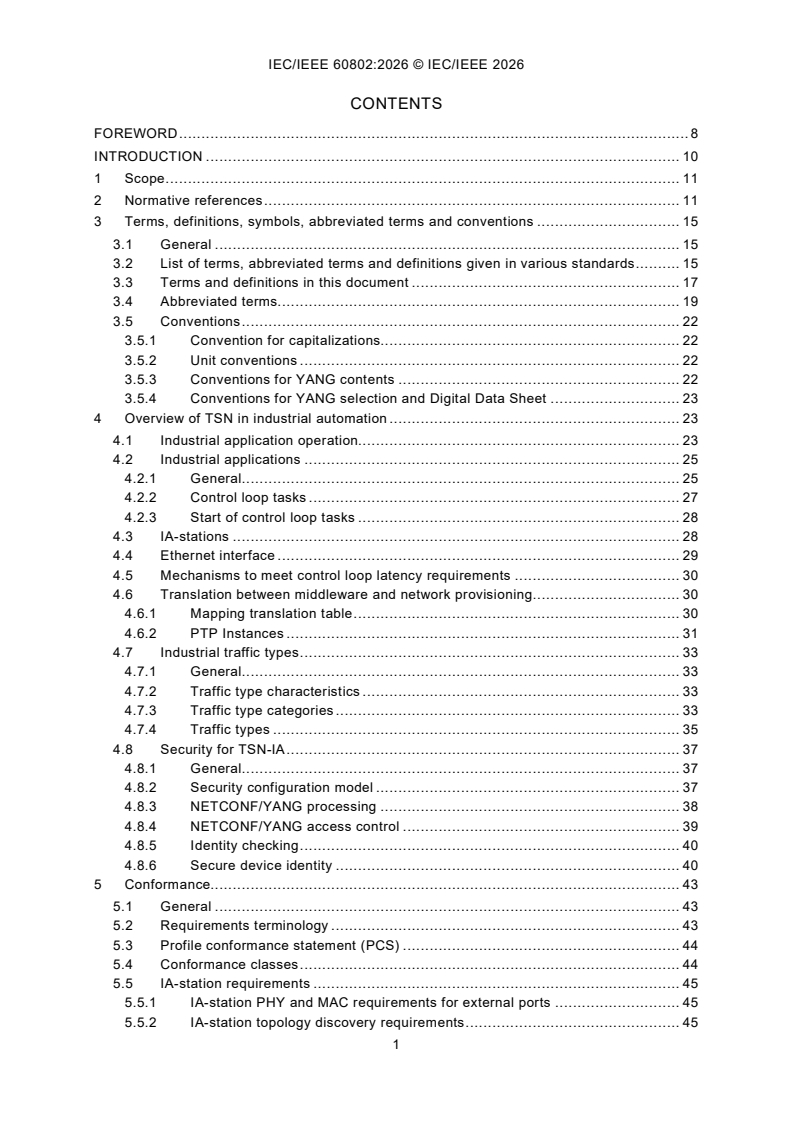
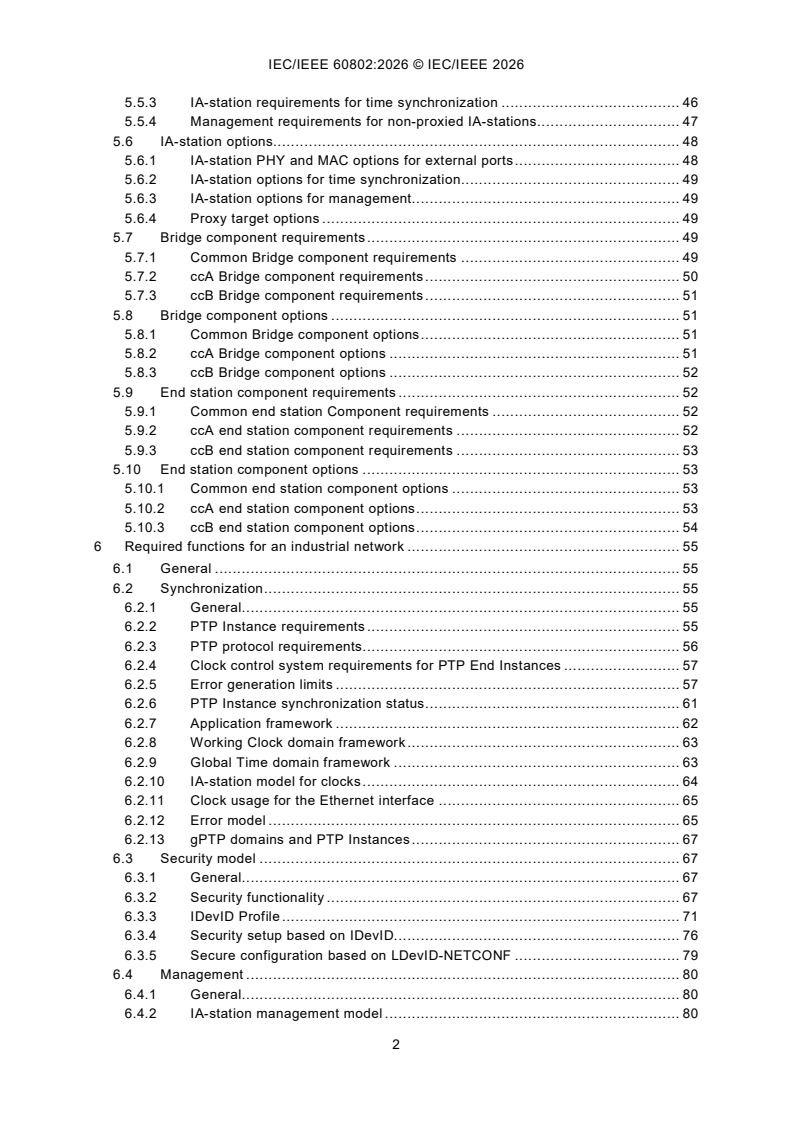
CONTENTS
FOREWORD . 8
INTRODUCTION . 10
1 Scope . 11
2 Normative references . 11
3 Terms, definitions, symbols, abbreviated terms and conventions . 15
3.1 General . 15
3.2 List of terms, abbreviated terms and definitions given in various standards . 15
3.3 Terms and definitions in this document . 17
3.4 Abbreviated terms. 19
3.5 Conventions . 22
3.5.1 Convention for capitalizations. 22
3.5.2 Unit conventions . 22
3.5.3 Conventions for YANG contents . 22
3.5.4 Conventions for YANG selection and Digital Data Sheet . 23
4 Overview of TSN in industrial automation . 23
4.1 Industrial application operation. 23
4.2 Industrial applications . 25
4.2.1 General. 25
4.2.2 Control loop tasks . 27
4.2.3 Start of control loop tasks . 28
4.3 IA-stations . 28
4.4 Ethernet interface . 29
4.5 Mechanisms to meet control loop latency requirements . 30
4.6 Translation between middleware and network provisioning. 30
4.6.1 Mapping translation table . 30
4.6.2 PTP Instances . 31
4.7 Industrial traffic types . 33
4.7.1 General. 33
4.7.2 Traffic type characteristics . 33
4.7.3 Traffic type categories . 33
4.7.4 Traffic types . 35
4.8 Security for TSN-IA . 37
4.8.1 General. 37
4.8.2 Security configuration model . 37
4.8.3 NETCONF/YANG processing . 38
4.8.4 NETCONF/YANG access control . 39
4.8.5 Identity checking . 40
4.8.6 Secure device identity . 40
5 Conformance. 43
5.1 General . 43
5.2 Requirements terminology . 43
5.3 Profile conformance statement (PCS) . 44
5.4 Conformance classes . 44
5.5 IA-station requirements . 45
5.5.1 IA-station PHY and MAC requirements for external ports . 45
5.5.2 IA-station topology discovery requirements . 45
5.5.3 IA-station requirements for time synchronization . 46
5.5.4 Management requirements for non-proxied IA-stations . 47
5.6 IA-station options. 48
5.6.1 IA-station PHY and MAC options for external ports . 48
5.6.2 IA-station options for time synchronization . 49
5.6.3 IA-station options for management. 49
5.6.4 Proxy target options . 49
5.7 Bridge component requirements . 49
5.7.1 Common Bridge component requirements . 49
5.7.2 ccA Bridge component requirements . 50
5.7.3 ccB Bridge component requirements . 51
5.8 Bridge component options . 51
5.8.1 Common Bridge component options . 51
5.8.2 ccA Bridge component options . 51
5.8.3 ccB Bridge component options . 52
5.9 End station component requirements . 52
5.9.1 Common end station Component requirements . 52
5.9.2 ccA end station component requirements . 52
5.9.3 ccB end station component requirements . 53
5.10 End station component options . 53
5.10.1 Common end station component options . 53
5.10.2 ccA end station component options . 53
5.10.3 ccB end station component options . 54
6 Required functions for an industrial network . 55
6.1 General . 55
6.2 Synchronization . 55
6.2.1 General. 55
6.2.2 PTP Instance requirements . 55
6.2.3 PTP protocol requirements . 56
6.2.4 Clock control system requirements for PTP End Instances . 57
6.2.5 Error generation limits . 57
6.2.6 PTP Instance synchronization status . 61
6.2.7 Application framework . 62
6.2.8 Working Clock domain framework . 63
6.2.9 Global Time domain framework . 63
6.2.10 IA-station model for clocks . 64
6.2.11 Clock usage for the Ethernet interface . 65
6.2.12 Error model . 65
6.2.13 gPTP domains and PTP Instances . 67
6.3 Security model . 67
6.3.1 General. 67
6.3.2 Security functionality . 67
6.3.3 IDevID Profile . 71
6.3.4 Security setup based on IDevID. 76
6.3.5 Secure configuration based on LDevID-NETCONF . 79
6.4 Management . 80
6.4.1 General. 80
6.4.2 IA-station management model . 80
6.4.3 Discovery of IA-station internal structure . 84
6.4.4 Network engineering model . 85
6.4.5 Operation . 88
6.4.6 Engineered time-synchronization spanning tree . 95
6.4.7 Diagnostics . 96
6.4.8 Data sheet . 99
6.4.9 YANG representation of managed objects and nodes . 100
6.4.10 YANG Data Model . 119
6.5 Topology discovery and verification . 163
6.5.1 Topology discovery and verification requirements . 163
6.5.2 Topology discovery overview. 164
6.5.3 Topology verification overview. 167
6.6 CNC . 167
6.6.1 General. 167
6.6.2 Stream destination MAC address range . 167
Annex A (normative) PCS proforma – Time-sensitive networking profile for industrial
automation. 169
A.1 General . 169
A.2 Abbreviated terms and special symbols. 170
A.2.1 Status symbols . 170
A.2.2 General abbreviated terms . 170
A.3 Instructions for completing the PCS proforma . 170
A.3.1 General structure of the PCS proforma . 170
A.3.2 Additional information . 171
A.3.3 Exception information . 171
A.3.4 Conditional status . 171
A.4 Common requirements . 172
A.4.1 Instructions . 172
A.4.2 Implementation identification . 172
A.4.3 Profile summary . 172
A.4.4 Implementation summary . 172
A.5 IA-station requirements and options. 173
A.5.1 Instructions . 173
A.5.2 IA-station requirements . 173
A.5.3 Management Requirements for non-proxied IA-stations . 173
A.5.4 IA-station PHY and MAC options for external ports . 174
A.5.5 IA-station options for time synchronization . 174
A.5.6 IA-station secure management exchange options . 174
A.5.7 Proxy target requirements . 175
A.6 Bridge component . 175
A.6.1 Bridge component requirements . 175
A.6.2 Instructions . 175
A.6.3 Bridge Common bridge component options . 175
A.6.4 Conformance class A bridge component options . 175
A.6.5 Conformance class B bridge component options . 176
A.7 End station component . 176
A.7.1 Instructions . 176
A.7.2 Common end station component requirements . 177
A.7.3 Common end station component options . 177
A.7.4 Conformance class A end station component options. 177
A.7.5 Conformance class B end station component options. 178
Annex B (informative) Representative Configuration Domain . 179
Annex C (informative) Description of clock control system . 180
C.1 Clock control system introduction . 180
C.2 Transfer function for control system . 181
C.3 Frequency response for control system . 182
C.4 Example . 187
Annex D (informative) Time synchronization annex . 189
D.1 Overview . 189
D.2 Principles of operation . 190
D.2.1 General. 190
D.2.2 Grandmaster PTP Instance implementation . 192
D.2.3 Splitting, joining and aligning time domains . 192
D.2.4 PTP link characteristics . 193
D.3 Notes on normative requirements . 194
D.3.1 Oscillator requirements . 194
D.3.2 Timestamp Granularity Error . 194
D.3.3 Dynamic Timestamp Error . 195
D.3.4 Grandmaster PTP Instance error generation . 195
D.3.5 PTP Relay Instance error generation. 195
D.3.6 PTP End Instance error generation . 197
D.3.7 Explanation for the asymmetric normative requirements for the
allowable range of dTE in Table 14, rows 2 and 3 . 198
D.4 Approach to testing normative requirements . 199
D.4.1 General. 199
D.4.2 Testing Grandmaster PTP Instance. 200
D.4.3 Testing PTP Relay Instance . 200
D.4.4 Testing PTP End Instance. 203
D.4.5 Testing meanLinkDelay Accuracy . 204
D.5 Example algorithms . 204
D.5.1 General. 204
D.5.2 Algorithm for tracking NRR drift . 204
D.5.3 Algorithm to compensate for errors in measured NRR due to clock drift . 206
D.5.4 Algorithm for tracking RR Drift . 209
D.5.5 Algorithm to compensate for errors in measured RR due to clock drift . 210
D.5.6 Algorithm to compensate for errors in measured RR due to clock drift at
PTP End Instance . 212
D.5.7 Mean Link Delay averaging . 214
Annex E (normative) 60802 device info TLV definition . 217
E.1 60802 device info TLV. 217
E.1.1 General. 217
E.1.2 Device flags . 217
E.1.3 Proxy type . 217
Annex F (informative) MAC and PHY delay . 218
F.1 Accumulated delays in industrial automation. 218
F.1.1 General. 218
F.1.2 Forwarding delay . 218
F.1.3 Time-triggered transmission . 218
F.1.4 Synchronization . 219
F.1.5 Recommended delays . 219
Bibliography . 220
Figure 1 – Data flow in a control loop . 24
Figure 2 – IA-station interaction with CNC – Transmit path . 26
Figure 3 – IA-station interaction with CNC – Receive path . 27
Figure 4 – IA-station example . 28
Figure 5 – Model for cycles. 29
Figure 6 – Traffic type translation example . 31
Figure 7 – PTP instance translation example . 32
Figure 8 – descriptionDS.userDescription used for PTP instance translation . 32
Figure 9 – NETCONF/YANG security processing steps. 38
Figure 10 – IA-station conformance model . 44
Figure 11 – Clock model . 63
Figure 12 – Example clock usage principles for PTP End Instances . 64
Figure 13 – Example clock usage principles for Grandmaster PTP Instances . 65
Figure 14 – Error budget scheme . 66
Figure 15 – Generic IEEE 802.1Q YANG Bridge management model . 81
Figure 16 – Internal LAN connection management model . 82
Figure 17 – IA-station example with IETF interfaces . 82
Figure 18 – VID/FID/MSTID example . 83
Figure 19 – Structure and interfaces of a CNC . 86
Figure 20 – IA-station structure example . 87
Figure 21 – CNC interaction . 87
Figure 22 – Operational management model . 88
Figure 23 – UNI service model . 89
Figure 24 – CNC southbound . 89
Figure 25 – NETCONF usage in a Configuration Domain . 90
Figure 26 – Boundary port model . 91
Figure 27 – Observer model . 97
Figure 28 – Creation of the digital data sheet of an IA-station . 100
Figure 29 – Module iecieee60802-ethernet-interface . 127
Figure 30 – Module iecieee60802-bridge. 128
Figure 31 – Module iecieee60802-dot1-sched-bridge . 129
Figure 32 – Module iecieee60802-subscribed-notifications. 129
Figure 33 – Module iecieee60802-ia-station . 129
Figure 34 – Module iecieee60802-cnc-config . 130
Figure 35 – Module iecieee60802-tt-mapping . 130
Figure 36 – Module iecieee60802-proxy . 130
Figure 37 – iecieee60802-proxy-target . 131
Figure 38 – Usage example of LLDP . 164
Figure 39 – Stream destination MAC Address . 168
Figure C.1 – Reference model for clock control system . 180
Figure C.2 – Frequency response for the control system of Figure C.1 . 183
Figure C.3 – Detail of frequency response for the control system of Figure C.1 for
dimensionless frequency in the range 0,1 to 10 . 184
Figure C.4 – Gain peaking (pure fraction) as a function of damping ratio . 186
Figure C.5 – Gain peaking in dB as a function of damping ratio . 186
Figure C.6 – Example frequency response . 188
Figure D.1 – Approach to testing normative requirements for Grandmaster PTP
Instance . 200
Figure D.2 – Approach to testing normative requirements for PTP Relay Instance - 1 . 201
Figure D.3 – Approach to testing normative requirements for PTP Relay Instance – 2 . 202
Figure D.4 – Approach to testing normative requirements for PTP Relay Instance – 3 . 202
Figure D.5 – Approach to testing normative requirements for PTP End Instance . 203
Figure D.6 – RR Drift tracking and error compensation calculations – PTP Relay
Instance . 211
Figure D.7 – RR Drift tracking and error compensation calculations – PTP End
Instance . 213
Figure D.8 – Signals and timestamps to measure path delay . 214
Figure E.1 – 60802 device info TLV . 217
Table 1 – List of terms . 15
Table 2 – Traffic type characteristics . 33
Table 3 – IA time-aware stream characteristics . 34
Table 4 – IA stream characteristics . 34
Table 5 – IA traffic engineered non-stream characteristics . 34
Table 6 – IA non-stream characteristics . 34
Table 7 – Industrial automation traffic types summary . 35
Table 8 – Example traffic class to traffic type mapping . 37
Table 9 – Required values . 56
Table 10 – Protocol settings . 56
Table 11 – Clock control system requirements . 57
Table 12 – Error generation limits for Grandmaster PTP Instance . 57
Table 13 – Error generation limits for PTP Relay Instance . 58
Table 14 – Error generation limits for PTP End Instance . 61
Table 15 – Error budget . 66
Table 16 – descriptionDS.userDescription of gPTP Domains . 67
Table 17 – Summary of the YANG modules . 132
Table A.1 – Implementation identification template. 172
Table A.2 – Profile summary template . 172
Table A.3 – Implementation type . 173
Table A.4 – IA-station requirements . 173
Table A.5 – Additional requirements for non-proxied IA-stations . 173
Table A.6 – IA-station PHY and MAC options . 174
Table A.7 – IA-station time synchronization options . 174
Table A.8 – IA-station secure management exchange options . 174
Table A.9 – Proxy target requirements . 175
Table A.10 – Bridge component requirements . 175
Table A.11 – Common bridge component options . 175
Table A.12 – Conformance class A bridge component options . 176
Table A.13 – Conformance class B bridge component options . 176
Table A.14 – Common end station component requirements . 177
Table A.15 – Common end station component options. 177
Table A.16 – Conformance class A end station component options . 177
Table A.17 – Conformance class B end station component options . 178
Table D.1 – Time synchronization error budget . 189
Table D.2 – Protocol configurations & other measures to achieve dTE budget . 190
Table D.3 – Main sources of error affecting normative requirements for Grandmaster
PTP Instance . 195
Table D.4 – Main sources of error affecting normative requirements for PTP Relay
Instance . 196
Table D.5 – Main sources of error affecting normative requirements for PTP End
Instance . 197
Table E.1 – Device flags . 217
Table F.1 – Recommended PHY delay . 219
Time-sensitive networking profile for industrial automation
FOREWORD
1) The International Electrotechnical Commission (IEC) is a worldwide organization for standardization comprising
all national electrotechnical committees (IEC National Committees). The object of IEC is to promote international
co-operation on all questions concerning standardization in the electrical and electronic fields. To this end and
in addition to other activities, IEC publishes International Standards, Technical Specifications, Technical Reports,
Publicly Available Specifications (PAS) and Guides (hereafter referred to as "IEC document(s)"). Their
preparation is entrusted to technical committees; any IEC National Committee interested in the subject dealt with
may participate in this preparatory work. International, governmental and non-governmental organizations liaising
with the IEC also participate in this preparation.
IEEE Standards documents are developed within IEEE Societies and subcommittees of IEEE Standards
Association (IEEE SA) Board of Governors. IEEE develops its standards through an accredited consensus
development process, which brings together volunteers representing varied viewpoints and interests to achieve
the final product. IEEE standards are documents developed by volunteers with scientific, academic, and industry-
based expertise in technical working groups. Volunteers involved in technical working groups are not necessarily
members of IEEE or IEEE SA and participate without compensation from IEEE. While IEEE administers the
process and establishes rules to promote fairness in the consensus development process, IEEE does not
independently evaluate, test, or verify the accuracy of any of the information or the soundness of any judgments
contained in its standards.
IEC collaborates closely with IEEE in accordance with conditions determined by agreement between the two
organizations. This Dual Logo International Standard was jointly developed by the IEC and IEEE under the terms
of that agreement.
2) The formal decisions of IEC on technical matters express, as nearly as possible, an international consensus of
opinion on the relevant subjects since each technical committee has representation from all interested IEC
National Committees. The formal decisions of IEEE on technical matters, once consensus within IEEE Societies
and Standards Coordinating Committees has been reached, is determined by a balanced ballot of materially
interested parties who indicate interest in reviewing the proposed standard. Final approval of the IEEE standards
document is given by the IEEE Standards Association (IEEE SA) Standards Board.
3) IEC/IEEE Publications have the form of recommendations for international use and are accepted by IEC National
Committees/IEEE Societies in that sense. While all reasonable efforts are made to ensure that the technical
content of IEC/IEEE Publications is accurate, IEC or IEEE cannot be held responsible for the way in which they
are used or for any misinterpretation by any end user.
4) In order to promote international uniformity, IEC National Committees undertake to apply IEC Publications
(including IEC/IEEE Publications) transparently to the maximum extent possible in their national and regional
publications. Any divergence between any IEC/IEEE Publication and the corresponding national or regional
publication shall be clearly indicated in the latter.
5) IEC and IEEE do not provide any attestation of conformity. Independent certification bodies provide conformity
assessment services and, in some areas, access to IEC marks of conformity. IEC and IEEE are not responsible
for any services carried out by independent certification bodies.
6) All users should ensure that they have the latest edition of this publication.
7) No liability shall attach to IEC or IEEE or their directors, employees, servants or agents including individual
experts and members of technical committees and IEC National Committees, or volunteers of IEEE Societies and
the Standards Coordinating Committees of the IEEE Standards Association (IEEE SA) Standards Board, for any
personal injury, property damage or other damage of any nature whatsoever, whether direct or indirect, or for
costs (including legal fees) and expenses arising out of the publication, use of, or reliance upon, this IEC/IEEE
Publication or any other IEC or IEEE Publications.
8) Attention is drawn to the normative references cited in this publication. Use of the referenced publications is
indispensable for the correct application of this publication.
9) Attention is drawn to the possibility that implementation of this IEC/IEEE Publication may require use of material
covered by patent rights. By publication of this standard, no position is taken with respect to the existence or
validity of any patent rights in connection therewith. IEC or IEEE shall not be held responsible for identifying
Essential Patent Claims for which a license may be required, for conducting inquiries into the legal validity or
scope of Patent Claims or determining whether any licensing terms or conditions provided in connection with
submission of a Letter of Assurance, if any, or in any licensing agreements are reasonable or non-discriminatory.
Users of this standard are expressly advised that determination of the validity of any patent rights, and the risk
of infringement of such rights, is entirely their own responsibility.
IEC/IEEE 60802 was prepared by subcommittee 65C: Industrial networks, of IEC technical
committee 65: Industrial-process measurement, control and automation, in cooperation with
IEEE 802.1: Higher Layer LAN Protocols Working Group of IEEE 802: LAN/MAN Standards
Committee of the IEEE computer society, under the IEC/IEEE Dual Logo Agreement between
IEC and IEEE. It is an International Standard.
This document is published as an IEC/IEEE Dual Logo standard.
This publication contains attached files in the form of YANG files and a Word document.
The text of this International Standard is based on the following IEC documents:
Draft Report on voting
65C/1406/FDIS 65C/1438/RVD
Full information on the voting for its approval can be found in the report on voting indicated in
the above table.
The language used for the development of this International Standard is English.
This document was drafted in accordance with the rules given in the ISO/IEC Directives, Part 2,
available at www.iec.ch/members_experts/refdocs. The main document types developed by IEC
are described in greater detail at www.iec.ch/publications/.
The IEC Technical Committee and IEEE Technical Committee have decided that the contents
of this document will remain unchanged until the stability date indicated on the IEC website
under webstore.iec.ch in the data related to the specific document. At this date, the document
will be
– reconfirmed,
– withdrawn, or
– revised.
INTRODUCTION
This document defines time-sensitive networking profiles for industrial automation. The profile
selects features, options, configurations, defaults, protocols, and procedures of bridges, end
stations, and LANs to build industrial automation networks. This document also specifies YANG
modules for the digital data sheet and for remote procedure calls.
The profile meets the industrial automation market objective of converging Operations
Technology (OT) and Information Technology (IT) networks by defining a common,
standardized network infrastructure. This objective is accomplished by taking advantage of the
improvements that Time-Sensitive Networking provides to IEEE 802.1 and IEEE 802.3 standard
Ethernet networks by providing guaranteed data transport with bounded low latency, low latency
variation, zero congestion loss for critical traffic, and high availability.
The profile helps the convergence of industrial communication networks by referring only to
international standards to build the lower layers of the communication stack and their
management.
Ethernet extended with Time-Sensitive Networking technology provides the features required
in the area of industrial communication networks, such as:
– meeting low latency and latency variation requirements concerning data transmission;
– efficient exchange of data records on a frequent time period;
– reliable communications with calculable d
...