


IEC 61984:2001
(Main)Connectors - Safety requirements and tests
Connectors - Safety requirements and tests
Applies to connectors with rated voltages above 50 V and up to 1 000 V and rated currents up to 125 A per contact, for which either no detail specification (DS) exists or the DS calls up this standard for safety aspects. For connectors with rated voltages up to 50 V, this standard may be used as a guide.
Connecteurs - Prescriptions de sécurité et essais
S'applique aux connecteurs de tensions assignées comprises entre 50 V et 1 000 V et de courants assignés jusqu'à 125 A par contact, pour lesquels soit il n'existe pas de spécification particulière (SP), soit la SP fait appel aux aspects de sécurité. Pour les connecteurs de tensions assignées jusqu'à 50 V, cette norme peut être utilisée comme guide.
General Information
- Status
- Published
- Publication Date
- 19-Jun-2001
- Technical Committee
- SC 48B - Electrical connectors
- Current Stage
- DELPUB - Deleted Publication
- Start Date
- 08-Oct-2008
- Completion Date
- 14-Feb-2026
Relations
- Effective Date
- 05-Sep-2023
Overview
IEC 61984:2001 - Connectors: Safety Requirements and Tests is an international standard developed by the International Electrotechnical Commission (IEC). It specifies safety requirements and testing methods for connectors used in electrical and electronic applications, covering products with rated voltages above 50 V and up to 1,000 V, and rated currents up to 125 A per contact. In instances where no dedicated detail specification exists, or where such a specification points to this standard for safety, IEC 61984:2001 serves as the authoritative guideline. For applications with rated voltages up to 50 V, this standard may be applied as a reference guide.
IEC 61984:2001 does not apply to connectors integrated into equipment when the product-specific safety standard already includes comprehensive safety requirements for connectors.
Key Topics
IEC 61984:2001 covers several critical aspects to ensure connector safety and reliability in electrical and electronic systems:
- Scope and Application: Defines the products and situations to which the standard applies, including usage up to 1,000 V and 125 A per contact.
- Technical Information: Addresses the necessary technical ratings such as electrical ratings and assignment details.
- Classification: Outlines connector types based on enclosure, style, and specific additional characteristics.
- Constructional Requirements: Specifies the necessary construction features that impact safety, including:
- Marking and identification
- Protection against electric shock
- Earthing provisions
- Terminations and connection methods
- Interlock mechanisms
- Durability against mechanical and electrical stresses
- Environmental resistance (e.g., ageing, moisture, corrosion)
- Mechanical strength and cable-clamping features
- Clearances and creepage distances
- Insulation requirements (functional, supplementary, reinforced)
- Testing Procedures: Details the preparations, types, and sequences of tests required to validate connector safety, such as:
- Durability of marking
- Interlock and earthing contact verification
- Temperature rise and mechanical operation tests
- Dielectric strength and resistance measurements
- Corrosion resistance evaluation
- In-process and routine test schedules
Applications
IEC 61984:2001 is relevant for a wide range of industries and applications requiring reliable and safe electrical connectors, such as:
- Industrial Electrical Systems: Used in manufacturing environments, automation, and process control systems where connectors must withstand higher voltages and currents.
- Building Installations: Applicable in commercial and residential projects for safe electrical distribution networks.
- Electronic Equipment Manufacturing: Ensures the safety of connectors in devices and assemblies where no product-specific safety standard is present.
- Testing and Maintenance: Provides guidance for maintenance professionals and testing laboratories to assess and verify the safety of connectors in service.
- Product Design and Development: Supports manufacturers in the design of new connector products or for use as a reference in absence of specialized detail specifications.
Related Standards
IEC 61984:2001 frequently references and interfaces with other international standards to address specific aspects of connector safety and testing. Notable related standards include:
- IEC 60664-1: Insulation coordination for low-voltage equipment (clearances and creepage distances).
- IEC 60309-1: Plugs, socket-outlets, and couplers for industrial purposes.
- IEC 60884-1: Plugs and socket-outlets for household and similar purposes.
- IEC 60529: Degrees of protection provided by enclosures (IP Code).
- IEC 60364 series: Electrical installations of buildings.
- IEC 60352 series: Solderless electrical connections.
- IEC 60112: Comparative and proof tracking indices of solid insulating materials.
IEC 61984:2001 serves as an essential safety benchmark for designers, engineers, and manufacturers requiring certified, compliant connectors in various electrical and electronic applications. By ensuring standardized safety requirements and rigorous testing, it promotes product reliability and minimizes safety risks for end users and industries worldwide.
Frequently Asked Questions
IEC 61984:2001 is a standard published by the International Electrotechnical Commission (IEC). Its full title is "Connectors - Safety requirements and tests". This standard covers: Applies to connectors with rated voltages above 50 V and up to 1 000 V and rated currents up to 125 A per contact, for which either no detail specification (DS) exists or the DS calls up this standard for safety aspects. For connectors with rated voltages up to 50 V, this standard may be used as a guide.
Applies to connectors with rated voltages above 50 V and up to 1 000 V and rated currents up to 125 A per contact, for which either no detail specification (DS) exists or the DS calls up this standard for safety aspects. For connectors with rated voltages up to 50 V, this standard may be used as a guide.
IEC 61984:2001 is classified under the following ICS (International Classification for Standards) categories: 31.220.10 - Plug-and-socket devices. Connectors. The ICS classification helps identify the subject area and facilitates finding related standards.
IEC 61984:2001 has the following relationships with other standards: It is inter standard links to IEC 61984:2008. Understanding these relationships helps ensure you are using the most current and applicable version of the standard.
IEC 61984:2001 is available in PDF format for immediate download after purchase. The document can be added to your cart and obtained through the secure checkout process. Digital delivery ensures instant access to the complete standard document.
Standards Content (Sample)
NORME CEI
INTERNATIONALE IEC
INTERNATIONAL
Première édition
STANDARD
First edition
2001-06
Connecteurs –
Prescriptions de sécurité et essais
Connectors –
Safety requirements and tests
Numéro de référence
Reference number
CEI/IEC 61984:2001
Numérotation des publications Publication numbering
Depuis le 1er janvier 1997, les publications de la CEI As from 1 January 1997 all IEC publications are
sont numérotées à partir de 60000. Ainsi, la CEI 34-1 issued with a designation in the 60000 series. For
devient la CEI 60034-1. example, IEC 34-1 is now referred to as IEC 60034-1.
Editions consolidées Consolidated editions
Les versions consolidées de certaines publications de la The IEC is now publishing consolidated versions of its
CEI incorporant les amendements sont disponibles. Par publications. For example, edition numbers 1.0, 1.1
exemple, les numéros d’édition 1.0, 1.1 et 1.2 indiquent and 1.2 refer, respectively, to the base publication,
respectivement la publication de base, la publication de the base publication incorporating amendment 1 and
base incorporant l’amendement 1, et la publication de the base publication incorporating amendments 1
base incorporant les amendements 1 et 2. and 2.
Informations supplémentaires Further information on IEC publications
sur les publications de la CEI
Le contenu technique des publications de la CEI est The technical content of IEC publications is kept
constamment revu par la CEI afin qu'il reflète l'état under constant review by the IEC, thus ensuring that
actuel de la technique. Des renseignements relatifs à the content reflects current technology. Information
cette publication, y compris sa validité, sont dispo- relating to this publication, including its validity, is
nibles dans le Catalogue des publications de la CEI available in the IEC Catalogue of publications
(voir ci-dessous) en plus des nouvelles éditions, (see below) in addition to new editions, amendments
amendements et corrigenda. Des informations sur les and corrigenda. Information on the subjects under
sujets à l’étude et l’avancement des travaux entrepris consideration and work in progress undertaken by the
par le comité d’études qui a élaboré cette publication, technical committee which has prepared this
ainsi que la liste des publications parues, sont publication, as well as the list of publications issued,
également disponibles par l’intermédiaire de: is also available from the following:
• Site web de la CEI (www.iec.ch) • IEC Web Site (www.iec.ch)
• Catalogue des publications de la CEI • Catalogue of IEC publications
Le catalogue en ligne sur le site web de la CEI The on-line catalogue on the IEC web site
(www.iec.ch/catlg-f.htm) vous permet de faire des (www.iec.ch/catlg-e.htm) enables you to search
recherches en utilisant de nombreux critères, by a variety of criteria including text searches,
comprenant des recherches textuelles, par comité technical committees and date of publication. On-
d’études ou date de publication. Des informations line information is also available on recently
en ligne sont également disponibles sur les issued publications, withdrawn and replaced
nouvelles publications, les publications rempla- publications, as well as corrigenda.
cées ou retirées, ainsi que sur les corrigenda.
• IEC Just Published
• IEC Just Published
Ce résumé des dernières publications parues
This summary of recently issued publications
(www.iec.ch/JP.htm) est aussi disponible par
(www.iec.ch/JP.htm) is also available by email.
courrier électronique. Veuillez prendre contact
Please contact the Customer Service Centre (see
avec le Service client (voir ci-dessous) pour plus
below) for further information.
d’informations.
• Service clients
• Customer Service Centre
Si vous avez des questions au sujet de cette
If you have any questions regarding this
publication ou avez besoin de renseignements
publication or need further assistance, please
supplémentaires, prenez contact avec le Service
contact the Customer Service Centre:
clients:
Email: custserv@iec.ch
Email: custserv@iec.ch
Tél: +41 22 919 02 11
Tel: +41 22 919 02 11
Fax: +41 22 919 03 00
Fax: +41 22 919 03 00
.
NORME CEI
INTERNATIONALE IEC
INTERNATIONAL
Première édition
STANDARD
First edition
2001-06
Connecteurs –
Prescriptions de sécurité et essais
Connectors –
Safety requirements and tests
IEC 2001 Droits de reproduction réservés Copyright - all rights reserved
Aucune partie de cette publication ne peut être reproduite ni No part of this publication may be reproduced or utilized in
utilisée sous quelque forme que ce soit et par aucun procédé, any form or by any means, electronic or mechanical,
électronique ou mécanique, y compris la photocopie et les including photocopying and microfilm, without permission in
microfilms, sans l'accord écrit de l'éditeur. writing from the publisher.
International Electrotechnical Commission 3, rue de Varembé Geneva, Switzerland
Telefax: +41 22 919 0300 e-mail: inmail@iec.ch IEC web site http://www.iec.ch
CODE PRIX
Commission Electrotechnique Internationale
W
PRICE CODE
International Electrotechnical Commission
Pour prix, voir catalogue en vigueur
For price, see current catalogue
– 2 – 61984 CEI:2001
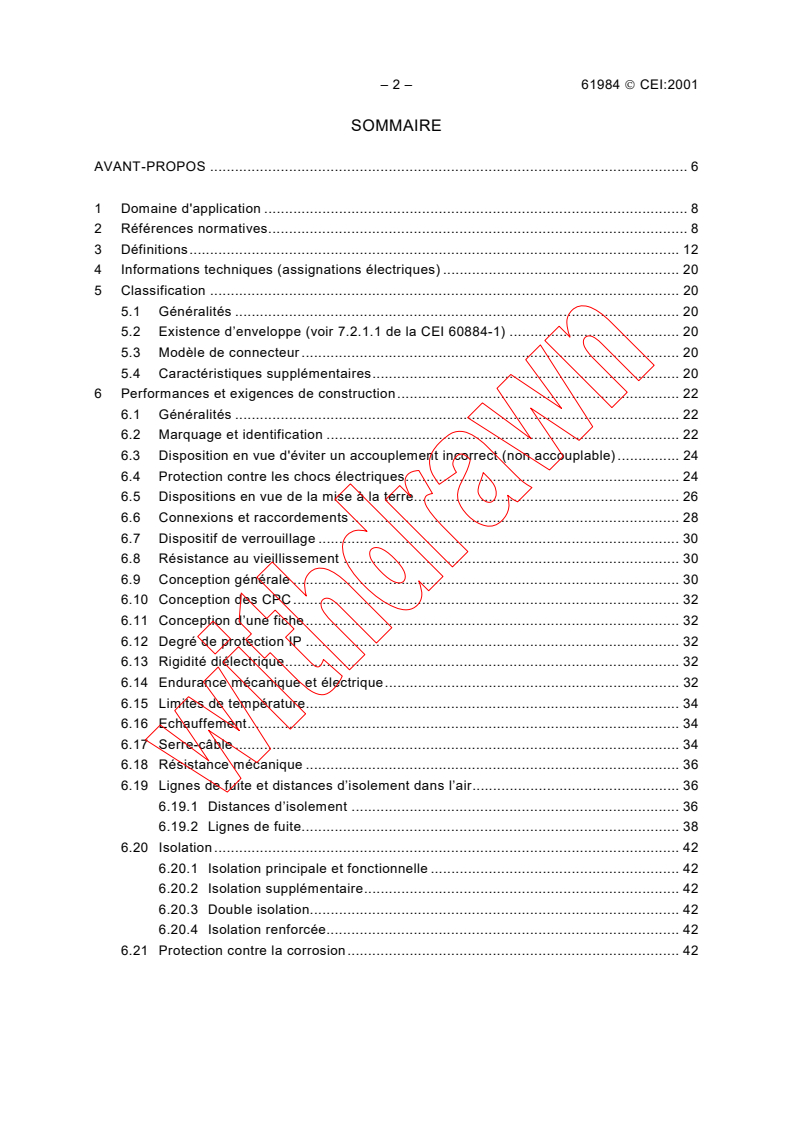
SOMMAIRE
AVANT-PROPOS . 6
1 Domaine d'application . 8
2 Références normatives. 8
3 Définitions. 12
4 Informations techniques (assignations électriques) . 20
5 Classification .20
5.1 Généralités . 20
5.2 Existence d’enveloppe (voir 7.2.1.1 de la CEI 60884-1) . 20
5.3 Modèle de connecteur . 20
5.4 Caractéristiques supplémentaires. 20
6 Performances et exigences de construction. 22
6.1 Généralités . 22
6.2 Marquage et identification . 22
6.3 Disposition en vue d'éviter un accouplement incorrect (non accouplable) . 24
6.4 Protection contre les chocs électriques. 24
6.5 Dispositions en vue de la mise à la terre. 26
6.6 Connexions et raccordements . 28
6.7 Dispositif de verrouillage . 30
6.8 Résistance au vieillissement . 30
6.9 Conception générale . 30
6.10 Conception des CPC . 32
6.11 Conception d’une fiche. 32
6.12 Degré de protection IP . 32
6.13 Rigidité diélectrique. 32
6.14 Endurance mécanique et électrique. 32
6.15 Limites de température. 34
6.16 Echauffement. 34
6.17 Serre-câble . 34
6.18 Résistance mécanique . 36
6.19 Lignes de fuite et distances d’isolement dans l’air. 36
6.19.1 Distances d’isolement . 36
6.19.2 Lignes de fuite. 38
6.20 Isolation. 42
6.20.1 Isolation principale et fonctionnelle . 42
6.20.2 Isolation supplémentaire. 42
6.20.3 Double isolation. 42
6.20.4 Isolation renforcée. 42
6.21 Protection contre la corrosion. 42
61984 IEC:2001 – 3 –
CONTENTS
FOREWORD . 7
1 Scope . 9
2 Normative references . 9
3 Definitions. 13
4 Technical information (electrical ratings). 21
5 Classification .21
5.1 General. 21
5.2 Existence of an enclosure (see 7.2.1.1 of IEC 60884-1). 21
5.3 Style of connector . 21
5.4 Additional characteristics. 21
6 Constructional requirements and performance. 23
6.1 General. 23
6.2 Marking and identification. 23
6.3 Provision against incorrect mating (non- intermateable) . 25
6.4 Protection against electric shock . 25
6.5 Provisions for earthing . 27
6.6 Terminations and connection methods. 29
6.7 Interlock. 31
6.8 Resistance to ageing. 31
6.9 General design. 31
6.10 Design of a CBC . 33
6.11 Design of a free connector . 33
6.12 Degree of protection IP . 33
6.13 Dielectric strength . 33
6.14 Mechanical and electrical durability . 33
6.15 Temperature limits . 35
6.16 Temperature rise. 35
6.17 Cable clamp. 35
6.18 Mechanical strength . 37
6.19 Clearances and creepage distances . 37
6.19.1 Clearances. 37
6.19.2 Creepage distances. 39
6.20 Insulation . 43
6.20.1 Functional and basic insulation. 43
6.20.2 Supplementary insulation. 43
6.20.3 Double insulation. 43
6.20.4 Reinforced insulation. 43
6.21 Protection against corrosion . 43
– 4 – 61984 CEI:2001
7 Essais. 42
7.1 Généralités . 42
7.2 Préparation des échantillons . 46
7.3 Réalisation des essais. 46
7.3.1 Généralités . 46
7.3.2 Résistance des marquages . 46
7.3.3 Contact de terre de protection de type « premier fermé, dernier
ouvert ». 46
7.3.4 Dispositif de verrouillage . 46
7.3.5 Pouvoir de coupure des CPC. 48
7.3.6 Protection contre les chocs électriques. 48
7.3.7 Echauffement. 48
7.3.8 Fonctionnement mécanique. 50
7.3.9 Essai de pliage (flexion) (voir 24.4, modifié, de la CEI 60309-1). 52
7.3.10 Mesure des lignes de fuite et distances dans l'air. 52
7.3.11 Rigidité diélectrique. 52
7.3.12 Résistance entre les pièces métalliques accessibles et le contact de
protection de terre. 54
7.3.13 Essai de corrosion. 54
7.4 Programme d’essai en cours de production (essai individuel de série) pour les
fiches ou CPC non démontables. 56
7.5 Programme d’essai . 58
Annexe A (informative) Informations à spécifier dans la spécification particulière, si elle
existe, ou dans la spécification du fabricant . 70
Bibliographie . 74
Figure 1 – Appareil pour l’essai de pliage. 50
Tableau 1 – Section minimale du conducteur de terre de protection ou de la connexion
aux pièces métalliques inactives . 26
Tableau 2a – Cycles de fonctionnement. 34
Tableau 2b – Pliages . 34
Tableau 2 – Cycles de fonctionnement et pliages – Valeurs préférentielles. 34
Tableau 3 – Valeurs préférentielles de température . 34
Tableau 4 – Valeurs pour les essais des serre-câbles . 36
Tableau 5 – Tension assignée de tenue aux chocs . 38
Tableau 6 – Lignes de fuite minimales . 40
Tableau 7 – Valeurs du couple pour les organes de serrage à vis. 44
Tableau 8 – Tensions d’essai . 54
Tableau 9 – Echantillonnage nécessaire pour les essais . 56
Tableau 10 – Groupe A – Essais mécaniques . 58
Tableau 11 – Groupe B – Essais de durée de vie . 62
Tableau 12 – Groupe C – Essais thermiques . 64
Tableau 13 – Groupe D – Essais climatiques . 64
Tableau 14 – Groupe E – Degré de protection. 68
61984 IEC:2001 – 5 –
7 Tests . 43
7.1 General. 43
7.2 Preparation of specimens. 47
7.3 Performance of tests. 47
7.3.1 General. 47
7.3.2 Durability of marking. . 47
7.3.3 "First make, last break" protective earthing contact. 47
7.3.4 Interlock. 47
7.3.5 Breaking capacity of a CBC . 49
7.3.6 Protection against electric shock . 49
7.3.7 Temperature rise. 49
7.3.8 Mechanical operation . 51
7.3.9 Bending (flexing) test (see 24.4, modified, of IEC 60309-1). 53
7.3.10 Measurement of clearances and creepage distances . 53
7.3.11 Dielectric strength . 53
7.3.12 Resistance between accessible metal parts and the protective
earthing contact . 55
7.3.13 Corrosion test . 55
7.4 In-process test schedule (routine test) for non-rewirable free connectors . 57
7.5 Test schedule . 59
Annex A (informative) Information to be specified in the detail specification, if any,
or manufacturer’s specification . 71
Bibliography . 75
Figure 1 – Device for the bending test. 51
Table 1 – Minimum cross-sectional area of the protective conductor or the connection to
inactive accessible metal parts . 27
Table 2 – Operating cycles and bendings – Preferred values. 35
Table 2a – Operating cycles . 35
Table 2b – Bendings. 35
Table 3 – Preferred values of temperature . 35
Table 4 – Values for cable clamp testing. 37
Table 5 – Rated impulse voltages . 39
Table 6 – Minimum creepage distances . 41
Table 7 – Values of torque for screw-type clamping units . 45
Table 8 – Test voltages . 55
Table 9 – Plan of specimens required for tests. 57
Table 10 – Mechanical test group A . 59
Table 11 – Service life test group B . 63
Table 12 – Thermal test group C. 65
Table 13 – Climatic test group D . 65
Table 14 – Degree of protection, test group E . 69
– 6 – 61984 CEI:2001
COMMISSION ÉLECTROTECHNIQUE INTERNATIONALE
____________
CONNECTEURS –
PRESCRIPTIONS DE SÉCURITÉ ET ESSAIS
AVANT-PROPOS
1) La CEI (Commission Electrotechnique Internationale) est une organisation mondiale de normalisation composée
de l’ensemble des comités électrotechniques nationaux (Comités nationaux de la CEI). La CEI a pour objet de
favoriser la coopération internationale pour toutes les questions de normalisation dans les domaines de
l’électricité et de l’électronique. A cet effet, la CEI, entre autres activités, publie des Normes internationales.
Leur élaboration est confiée à des comités d’études, aux travaux desquels tout Comité national intéressé par le
sujet traité peut participer. Les organisations internationales, gouvernementales et non gouvernementales, en
liaison avec la CEI, participent également aux travaux. La CEI collabore étroitement avec l’Organisation
Internationale de Normalisation (ISO), selon des conditions fixées par accord entre les deux organisations.
2) Les décisions ou accords officiels de la CEI concernant des questions techniques, représentent, dans la mesure
du possible, un accord international sur les sujets étudiés, étant donné que les Comités nationaux intéressés
sont représentés dans chaque comité d’études.
3) Les documents produits se présentent sous la forme de recommandations internationales; ils sont publiés
comme normes, spécifications techniques, rapports techniques ou guides et agréés comme tels par les Comités
nationaux.
4) Dans le but d'encourager l'unification internationale, les Comités nationaux de la CEI s’engagent à appliquer de
façon transparente, dans toute la mesure possible, les Normes internationales de la CEI dans leurs normes
nationales et régionales. Toute divergence entre la norme de la CEI et la norme nationale ou régionale
correspondante doit être indiquée en termes clairs dans cette dernière.
5) La CEI n'a fixé aucune procédure concernant le marquage comme indication d'approbation et sa responsabilité
n'est pas engagée quand un matériel est déclaré conforme à l'une de ses normes.
6) L’attention est attirée sur le fait que certains des éléments de la présente Norme internationale peuvent faire
l’objet de droits de propriété intellectuelle ou de droits analogues. La CEI ne saurait être tenue pour
responsable de ne pas avoir identifié de tels droits de propriété et de ne pas avoir signalé leur existence.
La Norme internationale CEI 61984 a été établie par le sous-comité 48B: Connecteurs, du
comité d’études 48 de la CEI: Composants électromécaniques et structures mécaniques pour
équipements électroniques.
Le texte de cette norme est issu des documents suivants:
FDIS Rapport de vote
48B/1007/FDIS 48B/1056/RVD
Le rapport de vote indiqué dans le tableau ci-dessus donne toute information sur le vote ayant
abouti à l'approbation de cette norme.
Cette publication a été rédigée selon les Directives ISO/CEI, Partie 3.
L’annexe A est donnée uniquement à titre d’information.
Le comité a décidé que le contenu de cette publication ne sera pas modifié avant 2005. A cette
date, la publication sera:
• reconduite;
• supprimée;
• remplacée par une édition révisée, ou
• amendée.
61984 IEC:2001 – 7 –
INTERNATIONAL ELECTROTECHNICAL COMMISSION
___________
CONNECTORS –
SAFETY REQUIREMENTS AND TESTS
FOREWORD
1) The IEC (International Electrotechnical Commission) is a worldwide organization for standardization comprising
all national electrotechnical committees (IEC National Committees). The object of the IEC is to promote
international co-operation on all questions concerning standardization in the electrical and electronic fields. To
this end and in addition to other activities, the IEC publishes International Standards. Their preparation is
entrusted to technical committees; any IEC National Committee interested in the subject dealt with may
participate in this preparatory work. International, governmental and non-governmental organizations liaising
with the IEC also participate in this preparation. The IEC collaborates closely with the International Organization
for Standardization (ISO) in accordance with conditions determined by agreement between the two
organizations.
2) The formal decisions or agreements of the IEC on technical matters express, as nearly as possible, an
international consensus of opinion on the reievant subjects since each technical committee has representation
from all interested National Committees.
3) The documents produced have the form of recommendations for international use and are published in the form
of standards, technical specifications, technical reports or guides and they are accepted by the National
Committees in that sense.
4) In order to promote international unification, IEC National Committees undertake to apply IEC International
Standards transparently to the maximum extent possible in their national and regional standards. Any
divergence between the IEC Standard and the corresponding national or regional standard shall be clearly
indicated in the latter.
5) The IEC provides no marking procedure to indicate its approval and cannot be rendered responsible for any
equipment declared to be in conformity with one of its standards.
6) Attention is drawn to the possibility that some of the elements of this International Standard may be the subject
of patent rights. The IEC shall not be held responsible for identifying any or all such patent rights.
International Standard IEC 61984 has been prepared by subcommittee 48B: Connectors, of
IEC technical committee 48: Electromechanical components and mechanical structures for
electronic equipment.
The text of this standard is based on the following documents:
FDIS Report on voting
48B/1007/FDIS 48B/1056/RVD
Full information on the voting for the approval of this standard can be found in the report on
voting indicated in the above table.
This publication has been drafted in accordance with the ISO/IEC Directives, Part 3.
Annex A is for information only.
The committee has decided that this publication remains valid until 2005. At this date, in
accordance with the committee’s decision, the publication will be
• reconfirmed:
• withdrawn:
• replaced by a revised edition, or
• amended.
– 8 – 61984 CEI:2001
CONNECTEURS –
PRESCRIPTIONS DE SÉCURITÉ ET ESSAIS
1 Domaine d’application
La présente Norme internationale s’applique aux connecteurs de tensions assignées comprises
entre 50 V et 1 000 V et de courants assignés jusqu’à 125 A par contact, pour lesquels soit il
n’existe pas de spécification particulière (SP) soit la SP fait appel aux aspects de sécurité.
Pour les connecteurs de tensions assignées jusqu'à 50 V, cette norme peut être utilisée
comme guide. Dans ce cas, pour les lignes de fuite et les distances dans l'air, il est fait
référence à la CEI 60664-1.
La présente norme ne s’applique pas aux connecteurs dans ou sur un équipement lorsque la
norme de sécurité applicable à cet équipement comprend des prescriptions complètes de
sécurité pour ces connecteurs.
2 Références normatives
Les documents normatifs suivants contiennent des dispositions qui, par suite de la référence
qui y est faite, constituent des dispositions valables pour la présente Norme internationale.
Pour les références datées, les amendements ultérieurs ou les révisions de ces publications ne
s’appliquent pas. Toutefois, les parties prenantes aux accords fondés sur la présente Norme
internationale sont invitées à rechercher la possibilité d'appliquer les éditions les plus récentes
des documents normatifs indiqués ci-après. Pour les références non datées, la dernière édition
du document normatif en référence s’applique. Les membres de la CEI et de l'ISO possèdent
le registre des Normes internationales en vigueur.
CEI 60050(581):1978, Vocabulaire Electrotechnique International (VEI), Chapitre 581:
Composants électromécaniques pour équipements électroniques
CEI 60050(826):1982, Vocabulaire Electrotechnique International (VEI), Chapitre 826:
Installations électriques des bâtiments
CEI 60060-1:1989, Techniques des essais à haute tension – Partie 1: Définitions et
prescriptions générales relatives aux essais
CEI 60068-1:1988, Essais d’environnement – Partie 1: Généralités et guide
CEI 60068-2-70:1995, Essais d’environnement – Partie 2: Essais – Essai Xb: Effacement des
marquages et inscriptions par friction des doigts et des mains
CEI 60112:1979, Méthode pour déterminer des indices de résistance et de tenue au chemine-
ment des matériaux isolants solides dans des conditions humides
CEI 60309-1:1999, Prises de courant pour usages industriels – Partie 1: Règles générales
CEI 60352-1, Connexions sans soudure – Partie 1: Connexions enroulées – Règles générales,
méthodes d'essai et guide pratique
CEI 60352-2, Connexions sans soudure – Deuxième partie: Connexions serties sans soudure –
Règles générales, méthodes d'essai et guide pratique
61984 IEC:2001 – 9 –
CONNECTORS –
SAFETY REQUIREMENTS AND TESTS
1 Scope
This International Standard applies to connectors with rated voltages above 50 V and up to
1 000 V and rated currents up to 125 A per contact, for which either no detail specification (DS)
exists or the DS calls up this standard for safety aspects.
For connectors with rated voltages up to 50 V, this standard may be used as a guide. In this
case, reference is made to IEC 60664-1 for clearances and creepage distances.
This standard does not apply to connectors in or on equipment where the applicable safety
standard for the equipment includes comprehensive safety requirements for those connectors.
2 Normative references
The following normative documents contain provisions which, through reference in this text,
constitute provisions of this International Standard. For dated references, subsequent
amendments to, or revisions of, any of these publications do not apply. However, parties to
agreements based on this International Standard are encouraged to investigate the possibility
of applying the most recent editions of the normative documents indicated below. For undated
references, the latest edition of the normative document referred to applies. Members of IEC
and ISO maintain registers of currently valid International Standards.
IEC 60050(581):1978, International Electrotechnical Vocabulary (IEV) – Chapter 581:
Electromechanical components for electronic equipment
IEC 60050(826):1982, International Electrotechnical Vocabulary (IEV) – Chapter 826: Electrical
installations of buildings
IEC 60060-1:1989, High-voltage test techniques – Part 1: General definitions and test
requirements
IEC 60068-1:1988, Environmental testing – Part 1: General and guidance
IEC 60068-2-70:1995, Environmental testing – Part 2: Tests – Test Xb: Abrasion of marking
and letterings caused by rubbing of fingers and hands
IEC 60112:1979, Method for determining the comparative and proof tracking indices of solid
insulating materials under moist conditions
IEC 60309-1:1999, Plugs, socket-outlets and couplers for industrial purposes – Part 1: General
requirements
IEC 60352-1, Solderless connections – Part 1: Wrapped connections – General requirements,
test methods and practical guidance
IEC 60352-2, Solderless connections – Part 2: Solderless crimped connections – General
requirements, test methods and practical guidance
– 10 – 61984 CEI:2001
CEI 60352-3, Connexions sans soudure – Troisième partie: Connexions autodénudantes
accessibles sans soudure – Règles générales, méthodes d'essai et guide pratique
CEI 60352-4, Connexions sans soudure – Partie 4: Connexions autodénudantes, non
accessibles sans soudure – Règles générales, méthodes d'essai et guide pratique
CEI 60352-5, Connexions sans soudure – Partie 5: Connexions insérées à force sans soudure –
Règles générales, méthodes d'essai et guide pratique
CEI 60364-4-41:1992, Installations électriques des bâtiments – Partie 4: Protection pour
assurer la sécurité – Chapitre 41: Protection contre les chocs électriques
CEI 60364-5-54:1980, Installations électriques des bâtiments – Cinquième partie: Choix et
mise en oeuvre des matériels électriques. Chapitre 54: Mises à la terre et conducteurs de
protection
CEI 60417-2:1998, Symboles graphiques utilisables sur le matériel – Partie 2: Dessins
originaux
1)
CEI 60512 (all parts), Composants électromécaniques pour équipements électroniques
CEI 60512-1, Composants électromécaniques pour équipements électroniques – Procédures
d'essai de base et méthodes de mesure – Partie 1: Généralités
CEI 60512-11-7:1996, Composants électromécaniques pour équipements électroniques –
Procédures d’essai de base et méthodes de mesure – Partie 11: Essais climatiques –
Section 7: Essai 11g: Essais de corrosion dans un flux de mélanges de gaz
CEI 60529:1989, Degrés de protection procurés par les enveloppes (Code IP)
CEI 60664-1:1992, Coordination de l’isolement des matériels dans les systèmes (réseaux) à
basse tension – Partie 1: Principes, prescriptions et essais
Amendement 1 (2000)
CEI 60760:1989, Bornes plates à connexion rapide
CEI 60884-1:1994, Prises de courant pour usages domestiques et analogues – Partie 1:
Règles générales
CEI 60999-1:1999, Dispositifs de connexion – Conducteurs électriques en cuivre –
Prescriptions de sécurité pour organes de serrage à vis et sans vis – Partie 1: Prescriptions
générales et particulières pour les organes de serrage pour les conducteurs de 0,2 mm à
35 mm (inclus)
CEI 60999-2:1995, Dispositifs de connexion – Prescriptions de sécurité pour organes de
serrage à vis et sans vis pour conducteurs électriques en cuivre – Partie 2: Prescriptions
2 2
particulières pour conducteurs de 35 mm à 300 mm
CEI 61140:1997, Protection contre les chocs électriques – Aspects communs pour les
installations et aux matériels
___________
1)
La CEI 60512-1-100 donne la liste des essais de la série CEI 60512 et la partie de la CEI 60512 correspondant
à chaque essai.
61984 IEC:2001 – 11 –
IEC 60352-3, Solderless connections – Part 3: Solderless accessible insulation displacement
connections – General requirements, test methods and practical guidance
IEC 60352-4, Solderless connections – Part 4: Solderless non-accessible insulation
displacement connections – General requirements, test methods and practical guidance
IEC 60352-5, Solderless connections – Part 5: Solderless press-in connections – General
requirements, test methods and practical guidance
IEC 60364-4-41:1992, Electrical installations of buildings – Part 4: Protection for safety –
Chapter 41: Protection against electric shock
IEC 60364-5-54:1980, Electrical installations of buildings. Part 5: Selection and erection of
electrical equipment. Chapter 54: Earthing arrangements and protective conductors
IEC 60417-2:1998, Graphical symbols for use on equipment – Part 2: Symbol originals
1)
IEC 60512 (all parts), Electromechanical components for electronic equipment
IEC 60512-1, Electromechanical components for electronic equipment – Basic testing
procedures and measuring methods – Part 1: General
IEC 60512-11-7:1996, Eletromechanical components for electronic equipment – Basic testing
procedures and measuring methods – Part 11: Climatic tests – Section 7: Test 11g: Flowing
mixed gas corrosion test
IEC 60529:1989, Degrees of protection provided by enclosures (IP Code)
IEC 60664-1:1992, Insulation coordination for equipment within low voltage systems – Part 1:
Principles, requirements and tests
Amendment 1 (2000)
IEC 60760:1989, Flat, quick-connect terminations
IEC 60884-1:1994, Plugs and socket-outlets for household and similar purposes – Part 1:
General requirements
IEC 60999-1:1999, Connecting devices – Electrical copper conductors – Safety requirements
for screw-type and screwless-type clamping units – Part 1: General requirements and particular
2 2
requirements for clamping units for conductors from 0,2 mm up to 35 mm
IEC 60999-2:1995, Connecting devices – Safety requirements for screw-type and screwless-
type clamping units for electrical copper conductors – Part 2: Particular requirements for
2 2
conductors from 35 mm up to 300 mm
IEC 61140:1997, Protection against electric shock – Common aspects for installation and
equipment
___________
1)
IEC 60512-1-100 gives the list of tests of the IEC 60512 series and the part of IEC 60512 corresponding to
each test.
– 12 – 61984 CEI:2001
CEI 61210:1993, Dispositifs de connexion – Bornes plates à connexion rapide pour
conducteurs en cuivre – Prescriptions de sécurité
ISO 6988:1985, Revêtements métalliques et autres revêtements non organiques – Essai au
dioxyde de soufre avec condensation générale de l'humidité
3 Définitions
Pour les besoins de la présente Norme internationale, les définitions de la CEI 60050(581), la
CEI 60050(826), la CEI 60309-1, la CEI 60664-1, la CEI 60999-1 et la CEI 61140 ainsi que
les suivantes s'appliquent.
3.1
connecteur
composant placé à l’extrémité de conducteurs afin de permettre de réaliser leur connexion ou
déconnexion avec un autre composant approprié
[VEI 581-06-01]
3.2
connecteur à pouvoir de coupure (CPC)
connecteur spécialement conçu, dans une utilisation normale, pour être connecté ou
déconnecté lorsqu’il est alimenté ou sous charge
NOTE 1 Dans cette norme, le terme «alimenté» est utilisé si les contacts sont sous tension sans qu’il y ait
nécessairement passage de courant dans les contacts.
Le terme «charge» est utilisé si un courant traverse les contacts.
NOTE 2 L'acronyme CPC sera utilisé dans cette norme uniquement si les exigences s'appliquent à un connecteur
à pouvoir de coupure spécifié.
3.3
fiche
connecteur destiné à être raccordé à l’extrémité libre d'un fil ou d'un câble
[VEI 581-06-12]
3.4
embase
connecteur destiné à être fixé à une surface rigide
[VEI 581-06-10]
3.5
connecteur non démontable
connecteur construit de façon que le câble souple ne puisse être séparé du connecteur sans le
rendre définitivement inutilisable
[CEI 60309-1, définition 2.5 modifiée]
3.6
connecteur pour matériel de la classe II
dispositif dont la protection contre le contact indirect est réalisée par double isolation ou
isolation renforcée
NOTE Classe II selon la CEI 61140.
61984 IEC:2001 – 13 –
IEC 61210:1993, Connecting devices – Flat quick-connect terminations for electrical copper
conductors – Safety requirements
ISO 6988:1985, Metallic and other non organic coatings – Sulfur dioxide test with general
condensation of moisture
3 Definitions
For the purpose of this International Standard, definitions from IEC 60050(581), IEC 60050(826),
IEC 60309-1, IEC 60664-1, IEC 60999-1 and IEC 61140, together with the following, apply.
3.1
connector
component which terminates conductors for the purpose of providing connection to and
disconnection from a suitable mating component
[IEV 581-06-01]
3.2
connector with breaking capacity (CBC)
connector specially designed to be engaged or disengaged in normal use when live or under
load
NOTE 1 In this standard, the term "live" is used if contacts are under an applied voltage, but not necessarily
carrying current.
The term "load" is used if a current is flowing through the contacts.
NOTE 2 In this standard, CBC is used only if requirements refer to connectors with a specified breaking capacity.
3.3
free connector
connector for attachment to the free end of a wire or cable
[IEV 581-06-12]
3.4
fixed connector
connector for attachment to a rigid surface
[IEV 581-06-10]
3.5
non-rewirable connector
connector so constructed that the cable cannot be separated from the connector without
making it permanently useless
[IEC 60309-1, definition 2.5 modified]
3.6
connector for class II equipment
device in which the protection against indirect contact is realised by double or reinforced
insulation
NOTE Class II according to IEC 61140.
–
...
Questions, Comments and Discussion
Ask us and Technical Secretary will try to provide an answer. You can facilitate discussion about the standard in here.
Loading comments...