

IEC TR 60865-2:2015
(Main)Short-circuit currents - Calculation of effects - Part 2: Examples of calculation
General Information
- Abstract
IEC TR 60865-2:2015(E) shows the application of procedures for the calculation of mechanical and thermal effects due to short circuits as presented in IEC 60865-1. Thus, this technical report is an addition to IEC 60865-1. It does not, however, change the basis for standardized procedures given in that publication. This second edition cancels and replaces the first edition published in 1994 and constitutes a technical revision. It includes the following changes. The determinations for auto reclosure together with rigid conductors have been revised. The configurations in cases of flexible conductor arrangements have been changed. The influence of mid-span droppers to the span has been included. For vertical cable-connection the displacement and the tensile force onto the lower fixing point may be calculated now. Additional recommendations for foundation loads due to tensile forces have been added. The subclause for determination of the thermal equivalent short-circuits current has been deleted (is part of IEC 60909-0:2001 now). The standard IEC 60865-1:2011 has been reorganized and some of the symbols have been changed to follow the conceptual characteristic of international standards.
- Status
- Published
- Publication Date
- 21-Apr-2015
- Technical Committee
- TC 73 - Short-circuit currents
- Current Stage
- PPUB - Publication issued
- Start Date
- 22-Apr-2015
- Completion Date
- 15-Apr-2015
Overview
IEC TR 60865-2:2015 - Short-circuit currents: Calculation of effects - Part 2: Examples of calculation - is a Technical Report published by the IEC that provides worked examples illustrating the procedures given in IEC 60865-1 for calculating the mechanical and thermal effects of short-circuit currents. This second edition (2015) replaces the 1994 edition and clarifies application cases without changing the fundamental, standardized calculation basis in IEC 60865-1.
The report focuses on practical, example-driven guidance for a variety of conductor arrangements (rigid, multi-conductor, high-voltage, slack/strained conductors, droppers, vertical droppers) and includes a dedicated example on thermal effects for bare conductors.
Key topics and requirements
- Examples of calculation showing step‑by‑step application of IEC 60865-1 procedures across multiple conductor configurations.
- Mechanical effects: conductor forces, tensile forces, support reactions, pinch forces, span displacement and dynamic sag during and after short-circuit events.
- Thermal effects: worked example for heating of bare conductors (note: the subclause for thermal equivalent short-circuit current was removed and is covered in IEC 60909-0:2001).
- Auto-reclosure considerations: revised determinations for auto-reclose sequences with rigid conductors.
- Flexible conductor arrangements and droppers: updated configurations, inclusion of mid-span dropper influence, and cases for droppers parallel or perpendicular to main conductors.
- Vertical cable connections: methods to calculate displacement and tensile force at the lower fixing point.
- Foundation loads: additional recommendations for designing foundations against tensile forces induced by short-circuit events.
- Symbols and reorganized notation aligned with IEC 60865-1:2011.
Practical applications and who uses it
This TR is intended for professionals who need to translate short-circuit current calculations into mechanical and thermal design parameters:
- Power system and transmission/distribution engineers
- Substation and overhead-line designers
- Civil/structural engineers sizing supports and foundations
- Manufacturers of conductors, insulators and fittings
- Utility safety and compliance teams performing verification and risk assessment Practical uses include sizing supports and foundations, verifying clearances and conductor sag under fault forces, evaluating auto-reclosure impacts, and checking thermal withstand of conductors during faults.
Related standards
- IEC 60865-1:2011 - Calculation procedures (primary normative basis)
- IEC 60909-0:2001 - Short-circuit current calculation: thermal equivalent short-circuit current (referenced for thermal calculations)
- Relevant national/regional standards and utility design practices for mechanical design and foundation loading
Keywords: IEC TR 60865-2:2015, short-circuit currents, calculation of effects, examples of calculation, IEC 60865-1, mechanical effects, thermal effects, conductor sag, tensile force, mid-span dropper, auto reclosure, power system engineers.
Get Certified
Connect with accredited certification bodies for this standard

IMQ S.p.A. (Certification)
Italian electrical product certification.

SLG Prüf- und Zertifizierungs GmbH
German testing and certification body.

UL Solutions
Global safety science company with testing, inspection and certification.
Sponsored listings
Frequently Asked Questions
IEC TR 60865-2:2015 is a technical report published by the International Electrotechnical Commission (IEC). Its full title is "Short-circuit currents - Calculation of effects - Part 2: Examples of calculation". This standard covers: IEC TR 60865-2:2015(E) shows the application of procedures for the calculation of mechanical and thermal effects due to short circuits as presented in IEC 60865-1. Thus, this technical report is an addition to IEC 60865-1. It does not, however, change the basis for standardized procedures given in that publication. This second edition cancels and replaces the first edition published in 1994 and constitutes a technical revision. It includes the following changes. The determinations for auto reclosure together with rigid conductors have been revised. The configurations in cases of flexible conductor arrangements have been changed. The influence of mid-span droppers to the span has been included. For vertical cable-connection the displacement and the tensile force onto the lower fixing point may be calculated now. Additional recommendations for foundation loads due to tensile forces have been added. The subclause for determination of the thermal equivalent short-circuits current has been deleted (is part of IEC 60909-0:2001 now). The standard IEC 60865-1:2011 has been reorganized and some of the symbols have been changed to follow the conceptual characteristic of international standards.
IEC TR 60865-2:2015(E) shows the application of procedures for the calculation of mechanical and thermal effects due to short circuits as presented in IEC 60865-1. Thus, this technical report is an addition to IEC 60865-1. It does not, however, change the basis for standardized procedures given in that publication. This second edition cancels and replaces the first edition published in 1994 and constitutes a technical revision. It includes the following changes. The determinations for auto reclosure together with rigid conductors have been revised. The configurations in cases of flexible conductor arrangements have been changed. The influence of mid-span droppers to the span has been included. For vertical cable-connection the displacement and the tensile force onto the lower fixing point may be calculated now. Additional recommendations for foundation loads due to tensile forces have been added. The subclause for determination of the thermal equivalent short-circuits current has been deleted (is part of IEC 60909-0:2001 now). The standard IEC 60865-1:2011 has been reorganized and some of the symbols have been changed to follow the conceptual characteristic of international standards.
IEC TR 60865-2:2015 is classified under the following ICS (International Classification for Standards) categories: 17.220.01 - Electricity. Magnetism. General aspects; 29.240.20 - Power transmission and distribution lines. The ICS classification helps identify the subject area and facilitates finding related standards.
IEC TR 60865-2:2015 is available in PDF format for immediate download after purchase. The document can be added to your cart and obtained through the secure checkout process. Digital delivery ensures instant access to the complete standard document.
Standards Content (Sample)
IEC TR 60865-2 ®
Edition 2.0 2015-04
TECHNICAL
REPORT
Short-circuit currents – Calculation of effects –
Part 2: Examples of calculation
All rights reserved. Unless otherwise specified, no part of this publication may be reproduced or utilized in any form
or by any means, electronic or mechanical, including photocopying and microfilm, without permission in writing from
either IEC or IEC's member National Committee in the country of the requester. If you have any questions about IEC
copyright or have an enquiry about obtaining additional rights to this publication, please contact the address below or
your local IEC member National Committee for further information.
IEC Central Office Tel.: +41 22 919 02 11
3, rue de Varembé Fax: +41 22 919 03 00
CH-1211 Geneva 20 info@iec.ch
Switzerland www.iec.ch
About the IEC
The International Electrotechnical Commission (IEC) is the leading global organization that prepares and publishes
International Standards for all electrical, electronic and related technologies.
About IEC publications
The technical content of IEC publications is kept under constant review by the IEC. Please make sure that you have the
latest edition, a corrigenda or an amendment might have been published.
IEC Catalogue - webstore.iec.ch/catalogue Electropedia - www.electropedia.org
The stand-alone application for consulting the entire The world's leading online dictionary of electronic and
bibliographical information on IEC International Standards, electrical terms containing more than 30 000 terms and
Technical Specifications, Technical Reports and other definitions in English and French, with equivalent terms in 15
documents. Available for PC, Mac OS, Android Tablets and additional languages. Also known as the International
iPad. Electrotechnical Vocabulary (IEV) online.
IEC publications search - www.iec.ch/searchpub IEC Glossary - std.iec.ch/glossary
The advanced search enables to find IEC publications by a More than 60 000 electrotechnical terminology entries in
variety of criteria (reference number, text, technical English and French extracted from the Terms and Definitions
committee,…). It also gives information on projects, replaced clause of IEC publications issued since 2002. Some entries
and withdrawn publications. have been collected from earlier publications of IEC TC 37,
77, 86 and CISPR.
IEC Just Published - webstore.iec.ch/justpublished
Stay up to date on all new IEC publications. Just Published IEC Customer Service Centre - webstore.iec.ch/csc
details all new publications released. Available online and If you wish to give us your feedback on this publication or
also once a month by email. need further assistance, please contact the Customer Service
Centre: csc@iec.ch.
IEC TR 60865-2 ®
Edition 2.0 2015-04
TECHNICAL
REPORT
Short-circuit currents – Calculation of effects –
Part 2: Examples of calculation
INTERNATIONAL
ELECTROTECHNICAL
COMMISSION
ICS 17.220.01; 29.240.20 ISBN 978-2-8322-2551-6
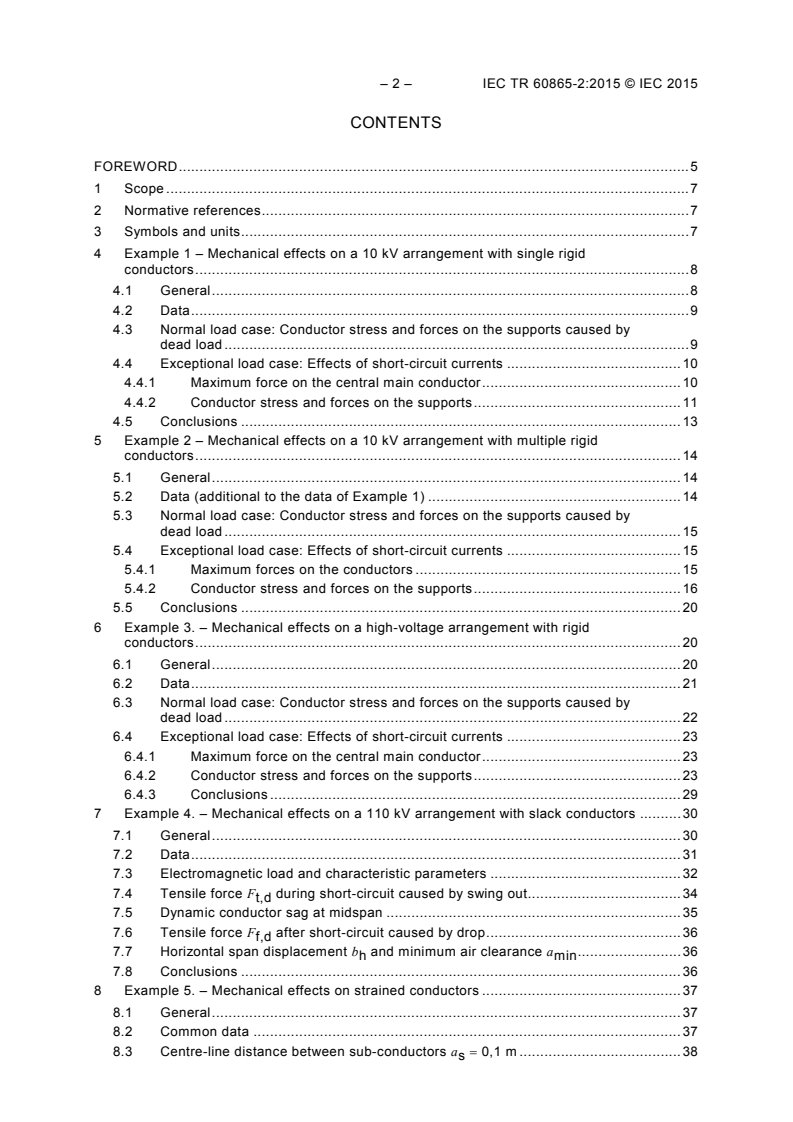
– 2 – IEC TR 60865-2:2015 © IEC 2015
CONTENTS
FOREWORD . 5
1 Scope . 7
2 Normative references . 7
3 Symbols and units . 7
4 Example 1 – Mechanical effects on a 10 kV arrangement with single rigid
conductors . 8
4.1 General . 8
4.2 Data . 9
4.3 Normal load case: Conductor stress and forces on the supports caused by
dead load . 9
4.4 Exceptional load case: Effects of short-circuit currents . 10
4.4.1 Maximum force on the central main conductor . 10
4.4.2 Conductor stress and forces on the supports . 11
4.5 Conclusions . 13
5 Example 2 – Mechanical effects on a 10 kV arrangement with multiple rigid
conductors . 14
5.1 General . 14
5.2 Data (additional to the data of Example 1) . 14
5.3 Normal load case: Conductor stress and forces on the supports caused by
dead load . 15
5.4 Exceptional load case: Effects of short-circuit currents . 15
5.4.1 Maximum forces on the conductors . 15
5.4.2 Conductor stress and forces on the supports . 16
5.5 Conclusions . 20
6 Example 3. – Mechanical effects on a high-voltage arrangement with rigid
conductors . 20
6.1 General . 20
6.2 Data . 21
6.3 Normal load case: Conductor stress and forces on the supports caused by
dead load . 22
6.4 Exceptional load case: Effects of short-circuit currents . 23
6.4.1 Maximum force on the central main conductor . 23
6.4.2 Conductor stress and forces on the supports . 23
6.4.3 Conclusions . 29
7 Example 4. – Mechanical effects on a 110 kV arrangement with slack conductors . 30
7.1 General . 30
7.2 Data . 31
7.3 Electromagnetic load and characteristic parameters . 32
7.4 Tensile force F during short-circuit caused by swing out . 34
t,d
7.5 Dynamic conductor sag at midspan . 35
7.6 Tensile force F after short-circuit caused by drop . 36
f,d
7.7 Horizontal span displacement b and minimum air clearance a . 36
h min
7.8 Conclusions . 36
8 Example 5. – Mechanical effects on strained conductors . 37
8.1 General . 37
8.2 Common data . 37
8.3 Centre-line distance between sub-conductors a = 0,1 m . 38
s
8.3.1 Electromagnetic load and characteristic parameters . 38
8.3.2 Tensile force F during short-circuit caused by swing out . 41
t,d
8.3.3 Dynamic conductor sag at midspan . 41
8.3.4 Tensile force F after short-circuit caused by drop . 42
f,d
8.3.5 Horizontal span displacement b and minimum air clearance a . 43
h min
8.3.6 Pinch force F . 43
pi,d
8.3.7 Conclusions . 43
8.4 Centre-line distance between sub-conductors a = 0,4 m . 44
s
8.4.1 Preliminary remarks . 44
8.4.2 Characteristic dimensions and parameters . 44
8.4.3 Pinch force F . 45
pi,d
8.4.4 Conclusions . 47
9 Example 6 – Mechanical effects on strained conductors with dropper in the middle
of the span . 47
9.1 General . 47
9.2 Common data . 48
9.3 Plane of the dropper parallel to the main conductors . 48
9.3.1 General . 48
9.3.2 Current flow along the whole length of the main conductor span . 49
9.3.3 Current flow along half of the length of the main conductor and along the
dropper . 57
9.4 Plane of the dropper perpendicular to the main conductors . 64
9.4.1 General . 64
9.4.2 Current flow along the whole length of the main conductor span . 64
9.4.3 Current flow along half of the length of the main conductor and along the
dropper . 69
10 Example 7 – Mechanical effects on vertical main conductors (droppers) . 77
10.1 General . 77
10.2 Data . 77
10.3 Short-circuit tensile force and maximum horizontal displacement . 78
10.4 Pinch force . 78
10.4.1 Static tensile force regarding droppers . 78
10.4.2 Characteristic dimensions and parameters . 79
10.4.3 Pinch force F . 80
pi,d
10.5 Conclusions . 81
11 Example 8 – Thermal effect on bare conductors . 81
11.1 General . 81
11.2 Data . 81
11.3 Calculations . 82
11.4 Conclusion . 82
Bibliography . 83
Figure 1 – Conductor arrangement . 8
Figure 2 – Position of the sub-conductors and connecting pieces . 14
Figure 3 – Two-span arrangement with tubular conductors. 21
Figure 4 – Arrangement with slack conductors . 31
Figure 5 – Arrangement with strained conductors . 37
Figure 6 – Arrangement with strained conductors and droppers in midspan. Plane of the
droppers parallel to the main conductors . 47
– 4 – IEC TR 60865-2:2015 © IEC 2015
Figure 7 – Possible arrangement of perpendicular droppers in three-phase system and
two-line system . 64
Figure 8 – Arrangement with strained conductors . 77
INTERNATIONAL ELECTROTECHNICAL COMMISSION
____________
SHORT-CIRCUIT CURRENTS –
CALCULATION OF EFFECTS
Part 2: Examples of calculation
FOREWORD
1) The International Electrotechnical Commission (IEC) is a worldwide organization for standardization comprising
all national electrotechnical committees (IEC National Committees). The object of IEC is to promote
international co-operation on all questions concerning standardization in the electrical and electronic fields. To
this end and in addition to other activities, IEC publishes International Standards, Technical Specifications,
Technical Reports, Publicly Available Specifications (PAS) and Guides (hereafter referred to as “IEC
Publication(s)”). Their preparation is entrusted to technical committees; any IEC National Committee interested
in the subject dealt with may participate in this preparatory work. International, governmental and non-
governmental organizations liaising with the IEC also participate in this preparation. IEC collaborates closely
with the International Organization for Standardization (ISO) in accordance with conditions determined by
agreement between the two organizations.
2) The formal decisions or agreements of IEC on technical matters express, as nearly as possible, an international
consensus of opinion on the relevant subjects since each technical committee has representation from all
interested IEC National Committees.
3) IEC Publications have the form of recommendations for international use and are accepted by IEC National
Committees in that sense. While all reasonable efforts are made to ensure that the technical content of IEC
Publications is accurate, IEC cannot be held responsible for the way in which they are used or for any
misinterpretation by any end user.
4) In order to promote international uniformity, IEC National Committees undertake to apply IEC Publications
transparently to the maximum extent possible in their national and regional publications. Any divergence
between any IEC Publication and the corresponding national or regional publication shall be clearly indicated in
the latter.
5) IEC itself does not provide any attestation of conformity. Independent certification bodies provide conformity
assessment services and, in some areas, access to IEC marks of conformity. IEC is not responsible for any
services carried out by independent certification bodies.
6) All users should ensure that they have the latest edition of this publication.
7) No liability shall attach to IEC or its directors, employees, servants or agents including individual experts and
members of its technical committees and IEC National Committees for any personal injury, property damage or
other damage of any nature whatsoever, whether direct or indirect, or for costs (including legal fees) and
expenses arising out of the publication, use of, or reliance upon, this IEC Publication or any other IEC
Publications.
8) Attention is drawn to the Normative references cited in this publication. Use of the referenced publications is
indispensable for the correct application of this publication.
9) Attention is drawn to the possibility that some of the elements of this IEC Publication may be the subject of
patent rights. IEC shall not be held responsible for identifying any or all such patent rights.
The main task of IEC technical committees is to prepare International Standards. However, a
technical committee may propose the publication of a technical report when it has collected
data of a different kind from that which is normally published as an International Standard, for
example "state of the art".
IEC TR 60865-2, which is a technical report, has been prepared by IEC technical
committee 73: Short-circuit currents.
This second edition cancels and replaces the first edition published in 1994. This edition
constitutes a technical revision.
This edition includes the following significant technical changes with respect to the previous
edition.
a) The determinations for auto reclosure together with rigid conductors have been revised.
– 6 – IEC TR 60865-2:2015 © IEC 2015
b) The configurations in cases of flexible conductor arrangements have been changed.
c) The influence of mid-span droppers to the span has been included.
d) For vertical cable-connection the displacement and the tensile force onto the lower fixing
point may be calculated now.
e) Additional recommendations for foundation loads due to tensile forces have been added.
f) The subclause for determination of the thermal equivalent short-circuits current has been
deleted (is part of IEC 60909-0:2001 now).
g) The standard IEC 60865-1:2011 has been reorganized and some of the symbols have been
changed to follow the conceptual characteristic of international standards.
The text of this technical report is based on the following documents:
Enquiry draft Report on voting
73/168/DTR 73/173/RVC
Full information on the voting for the approval of this technical report can be found in the report
on voting indicated in the above table.
This publication has been drafted in accordance with the ISO/IEC Directives, Part 2.
A list of all parts in the IEC 60865 series, published under the general title Short-circuit
currents – Calculations of effects, can be found on the IEC website.
The committee has decided that the contents of this publication will remain unchanged until the
stability date indicated on the IEC website under "http://webstore.iec.ch" in the data related to
the specific publication. At this date, the publication will be
• reconfirmed,
• withdrawn,
• replaced by a revised edition, or
• amended.
A bilingual version of this publication may be issued at a later date.
SHORT-CIRCUIT CURRENTS –
CALCULATION OF EFFECTS
Part 2: Examples of calculation
1 Scope
The object of this part of IEC 60865, which is a Technical Report, is to show the application of
procedures for the calculation of mechanical and thermal effects due to short circuits as
presented in IEC 60865-1. Thus, this technical report is an addition to IEC 60865-1. It does not,
however, change the basis for standardized procedures given in that publication.
The following points should particularly be noted:
a) The examples in this Technical Report illustrate how to make the calculations according to
IEC 60865-1 in a simplified and easy-to-follow manner. They are not intended as a check
for computer programs.
b) The numbers in parentheses at the end of the equations refer to the equations in
IEC 60865-1:2011.
c) The system voltages are referred to as nominal voltages.
d) The results are rounded to three significant digits.
e) Short-circuit effects appear as exceptional load in addition to the mechanical loads of the
normal operation of a switchgear. In the following examples with rigid conductors, a
possible static preloading is therefore calculated too. Depending on whether it concerns the
load of the normal operation or the load during the short-circuit different safety factors
come to use. The height of these factors has been chosen typically and is recommended
for the use. However, other safety factors may be necessary depending on the safety
concept.
2 Normative references
IEC 60865-1:2011, Short-Circuit Currents – Calculation of Effects – Part 1: Definitions and
calculation methods
IEC 60909-0:2001, Short-circuit currents in three-phase AC systems – Part 0: Calculation of
currents
3 Symbols and units
For symbols and units, reference is made to IEC 60865-1:2011.
In addition, the following symbols are used:
F Dead load (characteristic value) N
str,k
F Dead load (design value) N
str,d
Force on support of rigid conductors (design value) due to dead load
F N
st,r,d
h , h Height of the substructure, insulator m
S I
H Horizontal component of the force at the lower fixing point of one sub-
s
N
conductor of a dropper
– 8 – IEC TR 60865-2:2015 © IEC 2015
J Second moment of main conductor area with respect to the direction of
st,m
m
the dead load
I Steady-state short-circuit current (r.m.s) according to IEC 60909-0 A
k
l Effective length of a span m
eff
l Form factor of a span m
f
l Extend of one head armature and clamp m
h
m, n Factor for heat effect of the d.c. component and a.c. component 1
M , M Bending moment on the bottom on the substructure, insulator (design
S,d I,d
Nm
value)
V Vertical component of the force at the upper fixing point of one sub-
s
N
conductor of a dropper
W Section modulus of main conductor with respect to the direction of the
st,m 3
m
dead load
g Partial safety factor for action 1
F
Partial safety factor for material property 1
g
M
σ Bending stress caused by the dead load (design value) N/m
st,m,d
σ Bending stress caused by the dead load (characteristic value) N/m
st,m,k
4 Example 1 – Mechanical effects on a 10 kV arrangement with single rigid
conductors
4.1 General
The basis for the calculation in this example is a three-phase 10 kV busbar with one conductor
per phase. The conductors are continuous beams with equidistant simple supports. The
conductor arrangement is shown in Figure 1. According to IEC 61936-1 [1] , the calculation is
done for the normal load case considering the dead load of the busbar and the exceptional load
case considering the combination of effects of short-circuit currents and dead load.
c
m
g
a a
main conductor axis
IEC
Figure 1 – Conductor arrangement
______________
The numbers in square brackets refer to the Bibliography.
b
m
4.2 Data
Initial symmetrical three-phase short-circuit current (r.m.s.) ′′ 16 kA
I =
k
Factor for the calculation of the peak short-circuit current 1,35
k =
System frequency f 50 Hz
=
No automatic reclosing
Number of spans ≥ 3
Centre-line distance between supports l = 1 m
Centre-line distance between conductors a 0,2 m
=
Rectangular conductor EN AW-6101B T7
– Dimensions b 60 mm
=
m
c 10 mm
=
m
– Mass per unit length of main conductor 1,62 kg/m
m′ =
m
– Young’s modulus 70 000 N/mm
E =
– Stress corresponding to the yield point f = 120 N/mm to
y
180 N/mm
Conventional value of acceleration of gravity
g = 9,81 m/s
Partial safety factors; for example according to EN 1990 [2]
– Normal load case g = 1,35
F
1,1
g =
M
– Exceptional load case 1,0
g g =
F M
NOTE Safety factors differ in national standards.
4.3 Normal load case: Conductor stress and forces on the supports caused by dead
load
The dead load on the conductor is:
kg m
′
F = m lg= 1,62⋅⋅1,00 m 9,81= 15,9 N
str,k m
m
s
FF=g =1,35⋅=15,9 N 21,5 N
str,d F str,k
The conductor bending stress is:
Fl
15,9 N⋅1,00 m
str,k
62 2
s = = =0,33⋅=10 N/m 0,33 N/mm
st,m,k
−63
8W
8 ⋅⋅6 10 m
st,m
s =g s =1,35⋅=0,33 N/mm 0,45 N/mm
st,m,d F st,m,k
with
– 10 – IEC TR 60865-2:2015 © IEC 2015
c b 0,,010 ⋅0 060
4 −74
mm
J m 1,8⋅10 m
st,m
12 12
−74
J
1,8 ⋅10 m
st,m −63
W 6⋅10 m
st,m
b /2 0,03 m
m
NOTE The equation for the calculation of s gives the maximum value for two spans. The actual value for
st,m,k
three or more spans is slightly lower.
The conductors have sufficient strength if
f
y
s ≤
st,m,d
g
M
with the lower value of f . The partial safety factors for normal load case g , g see 4.2. This
y F M
gives:
f
120 N/mm
y
s 0,45 N/mm less than 109 N/mm
st,m,d
g 1,1
M
The forces on the supports are in the direction of the dead load:
– for the outer supports (A) with α = 0,4, see IEC 60865-1:2011, Table 3:
A
FF=α =0,4⋅=21,5 N 8,6 N
st,r,dA A str,d
– for the inner supports (B) with α = 1,1, see IEC 60865-1:2011, Table 3:
B
FF=α =1,1⋅=21,5 N 23,7 N
st,r,dB B str,d
NOTE In some standards the safety factors for the supports can include the partial safety factor g for action.
F
4.4 Exceptional load case: Effects of short-circuit currents
4.4.1 Maximum force on the central main conductor
The maximum electromagnetic force on the central main conductor is:
−7
m 3 l 4π ⋅10 Vs 3 1,00 m
Fi ⋅⋅ 30,6⋅10 A⋅ 803 N (2)
m3 p ( )
2ππ2 a 2 Am 2 0,202 m
m
where
iIk 2 ′′ 1,35⋅⋅2 16 kA 30,6 kA 30,6⋅10 A
pk
and the effective distance between the main conductors
a 0,20 m
a 0,202 m (6)
m
k 0,99
with k according to IEC 60865-1:2011, Figure 1 with a = a, b = b , c = c , for
12 1s s m s m
b /c = 60 mm/10 mm = 6, and a/c = 200 mm/10 mm = 20.
m m m
= ==
= = = =
= ==
== =
= = =
= = =
4.4.2 Conductor stress and forces on the supports
4.4.2.1 General
The calculations can be made according to the following 4.4.2.2 or 4.4.2.3.
4.4.2.2 Simplified method
4.4.2.2.1 Conductor bending stress
The maximum bending stress is:
Fl 803 N⋅1,00 m
m3 62 2
s =V V β =1,0⋅⋅0,73 =73,3⋅10 N/m=73,3 N/mm (9)
m,d σm rm
−63
8W
8 ⋅⋅1 10 m
m
where
V V = 1,0 (V V ) according to IEC 60865-1:2011, Table 2
sm rm sm rm max
β = 0,73 according to IEC 60865-1:2011, Table 3
−8 4
J 0,5 ⋅10 m
−6 3
m
W = = = 1⋅10 m
m
c / 2 0,005 m
m
The busbar is assumed to withstand the short-circuit force if
ss+≤ qf (11)
m,d st,m,k y
with the lower value of f . s see 4.3. For rectangular cross-section q = 1,5, see
y st,m,k
IEC 60865-1:2011, Table 4. This gives:
2 2 2 22
ss+=73,3 N/mm+ 0,33 N/mm=73,6 N/mm less than qf=1,5⋅120 N/mm=180 N/mm
m,d st,m,k y
4.4.2.2.2 Forces on the supports
The equivalent static force on the supports is:
F = VV α F (15)
r,d F rm m3
According to IEC 60865-1:2011, Table 2, with the upper value of f and s = s + s it
y tot,d m,d st,m,k
is:
s
73,6 N/mm
tot,d
0,511
0,8 f
0,8 ⋅180 N/mm
y
Therefore, with a three-phase short-circuit we meet range 2 in IEC 60865-1:2011, Table 2,
s
tot,d
0,370 << 1
0,8 f
y
hence
==
– 12 – IEC TR 60865-2:2015 © IEC 2015
0,8 f
y
VV 1,96
F rm
s 0,511
tot,d
For the outer supports (A) it is with α = 0,4, see IEC 60865-1:2011, Table 3:
A
F = VV α F = 1,96⋅⋅0,4 803 N= 630 N
r,dA F rm A m3
For the inner supports (B) it is with α = 1,1, see IEC 60865-1:2011, Table 3:
B
F VV α F 1,96⋅⋅1,1 803 N 1731N
r,dB F rm B m3
4.4.2.3 Detailed method
4.4.2.3.1 Relevant natural frequency f and factors V , V and V
cm F rm sm
The relevant natural frequency of the main conductor is:
10 2 −8 4
g E J 3,56 7 ⋅10 N/m ⋅0,5 ⋅10 m
m
f==⋅=52,3 Hz (16)
cm
′
m 1,62 kg/m
l
m
(1,00 m)
where
g = 3,56 according to IEC 60865-1:2011, Table 3
-8 4
J = 0,5 ⋅ 10 m see 4.4.2.2.1
m
The frequency ratio is:
f 52,3 Hz
cm
1,05
f 50 Hz
From Figure 4 and 5.7.3 of IEC 60865-1:2011, the following values for the factors V , V and
F sm
V are obtained:
rm
V = 1,8
F
V = 1,0
σm
V = 1,0
rm
4.4.2.3.2 Conductor bending stress
The maximum bending stress is:
Fl 803 N⋅1,00 m
m3 62 2
s = V V β = 1,0⋅⋅1,0 0,73⋅ = 73,3⋅10 N/m= 73,3 N/mm (9)
m,d σm rm
−63
8W
8 ⋅⋅1 10 m
m
where
V V = 1,0⋅1,0 according to 4.4.2.3.1
sm rm
β = 0,73 according to IEC 60865-1:2011, Table 3
-6 3
W = 1⋅10 m see 4.4.2.2.1
m
The busbar is assumed to withstand the short-circuit force if
==
= = =
===
ss+≤ qf (11)
m,d st,m,k y
with the lower value of f . s see 4.3. For rectangular cross-section q = 1,5, see
y st,m,k
IEC 60865-1:2011, Table 4. This gives:
2 2 2 22
ss+=73,3 N/mm+ 0,33 N/mm=73,6 N/mm less than qf=1,5⋅120 N/mm=180 N/mm
m,d st,m,k y
4.4.2.3.3 Forces on the supports
The equivalent static force on supports becomes:
F = VV α F (15)
r,d F rm m3
According to IEC 60865-1:2011, Table 2, with the upper value of f and s = s + s it
y tot,d m,d st,m,k
is:
s
73,6 N/mm
tot,d
0,511
0,8 f
0,8 ⋅180 N/mm
y
Therefore, with a three-phase short-circuit we meet range 2 in IEC 60865-1:2011, Table 2,
s
tot,d
0,370 << 1
0,8 f
y
hence
0,8 f
y
VV 1,96
F rm
s 0,511
tot,d
According to 4.4.2.3.1 above, VV = 1,8⋅1,0= 1,8 which is less than the value 1,96 according
F rm
to IEC 60865-1:2011, Table 2.
For the outer supports (A) it is with α = 0,4, see IEC 60865-1:2011, Table 3:
A
F = VV α F = 1,8⋅⋅1,0 0,4⋅803 N= 578 N
r,dA F rm A m3
For the inner supports (B) it is with α = 1,1, see IEC 60865-1:2011, Table 3:
B
F = VV α F = 1,8⋅1,0⋅⋅1,1 803 N= 1590 N
r,dB F rm B m3
4.5 Conclusions
The busbar will withstand the dead load
The calculated bending stress is s 1 N/mm
st,m,d
The outer supports have to withstand a vertical force
F 9 N
st,r,dA
of
The inner supports have to withstand a vertical force
F 24 N
st,r,dB
of
===
==
– 14 – IEC TR 60865-2:2015 © IEC 2015
Simplified Detailed
method method
The busbar will withstand the short-circuit load
2 2
The calculated bending stress is 74 N/mm 74 N/mm
s
tot,d
The outer supports have to withstand an equivalent
F 630 N 580 N
r,dA
static force of
The inner supports have to withstand an equivalent
F 1 740 N 1 590 N
r,dB
static force of
The stresses and forces are rounded.
The forces calculated with the detailed method are less than calculated with the simplified
method.
5 Example 2 – Mechanical effects on a 10 kV arrangement with multiple rigid
conductors
5.1 General
The basis for the calculation in this example is the same three-phase 10 kV busbar as in
Example 1, but now with three sub-conductors per main conductor as shown in Figure 2. The
cross-sections of the sub-conductors are 60 mm × 10 mm as the conductors of Example 1. The
connecting pieces are spacers. According to IEC 61936-1 [1], the calculation is done for the
normal load case considering the dead load of the busbar and the exceptional load case
considering the combination of effects of short-circuit currents and dead load.
l
l
s
c
s
c
s
IEC
Figure 2 – Position of the sub-conductors and connecting pieces
5.2 Data (additional to the data of Example 1)
Number of sub-conductors n 3
=
Dimension of sub-conductor in the direction of the force c 10 mm
=
s
Number of sets of spacers k 2
=
Centre-line distance between connecting pieces 0,5 m
l =
s
Dimension of spacers of EN AW-6101B T7 60 mm × 60 mm ×
10 mm
c
m
5.3 Normal load case: Conductor stress and forces on the supports caused by dead
load
In 4.3 (Example 1), the following values are calculated for one conductor
Dead load of the conductor F 15,9 N
=
str,k
F 21,5 N
=
str,d
Conductor bending stress 0,33 N/mm
s =
st,m,k
0,45 N/mm
s =
st,m,d
In this Example 2, the conductor bending stress is the same as in Example 1, 4.3. According to
the number of sub-conductors, the vertical forces on the supports are n times higher
– for the outer supports (A) with α = 0,4, see IEC 60865-1:2011, Table 3:
A
F =nFα =3⋅0,4⋅ 21,5 N=25,8 N
st,r,dA A str,d
– for the inner supports (B) with α = 1,1, see IEC 60865-1:2011, Table 3:
B
F =nFα =3⋅⋅1,1 21,5 N=71,0 N
st,r,dB B str,d
5.4 Exceptional load case: Effects of short-circuit currents
5.4.1 Maximum forces on the conductors
5.4.1.1 Maximum force on the central main conductor
The maximum electromagnetic force on the central main conductor is:
−7
m 3 l 4π ⋅10 Vs 3 1,00 m
Fi ⋅⋅ 30,6⋅10 A⋅ 811N (2)
m3 p ( )
2ππ2 a 2 Am 2 0,20 m
m
where
iIk 2 ′′ 1,35⋅⋅2 16 kA 30,6 kA 30,6⋅10 A
pk
and the effective distance between the main conductors
a 0,2 m
a 0,20 m (6)
m
k 1,00
with k according to IEC 60865-1:2011, Figure 1 with a = a, b = b , c = c , for
12 1s s m s m
b /c = 60 mm/50 mm = 1,2 and a/c = 200 mm/50 mm = 4. The dimensions b and c are
m m m m m
shown in IEC 60865-1:2011, Figure 2 b).
5.4.1.2 Maximum force on the sub-conductor
The maximum electromagnetic force on the outer sub-conductor between two adjacent
connecting pieces is:
−73
i
m l 4π ⋅⋅10 Vs 30,6 10 A 0,5 m
p
0s
F= = ⋅ ⋅=515 N (4)
s
-3
2π na 2π Am 3
20,2 ⋅10 m
s
where
= ==
= = = =
= ==
– 16 – IEC TR 60865-2:2015 © IEC 2015
1 kk 0,60 0,78 1
12 13
= += + = (8)
aa a 20 mm 40 mm 20,2 mm
s 12 13
with k and k from IEC 60865-1:2011, Figure 1:
12 13
– k = 0,60 for a /c = 20 mm/10 mm = 2 and b /c = b /c = 60 mm/10 mm = 6
12 12 s s s m s
– k = 0,78 for a /c = 40 mm/10 mm = 4 and b /c = b /c = 60 mm/10 mm = 6
13 13 s s s m s
or a from IEC 60865-1:2011, Table 1.
s
5.4.2 Conductor stress and forces on the supports
5.4.2.1 General
The calculations can be made according to 5.4.2.2 or 5.4.2.3.
5.4.2.2 Simplified method
5.4.2.2.1 Bending stress caused by the forces between the main conductors
The maximum bending stress caused by the forces between the main conductors is:
Fl 811N⋅1,00 m
62 2
m3
s =V V β =1,0⋅⋅0,73 =24,7⋅10 N/m=24,7 N/mm (9)
m,d σm rm
−63
8W
8 ⋅⋅3 10 m
m
where
V V 1,0 V V according to IEC 60865-1, Table 2
( )
σm rm σm rm
max
β = 0,73 according to IEC 60865-1, Table 3
cb 0,,010 ⋅0 060
ss 4 −84
J m 0,5⋅10 m
s
12 12
−84
J 0,5 ⋅10 m
s −63
W 1⋅10 m
s
c /2 0,005 m
s
−63 −63
W = nW = 3⋅⋅1 10 m = 3⋅10 m according to IEC 60865-1, 5.4.2
ms
5.4.2.2.2 Bending stress caused by the forces between the sub-conductors
The maximum bending stress caused by the forces between the sub-conductors is:
F l 515 N⋅0,5 m
ss 62 2
s =V V =1,0⋅ =16,1⋅10 N/m=16,1N/mm (10)
s,d σs rs
−63
16W
s 16 ⋅⋅1 10 m
where
V V = 1,0 = (V V ) according to IEC 60865-1:2011, Table 2
σs rs σs rs
max
-6 3
W = 1⋅10 m see 5.4.2.2.1
s
5.4.2.2.3 Total conductor stress
The total conductor stress is with the stresses calculated in 5.4.2.2.1, 5.4.2.2.2 and 5.3:
22 2 2
s = s ++ss = 24,7 N/mm+16,1N/mm+ 0,33 N/mm= 41,1N/mm (12)
tot,d m,d s,d st,m,k
= = =
= = =
= =
The busbar is assumed to withstand the short-circuit force if
s ≤ qf (13)
tot,d y
with the lower value of f . For rectangular cross-sections q = 1,5, see IEC 60865-1:2011, Table
y
4 or 5.4.2. This gives:
2 22
s =41,1N/mm less than qf=1,5⋅=120 N/mm 180 N/mm
tot,d y
It is recommended that the stress caused by the forces between sub-conductors holds
s ≤ f (14)
s,d y
with the lower value of f . This gives:
y
2 2
s 16,1N/mm less than f 120 N/mm
s,d y
5.4.2.2.4 Forces on the supports
The equivalent static force on supports is:
F = VV α F (15)
r,d F rm m3
According to IEC 60865-1:2011, Table 2, with the upper value of f it is:
y
s
41,1N/mm
tot,d
0,285
0,8 f
0,8 ⋅180 N/mm
y
therefore with a three-phase short-circuit we meet range 1 in IEC 60865-1:2011, Table 2,
s
tot,d
< 0,370
0,8 f
y
hence
VV = 2,7
F rm
For the outer supports (A) it is with α = 0,4, see IEC 60865-1:2011, Table 3:
A
F = VV α F = 2,7⋅0,4⋅811N= 876 N
r,dA F rm A m3
For the inner supports (B) it is with α = 1,1, see IEC 60865-1:2011, Table 3:
B
F = VV α F = 2,7⋅⋅1,1 811N= 2409 N
r,dB F rm B m3
==
==
– 18 – IEC TR 60865-2:2015 © IEC 2015
5.4.2.3 Detailed method
5.4.2.3.1 Relevant natural frequency f of the main conductors, f of the sub-
cm cs
conductors and factors V , V , V , V and V
F sm ss rm rs
The relevant natural frequency of the main conductors is:
10 2 −8 4
g E J 3,56 7 ⋅10 N/m ⋅0,5 ⋅10 m
s
fe= =0,97⋅⋅ =50,8 Hz (17)
cm
2 2
′
m 1,62 kg/m
l
s 1,00 m
( )
where
l
s
e = 0,97 according to IEC 60865-1:2011, Figure 3c), for k = 2 = 0,5and the radio
l
m 1,62 kg/m ⋅ 0,06 m ⋅ 2
z
= = 0,04
′
nm l 3 ⋅1,62 kg/m ⋅1,00 m
s
g = 3,56 according to IEC 60865-1:2011, Table 3
-8 4
J = 0,5⋅10 m see 5.4.2.2.1
s
The relevant natural frequency of the sub-conductors is:
10 2 −8 4
3,56 E J 3,56 7 ⋅10 N/m ⋅0,5 ⋅10 m
s
f==⋅=209 Hz (18)
cs
′
m 1,62 kg/m
l s
0,5 m
s ( )
The frequency ratios are:
f 50,8 Hz
cm
1,02
f 50 Hz
f 209 Hz
cs
4,18
f 50 Hz
This gives from IEC 60865-1:2011, Figure 4 and 5.7.3, the following values for the factors V ,
F
V , V , V and V :
sm ss rm rs
V = 1,8
F
VV1,0 1,0
σm σs
VV1,0 1,0
rm rs
5.4.2.3.2 Bending stress caused by the forces between the main conductors
The maximum bending stress caused by the forces between the main conductors is:
Fl 811N⋅1,00 m
62 2
m3
s = V V β = 1,0⋅⋅1,0 0,73⋅ = 24,7⋅10 N/m= 24,7 N/mm (9)
m,d σm rm
−63
8W
8 ⋅⋅3 10 m
m
where
V V = 1,0⋅1,0 according to 5.4.2.3.1
sm rm
β = 0,73 according to IEC 60865-1:2011, Table 3
==
==
==
==
-6 3
= 3⋅10 m see 5.4.2.2.1
W
m
5.4.2.3.3 Bending stress caused by the forces between the sub-conductors
The maximum bending stress caused by the forces between the sub-conductors is:
F l 515 N⋅0,5 m
ss 62 2
s = V V = 1,0⋅⋅1,0 = 16,1⋅10 N/m= 16,1N/mm (10)
s,d σs rs
−63
16W
16 ⋅⋅1 10 m
s
where
V V = 1,0⋅1,0 according to 5.4.2.3.1
ss rs
-6 3
W = 1⋅10 m see 5.4.2.2.1
s
5.4.2.3.4 Total bending stress in the busbar
The total conductor stress is with the stresses calculated in 5.4.2.3.2 and 5.4.2.3.3 and 5.3:
22 2 2
s = s ++ss = 24,7 N/mm+16,1N/mm+ 0,33 N/mm= 41,1N/mm (12)
tot,d m,d s,d st,m,k
The busbar is assumed to withstand the short-circuit force if
s ≤ qf (13)
tot,d y
with the lower value of f . For rectangular cross-sections q = 1,5, see IEC 60865-1:2011, Table
y
4. This gives:
2 22
s =41,1N/mm less than qf=1,5⋅=120 N/mm 180 N/mm
tot,d y
It is recommended a value
s ≤ f (14)
s,d y
with the lower value of f . This gives:
y
2 2
s 16,1N/mm less than f 120 N/mm
s,d y
5.4.2.3.5 Forces on the supports
The equivalent static force on supports is:
F = VV α F (15)
r,d F rm m3
According to IEC 60865-1:2011, Table 2, with the upper value of f it is:
y
s
41,1N/mm
tot,d
0,285
0,8 f
0,8 ⋅180 N/mm
y
Therefore with a three-phase short-circuit we meet range 1 in IEC 60865-1:2011, Table 2,
==
==
– 20 – IEC TR 60865-2:2015 © IEC 2015
s
tot,d
< 0,370
0,8 f
y
hence
VV = 2,7
F rm
According to 5.4.2.3.1 above, V V = 1,8 · 1,0 = 1,8, which is less than the value 2,7 obtained
F rm
from IEC 60865-1:2011, Table 2.
For the outer supports (A) it is with α = 0,4, see IEC 60865-1:2011, Table 3:
A
F = VV α F = 1,8⋅⋅1,0 0,4⋅811N= 584 N
r,dA F rm A m3
For the inner supports (B) it is with α = 1,1; see IEC 60865-1:2011, Table 3:
B
F = VV α F = 1,8⋅1,0⋅⋅1,1 811N= 1606 N
r,dB F rm B m3
5.5 Conclusions
The busbar will withstand the dead load
The calculated bending stress is s 1 N/mm
st,m,d
The outer supports have to withstand a vertical force
F 26 N
st,r,dA
of
The inner supports have to withstand a vertical force
F 71 N
st,r,dB
of
Simplified Detailed
method method
The busbar will withstand the short-circuit force
2 2
The calculated bending stresses are s 42 N/mm 42 N/mm
tot,d
2 2
17 N/mm 17 N/mm
s
s,d
The outer supports have to withstand an equivalent
F 880 N 590 N
r,dA
static force of
The inner supports have to withstand an equivalent
F 2 410 N 1 610 N
r,dB
static force of
The forces calculated with the detailed method are less than calculated with the simplified
method.
6 Example 3. – Mechanical effects on a high-voltage arrangement with rigid
conductors
6.1 General
The basis for the calculation in this example is a three-phase 380 kV busbar, with one tubular
conductor per phase. The conductor arrangement is shown in Figure 3. This example includes
calculations without and with automatic reclosing. Without automatic reclosing only one short-
circuit current duration exists, with automatic reclosing two short-circuit current durations exist
with an interval without current flow.
According to IEC 61936-1 [1], the calculation is done for the normal load case considering the
dead load of the busbar and the exceptional load case considering the combination of effects
of short-circuit currents and dead load.
l l
IEC
Figure 3 – Two-span arrangement with tubular conductors
6.2 Data
Initial symmetrical three-phase short-circuit current (r.m.s.) 50 kA
I′′ =
k
Factor for the calculation of the peak short-circuit current 1,81
k =
System frequency f = 50 Hz
Number of spans 2
Centre-line distance between supports l 18 m
=
Centre-line distance between conductors a 5 m
=
Height of the insulator with clamp h 3,7 m
=
I
Height of the support h 7,0 m
=
S
Tubular conductor 160 mm × 6 mm EN AW-6101B T6
– Mass per unit length m′ = 7,84 kg/m
m
– Outer diameter d = 160 mm
– Wall thickness t = 6 mm
– Young’s modulus E 70 000 N/mm
=
a a h
l
h
s
– 22 – IEC TR 60865-2:2015 © IEC 2015
– Stress corresponding to the yield point f = 160 N/mm to
y
240 N/mm
Conventional value of acceleration of gravity g = 9,81 m/s
Partial safety factors; for example according to EN 1990 [2]
– Normal load case 1,35
g =
F
1,1
g =
M
– Exceptional load case 1,0
g g =
F M
NOTE Safety factors differ in national standards.
6.3 Normal load case: Conductor stress and forces on the supports caused by dead
load
The dead load on the conductor is
kg m
′
F m lg 7,84⋅⋅18 m 9,81 1384 N
str.k m
m
s
FF=g =1,35⋅=1384 N 1868 N
str,d F str,k
The conductor bending stress is
Fl
1384 N⋅18 m
str 62 2
s == =28,8⋅=10 N/m 28,8 N/mm
st,m,k
−63
...