

IEC 60754-3:2018
(Main)Test on gases evolved during combustion of materials from cables - Part 3: Measurement of low level of halogen content by ion chromatography
General Information
- Abstract
IEC 60754-3:2018 specifies the apparatus and procedure for the measurement of the amount of halogens evolved during the combustion of materials taken from electric or optical fibre cable constructions.
The method specified in this document is intended for the measurement of the content of chlorine (Cl), bromine (Br), fluorine (F) and iodine (I), by using the analytical technique of ion chromatography for analysing an aqueous solution resulting from the gases evolved during the combustion.
The heating (combustion) procedure in this part of IEC 60754 is the same as in IEC 60754-2.
The method is intended for materials with an individual halogen content not exceeding 10 mg/g.
The method specified in this document is intended for the testing of individual components used in a cable construction. The use of this method will enable the verification of requirements which are stated in the appropriate cable specification for individual components of a cable construction.
For reasons of precision, this method is not recommended for detecting values of halogens less than 0,1 mg/g of the sample taken.
- Status
- Published
- Publication Date
- 18-Mar-2018
- Technical Committee
- TC 20 - Electric cables
- Drafting Committee
- WG 18 - TC 20/WG 18
- Current Stage
- PPUB - Publication issued
- Start Date
- 19-Mar-2018
- Completion Date
- 13-Apr-2018
Buy Documents
IEC 60754-3:2018 - Test on gases evolved during combustion of materials from cables - Part 3: Measurement of low level of halogen content by ion chromatography Released:3/19/2018
IEC 60754-3:2018 - Test on gases evolved during combustion of materials from cables - Part 3: Measurement of low level of halogen content by ion chromatography Released:3/19/2018
Overview - IEC 60754-3:2018 (ion chromatography, low‑level halogen measurement)
IEC 60754-3:2018 specifies a laboratory method to measure low levels of halogen content released when materials from electric or optical-fibre cable constructions are burned. The method captures combustion gases in water and quantifies chlorine (Cl), bromine (Br), fluorine (F) and iodine (I) by ion chromatography (IC). It uses the same heating/combustion procedure as IEC 60754-2 and is intended for materials with an individual halogen content up to 10 mg/g. For precision reasons this method is not recommended for reporting values below 0.1 mg/g.
Key technical topics and requirements
- Scope and purpose: Measurement of individual halogen contents in gases evolved from cable component combustion to verify cable specification limits or “halogen‑free” claims.
- Analytical technique: Ion chromatography of an aqueous solution produced by bubbling combustion effluent through distilled/demineralized water.
- Test apparatus (selected): tube furnace, quartz combustion tube, combustion boat, gas‑bubbling wash bottles, controlled air supply, analytical balance, laboratory glassware and an IC system.
- Test limits: Intended for individual halogen contents ≤ 10 mg/g; not reliable below 0.1 mg/g.
- Normative references and compatibility: Incorporates laboratory water and volumetric glassware standards (ISO 3696, ISO 1042) and aligns with liquid chromatography anion methods (ISO 10304-1).
- Linked procedures: Shares heating/absorption procedure with IEC 60754-2 (pH and conductivity); complements IEC 60754-1 (total halogen acid gas content).
Practical applications and who uses this standard
- Cable manufacturers and material suppliers: quality control of individual insulation, sheath or accessory components and verification of low-halogen materials.
- Independent testing laboratories: routine IC analysis for product certification and supplier validation.
- Specification writers and procurement: define acceptance criteria in cable specifications and supplier contracts (e.g., pre-qualification for “halogen‑free” materials).
- Fire safety and electrical engineers: assess potential corrosivity and toxic halogen release (used along with IEC 60754-1/2 and guidance such as IEC 60695-5-1).
Benefits include high analytical accuracy in the low concentration range (thanks to ion chromatography) and direct measurement of individual halogens for detailed material assessment.
Related standards
- IEC 60754-1 - Determination of halogen acid gas content
- IEC 60754-2 - Determination of acidity (pH) and conductivity; same heating procedure
- IEC 60695-5-1 - Guidance on corrosivity of fire effluent
- ISO 10304-1, ISO 3696, ISO 1042 - Relevant analytical and laboratory equipment/water standards
Keywords: IEC 60754-3:2018, ion chromatography, halogen content, cable combustion gases, halogen‑free testing, chlorine, bromine, fluorine, iodine, cable testing standards.
Buy Documents
IEC 60754-3:2018 - Test on gases evolved during combustion of materials from cables - Part 3: Measurement of low level of halogen content by ion chromatography Released:3/19/2018
IEC 60754-3:2018 - Test on gases evolved during combustion of materials from cables - Part 3: Measurement of low level of halogen content by ion chromatography Released:3/19/2018
Get Certified
Connect with accredited certification bodies for this standard

IMQ S.p.A. (Certification)
Italian electrical product certification.

SLG Prüf- und Zertifizierungs GmbH
German testing and certification body.

UL Solutions
Global safety science company with testing, inspection and certification.
Sponsored listings
Frequently Asked Questions
IEC 60754-3:2018 is a standard published by the International Electrotechnical Commission (IEC). Its full title is "Test on gases evolved during combustion of materials from cables - Part 3: Measurement of low level of halogen content by ion chromatography". This standard covers: IEC 60754-3:2018 specifies the apparatus and procedure for the measurement of the amount of halogens evolved during the combustion of materials taken from electric or optical fibre cable constructions. The method specified in this document is intended for the measurement of the content of chlorine (Cl), bromine (Br), fluorine (F) and iodine (I), by using the analytical technique of ion chromatography for analysing an aqueous solution resulting from the gases evolved during the combustion. The heating (combustion) procedure in this part of IEC 60754 is the same as in IEC 60754-2. The method is intended for materials with an individual halogen content not exceeding 10 mg/g. The method specified in this document is intended for the testing of individual components used in a cable construction. The use of this method will enable the verification of requirements which are stated in the appropriate cable specification for individual components of a cable construction. For reasons of precision, this method is not recommended for detecting values of halogens less than 0,1 mg/g of the sample taken.
IEC 60754-3:2018 specifies the apparatus and procedure for the measurement of the amount of halogens evolved during the combustion of materials taken from electric or optical fibre cable constructions. The method specified in this document is intended for the measurement of the content of chlorine (Cl), bromine (Br), fluorine (F) and iodine (I), by using the analytical technique of ion chromatography for analysing an aqueous solution resulting from the gases evolved during the combustion. The heating (combustion) procedure in this part of IEC 60754 is the same as in IEC 60754-2. The method is intended for materials with an individual halogen content not exceeding 10 mg/g. The method specified in this document is intended for the testing of individual components used in a cable construction. The use of this method will enable the verification of requirements which are stated in the appropriate cable specification for individual components of a cable construction. For reasons of precision, this method is not recommended for detecting values of halogens less than 0,1 mg/g of the sample taken.
IEC 60754-3:2018 is classified under the following ICS (International Classification for Standards) categories: 13.220.40 - Ignitability and burning behaviour of materials and products; 29.060.20 - Cables. The ICS classification helps identify the subject area and facilitates finding related standards.
IEC 60754-3:2018 is available in PDF format for immediate download after purchase. The document can be added to your cart and obtained through the secure checkout process. Digital delivery ensures instant access to the complete standard document.
Standards Content (Sample)
IEC 60754-3 ®
Edition 1.0 2018-03
INTERNATIONAL
STANDARD
Test on gases evolved during combustion of materials from cables –
Part 3: Measurement of low level of halogen content by ion chromatography
All rights reserved. Unless otherwise specified, no part of this publication may be reproduced or utilized in any form
or by any means, electronic or mechanical, including photocopying and microfilm, without permission in writing from
either IEC or IEC's member National Committee in the country of the requester. If you have any questions about IEC
copyright or have an enquiry about obtaining additional rights to this publication, please contact the address below or
your local IEC member National Committee for further information.
IEC Central Office Tel.: +41 22 919 02 11
3, rue de Varembé info@iec.ch
CH-1211 Geneva 20 www.iec.ch
Switzerland
About the IEC
The International Electrotechnical Commission (IEC) is the leading global organization that prepares and publishes
International Standards for all electrical, electronic and related technologies.
About IEC publications
The technical content of IEC publications is kept under constant review by the IEC. Please make sure that you have the
latest edition, a corrigenda or an amendment might have been published.
IEC Catalogue - webstore.iec.ch/catalogue Electropedia - www.electropedia.org
The stand-alone application for consulting the entire The world's leading online dictionary of electronic and
bibliographical information on IEC International Standards, electrical terms containing 21 000 terms and definitions in
Technical Specifications, Technical Reports and other English and French, with equivalent terms in 16 additional
documents. Available for PC, Mac OS, Android Tablets and languages. Also known as the International Electrotechnical
iPad. Vocabulary (IEV) online.
IEC publications search - webstore.iec.ch/advsearchform IEC Glossary - std.iec.ch/glossary
The advanced search enables to find IEC publications by a 67 000 electrotechnical terminology entries in English and
variety of criteria (reference number, text, technical French extracted from the Terms and Definitions clause of
committee,…). It also gives information on projects, replaced IEC publications issued since 2002. Some entries have been
and withdrawn publications. collected from earlier publications of IEC TC 37, 77, 86 and
CISPR.
IEC Just Published - webstore.iec.ch/justpublished
Stay up to date on all new IEC publications. Just Published IEC Customer Service Centre - webstore.iec.ch/csc
details all new publications released. Available online and If you wish to give us your feedback on this publication or
also once a month by email. need further assistance, please contact the Customer Service
Centre: sales@iec.ch.
IEC 60754-3 ®
Edition 1.0 2018-03
INTERNATIONAL
STANDARD
Test on gases evolved during combustion of materials from cables –
Part 3: Measurement of low level of halogen content by ion chromatography
INTERNATIONAL
ELECTROTECHNICAL
COMMISSION
ICS 13.220.40; 29.060.20 ISBN 978-2-8322-5484-4
– 2 – IEC 60754-3:2018 © IEC 2018
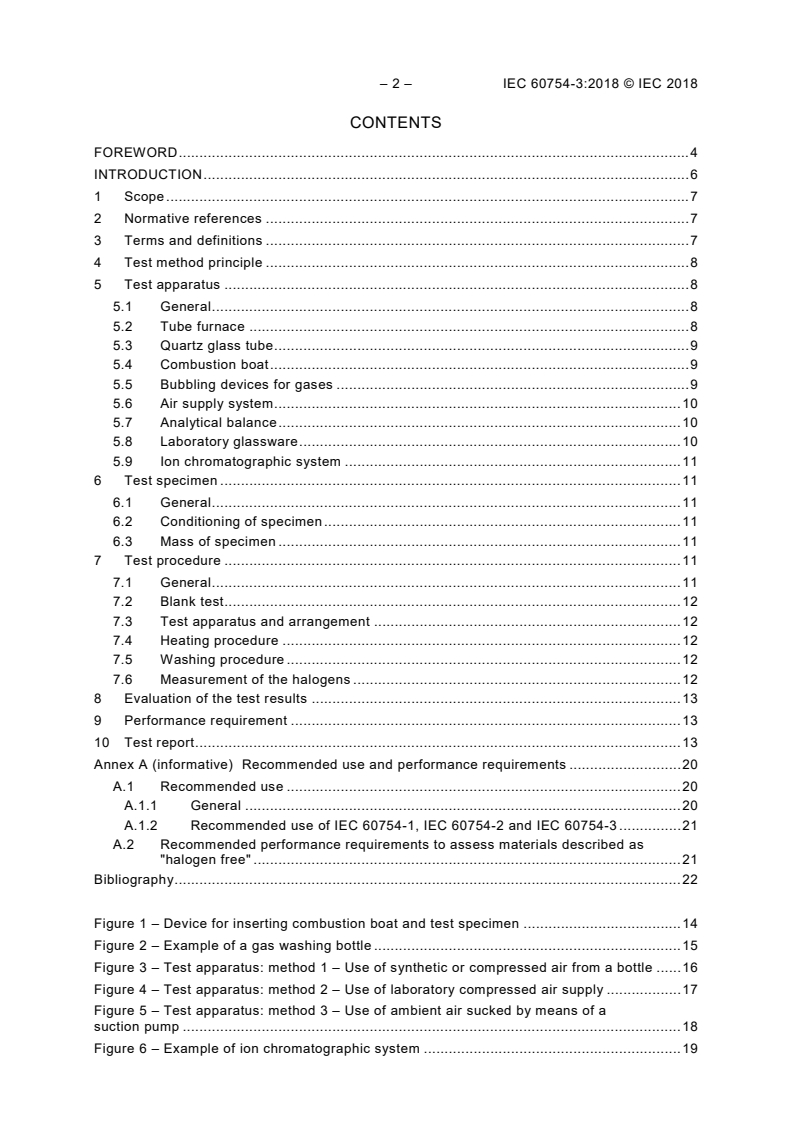
CONTENTS
FOREWORD . 4
INTRODUCTION . 6
1 Scope . 7
2 Normative references . 7
3 Terms and definitions . 7
4 Test method principle . 8
5 Test apparatus . 8
5.1 General . 8
5.2 Tube furnace . 8
5.3 Quartz glass tube . 9
5.4 Combustion boat . 9
5.5 Bubbling devices for gases . 9
5.6 Air supply system . 10
5.7 Analytical balance . 10
5.8 Laboratory glassware . 10
5.9 Ion chromatographic system . 11
6 Test specimen . 11
6.1 General . 11
6.2 Conditioning of specimen . 11
6.3 Mass of specimen . 11
7 Test procedure . 11
7.1 General . 11
7.2 Blank test . 12
7.3 Test apparatus and arrangement . 12
7.4 Heating procedure . 12
7.5 Washing procedure . 12
7.6 Measurement of the halogens . 12
8 Evaluation of the test results . 13
9 Performance requirement . 13
10 Test report . 13
Annex A (informative) Recommended use and performance requirements . 20
A.1 Recommended use . 20
A.1.1 General . 20
A.1.2 Recommended use of IEC 60754-1, IEC 60754-2 and IEC 60754-3 . 21
A.2 Recommended performance requirements to assess materials described as
"halogen free" . 21
Bibliography . 22
Figure 1 – Device for inserting combustion boat and test specimen . 14
Figure 2 – Example of a gas washing bottle . 15
Figure 3 – Test apparatus: method 1 – Use of synthetic or compressed air from a bottle . 16
Figure 4 – Test apparatus: method 2 – Use of laboratory compressed air supply . 17
Figure 5 – Test apparatus: method 3 – Use of ambient air sucked by means of a
suction pump . 18
Figure 6 – Example of ion chromatographic system . 19
Table A.1 – Scope and recommended use of IEC 60754-1, IEC 60754-2 and
IEC 60754-3 . 21
Table A.2 – Recommended performance requirements to assess materials described
as "halogen free" . 21
– 4 – IEC 60754-3:2018 © IEC 2018
INTERNATIONAL ELECTROTECHNICAL COMMISSION
____________
TEST ON GASES EVOLVED DURING
COMBUSTION OF MATERIALS FROM CABLES –
Part 3: Measurement of low level of halogen
content by ion chromatography
FOREWORD
1) The International Electrotechnical Commission (IEC) is a worldwide organization for standardization comprising
all national electrotechnical committees (IEC National Committees). The object of IEC is to promote
international co-operation on all questions concerning standardization in the electrical and electronic fields. To
this end and in addition to other activities, IEC publishes International Standards, Technical Specifications,
Technical Reports, Publicly Available Specifications (PAS) and Guides (hereafter referred to as “IEC
Publication(s)”). Their preparation is entrusted to technical committees; any IEC National Committee interested
in the subject dealt with may participate in this preparatory work. International, governmental and non-
governmental organizations liaising with the IEC also participate in this preparation. IEC collaborates closely
with the International Organization for Standardization (ISO) in accordance with conditions determined by
agreement between the two organizations.
2) The formal decisions or agreements of IEC on technical matters express, as nearly as possible, an international
consensus of opinion on the relevant subjects since each technical committee has representation from all
interested IEC National Committees.
3) IEC Publications have the form of recommendations for international use and are accepted by IEC National
Committees in that sense. While all reasonable efforts are made to ensure that the technical content of IEC
Publications is accurate, IEC cannot be held responsible for the way in which they are used or for any
misinterpretation by any end user.
4) In order to promote international uniformity, IEC National Committees undertake to apply IEC Publications
transparently to the maximum extent possible in their national and regional publications. Any divergence
between any IEC Publication and the corresponding national or regional publication shall be clearly indicated in
the latter.
5) IEC itself does not provide any attestation of conformity. Independent certification bodies provide conformity
assessment services and, in some areas, access to IEC marks of conformity. IEC is not responsible for any
services carried out by independent certification bodies.
6) All users should ensure that they have the latest edition of this publication.
7) No liability shall attach to IEC or its directors, employees, servants or agents including individual experts and
members of its technical committees and IEC National Committees for any personal injury, property damage or
other damage of any nature whatsoever, whether direct or indirect, or for costs (including legal fees) and
expenses arising out of the publication, use of, or reliance upon, this IEC Publication or any other IEC
Publications.
8) Attention is drawn to the Normative references cited in this publication. Use of the referenced publications is
indispensable for the correct application of this publication.
9) Attention is drawn to the possibility that some of the elements of this IEC Publication may be the subject of
patent rights. IEC shall not be held responsible for identifying any or all such patent rights.
International Standard IEC 60754-3 has been prepared by IEC technical committee 20:
Electric cables.
The text of this International Standard is based on the following documents:
FDIS Report on voting
20/1784/FDIS 20/1791/RVD
Full information on the voting for the approval of this International Standard can be found in
the report on voting indicated in the above table.
This document has been drafted in accordance with the ISO/IEC Directives, Part 2.
A list of all the parts in the IEC 60754 series, published under the general title Test on gases
evolved during combustion of materials from cables, can be found on the IEC website.
The committee has decided that the contents of this document will remain unchanged until the
stability date indicated on the IEC website under "http://webstore.iec.ch" in the data related to
the specific document. At this date, the document will be
• reconfirmed,
• withdrawn,
• replaced by a revised edition, or
• amended.
A bilingual version of this publication may be issued at a later date.
– 6 – IEC 60754-3:2018 © IEC 2018
INTRODUCTION
IEC 60754 consists of the following parts, under the general title: Test on gases evolved
during combustion of materials from cables:
– Part 1: Determination of the halogen acid gas content
– Part 2: Determination of acidity (by pH measurement) and conductivity
– Part 3: Measurement of low level of halogen content by ion chromatography
NOTE Guidance on the corrosivity of fire effluent is given in IEC 60695-5-1.
IEC 60754-1 and IEC 60754-2 were developed due to concerns expressed by cable users
over the amount of acid gas which is evolved when some cable insulating, sheathing and
other materials are burned, as this acid and such corrosive effluents can cause extensive
damage to electrical and electronic equipment not involved in the fire itself.
IEC 60754-1 provides a method for determining the amount of acid gases evolved by burning
cable components so that limits can be agreed for cable specifications.
IEC 60754-2 provides a method for determining the acidity (by pH measurement) and
conductivity of an aqueous solution of gases evolved during the combustion of materials so
that limits can be agreed for cable specifications
IEC 60754-1 is not able to determine hydrofluoric acid and, for reasons of precision, this
method is not recommended for reporting values of halogen acid evolved less than 5 mg/g of
the sample taken.
This document provides a method for measurement of low level of halogen content of the
gases evolved by burning cable and has a high accuracy in the low range of concentration.
The ion chromatic system has an inherently high accuracy. However, the overall accuracy of
the test method is limited by other factors (see Annex A for further information).
This part of IEC 60754 is linked with IEC 60754-2, using the same test procedure for
obtaining the absorption solution.
TEST ON GASES EVOLVED DURING
COMBUSTION OF MATERIALS FROM CABLES –
Part 3: Measurement of low level of halogen
content by ion chromatography
1 Scope
This part of IEC 60754 specifies the apparatus and procedure for the measurement of the
amount of halogens evolved during the combustion of materials taken from electric or optical
fibre cable constructions.
The method specified in this document is intended for the measurement of the content of
chlorine (Cl), bromine (Br), fluorine (F) and iodine (I), by using the analytical technique of ion
chromatography for analysing an aqueous solution resulting from the gases evolved during
the combustion.
The heating (combustion) procedure in this part of IEC 60754 is the same as in IEC 60754-2.
The method is intended for materials with an individual halogen content not exceeding
10 mg/g.
The method specified in this document is intended for the testing of individual components
used in a cable construction. The use of this method will enable the verification of
requirements which are stated in the appropriate cable specification for individual components
of a cable construction.
NOTE 1 The relevant cable standard indicates which components of the cable are tested.
NOTE 2 This test method is sometimes used to test materials to be used in cable manufacture.
For reasons of precision, this method is not recommended for detecting values of halogens
less than 0,1 mg/g of the sample taken.
2 Normative references
The following documents are referred to in the text in such a way that some or all of their
content constitutes requirements of this document. For dated references, only the edition
cited applies. For undated references, the latest edition of the referenced document (including
any amendments) applies.
ISO 1042, Laboratory glassware – One-mark volumetric flasks
ISO 3696, Water for analytical laboratory use – Specification and test methods
ISO 10304-1, Water quality – Determination of dissolved anions by liquid chromatography of
ions – Part 1: Determination of bromide, chloride, fluoride, nitrate, nitrite, phosphate and
sulfate
3 Terms and definitions
For the purposes of this document, the following terms and definitions apply.
– 8 – IEC 60754-3:2018 © IEC 2018
ISO and IEC maintain terminological databases for use in standardization at the following
addresses:
• IEC Electropedia: available at http://www.electropedia.org/
• ISO Online browsing platform: available at http://www.iso.org/obp
3.1
halogen
element of periodic table group 17, specifically fluorine, chlorine, bromine, iodine
3.2
individual halogen content
amount of a halogen in a test specimen that can be converted to water soluble halide ion in
the gaseous combustion effluent from the test specimen
Note 1 to entry: Halide ions are fluoride, chloride, bromide or iodide.
Note 2 to entry: The halogen in the test specimen may be in the form of organic or inorganic compounds.
Note 3 to entry: The individual halogen content is expressed as milligrams of halogen per gram of test specimen.
Note 4 to entry: Halide ions in any solid combustion residue that remains in the combustion boat are not
measured by this test method.
4 Test method principle
The material under test shall be heated in a stream of dry air. The evolved gases shall be
trapped by bubbling through wash bottles filled with distilled or demineralized water.
Each individual halogen content of the resulting solution shall then be determined by using ion
chromatography (IC).
The ion chromatography analysis can be done off line and does not have to be in line.
5 Test apparatus
5.1 General
The apparatus is shown in Figure 1 to Figure 5.
The assembly of the components which constitute the test apparatus shall be leak-tight. The
connecting distances between the quartz glass tube and the first bottle and between
subsequent bottles shall be as short as possible. Quartz glass or polypropylene tubing shall
be used for these connections, unless it is not required to measure and report fluorine, in
which case glass or silicone rubber may be used.
At the exit side of the quartz glass tube, as close to the end as possible, it is permitted to
place a plug of silica wool to aid collection of condensates.
A third empty bottle, of the same size as the gas washing bottles, placed before the gas
washing bottles may be used to improve safety, i.e. to prevent suck-back of water into the
quartz glass tube.
5.2 Tube furnace
The length of the heating zone of the furnace shall be within the range 480 mm to 620 mm
and its inside
...
IEC 60754-3 ®
Edition 1.0 2018-03
INTERNATIONAL
STANDARD
NORME
INTERNATIONALE
Test on gases evolved during combustion of materials from cables –
Part 3: Measurement of low level of halogen content by ion chromatography
Essai sur les gaz émis lors de la combustion des matériaux prélevés sur
câbles –
Partie 3: Mesure d’une faible teneur en halogène par chromatographie ionique
All rights reserved. Unless otherwise specified, no part of this publication may be reproduced or utilized in any form
or by any means, electronic or mechanical, including photocopying and microfilm, without permission in writing from
either IEC or IEC's member National Committee in the country of the requester. If you have any questions about IEC
copyright or have an enquiry about obtaining additional rights to this publication, please contact the address below or
your local IEC member National Committee for further information.
Droits de reproduction réservés. Sauf indication contraire, aucune partie de cette publication ne peut être reproduite
ni utilisée sous quelque forme que ce soit et par aucun procédé, électronique ou mécanique, y compris la photocopie
et les microfilms, sans l'accord écrit de l'IEC ou du Comité national de l'IEC du pays du demandeur. Si vous avez des
questions sur le copyright de l'IEC ou si vous désirez obtenir des droits supplémentaires sur cette publication, utilisez
les coordonnées ci-après ou contactez le Comité national de l'IEC de votre pays de résidence.
IEC Central Office Tel.: +41 22 919 02 11
3, rue de Varembé info@iec.ch
CH-1211 Geneva 20 www.iec.ch
Switzerland
About the IEC
The International Electrotechnical Commission (IEC) is the leading global organization that prepares and publishes
International Standards for all electrical, electronic and related technologies.
About IEC publications
The technical content of IEC publications is kept under constant review by the IEC. Please make sure that you have the
latest edition, a corrigenda or an amendment might have been published.
IEC Catalogue - webstore.iec.ch/catalogue Electropedia - www.electropedia.org
The stand-alone application for consulting the entire The world's leading online dictionary of electronic and
bibliographical information on IEC International Standards, electrical terms containing 21 000 terms and definitions in
Technical Specifications, Technical Reports and other English and French, with equivalent terms in 16 additional
documents. Available for PC, Mac OS, Android Tablets and languages. Also known as the International Electrotechnical
iPad. Vocabulary (IEV) online.
IEC publications search - webstore.iec.ch/advsearchform IEC Glossary - std.iec.ch/glossary
The advanced search enables to find IEC publications by a 67 000 electrotechnical terminology entries in English and
variety of criteria (reference number, text, technical French extracted from the Terms and Definitions clause of
committee,…). It also gives information on projects, replaced IEC publications issued since 2002. Some entries have been
and withdrawn publications. collected from earlier publications of IEC TC 37, 77, 86 and
CISPR.
IEC Just Published - webstore.iec.ch/justpublished
Stay up to date on all new IEC publications. Just Published IEC Customer Service Centre - webstore.iec.ch/csc
details all new publications released. Available online and If you wish to give us your feedback on this publication or
also once a month by email. need further assistance, please contact the Customer Service
Centre: sales@iec.ch.
A propos de l'IEC
La Commission Electrotechnique Internationale (IEC) est la première organisation mondiale qui élabore et publie des
Normes internationales pour tout ce qui a trait à l'électricité, à l'électronique et aux technologies apparentées.
A propos des publications IEC
Le contenu technique des publications IEC est constamment revu. Veuillez vous assurer que vous possédez l’édition la
plus récente, un corrigendum ou amendement peut avoir été publié.
Catalogue IEC - webstore.iec.ch/catalogue Electropedia - www.electropedia.org
Application autonome pour consulter tous les renseignements
Le premier dictionnaire en ligne de termes électroniques et
bibliographiques sur les Normes internationales,
électriques. Il contient 21 000 termes et définitions en anglais
Spécifications techniques, Rapports techniques et autres
et en français, ainsi que les termes équivalents dans 16
documents de l'IEC. Disponible pour PC, Mac OS, tablettes
langues additionnelles. Egalement appelé Vocabulaire
Android et iPad.
Electrotechnique International (IEV) en ligne.
Recherche de publications IEC -
Glossaire IEC - std.iec.ch/glossary
webstore.iec.ch/advsearchform
67 000 entrées terminologiques électrotechniques, en anglais
La recherche avancée permet de trouver des publications IEC et en français, extraites des articles Termes et Définitions des
en utilisant différents critères (numéro de référence, texte, publications IEC parues depuis 2002. Plus certaines entrées
comité d’études,…). Elle donne aussi des informations sur les antérieures extraites des publications des CE 37, 77, 86 et
projets et les publications remplacées ou retirées. CISPR de l'IEC.
IEC Just Published - webstore.iec.ch/justpublished Service Clients - webstore.iec.ch/csc
Restez informé sur les nouvelles publications IEC. Just Si vous désirez nous donner des commentaires sur cette
Published détaille les nouvelles publications parues. publication ou si vous avez des questions contactez-nous:
Disponible en ligne et aussi une fois par mois par email. sales@iec.ch.
IEC 60754-3 ®
Edition 1.0 2018-03
INTERNATIONAL
STANDARD
NORME
INTERNATIONALE
Test on gases evolved during combustion of materials from cables –
Part 3: Measurement of low level of halogen content by ion chromatography
Essai sur les gaz émis lors de la combustion des matériaux prélevés sur
câbles –
Partie 3: Mesure d’une faible teneur en halogène par chromatographie ionique
INTERNATIONAL
ELECTROTECHNICAL
COMMISSION
COMMISSION
ELECTROTECHNIQUE
INTERNATIONALE
ICS 13.220.40; 29.060.20 ISBN 978-2-8322-6167-5
– 2 – IEC 60754-3:2018 © IEC 2018
CONTENTS
FOREWORD . 4
INTRODUCTION . 6
1 Scope . 7
2 Normative references . 7
3 Terms and definitions . 7
4 Test method principle . 8
5 Test apparatus . 8
5.1 General . 8
5.2 Tube furnace . 8
5.3 Quartz glass tube . 9
5.4 Combustion boat . 9
5.5 Bubbling devices for gases . 9
5.6 Air supply system . 10
5.7 Analytical balance . 10
5.8 Laboratory glassware . 10
5.9 Ion chromatographic system . 11
6 Test specimen . 11
6.1 General . 11
6.2 Conditioning of specimen . 11
6.3 Mass of specimen . 11
7 Test procedure . 11
7.1 General . 11
7.2 Blank test . 12
7.3 Test apparatus and arrangement . 12
7.4 Heating procedure . 12
7.5 Washing procedure . 12
7.6 Measurement of the halogens . 12
8 Evaluation of the test results . 13
9 Performance requirement . 13
10 Test report . 13
Annex A (informative) Recommended use and performance requirements . 20
A.1 Recommended use . 20
A.1.1 General . 20
A.1.2 Recommended use of IEC 60754-1, IEC 60754-2 and IEC 60754-3 . 21
A.2 Recommended performance requirements to assess materials described as
"halogen free" . 21
Bibliography . 22
Figure 1 – Device for inserting combustion boat and test specimen . 14
Figure 2 – Example of a gas washing bottle . 15
Figure 3 – Test apparatus: method 1 – Use of synthetic or compressed air from a bottle . 16
Figure 4 – Test apparatus: method 2 – Use of laboratory compressed air supply . 17
Figure 5 – Test apparatus: method 3 – Use of ambient air sucked by means of a
suction pump . 18
Figure 6 – Example of ion chromatographic system . 19
Table A.1 – Scope and recommended use of IEC 60754-1, IEC 60754-2 and
IEC 60754-3 . 21
Table A.2 – Recommended performance requirements to assess materials described
as "halogen free" . 21
– 4 – IEC 60754-3:2018 © IEC 2018
INTERNATIONAL ELECTROTECHNICAL COMMISSION
____________
TEST ON GASES EVOLVED DURING
COMBUSTION OF MATERIALS FROM CABLES –
Part 3: Measurement of low level of halogen
content by ion chromatography
FOREWORD
1) The International Electrotechnical Commission (IEC) is a worldwide organization for standardization comprising
all national electrotechnical committees (IEC National Committees). The object of IEC is to promote
international co-operation on all questions concerning standardization in the electrical and electronic fields. To
this end and in addition to other activities, IEC publishes International Standards, Technical Specifications,
Technical Reports, Publicly Available Specifications (PAS) and Guides (hereafter referred to as “IEC
Publication(s)”). Their preparation is entrusted to technical committees; any IEC National Committee interested
in the subject dealt with may participate in this preparatory work. International, governmental and non-
governmental organizations liaising with the IEC also participate in this preparation. IEC collaborates closely
with the International Organization for Standardization (ISO) in accordance with conditions determined by
agreement between the two organizations.
2) The formal decisions or agreements of IEC on technical matters express, as nearly as possible, an international
consensus of opinion on the relevant subjects since each technical committee has representation from all
interested IEC National Committees.
3) IEC Publications have the form of recommendations for international use and are accepted by IEC National
Committees in that sense. While all reasonable efforts are made to ensure that the technical content of IEC
Publications is accurate, IEC cannot be held responsible for the way in which they are used or for any
misinterpretation by any end user.
4) In order to promote international uniformity, IEC National Committees undertake to apply IEC Publications
transparently to the maximum extent possible in their national and regional publications. Any divergence
between any IEC Publication and the corresponding national or regional publication shall be clearly indicated in
the latter.
5) IEC itself does not provide any attestation of conformity. Independent certification bodies provide conformity
assessment services and, in some areas, access to IEC marks of conformity. IEC is not responsible for any
services carried out by independent certification bodies.
6) All users should ensure that they have the latest edition of this publication.
7) No liability shall attach to IEC or its directors, employees, servants or agents including individual experts and
members of its technical committees and IEC National Committees for any personal injury, property damage or
other damage of any nature whatsoever, whether direct or indirect, or for costs (including legal fees) and
expenses arising out of the publication, use of, or reliance upon, this IEC Publication or any other IEC
Publications.
8) Attention is drawn to the Normative references cited in this publication. Use of the referenced publications is
indispensable for the correct application of this publication.
9) Attention is drawn to the possibility that some of the elements of this IEC Publication may be the subject of
patent rights. IEC shall not be held responsible for identifying any or all such patent rights.
International Standard IEC 60754-3 has been prepared by IEC technical committee 20:
Electric cables.
This bilingual version (2018-11) corresponds to the monolingual English version, published in
2018-03.
The text of this International Standard is based on the following documents:
FDIS Report on voting
20/1784/FDIS 20/1791/RVD
Full information on the voting for the approval of this International Standard can be found in
the report on voting indicated in the above table.
The French version of this standard has not been voted upon.
This document has been drafted in accordance with the ISO/IEC Directives, Part 2.
A list of all the parts in the IEC 60754 series, published under the general title Test on gases
evolved during combustion of materials from cables, can be found on the IEC website.
The committee has decided that the contents of this document will remain unchanged until the
stability date indicated on the IEC website under "http://webstore.iec.ch" in the data related to
the specific document. At this date, the document will be
• reconfirmed,
• withdrawn,
• replaced by a revised edition, or
• amended.
– 6 – IEC 60754-3:2018 © IEC 2018
INTRODUCTION
IEC 60754 consists of the following parts, under the general title: Test on gases evolved
during combustion of materials from cables:
– Part 1: Determination of the halogen acid gas content
– Part 2: Determination of acidity (by pH measurement) and conductivity
– Part 3: Measurement of low level of halogen content by ion chromatography
NOTE Guidance on the corrosivity of fire effluent is given in IEC 60695-5-1.
IEC 60754-1 and IEC 60754-2 were developed due to concerns expressed by cable users
over the amount of acid gas which is evolved when some cable insulating, sheathing and
other materials are burned, as this acid and such corrosive effluents can cause extensive
damage to electrical and electronic equipment not involved in the fire itself.
IEC 60754-1 provides a method for determining the amount of acid gases evolved by burning
cable components so that limits can be agreed for cable specifications.
IEC 60754-2 provides a method for determining the acidity (by pH measurement) and
conductivity of an aqueous solution of gases evolved during the combustion of materials so
that limits can be agreed for cable specifications
IEC 60754-1 is not able to determine hydrofluoric acid and, for reasons of precision, this
method is not recommended for reporting values of halogen acid evolved less than 5 mg/g of
the sample taken.
This document provides a method for measurement of low level of halogen content of the
gases evolved by burning cable and has a high accuracy in the low range of concentration.
The ion chromatic system has an inherently high accuracy. However, the overall accuracy of
the test method is limited by other factors (see Annex A for further information).
This part of IEC 60754 is linked with IEC 60754-2, using the same test procedure for
obtaining the absorption solution.
TEST ON GASES EVOLVED DURING
COMBUSTION OF MATERIALS FROM CABLES –
Part 3: Measurement of low level of halogen
content by ion chromatography
1 Scope
This part of IEC 60754 specifies the apparatus and procedure for the measurement of the
amount of halogens evolved during the combustion of materials taken from electric or optical
fibre cable constructions.
The method specified in this document is intended for the measurement of the content of
chlorine (Cl), bromine (Br), fluorine (F) and iodine (I), by using the analytical technique of ion
chromatography for analysing an aqueous solution resulting from the gases evolved during
the combustion.
The heating (combustion) procedure in this part of IEC 60754 is the same as in IEC 60754-2.
The method is intended for materials with an individual halogen content not exceeding
10 mg/g.
The method specified in this document is intended for the testing of individual components
used in a cable construction. The use of this method will enable the verification of
requirements which are stated in the appropriate cable specification for individual components
of a cable construction.
NOTE 1 The relevant cable standard indicates which components of the cable are tested.
NOTE 2 This test method is sometimes used to test materials to be used in cable manufacture.
For reasons of precision, this method is not recommended for detecting values of halogens
less than 0,1 mg/g of the sample taken.
2 Normative references
The following documents are referred to in the text in such a way that some or all of their
content constitutes requirements of this document. For dated references, only the edition
cited applies. For undated references, the latest edition of the referenced document (including
any amendments) applies.
ISO 1042, Laboratory glassware – One-mark volumetric flasks
ISO 3696, Water for analytical laboratory use – Specification and test methods
ISO 10304-1, Water quality – Determination of dissolved anions by liquid chromatography of
ions – Part 1: Determination of bromide, chloride, fluoride, nitrate, nitrite, phosphate and
sulfate
3 Terms and definitions
For the purposes of this document, the following terms and definitions apply.
– 8 – IEC 60754-3:2018 © IEC 2018
ISO and IEC maintain terminological databases for use in standardization at the following
addresses:
• IEC Electropedia: available at http://www.electropedia.org/
• ISO Online browsing platform: available at http://www.iso.org/obp
3.1
halogen
element of periodic table group 17, specifically fluorine, chlorine, bromine, iodine
3.2
individual halogen content
amount of a halogen in a test specimen that can be converted to water soluble halide ion in
the gaseous combustion effluent from the test specimen
Note 1 to entry: Halide ions are fluoride, chloride, bromide or iodide.
Note 2 to entry: The halogen in the test specimen may be in the form of organic or inorganic compounds.
Note 3 to entry: The individual halogen content is expressed as milligrams of halogen per gram of test specimen.
Note 4 to entry: Halide ions in any solid combustion residue that remains in the combustion boat are not
measured by this test method.
4 Test method principle
The material under test shall be heated in a stream of dry air. The evolved gases shall be
trapped by bubbling through wash bottles filled with distilled or demineralized water.
Each individual halogen content of the resulting solution shall then be determined by using ion
chromatography (IC).
The ion chromatography analysis can be done off line and does not have to be in line.
5 Test apparatus
5.1 General
The apparatus is shown in Figure 1 to Figure 5.
The assembly of the components which constitute the test apparatus shall be leak-tight. The
connecting distances between the quartz glass tube and the first bottle and between
subsequent bottles shall be as short as possible. Quartz glass or polypropylene tubing shall
be used for these connections, unless it is not required to measure and report fluorine, in
which case glass or silicone rubber may be used.
At the exit side of the quartz glass tube, as close to the end as possible, it is permitted to
place a plug of silica wool to aid collection of condensates.
A third empty bottle, of the same size as the gas washing bottles, placed before the gas
washing bottles may be used to improve safety, i.e. to prevent suck-back of water into the
quartz glass tube.
5.2 Tube furnace
The length of the heating zone of the furnace shall be within the range 480 mm to 620 mm
and its inside diameter shall be within the range 38 mm to 62 mm. It shall be equipped with an
adjustable electrical heating system.
5.3 Quartz glass tube
For the test, a quartz glass tube shall be introduced into the tube furnace. The tube shall be
approximately concentric to the furnace. It shall be resistant to the action of corrosive gases.
The inside diameter of the tube shall be within the range 30 mm to 46 mm. The tube shall
protrude on the entrance side of the furnace by a length of between 60 mm to 200 mm, and
on the exit side by between 60 mm to 100 mm. The initial clearance shall allow for thermal
expansion. For the purposes of measurement of the protrusion distances, the tube shall be
regarded as that part of essentially constant diameter.
The outer diameter of the tube should be chosen with due regard to the inside diameter of the
tube furnace.
Prior to each test, the tube shall be cleaned throughout its length by being calcined at
approximately 950 °C.
5.4 Combustion boat
The combustion boat shall be made of porcelain, fused quartz or soapstone. In case the
method is used to report fluorine, the combustion boat shall be made of quartz glass. The
combustion boat shall have the following dimensions:
– external length: within the range 45 mm to 100 mm;
– external width: within the range 12 mm to 30 mm;
– internal depth: within the range 5 mm to 10 mm.
The dimensions of the boat should be chosen with due regard to the inside diameter of the
quartz tube.
The preferred method for insertion of the combustion boat into the quartz glass tube is shown
in Figure 1.
Prior to each test, the combustion boat shall be washed and calcined in a muffle furnace at
approximately 950 °C for 4 h, after which it shall be introduced into a desiccator and cooled to
ambient temperature. The combustion boat shall then be weighed with a precision of
≤ 0,1 mg until two identical consecutive weights are obtained. This weight m shall be
recorded.
5.5 Bubbling devices for gases
At the exit of the quartz glass tube, the evolved gases shall be trapped by bubbling through
two wash bottles (see Figure 2), each containing approximately 450 ml of distilled or
demineralized water of a purity at least Grade 3 in accordance with ISO 3696.
The wash bottles shall be made of quartz glass, unless it is not required to measure and
report fluorine, in which case wash bottles made of glass may be used.
The pH value of the water shall be between 5,5 and 7,5, and the conductivity less than
0,5 µS/mm.
A magnetic stirrer shall be introduced in the first wash bottle, to get a good swirling motion
and an effective absorption of the combustion gases. The tubes into the wash bottles shall
have a maximum internal diameter at their tip of 5 mm, in order to aid absorption.
The height of the liquid above the end of the tube shall be (110 ± 10) mm in each bottle.
NOTE Use of a wash bottle of internal diameter approximately 75 mm will enable this requirement to be met.
– 10 – IEC 60754-3:2018 © IEC 2018
5.6 Air supply system
The gas used for combustion shall be air.
The flow rate of air, ρ, shall be 20 m/h x (π/4) x D with a tolerance of ± 10 %, where D is the
internal diameter of the quartz tube.
EXAMPLES
If D = 30 mm, 20 m/h × (π/4) × D = 14,1 l/h, and the flow rate can be in the range 12,7 l/h to 15,5 l/h.
If D = 46 mm, 20 m/h × (π/4) × D = 33,2 l/h, and the flow rate can be in the range 29,9 l/h to 36,5 l/h.
NOTE The flow rate of air, ρ, is related to the velocity, v, according to the formula
π D
[1]
ρ= v×
where
D is the internal diameter of the tube (mm);
ρ is the flow rate of air (ml/h);
v is the speed of air (ml/mm /h).
If v = 20 m/h, this becomes, ρ = 15,7 m/h × D
The air supply shall be adjusted and controlled by a needle valve, and the flow rate monitored
by a flowmeter of the appropriate range.
The air supplied shall be selected from one of the following methods:
Method 1
This method uses synthetic air or compressed air from a bottle. The air shall be introduced on
the inlet side of the quartz glass tube (see Figure 3).
Method 2
This method uses a laboratory compressed air supply. The air shall be filtered and dried and
shall be introduced on the inlet side of the quartz glass tube (see Figure 4).
Method 3
This method uses the ambient air of the laboratory. The air shall be filtered and dried. In this
case, the mixture of air and combustion gas shall be sucked by a pump (see Figure 5).
5.7 Analytical balance
The balance shall have a precision of ± 0,1 mg or better.
5.8 Laboratory glassware
The following laboratory glassware shall be available:
– one mark volumetric flask in accordance with ISO 1042 class B with 1 000 ml capacity.
The volumetric flask shall be made of quartz glass or polypropylene, unless it is not required
to measure and report fluorine, in which case a volumetric flask made of glass may be used.
5.9 Ion chromatographic system
In general, the ion chromatographic system consists of the following components (see
Figure 6):
– eluent reservoir;
– IC pump;
– sample injection system, incorporating a sample loop of appropriate volume (e.g. 0,02 ml)
or auto sample device;
– precolumn or guard column;
– separation column;
– suppressor;
– conductivity detector.
6 Test specimen
6.1 General
Two test specimens, each consisting of (1 000 ± 5) mg of the material to be tested, shall be
prepared. Each test specimen shall be taken from a cable sample representative of the
material. Each test specimen shall be cut into a number of smaller pieces.
NOTE Pieces with a maximum dimension of 3 mm have been found to be suitable.
6.2 Conditioning of specimen
The prepared test specimens shall be stored for at least 16 h at a temperature of (23 ± 2) °C
and a relative humidity of (50 ± 5) %.
6.3 Mass of specimen
Weigh the combustion boat ( m ) with a precision of ≤ 0,1 mg (see 5.4). After conditioning, the
test specimen shall be put into the combustion boat and evenly distributed on the bottom of the
boat, which shall be weighed with a precision of ≤ 0,1 mg. The weight ( m ) shall be recorded.
The mass m of the test specimen shall be calculated as follows:
m= m − m [2]
2 1
where
m is the mass of the test specimen in grams;
m is the mass of the combustion boat in grams;
m is the mass of the combustion boat with the test specimen, in grams.
7 Test procedure
7.1 General
The test procedure shall be carried out using the apparatus detailed in Clause 5.
After a satisfactory blank test procedure (see 7.2), the test procedure and measurement of the
individual halogen content shall be carried out on each test specimen.
– 12 – IEC 60754-3:2018 © IEC 2018
7.2 Blank test
A blank test, i.e. with no test specimen in the boat, shall be carried out under the same
conditions as when a test specimen is present.
If the result of this blank test is too high compared with the limit of measurement, check that
all components of the test apparatus are clean, especially the boat and quartz glass tube.
Repeat the blank test procedure until a satisfactory result is obtained.
7.3 Test apparatus and arrangement
The test procedure shall be carried out using the apparatus detailed in Clause 5.
7.4 Heating procedure
The air flow shall be adjusted by means of a needle valve to the value specified in 5.6 and
shall be kept constant during the test.
The temperature shall be measured by a thermocouple suitably protected against corrosion
and placed inside the quartz glass tube. The heating system shall be adjusted such that the
temperature at the designated position for the boat shall be not less than 935 °C and not
more than 965 °C. The temperature at a position approximately 300 mm from the
designated position in the direction of the air flow shall be not less than 900 °C.
The boat containing the test specimen shall be quickly inserted into the heating zone of the
tube to the designated position determined by the thermocouple measurement and the timer
shall be started. The combustion boat shall be placed in such a way that the distance between
the boat and the exit end of the effective heating zone is at least 300 mm. The effective
heating zone is that zone where a temperature of not less than 900 °C has been determined
by the thermocouple measurement.
The combustion procedure, under the air flow condition, shall be continued for (30 ± 1) min in
the furnace.
WARNING The operator should take precautions, e.g. the wearing of eye protection and suitable protective
clothing, because certain materials ignite quickly and can cause "blow back" of hot gases. Care should also be
taken to avoid over-pressurization of the system, and to allow for venting of exhaust gases. Guidance on the
avoidance of "blow back" is given in 5.1.
7.5 Washing procedure
Following the heating procedure, all the bottles used shall be disconnected, and the contents
washed into a 1 000 ml volumetric flask. Using water with the properties given in 5.5, the
bottles, the connecting links and, after cooling, the end of the quartz glass tube including the
silica wool (if used) shall also be washed into the flask, and the contents made up to the
1 000 ml mark.
7.6 Measurement of the halogens
The absorption solution obtained shall be analyzed using ion chromatography.
The ion chromatographic analysis shall be carried out according to ISO 10304-1.
a) Set up the IC equipment according to the instrument manufacturer’s instructions.
b) Run the eluent and wait for a stable baseline.
c) Perform the calibration.
d) Measure the samples.
For the purpose of this test, five calibration solutions shall be made up with concentrations of
the anions in the range of 0,1 mg/g to 1 mg/g.
The concentration of anions in the absorption solution may be higher than 1 mg/g. Therefore,
in order to complete the analysis, a dilution shall be made and an appropriate correction
applied. The individual halogen content, expressed as milligrams per gram of test specimen
taken, shall be determined for each halogen.
In case where the ion chromatography analysis cannot be performed immediately, the
absorption solution should be stored at not more than 6 °C in a polypropylene container or
otherwise as recommended by the IC specialist.
8 Evaluation of the test results
Calculate the individual halogen content, in units of mg/g, using the equation [3]:
X = (C ∙ V)/m [3]
i i
where
X is the individual halogen content ("i" = Cl, Br, I or F);
i
C is the concentration of this element, "i", in the absorption solution;
i
V is the final volume of the absorption solution;
m is the mass of the test specimen.
EXAMPLE In the case where the concentration of chloride ion in the absorption solution, C , is 1 mg/l, the final
Cl
volume of the absorption solution is 1 000 ml and the mass of the test specimen is 1 000 mg, then X becomes
Cl
(1 mg/l × 1 000 ml / 1 000 mg) = (1 mg/l × 1 l / 1 g) = 1 mg/g.
The individual halogen content shall be taken as the mean of the determination of the two test
specimens.
If the difference in two results is greater than 0,1 mg/g and if the ratio of the standard
deviation to the mean is greater than 0,25, the test results should be discarded and the test
procedure should be repeated.
9 Performance requirement
No performance requirements are included in this document.
If no performance requirement is given in the relevant cable specification, it is recommended
that the guidance in Annex A is followed.
10 Test report
The test report shall include the following information:
a) a full description of the material tested and the cable from which it was taken;
b) the number of this document;
c) the individual halogen content for fluorine, for chlorine, for bromine and for iodine;
d) a description of the ion chromatography equipment.
– 14 – IEC 60754-3:2018 © IEC 2018
2 5
6 7 9 8
IEC
Key
synthetic air or compressed air, filtered and dried 6 bar magnets
2 glass tube 7 platinum wire
3 thermocouple 8 combustion boat
4 quartz glass tube 9 standard ground joint, size in correlation to the diameter of the quartz glass tube
5 test specimen 10 furnace
Figure 1 – Device for inserting combustion boat and test specimen
IEC
Key
1 magnetic stirring bar h 100 mm to 120 mm
Figure 2 – Example of a gas washing bottle
h
– 16 – IEC 60754-3:2018 © IEC 2018
3 4
10 7 12
IEC
Key
1 pressure reducing valve 7 gas washing bottles
2 flow meter 8 synthetic air
3 quartz glass tube 9 device for inserting combustion boat containing test specimen
4 furnace 10 combustion boat containing test specimen
5 needle valve 11 magnetic stirrer
6 thermocouple 12 magnetic stirring bar
13 optional empty bottle to prevent suck-back of water into the quartz glass tube
Figure 3 – Test apparatus: method 1 – Use of synthetic or compressed air from a bottle
11 12
14 10
IEC
Key
1 pressure reducing valve 7 activated charcoal 13 device for inserting combustion boat containing test specimen
2 flow meter 8 silica gel 14 combustion boat containing test specimen
3 quartz glass tube 9 thermocouple 15 magnetic stirring bar
4 furnace 10 gas washing bottles 16 magnetic stirrer
5 compressed air 11 air filtering 17 optional empty bottle to prevent suck-back of water into the quartz
glass tube
6 needle valve 12 air drying
Figure 4 – Test apparatus: method 2 – Use of laboratory compressed air supply
– 18 – IEC 60754-3:2018 © IEC 2018
3 1
11 12
14 9
IEC
Key
1 flow meter 7 silica gel 13 device for inserting combustion boat containing test specimen
2 furnace 8 thermocouple 14 combustion boat containing test specimen
3 ambient air 9 gas washing bottles 15 magnetic stirring bar
4 quartz glass tube 10 suction pump 16 magnetic stirrer
5 needle valve 11 air filtering 17 optional empty bottle to prevent suck-back of water into the quartz
glass tube
6 activated charcoal 12 air drying
Figure 5 – Test apparatus: method 3 – Use of ambient air sucked by means of a suction pump
Sample
Separation
Eluent IC pump Precolumn Suppressor CD detector Waste
column
Recorder
IEC
Figure 6 – Example of ion chromatographic system
– 20 – IEC 60754-3:2018 © IEC 2018
Annex A
(informative)
Recommended use and performance requirements
A.1 Recommended use
A.1.1 General
The test method indicated in this document can be used to measure low levels of halogens in
the gases evolved during the combustion of materials. For the purpose of this document, the
materials are taken from electric or optical fibre cable constructions.
To assess halogens in materials, it is a common technique to combust the material to release
the components, absorb the components in an absorption solution and measure the content in
the absorption solution using ion chromatography.
NOTE 1 IEC 62321-3-2 by TC 111 is a test method based on combustion ion chromatography for the assessment
of halogens for environmental purposes.
The method is suitable to assess materials or compounds from cables described as “halogen
free”, where the term "halogen free" means that less than a defined low level of halogen is
present in the combustion effluent from the material or compound (see Clause A.2).
NOTE 2 ”Halogen free”, when defined in this way, does not necessarily mean that the material or compound
contains no halogen.
The test is suitable for measuring halogens in the combustion effluent from materials with
both low and high level of halogens, but in the case of high level of halogens, the method is
not intended to measure the level with high accuracy.
In case of measuring the content of chlorine and bromide in the combustion effluent from
materials having a halogen acid gas content above 5 mg/g, the method of IEC 60754-1 should
be used.
The ion chromatography procedure has an inherently high accuracy. However, it is limited in
this case to the measurements of halide ions in the solution of the combustion effluent from
the sample under test.
Only a part of the halogens in the material under test will be measured by this method, for
reasons such as the following:
– part of the halogens might remain in the ashes/residue in the combustion boat, depending
on the material composition. For example, some mineral fillers will form solid halide
residues;
– experience has shown that for some mineral-filled compounds, only 10 % to 20 % of the
halogens in the material are detected by this method;
– some halogen in the combustion effluent may be covalently bound and therefore will not
be detected;
– some halide containing material may deposit on parts of the apparatus that are not
washed into the absorption solution;
– fluorine can form insoluble compounds with many materials (this is why quartz and
polypropylene are used when testing for fluorine).
A.1.2 Recommended use of IEC 60754-1, IEC 60754-2 and IEC 60754-3
Table A.1 presents an overview of the scope and recommended use of the test methods
within the IEC 60754 series.
Table A.1 – Scope and recommended use of IEC 60754-1,
IEC 60754-2 and IEC 60754-3
Test Scope Recommended use
IEC 60754-1 Measurement of halogen acid content of To measure halogen acid content > 5 mg/g,
gases evolved during combustion of but not accurate enough to detect low levels of
materials from cables halogens.
Limited to chlorine and bromine.
For assessment of halogens, this test should
be combined with other tests, as for instance
IEC 60684-2 for the assessment of fluorine
IEC 60754-2 Measurement of the acidity (pH) and To indirectly assess the potential corrosivity of
conductivity of an aqueous solution of combustion effluent
gases evolved during combustion of
materials from cables
IEC 60754-3 Measurement of low levels of halide ions To measure with a single test the halide ion
in an aqueous solution of combustion content in an aqueous solution of combustion
effluent from materials from cables effluent from materials from cables.
To assess materials described as "halogen
free" (see Clause A.2).
The heating regime of IEC 60754-3 is the same as for IEC 60754-2 and therefore this test is
useful for material selection at the design stage of cables, because individual halogen content,
acidity and conductivity can be obtained from one combustion procedure.
A.2 Recommended performance requirements to assess materials described
as "halogen free"
The individual halogen content should not exceed the values in Table A.2.
Table A.2 – Recommended performance requirements to assess materials
described as "halogen free"
Halogen Recommended performance
requirement
Chlorine ≤ 1,0 mg/g
Fluorine ≤ 1,0 mg/g
Bromine ≤ 1,0 mg/g
Iodine ≤ 1,0 mg/g
– 22 – IEC 60754-3:2018 © IEC 2018
Bibliography
IEC 60684-2, Flexible insulating sleeving – Part 2: Methods of test
IEC 60695-5-1, Fire hazard testing – Part 5-1: Corrosion damage effects of fire effluent –
General guidance
IEC 60754-1, Test on gases evolved during combustion of materials from cables – Part 1:
Determination of the halogen acid gas content
IEC 60754-2, Test on gases evolved during combustion of materials from cables – Part 2:
Determination of acidity (by pH measurement) and conductivity
IEC 62321-3-2, Determination of certain substances in electrotechnical products – Part 3-2:
Screening – Total bromine in polymers a
...