

IEC TR 63283-5:2024
(Main)Industrial-process measurement, control and automation – Smart manufacturing – Part 5: Market and innovation trends analysis
General Information
- Abstract
IEC TR 63283-5:2024 describes the market and innovation trend analysis affecting smart manufacturing (SM). The market and innovation trends will influence the evolution of smart manufacturing and it will be important to have good insights on these trends. Specific aspects of the market trends are the evolution of the business cases that is assumed to highlight new supplier chain models, new revenue streams, new customer services, and/or new customer segments.
The document will address the following topics:
• Market watch: Identify the important, likely, and/or disruptive market trends (e.g. mass customization) from an end-to-end perspective, which impact smart manufacturing topics/aspects. This includes the end-user, producers, supply chain, regulators, etc.
• Business model watch: Identify the new business model trends from an end-to-end perspective, which impact smart manufacturing.
• Technological watch: Identify the important, likely, and/or disruptive innovations (AI chipsets, 6G, quantum computing, etc.) describing the impacted smart manufacturing topics/aspects; this topic will focus on those technologies that are still under development but is assumed to influence (or is assumed to be influenced by) smart manufacturing.
There are many more new trends which are used in SM. In this document, only some frequently discussed trends are presented. Some technologies are considered to have priority according to their maturity.
This work will focus on how they can be used in SM.
- Status
- Published
- Publication Date
- 19-Nov-2024
- Technical Committee
- TC 65 - Industrial-process measurement, control and automation
- Drafting Committee
- WG 23 - TC 65/WG 23
- Current Stage
- PPUB - Publication issued
- Start Date
- 20-Nov-2024
- Completion Date
- 24-Nov-2023
Overview
IEC TR 63283-5:2024 is a Technical Report from the International Electrotechnical Commission (IEC) that analyzes market and innovation trends affecting smart manufacturing (SM). Rather than prescribing mandatory requirements, this informational report maps how near‑term market shifts (3–5 years) and longer‑term technology innovations (5–10 years) are likely to influence manufacturing ecosystems, business models, supplier chains and standards development.
Key topics
The report provides structured trend analysis and covers these major areas:
- Market watch - end‑to‑end market trends such as mass customization, value‑based services across asset life cycles, and the distribution of stakeholders (end users, producers, supply chains, regulators).
- Business model watch - emergence of platform, data‑driven, and service/performance‑based business models that change revenue streams and supplier roles.
- Technology watch - disruptive and maturing innovations expected to impact SM, including AI chipsets and tools, 6G, quantum computing/networking, 5G fixed networks, edge‑ vs‑cloud distribution, digital twin concepts, zero‑defect manufacturing (ZDM), collaborative safety (Safety 2.0), and semantic interoperability.
- Supporting structure - trend analysis templates, terminology, and an end‑to‑end perspective to assess impacts on applications and standards.
Note: As a Technical Report, IEC TR 63283-5:2024 is primarily informative and does not itself impose normative requirements.
Practical applications
Who will use this TR and how:
- Manufacturers and plant managers - to prioritize digital transformation initiatives (mass customization, ZDM, digital factory).
- Systems integrators and technology vendors - to align product roadmaps (edge/cloud architectures, AI accelerators, IIoT platforms) with market demand.
- Product and service designers - to model new value‑based and performance‑based offerings across asset life cycles.
- Standards developers and regulators - to identify gaps and harmonize future interoperability, safety and data standards.
- R&D teams and strategists - for technology scouting (6G, quantum, AI hardware) and time‑horizon planning.
Benefits
- Clear mapping of market, business and technology trends relevant to smart manufacturing.
- Guidance on how evolving technologies can be applied in SM use cases.
- Insights to inform strategic investment, interoperability planning, and standards roadmaps.
Related standards
- Other parts of the IEC 63283 series (smart manufacturing framework, use cases, cybersecurity, etc.).
- Outputs from IEC TC 65 and related IEC/ISO work on industrial automation, IIoT platforms and interoperability.
Keywords: IEC TR 63283-5:2024, smart manufacturing, market trends, innovation trends, mass customization, AI chipsets, 6G, quantum computing, digital twin, zero-defect manufacturing, IIoT, semantic interoperability.
Get Certified
Connect with accredited certification bodies for this standard

DVS-ZERT GmbH
German welding certification society.
CARES (UK Certification Authority for Reinforcing Steels)
UK certification for reinforcing steels and construction.
EWF/IIW (European/International Welding Federation)
International welding personnel certification.
Sponsored listings
Frequently Asked Questions
IEC TR 63283-5:2024 is a technical report published by the International Electrotechnical Commission (IEC). Its full title is "Industrial-process measurement, control and automation – Smart manufacturing – Part 5: Market and innovation trends analysis". This standard covers: IEC TR 63283-5:2024 describes the market and innovation trend analysis affecting smart manufacturing (SM). The market and innovation trends will influence the evolution of smart manufacturing and it will be important to have good insights on these trends. Specific aspects of the market trends are the evolution of the business cases that is assumed to highlight new supplier chain models, new revenue streams, new customer services, and/or new customer segments. The document will address the following topics: • Market watch: Identify the important, likely, and/or disruptive market trends (e.g. mass customization) from an end-to-end perspective, which impact smart manufacturing topics/aspects. This includes the end-user, producers, supply chain, regulators, etc. • Business model watch: Identify the new business model trends from an end-to-end perspective, which impact smart manufacturing. • Technological watch: Identify the important, likely, and/or disruptive innovations (AI chipsets, 6G, quantum computing, etc.) describing the impacted smart manufacturing topics/aspects; this topic will focus on those technologies that are still under development but is assumed to influence (or is assumed to be influenced by) smart manufacturing. There are many more new trends which are used in SM. In this document, only some frequently discussed trends are presented. Some technologies are considered to have priority according to their maturity. This work will focus on how they can be used in SM.
IEC TR 63283-5:2024 describes the market and innovation trend analysis affecting smart manufacturing (SM). The market and innovation trends will influence the evolution of smart manufacturing and it will be important to have good insights on these trends. Specific aspects of the market trends are the evolution of the business cases that is assumed to highlight new supplier chain models, new revenue streams, new customer services, and/or new customer segments. The document will address the following topics: • Market watch: Identify the important, likely, and/or disruptive market trends (e.g. mass customization) from an end-to-end perspective, which impact smart manufacturing topics/aspects. This includes the end-user, producers, supply chain, regulators, etc. • Business model watch: Identify the new business model trends from an end-to-end perspective, which impact smart manufacturing. • Technological watch: Identify the important, likely, and/or disruptive innovations (AI chipsets, 6G, quantum computing, etc.) describing the impacted smart manufacturing topics/aspects; this topic will focus on those technologies that are still under development but is assumed to influence (or is assumed to be influenced by) smart manufacturing. There are many more new trends which are used in SM. In this document, only some frequently discussed trends are presented. Some technologies are considered to have priority according to their maturity. This work will focus on how they can be used in SM.
IEC TR 63283-5:2024 is classified under the following ICS (International Classification for Standards) categories: 25.040.40 - Industrial process measurement and control. The ICS classification helps identify the subject area and facilitates finding related standards.
IEC TR 63283-5:2024 is available in PDF format for immediate download after purchase. The document can be added to your cart and obtained through the secure checkout process. Digital delivery ensures instant access to the complete standard document.
Standards Content (Sample)
IEC TR 63283-5 ®
Edition 1.0 2024-11
TECHNICAL
REPORT
Industrial-process measurement, control and automation – Smart manufacturing –
Part 5: Market and innovation trends analysis
All rights reserved. Unless otherwise specified, no part of this publication may be reproduced or utilized in any form
or by any means, electronic or mechanical, including photocopying and microfilm, without permission in writing from
either IEC or IEC's member National Committee in the country of the requester. If you have any questions about IEC
copyright or have an enquiry about obtaining additional rights to this publication, please contact the address below or
your local IEC member National Committee for further information.
IEC Secretariat Tel.: +41 22 919 02 11
3, rue de Varembé info@iec.ch
CH-1211 Geneva 20 www.iec.ch
Switzerland
About the IEC
The International Electrotechnical Commission (IEC) is the leading global organization that prepares and publishes
International Standards for all electrical, electronic and related technologies.
About IEC publications
The technical content of IEC publications is kept under constant review by the IEC. Please make sure that you have the
latest edition, a corrigendum or an amendment might have been published.
IEC publications search - webstore.iec.ch/advsearchform IEC Products & Services Portal - products.iec.ch
The advanced search enables to find IEC publications by a Discover our powerful search engine and read freely all the
variety of criteria (reference number, text, technical publications previews, graphical symbols and the glossary.
committee, …). It also gives information on projects, replaced With a subscription you will always have access to up to date
and withdrawn publications. content tailored to your needs.
IEC Just Published - webstore.iec.ch/justpublished
Electropedia - www.electropedia.org
Stay up to date on all new IEC publications. Just Published
The world's leading online dictionary on electrotechnology,
details all new publications released. Available online and once
containing more than 22 500 terminological entries in English
a month by email.
and French, with equivalent terms in 25 additional languages.
Also known as the International Electrotechnical Vocabulary
IEC Customer Service Centre - webstore.iec.ch/csc
(IEV) online.
If you wish to give us your feedback on this publication or need
further assistance, please contact the Customer Service
Centre: sales@iec.ch.
IEC TR 63283-5 ®
Edition 1.0 2024-11
TECHNICAL
REPORT
Industrial-process measurement, control and automation – Smart manufacturing –
Part 5: Market and innovation trends analysis
INTERNATIONAL
ELECTROTECHNICAL
COMMISSION
ICS 25.040.40 ISBN 978-2-8327-0022-8
– 2 – IEC TR 63283-5:2024 © IEC 2024
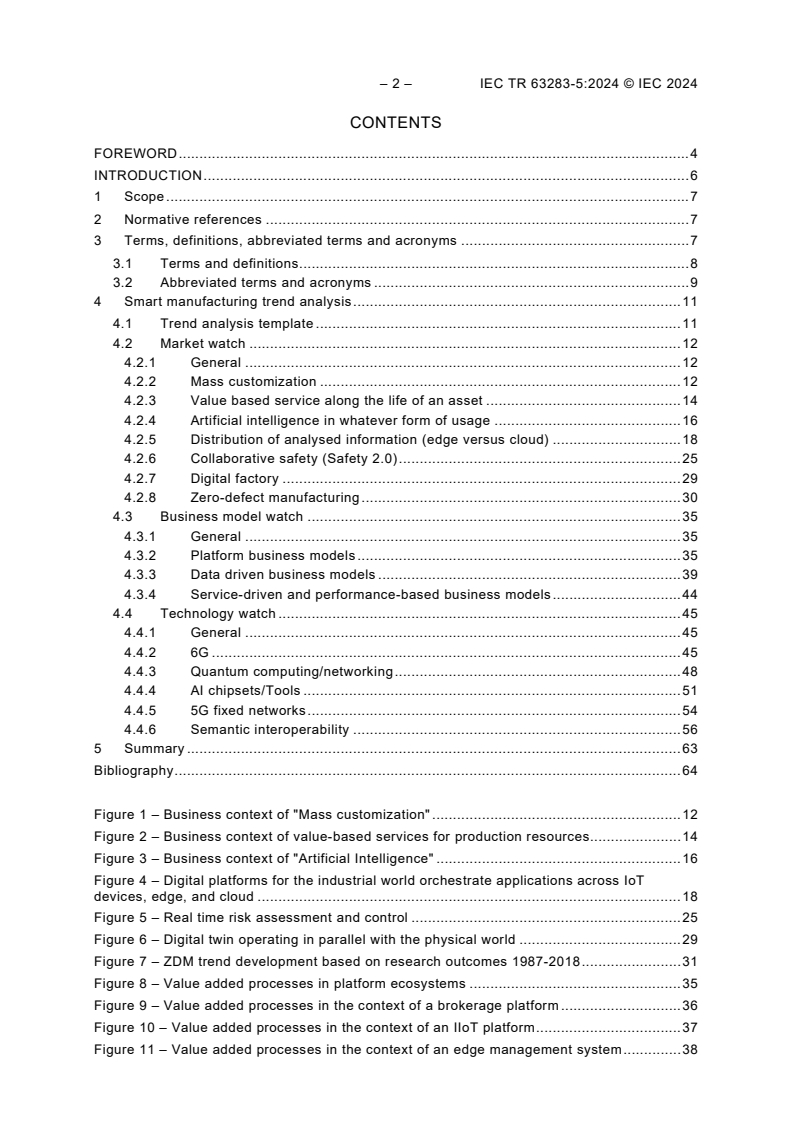
CONTENTS
FOREWORD . 4
INTRODUCTION . 6
1 Scope . 7
2 Normative references . 7
3 Terms, definitions, abbreviated terms and acronyms . 7
3.1 Terms and definitions . 8
3.2 Abbreviated terms and acronyms . 9
4 Smart manufacturing trend analysis . 11
4.1 Trend analysis template . 11
4.2 Market watch . 12
4.2.1 General . 12
4.2.2 Mass customization . 12
4.2.3 Value based service along the life of an asset . 14
4.2.4 Artificial intelligence in whatever form of usage . 16
4.2.5 Distribution of analysed information (edge versus cloud) . 18
4.2.6 Collaborative safety (Safety 2.0) . 25
4.2.7 Digital factory . 29
4.2.8 Zero-defect manufacturing . 30
4.3 Business model watch . 35
4.3.1 General . 35
4.3.2 Platform business models . 35
4.3.3 Data driven business models . 39
4.3.4 Service-driven and performance-based business models . 44
4.4 Technology watch . 45
4.4.1 General . 45
4.4.2 6G . 45
4.4.3 Quantum computing/networking . 48
4.4.4 AI chipsets/Tools . 51
4.4.5 5G fixed networks . 54
4.4.6 Semantic interoperability . 56
5 Summary . 63
Bibliography . 64
Figure 1 – Business context of "Mass customization" . 12
Figure 2 – Business context of value-based services for production resources. 14
Figure 3 – Business context of "Artificial Intelligence" . 16
Figure 4 – Digital platforms for the industrial world orchestrate applications across IoT
devices, edge, and cloud . 18
Figure 5 – Real time risk assessment and control . 25
Figure 6 – Digital twin operating in parallel with the physical world . 29
Figure 7 – ZDM trend development based on research outcomes 1987-2018 . 31
Figure 8 – Value added processes in platform ecosystems . 35
Figure 9 – Value added processes in the context of a brokerage platform . 36
Figure 10 – Value added processes in the context of an IIoT platform . 37
Figure 11 – Value added processes in the context of an edge management system . 38
Figure 12 – Value added processes in the context of a cloud platform . 39
Figure 13 – Potential value from data and analytics . 40
Figure 14 – Data and analytics transformation steps . 41
Figure 15 – Data driven business model – value add (example industry goods) . 42
Figure 16 – 6G Key features . 46
Figure 17 – Heterogeneous network . 46
Figure 18 – AI industrial structure and technology stack . 51
Figure 19 – Overview of AI chip related technologies . 52
Figure 20 – Defining AI, PwC broad definition AI . 54
Figure 21 – Evolution of fixed networks . 55
Figure 22 – Different levels of interoperability . 56
Figure 23 – Semantic interoperability . 57
Figure 24 – Semantic web Cake. 58
Figure 25 – Typical response of traditional companies to unplanned events . 59
Figure 26 – Typical response of agile companies to unplanned events. 60
Figure 27 – The McKinsey digital compass maps industry 4.0 applications to the 8
main value drivers. 61
Figure 28 – Strategic path for future common OT and IT standardization for semantical
interoperability . 62
– 4 – IEC TR 63283-5:2024 © IEC 2024
INTERNATIONAL ELECTROTECHNICAL COMMISSION
____________
INDUSTRIAL-PROCESS MEASUREMENT, CONTROL
AND AUTOMATION – SMART MANUFACTURING –
Part 5: Market and innovation trends analysis
FOREWORD
1) The International Electrotechnical Commission (IEC) is a worldwide organization for standardization comprising
all national electrotechnical committees (IEC National Committees). The object of IEC is to promote international
co-operation on all questions concerning standardization in the electrical and electronic fields. To this end and
in addition to other activities, IEC publishes International Standards, Technical Specifications, Technical Reports,
Publicly Available Specifications (PAS) and Guides (hereafter referred to as “IEC Publication(s)”). Their
preparation is entrusted to technical committees; any IEC National Committee interested in the subject dealt with
may participate in this preparatory work. International, governmental and non-governmental organizations liaising
with the IEC also participate in this preparation. IEC collaborates closely with the International Organization for
Standardization (ISO) in accordance with conditions determined by agreement between the two organizations.
2) The formal decisions or agreements of IEC on technical matters express, as nearly as possible, an international
consensus of opinion on the relevant subjects since each technical committee has representation from all
interested IEC National Committees.
3) IEC Publications have the form of recommendations for international use and are accepted by IEC National
Committees in that sense. While all reasonable efforts are made to ensure that the technical content of IEC
Publications is accurate, IEC cannot be held responsible for the way in which they are used or for any
misinterpretation by any end user.
4) In order to promote international uniformity, IEC National Committees undertake to apply IEC Publications
transparently to the maximum extent possible in their national and regional publications. Any divergence between
any IEC Publication and the corresponding national or regional publication shall be clearly indicated in the latter.
5) IEC itself does not provide any attestation of conformity. Independent certification bodies provide conformity
assessment services and, in some areas, access to IEC marks of conformity. IEC is not responsible for any
services carried out by independent certification bodies.
6) All users should ensure that they have the latest edition of this publication.
7) No liability shall attach to IEC or its directors, employees, servants or agents including individual experts and
members of its technical committees and IEC National Committees for any personal injury, property damage or
other damage of any nature whatsoever, whether direct or indirect, or for costs (including legal fees) and
expenses arising out of the publication, use of, or reliance upon, this IEC Publication or any other IEC
Publications.
8) Attention is drawn to the Normative references cited in this publication. Use of the referenced publications is
indispensable for the correct application of this publication.
9) IEC draws attention to the possibility that the implementation of this document may involve the use of (a)
patent(s). IEC takes no position concerning the evidence, validity or applicability of any claimed patent rights in
respect thereof. As of the date of publication of this document, IEC had not received notice of (a) patent(s), which
may be required to implement this document. However, implementers are cautioned that this may not represent
the latest information, which may be obtained from the patent database available at https://patents.iec.ch. IEC
shall not be held responsible for identifying any or all such patent rights.
IEC TR 63283-5 has been prepared by IEC technical committee 65: Industrial-process
measurement, control and automation. It is a Technical Report.
The text of this Technical Report is based on the following documents:
Draft Report on voting
65/1008/DTR 65/1028/RVDTR
Full information on the voting for its approval can be found in the report on voting indicated in
the above table.
The language used for the development of this Technical Report is English.
This document was drafted in accordance with ISO/IEC Directives, Part 2, and developed in
accordance with ISO/IEC Directives, Part 1 and ISO/IEC Directives, IEC Supplement, available
at www.iec.ch/members_experts/refdocs. The main document types developed by IEC are
described in greater detail at www.iec.ch/publications.
A list of all parts in the IEC 63283 series, published under the general title Industrial-process
measurement, control and automation – Smart manufacturing, can be found on the IEC website
The committee has decided that the contents of this document will remain unchanged until the
stability date indicated on the IEC website under webstore.iec.ch in the data related to the
specific document. At this date, the document will be
• reconfirmed,
• withdrawn, or
• revised.
IMPORTANT – The "colour inside" logo on the cover page of this document indicates
that it contains colours which are considered to be useful for the correct understanding
of its contents. Users should therefore print this document using a colour printer.
– 6 – IEC TR 63283-5:2024 © IEC 2024
INTRODUCTION
The IEC TR 63283 series describes the framework for smart manufacturing concepts and in
particular, terms and definitions, use cases, cyber security, market and innovation trends and
new technologies.
This document describes the market and innovation trends and analyses their impediments and
impacts to smart manufacturing.
The market trends are based on the tendency that the smart manufacturing markets move into
a particular direction potentially using technologies described in other parts of the series. These
market trends have the time prospective of 3 years to 5 years to become common smart
manufacturing concepts.
The innovation trends describe those technology innovations that are considered to have an
impact on or to influence the smart manufacturing concepts. These innovation trends have the
time prospective of 5 years to 10 years.
This document also describes how the market and technology trends are influencing the current
business models. Some examples of the forthcoming business models are described.
This document has no intention to describe an exhaustive list of market, innovation or the
business model trends. It also forecasts how standards will be influenced by these market,
innovation and business model trends.
INDUSTRIAL-PROCESS MEASUREMENT, CONTROL
AND AUTOMATION – SMART MANUFACTURING –
Part 5: Market and innovation trends analysis
1 Scope
This part of IEC 63283 describes the market and innovation trends analysis affecting smart
manufacturing (SM). The market and innovation trends will influence the evolution of smart
manufacturing and it will be important to have good insights on these trends. Specific aspects
of the market trends are the evolution of the business cases that is assumed to highlight new
supplier chain models, new revenue streams, new customer services, and/or new customer
segments.
The document will address the following topics:
• Market watch: Identify the important, likely, and/or disruptive market trends (e.g. mass
customization) from an end-to-end perspective, which impact smart manufacturing
topics/aspects. This includes the end-user, producers, supply chain, regulators, etc.
• Business model watch: Identify the new business model trends from an end-to-end
perspective, which impact smart manufacturing.
• Technological watch: Identify the important, likely, and/or disruptive innovations (AI
chipsets, 6G, quantum computing, etc.) describing the impacted smart manufacturing
topics/aspects; this topic will focus on those technologies that are still under development
but is assumed to influence (or is assumed to be influenced by) smart manufacturing.
There are many more new trends which are used in SM. In this document, only some frequently
discussed trends are presented. Some technologies are considered to have priority according
to their maturity.
This work will focus on how they can be used in SM.
2 Normative references
There are no normative references in this document.
3 Terms, definitions, abbreviated terms and acronyms
For the purposes of this document, the following terms and definitions apply.
ISO and IEC maintain terminology databases for use in standardization at the following
addresses:
• IEC Electropedia: available at https://www.electropedia.org/
• ISO Online browsing platform: available at https://www.iso.org/obp
NOTE Numbers in square brackets refer to the Bibliography.
– 8 – IEC TR 63283-5:2024 © IEC 2024
3.1 Terms and definitions
3.1.1
market trend
perceived tendency of a particular sector to move in a particular direction over time
Note 1 to entry: These trends are classified as secular for long time frames, primary for medium time frames, and
secondary for short time frames.
Note 2 to entry: This report attempts to identify market trends using technical analysis, a framework which
characterizes market trends as predictable tendencies within the market when the trend reaches support and
resistance levels, varying over time.
Note 3 to entry: A trend can only be confirmed in hindsight, since at any time the future is not known.
Note 4 to entry: In this document, market trend also includes tendency of technology innovations and behaviour of
the stakeholders around such innovations.
3.1.2
innovation
new idea, creative thoughts, new imaginations in form of device or method
Note 1 to entry: Innovation is often also viewed as the application of better solutions that meet new requirements,
unarticulated needs, or existing market needs. Such innovation takes place through the provision of more-effective
products, processes, services, technologies, or business models that are made available to markets, governments
and society.
Note 2 to entry: An innovation is something original and more effective and, as a consequence, new, that "breaks
into" the market or society. Innovation is related to, but not the same as, invention, as innovation is more apt to
involve the practical implementation of an invention (i.e. new/improved ability) to make a meaningful impact in the
market or society and not all innovations require an invention. Innovation often manifests itself via the engineering
process, when the problem being solved is of a technical or scientific nature.
Note 3 to entry: While a novel device is often described as an innovation, in economics, management science, and
other fields of practice and analysis, innovation is generally considered to be the result of a process that brings
together various novel ideas in such a way that they affect society. In industrial economics, innovations are created
and found empirically from services to meet growing consumer demand.
[SOURCE: Wikipedia article on Innovation, https://en.wikipedia.org/wiki/Innovation. This work
is licensed under the Creative Commons Attribution-ShareAlike 4.0 International License. To
view a copy of this license, visit http://creativecommons.org/licenses/by-sa/4.0/]
3.1.3
innovation trend
assumed innovation in the future that will have a long-term and lasting effect on and change
something
EXAMPLE Current developments are moving in a different direction or intensifying even more.
3.1.4
zero-defect manufacturing
ZDM
holistic approach for ensuring both process and product quality by reducing defects
Note 1 to entry: Defect reduction is achieved through corrective, preventive and predictive techniques using mainly
data-driven technologies and guaranteeing that no defective products leave the production site and reach the
customer aiming at higher manufacturing sustainability.
Note 2 to entry: ZDM improves process efficiency and product quality.
3.1.5
asset
entity owned by or under the custodial duties of an organization, which has either a perceived
or actual value to the organization
[SOURCE: IEC TR 63283-1:2022 [1], 3.1.26]
3.1.6
production system
system intended for production of goods
Note 1 to entry: The concept of production system includes spare parts.
Note 2 to entry: The concept of production system does not encompass the whole manufacturing facility. It excludes
in particular the supporting infrastructure (such as building, power distribution, lighting, ventilation). It also excludes
financial assets, human resources, raw process materials, energy, work pieces in process, end products.
Note 3 to entry: Production systems can support different types of production processes (continuous, batch, or
discrete).
[SOURCE: IEC TR 63283-1:2022 [1], 3.1.350]
3.2 Abbreviated terms and acronyms
th
4G
4 generation cellular system
th
5G
5 generation cellular system
th
5G-PPP
5 Generation – Public Private Partnership
th
6G
6 generation cellular system
th
6G-PPP
6 Generation – Public Private Partnership
AAS asset administration shell
ADSL asymmetric digital subscriber line
AI artificial intelligence
AIOTI Alliance for the Internet of Things Innovation
API application programming interface
App application
B2B business to business
B2C business to consumer
BIS building information system
CAD computer aided design
CAM computer aided manufacturing
CCPA California Consumer Privacy Act
CDD common data dictionary
CPU central processing unit
CSA coordination and support action
CWA CEN Workshop Agreement
DevOps SW development and IT operations
DF digital factory
DMP digital manufacturing platform
DSP digital signal processor
E/W East/West
ECN edge control node
EPON Ethernet Passive Optical Network
ERP enterprise resource planning
– 10 – IEC TR 63283-5:2024 © IEC 2024
EU-OSHA European Agency for Safety & Health at Work
th
F6G
6 generation fixed network
FCC Federal Communications Commission
GDPR General Data Protection Regulation
GHz giga hertz
GPON gigabit passive optical network
GPU graphics processor unit
HAP high-altitude platform
HPC high performance computing
I4.0 Industry 4.0
IACS industrial automation and control systems
ICT information communication technology
IEEE Institute of Electrical and Electronics Engineers
IETF Internet Engineering Task Force
IIoT industrial Internet of things
IoT Internet of things
ISDN Integrated Services Digital Network
ISP image signal processor
IT information technology
ITU-T International Telecommunication Union – Telecommunication
Standardization Sector
LCA life cycle assessment
LGPD Lei Geral de Proteção de Dados or General Data Protection Law
LTE long term evolution
M2M machine to machine
MES manufacturing execution system
MIIT China Ministry of Industry and Information Technology
MIMO multiple input multiple output
ML machine learning
mmWave millimeter wave
MQTT Message Queuing Telemetry Transport
N/S North/South
NB-IoT narrowband – Internet of things
NISQ noisy intermediate-scale quantum
O&M operations and maintenance
OCI open container initiative
oneM2M Standards for M2M and the Internet of Things
OPC Open Platform Communications
OPC-UA OPC Unified Architecture
OPE operational excellence
OPEX operational expenses
OS operating system
OTD open technical dictionary
OWL web ontology language
PC personal computer
PON passive optical network
PSTN public switched telephone network
QKD quantum key distribution
QoS quality of service
Qubits quantum bits
RDF resource description framework
R&D research and development
SaaS software as a service
SG study group
SM smart manufacturing
SME small medium enterprise
SW software
TCG Trust Computing Group
THz tera hertz
TRL technology readiness level
TSN Time Sensitive Networking
VDSL very high-speed digital subscriber line
WFA Wi-Fi Alliance
WIA-PA Wireless Networks for Industrial Automation/Process Automation
Wi-Fi Wireless Fidelity
XML eXtended Markup Language
ZDM Zero-Defect Manufacturing
4 Smart manufacturing trend analysis
4.1 Trend analysis template
Each trend is described by the following template introducing the following aspects of the trend:
• Description
This subclause describes the trend textually, how the trend is used in reality (use case), and
the stakeholders in order to clarify the referenced market, market expectations, business model
or the technology trend.
• Impediments to market acceptance
This subclause describes what the market obstacles are to realise the market trends, e.g.
restrictions, uncertainty, competitive technologies, regulatory restrictions.
• Impacts to smart manufacturing
This subclause analyses the trend and describes the impacts to smart manufacturing. Potential
impacts, if addressed, could be specified to the smart manufacturing use cases, architecture,
information models, lifecycle, interfaces, security and safety.
– 12 – IEC TR 63283-5:2024 © IEC 2024
• Standardization needs
This subclause describes the standardization needs internally and externally of IEC TC 65. If
there are standardization needs identified for IEC TC 65, then the suggested respective working
group and/or subcommittee are identified where such standardization ought to take place.
4.2 Market watch
4.2.1 General
Some of the common smart manufacturing market trends are listed within the following
subclauses. They are based on the technologies as described in other parts of this series, which
describe new innovative technologies expected in the coming years. It is understood that these
innovative technologies are already available and have been proven useful to the domain of
smart manufacturing. Therefore, the required technologies are ready to realise the described
market trends below and it is assumed that these market trends will be common within smart
manufacturing in 3 years to 5 years.
What is being described is not intended to produce an exhaustive list of market trends.
4.2.2 Mass customization
4.2.2.1 Description
The customer demands have evolved from standard mass market products towards
personalised products based on the customer needs. This market trend can be realised by
benefiting from the capabilities that smart manufacturing provides, like the flexible production
systems.
The manufacturing market is evolving towards an individualised market that will require a
manufacturing company to offer a flexible product/service portfolio. Therefore, a manufacturing
company will require a strategy addressing such individualised market, while still being
profitable from its operational perspective. Examples of such strategies are Manufacturing of
Individualised Products, Flexible Scheduling and Resource Allocation and Outsourcing of
Production, collectively named order-controlled production. Figure 1 illustrates a combined
business context of the separate business contexts of Manufacturing of Individualised Products,
Flexible Scheduling and Resource Allocation and Outsourcing of Production, which are further
explained within IEC TR 63283-2 [2] .
SOURCE: IEC TR 63283-2:2022, modified combining use cases 6.1.1, 6.1.2 and 6.1.3 (Figures 6, 8, and 10).
Figure 1 – Business context of "Mass customization"
___________
Numbers in square brackets refer to the Bibliography.
Such a market trend is achieved with the usage of an adaptable production system. This system
will require standardized interfaces to ensure interoperability within and between production
systems. One aspect of such adaptability will be related to the production outsourcing, i.e.
cooperation between own and/or external factories to improve the efficiency of the
manufacturing process. This market trend will allow the manufacturing company to supplement
its own production capability by integrating a highly individual production capability offered by
a specialised 3rd party manufacturer. The inclusion of the 3rd party manufacturing company
can be established by purchaser, supplier or by an independent broker. In case of the
independent broker, the business relationship between the purchaser and supplier will be
managed by the broker.
Finally, the market is providing additional product configuration tools to allow customers to
configure and order its products. The configuration tools will offer mandatory boundary
conditions when combining the different configuration options. The configuration tool will
provide the order information which will be analysed regarding the correctness of the order and
additional information, such as specific customer information, order history and related service
information.
4.2.2.2 Impediments to market acceptance
The market trend mass customization will be dependent on the degree of automation within the
product design and production process. Currently most of these processes are carried
manually, and this makes the mass customization to be a negative impact on the effectiveness
and efficiency of the manufacturing process.
Another aspect is the degree of the agility of the production process. The production process
is expected to be highly automated to support the high number of individualised products.
Therefore, once the production processes are digitalised, additional new technologies, such as
AI, edge computing, digital twin, etc., need to be introduced. Most of this digitalization will be
realised in the context of digital factory and/or smart manufacturing.
The changed engagement between the purchaser and the manufacturing company will require
the establishment of a new legal contract between the purchaser and the manufacturing
company, in which terms and conditions are described about what the manufacturing company
will offer and deliver towards the purchaser.
The current role of the broker is limited to outsourcing specific production capabilities by
identifying suitable manufacturing companies and providing supportive services to establish the
contractual relationship between the purchaser and the supplier. This brokering is highly
manual, and mass customization will require a more dynamic, generic brokering, and platform
based brokering mechanism.
Product configuration will be highly dependent on the boundary conditions that are mandatory
to be followed when combining different sub-systems to form an overall system.
4.2.2.3 Impacts to smart manufacturing
The mass customization market trend will accelerate the evolution towards smart manufacturing
introducing new features, like artificial intelligence, edge computing, digital twin, and asset
administration shell. The market trend will also provide a much higher digitalization degree of
the product and production design and allow for a full automation of the manufacturing
processes.
The digitalization and automation handling of the product orders will enable applying algorithms
to optimize the manufacturing operational processes. This automation will increase the
efficiency and effectiveness of the factory performance. It will also broaden the order offering
of the manufacturing company to their purchasers and/or brokers. The digitalization and
automation will also decrease the time to market of their offerings and therefore increase the
production capacity of the manufacturing company.
– 14 – IEC TR 63283-5:2024 © IEC 2024
The digitalization and the digital twin of the product and production processes will allow the
manufacturing company to give more updated information about the current status of the
product and/or status of the production of the targeted product.
The automated negotiations, offered by the broker, will allow a broader market for the supplier
manufacturing companies while it will be easier to integrate the supplier manufacturing
company within the purchaser supply chain. Additional brokering services can be offered in the
sense of logistics services, supplier offering optimization services and quality assurance
services.
The information retrieved from the product configuration will provide a prediction of the
customer order and will allow any manufacturing company to provide product configuration
recommendations to the purchaser.
4.2.2.4 Standardization needs
Standardization needs can be derived from the smart manufacturing order controlled production
use case cluster within the smart manufacturing use cases report
(IEC TR 63283-2), as specifically mentioned in the use case:
• manufacturing of individualised products;
• outsourcing of production;
• decision support for product configuration.
4.2.3 Value based service along the life of an asset
4.2.3.1 Description
The trend of the provisioning of value-added services complementing the delivered production
resources is increasing the efficiency of using these resources. The value-added services will
allow the manufacturing companies to increase the efficiency of the production processes and
will optimize the usage of the production resources.
SOURCE: IEC TR 63283-2 :2022, use case 6.7.1 (Figure 70).
Figure 2 – Business context of value-based services for production resources
An additional business role of the value-based services provider is illustrated in Figure 2 to
provide value-based services complementary to the delivered production resources. The
value-based service provider will receive production insights via analysis of the production data
from the manufacturer. For example, analysing production usage information can improve
efficiency and predictability of the production process by providing optimizations to the product
combinations and/or device programming to minimize waste and failure, reduce assembly costs
and time, and simplify sourcing and ordering.
4.2.3.2 Impediments to market acceptance
This market trend will require a substantial digitalization of the production process so that
appropriate production data can be derived from the production process. An efficient
infrastructure would be required to extract the production data from the different production
resources. Furthermore, it is assumed that dedicated AI solutions are needed to analyse the
production usage information to provide the relevant production insights, which would be the
input to further optimize the collected production usage information.
One aspect that will influence the realization of this market trend is related to the privacy
aspects. The availability of anonymization of the exchanged data needs to be addressed.
Therefore, smooth computing and connective infrastructures and also advanced data analytics
solutions are needed within the manufacturing operations. This introduction is ongoing at this
moment within the manufacturing industries, but it is far from complete.
4.2.3.3 Impacts to smart manufacturing
The current manufacturing infrastructure is very much a closed infrastructure and the production
data is not always available outside the factory. Therefore, the impact related to the introduction
rd
of 3 party computing and connective infrastructure will require a substantial change within the
manufacturing culture.
rd
A second impact is to make the production resource usage data available to 3 party
stakeholders to analyse the data to provide relevant production insights. These production
insights will be the basis to develop the added value services by an independent value-based
service provider.
The benefit of the required openness will be the improved efficiency of production processes
across different production resources.
4.2.3.4 Standardization needs
Standardization needs can be derived from the smart manufacturing product and production
services use case cluster within the smart manufacturing use cases report (IEC TR 63283-2),
as specifically mentioned in the use cases:
• value-based services for production resources;
• update and functional scalability of production resources;
• condition monitoring of production resource;
• self-optimization of production resources;
• benchmarking of production resources;
• production resource as-a-service.
– 16 – IEC TR 63283-5:2024 © IEC 2024
4.2.4 Artificial intelligence in whatever form of usage
4.2.4.1 Description
The current market trend is to optimize the value-added process of manufacturing companies
via analysing data from various sources, for example production resource data, using artificial
intelligence (AI) technologies to deliver the targeted improvements to the operational
excellence. This will require pattern recognition within the various usage information to deliver
the optimization opportunities. This pattern recognition is automated via AI technologies, for
example machine learning.
The introduction of AI technologies to optimize the value-added processes can be provided by
rd
3 party technology and service providers. This will enable manufacturing companies to focus
on their domain knowledge and the application of AI technologies.
Figure 3 – Business context of "Artificial Intelligence"
As displayed in Figure 3, there are mainly three different business stakeholders in the context
of AI in manufacturing industries:
• provider of AI technologies (including provision of services related to the application of the
offered AI technologies);
• manufacturing companies, which internally apply AI technologies in order to optimize their
value-added processes. In this case, the necessary data to be analysed using AI
technologies is typically owned by the manufacturing company;
• value based service providers, which apply AI technologies in order to extend their portfolio
from offering production resources to additionally offer value-based services to their
customers; see also market trend "value-based services". In this case, the necessary data
to be analysed using AI technologies typically needs to be provided by the customer based
on some individual contractual agreement between the customer and the provider of value-
based services. In the market, there are very few examples of value-based services based
on AI technology being offered by companies without them also offering a physical product.
For example, in the context of production related value-added processes, automated AI based
production improvements will enhance the production quality and efficiency, and will reduce the
number of production faults.
4.2.4.2 Impediments to market acceptance
This market trend will require similar digitalization aspects as defined for the value based
services market trend. In addition, manufacturing specific AI models are needed to target the
required optimizations. Therefore, it needs to be ensured that such models can be created
economically. Standardization, for example, can contribute to this to allow for interoperability
between different AI based services. In addition, further research on the AI models is assumed
to be needed.
The quality of AI will substantially depend on the availability of suitable and correct AI training
data. The availability of the right set of AI training data is still under further research as well,
especially in the context of manufacturing industries, where information models are typically
very complex and application specific.
In addition, there is also a chicken-egg problem to be solved with value-based services based
on AI: On the one hand, the value-based services provider asks the customer to provide suitable
data so that high-quality value-based services can be offered. On the other hand, customers
will only make their data accessible if the provider of the value-based services contractually
promises a sufficiently high level of benefits.
4.2.4.3 Impacts to smart manufacturing
The current manufacturing infrastructure is often a closed technical infrastructure and often
production data is not available outside the factory, even not to the design and engineering
departments of the manufacturing company. Therefore, the impact is related to the introduction
of a technical computing and connectivity infrastructure, which can also be operated by some
rd
3 party company. This will require not negligible investments and a substantial change
especially within the manufacturing culture.
In the context of production processes, AI related improvements are:
• qualitative analysis of the produced products;
• safety improvements to the production staff;
• safe working in a collaborative environment between humans and machines;
• predictive maintenance resulting in higher availability systems;
• high level of automation of complex production processes.
There will not be a single one-size-fits-all AI solution, but there will be several specialised AI
solutio
...