


ISO/IEC TR 15067-3-2:2016
(Main)Information technology - Home electronic system application model - Part 3-2: GridWise - Interoperability context-setting framework
Information technology - Home electronic system application model - Part 3-2: GridWise - Interoperability context-setting framework
ISO/IEC TR 15067-3-2:2016(E) This Technical Report is based on work done by the GridWise Architecture Council. It describes a framework for identifying and discussing interoperability issues to facilitate the integration of entities that interact with electric power systems.
General Information
- Status
- Published
- Publication Date
- 03-Nov-2016
- Technical Committee
- ISO/IEC JTC 1/SC 25 - Interconnection of information technology equipment
- Current Stage
- PPUB - Publication issued
- Start Date
- 04-Nov-2016
- Completion Date
- 31-Aug-2016
Overview
ISO/IEC TR 15067-3-2:2016 - Information technology - Home electronic system application model - Part 3-2: GridWise – Interoperability context-setting framework is a Technical Report published by IEC/ISO in 2016. Based on work from the GridWise Architecture Council (GWAC), it provides a high-level, context-setting framework to identify, discuss and prioritize interoperability issues that arise when integrating entities that interact with electric power systems. The report is intended as neutral, organizational guidance rather than a prescriptive protocol.
Key topics and technical areas
The Technical Report organizes interoperability concerns into layered categories and cross-cutting issues. Major topics include:
- System integration philosophy
- Agreement at the interface (contracts)
- Boundary of authority and decision-making in very large networks
- The role of standards in enabling integration
- High-level interoperability categories (technical, informational, organizational)
- Category 1–3: Basic connectivity, network interoperability, syntactic interoperability
- Category 4–5: Semantic understanding and business context
- Category 6–8: Business procedures, objectives, economic and regulatory policy
- Cross-cutting technical issues
- Shared meaning of content and semantic interoperability
- Resource identification and discovery
- Time synchronization and sequencing
- Security, privacy, logging and auditing
- Transaction and state management; quality of service
- System preservation, evolution and scalability
- Companion material and examples
- Application scenarios such as residential and commercial demand response and congestion-management markets illustrate framework application.
Practical applications
This interoperability framework helps stakeholders:
- Map interoperability gaps before specifying interfaces or protocols
- Prioritize standards, policies and implementation work across technical and organizational layers
- Design energy management, demand response and distributed energy resource (DER) integrations that respect regulatory and business constraints
- Improve cross-domain coordination between bulk system operators, utilities, energy service providers, building automation systems and consumer devices
Common use cases: smart grid integration, home/building energy management, demand response programs, DER aggregation, market signaling and utility–customer automation interactions.
Who should use this standard
- Utilities, bulk power system operators and distribution operators
- Device and system integrators, vendors of EMS/BMS and DER controls
- Policy makers, regulators and market operators
- Standards developers and systems architects working on smart grid interoperability
Related standards and sources
- Part of the ISO/IEC TR 15067 series and informed by GridWise Architecture Council materials
- Intended to complement ISO/IEC and IEC smart grid and interoperability work by offering a context-setting taxonomy and examples for electric power system integration
Keywords: ISO/IEC TR 15067-3-2, GridWise, interoperability framework, smart grid, demand response, energy management, electric power systems.
Get Certified
Connect with accredited certification bodies for this standard

BSI Group
BSI (British Standards Institution) is the business standards company that helps organizations make excellence a habit.

NYCE
Mexican standards and certification body.
Sponsored listings
Frequently Asked Questions
ISO/IEC TR 15067-3-2:2016 is a technical report published by the International Electrotechnical Commission (IEC). Its full title is "Information technology - Home electronic system application model - Part 3-2: GridWise - Interoperability context-setting framework". This standard covers: ISO/IEC TR 15067-3-2:2016(E) This Technical Report is based on work done by the GridWise Architecture Council. It describes a framework for identifying and discussing interoperability issues to facilitate the integration of entities that interact with electric power systems.
ISO/IEC TR 15067-3-2:2016(E) This Technical Report is based on work done by the GridWise Architecture Council. It describes a framework for identifying and discussing interoperability issues to facilitate the integration of entities that interact with electric power systems.
ISO/IEC TR 15067-3-2:2016 is classified under the following ICS (International Classification for Standards) categories: 35.200 - Interface and interconnection equipment. The ICS classification helps identify the subject area and facilitates finding related standards.
ISO/IEC TR 15067-3-2:2016 is available in PDF format for immediate download after purchase. The document can be added to your cart and obtained through the secure checkout process. Digital delivery ensures instant access to the complete standard document.
Standards Content (Sample)
ISO/IEC TR 15067-3-2
Edition 1.0 2016-11
TECHNICAL
REPORT
colour
inside
Information technology – Home electronic system application model –
Part 3-2: GridWise – Interoperability context-setting framework
All rights reserved. Unless otherwise specified, no part of this publication may be reproduced or utilized in any form
or by any means, electronic or mechanical, including photocopying and microfilm, without permission in writing from
either IEC or IEC's member National Committee in the country of the requester. If you have any questions about
ISO/IEC copyright or have an enquiry about obtaining additional rights to this publication, please contact the address
below or your local IEC member National Committee for further information.
IEC Central Office Tel.: +41 22 919 02 11
3, rue de Varembé Fax: +41 22 919 03 00
CH-1211 Geneva 20 info@iec.ch
Switzerland www.iec.ch
About the IEC
The International Electrotechnical Commission (IEC) is the leading global organization that prepares and publishes
International Standards for all electrical, electronic and related technologies.
About IEC publications
The technical content of IEC publications is kept under constant review by the IEC. Please make sure that you have the
latest edition, a corrigenda or an amendment might have been published.
IEC Catalogue - webstore.iec.ch/catalogue Electropedia - www.electropedia.org
The stand-alone application for consulting the entire The world's leading online dictionary of electronic and
bibliographical information on IEC International Standards, electrical terms containing 20 000 terms and definitions in
Technical Specifications, Technical Reports and other English and French, with equivalent terms in 15 additional
documents. Available for PC, Mac OS, Android Tablets and languages. Also known as the International Electrotechnical
iPad. Vocabulary (IEV) online.
IEC publications search - www.iec.ch/searchpub IEC Glossary - std.iec.ch/glossary
The advanced search enables to find IEC publications by a 65 000 electrotechnical terminology entries in English and
variety of criteria (reference number, text, technical French extracted from the Terms and Definitions clause of
committee,…). It also gives information on projects, replaced IEC publications issued since 2002. Some entries have been
and withdrawn publications. collected from earlier publications of IEC TC 37, 77, 86 and
CISPR.
IEC Just Published - webstore.iec.ch/justpublished
Stay up to date on all new IEC publications. Just Published IEC Customer Service Centre - webstore.iec.ch/csc
details all new publications released. Available online and If you wish to give us your feedback on this publication or
also once a month by email. need further assistance, please contact the Customer Service
Centre: csc@iec.ch.
ISO/IEC TR 15067-3-2
Edition 1.0 2016-11
TECHNICAL
REPORT
colour
inside
Information technology – Home electronic system application model –
Part 3-2: GridWise – Interoperability context-setting framework
INTERNATIONAL
ELECTROTECHNICAL
COMMISSION
ICS 35.200 ISBN 978-2-8322-3722-9
– 2 – ISO/IEC TR 15067-3-2:2016
© ISO/IEC 2016
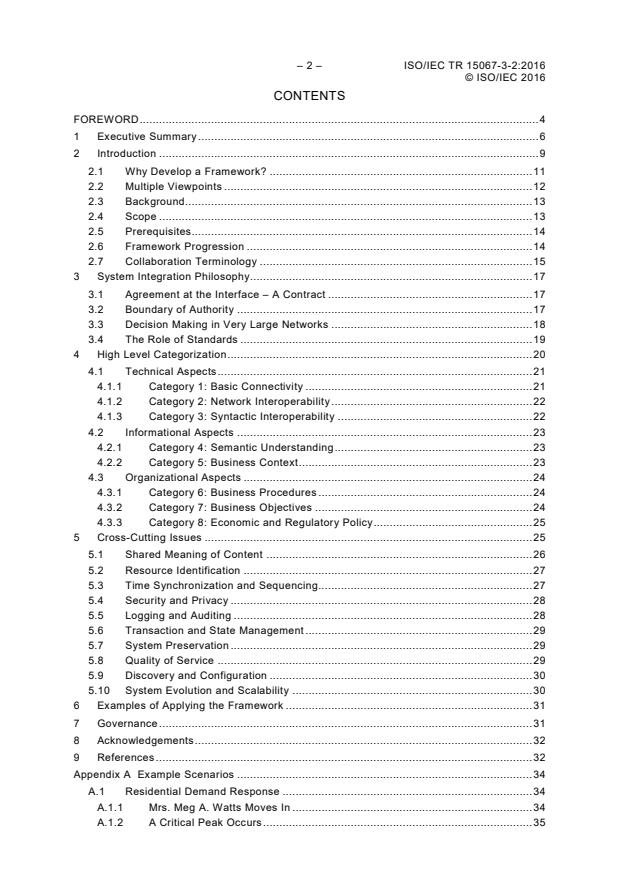
CONTENTS
FOREWORD . 4
1 Executive Summary . 6
2 Introduction . 9
2.1 Why Develop a Framework? . 11
2.2 Multiple Viewpoints . 12
2.3 Background. 13
2.4 Scope . 13
2.5 Prerequisites. 14
2.6 Framework Progression . 14
2.7 Collaboration Terminology . 15
3 System Integration Philosophy . 17
3.1 Agreement at the Interface – A Contract . 17
3.2 Boundary of Authority . 17
3.3 Decision Making in Very Large Networks . 18
3.4 The Role of Standards . 19
4 High Level Categorization . 20
4.1 Technical Aspects . 21
4.1.1 Category 1: Basic Connectivity . 21
4.1.2 Category 2: Network Interoperability . 22
4.1.3 Category 3: Syntactic Interoperability . 22
4.2 Informational Aspects . 23
4.2.1 Category 4: Semantic Understanding . 23
4.2.2 Category 5: Business Context . 23
4.3 Organizational Aspects . 24
4.3.1 Category 6: Business Procedures . 24
4.3.2 Category 7: Business Objectives . 24
4.3.3 Category 8: Economic and Regulatory Policy . 25
5 Cross-Cutting Issues . 25
5.1 Shared Meaning of Content . 26
5.2 Resource Identification . 27
5.3 Time Synchronization and Sequencing. 27
5.4 Security and Privacy . 28
5.5 Logging and Auditing . 28
5.6 Transaction and State Management . 29
5.7 System Preservation . 29
5.8 Quality of Service . 29
5.9 Discovery and Configuration . 30
5.10 System Evolution and Scalability . 30
6 Examples of Applying the Framework . 31
7 Governance . 31
8 Acknowledgements . 32
9 References . 32
Appendix A Example Scenarios . 34
A.1 Residential Demand Response . 34
A.1.1 Mrs. Meg A. Watts Moves In . 34
A.1.2 A Critical Peak Occurs . 35
© ISO/IEC 2016
A.1.3 An Emergency Occurs . 36
A.1.4 Meg and the Framework . 37
A.2 Commercial Building Demand Response . 39
A.3 Congestion Management Market . 41
Bibliography . 43
Figure S.1 – A Framework Provides High-Level Perspective . 7
Figure S.2 – Interoperability Framework Categories . 8
Figure S.3 – Interoperability Framework Companion Material . 9
Figure 1 – Distance to Integrate . 10
Figure 2 – Interoperability Framework Companion Material . 14
Figure 3 – Phases for Progressing Interoperability . 15
Figure 4 – Collaboration Model Elements . 16
Figure 5 – Interoperability Layered Categories . 21
Figure 6 – Interoperability Context-Setting Framework Diagram . 26
– 4 – ISO/IEC TR 15067-3-2:2016
© ISO/IEC 2016
INFORMATION TECHNOLOGY –
HOME ELECTRONIC SYSTEM APPLICATION MODEL –
Part 3-2: GridWise – Interoperability context-setting framework
FOREWORD
1) ISO (the International Organization for Standardization) and IEC (the International Electrotechnical
Commission) form the specialized system for worldwide standardization. National bodies that are members of
ISO or IEC participate in the development of International Standards through technical committees established
by the respective organization to deal with particular fields of technical activity. ISO and IEC technical
committees collaborate in fields of mutual interest. Other international organizations, governmental and non-
governmental, in liaison with ISO and IEC, also take part in the work. In the field of information technology,
ISO and IEC have established a joint technical committee, ISO/IEC JTC 1.
2) The formal decisions or agreements of IEC and ISO on technical matters express, as nearly as possible, an
international consensus of opinion on the relevant subjects since each technical committee has representation
from all interested IEC National Committees and ISO member bodies.
3) IEC, ISO and ISO/IEC publications have the form of recommendations for international use and are accepted
by IEC National Committees and ISO member bodies in that sense. While all reasonable efforts are made to
ensure that the technical content of IEC, ISO and ISO/IEC publications is accurate, IEC or ISO cannot be held
responsible for the way in which they are used or for any misinterpretation by any end user.
4) In order to promote international uniformity, IEC National Committees and ISO member bodies undertake to
apply IEC, ISO and ISO/IEC publications transparently to the maximum extent possible in their national and
regional publications. Any divergence between any ISO, IEC or ISO/IEC publication and the corresponding
national or regional publication should be clearly indicated in the latter.
5) ISO and IEC do not provide any attestation of conformity. Independent certification bodies provide conformity
assessment services and, in some areas, access to IEC marks of conformity. ISO or IEC are not responsible
for any services carried out by independent certification bodies.
6) All users should ensure that they have the latest edition of this publication.
7) No liability shall attach to IEC or ISO or its directors, employees, servants or agents including individual
experts and members of their technical committees and IEC National Committees or ISO member bodies for
any personal injury, property damage or other damage of any nature whatsoever, whether direct or indirect, or
for costs (including legal fees) and expenses arising out of the publication of, use of, or reliance upon, this
ISO/IEC publication or any other IEC, ISO or ISO/IEC publications.
8) Attention is drawn to the normative references cited in this publication. Use of the referenced publications is
indispensable for the correct application of this publication.
9) Attention is drawn to the possibility that some of the elements of this ISO/IEC publication may be the subject
of patent rights. ISO and IEC shall not be held responsible for identifying any or all such patent rights.
The main task of the joint technical committee is to prepare International Standards. However,
the joint technical committee may propose the publication of a Technical Report when it has
collected data of a different kind from that which is normally published as an International
Standard, for example "state of the art".
ISO/IEC TR 15067-3-2, which is a Technical Report, has been adopted and adapted by
subcommittee 25: Interconnection of information technology equipment, of ISO/IEC joint
technical committee 1: Information technology.
This Technical Report is closely based on the document GridWise® Interoperability Context-
Setting Framework (March 2008), prepared by The GridWise Architecture. Also, the original
structure of the technical part of this document has been maintained.
____________
GridWise® is a registered tradename by The GridWise Architecture Council.
© ISO/IEC 2016
This Technical Report has been approved by vote of the member bodies, and the voting
results may be obtained from the address given on the second title page.
IMPORTANT – The 'colour inside' logo on the cover page of this publication indicates
that it contains colours which are considered to be useful for the correct
understanding of its contents. Users should therefore print this document using a
colour printer.
– 6 – ISO/IEC TR 15067-3-2:2016
© ISO/IEC 2016
INFORMATION TECHNOLOGY –
HOME ELECTRONIC SYSTEM APPLICATION MODEL –
Part 3-2: GridWise – Interoperability context-setting framework
1 Executive Summary
As the deployment of automation technology advances, it touches upon many areas of our
corporate and personal lives. A trend is emerging where automation systems are growing to
the extent that integration is taking place with other systems to provide even greater
capabilities more efficiently and effectively. GridWise provides a vision for this type of
integration as it applies to the electric system.
Imagine a time in the not too distant future when homeowners can offer the management of
their electricity demand to participate in a more efficient and environmentally friendly
operation of the electric power grid. They will do this using automation technology that acts on
their behalf in response to information from other automation components of the electric
system. This technology will recognize their preferences to parameters such as comfort and
the price of energy to form responses that optimize the local need to a signal that satisfies a
higher-level need in the grid.
For example, consider a particularly hot day with air stagnation in an area with a significant
dependence on wind generation. To manage the forecasted peak electricity demand, the bulk
system operator issues a critical peak price warning. Their automation systems alert electric
service providers who distribute electricity from the wholesale electricity system to
consumers. In response, the electric service providers use their automation systems to inform
consumers of impending price increases for electricity. This information is passed to an
energy management system at the premises, which acts on the consumer’s behalf, to adjust
the electricity usage of the onsite equipment (which might include generation from such
sources as a fuel cell). The objective of such a building automation system is to honor the
agreement with the electricity service provider and reduce the consumer’s bill while keeping
the occupants as comfortable as possible. This will include actions such as moving the
thermostat on the heating, ventilation, and air-conditioning (HVAC) unit up several degrees.
The resulting load reduction becomes part of an aggregated response from the electricity
service provider to the bulk power system operator who is now in a better position to manage
total system load with available generation.
Looking across the electric system, from generating plants, to transmission substations, to the
distribution system, to factories, office parks, and buildings, automation is growing, and the
opportunities for unleashing new value propositions are exciting. How can we facilitate this
change and do so in a way that ensures the reliability of electric resources for the wellbeing of
our economy and security? The GridWise Architecture Council (GWAC) mission is to enable
interoperability among the many entities that interact with the electric power system. A good
definition of interoperability is, “The capability of two or more networks, systems, devices,
applications, or components to exchange information between them and to use the
information so exchanged.” As a step in the direction of enabling interoperability, the GWAC
proposes a context-setting framework to organize concepts and terminology so that
interoperability issues can be identified and debated, improvements to address issues
articulated, and actions prioritized and coordinated across the electric power community.
By a context-setting framework, we mean something at a high, organizational level (see
Figure S.1), some neutral ground upon which a community of stakeholders can talk about
____________
“EICTA Interoperability White Paper,” European Industry Association, Information Systems Communication
Technologies Consumer Electronics, 21 June 2004.
© ISO/IEC 2016
issues and concerns related to integrating parts of a large, complex system. Borrowing
concepts from the Australian National E-Health Transition Authority, a framework sits at a
broad, conceptual level and provides context for more detailed technical aspects of
interoperability. In contrast, “A model (or architecture) identifies a particular problem space
and defines a technology-independent analysis of requirements. The design maps model
requirements into a particular family of solutions based upon standards and technical
approaches. Finally a solution manifests a design into a particular vendor software
technology, ensuring adherence to designs, models, and frameworks.”
Framework
Model
Design
Solution
IEC
Figure S.1 – A Framework Provides High-Level Perspective
The intent of the interoperability framework is to provide the context for identifying and
debating interoperability issues to advance actions that make integration within this complex
system easier. The framework recognizes that interoperability is only achieved when
agreement is reached across many layers of concern. These layers span the details of the
technology involved to link systems together, to the understanding of the information
exchanged, to the business processes and organizational objectives that are represented in
business, economic, and regulatory policy.
Besides introducing new opportunities and benefits, the application of information technology
(IT) also introduces a new set of challenges. As they contribute to all economic sectors,
traditionally separate applications and infrastructures get more and more interconnected.
Effects and decisions within each critical infrastructure influence the other infrastructures
much more than before. The framework identifies the key interoperability issue areas and can
help resolve interdependencies within the electric system and with other infrastructures. It
reflects the increasingly important role of IT in the electric system, resulting in an electricity
plus information (E+I) infrastructure. The framework also enables the representation and
exchange of ideas with other critical infrastructure domains. It supports comparing, aligning,
and harmonizing technical approaches with accompanying management procedures and
business processes.
Figure S.2 summarizes the layered interoperability categories according to technical,
informational, and organizational groups. In addition to these categories of interoperability,
the framework proposes a classification of interoperability issues that cut across the layers.
This document introduces these issue areas with the intent to explore and articulate the
detailed nature of each issue area in separate documents engaging interested experts in their
creation. The cross-cutting issues represent the areas we believe should be focused on to
start improving interoperability across the web of electricity concerns.
____________
National E-Health Transition Authority (NEHTA), “Towards an Interoperability Framework, v 1.8,“ August 2005.
(www.nehta.gov.au)
– 8 – ISO/IEC TR 15067-3-2:2016
© ISO/IEC 2016
Political and Economic
Objectives as Embodied in
E
8: Economic/Regulatory Policy
Policy and Regulation
Strategic and Tactical
Objectives Shared
Organizational
7: Business Objectives
between Businesses
(Pragmatics)
Alignment between
Operational Business
6: Business Procedures
Processes and Procedures
Relevant Business Knowledge
that Applies Semantics with
5: Business Context
E + I
Process Workflow
Informational
Understanding of Concepts
(Semantics)
Contained in the Message
4: Semantic Understanding
Data Structures
Understanding of Data Structure
in Messages Exchanged
3: Syntactic Interoperability
between Systems
Exchange Messages between
Systems across a
Technical
2: Network Interoperability
Variety of Networks
(Syntax)
Mechanism to Establish
Physical and Logical I
1: Basic Connectivity
Connectivity of Systems
IEC
Figure S.2 – Interoperability Framework Categories
The audience for this document are system architects and integrators with the ability to
participate in establishing a technical foundation to discuss interoperability, articulate issues
to achieving interoperability, and develop proposals to improve the situation. It presumes the
reader is knowledgeable of complex system integration and the technical, informational, and
organizational issues that surround this area. This technical document lays the foundation for
future, companion material to targeted purposes and audiences. Ideally, the reader will
consider the application of the concepts presented in this material to their field of interest to
help address interoperability challenges as well as to provide suggestions on improvements to
this material.
The GWAC realizes that other versions of the framework should be tailored to speak to the
interests of other audiences, such as regulators, business decision-makers, system operators,
and system suppliers. This material may consist of white papers, checklists, or other forms of
presentation.
To introduce this framework, we provide some background for this work in the context of past
GWAC activity and establish some basic concepts and terminology. We then state some
important points about the system-integration philosophy that influences the way automation
components are expected to interface and operate in a collaborative manner in something as
complex as the electric power system. These philosophical tenets are important because they
emphasize the needs of the system integrator and underlie many of the statements made
about the interoperability categories and the cross-cutting issues that are described in
subsequent sections. The set of layered interoperability categories and the cross-cutting
issues is followed by some clarifying examples.
The document closes with an acknowledgement that such a framework is a living concept,
and therefore, a process needs to be put in place to govern its evolution over time both in
terms of concepts and the material used to convey these concepts. If such a framework is to
be helpful to interoperability improvements, the diverse stakeholders in the electric system
should take ownership and have access to participate in its development. This then is the first
of an evolutionary series of documents to describe an interoperability framework and
articulate interoperability issues that assists discussions with participants at all levels.
Providing venues for participation in this work is an important aspect of engaging the
electricity community.
© ISO/IEC 2016
The process to specify and develop future material requires the participation of the electricity
community. Figure S.3 provides a conceptual view of companion material envisaged to follow
from the framework. These works include executive summaries for targeted audiences,
technical papers that articulate interoperability issues and proposed approaches to address
them, checklists, tools, use case scenarios that provide examples of applying the framework,
and other similar documents.
Executive Summaries
(windows for targeted
audiences onto the
framework)
FRAMEWORK
Interoperability Categories Cross-cutting Issues
8: Economic/Regulatory Policy
Organizational 7: Business Objectives
6: Business Procedures
5: Business Context
Informational
4: Semantic Understanding
Technical Papers
(technical expertise)
3: Syntactic Interoperability
Technical
2: Network Interoperability
Architecture
1: Basic Connectivity
Documents
Actionable
Companion
checklists tools scenarios …
Documents
IEC
Figure S.3 – Interoperability Framework Companion Material
2 Introduction
The Gridwise Architecture Council (GWAC) exists to enable automation among the many
entities that interact with the electric power infrastructure. Though we do not prejudge what
this automation will be used for, once it is enabled, we presume that, given opportunity, many
possibilities will be explored, and much economic and social good will result. The GWAC
mission is merely to enable. The goal is a concept called interoperability, which incorporates
the following characteristics:
• exchange of meaningful, actionable information between two or more systems across
organizational boundaries
• a shared understanding of the exchanged information
• an agreed expectation for the response to the information exchange
• a requisite quality of service: reliability, fidelity, and security.
The result of such interaction enables a larger interconnected system capability that
transcends the local perspective of each participating subsystem.
A commonly understood objective for interoperability is the concept of “plug-and-play”. With
plug-and-play, the system integrator is able to configure an automation component into the
system simply by “plugging” it in. Behind the scenes, automated processes determine the
Shared Meaning of Content
Resource Identification
Time Synch and Sequencing
Security and Privacy
Logging and Auditing
Transaction and State Mgt
System Preservation
Performance/Rellability/Scalability
Discovery and Configuration
System Evolution
– 10 – ISO/IEC TR 15067-3-2:2016
© ISO/IEC 2016
nature of the newly connected automation component and the component determines the
nature of the system so that it is properly configured and can begin to operation properly. If
we consider the level of integration involved as a length or distance, then the “distance to
integrate” for plug-and-play is small [1] .
As attractive as this concept is, achieving plug-and-play is not easy and in many, complex
situations it is not practical to specify standard interfaces to this level of detail. For example,
consider specifying an interface to an electricity market. Market participants may use software
tools to manage the resources that they trade. Integrating these tools with the market
interface usually requires some manual changes so the interface agreements are satisfied.
The greater the customization and effort to make and test these changes, the greater is the
distance to integrate. However, standards or best practices can be used to shorten this
distance. For example, a commonly used information model can provide semantics that a
community of integrators readily understands. Standard syntax, such as XML, provides a
familiar format and structure for use without significant training. With time, things can more
closely approach plug-and-play. At least by reaching agreements in specific areas of
interoperation, a community can improve system integration and the effort to achieve
interoperation. Figure 1 visualizes this concept.
No standard exists requires
completely custom integration
Interfaces can be
transformed and/or
mapped
Party A Party B
Interfaces use
a common
model
ʻPlug and Playʼ standard defined
IEC
Figure 1 – Distance to Integrate
Why do we want to improve interoperability? Reducing the distance to integrate has a direct
impact on installation and integration costs; however, it also creates well-defined points in a
system of automation components and business enterprises that allow for new automation
components and businesses to connect. This can enable one automation component to be
substituted for another with a reasonable amount of effort; it can also provide a path to
upgrade automation components in a localized fashion that preserves overall integrated
system operation. The power system should accommodate such upgrades so that it can
evolve to satisfy changing resources, demands, and more efficient technologies.
Substitutability can create an environment where multiple vendors can compete to provide the
same automation component capability, where things such as price and reliability become
distinguishing characteristics. The same well-defined point of connection can also allow for
new capabilities or features to be integrated into the system.
While we emphasize the local point of interaction aspect of interoperation, attention should
also be given to broader system issues. Not only should the local dynamics of an interaction
be resolved, but also the implications of behavior between automation components and
____________
Numbers in square brackets refer to Clause 9, References.
© ISO/IEC 2016
business enterprises should be understood in the context of larger system dynamics.
Seemingly, unrelated processes may interact in unforeseen ways to affect system stability in
positive or negative ways. The way individual automation components and businesses interact
may need to reflect constraints imposed because of larger systemic dynamic conditions.
A path toward enabling interoperability was outlined in GWAC’s “Interoperability Path Forward
Whitepaper” [2]. An important early step in the path forward is to develop a common
understanding of interoperability, the various levels of interoperability, and a categorization of
issue areas where a consensus on improvements can better enable interoperability. This
document presents a context-setting framework to organize concepts and terminology so that
interoperability issues can be identified and debated, improvements articulated, and actions
prioritized and coordinated across the electric power community.
2.1 Why Develop a Framework?
The context-setting framework was developed as a tool in support of making the GridWise
vision reality. To understand the value of the framework it is necessary to remember that
GridWise is not an engineering product to deliver power, but that it is an entirely new way to
think about how we generate, distribute and use energy. The framework strives to
communicate and organize ideas about distributed system integration that can be used by
decision makers, architects, designers, and solution providers within the electric system
community. This document supports the discussion of ideas and steps to improve the present
system integration situation by providing a structure to identify domains of concern and their
interdependencies that need to be addressed through follow-on activities.
Our society is in a paradigm shift regarding the management and evolution of our electric
infrastructure as well as other critical infrastructures and the resulting system engineering
processes. The traditional approaches helped us to set up successful infrastructures for
energy, water, transportation, communication, and many more. System engineering focused
on all aspects of the lifecycle of a system, being able to draw clear lines between the system
and its environment. This paradigm started to shift with the development of information
technology (IT) in the recent decades. IT in the form of communication and computing power
is ubiquitous. It allows a new way of information generation and transformation that influences
the rules that govern all infrastructures.
While this introduces a new set of opportunities and potential benefits, IT also introduces a
new set of challenges. As they contribute to all economic sectors, traditionally separate
applications and infrastructures get more and more interconnected. Effects and decisions
within each supply chain or critical infrastructure influence the others much more than before.
The framework identifies the key interoperability issue areas and can help resolve
interdependencies within the electric system and with other infrastructures. It reflects the
increasingly important role of IT in the electric system, resulting in an electricity plus
information (E+I) infrastructure. The framework also enables the representation and exchange
of ideas with other supply chain and critical infrastructure domains. It supports comparing,
aligning, and harmonizing technical approaches with accompanying management procedures
and business processes.
Within the electricity community, the framework represents a context-setting level in a serious
of specification and actions necessary to support the engineering and management processes
required to make the GridWise vision a reality. The framework concept was inspired by a
similar coordinating effort by the National Electronic Health Trust of Australia [3]. The
framework sits at the top level of a hierarchy of well-known system engineering categories:
• A framework captures the key domains and their interdependencies in a way that
partners can address how their contributions are placed within the overall context. As
such, a framework makes no architectural or technical recommendations but
establishes a context to discuss alternatives and complementary approaches. The
framework is a high-level, operational view common to the electricity community used
to communicate within the electricity system to compare, align, and harmonize
solutions and processes as well as with the management other critical infrastructure.
– 12 – ISO/IEC TR 15067-3-2:2016
© ISO/IEC 2016
• The next category comprises architectures. Architectures are the blueprints for
solutions addressing the issues identified in the framework. Architectures are derived
from the framework by modeling (which means creating meaningful abstractions from
reality to identify a bounded and solvable problem space). Many architectures can be
derived from the framework and alternative architecting principles and techniques can
be applied. The framework is the means to compare alternatives on the operational
level and supports managers and decision makers in the process of selection,
migration, and development.
• Based on architectures, system engineers create designs. In this category, technology
and standards become important. While the architecture is the blueprint for the system,
the design category comprises the blueprints for the implementing automation
components that have to deliver the required functionality.
• Finally, solutions are implemented designs, which are real systems with real use in the
real world. This includes not only the automation components, but also the meters and
sensors necessary to collect the information.
The management procedures and business processes in each category above are as
important as the technical specifications. To bring together different groups and support
evolutionary trends, the framework is technology and standard agnostic, but processes
following recommended practices support standards-based solutions more than proprietary
solutions. In the framework, concrete standards are only used as examples to clarify
principles. The identification of applicable standards takes place in the modeling process and
is captured as part of the resulting architecture.
To ease communication between the varied participants involved with the electric system,
such a framework attempts to simplify an extremely complex topic. All the while, we should
remember that the topic remains complex and crosses many disciplines. This document
endeavors to use terms that align with the mainstream nomenclature used in information
science, but while communication hopefully is improved, we acknowledge that semantic
misunderstanding will remain a stumbling block and an area for continual improvement.
The interoperability concepts of this framework come from work relevant to distributed
process integration and interoperation across the economic spectrum that includes many
industries. By framing the debate, we endeavor to align thought and vision around the best
ideas that exist in this field today, watching for the emergence of new concepts that may
better address interoperation issues and expand the community of adopters in the future. With
a shared meaning of interoperability and an appreciation of the related complex issues, we
look to a path that prioritizes areas where policy agreements and/or standardization can ease
integration and interoperability for all participants in the electric system.
2.2 Multiple Viewpoints
Multiple facets contribute to the complexity of interoperability concerns. The framework
presumes some important points about the system-integration philosophy that influences the
way automation components are expected to interface and operate in a collaborative manner
in something as complex as the electric power system. These philosophical tenets are
important because they emphasize the needs of the system integrator and underlie many of
the statements made in the subsequent sections.
Beyond the philosophical tenets, the framework proposes two main dimensions to provide
context to interoperability discussions. The first presents a categorization of interoperability
into levels much like layers in the Open Systems Interconnection (OSI) 7-layer communication
model [4]. The major categories cover technical, informational, and organizational levels. The
second dimension presents issue areas for interoperability. Each issue area can cut across
the multiple category levels. For example, an issue topic such as security and privacy may
have concerns that involve aspects at technical levels, informational levels, as well as
organizational levels in the interoperability categorization dimension.
© ISO/IEC 2016
The reader should keep in mind that to achieve interoperation between automation
components, all relevant cross-cutting issues should be resolved across all of the categorical
levels. The intent of the framework is to help bring focus to specific aspects of interoperation
in a discussion while keeping that aspect in perspective of the many other items requiring
agreement or resolution.
2.3 Background
The GWAC first engaged the electric system community to develop shared thinking around a
set of interoperability principles [5]. Through a series of interviews, these high-level
statements were debated and revised until they reflected broad agreement on their validity
and their wording. The interoperability context-setting framework provides a perspective
consistent with these principles. The topics addressed in the framework were selected to
cover these principles. Throughout the description of the framework in this document, you will
see references to related principles.
Large-scale system integration is not unique to the electric system. Interoperability issues are
being tackled in all economic sectors, including banking, telecom, transportation, and
healthcare. We are not alone or isolated in confronting these issues, though the scope of the
electric system and the number of collaborating participants makes it particularly complex.
The advancements to resolving interoperability problems will ultimately be shared by all
sectors of the economy. By being aware of, learning, and borrowing from related efforts, we
can influence synergistic directions that increase the chances of success. With this
background, the framework borrows heavily from concepts put forth by others [3], [6], [7], [8],
[9], [10] and [11].
On April 11 and 12, 2007, the GWAC held a workshop with 45 experts in complex software
system integration and interoperability representing various aspects of the electric system
including reliability coordinators, electric power company automation, building automation,
and industrial systems automation, as well as the information technology and communications
that enable this automation. The participants found that, overall, a draft version of the context
–setting framework appeared sound. They also provided excellent recommendations on
clarifications, modifications, and future extensions to that draft framework document. This
version incorporates the valuable near-term recommendations from the workshop [12].
2.4 Scope
Consistent with the first business-related principle of interoperability, B01 [5], the context-
setting framework focuses on the interface between two or more interacting parties. This may
be associated with inter- or intra-organizational software; however, we emphasize the
independence of information technology choices and solution approaches to the business that
occurs on either side of the interface.
Our scope concentrates on the situation and needs of the system integrator. Improvements in
interoperability facilitate the integrator’s job to hook-up and configure the interacting
automation components so that they perform properly. Whereas other aspects of software
engineering focus on the developer or end user, the framework focuses on con
...
Questions, Comments and Discussion
Ask us and Technical Secretary will try to provide an answer. You can facilitate discussion about the standard in here.
Loading comments...