

IEC TS 60034-27-6:2026
(Main)Rotating electrical machines - Part 27-6: On-line partial discharge measurements of rotating machine windings supplied from a converter
General Information
- Abstract
IEC TS 60034-27-6:2026 which is a Technical Specification, deals with the on-line electrical detection and monitoring of partial discharges on both motors and generators whose rotor windings or stator windings, or both, are supplied from converters. The tests are applicable to both type I and type II insulation systems, encompassing AC windings rated 300 V and above.
Details of non-electrical methods such as optical or acoustic detection are not included. The on-line measurement of PD where the winding is supplied via slip rings are also not covered.
- Status
- Published
- Publication Date
- 19-May-2026
- Technical Committee
- TC 2 - Rotating machinery
- Drafting Committee
- PT 60034-27-6 - TC 2/PT 60034-27-6
- Current Stage
- PPUB - Publication issued
- Start Date
- 20-May-2026
- Completion Date
- 22-May-2026
Buy Documents
IEC TS 60034-27-6:2026 - Rotating electrical machines - Part 27-6: On-line partial discharge measurements of rotating machine windings supplied from a converter
Overview
IEC TS 60034-27-6:2026 is an international technical specification published by the International Electrotechnical Commission (IEC), focusing on the on-line electrical detection and monitoring of partial discharges (PD) in rotating electrical machines. This document applies to motors and generators equipped with rotor or stator windings supplied by converters, covering both type I and type II insulation systems for AC windings rated at 300 V and above. The standard is highly relevant for asset managers, manufacturers, electrical engineers, and maintenance professionals aiming to enhance the reliability and lifespan of machines operating with variable frequency drives or converter-fed supplies.
On-line PD monitoring is a vital diagnostic technique for identifying insulation degradation in high-voltage rotating machines, enabling condition-based maintenance, reducing unplanned downtime, and supporting predictive maintenance frameworks. This technical specification provides guidance on measurement procedures, sensor selection, data interpretation, and the challenges unique to converter-fed windings.
Key Topics
Scope and Applicability
- Covers on-line electrical PD detection for motors and generators with converter-fed windings.
- Applicable to both type I (PD-free under rated conditions) and type II (PD-resistant) insulation systems.
- Addresses AC windings at 300 V and higher.
- Excludes non-electrical PD detection methods (e.g., optical, acoustic) and windings supplied via slip rings.
Insulation System Considerations
- Type I insulation: Should experience minimal to no PD; frequent PD signals a critical fault.
- Type II insulation: Designed to withstand and tolerate PD without premature failure.
Measurement Challenges
- Converter-fed machines introduce noise and voltage impulses, complicating PD detection.
- Need for synchronization with variable AC frequencies and identification of interference from converter switching.
Sensor Selection and Frequency Ranges
- Recommends use of electrical and electromagnetic sensors such as high-voltage capacitors, antennas, and high-frequency current transformers (HFCT).
- VHF (30 MHz – 300 MHz) and UHF (300 MHz – 3 GHz) frequency ranges help suppress converter noise and improve PD detection accuracy.
Instrumentation and Data Analysis
- Requires specialized instruments capable of distinguishing PD from converter-generated disturbances.
- Utilizes phase-resolved partial discharge (PRPD) plots and hybrid test approaches for more reliable assessment.
Applications
Condition Monitoring
- Continuous on-line PD measurement enables real-time monitoring of insulation condition in high-voltage motors and generators.
Predictive and Preventive Maintenance
- Early PD detection allows for timely intervention, reducing costly repairs and unplanned outages.
Asset Management
- Supports life cycle extension of rotating electrical machines by identifying insulation degradation before it leads to failure.
Quality Assurance for New and Retrofit Installations
- Used during commissioning and periodic testing to ensure installation quality and ongoing reliability, especially in converter-driven industrial applications.
Industry Sectors
- Widely adopted in utilities, process industries, transportation, and critical infrastructure operating converter-fed electrical machines.
Related Standards
IEC 60034-27-2
Rotating electrical machines - Part 27-2: On-line partial discharge measurements on the stator winding insulation. Focuses on machines directly connected to the grid.IEC TS 60034-27-5
Rotating electrical machines - Part 27-5: Off-line measurement of partial discharge inception voltage under repetitive impulse voltage.IEC 60034-18-41 / IEC 60034-18-42
Specify qualification and quality control tests for insulation systems (Type I and Type II) used in converter-fed machines.IEC TS 60034-25
Provides application guides for AC electrical machines used in power drive systems.IEC 60270
Sets out charge-based methods for partial discharge measurements.
IEC TS 60034-27-6:2026 establishes a practical, internationally accepted framework for on-line PD monitoring in converter-supplied rotating machines. By adopting standardized measurement procedures and interpreting results in accordance with the latest techniques, stakeholders can significantly improve machine reliability and performance, and reduce the risk of insulation-related failures in critical applications.
Buy Documents
IEC TS 60034-27-6:2026 - Rotating electrical machines - Part 27-6: On-line partial discharge measurements of rotating machine windings supplied from a converter
Get Certified
Connect with accredited certification bodies for this standard

IMQ S.p.A. (Certification)
Italian electrical product certification.

SLG Prüf- und Zertifizierungs GmbH
German testing and certification body.

UL Solutions
Global safety science company with testing, inspection and certification.
Sponsored listings
Frequently Asked Questions
IEC TS 60034-27-6:2026 is a technical specification published by the International Electrotechnical Commission (IEC). Its full title is "Rotating electrical machines - Part 27-6: On-line partial discharge measurements of rotating machine windings supplied from a converter". This standard covers: IEC TS 60034-27-6:2026 which is a Technical Specification, deals with the on-line electrical detection and monitoring of partial discharges on both motors and generators whose rotor windings or stator windings, or both, are supplied from converters. The tests are applicable to both type I and type II insulation systems, encompassing AC windings rated 300 V and above. Details of non-electrical methods such as optical or acoustic detection are not included. The on-line measurement of PD where the winding is supplied via slip rings are also not covered.
IEC TS 60034-27-6:2026 which is a Technical Specification, deals with the on-line electrical detection and monitoring of partial discharges on both motors and generators whose rotor windings or stator windings, or both, are supplied from converters. The tests are applicable to both type I and type II insulation systems, encompassing AC windings rated 300 V and above. Details of non-electrical methods such as optical or acoustic detection are not included. The on-line measurement of PD where the winding is supplied via slip rings are also not covered.
IEC TS 60034-27-6:2026 is classified under the following ICS (International Classification for Standards) categories: 29.160.01 - Rotating machinery in general. The ICS classification helps identify the subject area and facilitates finding related standards.
IEC TS 60034-27-6:2026 is available in PDF format for immediate download after purchase. The document can be added to your cart and obtained through the secure checkout process. Digital delivery ensures instant access to the complete standard document.
Standards Content (Sample)
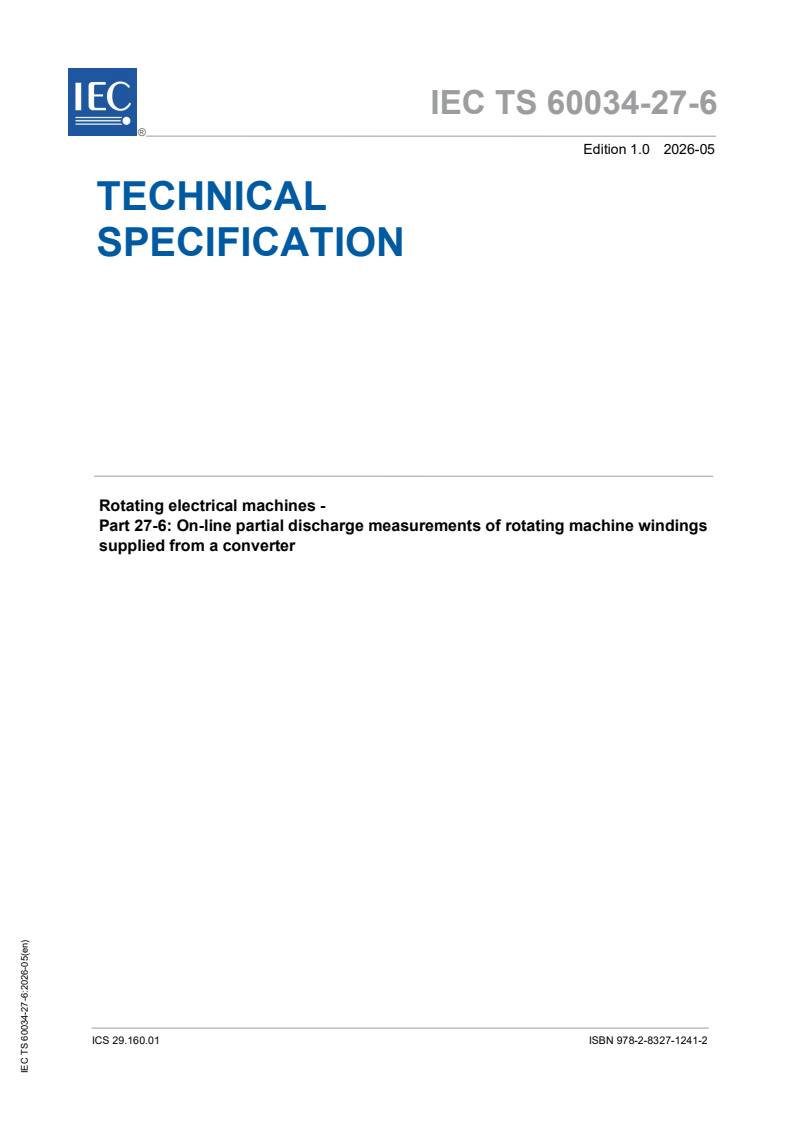
IEC TS 60034-27-6 ®
Edition 1.0 2026-05
TECHNICAL
SPECIFICATION
Rotating electrical machines -
Part 27-6: On-line partial discharge measurements of rotating machine windings
supplied from a converter
ICS 29.160.01 ISBN 978-2-8327-1241-2
All rights reserved. Unless otherwise specified, no part of this publication may be reproduced or utilized in any form or
by any means, electronic or mechanical, including photocopying and microfilm, without permission in writing from either
IEC or IEC's member National Committee in the country of the requester. If you have any questions about IEC copyright
or have an enquiry about obtaining additional rights to this publication, please contact the address below or your local
IEC member National Committee for further information.
IEC Secretariat Tel.: +41 22 919 02 11
3, rue de Varembé info@iec.ch
CH-1211 Geneva 20 www.iec.ch
Switzerland
About the IEC
The International Electrotechnical Commission (IEC) is the leading global organization that prepares and publishes
International Standards for all electrical, electronic and related technologies.
About IEC publications
The technical content of IEC publications is kept under constant review by the IEC. Please make sure that you have the
latest edition, a corrigendum or an amendment might have been published.
IEC publications search - IEC Products & Services Portal - products.iec.ch
webstore.iec.ch/advsearchform Discover our powerful search engine and read freely all the
The advanced search enables to find IEC publications by a
publications previews, graphical symbols and the glossary.
variety of criteria (reference number, text, technical With a subscription you will always have access to up to date
committee, …). It also gives information on projects, content tailored to your needs.
replaced and withdrawn publications.
Electropedia - www.electropedia.org
IEC Just Published - webstore.iec.ch/justpublished The world's leading online dictionary on electrotechnology,
Stay up to date on all new IEC publications. Just Published containing more than 22 500 terminological entries in English
details all new publications released. Available online and and French, with equivalent terms in 25 additional languages.
once a month by email. Also known as the International Electrotechnical Vocabulary
(IEV) online.
IEC Customer Service Centre - webstore.iec.ch/csc
If you wish to give us your feedback on this publication or
need further assistance, please contact the Customer
Service Centre: sales@iec.ch.
CONTENTS
FOREWORD . 3
INTRODUCTION . 5
1 Scope . 6
2 Normative references . 6
3 Terms and definitions . 6
4 Causes and effects of on-line PD . 9
4.1 General requirements. 9
4.2 Type I windings . 9
4.3 Type II windings . 9
5 Challenges with measuring PD on-line with windings connected to converters . 10
5.1 General . 10
5.2 Synchronizing to the fundamental AC voltage cycle . 11
5.3 Fundamental frequency stability . 11
5.4 Synchronizing to the impulse voltage . 11
5.5 Disturbances caused by converter switching . 12
6 Measurement frequency range . 12
6.1 VHF . 12
6.2 UHF . 12
7 PD sensors . 12
7.1 General . 12
7.2 Capacitors . 13
7.3 Electromagnetic couplers (antennas) . 13
7.4 High frequency current transformers (HFCT) . 14
7.5 Ultrasonic sensor . 14
7.6 UV detection . 14
7.7 Ozone sensor . 14
8 Instrumentation and software . 14
8.1 General . 14
8.2 Switching transient interference suppression . 15
8.3 Frequency stability check . 15
8.4 Types of output plots. 15
8.4.1 General. 15
8.4.2 PRPD plot . 15
8.4.3 PD transient impulse plot . 16
8.5 Hybrid method . 18
9 Sensitivity check . 18
10 Measuring procedures . 18
11 Basic interpretation . 19
11.1 General . 19
11.2 Type I windings . 19
11.3 Type II windings . 20
Bibliography . 21
Figure 1 – PRPD plot from one phase of an operating 7,2 kV motor running at 100 Hz
with an 11-level converter [1] . 16
Figure 2 – Waveform from an unfiltered antenna (red line) showing the switching
transient at the beginning of the impulse (blue line), as well as PD at the peak of the
impulse [2] . 17
Figure 3 – PD from an antenna and bandpass filter in a stator winding (upper trace)
due to switching impulses from a converter [3] . 17
Figure 4 – Modified converter connected to three phase winding for a hybrid test to
measure winding PD just prior to just after motor operation [4] . 18
INTERNATIONAL ELECTROTECHNICAL COMMISSION
____________
Rotating electrical machines -
Part 27-6: On-line partial discharge measurements
of rotating machine windings supplied from a converter
FOREWORD
1) The International Electrotechnical Commission (IEC) is a worldwide organization for standardization comprising
all national electrotechnical committees (IEC National Committees). The object of IEC is to promote international
co-operation on all questions concerning standardization in the electrical and electronic fields. To this end and
in addition to other activities, IEC publishes International Standards, Technical Specifications, Technical Reports,
Publicly Available Specifications (PAS) and Guides (hereafter referred to as "IEC Publication(s)"). Their
preparation is entrusted to technical committees; any IEC National Committee interested in the subject dealt with
may participate in this preparatory work. International, governmental and non-governmental organizations liaising
with the IEC also participate in this preparation. IEC collaborates closely with the International Organization for
Standardization (ISO) in accordance with conditions determined by agreement between the two organizations.
2) The formal decisions or agreements of IEC on technical matters express, as nearly as possible, an international
consensus of opinion on the relevant subjects since each technical committee has representation from all
interested IEC National Committees.
3) IEC Publications have the form of recommendations for international use and are accepted by IEC National
Committees in that sense. While all reasonable efforts are made to ensure that the technical content of IEC
Publications is accurate, IEC cannot be held responsible for the way in which they are used or for any
misinterpretation by any end user.
4) In order to promote international uniformity, IEC National Committees undertake to apply IEC Publications
transparently to the maximum extent possible in their national and regional publications. Any divergence between
any IEC Publication and the corresponding national or regional publication shall be clearly indicated in the latter.
5) IEC itself does not provide any attestation of conformity. Independent certification bodies provide conformity
assessment services and, in some areas, access to IEC marks of conformity. IEC is not responsible for any
services carried out by independent certification bodies.
6) All users should ensure that they have the latest edition of this publication.
7) No liability shall attach to IEC or its directors, employees, servants or agents including individual experts and
members of its technical committees and IEC National Committees for any personal injury, property damage or
other damage of any nature whatsoever, whether direct or indirect, or for costs (including legal fees) and
expenses arising out of the publication, use of, or reliance upon, this IEC Publication or any other IEC
Publications.
8) Attention is drawn to the Normative references cited in this publication. Use of the referenced publications is
indispensable for the correct application of this publication.
9) IEC draws attention to the possibility that the implementation of this document may involve the use of (a)
patent(s). IEC takes no position concerning the evidence, validity or applicability of any claimed patent rights in
respect thereof. As of the date of publication of this document, IEC had not received notice of (a) patent(s), which
may be required to implement this document. However, implementers are cautioned that this may not represent
the latest information, which may be obtained from the patent database available at https://patents.iec.ch. IEC
shall not be held responsible for identifying any or all such patent rights.
IEC TS 60034-27-6 has been prepared by subcommittee IEC technical committee 2: Rotating
machines. It is a Technical Specification.
The text of this Technical Specification is based on the following documents:
Draft Report on voting
2/2282/DTS 2/2308/RVDTS
Full information on the voting for its approval can be found in the report on voting indicated in
the above table.
The language used for the development of this Technical Specification is English.
This document was drafted in accordance with ISO/IEC Directives, Part 2, and developed in
accordance with ISO/IEC Directives, Part 1 and ISO/IEC Directives, IEC Supplement, available
at www.iec.ch/members_experts/refdocs. The main document types developed by IEC are
described in greater detail at www.iec.ch/publications.
A list of all parts in the IEC 60034 series, published under the general title Rotating electrical
machines, can be found on the IEC website.
The committee has decided that the contents of this document will remain unchanged until the
stability date indicated on the IEC website under https://webstore.iec.ch/ in the data related to
the specific document. At this date, the document will be
– reconfirmed,
– withdrawn, or
– revised.
INTRODUCTION
The on-line measurement of partial discharges (PD) is a well-established technology to help
assess if deterioration has occurred in the electrical insulation of form-wound stator windings
in motors and generators rated 3 kV and above that are directly connected to the 50/60 Hz
power system. Such on-line testing helps machine owners determine when stator winding
maintenance is required.
IEC 60034-27-2 provides methods for on-line PD detection, as well as advice on interpretation.
However, the methods described in IEC 60034-27-2, in general, are not effective when applied
to machines connected to most common types of AC frequency converters. This is because the
AC fundamental frequency is not fixed, and since some types of drives (and the voltage source
PWM converter in particular) produce high voltage impulses that in many respects have the
same shape as PD pulses but are orders of magnitude higher than the PD pulses. The
interference from the voltage impulses from operating converters can obscure the winding PD
and make on-line measurement difficult if not impossible using the methods intended for
machines fed from industrial sinusoidal AC voltage.
IEC TS 60034-27-5 is concerned with the off-line measurement of PD in windings caused by
voltage impulses from specialized impulse test supplies. Usually, these voltage impulses are
few in number per second, and the impulse waveform is well-behaved, reducing the risk of false
indications. In contrast there are often thousands of impulses per second from converters, and
a variety of impulse voltage waveforms occur, even from the same converter. Although some
of the methods in IEC TS 60034-27-5 can produce good results when applied on-line, it is
important to apply special provisions if they are used for on-line PD detection in windings
supplied by converters.
On-line testing can be relevant for type I windings to confirm that frequent PD caused by
converter switching is not occurring in service. On-line testing of type II windings can also be
used for insulation condition monitoring to detect if aging processes are increasing the PD
activity. Since some machine vendors are being asked to supply on-line PD systems for
converter-fed machines, this document is intended to make users aware of the technical
reasons why the methods in IEC 60034-27-2 are usually inadequate. It also provides guidance
on methods that can be more effective.
Due to the high magnitude sparking that occurs with slip rings, at this time there are no on-line
PD systems usable with converter-fed windings supplied via brushes/slip-rings.
This is a rapidly evolving technology with minimally proven systems available at the time of
publication. Revisions to this document are expected in the near future as technology advances.
1 Scope
This part of the IEC 60034-27 deals with the on-line electrical detection and monitoring of partial
discharges on both motors and generators whose rotor windings or stator windings, or both, are
supplied from converters. The tests are applicable to both type I and type II insulation systems,
encompassing AC windings rated 300 V and above.
Details of non-electrical methods such as optical or acoustic detection are not included. The
on-line measurement of PD where the winding is supplied via slip rings are also not covered.
2 Normative references
The following documents are referred to in the text in such a way that some or all of their content
constitutes requirements of this document. For dated references, only the edition cited applies.
For undated references, the latest edition of the referenced document (including any
amendments) applies.
IEC 60034-27-2:2023, Rotating electrical machines - Part 27-2: On-line partial discharge
measurements on the stator winding insulation
IEC 60034-18-41, Rotating electrical machines - Part 18-41: Partial discharge free electrical
insulation systems (Type I) used in rotating electrical machines fed from voltage converters -
Qualification and quality control tests
IEC 60034-18-42, Rotating electrical machines - Part 18-42: Partial discharge resistant
electrical insulation systems (Type II) used in rotating electrical machines fed from voltage
converters - Qualification tests
IEC TS 60034-25, Rotating electrical machines - Part 25: AC electrical machines used in power
drive systems - Application guide
IEC TS 60034-27-5, Rotating electrical machines - Part 27-5: Off-line measurement of partial
discharge inception voltage on winding insulation under repetitive impulse voltage
IEC 60270, High-voltage test techniques - Charge-based measurement of partial discharges
3 Terms and definitions
For the purposes of this document, the following terms and definitions apply.
ISO and IEC maintain terminology databases for use in standardization at the following
addresses:
– IEC Electropedia: available at https://www.electropedia.org/
– ISO Online browsing platform: available at https://www.iso.org/obp
3.1
type I insulation system
insulation systems, or parts of, that are not expected to experience PD activity under the
specified rated conditions
3.2
type II insulation system
insulation systems, or parts of, that are expected to withstand PD activity under the specified
rated conditions
3.3
partial discharge
PD
localized electrical discharge that only partially bridges the insulation between conductors and
which can occur adjacent to a conductor
3.4
on-line measurement
measurement taken with the rotating electrical machine in operation
3.5
off-line measurement
measurement taken with the rotating electrical machine at standstill, the machine being
disconnected from the power system
Note 1 to entry: The necessary test voltage is applied to the winding from a separate voltage source.
3.6
conductive slot coating
conductive paint or tape layer in intimate contact with the mainwall insulation in the slot portion
of the coil side, often called semi-conductive coating
Note 1 to entry: This coating, together with adequate slot design, provides electrical contact to the stator core
without short-circuiting the core laminations.
3.7
stress control coating
paint or tape on the surface of the mainwall insulation that extends beyond the conductive slot
coating in high-voltage stator bars and coils
Note 1 to entry: The purpose of the coating is to prevent surface discharges near the slot exit or in the end winding
area.
3.8
slot discharges
discharges that occur between the outer surface of the slot portion of a coil or bar and the
earthed core laminations due to high electrical field strength
3.9
surface discharges
discharges that occur on the surface of the insulation or on the surface of winding components
in the winding overhang or the active part of the machine winding
Note 1 to entry: Not every discharge on the surface of the winding can be considered a Corona discharge.
3.10
phase resolved partial discharge pattern
PRPD
PD distribution map of PD magnitude and number of PD pulses vs. fundamental frequency AC
cycle phase position, for visualization of the PD behaviour during a predefined measuring time
3.11
PD sensor
general type of transducer, which can be used to detect PD signals from the machine winding
3.12
PD magnitude
Q
magnitude associated with a PD pulse recorded by a measuring system
Note 1 to entry: In this document, the symbol Q is used as a placeholder for both definitions of PD magnitude, Q
m
and Q as given in IEC 60034-27-1. This magnitude is usually derived from a stream of individual PD pulses.
IEC
3.13
fundamental frequency
frequency of the voltage harmonic with the largest magnitude in normal operation
3.14
partial discharge inception voltage
PDIV
lowest voltage at which partial discharges are initiated in the test object when the voltage
applied to the test object is gradually increased from a lower value at which no such discharges
are observed
Note 1 to entry: The PDIV is defined as the peak-to-peak voltage. With sinusoidal applied voltages, the PDIV is
normally measured as the RMS value of the voltage. Converting to the peak-to-peak voltage requires the knowledge
of the form factor.
3.15
partial discharge extinction voltage
PDEV
voltage at which partial discharges are extinguished in the test object when the voltage applied
to the test object is gradually decreased from a higher value at which such discharges are
observed
Note 1 to entry: The PDEV is defined as the peak-to-peak voltage. With sinusoidal applied voltages, the PDEV is
normally measured as the RMS value of the voltage. Converting to the peak-to-peak voltage requires the knowledge
of the form factor.
3.16
repetitive partial discharge inception voltage
RPDIV
minimum peak-to-peak impulse voltage at which more than five PD pulses occur on ten voltage
impulses when the voltage applied to the test object is increased with step-by-step method from
a lower value at which no discharges are observed
Note 1 to entry: The RPDIV is a mean value for the specified test time and a test arrangement where the voltage
applied to the test object is gradually increased from a value at which no partial discharges can be detected for the
measured PD sensitivity.
3.17
repetitive partial discharge extinction voltage
RPDEV
maximum peak-to-peak impulse voltage at which less than five PD pulses occur on ten voltage
impulses of the same peak-to-peak values when the voltage applied to the test object is
decreased with step-by-step method from a higher value at which such discharges are observed
Note 1 to entry: The RPDEV is a mean value for the specified test time and a test arrangement where the voltage
applied to the test object is decreased with step-by-step method.
4 Causes and effects of on-line PD
4.1 General requirements
The approval of electrical insulation systems for use in rotating electrical machines driven from
voltage converters is set out in IEC 60034-18-41 and IEC 60034-18-42. They divide the systems
into those which are not expected to experience partial discharge activity within specified
conditions in their service lives (type I) and those which are expected to withstand partial
discharge activity in any part of the insulation system throughout their service lives (type II).
4.2 Type I windings
In type I windings one or more of the turn, earth and phase-phase insulation components do
not contain PD-resistant materials. When PD frequently occurs in a winding during operation,
the PD will usually rapidly age the insulation, leading to winding insulation failure. Thus,
detection of any frequently occurring winding PD during operation by on-line monitoring will
normally cause asset managers to remove the machine from service as soon as possible to
confirm that PD is occurring and to implement corrective measures such as adding filters or
using different cables between the converter and the winding.
PD can occur as a result of imperfections in the manufacturing process, improper application
of the specific motor and as a consequence of other aging stresses present during operation.
The capabilities of the insulation system and its PD performance in response to repetitive
voltage impulses should be assessed by means of the qualification and routine PD tests
presented in IEC 60034-18-41, using one of the off-line test methods described in
IEC TS 60034-27-5. However, it is useful to confirm that PD is not occurring during operation
using an on-line PD detection system.
This document is also concerned with using on-line PD monitoring to detect defects that arise
in service due to non-electrical aging stresses and factors, including
– PD on insulation surfaces that can occur at low ambient pressure, such as motors operating
at high altitudes,
– voids, cracks and delamination in the insulation system due to either thermal aging, or
thermo-mechanical cycling or both,
– cracks and delamination in the insulation system caused by magnetic forces causing relative
movement of the winding conductors,
– surface electrical tracking caused by contamination of the windings by partly conductive
contamination, for example metallic particles when lubricant oils are in contact with the
insulation,
– cracking of the insulation caused by exposure to radiation in nuclear plants and aircraft
applications, and
– exposure to harmful atmospheres such as ozone and other gasses that leads to cracks and
voids in the insulation system.
4.3 Type II windings
In type II windings PD can frequently occur during normal operation of the winding yet still not
lead to premature failure, since the insulating materials exposed to the PD are usually PD-
resistant, i.e. contain mica, nanodielectrics, ceramics, fiberglass or other inorganic materials.
The set of voltage endurance tests in IEC 60034-18-42 are intended to prove that the design of
the insulation system and the PD-resistance is sufficient that normal winding life will occur in
spite of any PD that can be present.
As with on-line PD detection in windings directly connected to the power system, the purpose
of on-line PD monitoring of converter fed windings is also to detect significant changes in the
PD activity that can lead to accelerated degradation of the insulation. If the PD activity increases
over time, the cause should be investigated. A consistent increase over time can indicate that
an ageing mechanism is developing. It is then prudent to consider additional investigations to
enable decision making about the need for maintenance.
Deterioration processes that can lead to increasing PD over time in type II insulation systems
include
– voids and delamination in the insulation system due to thermal aging,
– delamination in the insulation system due to thermo-mechanical cycling,
– cracks and delamination in the insulation system caused by magnetic forces that lead to
relative movement of the winding conductors especially in the slots of magnetic cores,
– surface electrical tracking caused by partly conductive contamination of the windings,
– switching impulse voltages at high frequency that can lead to the thermal aging of the
conductive slot coating, or stress control coatings, or both,
– PD between turns caused by higher-than-expected switching impulse voltages with short
rise times,
– PD in small defects that can occur at low ambient pressure, such as motors operating at
high altitudes,
– cracking of the insulation caused by exposure to radiation in nuclear plants and in aircraft
applications, and
– exposure to harmful atmospheres such as ozone and other gasses that leads to cracks and
voi
...