

IEC 61804-3:2020
(Main)Devices and integration in enterprise systems - Function blocks (FB) for process control and electronic device description language (EDDL) - Part 3: EDDL syntax and semantics
General Information
- Abstract
IEC 61804-3:2020 specifies the electronic device description language (EDDL) technology, which enables the integration of real product details using the tools of the engineering life cycle.
This document specifies EDDL as a generic language for describing the properties of automation system components. EDDL is capable of describing
• device parameters and their dependencies;
• device functions, for example, simulation mode, calibration;
• graphical representations, for example, menus;
• interactions with control devices;
• graphical representations:
– enhanced user interface,
– graphing system;
• persistent data store.
EDDL is used to create electronic device description (EDD) for e.g. concrete devices, common usable profiles or libraries. This EDD is used with appropriate tools to generate an interpretative code to support parameter handling, operation, and monitoring of automation system components such as remote I/Os, controllers, sensors, and programmable controllers. Tool implementation is outside the scope of this document.
This document specifies the semantic and lexical structure in a syntax-independent manner. A specific syntax is defined in Annex A, but it is possible to use the semantic model also with different syntaxes.
IEC 61804-4 specifies EDD interpretation for EDD applications and EDDs to support EDD interoperability.
IEC 61804-5 specifies the EDDL builtin library and provides the profiles of the various fieldbuses.
This fourth edition cancels and replaces the third edition published in 2015. This edition constitutes a technical revision.
This edition was developed by merging material from multiple variants of existing EDDL specifications including those from FieldComm Group (FOUNDATION™ Fieldbus , HART® ), PROFIBUS™ Nutzerorganisation e.V. (PNO), and ISA100_Wireless™ Compliance Institute (ISA100 WCI). Any places where there may be a profile deviation are now indicated in the context where the related deviation is found. As a result, the formatting and numbering of this edition may be different from any of the individual specifications from which this edition was derived.
This edition includes the following significant technical changes with respect to the previous edition:
• Communication profiles ISA100 and GPE were added.
• EDD Identification Information has a new LAYOUT_TYPE attribute.
• New construct SEMANTIC_MAP was added.
• CLASS attribute values LOCAL_A and LOCAL_B were added.
• Extended LIST functionality to support device managed lists.
- Status
- Published
- Publication Date
- 23-Jun-2020
- Technical Committee
- SC 65E - Devices and integration in enterprise systems
- Drafting Committee
- WG 7 - TC 65/SC 65E/WG 7
- Current Stage
- PPUB - Publication issued
- Start Date
- 24-Jun-2020
- Completion Date
- 06-Jul-2020
Buy Documents
IEC 61804-3:2020 - Devices and integration in enterprise systems - Function blocks (FB) for process control and electronic device description language (EDDL) - Part 3: EDDL syntax and semantics Released:6/24/2020
Overview
IEC 61804-3:2020 is an international standard published by the International Electrotechnical Commission (IEC) that defines the syntax and semantics of the Electronic Device Description Language (EDDL). As part of the IEC 61804 series focused on devices and integration in enterprise systems, this standard specifically addresses how EDDL is used to describe automation system components in a generic and interoperable way. The fourth edition of this standard consolidates previous EDDL specifications from multiple organizations (FieldComm Group, PROFIBUS Nutzerorganisation, ISA100 Wireless Compliance Institute), ensuring coherent syntax and semantics for device descriptions in process control environments.
This standard is essential for system integrators, device manufacturers, and software tool developers involved in the engineering life cycle of industrial automation solutions. It enables integration of detailed real product data into system tools, supporting configuration, operation, calibration, simulation, monitoring, and maintenance of devices like sensors, controllers, remote I/Os, and programmable logic controllers (PLCs).
Key Topics
- Generic EDDL Language: Describes device properties including parameters, dependencies, device functions (e.g., simulation modes, calibration), and interactions with control devices.
- Graphical Representations: Supports enhanced user interfaces with graphical menus, charting systems, and device function visualization.
- Persistent Data Storage: Defines models for storing device data safely and consistently for use across engineering tools.
- EDD Structure and Development: Specifies the architecture and development process of Electronic Device Descriptions (EDDs), including source generation, preprocessing, and compilation.
- Lexical and Semantic Model: Provides a syntax-independent semantic model with an optionally defined specific syntax, ensuring flexibility in implementation.
- Profiles and Built-in Libraries: Describes standard profiles for various fieldbuses and built-in language elements enhancing interoperability.
- Advanced Data Modeling: Details complex constructs such as VARIABLE lists, collections, arrays, commands, methods, and response codes critical in describing device behavior and data.
- New Technical Features: Includes recent additions like new communication profiles (ISA100, GPE), EDIT_DISPLAY attributes (LAYOUT_TYPE), semantic mapping constructs, and extended list functionalities.
Applications
IEC 61804-3:2020 finds practical application across a broad spectrum of industrial automation sectors, including:
- Device Integration: Enables manufacturers to create standardized device descriptions that multiple system tools can interpret, facilitating plug-and-play capabilities.
- Process Control Engineering: Assists engineering teams in developing, configuring, and commissioning automation systems more efficiently.
- Interoperability: Supports communication and data exchange between devices from different vendors using common fieldbus protocols (FOUNDATION Fieldbus, HART, PROFIBUS, ISA100 Wireless).
- Software Tool Development: Provides the basis for software vendors to implement EDDL interpreters enabling device parameter handling, diagnostics, and monitoring.
- Maintenance and Calibration: Facilitates remote diagnostics, simulation, and calibration procedures through detailed electronic descriptions.
- Enhanced User Interfaces: Enables creation of advanced graphical interfaces, improving operator interaction with devices and process data for better decision making.
Related Standards
IEC 61804-3:2020 is part of a comprehensive family of standards addressing function blocks and device description languages:
- IEC 61804-4: Specifies the interpretation of EDDs to support interoperability among EDDL applications and devices.
- IEC 61804-5: Defines the built-in library for EDDL and profiles for various fieldbus communication systems.
- IEC 61804-1 & IEC 61804-2: Address function blocks for process control and system integration architecture.
- Fieldbus and Wireless Protocol Standards: Such as FOUNDATION Fieldbus, HART, PROFIBUS, and ISA100 Wireless that complement EDDL for device communications.
When combined, these standards streamline device integration and interoperability in industrial automation systems, reducing engineering effort and improving system reliability.
Keywords: IEC 61804-3, Electronic Device Description Language, EDDL syntax, device integration, process control, automation system components, function blocks, device parameters, graphical user interface, device description, interoperability, fieldbus profiles, ISA100, FOUNDATION Fieldbus, HART, PROFIBUS, industrial automation standards.
Relations
- Effective Date
- 05-Sep-2023
Buy Documents
IEC 61804-3:2020 - Devices and integration in enterprise systems - Function blocks (FB) for process control and electronic device description language (EDDL) - Part 3: EDDL syntax and semantics Released:6/24/2020
Get Certified
Connect with accredited certification bodies for this standard

BSI Group
BSI (British Standards Institution) is the business standards company that helps organizations make excellence a habit.

DVS-ZERT GmbH
German welding certification society.
CARES (UK Certification Authority for Reinforcing Steels)
UK certification for reinforcing steels and construction.
Sponsored listings
Frequently Asked Questions
IEC 61804-3:2020 is a standard published by the International Electrotechnical Commission (IEC). Its full title is "Devices and integration in enterprise systems - Function blocks (FB) for process control and electronic device description language (EDDL) - Part 3: EDDL syntax and semantics". This standard covers: IEC 61804-3:2020 specifies the electronic device description language (EDDL) technology, which enables the integration of real product details using the tools of the engineering life cycle. This document specifies EDDL as a generic language for describing the properties of automation system components. EDDL is capable of describing • device parameters and their dependencies; • device functions, for example, simulation mode, calibration; • graphical representations, for example, menus; • interactions with control devices; • graphical representations: – enhanced user interface, – graphing system; • persistent data store. EDDL is used to create electronic device description (EDD) for e.g. concrete devices, common usable profiles or libraries. This EDD is used with appropriate tools to generate an interpretative code to support parameter handling, operation, and monitoring of automation system components such as remote I/Os, controllers, sensors, and programmable controllers. Tool implementation is outside the scope of this document. This document specifies the semantic and lexical structure in a syntax-independent manner. A specific syntax is defined in Annex A, but it is possible to use the semantic model also with different syntaxes. IEC 61804-4 specifies EDD interpretation for EDD applications and EDDs to support EDD interoperability. IEC 61804-5 specifies the EDDL builtin library and provides the profiles of the various fieldbuses. This fourth edition cancels and replaces the third edition published in 2015. This edition constitutes a technical revision. This edition was developed by merging material from multiple variants of existing EDDL specifications including those from FieldComm Group (FOUNDATION™ Fieldbus , HART® ), PROFIBUS™ Nutzerorganisation e.V. (PNO), and ISA100_Wireless™ Compliance Institute (ISA100 WCI). Any places where there may be a profile deviation are now indicated in the context where the related deviation is found. As a result, the formatting and numbering of this edition may be different from any of the individual specifications from which this edition was derived. This edition includes the following significant technical changes with respect to the previous edition: • Communication profiles ISA100 and GPE were added. • EDD Identification Information has a new LAYOUT_TYPE attribute. • New construct SEMANTIC_MAP was added. • CLASS attribute values LOCAL_A and LOCAL_B were added. • Extended LIST functionality to support device managed lists.
IEC 61804-3:2020 specifies the electronic device description language (EDDL) technology, which enables the integration of real product details using the tools of the engineering life cycle. This document specifies EDDL as a generic language for describing the properties of automation system components. EDDL is capable of describing • device parameters and their dependencies; • device functions, for example, simulation mode, calibration; • graphical representations, for example, menus; • interactions with control devices; • graphical representations: – enhanced user interface, – graphing system; • persistent data store. EDDL is used to create electronic device description (EDD) for e.g. concrete devices, common usable profiles or libraries. This EDD is used with appropriate tools to generate an interpretative code to support parameter handling, operation, and monitoring of automation system components such as remote I/Os, controllers, sensors, and programmable controllers. Tool implementation is outside the scope of this document. This document specifies the semantic and lexical structure in a syntax-independent manner. A specific syntax is defined in Annex A, but it is possible to use the semantic model also with different syntaxes. IEC 61804-4 specifies EDD interpretation for EDD applications and EDDs to support EDD interoperability. IEC 61804-5 specifies the EDDL builtin library and provides the profiles of the various fieldbuses. This fourth edition cancels and replaces the third edition published in 2015. This edition constitutes a technical revision. This edition was developed by merging material from multiple variants of existing EDDL specifications including those from FieldComm Group (FOUNDATION™ Fieldbus , HART® ), PROFIBUS™ Nutzerorganisation e.V. (PNO), and ISA100_Wireless™ Compliance Institute (ISA100 WCI). Any places where there may be a profile deviation are now indicated in the context where the related deviation is found. As a result, the formatting and numbering of this edition may be different from any of the individual specifications from which this edition was derived. This edition includes the following significant technical changes with respect to the previous edition: • Communication profiles ISA100 and GPE were added. • EDD Identification Information has a new LAYOUT_TYPE attribute. • New construct SEMANTIC_MAP was added. • CLASS attribute values LOCAL_A and LOCAL_B were added. • Extended LIST functionality to support device managed lists.
IEC 61804-3:2020 is classified under the following ICS (International Classification for Standards) categories: 25.040.40 - Industrial process measurement and control; 35.240.50 - IT applications in industry. The ICS classification helps identify the subject area and facilitates finding related standards.
IEC 61804-3:2020 has the following relationships with other standards: It is inter standard links to IEC 61804-3:2015. Understanding these relationships helps ensure you are using the most current and applicable version of the standard.
IEC 61804-3:2020 is available in PDF format for immediate download after purchase. The document can be added to your cart and obtained through the secure checkout process. Digital delivery ensures instant access to the complete standard document.
Standards Content (Sample)
IEC 61804-3 ®
Edition 4.0 2020-06
INTERNATIONAL
STANDARD
NORME
INTERNATIONALE
colour
inside
Devices and integration in enterprise systems – Function blocks (FB) for
process control and electronic device description language (EDDL) –
Part 3: EDDL syntax and semantics
Les dispositifs et leur intégration dans les systèmes de l'entreprise – Blocs
fonctionnels (FB) pour les procédés industriels et le langage de description
électronique de produit (EDDL) –
Partie 3: Sémantique et syntaxe EDDL
All rights reserved. Unless otherwise specified, no part of this publication may be reproduced or utilized in any form
or by any means, electronic or mechanical, including photocopying and microfilm, without permission in writing from
either IEC or IEC's member National Committee in the country of the requester. If you have any questions about IEC
copyright or have an enquiry about obtaining additional rights to this publication, please contact the address below or
your local IEC member National Committee for further information.
Droits de reproduction réservés. Sauf indication contraire, aucune partie de cette publication ne peut être reproduite
ni utilisée sous quelque forme que ce soit et par aucun procédé, électronique ou mécanique, y compris la photocopie
et les microfilms, sans l'accord écrit de l'IEC ou du Comité national de l'IEC du pays du demandeur. Si vous avez des
questions sur le copyright de l'IEC ou si vous désirez obtenir des droits supplémentaires sur cette publication, utilisez
les coordonnées ci-après ou contactez le Comité national de l'IEC de votre pays de résidence.
IEC Central Office Tel.: +41 22 919 02 11
3, rue de Varembé info@iec.ch
CH-1211 Geneva 20 www.iec.ch
Switzerland
About the IEC
The International Electrotechnical Commission (IEC) is the leading global organization that prepares and publishes
International Standards for all electrical, electronic and related technologies.
About IEC publications
The technical content of IEC publications is kept under constant review by the IEC. Please make sure that you have the
latest edition, a corrigendum or an amendment might have been published.
IEC publications search - webstore.iec.ch/advsearchform Electropedia - www.electropedia.org
The advanced search enables to find IEC publications by a The world's leading online dictionary on electrotechnology,
variety of criteria (reference number, text, technical containing more than 22 000 terminological entries in English
committee,…). It also gives information on projects, replaced and French, with equivalent terms in 16 additional languages.
and withdrawn publications. Also known as the International Electrotechnical Vocabulary
(IEV) online.
IEC Just Published - webstore.iec.ch/justpublished
Stay up to date on all new IEC publications. Just Published IEC Glossary - std.iec.ch/glossary
details all new publications released. Available online and 67 000 electrotechnical terminology entries in English and
once a month by email. French extracted from the Terms and Definitions clause of
IEC publications issued since 2002. Some entries have been
IEC Customer Service Centre - webstore.iec.ch/csc collected from earlier publications of IEC TC 37, 77, 86 and
If you wish to give us your feedback on this publication or CISPR.
need further assistance, please contact the Customer Service
Centre: sales@iec.ch.
A propos de l'IEC
La Commission Electrotechnique Internationale (IEC) est la première organisation mondiale qui élabore et publie des
Normes internationales pour tout ce qui a trait à l'électricité, à l'électronique et aux technologies apparentées.
A propos des publications IEC
Le contenu technique des publications IEC est constamment revu. Veuillez vous assurer que vous possédez l’édition la
plus récente, un corrigendum ou amendement peut avoir été publié.
Recherche de publications IEC - Electropedia - www.electropedia.org
webstore.iec.ch/advsearchform Le premier dictionnaire d'électrotechnologie en ligne au
La recherche avancée permet de trouver des publications IEC monde, avec plus de 22 000 articles terminologiques en
en utilisant différents critères (numéro de référence, texte, anglais et en français, ainsi que les termes équivalents dans
comité d’études,…). Elle donne aussi des informations sur les 16 langues additionnelles. Egalement appelé Vocabulaire
projets et les publications remplacées ou retirées. Electrotechnique International (IEV) en ligne.
IEC Just Published - webstore.iec.ch/justpublished Glossaire IEC - std.iec.ch/glossary
Restez informé sur les nouvelles publications IEC. Just 67 000 entrées terminologiques électrotechniques, en anglais
Published détaille les nouvelles publications parues. et en français, extraites des articles Termes et Définitions des
Disponible en ligne et une fois par mois par email. publications IEC parues depuis 2002. Plus certaines entrées
antérieures extraites des publications des CE 37, 77, 86 et
Service Clients - webstore.iec.ch/csc CISPR de l'IEC.
Si vous désirez nous donner des commentaires sur cette
publication ou si vous avez des questions contactez-nous:
sales@iec.ch.
IEC 61804-3 ®
Edition 4.0 2020-06
INTERNATIONAL
STANDARD
NORME
INTERNATIONALE
colour
inside
Devices and integration in enterprise systems – Function blocks (FB) for
process control and electronic device description language (EDDL) –
Part 3: EDDL syntax and semantics
Les dispositifs et leur intégration dans les systèmes de l'entreprise – Blocs
fonctionnels (FB) pour les procédés industriels et le langage de description
électronique de produit (EDDL) –
Partie 3: Sémantique et syntaxe EDDL
INTERNATIONAL
ELECTROTECHNICAL
COMMISSION
COMMISSION
ELECTROTECHNIQUE
INTERNATIONALE
ICS 25.040.40; 35.240.50 ISBN 978-2-8322-8468-1
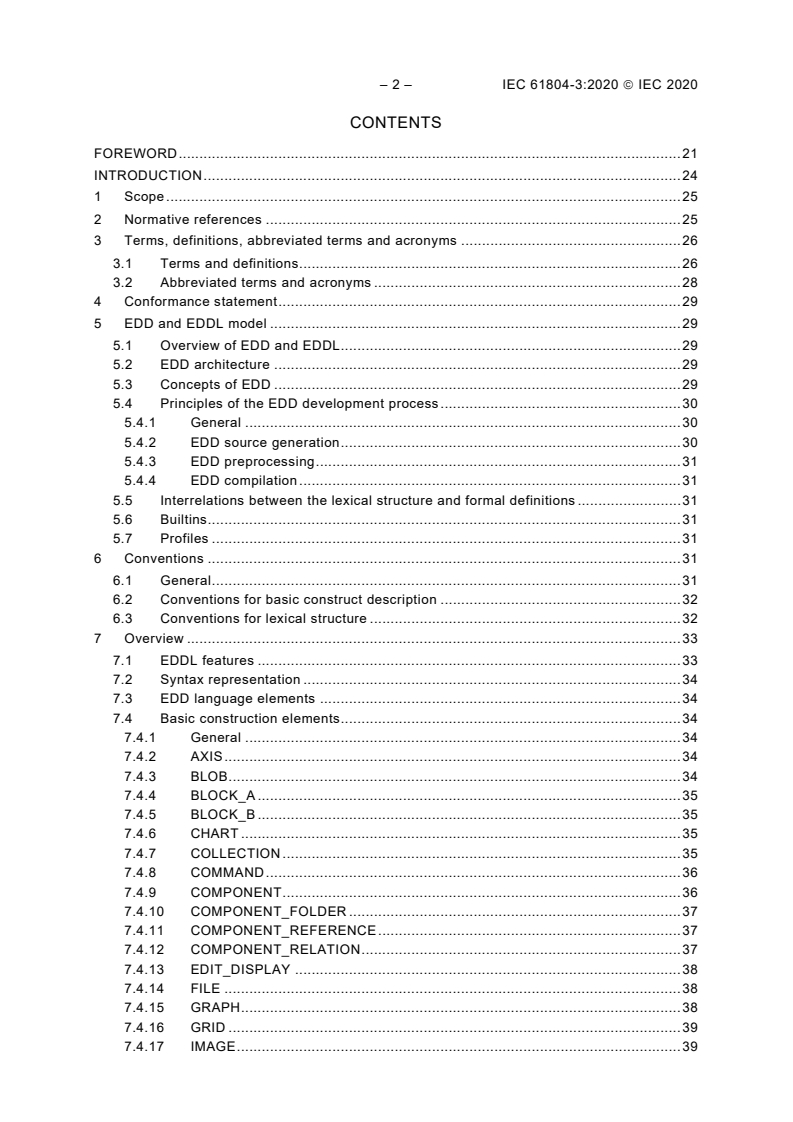
– 2 – IEC 61804-3:2020 IEC 2020
CONTENTS
FOREWORD . 21
INTRODUCTION . 24
1 Scope . 25
2 Normative references . 25
3 Terms, definitions, abbreviated terms and acronyms . 26
3.1 Terms and definitions . 26
3.2 Abbreviated terms and acronyms . 28
4 Conformance statement . 29
5 EDD and EDDL model . 29
5.1 Overview of EDD and EDDL . 29
5.2 EDD architecture . 29
5.3 Concepts of EDD . 29
5.4 Principles of the EDD development process . 30
5.4.1 General . 30
5.4.2 EDD source generation . 30
5.4.3 EDD preprocessing . 31
5.4.4 EDD compilation . 31
5.5 Interrelations between the lexical structure and formal definitions . 31
5.6 Builtins . 31
5.7 Profiles . 31
6 Conventions . 31
6.1 General . 31
6.2 Conventions for basic construct description . 32
6.3 Conventions for lexical structure . 32
7 Overview . 33
7.1 EDDL features . 33
7.2 Syntax representation . 34
7.3 EDD language elements . 34
7.4 Basic construction elements . 34
7.4.1 General . 34
7.4.2 AXIS . 34
7.4.3 BLOB . 34
7.4.4 BLOCK_A . 35
7.4.5 BLOCK_B . 35
7.4.6 CHART . 35
7.4.7 COLLECTION . 35
7.4.8 COMMAND . 36
7.4.9 COMPONENT . 36
7.4.10 COMPONENT_FOLDER . 37
7.4.11 COMPONENT_REFERENCE . 37
7.4.12 COMPONENT_RELATION . 37
7.4.13 EDIT_DISPLAY . 38
7.4.14 FILE . 38
7.4.15 GRAPH . 38
7.4.16 GRID . 39
7.4.17 IMAGE . 39
7.4.18 IMPORT . 39
7.4.19 INTERFACE . 39
7.4.20 LIKE . 39
7.4.21 LIST . 40
7.4.22 MENU . 40
7.4.23 METHOD . 41
7.4.24 PLUGIN . 41
7.4.25 RECORD . 41
7.4.26 REFERENCE_ARRAY . 42
7.4.27 Relations . 42
7.4.28 RESPONSE_CODES . 43
7.4.29 SOURCE . 43
7.4.30 TEMPLATE . 44
7.4.31 VALUE_ARRAY . 44
7.4.32 VARIABLE . 44
7.4.33 VARIABLE_LIST . 45
7.4.34 WAVEFORM . 45
7.5 Common attributes . 46
7.6 Special elements . 46
7.7 Rules for instances . 46
7.8 Rules for a list of VARIABLEs . 46
8 EDD identification information. 47
8.1 General structure . 47
8.2 DD_REVISION . 48
8.3 DEVICE_REVISION . 48
8.4 DEVICE_TYPE . 49
8.5 EDD_PROFILE . 49
8.6 EDD_VERSION. 50
8.7 LAYOUT_TYPE. 50
8.8 MANUFACTURER . 50
8.9 MANUFACTURER_EXT . 51
9 Data modelling . 51
9.1 VARIABLE . 51
9.1.1 General structure . 51
9.1.2 CLASS . 53
9.1.3 CONSTANT_UNIT . 56
9.1.4 DEFAULT_VALUE . 57
9.1.5 INITIAL_VALUE . 57
9.1.6 POST_EDIT_ACTIONS . 58
9.1.7 POST_READ_ACTIONS . 58
9.1.8 POST_RQSTUPDATE_ACTIONS . 59
9.1.9 POST_USERCHANGE_ACTIONS. 59
9.1.10 POST_WRITE_ACTIONS . 60
9.1.11 PRE_EDIT_ACTIONS . 60
9.1.12 PRE_READ_ACTIONS . 60
9.1.13 PRE_WRITE_ACTIONS . 61
9.1.14 REFRESH_ACTIONS . 61
9.1.15 TYPE . 62
9.2 REFERENCE_ARRAY . 81
– 4 – IEC 61804-3:2020 IEC 2020
9.2.1 General structure . 81
9.2.2 ELEMENTS . 84
9.2.3 item-type . 84
9.3 VALUE_ARRAY . 84
9.3.1 General structure . 84
9.3.2 NUMBER_OF_ELEMENTS . 85
9.3.3 TYPE . 86
9.4 LIST . 87
9.4.1 General structure . 87
9.4.2 CAPACITY . 88
9.4.3 COUNT . 88
9.4.4 TYPE . 89
9.5 COLLECTION . 90
9.5.1 General structure . 90
9.5.2 item-type . 91
9.6 FILE . 92
9.6.1 General structure . 92
9.6.2 IDENTITY . 93
9.6.3 ON_UPDATE_ACTIONS . 94
9.6.4 SHARED. 94
9.7 Relations . 95
9.7.1 REFRESH . 95
9.7.2 SEMANTIC_MAP . 96
9.7.3 UNIT . 98
9.7.4 WRITE_AS_ONE . 99
9.8 BLOB . 100
9.8.1 General structure . 100
9.8.2 IDENTITY . 101
10 Communication . 102
10.1 COMMAND . 102
10.1.1 General structure . 102
10.1.2 Command addressing . 103
10.1.3 API . 104
10.1.4 BLOCK_B . 104
10.1.5 HEADER. 105
10.1.6 INDEX . 105
10.1.7 NUMBER . 105
10.1.8 OPERATION . 106
10.1.9 SLOT . 107
10.1.10 SUB_SLOT . 107
10.1.11 TRANSACTION . 108
10.2 RECORD . 114
10.3 RESPONSE_CODES . 115
10.4 VARIABLE_LIST . 116
11 User interface . 117
11.1 MENU . 117
11.1.1 General structure . 117
11.1.2 ACCESS . 118
11.1.3 EXIT_ACTIONS . 119
11.1.4 INIT_ACTIONS . 119
11.1.5 ITEMS . 119
11.1.6 POST_EDIT_ACTIONS . 121
11.1.7 POST_READ_ACTIONS . 122
11.1.8 POST_WRITE_ACTIONS . 122
11.1.9 PRE_EDIT_ACTIONS . 123
11.1.10 PRE_READ_ACTIONS . 123
11.1.11 PRE_WRITE_ACTIONS . 123
11.1.12 STYLE . 124
11.1.13 Sequence diagrams for actions . 125
11.2 EDIT_DISPLAY . 127
11.2.1 General structure . 127
11.2.2 EDIT_ITEMS . 127
11.2.3 DISPLAY_ITEMS . 128
11.2.4 POST_EDIT_ACTIONS . 128
11.2.5 PRE_EDIT_ACTIONS . 129
11.3 IMAGE . 129
11.3.1 General structure . 129
11.3.2 LINK . 131
11.3.3 PATH . 131
11.4 GRID . 132
11.4.1 General structure . 132
11.4.2 ORIENTATION . 134
11.4.3 VECTORS . 135
11.5 CHART . 136
11.5.1 General structure . 136
11.5.2 CYCLE_TIME . 143
11.5.3 LENGTH . 144
11.5.4 TYPE . 144
11.5.5 Sequence diagram for actions . 146
11.5.6 CHART legend/help rules . 147
11.6 SOURCE . 149
11.6.1 General structure . 149
11.6.2 EXIT_ACTIONS . 150
11.6.3 INIT_ACTIONS . 151
11.6.4 REFRESH_ACTIONS . 151
11.6.5 Y_AXIS . 152
11.7 AXIS . 152
11.7.1 General structure . 152
11.7.2 MIN_VALUE, MAX_VALUE . 153
11.7.3 SCALING . 154
11.7.4 CONSTANT_UNIT . 154
11.8 GRAPH . 155
11.8.1 General structure . 155
11.8.2 CYCLE_TIME . 163
11.8.3 X_AXIS . 164
11.8.4 Sequence diagram for actions . 164
11.9 WAVEFORM . 165
11.9.1 General structure . 165
– 6 – IEC 61804-3:2020 IEC 2020
11.9.2 EXIT_ACTIONS . 167
11.9.3 INIT_ACTIONS . 167
11.9.4 KEY_POINTS . 168
11.9.5 REFRESH_ACTIONS . 169
11.9.6 TYPE . 169
11.9.7 Y_AXIS . 172
11.10 PLUGIN . 173
11.10.1 General structure . 173
11.10.2 UUID . 173
12 METHODs . 174
12.1 General structure . 174
12.2 ACCESS . 175
12.3 CLASS . 176
12.4 TYPE . 177
13 Device modelling . 178
13.1 BLOCK_A . 178
13.1.1 General structure . 178
13.1.2 AXIS_ITEMS . 180
13.1.3 CHARACTERISTICS . 181
13.1.4 CHARTS . 181
13.1.5 CHART_ITEMS . 182
13.1.6 COLLECTION_ITEMS. 182
13.1.7 EDIT_DISPLAY_ITEMS . 182
13.1.8 FILES . 183
13.1.9 FILE_ITEMS . 183
13.1.10 GRAPHS . 183
13.1.11 GRAPH_ITEMS . 184
13.1.12 GRIDS . 184
13.1.13 GRID_ITEMS . 184
13.1.14 IMAGE_ITEMS . 185
13.1.15 ITEM_ARRAY_ITEMS. 185
13.1.16 LISTS . 185
13.1.17 LIST_ITEMS . 186
13.1.18 LOCAL_PARAMETERS . 186
13.1.19 MENUS . 186
13.1.20 MENU_ITEMS . 187
13.1.21 METHODS . 187
13.1.22 METHOD_ITEMS . 188
13.1.23 PARAMETERS . 188
13.1.24 PARAMETER_LISTS . 188
13.1.25 PLUGINS . 189
13.1.26 PLUGIN_ITEMS . 189
13.1.27 REFRESH_ITEMS . 190
13.1.28 SEMANTIC_MAP_ITEMS . 190
13.1.29 SOURCE_ITEMS . 190
13.1.30 UNIT_ITEMS . 191
13.1.31 WAVEFORM_ITEMS . 191
13.1.32 WRITE_AS_ONE_ITEMS . 191
13.2 BLOCK_B . 192
13.2.1 General structure . 192
13.2.2 NUMBER . 192
13.2.3 TYPE . 193
13.3 LIKE . 193
13.4 IMPORT . 194
13.5 TEMPLATE . 197
13.5.1 General structure . 197
13.5.2 DEFAULT_VALUES . 198
13.6 COMPONENT . 199
13.6.1 General structure . 199
13.6.2 BYTE_ORDER . 200
13.6.3 CAN_DELETE . 201
13.6.4 CHECK_CONFIGURATION . 201
13.6.5 COMPONENT_RELATIONS . 201
13.6.6 CONNECTION_POINT . 202
13.6.7 DETECT . 202
13.6.8 EDD . 202
13.6.9 INITIAL_VALUES . 203
13.6.10 REDUNDANCY . 203
13.6.11 SCAN . 204
13.6.12 SCAN_LIST . 204
13.6.13 PRODUCT_URI . 204
13.7 COMPONENT_FOLDER . 205
13.8 COMPONENT_REFERENCE . 205
13.9 COMPONENT_RELATION . 206
13.9.1 General structure . 206
13.9.2 COMPONENTS . 207
13.9.3 RELATION_TYPE . 208
13.9.4 ADDRESSING . 209
13.9.5 MAXIMUM_NUMBER . 210
13.9.6 MINIMUM_NUMBER . 210
13.9.7 REQUIRED_INTERFACE . 210
13.10 INTERFACE . 211
13.10.1 General structure . 211
13.10.2 DECLARATION . 211
14 Common attributes . 212
14.1 CLASSIFICATION . 212
14.2 COMPONENT_PARENT . 214
14.3 COMPONENT_PATH . 214
14.4 DEFINITION . 214
14.5 EMPHASIS . 215
14.6 HANDLING . 216
14.7 HEIGHT . 216
14.8 HELP . 217
14.9 LABEL . 218
14.10 LINE_COLOR . 218
14.11 LINE_TYPE . 219
14.12 MEMBERS . 220
14.13 PRIVATE . 221
– 8 – IEC 61804-3:2020 IEC 2020
14.14 PROTOCOL . 221
14.15 RESPONSE_CODES . 222
14.16 SUPPLIED_INTERFACE . 223
14.17 VALIDITY . 223
14.18 VISIBILITY . 223
14.19 WIDTH . 224
14.20 WRITE_MODE . 224
15 Redefinitions . 225
15.1 Overview. 225
15.2 AXIS . 227
15.3 BLOB . 228
15.4 BLOCK_A . 228
15.5 BLOCK_B . 230
15.6 CHART . 230
15.7 COLLECTION . 230
15.8 COMMAND . 231
15.9 COMPONENT . 231
15.10 COMPONENT_FOLDER . 232
15.11 COMPONENT_REFERENCE . 233
15.12 COMPONENT_RELATION . 233
15.13 EDIT_DISPLAY . 234
15.14 FILE . 234
15.15 GRAPH .
...