

IEC 60900:2018
(Main)Live working - Hand tools for use up to 1 000 V AC and 1 500 V DC
General Information
- Abstract
IEC 60900:2018 is applicable to insulated, insulating and hybrid hand tools used for working live or close to live parts at nominal voltages up to 1 000 V AC and 1 500 V DC. The products designed and manufactured according to this document contribute to the safety of the users provided they are used by skilled persons, in accordance with safe methods of work and the instructions for use (where appropriate). This document has been prepared in accordance with the requirements of IEC 61477 where applicable. The products covered by this document may have an impact on the environment during some or all stages of its life cycle. These impacts can range from slight to significant, be of short term or long-term duration, and occur at the global, regional or local level. This document does not include requirements and test provisions for the manufacturers of the products, or recommendations to the users of the products for environmental improvement. This fourth edition cancels and replaces the third edition, published in 2012. This edition constitutes a technical revision. This edition includes the following significant technical changes with respect to the previous edition:
a) addition of a third category of tools has been added, namely hybrid hand tools;
b) introduction of a new informative Annex A on examples of insulated, insulating and hybrid hand tools.
Key words: Live Working, Insulated, Insulating, Hand Tools
The contents of the corrigendum of January 2019 and May 2020 have been included in this copy.
- Status
- Published
- Publication Date
- 19-Jun-2018
- Technical Committee
- TC 78 - Live working
- Drafting Committee
- MT 60900 - TC 78/MT 60900
- Current Stage
- PPUB - Publication issued
- Start Date
- 20-Jun-2018
- Completion Date
- 29-Jun-2018
Buy Documents
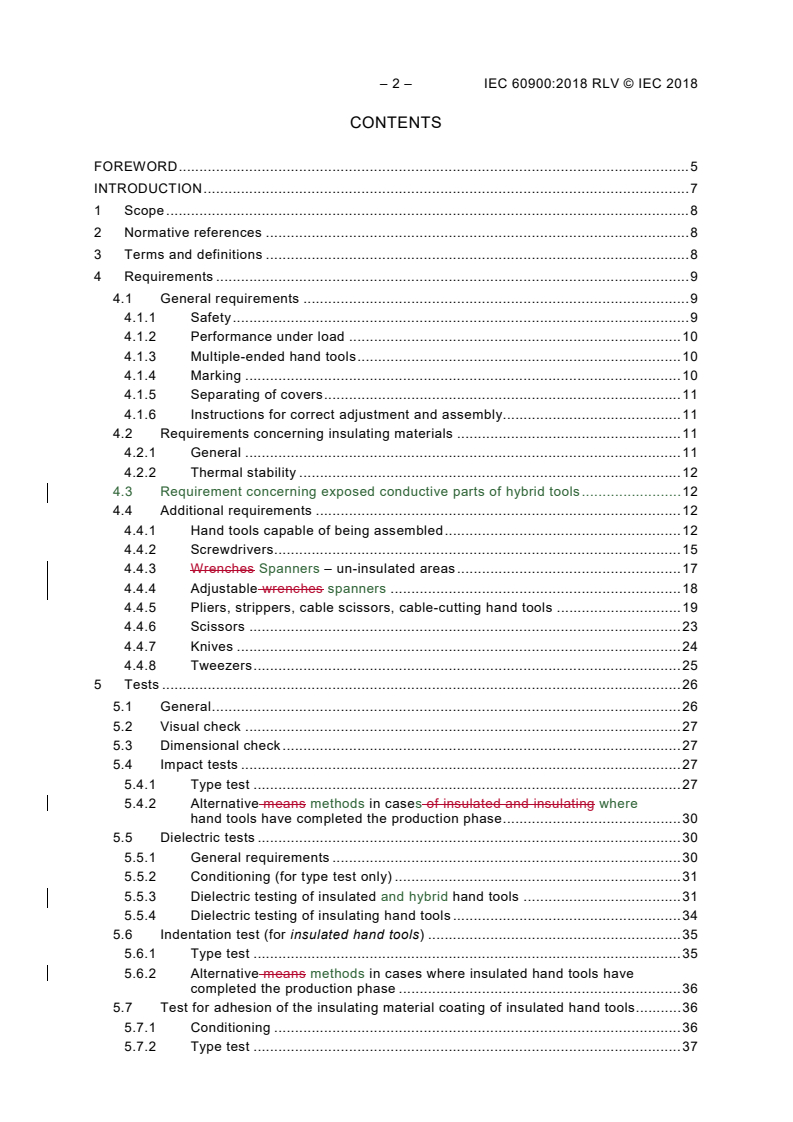
IEC 60900:2018 RLV - Live working - Hand tools for use up to 1 000 V AC and 1 500 V DC Released:6/20/2018
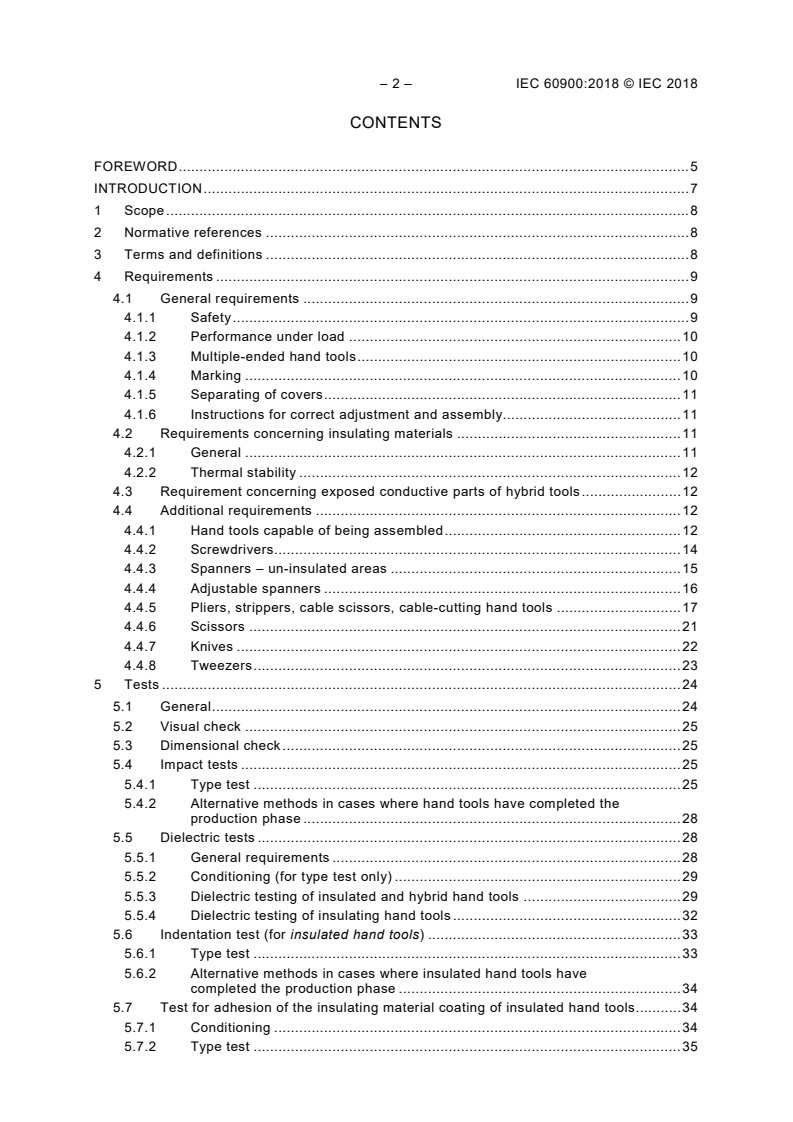
IEC 60900:2018 - Live working - Hand tools for use up to 1 000 V AC and 1 500 V DC Released:6/20/2018
Overview
IEC 60900:2018 - Live working - Hand tools for use up to 1 000 V AC and 1 500 V DC specifies safety, performance and testing requirements for insulated, insulating and hybrid hand tools intended for live working or work close to live parts at nominal voltages up to 1 000 V AC / 1 500 V DC. This fourth edition (technical revision) replaces the 2012 edition, adds hybrid hand tools as a third category and includes an informative Annex A with examples. The standard was prepared where applicable in accordance with IEC 61477 and includes corrigenda from Jan 2019 and May 2020.
Key topics and technical requirements
- Scope & definitions: classifies insulated, insulating and hybrid hand tools and sets electrical working limits.
- Safety & performance: requirements for safe use by skilled persons, labelling and user instructions.
- Materials & construction: requirements for insulating materials, thermal stability and exposed conductive parts on hybrid tools.
- Marking & documentation: mandatory marking (including the double-triangle symbol for live-working) and instructions for assembly, adjustment and care.
- Test program: comprehensive type and routine tests, including:
- Impact tests
- Dielectric tests (with conditioning and leakage checks)
- Indentation and adhesion tests for insulation coatings
- Mechanical strength and durability tests
- Flame-retardancy tests
- Durability of marking
- Conformity assessment: procedures for hand tools that have completed production, including classification of defects and re-testing.
- Maintenance guidance: informative Annex D provides recommendations for storage, inspection before use, periodic examination and electrical retesting.
Applications and who uses it
IEC 60900:2018 is essential for:
- Manufacturers and product designers of insulated, insulating and hybrid hand tools to ensure compliant design and production.
- Testing and certification laboratories performing type and routine tests and conformity assessments.
- Procurement and compliance officers specifying tools for electrical utilities, maintenance contractors and industrial facilities.
- Safety managers, electricians and skilled live-working personnel who rely on correct marking, instructions and in-service care to reduce electrical hazards.
- Regulators and standards committees referencing consistent requirements for live-working tools.
Related standards
- IEC 61477 (live working - insulating equipment)
- IEC 60417-5216 (graphical symbol - double triangle “suitable for live working”)
- ISO 1174 (referenced for square-drive dimensions in testing)
IEC 60900:2018 is a practical, safety-focused standard for anyone involved in the design, testing, procurement or use of hand tools for live electrical work.
Relations
- Corrected By
IEC 60900:2018/COR1:2019 - Corrigendum 1 - Live working - Hand tools for use up to 1 000 V AC and 1 500 V DC - Effective Date
- 05-Sep-2023
- Corrected By
IEC 60900:2018/COR2:2020 - Corrigendum 2 - Live working - Hand tools for use up to 1 000 V AC and 1 500 V DC - Effective Date
- 05-Sep-2023
- Effective Date
- 05-Sep-2023
Buy Documents
IEC 60900:2018 RLV - Live working - Hand tools for use up to 1 000 V AC and 1 500 V DC Released:6/20/2018
IEC 60900:2018 - Live working - Hand tools for use up to 1 000 V AC and 1 500 V DC Released:6/20/2018
Get Certified
Connect with accredited certification bodies for this standard

IMQ S.p.A. (Certification)
Italian electrical product certification.

SLG Prüf- und Zertifizierungs GmbH
German testing and certification body.

UL Solutions
Global safety science company with testing, inspection and certification.
Sponsored listings
Frequently Asked Questions
IEC 60900:2018 is a standard published by the International Electrotechnical Commission (IEC). Its full title is "Live working - Hand tools for use up to 1 000 V AC and 1 500 V DC". This standard covers: IEC 60900:2018 is applicable to insulated, insulating and hybrid hand tools used for working live or close to live parts at nominal voltages up to 1 000 V AC and 1 500 V DC. The products designed and manufactured according to this document contribute to the safety of the users provided they are used by skilled persons, in accordance with safe methods of work and the instructions for use (where appropriate). This document has been prepared in accordance with the requirements of IEC 61477 where applicable. The products covered by this document may have an impact on the environment during some or all stages of its life cycle. These impacts can range from slight to significant, be of short term or long-term duration, and occur at the global, regional or local level. This document does not include requirements and test provisions for the manufacturers of the products, or recommendations to the users of the products for environmental improvement. This fourth edition cancels and replaces the third edition, published in 2012. This edition constitutes a technical revision. This edition includes the following significant technical changes with respect to the previous edition: a) addition of a third category of tools has been added, namely hybrid hand tools; b) introduction of a new informative Annex A on examples of insulated, insulating and hybrid hand tools. Key words: Live Working, Insulated, Insulating, Hand Tools The contents of the corrigendum of January 2019 and May 2020 have been included in this copy.
IEC 60900:2018 is applicable to insulated, insulating and hybrid hand tools used for working live or close to live parts at nominal voltages up to 1 000 V AC and 1 500 V DC. The products designed and manufactured according to this document contribute to the safety of the users provided they are used by skilled persons, in accordance with safe methods of work and the instructions for use (where appropriate). This document has been prepared in accordance with the requirements of IEC 61477 where applicable. The products covered by this document may have an impact on the environment during some or all stages of its life cycle. These impacts can range from slight to significant, be of short term or long-term duration, and occur at the global, regional or local level. This document does not include requirements and test provisions for the manufacturers of the products, or recommendations to the users of the products for environmental improvement. This fourth edition cancels and replaces the third edition, published in 2012. This edition constitutes a technical revision. This edition includes the following significant technical changes with respect to the previous edition: a) addition of a third category of tools has been added, namely hybrid hand tools; b) introduction of a new informative Annex A on examples of insulated, insulating and hybrid hand tools. Key words: Live Working, Insulated, Insulating, Hand Tools The contents of the corrigendum of January 2019 and May 2020 have been included in this copy.
IEC 60900:2018 is classified under the following ICS (International Classification for Standards) categories: 13.260 - Protection against electric shock. Live working; 29.240.20 - Power transmission and distribution lines; 29.260.99 - Other electrical equipment for working in special conditions. The ICS classification helps identify the subject area and facilitates finding related standards.
IEC 60900:2018 has the following relationships with other standards: It is inter standard links to IEC 60900:2018/COR1:2019, IEC 60900:2018/COR2:2020, IEC 60900:2012. Understanding these relationships helps ensure you are using the most current and applicable version of the standard.
IEC 60900:2018 is available in PDF format for immediate download after purchase. The document can be added to your cart and obtained through the secure checkout process. Digital delivery ensures instant access to the complete standard document.
Standards Content (Sample)
IEC 60900 ®
Edition 4.0 2018-06
REDLINE VERSION
INTERNATIONAL
STANDARD
colour
inside
Live working –
Hand tools for use up to 1 000 V AC and 1 500 V DC
All rights reserved. Unless otherwise specified, no part of this publication may be reproduced or utilized in any form
or by any means, electronic or mechanical, including photocopying and microfilm, without permission in writing from
either IEC or IEC's member National Committee in the country of the requester. If you have any questions about IEC
copyright or have an enquiry about obtaining additional rights to this publication, please contact the address below or
your local IEC member National Committee for further information.
IEC Central Office Tel.: +41 22 919 02 11
3, rue de Varembé info@iec.ch
CH-1211 Geneva 20 www.iec.ch
Switzerland
About the IEC
The International Electrotechnical Commission (IEC) is the leading global organization that prepares and publishes
International Standards for all electrical, electronic and related technologies.
About IEC publications
The technical content of IEC publications is kept under constant review by the IEC. Please make sure that you have the
latest edition, a corrigenda or an amendment might have been published.
IEC Catalogue - webstore.iec.ch/catalogue Electropedia - www.electropedia.org
The stand-alone application for consulting the entire The world's leading online dictionary of electronic and
bibliographical information on IEC International Standards, electrical terms containing 21 000 terms and definitions in
Technical Specifications, Technical Reports and other English and French, with equivalent terms in 16 additional
documents. Available for PC, Mac OS, Android Tablets and languages. Also known as the International Electrotechnical
iPad. Vocabulary (IEV) online.
IEC publications search - webstore.iec.ch/advsearchform IEC Glossary - std.iec.ch/glossary
The advanced search enables to find IEC publications by a 67 000 electrotechnical terminology entries in English and
variety of criteria (reference number, text, technical French extracted from the Terms and Definitions clause of
committee,…). It also gives information on projects, replaced IEC publications issued since 2002. Some entries have been
and withdrawn publications. collected from earlier publications of IEC TC 37, 77, 86 and
CISPR.
IEC Just Published - webstore.iec.ch/justpublished
Stay up to date on all new IEC publications. Just Published IEC Customer Service Centre - webstore.iec.ch/csc
details all new publications released. Available online and If you wish to give us your feedback on this publication or
also once a month by email. need further assistance, please contact the Customer Service
Centre: sales@iec.ch.
IEC 60900 ®
Edition 4.0 2018-06
REDLINE VERSION
INTERNATIONAL
STANDARD
colour
inside
Live working –
Hand tools for use up to 1 000 V AC and 1 500 V DC
INTERNATIONAL
ELECTROTECHNICAL
COMMISSION
ICS 13.260; 29.240.20; 29.260.99 ISBN 978-2-8322-5842-2
– 2 – IEC 60900:2018 RLV © IEC 2018
CONTENTS
FOREWORD . 5
INTRODUCTION . 7
1 Scope . 8
2 Normative references . 8
3 Terms and definitions . 8
4 Requirements . 9
4.1 General requirements . 9
4.1.1 Safety . 9
4.1.2 Performance under load . 10
4.1.3 Multiple-ended hand tools . 10
4.1.4 Marking . 10
4.1.5 Separating of covers . 11
4.1.6 Instructions for correct adjustment and assembly. 11
4.2 Requirements concerning insulating materials . 11
4.2.1 General . 11
4.2.2 Thermal stability . 12
4.3 Requirement concerning exposed conductive parts of hybrid tools . 12
4.4 Additional requirements . 12
4.4.1 Hand tools capable of being assembled . 12
4.4.2 Screwdrivers . 15
4.4.3 Wrenches Spanners – un-insulated areas . 17
4.4.4 Adjustable wrenches spanners . 18
4.4.5 Pliers, strippers, cable scissors, cable-cutting hand tools . 19
4.4.6 Scissors . 23
4.4.7 Knives . 24
4.4.8 Tweezers . 25
5 Tests . 26
5.1 General . 26
5.2 Visual check . 27
5.3 Dimensional check . 27
5.4 Impact tests . 27
5.4.1 Type test . 27
5.4.2 Alternative means methods in cases of insulated and insulating where
hand tools have completed the production phase . 30
5.5 Dielectric tests . 30
5.5.1 General requirements . 30
5.5.2 Conditioning (for type test only) . 31
5.5.3 Dielectric testing of insulated and hybrid hand tools . 31
5.5.4 Dielectric testing of insulating hand tools . 34
5.6 Indentation test (for insulated hand tools) . 35
5.6.1 Type test . 35
5.6.2 Alternative means methods in cases where insulated hand tools have
completed the production phase . 36
5.7 Test for adhesion of the insulating material coating of insulated hand tools . 36
5.7.1 Conditioning . 36
5.7.2 Type test . 37
5.7.3 Alternative means methods in cases where insulated hand tools have
completed the production phase . 42
5.8 Test of adhesion of exposed conductive parts at the working head of hybrid
hand tools . 43
5.8.1 Type test . 43
5.8.2 Alternative methods in cases where hybrid hand tools have completed
the production phase . 43
5.9 Mechanical tests . 43
5.9.1 Test of adhesion of insulating covers of conductive adjusting or
switching elements . 43
5.9.2 Insulated hand tools . 44
5.9.3 Insulating and hybrid hand tools . 44
5.9.4 Tweezers . 45
5.9.5 Retaining force test for tools capable of being assembled . 45
5.10 Durability of marking . 48
5.11 Flame retardancy test . 48
5.11.1 Type test . 48
5.11.2 Alternative means methods in cases where hand tools have completed
the production phase . 49
6 Conformity assessment of hand tools having completed the production phase . 50
7 Modifications . 50
Annex A (informative) Description and examples for insulated, hybrid and insulating
hand tools . 51
Annex B (informative) Mechanical strength of insulating and hybrid hand tools . 52
B.1 Context . 52
B.2 General . 52
B.3 Insulating and hybrid screwdrivers . 52
B.4 Insulating and hybrid wrenches spanners and ratchets . 53
B.5 Insulating and hybrid T- wrenches spanners . 53
B.6 Insulating and hybrid pliers and cable shears . 53
Annex C (normative) Suitable for live working; double triangle
(IEC 60417-5216:2002-10) . 54
Annex D (informative) Recommendation for use and in-service care . 55
D.1 General . 55
D.2 Storage . 55
D.3 Inspection before use . 55
D.4 Temperature . 55
D.5 Periodic examination and electrical retesting . 55
Annex E (normative) General type test procedure . 56
Annex F (normative) Examples of calculation of the unwinded total linear length
of coating insulation and acceptable leakage current (see 5.5.3.1.1) . 57
Annex G (normative) Classification of defects and tests to be allocated . 58
Annex H (informative) Rationale for the classification of defects . 60
Bibliography . 62
Figure 1 – Marking of the electrical working limit adjacent to the double triangle symbol
(IEC 60417-5216:2002-10) . 11
Figure 2 – Description of the insulating overlapping element and different assembly
configurations for hand tools capable of being assembled with square drives . 13
– 4 – IEC 60900:2018 RLV © IEC 2018
Figure 3 – Marking symbol for hand tools capable of being assembled and designed to
be interchangeable between different manufacturers (IEC 60417-6168:2012-07) . 15
Figure – Illustration of insulation of typical hand tools .
Figure 4 – Illustration of insulation of a typical screwdriver . 17
Figure 5 – Illustration of insulation of typical spanners . 18
Figure 6 – Insulated or hybrid adjustable wrench spanner . 19
Figure 7 – Illustration of insulation of typical pliers . 20
Figure 8 – Insulation of pliers . 21
Figure 9 – Insulation of multiple slip joint pliers . 21
Figure 10 – Insulation of pliers with a functional area below the joint . 22
Figure 11 – Illustration of insulation of pliers and nippers for electronics . 23
Figure 12 – Insulation of scissors . 24
Figure 13 – Insulation of knives . 25
Figure 14 – Example of insulation of the handles of tweezers . 26
Figure 15 – Example of test arrangement for the impact test – Method A . 28
Figure 16 – Example of test arrangement for the impact test – Method B . 29
Figure 17 – Dielectric testing arrangement for insulated or hybrid hand tools . 32
Figure 18 – Description of dummies for dielectric tests for hand tools capable of being
assembled with square drives . 33
Figure 19 – Dielectric testing arrangement for insulating hand tools . 34
Figure 20 – Indentation test . 36
Figure 21 – Principle of the testing device for checking adhesion of the insulating
coating on conductive parts of the insulated hand tool – Test on the working head –
Method A . 38
Figure 22 – Principle of the testing device for checking adhesion of the insulating
coating on conductive parts of the insulated hand tools – Test on the working head –
Method B . 39
Figure 23 – Testing device for checking adhesion of the insulating coating of insulated
screwdrivers on conductive parts and the handle . 40
Figure 24 – Example of mountings for checking stability of adhesion of the insulation of
the entire insulated hand tool . 42
Figure 25 – Dummies for testing locking systems used with square drives of nominal
size 12,5 mm of ISO 1174 . 46
Figure 26 – Dummies for testing locking systems used with square drives of nominal
size 10 mm of ISO 1174 . 47
Figure 27 – Example of a flame retardancy test arrangement . 49
Table 1 – Dimensions and tolerances of the insulating overlapping element . 14
Table 2 – Dimensions and tolerances for dummies to be used for dielectric tests. 33
Table B.1 – Torque values for insulating and hybrid screwdrivers . 52
Table E.1 – Sequential order for performing type tests . 56
Table G.1 – Classification of defects and associated requirements and tests . 58
Table H.1 – Justification for the type of defect . 60
INTERNATIONAL ELECTROTECHNICAL COMMISSION
____________
LIVE WORKING – HAND TOOLS FOR USE UP
TO 1 000 V AC AND 1 500 V DC
FOREWORD
1) The International Electrotechnical Commission (IEC) is a worldwide organization for standardization comprising
all national electrotechnical committees (IEC National Committees). The object of IEC is to promote
international co-operation on all questions concerning standardization in the electrical and electronic fields. To
this end and in addition to other activities, IEC publishes International Standards, Technical Specifications,
Technical Reports, Publicly Available Specifications (PAS) and Guides (hereafter referred to as “IEC
Publication(s)”). Their preparation is entrusted to technical committees; any IEC National Committee interested
in the subject dealt with may participate in this preparatory work. International, governmental and non-
governmental organizations liaising with the IEC also participate in this preparation. IEC collaborates closely
with the International Organization for Standardization (ISO) in accordance with conditions determined by
agreement between the two organizations.
2) The formal decisions or agreements of IEC on technical matters express, as nearly as possible, an international
consensus of opinion on the relevant subjects since each technical committee has representation from all
interested IEC National Committees.
3) IEC Publications have the form of recommendations for international use and are accepted by IEC National
Committees in that sense. While all reasonable efforts are made to ensure that the technical content of IEC
Publications is accurate, IEC cannot be held responsible for the way in which they are used or for any
misinterpretation by any end user.
4) In order to promote international uniformity, IEC National Committees undertake to apply IEC Publications
transparently to the maximum extent possible in their national and regional publications. Any divergence
between any IEC Publication and the corresponding national or regional publication shall be clearly indicated in
the latter.
5) IEC itself does not provide any attestation of conformity. Independent certification bodies provide conformity
assessment services and, in some areas, access to IEC marks of conformity. IEC is not responsible for any
services carried out by independent certification bodies.
6) All users should ensure that they have the latest edition of this publication.
7) No liability shall attach to IEC or its directors, employees, servants or agents including individual experts and
members of its technical committees and IEC National Committees for any personal injury, property damage or
other damage of any nature whatsoever, whether direct or indirect, or for costs (including legal fees) and
expenses arising out of the publication, use of, or reliance upon, this IEC Publication or any other IEC
Publications.
8) Attention is drawn to the Normative references cited in this publication. Use of the referenced publications is
indispensable for the correct application of this publication.
9) Attention is drawn to the possibility that some of the elements of this IEC Publication may be the subject of
patent rights. IEC shall not be held responsible for identifying any or all such patent rights.
This redline version of the official IEC Standard allows the user to identify the changes
made to the previous edition. A vertical bar appears in the margin wherever a change
has been made. Additions are in green text, deletions are in strikethrough red text.
– 6 – IEC 60900:2018 RLV © IEC 2018
International Standard IEC 60900 has been prepared by IEC technical committee 78: Live
working.
This fourth edition cancels and replaces the third edition, published in 2012. This edition
constitutes a technical revision.
This edition includes the following significant technical changes with respect to the previous
edition:
a) addition of a third category of tools has been added, namely hybrid hand tools;
b) introduction of a new informative Annex A on examples of insulated, insulating and hybrid
hand tools.
The text of this standard is based on the following documents:
FDIS Report on voting
78/1221/FDIS 78/1229/RVD
Full information on the voting for the approval of this International Standard can be found in
the report on voting indicated in the above table.
This document has been drafted in accordance with the ISO/IEC Directives, Part 2.
Terms defined in Clause 3 are given in italic print throughout this document.
The committee has decided that the contents of this document will remain unchanged until the
stability date indicated on the IEC website under "http://webstore.iec.ch" in the data related to
the specific document. At this date, the document will be
• reconfirmed,
• withdrawn,
• replaced by a revised edition, or
• amended.
The contents of the corrigenda of January 2019 and May 2020 have been included in this copy.
IMPORTANT – The 'colour inside' logo on the cover page of this publication indicates
that it contains colours which are considered to be useful for the correct
understanding of its contents. Users should therefore print this document using a
colour printer.
INTRODUCTION
This document has been prepared in accordance with the requirements of IEC 61477 where
applicable.
The products covered by this document may have an impact on the environment during some
or all stages of its life cycle. These impacts can range from slight to significant, be of short-
term or long-term duration, and occur at the global, regional or local level.
This document does not include requirements and test provisions for the manufacturers of the
products, or recommendations to the users of the products for environmental improvement.
However, all parties intervening in its their design, manufacture, packaging, distribution, use,
maintenance, repair, reuse, recovery and disposal are invited to take account of
environmental considerations.
– 8 – IEC 60900:2018 RLV © IEC 2018
LIVE WORKING – HAND TOOLS FOR USE UP
TO 1 000 V AC AND 1 500 V DC
1 Scope
This document is applicable to insulated, insulating and hybrid hand tools used for working
live or close to live parts at nominal voltages up to 1 000 V AC and 1 500 V DC.
The products designed and manufactured according to this document contribute to the safety
of the users provided they are used by skilled persons, in accordance with safe methods of
work and the instructions for use (where appropriate).
2 Normative references
The following documents are referred to in the text in such a way that some or all of their
content constitutes requirements of this document. For dated references, only the edition
cited applies. For undated references, the latest edition of the referenced document (including
any amendments) applies.
IEC 60060-1, High-voltage test techniques – Part 1: General definitions and test requirements
IEC 60212, Standard conditions for use prior to and during the testing of solid electrical
insulating materials
IEC 60417, Graphical symbols for use on equipment (available at: http://www.graphical-
symbols.info/equipment)
IEC 61318, Live working – Conformity assessment applicable to tools, devices and equipment
IEC 61477, Live working – Minimum requirements for the utilization of tools, devices and
equipment
ISO 1174-1, Assembly tools for screw and nuts – Driving squares – Part 1: Driving squares for
hand socket tools
ISO 9654, Pliers and nippers for electronics – Single-purpose nippers – Cutting nippers
ISO 9655, Pliers and nippers for electronics – Single-purpose pliers – Pliers for gripping and
manipulating
ISO 9656, Pliers and nippers for electronics – Test methods
ISO 9657, Pliers and nippers for electronics – General technical requirements
3 Terms and definitions
For the purposes of this document, the terms and definitions given in IEC 61318 and the
following apply.
ISO and IEC maintain terminological databases for use in standardization at the following
addresses:
• IEC Electropedia: available at http://www.electropedia.org/
• ISO Online browsing platform: available at http://www.iso.org/obp
NOTE For the definitions of general terms in this document, reference should be made to the IEC 60050 series or
to special definitions laid down in IEC 60743. Nomenclature of hand tools are found in the relevant ISO standards
such as ISO 1703, ISO 5742 and ISO 8979. The definitions of general terms used in this document are given in
IEC 60050 or in special definitions given in IEC 60743.
3.1
hand tool (for live working)
hand held insulated or insulating tool
Note 1 to entry: Hand tools may be insulated hand tools, insulating hand tools or hybrid hand tools (see Annex A).
Note 2 to entry: Hand tools are normally tools such as screwdrivers, pliers, wrenches spanners or knives.
Note 3 to entry: Hand tools are designed to provide protection to the worker against electric shock.
[SOURCE: IEC 60050-651:1999 2014, 651-01-27, modified – The scope of the definition has
been enlarged 651-21-19, modified – Note 1 to entry has been modified to refer to Annex A.]
3.1.1
hybrid hand tool
hand tool made from insulating material(s) with exposed conductive parts at the working head
Note 1 to entry: Hybrid hand tools may have some non-exposed conductive parts used for reinforcement.
[SOURCE: IEC 60050-651:2014, 651-21-22]
3.1.2
insulated hand tool
hand tool made of conductive material(s), fully or partially covered by insulating material(s)
[SOURCE: IEC 60050-651:1999 2014, 651-01-25, modified – The definition has been
changed to refer specifically to hand tools 651-21-20.]
3.1.3
insulating hand tool
hand tool made totally or essentially from insulating material(s) except for inserts made from
conductive material(s) used for reinforcement, but with no exposed conductive parts
[SOURCE: IEC 60050-651:1999 2014, 651-01-26, modified - The definition has been changed
to refer specifically to hand tools and its scope has been narrowed 651-21-21.]
3.2
working head
part of the tool head that is limited to the working surface and the contact area
Note 1 to entry: See Figures 5 and 7.
4 Requirements
4.1 General requirements
4.1.1 Safety
Insulated, insulating and hybrid hand tools shall be manufactured and dimensioned in such a
way that they protect the user from electric shock.
NOTE 1 Insulating hand tools minimize the risk of short-circuits between two parts at different potentials.
– 10 – IEC 60900:2018 RLV © IEC 2018
NOTE 2 Hybrid hand tools reduce the risk of short-circuits between two parts at different potentials.
NOTE 3 Insulated hand tools, completely covered by insulating materials and insulating tools minimize the risk of
short circuits between two parts at different potentials when they are used in the correct manner, except the
conductive part of the working surface, reduce the risk of short-circuits between two parts at different potentials.
The following requirements have been prepared in order that the hand tools covered by this
document are designed and manufactured to contribute to the safety of the users, provided
they are used by persons skilled for live working, in accordance with safe methods of work
and the instructions for use (where appropriate).
4.1.2 Performance under load
The mechanical specifications for insulated hand tools shall comply with the corresponding
ISO standards, or, where no ISO standard exists, with a standard specified by the
manufacturer or the customer (for example a national standard). The mechanical
specifications for the working parts of the hand tools shall be retained even after application
of an insulating layer.
Insulating and hybrid hand tools specially designed for live working may have lower stress
resistance than insulated hand tools, but they shall withstand the expected workloads without
failing due to remaining deformation or breaking. These hand tools can be equipped with
devices that limit the workloads that can be applied with them, for example by overload
slipping clutches (see also Annex B).
4.1.3 Multiple-ended hand tools
Multiple-ended hand tools, such as box wrenches spanner, keys for hexagonal socket screws,
double-ended socket-wrenches spanner, double-head open-end wrenches spanner, etc., are
not allowed for insulated hand tools but are allowed for insulating or hybrid hand tools if the
design assures that there is no conductive connection between two of the working heads.
4.1.4 Marking
The marking shall be clearly identifiable by persons with normal or corrected sight without
further magnification.
Each hand tool and/or tool component shall be legibly and permanently marked with the
following items of marking:
• on the insulating material or on the metal part:
– marking of the origin (manufacturer’s name or trade mark);
• on the insulating material:
– model/type reference;
– year of manufacture (at least the last two digits of the year);
– symbol IEC 60417-5216:2002-10 – Suitable for live working; double triangle
(see Annex C);
NOTE For the symbol, the exact ratio of the height of the figure to the base of the triangle is
1,43:1. For the purpose of convenience, this ratio can be between the values of 1,4 and 1,5.
– indication 1 000 V (i.e. the electrical working limit for alternating current), immediately
adjacent to the double triangle symbol (see Figure 1 for an example);
IEC
Figure 1 – Marking of the electrical working limit adjacent to
the double triangle symbol (IEC 60417-5216:2002-10)
– number of the relevant IEC standard immediately adjacent to the double triangle
symbol (IEC 60900);
– for hand tools designed for use at extremely low temperature: letter “C” (see 4.2.2);
– additional marking for hand tools capable of being assembled and designed to be
interchangeable between different manufacturers (see 4.4.1.3.2);
– additional marking where specified by the customer (for example ownership mark).
The hand tools shall bear no voltage marking apart from those described above.
NOTE For example, the indication of test voltage may lead to the assumption that the hand tool is suitable for
work at that voltage.
Other characteristics or information not needed at the work location, like the year of
publication of the standard and the type of hand tool, shall be associated to the product item
by other means, such as coded information (bar codes, microchips, etc.), or shall be
associated to its packaging.
The double triangle symbol shall be at least 3 mm high; the letter and the figures of the
electrical working limit shall be at least 2 mm high (see Figure 1).
4.1.5 Separating of covers
If hand tools have conductive elements (for example: torque adjusting screws, operating
direction switches, etc.) which are insulated with covers of insulating materials, these covers
shall be well securely fastened, so that they do not come off become separated during normal
use (see 5.9.1).
4.1.6 Instructions for correct adjustment and assembly
Where the manufacturer deems that instructions are necessary for correct adjustment or
assembly, then the manufacturer shall provide these in accordance with the general
provisions given in IEC 61477 (see also Annex D).
4.2 Requirements concerning insulating materials
4.2.1 General
The insulating material shall be selected according to the electrical, mechanical and thermal
stresses to which it may be exposed during use. In addition, the insulating material shall have
an adequate resistance to ageing and be flame retardant.
– 12 – IEC 60900:2018 RLV © IEC 2018
The insulating coating may consist of one or more layers. If two or more layers are adopted,
contrasting colours may be used.
The design and construction of the handles shall provide a secure handhold and prevent
unintentional hand slipping. The handle and guard dimensions given in different figures are
applicable to all types of hand tools in order to define the handling zone.
4.2.2 Thermal stability
The service ability of the hand tools shall not be impaired within the temperature range −20 °C
to +70 °C.
The insulating material applied on hand tools shall adhere securely to the conductive part
from −20 °C to +70 °C.
Hand tools intended for use at extremely low temperatures (down to −40 °C) shall be
designated “Category °C” and shall be designed for this purpose.
4.3 Requirement concerning exposed conductive parts of hybrid tools
Exposed conductive parts shall be securely fastened, so that they do not become separated
during normal use (see 5.8).
4.4 Additional requirements
4.4.1 Hand tools capable of being assembled
4.4.1.1 Retaining devices for hand tools capable of being assembled
Hand tools capable of being assembled shall have suitable retaining devices to prevent
unintentional separation of the assembly. The retaining forces shall be tested according to
5.9.5.
4.4.1.2 Insulation design for hand tools capable of being assembled
In the case of connecting parts of hand tools capable of being assembled, the insulation shall
be applied in such a manner that if any part becomes detached during use by exceeding the
retaining forces according to 5.9.5, no conductive part, which may still be live, can be
inadvertently touched or cause a disruptive discharge.
4.4.1.3 Hand tools capable of being assembled with square drives
4.4.1.3.1 General
Hand tools capable of being assembled with square drives shall have square drives and
square sockets in accordance with ISO 1174-1 (for separating forces, see 5.9.5.2). To ensure
compatibility of insulation between different manufacturers, these hand tools shall be
designed with overlapping elements described in Figure 2. Their dimensions and tolerances
shall be in accordance with Table 1.
IEC 1043/12
Key
A admitted shapes
– 14 – IEC 60900:2018 RLV © IEC 2018
l
l
l
l
l
IEC
Figure 2 – Description of the insulating overlapping element and different assembly
configurations for hand tools capable of being assembled with square drives
Table 1 – Dimensions and tolerances of the insulating overlapping element
Dimensions in millimetres
+2 +0,5 0 +1,5 0 +1,5
Nominal size l min. l l d d d d
1 2 0 3 1 2 3 4
-1,5 0 -1,5 0
-0,5
of the
square drive
6,3 19 16 2 12,5 13 18 19
10 19 16 2 17,5 18 23 24
12,5 19 16 2 21,5 22 27 28
20 19 16 2 32 33 38 39
l , l , l , d , d , d and d are described in Figure 2.
1 2 3 1 2 3 4
d
d d d d
2 2 2 2
d d d d
3 3 3 3
d
d
d
4.4.1.3.2 Interchangeability of components made by different manufacturers
Hand tools capable of being assembled and designed to be interchangeable between different
manufacturers shall be specifically marked as such.
The marking symbol and the dimensions are given in Figure 3. The dimension H shall be
greater than or equal to 5 mm.
Dimensions in millimetres
0,3 H 0,3 H 0,3 H
= =
0,125 H
IEC
Figure 3 – Marking symbol for hand tools capable of being assembled and designed to
be interchangeable between different manufacturers (IEC 60417-6168:2012-07)
The reliable function of locking systems used for these hand tools shall be tested by applying
a separation test in accordance with 5.9.5 with a corresponding dummy.
For this kind of hand tools, instructions for correct assembly are mandatory. The manufacturer
shall include the following information: “To assure that the complete assembly of insulated
hand tool components from different manufacturers will withstand separating forces that are
expected during the intended use, prior to the use of any assembly the user shall assure, by
pulling by hand in a separating direction, that the retaining devices of all used elements are
working efficiently”.
4.4.2 Screwdrivers
4.4.2.1 Un-insulated areas
For insulated or hybrid screwdrivers, an un-insulated conductive area having a maximum
length of 18 mm is permissible on the working head (see Figure 4).
H
= =
= =
0,125 H
0,125 H
0,6 H
– 16 – IEC 60900:2018 RLV © IEC 2018
≤ 18 30 ≤ 18 30
IEC 1045/12
Key
a conductive part
b working surface
c insulation
d contact area
W working head
Figure 4 – Illustration of insulation of typical hand tools
Dimensions in millimetres
W
b b
a
a
≤18 30 ≤18 30
IEC
Key
a conductive part
b insulation
W working head
Figure 4 – Illustration of insulation of a typical screwdriver
4.4.2.2 Shape of shaft insulation
The shaft insulation of insulated screwdrivers shall be bonded to the handle.
The outer diameter of the insulation of insulated and hybrid screwdrivers, over a length of
30 mm, in area c "W" of Figure 4, shall not exceed by more than 2 mm the width of the shaft
at the tip or the width of the tip, whatever is the larger dimension. This area may be parallel or
tapered towards the tip.
This requirement does not apply to insulated bit sockets (or insulated socket drivers).
4.4.2.3 Screwdrivers with exchangeable working heads
Insulated or hybrid screwdrivers with exchangeable working heads are regarded as hand tools
capable of being assembled. They shall meet the relevant requirements. The outer diameter
of the insulation may exceed the dimensions of 4.4.2.2.
4.4.2.4 Screwdrivers with screw retaining devices
If an insulated or hybrid screwdriver has a screw retaining device, the screwdriver itself shall
meet the requirements of this document. The outer diameter of the retaining device may
exceed the dimensions of 4.4.2.2. The retaining device shall be made from insulating
material.
4.4.3 Wrenches Spanners – un-insulated areas
The following un-insulated areas and lengths on the working head of insulated and hybrid
spanners are permissible (see Figure 5):
• engineers’ wrenches single headed spanner: the working surface;
≤1
≤1
– 18 – IEC 60900:2018 RLV © IEC 2018
NOTE At the request of the customer, the un-insulated area may can be extended to the working head.
• box wrenches, socket-wrenches, tee wrenches ring spanner, socket-spanner, T spanner:
the working surface and the contact area.
W
b
a, c
b
c
a d
IEC
Key
a conductive part
b insulation
c working surface
d contact area
W working head
Figure 5 – Illustration of insulation of typical spanners
4.4.4 Adjustable wrenches spanners
The insulation of insulated adjustable wrenches spanners shall be applied as far as possible
towards the working head. The un-insulated area may be extended to the working head. If the
working head remains un-insulated, a guard shall be applied so that the hand is prevented
from slipping towards the uncovered conductive parts of the head. For the minimum
dimensions of the guards, see Figure 6.
In the case of hybrid adjustable spanners where there are more uncovered conductive parts
than the working surface at the head, a guard shall be applied.
Dimensions in millimetres
≥10 ≥10
≥5 ≥5
IEC
Figure 6 – Insulated or hybrid adjustable wrench spanner
4.4.5 Pliers, strippers, cable scissors, cable-cutting hand tools
The handle insulation of such insulated or hybrid hand tools shall have a guard so that the
hand is prevented from slipping towards the uncovered conductive parts of the head
(see Figure 7 as an example).
≥12
– 20 – IEC 60900:2018 RLV © IEC 2018
b
d
a, W
c
IEC
Key
a conductive part
b working surface
c insulation
d contact area
W working head
Figure 7 – Illustration of insulation of typical pliers
The height of the guard shall be sufficient to prevent the slipping of the fingers towards the
uncovered conductive parts during the work.
For pliers, the minimum dimensions of the guard shall be (see Figures 8, 9 and 10 as an
example):
• 10 mm on the left and on the right of the pliers held on a flat surface;
• 5 mm on the upper and lower part of the pliers held on a flat surface.
The minimum insulated distance between the inner edge of each guard and any non-insulated
parts shall be 12 mm (see Figures 8, 9, 10 and 11). The insulation portion in front of the guard
shall extend as far as possible towards the working head.
Dimensions in millimetres
≥12
≥12
≥5 ≥5
≥10
≥10
IEC
Figure 8 – Insulation of pliers
In the case of a slip joint, a guard of 5 mm shall be provided for the inner part
...
IEC 60900 ®
Edition 4.0 2018-06
INTERNATIONAL
STANDARD
NORME
INTERNATIONALE
colour
inside
Live working –
Hand tools for use up to 1 000 V AC and 1 500 V DC
Travaux sous tension –
Outils à main pour usage jusqu’à 1 000 V en courant alternatif et 1 500 V
en courant continu
All rights reserved. Unless otherwise specified, no part of this publication may be reproduced or utilized in any form
or by any means, electronic or mechanical, including photocopying and microfilm, without permission in writing from
either IEC or IEC's member National Committee in the country of the requester. If you have any questions about IEC
copyright or have an enquiry about obtaining additional rights to this publication, please contact the address below or
your local IEC member National Committee for further information.
Droits de reproduction réservés. Sauf indication contraire, aucune partie de cette publication ne peut être reproduite
ni utilisée sous quelque forme que ce soit et par aucun procédé, électronique ou mécanique, y compris la photocopie
et les microfilms, sans l'accord écrit de l'IEC ou du Comité national de l'IEC du pays du demandeur. Si vous avez des
questions sur le copyright de l'IEC ou si vous désirez obtenir des droits supplémentaires sur cette publication, utilisez
les coordonnées ci-après ou contactez le Comité national de l'IEC de votre pays de résidence.
IEC Central Office Tel.: +41 22 919 02 11
3, rue de Varembé info@iec.ch
CH-1211 Geneva 20 www.iec.ch
Switzerland
About the IEC
The International Electrotechnical Commission (IEC) is the leading global organization that prepares and publishes
International Standards for all electrical, electronic and related technologies.
About IEC publications
The technical content of IEC publications is kept under constant review by the IEC. Please make sure that you have the
latest edition, a corrigenda or an amendment might have been published.
IEC Catalogue - webstore.iec.ch/catalogue Electropedia - www.electropedia.org
The stand-alone application for consulting the entire The world's leading online dictionary of electronic and
bibliographical information on IEC International Standards, electrical terms containing 21 000 terms and definitions in
Technical Specifications, Technical Reports and other English and French, with equivalent terms in 16 additional
documents. Available for PC, Mac OS, Android Tablets and languages. Also known as the International Electrotechnical
iPad. Vocabulary (IEV) online.
IEC publications search - webstore.iec.ch/advsearchform IEC Glossary - std.iec.ch/glossary
The advanced search enables to find IEC publications by a 67 000 electrotechnical terminology entries in English and
variety of criteria (reference number, text, technical French extracted from the Terms and Definitions clause of
committee,…). It also gives information on projects, replaced IEC publications issued since 2002. Some entries have been
and withdrawn publications. collected from earlier publications of IEC TC 37, 77, 86 and
CISPR.
IEC Just Published - webstore.iec.ch/justpublished
Stay up to date on all new IEC publications. Just Published IEC Customer Service Centre - webstore.iec.ch/csc
details all new publications released. Available online and If you wish to give us your feedback on this publication or
also once a month by email. need further assistance, please contact the Customer Service
Centre: sales@iec.ch.
A propos de l'IEC
La Commission Electrotechnique Internationale (IEC) est la première organisation mondiale qui élabore et publie des
Normes internationales pour tout ce qui a trait à l'électricité, à l'électronique et aux technologies apparentées.
A propos des publications IEC
Le contenu technique des publications IEC est constamment revu. Veuillez vous assurer que vous possédez l’édition la
plus récente, un corrigendum ou amendement peut avoir été publié.
Catalogue IEC - webstore.iec.ch/catalogue Electropedia - www.electropedia.org
Application autonome pour consulter tous les renseignements
Le premier dictionnaire en ligne de termes électroniques et
bibliographiques sur les Normes internationales,
électriques. Il contient 21 000 termes et définitions en anglais
Spécifications techniques, Rapports techniques et autres
et en français, ainsi que les termes équivalents dans 16
documents de l'IEC. Disponible pour PC, Mac OS, tablettes
langues additionnelles. Egalement appelé Vocabulaire
Android et iPad.
Electrotechnique International (IEV) en ligne.
Recherche de publications IEC -
Glossaire IEC - std.iec.ch/glossary
webstore.iec.ch/advsearchform
67 000 entrées terminologiques électrotechniques, en anglais
La recherche avancée permet de trouver des publications IEC et en français, extraites des articles Termes et Définitions des
en utilisant différents critères (numéro de référence, texte, publications IEC parues depuis 2002. Plus certaines entrées
comité d’études,…). Elle donne aussi des informations sur les antérieures extraites des publications des CE 37, 77, 86 et
projets et les publications remplacées ou retirées. CISPR de l'IEC.
IEC Just Published - webstore.iec.ch/justpublished Service Clients - webstore.iec.ch/csc
Restez informé sur les nouvelles publications IEC. Just Si vous désirez nous donner des commentaires sur cette
Published détaille les nouvelles publications parues. publication ou si vous avez des questions contactez-nous:
Disponible en ligne et aussi une fois par mois par email. sales@iec.ch.
IEC 60900 ®
Edition 4.0 2018-06
INTERNATIONAL
STANDARD
NORME
INTERNATIONALE
colour
inside
Live working –
Hand tools for use up to 1 000 V AC and 1 500 V DC
Travaux sous tension –
Outils à main pour usage jusqu’à 1 000 V en courant alternatif et 1 500 V
en courant continu
INTERNATIONAL
ELECTROTECHNICAL
COMMISSION
COMMISSION
ELECTROTECHNIQUE
INTERNATIONALE
ICS 13.260; 29.240.20; 29.260.99 ISBN 978-2-8322-5783-8
– 2 – IEC 60900:2018 © IEC 2018
CONTENTS
FOREWORD . 5
INTRODUCTION . 7
1 Scope . 8
2 Normative references . 8
3 Terms and definitions . 8
4 Requirements . 9
4.1 General requirements . 9
4.1.1 Safety . 9
4.1.2 Performance under load . 10
4.1.3 Multiple-ended hand tools . 10
4.1.4 Marking . 10
4.1.5 Separating of covers . 11
4.1.6 Instructions for correct adjustment and assembly. 11
4.2 Requirements concerning insulating materials . 11
4.2.1 General . 11
4.2.2 Thermal stability . 12
4.3 Requirement concerning exposed conductive parts of hybrid tools . 12
4.4 Additional requirements . 12
4.4.1 Hand tools capable of being assembled . 12
4.4.2 Screwdrivers . 14
4.4.3 Spanners – un-insulated areas . 15
4.4.4 Adjustable spanners . 16
4.4.5 Pliers, strippers, cable scissors, cable-cutting hand tools . 17
4.4.6 Scissors . 21
4.4.7 Knives . 22
4.4.8 Tweezers . 23
5 Tests . 24
5.1 General . 24
5.2 Visual check . 25
5.3 Dimensional check . 25
5.4 Impact tests . 25
5.4.1 Type test . 25
5.4.2 Alternative methods in cases where hand tools have completed the
production phase . 28
5.5 Dielectric tests . 28
5.5.1 General requirements . 28
5.5.2 Conditioning (for type test only) . 29
5.5.3 Dielectric testing of insulated and hybrid hand tools . 29
5.5.4 Dielectric testing of insulating hand tools . 32
5.6 Indentation test (for insulated hand tools) . 33
5.6.1 Type test . 33
5.6.2 Alternative methods in cases where insulated hand tools have
completed the production phase . 34
5.7 Test for adhesion of the insulating material coating of insulated hand tools . 34
5.7.1 Conditioning . 34
5.7.2 Type test . 35
5.7.3 Alternative methods in cases where insulated hand tools have
completed the production phase . 40
5.8 Test of adhesion of exposed conductive parts at the working head of hybrid
hand tools . 41
5.8.1 Type test . 41
5.8.2 Alternative methods in cases where hybrid hand tools have completed
the production phase . 41
5.9 Mechanical tests . 41
5.9.1 Test of adhesion of insulating covers of conductive adjusting or
switching elements . 41
5.9.2 Insulated hand tools . 42
5.9.3 Insulating and hybrid hand tools . 42
5.9.4 Tweezers . 43
5.9.5 Retaining force test for tools capable of being assembled . 43
5.10 Durability of marking . 46
5.11 Flame retardancy test . 46
5.11.1 Type test . 46
5.11.2 Alternative methods in cases where hand tools have completed the
production phase . 47
6 Conformity assessment of hand tools having completed the production phase . 48
7 Modifications . 48
Annex A (informative) Description and examples for insulated, hybrid and insulating
hand tools . 49
Annex B (informative) Mechanical strength of insulating and hybrid hand tools . 50
B.1 Context . 50
B.2 General . 50
B.3 Insulating and hybrid screwdrivers . 50
B.4 Insulating and hybrid spanners and ratchets . 51
B.5 Insulating and hybrid T-spanners . 51
B.6 Insulating and hybrid pliers and cable shears . 51
Annex C (normative) Suitable for live working; double triangle
(IEC 60417-5216:2002-10) . 52
Annex D (informative) Recommendation for use and in-service care . 53
D.1 General . 53
D.2 Storage . 53
D.3 Inspection before use . 53
D.4 Temperature . 53
D.5 Periodic examination and electrical retesting . 53
Annex E (normative) General type test procedure . 54
Annex F (normative) Examples of calculation of the total linear length of insulation
and acceptable leakage current (see 5.5.3.1.1) . 55
Annex G (normative) Classification of defects and tests to be allocated . 56
Annex H (informative) Rationale for the classification of defects . 57
Bibliography . 59
Figure 1 – Marking of the electrical working limit adjacent to the double triangle symbol
(IEC 60417-5216:2002-10) . 11
Figure 2 – Description of the insulating overlapping element and different assembly
configurations for hand tools capable of being assembled with square drives . 13
– 4 – IEC 60900:2018 © IEC 2018
Figure 3 – Marking symbol for hand tools capable of being assembled and designed to
be interchangeable between different manufacturers (IEC 60417-6168:2012-07) . 14
Figure 4 – Illustration of insulation of a typical screwdriver . 15
Figure 5 – Illustration of insulation of typical spanners . 16
Figure 6 – Insulated or hybrid adjustable spanner . 17
Figure 7 – Illustration of insulation of typical pliers . 18
Figure 8 – Insulation of pliers . 19
Figure 9 – Insulation of multiple slip joint pliers . 19
Figure 10 – Insulation of pliers with a functional area below the joint . 20
Figure 11 – Illustration of insulation of pliers and nippers for electronics . 21
Figure 12 – Insulation of scissors . 22
Figure 13 – Insulation of knives . 23
Figure 14 – Example of insulation of the handles of tweezers . 24
Figure 15 – Example of test arrangement for the impact test – Method A . 26
Figure 16 – Example of test arrangement for the impact test – Method B . 27
Figure 17 – Dielectric testing arrangement for insulated or hybrid hand tools . 30
Figure 18 – Description of dummies for dielectric tests for hand tools capable of being
assembled with square drives . 31
Figure 19 – Dielectric testing arrangement for insulating hand tools . 32
Figure 20 – Indentation test . 34
Figure 21 – Principle of the testing device for checking adhesion of the insulating
coating on conductive parts of the insulated hand tool – Test on the working head –
Method A . 36
Figure 22 – Principle of the testing device for checking adhesion of the insulating
coating on conductive parts of the insulated hand tools – Test on the working head –
Method B . 37
Figure 23 – Testing device for checking adhesion of the insulating coating of insulated
screwdrivers on conductive parts and the handle . 38
Figure 24 – Example of mountings for checking stability of adhesion of the insulation
of the entire insulated hand tool . 40
Figure 25 – Dummies for testing locking systems used with square drives of nominal
size 12,5 mm of ISO 1174 . 44
Figure 26 – Dummies for testing locking systems used with square drives of nominal
size 10 mm of ISO 1174 . 45
Figure 27 – Example of a flame retardancy test arrangement . 47
Table 1 – Dimensions and tolerances of the insulating overlapping element . 13
Table 2 – Dimensions and tolerances for dummies to be used for dielectric tests. 31
Table B.1 – Torque values for insulating and hybrid screwdrivers . 50
Table E.1 – Sequential order for performing type tests . 54
Table G.1 – Classification of defects and associated requirements and tests . 56
Table H.1 – Justification for the type of defect . 57
INTERNATIONAL ELECTROTECHNICAL COMMISSION
____________
LIVE WORKING – HAND TOOLS FOR USE UP
TO 1 000 V AC AND 1 500 V DC
FOREWORD
1) The International Electrotechnical Commission (IEC) is a worldwide organization for standardization comprising
all national electrotechnical committees (IEC National Committees). The object of IEC is to promote
international co-operation on all questions concerning standardization in the electrical and electronic fields. To
this end and in addition to other activities, IEC publishes International Standards, Technical Specifications,
Technical Reports, Publicly Available Specifications (PAS) and Guides (hereafter referred to as “IEC
Publication(s)”). Their preparation is entrusted to technical committees; any IEC National Committee interested
in the subject dealt with may participate in this preparatory work. International, governmental and non-
governmental organizations liaising with the IEC also participate in this preparation. IEC collaborates closely
with the International Organization for Standardization (ISO) in accordance with conditions determined by
agreement between the two organizations.
2) The formal decisions or agreements of IEC on technical matters express, as nearly as possible, an international
consensus of opinion on the relevant subjects since each technical committee has representation from all
interested IEC National Committees.
3) IEC Publications have the form of recommendations for international use and are accepted by IEC National
Committees in that sense. While all reasonable efforts are made to ensure that the technical content of IEC
Publications is accurate, IEC cannot be held responsible for the way in which they are used or for any
misinterpretation by any end user.
4) In order to promote international uniformity, IEC National Committees undertake to apply IEC Publications
transparently to the maximum extent possible in their national and regional publications. Any divergence
between any IEC Publication and the corresponding national or regional publication shall be clearly indicated in
the latter.
5) IEC itself does not provide any attestation of conformity. Independent certification bodies provide conformity
assessment services and, in some areas, access to IEC marks of conformity. IEC is not responsible for any
services carried out by independent certification bodies.
6) All users should ensure that they have the latest edition of this publication.
7) No liability shall attach to IEC or its directors, employees, servants or agents including individual experts and
members of its technical committees and IEC National Committees for any personal injury, property damage or
other damage of any nature whatsoever, whether direct or indirect, or for costs (including legal fees) and
expenses arising out of the publication, use of, or reliance upon, this IEC Publication or any other IEC
Publications.
8) Attention is drawn to the Normative references cited in this publication. Use of the referenced publications is
indispensable for the correct application of this publication.
9) Attention is drawn to the possibility that some of the elements of this IEC Publication may be the subject of
patent rights. IEC shall not be held responsible for identifying any or all such patent rights.
International Standard IEC 60900 has been prepared by IEC technical committee 78: Live
working.
This fourth edition cancels and replaces the third edition, published in 2012. This edition
constitutes a technical revision.
This edition includes the following significant technical changes with respect to the previous
edition:
a) addition of a third category of tools has been added, namely hybrid hand tools;
b) introduction of a new informative Annex A on examples of insulated, insulating and hybrid
hand tools.
– 6 – IEC 60900:2018 © IEC 2018
The text of this standard is based on the following documents:
FDIS Report on voting
78/1221/FDIS 78/1229/RVD
Full information on the voting for the approval of this International Standard can be found in
the report on voting indicated in the above table.
This document has been drafted in accordance with the ISO/IEC Directives, Part 2.
Terms defined in Clause 3 are given in italic print throughout this document.
The committee has decided that the contents of this document will remain unchanged until the
stability date indicated on the IEC website under "http://webstore.iec.ch" in the data related to
the specific document. At this date, the document will be
• reconfirmed,
• withdrawn,
• replaced by a revised edition, or
• amended.
The contents of the corrigendum of January 2019 have been included in this copy.
IMPORTANT – The 'colour inside' logo on the cover page of this publication indicates
that it contains colours which are considered to be useful for the correct
understanding of its contents. Users should therefore print this document using a
colour printer.
INTRODUCTION
This document has been prepared in accordance with the requirements of IEC 61477 where
applicable.
The products covered by this document may have an impact on the environment during some
or all stages of its life cycle. These impacts can range from slight to significant, be of short-
term or long-term duration, and occur at the global, regional or local level.
This document does not include requirements and test provisions for the manufacturers of the
products, or recommendations to the users of the products for environmental improvement.
However, all parties intervening in their design, manufacture, packaging, distribution, use,
maintenance, repair, reuse, recovery and disposal are invited to take account of
environmental considerations.
– 8 – IEC 60900:2018 © IEC 2018
LIVE WORKING – HAND TOOLS FOR USE UP
TO 1 000 V AC AND 1 500 V DC
1 Scope
This document is applicable to insulated, insulating and hybrid hand tools used for working
live or close to live parts at nominal voltages up to 1 000 V AC and 1 500 V DC.
The products designed and manufactured according to this document contribute to the safety
of the users provided they are used by skilled persons, in accordance with safe methods of
work and the instructions for use (where appropriate).
2 Normative references
The following documents are referred to in the text in such a way that some or all of their
content constitutes requirements of this document. For dated references, only the edition
cited applies. For undated references, the latest edition of the referenced document (including
any amendments) applies.
IEC 60060-1, High-voltage test techniques – Part 1: General definitions and test requirements
IEC 60212, Standard conditions for use prior to and during the testing of solid electrical
insulating materials
IEC 60417, Graphical symbols for use on equipment (available at: http://www.graphical-
symbols.info/equipment)
IEC 61318, Live working – Conformity assessment applicable to tools, devices and equipment
IEC 61477, Live working – Minimum requirements for the utilization of tools, devices and
equipment
ISO 1174-1, Assembly tools for screw and nuts – Driving squares – Part 1: Driving squares for
hand socket tools
ISO 9654, Pliers and nippers for electronics – Single-purpose nippers – Cutting nippers
ISO 9655, Pliers and nippers for electronics – Single-purpose pliers – Pliers for gripping and
manipulating
ISO 9656, Pliers and nippers for electronics – Test methods
ISO 9657, Pliers and nippers for electronics – General technical requirements
3 Terms and definitions
For the purposes of this document, the terms and definitions given in IEC 61318 and the
following apply.
ISO and IEC maintain terminological databases for use in standardization at the following
addresses:
• IEC Electropedia: available at http://www.electropedia.org/
• ISO Online browsing platform: available at http://www.iso.org/obp
NOTE The definitions of general terms used in this document are given in IEC 60050 or in special definitions
given in IEC 60743.
3.1
hand tool
hand held tool
Note 1 to entry: Hand tools may be insulated hand tools, insulating hand tools or hybrid hand tools (see Annex A).
Note 2 to entry: Hand tools are normally tools such as screwdrivers, pliers, spanners or knives.
Note 3 to entry: Hand tools are designed to provide protection to the worker against electric shock.
[SOURCE: IEC 60050-651:2014, 651-21-19, modified – Note 1 to entry has been modified to
refer to Annex A.]
3.1.1
hybrid hand tool
hand tool made from insulating material(s) with exposed conductive parts at the working head
Note 1 to entry: Hybrid hand tools may have some non-exposed conductive parts used for reinforcement.
[SOURCE: IEC 60050-651:2014, 651-21-22]
3.1.2
insulated hand tool
hand tool made of conductive material(s), fully or partially covered by insulating material(s)
[SOURCE: IEC 60050-651:2014, 651-21-20]
3.1.3
insulating hand tool
hand tool made totally or essentially from insulating material(s) except for inserts made from
conductive material(s) used for reinforcement, but with no exposed conductive parts
[SOURCE: IEC 60050-651: 2014, 651-21-21,]
3.2
working head
part of the tool head that is limited to the working surface and the contact area
Note 1 to entry: See Figures 5 and 7.
4 Requirements
4.1 General requirements
4.1.1 Safety
Insulated, insulating and hybrid hand tools shall be manufactured and dimensioned in such a
way that they protect the user from electric shock.
NOTE 1 Insulating hand tools minimize the risk of short-circuits between two parts at different potentials.
NOTE 2 Hybrid hand tools reduce the risk of short-circuits between two parts at different potentials.
– 10 – IEC 60900:2018 © IEC 2018
NOTE 3 Insulated hand tools, completely covered by insulating material, except the conductive part of the
working surface, reduce the risk of short-circuits between two parts at different potentials.
The following requirements have been prepared in order that the hand tools covered by this
document are designed and manufactured to contribute to the safety of the users, provided
they are used by persons skilled for live working, in accordance with safe methods of work
and the instructions for use (where appropriate).
4.1.2 Performance under load
The mechanical specifications for insulated hand tools shall comply with the corresponding
ISO standards, or, where no ISO standard exists, with a standard specified by the
manufacturer or the customer (for example a national standard). The mechanical
specifications for the working parts of the hand tools shall be retained even after application
of an insulating layer.
Insulating and hybrid hand tools specially designed for live working may have lower stress
resistance than insulated hand tools, but they shall withstand the expected workloads without
failing due to remaining deformation or breaking. These hand tools can be equipped with
devices that limit the workloads that can be applied with them, for example by overload
slipping clutches (see also Annex B).
4.1.3 Multiple-ended hand tools
Multiple-ended hand tools, such as box spanner, keys for hexagonal socket screws, double-
ended socket-spanner, double-head open-end spanner, etc., are not allowed for insulated
hand tools but are allowed for insulating or hybrid hand tools if the design assures that there
is no conductive connection between two of the working heads.
4.1.4 Marking
The marking shall be clearly identifiable by persons with normal or corrected sight without
further magnification.
Each hand tool and/or tool component shall be legibly and permanently marked with the
following items of marking:
• on the insulating material or on the metal part:
– marking of the origin (manufacturer’s name or trade mark);
• on the insulating material:
– model/type reference;
– year of manufacture (at least the last two digits of the year);
– symbol IEC 60417-5216:2002-10 – Suitable for live working; double triangle
(see Annex C);
NOTE For the symbol, the exact ratio of the height of the figure to the base of the triangle is
1,43:1. For the purpose of convenience, this ratio can be between the values of 1,4 and 1,5.
– indication 1 000 V (i.e. the electrical working limit for alternating current), immediately
adjacent to the double triangle symbol (see Figure 1 for an example);
IEC
Figure 1 – Marking of the electrical working limit adjacent to
the double triangle symbol (IEC 60417-5216:2002-10)
– number of the relevant IEC standard immediately adjacent to the double triangle
symbol (IEC 60900);
– for hand tools designed for use at extremely low temperature: letter “C” (see 4.2.2);
– additional marking for hand tools capable of being assembled and designed to be
interchangeable between different manufacturers (see 4.4.1.3.2);
– additional marking where specified by the customer (for example ownership mark).
The hand tools shall bear no voltage marking apart from those described above.
NOTE For example, the indication of test voltage may lead to the assumption that the hand tool is suitable for
work at that voltage.
Other characteristics or information not needed at the work location, like the year of
publication of the standard and the type of hand tool, shall be associated to the product item
by other means, such as coded information (bar codes, microchips, etc.), or shall be
associated to its packaging.
The double triangle symbol shall be at least 3 mm high; the letter and the figures of the
electrical working limit shall be at least 2 mm high (see Figure 1).
4.1.5 Separating of covers
If hand tools have conductive elements (for example: torque adjusting screws, operating
direction switches, etc.) which are insulated with covers of insulating materials, these covers
shall be securely fastened, so that they do not become separated during normal use
(see 5.9.1).
4.1.6 Instructions for correct adjustment and assembly
Where the manufacturer deems that instructions are necessary for correct adjustment or
assembly, then the manufacturer shall provide these in accordance with the general
provisions given in IEC 61477 (see also Annex D).
4.2 Requirements concerning insulating materials
4.2.1 General
The insulating material shall be selected according to the electrical, mechanical and thermal
stresses to which it may be exposed during use. In addition, the insulating material shall have
an adequate resistance to ageing and be flame retardant.
– 12 – IEC 60900:2018 © IEC 2018
The insulating coating may consist of one or more layers. If two or more layers are adopted,
contrasting colours may be used.
The design and construction of the handles shall provide a secure handhold and prevent
unintentional hand slipping. The handle and guard dimensions given in different figures are
applicable to all types of hand tools in order to define the handling zone.
4.2.2 Thermal stability
The service ability of the hand tools shall not be impaired within the temperature range −20 °C
to +70 °C.
The insulating material applied on hand tools shall adhere securely to the conductive part
from −20 °C to +70 °C.
Hand tools intended for use at extremely low temperatures (down to −40 °C) shall be
designated “Category °C” and shall be designed for this purpose.
4.3 Requirement concerning exposed conductive parts of hybrid tools
Exposed conductive parts shall be securely fastened, so that they do not become separated
during normal use (see 5.8).
4.4 Additional requirements
4.4.1 Hand tools capable of being assembled
4.4.1.1 Retaining devices for hand tools capable of being assembled
Hand tools capable of being assembled shall have suitable retaining devices to prevent
unintentional separation of the assembly. The retaining forces shall be tested according to
5.9.5.
4.4.1.2 Insulation design for hand tools capable of being assembled
In the case of connecting parts of hand tools capable of being assembled, the insulation shall
be applied in such a manner that if any part becomes detached during use by exceeding the
retaining forces according to 5.9.5, no conductive part, which may still be live, can be
inadvertently touched or cause a disruptive discharge.
4.4.1.3 Hand tools capable of being assembled with square drives
4.4.1.3.1 General
Hand tools capable of being assembled with square drives shall have square drives and
square sockets in accordance with ISO 1174-1 (for separating forces, see 5.9.5.2). To ensure
compatibility of insulation between different manufacturers, these hand tools shall be
designed with overlapping elements described in Figure 2. Their dimensions and tolerances
shall be in accordance with Table 1.
l
l
l
l
l
IEC
Figure 2 – Description of the insulating overlapping element and different assembly
configurations for hand tools capable of being assembled with square drives
Table 1 – Dimensions and tolerances of the insulating overlapping element
Dimensions in millimetres
+2 0 +1,5 0 +1,5
Nominal size l min. l l +0,5 d d d
d
1 2 3 1 2 3
0 -1,5 -1,5 4
-0,5 0 0
of the
square drive
6,3 19 16 2 12,5 13 18 19
10 19 16 2 17,5 18 23 24
12,5 19 16 2 21,5 22 27 28
20 19 16 2 32 33 38 39
l , l , l , d , d , d and d are described in Figure 2.
1 2 3 1 2 3 4
d
d d d d
2 2 2 2
d d d d
3 3 3 3
d
d
d
– 14 – IEC 60900:2018 © IEC 2018
4.4.1.3.2 Interchangeability of components made by different manufacturers
Hand tools capable of being assembled and designed to be interchangeable between different
manufacturers shall be specifically marked as such.
The marking symbol and the dimensions are given in Figure 3. The dimension H shall be
greater than or equal to 5 mm.
Dimensions in millimetres
0,3 H 0,3 H 0,3 H
= =
0,125 H
IEC
Figure 3 – Marking symbol for hand tools capable of being assembled and designed to
be interchangeable between different manufacturers (IEC 60417-6168:2012-07)
The reliable function of locking systems used for these hand tools shall be tested by applying
a separation test in accordance with 5.9.5 with a corresponding dummy.
For this kind of hand tools, instructions for correct assembly are mandatory. The manufacturer
shall include the following information: “To assure that the complete assembly of insulated
hand tool components from different manufacturers will withstand separating forces that are
expected during the intended use, prior to the use of any assembly the user shall assure, by
pulling by hand in a separating direction, that the retaining devices of all used elements are
working efficiently”.
4.4.2 Screwdrivers
4.4.2.1 Un-insulated areas
For insulated or hybrid screwdrivers, an un-insulated conductive area having a maximum
length of 18 mm is permissible on the working head (see Figure 4).
H
= =
= =
0,125 H
0,125 H
0,6 H
Dimensions in millimetres
W
b b
a
a
≤18 30 ≤18 30
IEC
Key
a conductive part
b insulation
W working head
Figure 4 – Illustration of insulation of a typical screwdriver
4.4.2.2 Shape of shaft insulation
The shaft insulation of insulated screwdrivers shall be bonded to the handle.
The outer diameter of the insulation of insulated and hybrid screwdrivers, over a length of
30 mm, in area "W" of Figure 4, shall not exceed by more than 2 mm the width of the shaft at
the tip or the width of the tip, whatever is the larger dimension. This area may be parallel or
tapered towards the tip.
This requirement does not apply to insulated bit sockets (or insulated socket drivers).
4.4.2.3 Screwdrivers with exchangeable working heads
Insulated or hybrid screwdrivers with exchangeable working heads are regarded as hand tools
capable of being assembled. They shall meet the relevant requirements. The outer diameter
of the insulation may exceed the dimensions of 4.4.2.2.
4.4.2.4 Screwdrivers with screw retaining devices
If an insulated or hybrid screwdriver has a screw retaining device, the screwdriver itself shall
meet the requirements of this document. The outer diameter of the retaining device may
exceed the dimensions of 4.4.2.2. The retaining device shall be made from insulating
material.
4.4.3 Spanners – un-insulated areas
The following un-insulated areas on the working head of insulated and hybrid spanners are
permissible (see Figure 5):
• single headed spanner: the working surface;
≤1
≤1
– 16 – IEC 60900:2018 © IEC 2018
NOTE At the request of the customer, the un-insulated area can be extended to the working head.
• ring spanner, socket-spanner, T spanner: the working surface and the contact area.
W
b
a, c
b
c d
a
IEC
Key
a conductive part
b insulation
c working surface
d contact area
W working head
Figure 5 – Illustration of insulation of typical spanners
4.4.4 Adjustable spanners
The insulation of insulated adjustable spanners shall be applied as far as possible towards
the working head. The un-insulated area may be extended to the working head. If the working
head remains un-insulated, a guard shall be applied so that the hand is prevented from
slipping towards the uncovered conductive parts of the head. For the minimum dimensions of
the guards, see Figure 6.
In the case of hybrid adjustable spanners where there are more uncovered conductive parts
than the working surface at the head, a guard shall be applied.
Dimensions in millimetres
≥10 ≥10
≥5 ≥5
IEC
Figure 6 – Insulated or hybrid adjustable spanner
4.4.5 Pliers, strippers, cable scissors, cable-cutting hand tools
The handle insulation of such insulat
...