


ISO/IEC 14776-414:2009
(Main)Information technology - Small computer system interface (SCSI) - Part 414: SCSI Architecture model-4 (SAM-4)
Information technology - Small computer system interface (SCSI) - Part 414: SCSI Architecture model-4 (SAM-4)
ISO/IEC 14776-414:2009(E) defines a reference model that specifies common behaviours for SCSI devices and an abstract structure that is generic to all SCSI I/O system implementations. This standard specifies generic requirements that pertain to SCSI implementation standards and implementation requirements.
General Information
- Status
- Published
- Publication Date
- 16-Jun-2009
- Technical Committee
- ISO/IEC JTC 1/SC 25 - Interconnection of information technology equipment
- Current Stage
- PPUB - Publication issued
- Start Date
- 17-Jun-2009
- Completion Date
- 30-Jun-2009
Overview
ISO/IEC 14776-414:2009 - SCSI Architecture Model‑4 (SAM‑4) defines a formal reference model for the Small Computer System Interface (SCSI) family. The standard specifies the abstract structure, common behaviors and generic requirements that apply across SCSI I/O system implementations. SAM‑4 provides a device‑ and transport‑independent architecture for SCSI clients, servers and the services that mediate command, data and task management operations.
Keywords: ISO/IEC 14776-414:2009, SAM-4, SCSI architecture, SCSI devices, SCSI I/O, LUN, target port, initiator port, task management.
Key Topics
- SCSI architecture model: Defines the distributed service and client‑server models used by SCSI implementations, including state synchronization and request/response ordering.
- Compliance and requirements: Establishes mandatory compliance rules and generic implementation requirements that implementation standards must follow.
- Structural model and classes: Describes core SCSI classes such as SCSI Device, SCSI Port, Target Port, Initiator Port, Task Router, Device Server, Task Manager, Command and Logical Unit (LUN).
- Attributes and objects: Covers common object attributes and controls referenced by implementations - for example, LUN representation, port identifiers, command descriptors (CDB), command reference numbers (CRN), task attributes, status/sense data and service responses.
- Behavioral modelling and notation: Uses UML and state/sequence notation to specify interactions, constraints and conventions for SCSI entities.
- Task management and routing: Specifies the abstract Task Management Function and behavior of task sets, command routing and delivery result handling.
Applications
- Storage device vendors: Use SAM‑4 as a reference to ensure SCSI device firmware and controllers conform to generic SCSI behaviors and interoperability expectations.
- Storage system architects & SAN integrators: Apply the model when designing multi‑vendor storage solutions, ensuring consistent handling of tasks, LUNs and ports across transports.
- Operating system and driver developers: Implement SCSI client behavior, command sequencing and error/response handling consistent with the SAM model.
- Testing & certification labs: Validate compliance, interoperability and correct implementation of generic SCSI behaviors described by SAM‑4.
- Standards authors: Use SAM‑4 as the base architecture when creating or extending transport‑ or device‑specific SCSI implementation standards.
Related Standards
SAM‑4 is part of the broader SCSI standards family and complements transport‑ and command‑level documents (SCSI implementation and transport standards such as SCSI Primary Commands, SAS, iSCSI and other parts of ISO/IEC 14776). Implementers typically use SAM‑4 together with those transport and command specifications to produce full, compliant SCSI solutions.
For procurement, interoperability planning and technical implementation, ISO/IEC 14776‑414:2009 is the authoritative architecture reference for modern SCSI I/O system design.

Get Certified
Connect with accredited certification bodies for this standard

BSI Group
BSI (British Standards Institution) is the business standards company that helps organizations make excellence a habit.

NYCE
Mexican standards and certification body.
Sponsored listings
Frequently Asked Questions
ISO/IEC 14776-414:2009 is a standard published by the International Electrotechnical Commission (IEC). Its full title is "Information technology - Small computer system interface (SCSI) - Part 414: SCSI Architecture model-4 (SAM-4)". This standard covers: ISO/IEC 14776-414:2009(E) defines a reference model that specifies common behaviours for SCSI devices and an abstract structure that is generic to all SCSI I/O system implementations. This standard specifies generic requirements that pertain to SCSI implementation standards and implementation requirements.
ISO/IEC 14776-414:2009(E) defines a reference model that specifies common behaviours for SCSI devices and an abstract structure that is generic to all SCSI I/O system implementations. This standard specifies generic requirements that pertain to SCSI implementation standards and implementation requirements.
ISO/IEC 14776-414:2009 is classified under the following ICS (International Classification for Standards) categories: 35.200 - Interface and interconnection equipment. The ICS classification helps identify the subject area and facilitates finding related standards.
ISO/IEC 14776-414:2009 is available in PDF format for immediate download after purchase. The document can be added to your cart and obtained through the secure checkout process. Digital delivery ensures instant access to the complete standard document.
Standards Content (Sample)
ISO/IEC 14776-414
Edition 1.0 2009-06
INTERNATIONAL
STANDARD
Information technology –
Small computer system interface (SCSI) –
Part 414: Architecture model-4 (SAM-4)
All rights reserved. Unless otherwise specified, no part of this publication may be reproduced or utilized in any form
or by any means, electronic or mechanical, including photocopying and microfilm, without permission in writing from
either IEC or IEC's member National Committee in the country of the requester.
If you have any questions about ISO/IEC copyright or have an enquiry about obtaining additional rights to this
publication, please contact the address below or your local IEC member National Committee for further information.
IEC Central Office
3, rue de Varembé
CH-1211 Geneva 20
Switzerland
Email: inmail@iec.ch
Web: www.iec.ch
About the IEC
The International Electrotechnical Commission (IEC) is the leading global organization that prepares and publishes
International Standards for all electrical, electronic and related technologies.
About IEC publications
The technical content of IEC publications is kept under constant review by the IEC. Please make sure that you have the
latest edition, a corrigenda or an amendment might have been published.
ƒ Catalogue of IEC publications: www.iec.ch/searchpub
The IEC on-line Catalogue enables you to search by a variety of criteria (reference number, text, technical committee,…).
It also gives information on projects, withdrawn and replaced publications.
ƒ IEC Just Published: www.iec.ch/online_news/justpub
Stay up to date on all new IEC publications. Just Published details twice a month all new publications released. Available
on-line and also by email.
ƒ Electropedia: www.electropedia.org
The world's leading online dictionary of electronic and electrical terms containing more than 20 000 terms and definitions
in English and French, with equivalent terms in additional languages. Also known as the International Electrotechnical
Vocabulary online.
ƒ Customer Service Centre: www.iec.ch/webstore/custserv
If you wish to give us your feedback on this publication or need further assistance, please visit the Customer Service
Centre FAQ or contact us:
Email: csc@iec.ch
Tel.: +41 22 919 02 11
Fax: +41 22 919 03 00
ISO/IEC 14776-414
Edition 1.0 2009-06
INTERNATIONAL
STANDARD
Information technology –
Small computer system interface (SCSI) –
Part 414: Architecture model-4 (SAM-4)
INTERNATIONAL
ELECTROTECHNICAL
COMMISSION
PRICE CODE
XB
ICS 35.200 ISBN 978-2-88910-829-9
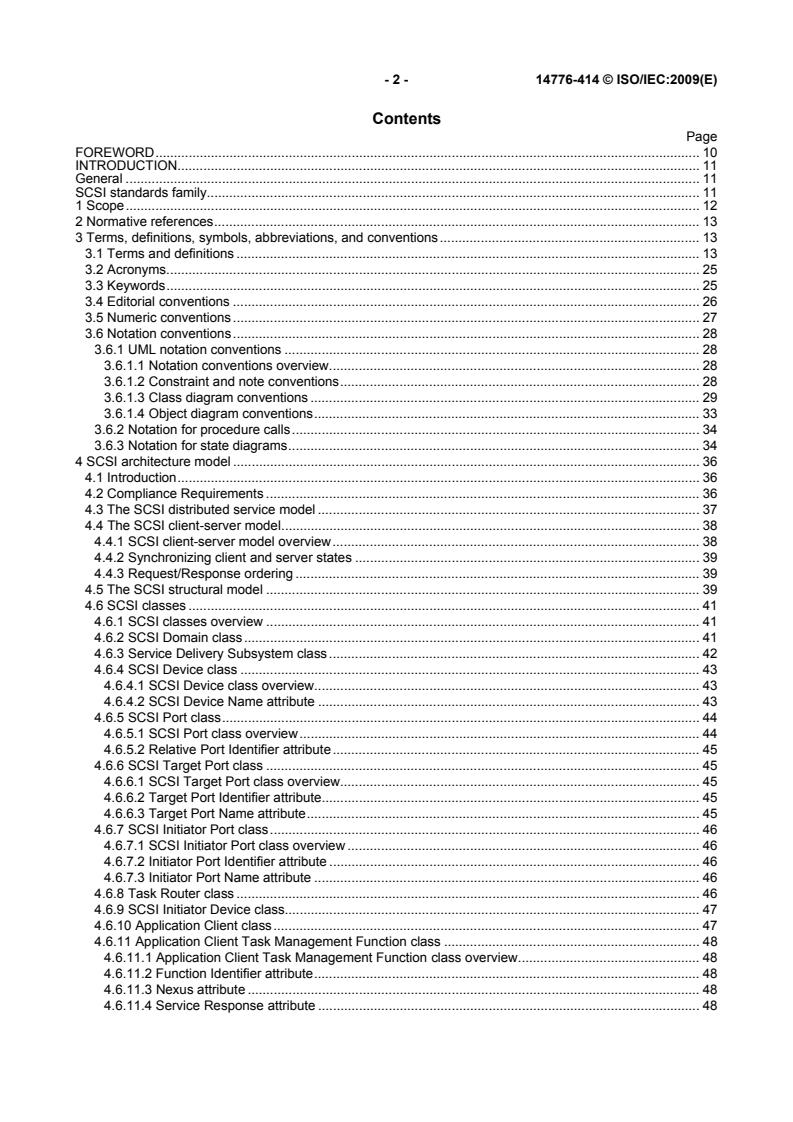
- 2 - 14776-414 © ISO/IEC:2009(E)
Contents
Page
FOREWORD. 10
INTRODUCTION. 11
General . 11
SCSI standards family. 11
1 Scope. 12
2 Normative references. 13
3 Terms, definitions, symbols, abbreviations, and conventions. 13
3.1 Terms and definitions . 13
3.2 Acronyms. 25
3.3 Keywords. 25
3.4 Editorial conventions . 26
3.5 Numeric conventions. 27
3.6 Notation conventions. 28
3.6.1 UML notation conventions . 28
3.6.1.1 Notation conventions overview. 28
3.6.1.2 Constraint and note conventions. 28
3.6.1.3 Class diagram conventions . 29
3.6.1.4 Object diagram conventions. 33
3.6.2 Notation for procedure calls. 34
3.6.3 Notation for state diagrams. 34
4 SCSI architecture model . 36
4.1 Introduction. 36
4.2 Compliance Requirements . 36
4.3 The SCSI distributed service model . 37
4.4 The SCSI client-server model. 38
4.4.1 SCSI client-server model overview. 38
4.4.2 Synchronizing client and server states . 39
4.4.3 Request/Response ordering . 39
4.5 The SCSI structural model . 39
4.6 SCSI classes . 41
4.6.1 SCSI classes overview . 41
4.6.2 SCSI Domain class. 41
4.6.3 Service Delivery Subsystem class. 42
4.6.4 SCSI Device class . 43
4.6.4.1 SCSI Device class overview. 43
4.6.4.2 SCSI Device Name attribute . 43
4.6.5 SCSI Port class. 44
4.6.5.1 SCSI Port class overview. 44
4.6.5.2 Relative Port Identifier attribute. 45
4.6.6 SCSI Target Port class . 45
4.6.6.1 SCSI Target Port class overview. 45
4.6.6.2 Target Port Identifier attribute. 45
4.6.6.3 Target Port Name attribute. 45
4.6.7 SCSI Initiator Port class. 46
4.6.7.1 SCSI Initiator Port class overview . 46
4.6.7.2 Initiator Port Identifier attribute . 46
4.6.7.3 Initiator Port Name attribute . 46
4.6.8 Task Router class . 46
4.6.9 SCSI Initiator Device class. 47
4.6.10 Application Client class. 47
4.6.11 Application Client Task Management Function class . 48
4.6.11.1 Application Client Task Management Function class overview. 48
4.6.11.2 Function Identifier attribute. 48
4.6.11.3 Nexus attribute . 48
4.6.11.4 Service Response attribute . 48
14776-414 © ISO/IEC:2009(E) - 3 -
4.6.11.5 Additional Response Information attribute . 48
4.6.12 Application Client Task Set class. 48
4.6.13 Application Client Command class . 49
4.6.13.1 Application Client Command class overview. 49
4.6.13.2 I_T_L_Q Nexus attribute . 49
4.6.13.3 CDB attribute. 49
4.6.13.4 Task Attribute attribute . 49
4.6.13.5 Status attribute . 49
4.6.13.6 Service Response attribute . 49
4.6.13.7 Data-In Buffer attribute. 49
4.6.13.8 Data-In Buffer Size attribute. 49
4.6.13.9 Data-Out Buffer attribute . 49
4.6.13.10 Data-Out Buffer size attribute. 49
4.6.13.11 CRN attribute. 49
4.6.13.12 Command Priority attribute. 50
4.6.13.13 First Burst Enabled attribute. 50
4.6.13.14 Sense Data attribute. 50
4.6.13.15 Sense Data Length attribute. 50
4.6.13.16 Status Qualifier attribute. 50
4.6.14 SCSI Target Device class. 50
4.6.15 Level 1 Hierarchical Logical Unit class . 51
4.6.16 Level 2 Hierarchical Logical Unit class . 52
4.6.17 Level 3 Hierarchical Logical Unit class . 52
4.6.18 Level 4 Hierarchical Logical Unit class . 53
4.6.19 Logical Unit class. 53
4.6.19.1 Logical Unit class overview . 53
4.6.19.2 LUN attribute . 55
4.6.19.3 Logical Unit Name attribute. 55
4.6.19.4 Dependent Logical Unit attribute. 55
4.6.20 Device Server class . 56
4.6.21 Task Manager class. 56
4.6.22 Task Set class. 56
4.6.23 Command class . 56
4.6.23.1 Command class overview . 56
4.6.23.2 I_T_L_Q Nexus attribute . 56
4.6.23.3 Task Attribute attribute . 56
4.6.23.4 CDB attribute. 57
4.6.23.5 CRN attribute. 57
4.6.23.6 Command Priority attribute. 57
4.6.23.7 Status attribute . 57
4.6.23.8 Sense Data attribute. 57
4.6.23.9 Sense Data Length attribute. 57
4.6.23.10 Service Response attribute . 57
4.6.23.11 Status Qualifier attribute. 57
4.6.23.12 First Burst Enabled attribute. 57
4.6.23.13 Device Server Buffer attribute . 57
4.6.23.14 Application Client Buffer Offset attribute . 57
4.6.23.15 Request Byte Count attribute . 57
4.6.23.16 Delivery Result attribute . 58
4.6.24 Task Management Function class . 58
4.6.24.1 Task Management Function class overview . 58
4.6.24.2 Function Identifier attribute. 58
4.6.24.3 Nexus attribute . 58
4.6.24.4 Service Response attribute . 58
4.6.24.5 Additional Response Information attribute . 58
4.6.25 Well Known Logical Unit class. 58
4.7 Logical unit number (LUN). 59
4.7.1 Introduction . 59
- 4 - 14776-414 © ISO/IEC:2009(E)
4.7.2 Logical unit representation format. 59
4.7.3 LUNs overview. 59
4.7.4 Minimum LUN addressing requirements. 59
4.7.5 Single level LUN structure . 60
4.7.6 Eight byte LUN structure. 62
4.7.7 Peripheral device addressing method. 64
4.7.8 Flat space addressing method. 65
4.7.9 Logical unit addressing method . 66
4.7.10 Extended logical unit addressing . 67
4.7.11 Well known logical unit addressing. 70
4.7.12 Extended flat space addressing method. 70
4.7.13 Logical unit not specified addressing. 71
4.8 Nexus . 71
4.8.1 Nexus overview. 71
4.8.2 Command identifier. 72
4.8.3 Nexus usage rules . 72
4.9 SCSI ports . 72
4.9.1 SCSI port configurations. 72
4.9.2 SCSI devices with multiple ports. 73
4.9.3 Multiple port SCSI target device structure . 74
4.9.4 Multiple port SCSI initiator device structure. 75
4.9.5 Multiple port SCSI device structure. 76
4.9.6 SCSI initiator device view of a multiple port SCSI target device. 77
4.9.7 SCSI target device view of a multiple port SCSI initiator device. 79
4.10 The SCSI model for distributed communications . 79
5 SCSI command model . 84
5.1 The Execute Command procedure call . 84
5.2 Command descriptor block (CDB). 85
5.3 Status . 86
5.3.1 Status codes . 86
5.3.2 Status qualifier . 87
5.3.3 Status precedence. 89
5.4 SCSI transport protocol services in support of Execute Command. 90
5.4.1 Overview. 90
5.4.2 Command and status SCSI transport protocol services . 90
5.4.2.1 Command and status SCSI transport protocol services overview . 90
5.4.2.2 Send SCSI Command SCSI transport protocol service request . 91
5.4.2.3 SCSI Command Received SCSI transport protocol service indication . 91
5.4.2.4 Send Command Complete SCSI transport protocol service response . 92
5.4.2.5 Command Complete Received SCSI transport protocol service confirmation. 92
5.4.3 Data transfer SCSI transport protocol services. 93
5.4.3.1 Introduction. 93
5.4.3.2 Data-In delivery service. 95
5.4.3.2.1 Send Data-In SCSI transport protocol service request. 95
5.4.3.2.2 Data-In Delivered SCSI transport protocol service confirmation . 95
5.4.3.3 Data-Out delivery service. 95
5.4.3.3.1 Receive Data-Out SCSI transport protocol service request . 95
5.4.3.3.2 Data-Out Received SCSI transport protocol service confirmation. 96
5.4.3.4 Terminate Data Transfer service. 96
5.4.3.4.1 Terminate Data Transfer SCSI transport protocol service request. 96
5.4.3.4.2 Data Transfer Terminated SCSI transport protocol service confirmation . 97
5.5 Command lifetimes. 97
5.6 Aborting commands. 98
5.7 Command processing example. 103
5.8 Commands that complete with CHECK CONDITION status. 103
5.8.1 Overview. 103
5.8.2 Handling commands when ACA is not in effect. 104
5.8.3 Aborting commands terminated with a CHECK CONDITION status without establishing an ACA 104
14776-414 © ISO/IEC:2009(E) - 5 -
5.9 Auto contingent allegiance (ACA). 105
5.9.1 ACA overview . 105
5.9.2 Establishing an ACA . 105
5.9.3 Handling new commands received on the faulted I_T nexus when ACA is in effect . 106
5.9.4 Handling new commands received on non-faulted I_T nexuses when ACA is in effect . 107
5.9.4.1 Command processing permitted for commands received on non-faulted
I_T nexuses during ACA . 107
5.9.4.2 Handling new commands received on non-faulted I_T nexuses when ACA is in effect. 107
5.9.5 Clearing an ACA condition. 108
5.10 Overlapped commands . 109
5.11 Incorrect logical unit. 109
5.12 Task attribute exception conditions . 109
5.13 Sense data . 110
5.14 Unit attention condition. 110
6 SCSI events and event notification model . 114
6.1 SCSI events overview . 114
6.2 Establishing a unit attention condition subsequent to detection of an event . 116
6.3 Conditions resulting from SCSI events. 117
6.3.1 Power on. 117
6.3.2 Hard reset . 118
6.3.3 Logical unit reset. 118
6.3.4 I_T nexus loss. 118
6.3.5 Power loss expected. 119
6.4 Event notification SCSI transport protocol services. 119
7 Task management functions. 121
7.1 Task management function procedure calls. 121
7.2 ABORT TASK. 122
7.3 ABORT TASK SET. 123
7.4 CLEAR ACA . 123
7.5 CLEAR TASK SET . 123
7.6 I_T NEXUS RESET. 124
7.7 LOGICAL UNIT RESET. 124
7.8 QUERY TASK . 124
7.9 QUERY TASK SET . 125
7.10 QUERY ASYNCHRONOUS EVENT. 125
7.11 Task management function lifetime. 126
7.12 Task management SCSI transport protocol services . 127
7.12.1 Task management SCSI transport protocol services overview . 127
7.12.2 Send Task Management Request SCSI transport protocol service request. 127
7.12.3 Task Management Request Received SCSI transport protocol service indication. 128
7.12.4 Task Management Function Executed SCSI transport protocol service response. 128
7.12.5 Received Task Management Function Executed SCSI transport protocol service confirmation. 129
7.13 Task management function example. 130
8 Task set management. 131
8.1 Introduction to task set management . 131
8.2 Implicit head of queue . 131
8.3 Command management model . 131
8.4 Command management events . 132
8.5 Command states . 132
8.5.1 Overview. 132
8.5.1.1 Command state nomenclature . 132
8.5.1.2 Suspended information . 133
8.5.2 Enabled command state . 133
8.5.3 Blocked command state. 133
8.5.4 Dormant command state. 133
8.5.5 Completed command state. 133
8.5.6 Command states and command lifetimes. 133
8.6 Task attributes. 134
- 6 - 14776-414 © ISO/IEC:2009(E)
8.6.1 Overview. 134
8.6.2 Commands having the SIMPLE task attribute. 134
8.6.3 Commands having the ORDERED task attribute. 135
8.6.4 Commands having the HEAD OF QUEUE task attribute . 135
8.6.5 Commands having the ACA task attribute . 135
8.7 Command priority . 135
8.8 Command state transitions. 136
8.9 Task set management examples. 137
8.9.1 Introduction . 137
8.9.2 Commands having the HEAD OF QUEUE task attribute . 138
8.9.3 Commands having the ORDERED task attribute. 140
8.9.4 Commands having the ACA task attribute . 141
Annex A (informative) Identifiers and names for objects. 142
A.1 Identifiers and names overview. 142
A.2 Identifiers and names. 142
Annex B (informative) SCSI Initiator Port attributes and SCSI Target Port attributes supported by
SCSI transport protocols. 147
Annex C (informative) Terminology mapping to SAM-3. 149
Annex D (informative) SCSI transport protocol acronyms . 150
Bibliography . 151
14776-414 © ISO/IEC:2009(E) - 7 -
Table 1 — Numbering conventions. 28
Table 2 — Constraint and note notation . 28
Table 3 — Class diagram notation for classes. 29
Table 4 — Multiplicity notation . 30
Table 5 — Class diagram notation for associations. 30
Table 6 — Class diagram notation for aggregations. 31
Table 7 — Class diagram notation for generalizations . 32
Table 8 — Class diagram notation for dependency. 32
Table 9 — Object diagram notation for objects. 33
Table 10 — Object diagram notation for link. 33
Table 11 — Single level LUN structure using peripheral device addressing method . 60
Table 12 — Single level LUN structure using flat space addressing method . 60
Table 13 — Single level LUN structure using extended flat space addressing method. 61
Table 14 — Eight byte LUN structure adjustments. 62
Table 15 — Eight byte LUN structure . 63
Table 16 — Format of addressing fields . 63
Table 17 — ADDRESS METHOD field. 64
Table 18 — Peripheral device addressing format. 64
Table 19 — Flat space addressing format . 66
Table 20 — Logical unit addressing format. 66
Table 21 — Extended logical unit addressing format. 68
Table 22 — LENGTH field and related sizes . 68
Table 23 — Two byte extended logical unit addressing format . 68
Table 24 — Four byte extended logical unit addressing format. 69
Table 25 — Six byte extended logical unit addressing format . 69
Table 26 — Eight byte extended logical unit addressing format. 69
Table 27 — Logical unit extended addressing. 70
Table 28 — Well known logical unit extended addressing format.70
Table 29 — Extended flat space addressing format . 71
Table 30 — Logical unit not specified extended addressing format.71
Table 31 — Nexus . 72
Table 32 — CONTROL byte. 86
Table 33 — Status codes. 86
Table 34 — Status qualifier format. 87
Table 35 — SCOPE field. 88
Table 36 — QUALIFIER field. 89
Table 37 — SCSI device conditions that abort commands in a SCSI initiator device. 98
Table 38 — SCSI device conditions that abort commands in a SCSI target device. 99
Table 39 — Task management functions that abort commands. 100
Table 40 — Command related conditions that abort commands. 101
Table 41 — Command handling when ACA is not in effect . 104
Table 42 — Aborting commands when an ACA is not established. 104
Table 43 — Blocki
...
Questions, Comments and Discussion
Ask us and Technical Secretary will try to provide an answer. You can facilitate discussion about the standard in here.
Loading comments...